By: Alexa Kownacki, Ph.D. Student, OSU Department of Fisheries and Wildlife, Geospatial Ecology of Marine Megafauna Lab
Human-wildlife interactions have occurred since people first inhabited the Earth. However, today, when describing human-wildlife interactions specifically in relation to dolphins, frequently we hear about ‘conflicts’. Interactions between fisheries and dolphins that lead to bycatch or depredation (stealing bait/catching from gear) are particularly common. But, symbiotic relationships with dolphin species and certain human groups can also be mutualistic, with both groups benefitting. These symbiotic relationships have been around for hundreds, if not thousands of years.
A depiction of Aboriginal Australians using nets to catch fish in a small inlet with the assistance of coastal dolphins. (Image source: Our Pacific Ocean)
In eastern Australia, cooperative fishing interactions occur
between Aboriginal Australians and dolphins—both bottlenose dolphins and orcas.
In Burleigh Heads National Park, Queensland, AUS, the dolphins are thought to
help the local indigenous Kombemerri (saltwater) people hunt for fish. Indigenous
stories recall men wading into the water with their spears and nets. Then, many
of the men would hit the surface waters to make noises with the splashes.
Underwater, this sound was amplified and then the dolphins would begin chasing
the fish toward the men and their nets (Neil 2002). Aboriginal Australians,
especially those in eastern Australia have an emotional and spiritual
connection to both dolphins and orcas. There are widespread accounts of cooperation
between indigenous people and small cetaceans on the eastern Australian
coastline, which create both context and precedent for the economic and
emotional objectives to contemporary human-dolphin interactions such as dolphin
provisioning (Neil 2002).
Dolphins and fishermen work together in Laguna, Brazil, to catch mullet. (Image Source: Fábio Daura-Jorge)
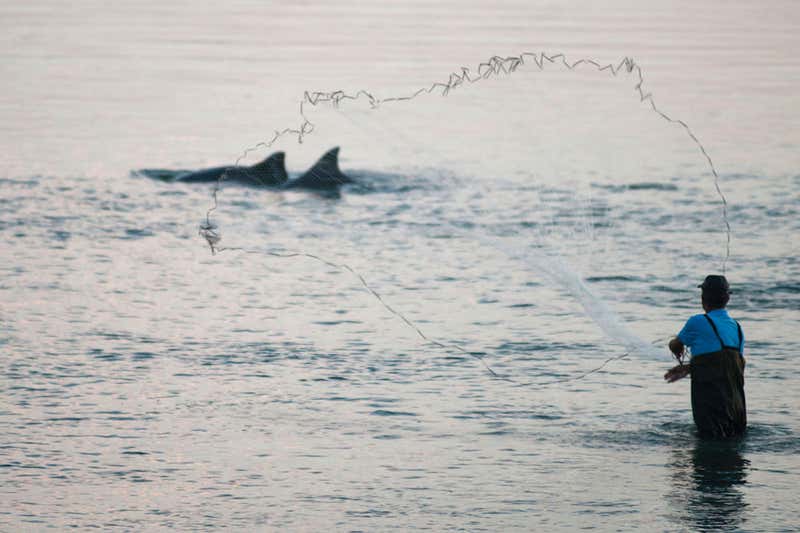
In the coasts off of Laguna, Brazil, bottlenose dolphins and local fishermen cooperatively fish while tourists gather to watch. Previously, PhD candidate Leila Lemos wrote about these interactions in a blog post. Like many groups of socializing dolphins, these dolphins have a unique whistle to recognize each other. The waters surrounding Laguna, Brazil are murky, turbid and dark green to the point where the fisherman cannot see any of the fish in the water. As the fishermen wade into the murky waters, bottlenose dolphins chase shoals of mullet toward the shore. Then the dolphins tail slap or abruptly dive, “signaling” the fishermen to cast their nets. Research has shown that when the fishermen “work with” the dolphins, both the dolphins and the people catch more, larger fish (Roman 2013). One fisherman claims it is not worth fishing unless the dolphins are around (Roman 2013). Here, the fishermen know the dolphins based on their markings. They know which dolphins participate in the different parts of hunting as well—which dolphin initiates the tail slap, which dolphin usually circles the fish, and which drive the fish towards the coastline. After the dolphins round up and chase the fish for the fishermen and themselves, there is no “reward” from the fishermen for the dolphins—no fish tossed their way. Scientists also found there is a difference in whistle structure between cooperative and non-cooperative dolphin groups (Preston 2017).
A fisherman in Brazil throws a net after dolphins chase mullet into the shore. (Image Source: Leo Francini:Alamy Stock Photo)
Along most coastlines worldwide, humans and dolphins are
competitors. Dolphins are seen as thieves who steal fish out of nets, or get
caught in their gear and ruin fishing opportunities. Thus, dolphins are often unwelcome
near fishing communities. Such negative interactions sometimes lead to
human-caused fatalities of dolphin from gunshots or stabbings, thought to be
from angry fishermen. Yet, in this same
world, fishermen thank the dolphins for bringing their catch to them. Clearly,
both humans and dolphins share high intelligence levels and skills in fishing.
If it is a matter of two minds are better than one, then I think indigenous
communities figured this equation out first: working with the dolphins, and not
against, can better feed their people.
Citations:
Neil, David.
(2002). Cooperative fishing interactions between Aboriginal Australians and
dolphins in eastern Australia. Anthrozoos: A Multidisciplinary Journal of The
Interactions of People & Animals. 15. 10.2752/089279302786992694.
Preston, Elizabeth.
“Dolphins That Work with Humans to Catch Fish Have Unique Accent.” New
Scientist, 2 Oct. 2017,
www.newscientist.com/article/2149139-dolphins-that-work-with-humans-to-catch-fish-have-unique-accent/.
Roman, Joe. “Fishing with
Dolphins: An astonishing cooperative venture in which every species wins but
the fish.” Slate Magazine, 31 Jan. 2013,
slate.com/technology/2013/01/fishing-with-dolphins-symbiosis-between-humans-and-marine-mammals-to-catch-more-fish.html.
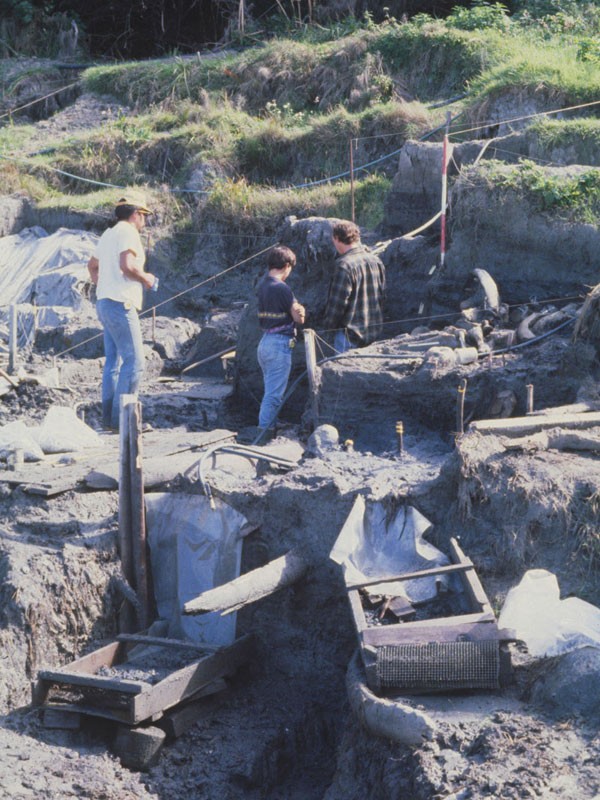
Archaeological site of Ozette Village. Source: Makah Museum.
The Makah, an indigenous people of the Pacific Northwest Coast living in Washington State, have a long history with whaling. Deposits from a mudslide in the village of Ozette suggest that whaling may date back 2,000 years as archaeologists uncovered humpback and gray whale bones and barbs from harpoons (Kirk 1986). However, the history of Makah whaling is also quite recent. On January 29 of this year, the National Marine Fisheries Service (NMFS; informally known as NOAA Fisheries) announced a 45-day public comment period regarding a NMFS proposed waiver on the Marine Mammal Protection Act’s (MMPA) moratorium on the take of marine mammals to allow the Makah to take a limited number of eastern North Pacific gray whales (ENP). To understand how the process reached this point, we first must go back to 1855.
1855 marks the year in which the U.S. government and the Makah entered into the Treaty of Neah Bay (in Washington state). The Makah ceded thousands of acres of land to the U.S. government, and in return reserved their right to whale. Following the treaty, the Makah hunt of gray whales continued until the 1920s. At this point, commercial hunting had greatly reduced the ENP population, so much so that the Makah voluntarily ceased their whaling. The next seven decades brought about the formation of the International Whaling Commission (IWC), the enactment of the Whaling Convention Act, the listing of gray whales as endangered under the U.S. Endangered Species Act, and the enactment of the MMPA. For gray whales, these national and international measures were hugely successful, leading to the removal of the ENP from the Federal List of Endangered Wildlife in 1994 when it was determined that the population had recovered to near its estimated original population size.
One year later on May 5, 1995 (just one month after I was born!), the Makah asked the U.S. Department of Commerce to represent its interest to obtain a quota for gray whales from the IWC in order to resume their treaty right for ceremonial and subsistence harvest of the ENP. The U.S. government pursued this request at the next IWC meeting, and subsequently NMFS issued a final Environmental Assessment that found no significant impact to the ENP population if the hunt recommenced. The IWC set a catch limit and NMFS granted the Makah a quota in 1998. In 1999 the Makah hunted, struck and landed an ENP gray whale.
“Makahs cutting up whale, Neah Bay, ca. 1930. Photo by Asahel Curtis, Courtesy UW Special Collections (CUR767)”.Source and caption: History Link.
I will not go into detail about what happened between 1999 and now because frankly, a lot happened, particularly a lot of legal events including summary judgements, appeals, and a lot of other legal jargon that I do not quite understand. If you want to know the specifics of what happened in those two decades, I suggest you look at NMFS’ chronology of the Makah Tribal Whale Hunt. In short, cases brought against NMFS argued that they did not take a “hard [enough] look” at the National Environmental Policy Act when deciding that the Makah could resume the hunt. Consequently, the hunt was put on hold. Yet, in 2005 NMFS received a waiver request from the Makah on the MMPA’s take moratorium and NMFS published a notice of intent to review this request. A lot more happened between that event and now, including on January 29 of this year when NMFS announced the availability of transcripts from the Administrative Law Judge’s (ALJ) hearing (which happened from November 14-21, 2019) on the proposed regulations and waiver to allow the Makah to resume hunting the ENP. We are currently in the middle of the aforementioned 45-day public comment period on the formal rulemaking record.
It has been 15 years since the Makah requested the waiver and while the decision has not yet been reached, we are likely nearing the end of this long process. This blog has turned into somewhat of a history lesson (not really my intention) but I feel it is important to understand the lengthy and complex history associated with the decision that is probably going to happen sometime this year. My actual intent for this blog is to ruminate on a few questions, some of which remain unanswered in my opinion, that are large and broad, and important to consider. Some of these questions point out gaps in our ecological knowledge regarding gray whales that I believe should be addressed for a truly informed decision to be made on NMFS’ proposed waiver now or anytime in the near future.
1. Should the Pacific Coast Feeding Group (PCFG) of gray whales be recognized as its own stock?
Currently, the PCFG are considered a part of the ENP stock. This decision was published following a workshop held by a NMFS task force (Weller et al. 2013). The report concluded that based on photo-identification, genetics, tagging, and other data, there was a substantial level of uncertainty in the strength of the evidence to support the independence of the PCFG from the ENP. Nevertheless, mitochondrial genetic data have indicated a differentiation between the PCFG and the ENP, and the exchange rate between the two groups may be small enough for the two to be considered demographically independent (Frasier et al. 2011). Based on all currently available data, it seems that matrilineal fidelity plays a role in creating population structure within and between the PCFG and the ENP, however there has not been any evidence to suggest that whales from one feeding area (i.e. the PCFG range) are reproductively isolated from whales that utilize other feeding areas (i.e. the Arctic ENP feeding grounds) (Lang et al. 2011). Several PCFG researchers do argue that there needs to be recognition of the PCFG as an independent stock. It is clear that more research, especially efforts to link genetic and photo-identification data within and between groups, is required.
ENP gray whales foraging off the coast of Alaska on their main foraging grounds in the Bering Sea. Photo taken by ASAMM/AFSC. Funded by BOEM IAA No. M11PG00033. Source: NMFS.
2. Is emigration/immigration driving PCFG population growth, or is it births/deaths?
It is unclear whether the current PCFG population growth is a consequence of births and deaths that occur within the group (internal dynamics) or whether it is due to immigration and emigration (external dynamics). Likely, it is a combination of the two, however which of the two has more of an effect or is more prevalent? This question is important to answer because if population growth is driven more by external dynamics, then potential losses to the PCFG population due to the Makah hunt may not be as detrimental to the group as a whole. However, if internal dynamics play a bigger role, then the loss of just a few females could have long-term ramifications for the PCFG (Schubert 2019). NMFS has taken precautions to try and avoid such effects. In their proposed waiver, of the cumulative limit of 16 strikes of PCFG whales over the 10-year waiver period, no more than 8 of the strikes may be PCFG females (Yates 2019a). While a great step, it still begs the question how the loss of 8 females, admittedly over a rather long period of time, may affect population dynamics since we do not know what ultimately drives recruitment. Especially when taken together with potential non-lethal effects on whales (further discussed in question 5 below).
“Scarlet” is a PCFG female who has had multiple calves in the decades that researchers have seen her in the PCFG range. Image captured under NOAA/NMFS permit #21678. Source: L Hildebrand.
3. How important are individual patterns within the PCFG, and how might the loss of these individuals affect the population?
The hunt will be restricted to the Makah Usual & Accustomed fishing area (U&A), which is off the Washington coast. It has been shown that site fidelity among PCFG individuals is strong. In fact, based on the 143 PCFG gray whales observed in nine or more years from 1996 to 2015, 94.4% were seen in at least one of nine different PCFG regions during six or more of the years they were seen (Calambokidis et al. 2017). While high site-fidelity seems to be common for some PCFG individuals in certain regions, interestingly, an analysis of sighting histories of all individuals that utilized the Makah U&A from 1985-2011 revealed that most PCFG whales do not have strong site fidelity to the Makah U&A (Scordino et al. 2017). Only about 20% of the whales were observed in six or more years of the total 26 years of data analyzed. Since high individual site fidelity does not appear to be strong in this area, perhaps a loss of genetic diversity, cultural knowledge, and behavioral individualism is not of great concern.
“Buttons” seems to have a preference for the southern Oregon coast as in the last 5 years the GEMM Lab has conducted research, he has only been sighted in 1 year in Newport but in all 5 years in Port Orford. However, perhaps such preferences are not common among all PCFG whales. Source: F. Sullivan.
4. How has the current UME affected the situation?
The ENP has experienced two Unusual Mortality Events (UMEs) in the past 20 years; one from 1999-2000 and the second began in May 2019. Many questions arise when thinking about the Makah hunt in light of the UME.
What impacts will the current UME have on ENP and PCFG birth rates in subsequent years?
Could the UME lead to shifts in feeding behavior of ENP whales and result in greater use of PCFG range by more individuals?
What caused the UME? Shifting prey availability and a changing climate? Or has the ENP reached carrying capacity?
Will UMEs become more frequent in the future with continued warming of the Arctic?
What is the added impact of such periodic UMEs on population trends?
“A gray whale found dead off Point Reyes National Seashore in northern California [during the 2019 UME]. Photo by M. Flannery, California Academy of Sciences.” Source and caption: NMFS.
A key assumption of the model developed by NMFS (Moore 2019) to forecast PCFG population size for the period 2016-2028, is that the population processes underlying the data from 2002-2015 (population size estimates developed by Calambokidis et al. 2017) will be the same during the forecasted period. In other words, it is assuming that PCFG gray whales will experience similar environmental conditions (with similar variation) during the next decade as the previous one, and that there will be no catastrophic events that could drastically affect population dynamics. The UME that is still ongoing could arguably affect population dynamics enough such that they are drastically different to effects on the population dynamics during the previous decade. The cause of the 1999/2000 UME remains undetermined and the results of the investigation of the current UME will possibly not be available for several years (Yates 2019b). Even though the ENP did rebound following the 1999/2000 UME and the abundance of the PCFG increased during and subsequent to that UME, much has changed in the 20 years since then. Increased noise due to increased vessel traffic and other anthropogenic activities (seismic surveys, pile driving, construction to name a few) as well as increased coastal recreational and commercial fishing, have all contributed to a very different oceanscape than the ENP and PCFG encountered 20 years ago. Furthermore, the climate has changed considerably since then too, which likely has caused changes in the spatial distribution of habitat and quantity, quality, and predictability of prey. All of these factors make it difficult to predict what impact the UME will have now. If such events were to become more frequent in the future or the impacts of such events are greater than anticipated, then the PCFG population forecasts will not have accounted for this change.
5. What impacts will the hunt and associated training exercises have on energy and stress levels of whales?
The proposed waiver would allow hunts to occur in the following manner: in even-years, the hunting period is from December 1 of an odd-numbered year through May 31 of the following even-numbered year. While in odd-years, the hunt is limited from July to October.
In the even-years, the hunt coincides with the northbound migration toward the foraging grounds for ENP whales and with the arrival of PCFG whales to their foraging grounds near the Makah U&A. During the northbound migration, gray whales are at their most nutritionally stressed state as they have been fasting for several months. They are therefore most vulnerable to energy losses due to disturbance at this point (Villegas-Amtmann 2019). Attempted strikes and training exercises would certainly cause some level of disturbance and stress to the whales. Furthermore, the timing of even-year hunts, means that hunters would likely encounter pregnant females, as they are the first to arrive at foraging grounds. A loss of just ~4% of a pregnant female’s energy budget could cause them to abort the fetus or not produce a calf that year (Villegas-Amtmann 2019).
In odd-years, the Makah hunt will most certainly target PCFG whales as the Makah U&A forms one of the nine PCFG regions where PCFG individuals will be feeding during those months. However, NMFS’ waiver limits the number of strikes during odd-years to 2 (Yates 2019a), which certainly protects the PCFG population.
Stress is a difficult response to quantify in baleen whales and research on stress through hormone analysis is still relatively novel. It is unlikely that a single boat training approach of a gray whale will have an adverse effect on the individual. However, a whale is never just experiencing one disturbance at a time. There are typically many confounding factors that influence a whale’s state. In an ideal world, we would know what all of these factors are and how to recognize these effects. Yet, this is virtually impossible. Therefore, while precautions will be taken to try to minimize harm and stress to the gray whales, there may very well still be unanticipated impacts that we cannot anticipate.
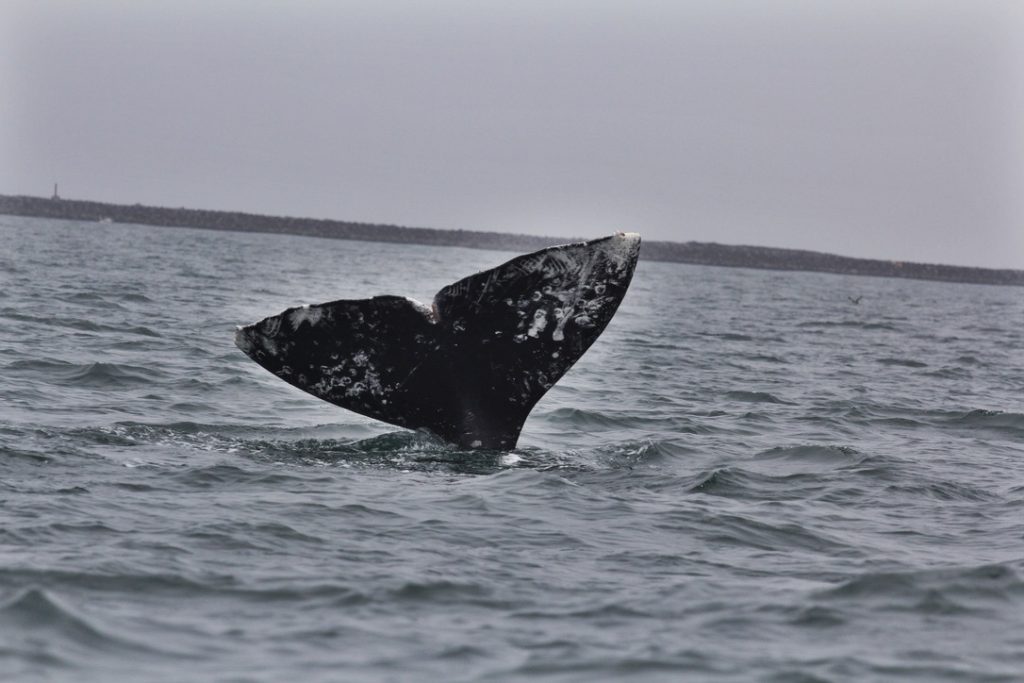
Gray whale fluke. Image captured under NOAA/NMFS permit #21678. Photo: L Hildebrand.
Final thoughts
Many unknowns still remain about the ENP and PCFG gray whale populations. During the ALJ hearing, both sides tried to deal with these unknowns. After reading testimony from both sides, it is clear to me that some of the unknowns still have not been reconciled. Ultimately, a lot of the questions circle back to the first one I posed above: Are the PCFG an independent stock? If there is independent population structure, then the proposed waiver put forth by NMFS would likely change. While NMFS has certainly taken the PCFG into account during the declarations of several experts at the ALJ hearing and has aired on the side of caution, the fact that the PCFG is considered part of the ENP might underestimate the impact that a resumption of the Makah hunt may have on the PCFG. As you can see, there are still many questions that should be addressed to make fully informed decisions on such an important ruling. While this research may take several years to obtain results, the data are within reach through synthesis and collaboration that will fill these critical knowledge gaps.
Literature cited
Calambokidis, J. C., J. Laake, and A. Pérez. 2017. Updated analysis of abundance and population structure of seasonal gray whales in the Pacific Northwest, 1996-2015. International Whaling Commission SC/A17/GW/05.
Frasier, T. R., S. M. Koroscil, B. N. White, and J. D. Darling. 2011. Assessment of population substructure in relation to summer feeding ground use in eastern North Pacific gray whale. Endangered Species Research 14:39-48.
Kirk, Ruth. 1986. Tradition and change on the Northwest Coast: the Makah, Nuu-chah-nulth, southern Kwakiutl and Nuxalk. University of Washington Press, Seattle.
Lang, A. R., D. W. Weller, R. LeDuc, A. M. Burdin, V. L. Pease, D. Litovka, V. Burkanov, and R. L. Brownell, Jr. 2011. Genetic analysis of stock structure and movements of gray whales in the eastern and western North Pacific. SC/63/BRG10.
Moore, J. E. 2019. Declaration in re: ‘Proposed Waiver and Regulations Governing the Taking of Eastern North Pacific Gray Whales by the Makah Indian Tribe’. Administrative Law Judge, Hon. George J. Jordan. Docket No. 19-NMFS-0001. RINs: 0648-BI58; 0648-XG584.
Schubert, D. J. 2019. Rebuttal testimony in re: ‘Proposed Waiver and Regulations Governing the Taking of Eastern North Pacific Gray Whales by the Makah Indian Tribe’. Administrative Law Judge, Hon. George J. Jordan. Docket No. 19-NMFS-0001. RINs: 0648-BI58; 0648-XG584.
Scordino, J. J., M. Gosho, P. J. Gearin, A. Akmajian, J. Calambokidis, and N. Wright. 2017. Individual gray whale use of coastal waters off northwest Washington during the feeding season 1984-2011: Implications for management. Journal of Cetacean Research and Management 16:57-69.
Villegas-Amtmann, S. 2019. Declaration in re: ‘Proposed Waiver and Regulations Governing the Taking of Eastern North Pacific Gray Whales by the Makah Indian Tribe’. Administrative Law Judge, Hon. George J. Jordan. Docket No. 19-NMFS-0001.
Weller, D. W., S. Bettridge, R. L. Brownell, Jr., J. L. Laake, J. E. Moore, P. E. Rosel, B. L. Taylor, and P. R. Wade. 2013. Report of the National Marine Fisheries Service Gray Whale Stock Identification Workshop. NOAA-TM-NMFS-SWFSC-507.
Yates, C. 2019a. Declaration in re: ‘Proposed Waiver and Regulations Governing the Taking of Eastern North Pacific Gray Whales by the Makah Indian Tribe’. Administrative Law Judge, Hon. George J. Jordan. Docket No. 19-NMFS-0001. RINs: 0648-BI58; 0648-XG584.
Yates, C. 2019b. Fifth declaration in re: ‘Proposed Waiver and Regulations Governing the Taking of Eastern North Pacific Gray Whales by the Makah Indian Tribe’. Administrative Law Judge, Hon. George J. Jordan. Docket No. 19-NMFS-0001. RINs: 0648-BI58; 0648-XG584.
By: Alexa Kownacki, Ph.D. Student, OSU Department of Fisheries and Wildlife, Geospatial Ecology of Marine Megafauna Lab
As technology has developed over the past ten years, toxins
in marine mammals have become an emerging issue. Environmental toxins are
anything that can pose a risk to the health of plants or animals at a dosage.
They can be natural or synthetic with varying levels of toxicity based on the
organism and its physiology. Most prior research on the impacts toxins before
the 2000s was conducted on land or in streams because of human proximity to
these environments. However. with advancements in sampling methods, increasing
precision in laboratory testing, and additional focus from researchers, marine
mammals are being assessed for toxin loads more regularly.
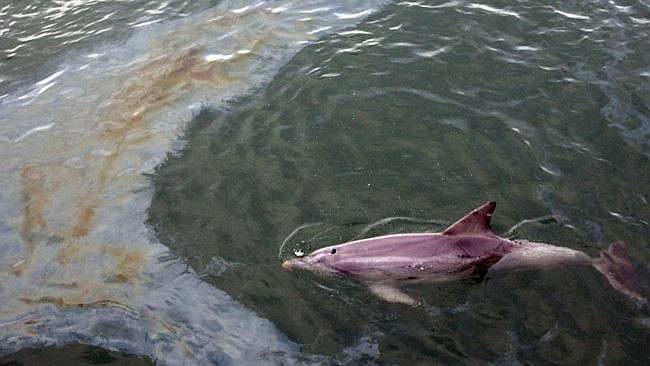
A dolphin swims through a diesel slick caused by a small oil spill in a port. (Image Source: The Ocean Update Blog)
Marine mammals live most of their lives in the ocean or other aquatic systems, which requires additional insulation for protection from both cold temperatures and water exposure. This added insulation can take the form of lipid rich blubber, or fur and hair. Many organic toxins are lipid soluble and therefore are more readily found and stored in fatty tissues. When an organic toxin like a polychlorinated biphenyl (PCB) is released into the environment from an old electrical transformer, it persists in sediments. As these sediments travel down rivers and into the ocean, these toxic substances slowly degrade in the environment and are lipophilic (attracted to fat). Small marine critters eat the sediment with small quantities of toxins, then larger critters eat those small critters and ingest larger quantities of toxins. This process is called biomagnification. By the time a dolphin consumes large contaminated fishes, the chemical levels may have reached a toxic level.
The process by which PCBs accumulate in marine mammals from small particles up to high concentrations in lipid layers. (Image Source: World Ocean Review)
Marine mammal scientists are teaming with biochemists and ecotoxicologists to better understand which toxins are more lethal and have more severe long-term effects on marine mammals, such as decreased reproduction rates, lowered immune systems, and neurocognitive delays. Studies have already shown that higher contaminant loads in dolphins cause all three of these negative effects (Trego et al. 2019). As a component of my thesis work on bottlenose dolphins I will be measuring contaminant levels of different toxins in blubber. Unfortunately, this research is costly and time-consuming. Many studies regarding the effects of toxins on marine mammals are funded through the US government, and this is where the public can have a voice in scientific research.
Rachel Carson examines a specimen from a stream collection site in the 1950s. (Image Source: Alfred Eisenstaedt/ The LIFE picture collection/ Getty Images.)
Prior to the 1960s, there were no laws regarding the discharge of toxic substances into our environment. When Rachel Carson published “Silent Spring” and catalogued the effects of pesticides on birds, the American public began to understand the importance of environmental regulation. Once World War II was over and people did not worry about imminent death due to wartime activities, a large portion of American society focused on what they were seeing in their towns: discharges from chemical plants, effluents from paper mills, taconite mines in the Great Lakes, and many more.
Discharge from a metallic sulfide mine collects in streams in northern Wisconsin. (Image Source: Sierra Club)
However, it was a very different book regarding pollutants in the environment that caught my attention – and that of a different generation and part of society – even more than “Silent Spring”. A book called “The Lorax”. In this 1972 children’s illustrated book by Dr. Seuss, a character called the Lorax “speaks for the trees”. The Lorax touches upon critical environmental issues such as water pollution, air pollution, terrestrial contamination, habitat loss, and ends with the poignant message, “Unless someone like you cared a whole awful lot, nothing is going to get better. It’s not.”
The original book cover for “The Lorax” by Dr. Seuss. (Image source: Amazon.com)
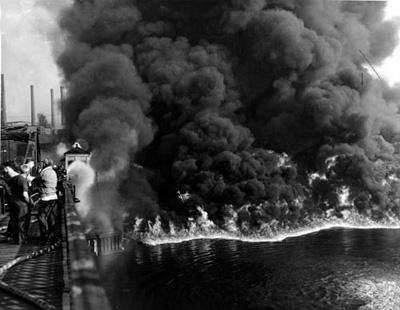
Within a decade, the US Environmental Protection Agency (EPA) was formed and multiple acts of congress were put in place, such as the National Environmental Policy Act, Clean Air Act, Clean Water Act, and Toxic Substances Control Act, with a mission to “protect human health and the environment.” The public had successfully prioritized protecting the environment and the government responded. Before this, rivers would catch fire from oil slicks, children would be banned from entering the water in fear of death, and fish would die by the thousands. The resulting legislation cleaned up our air, rivers, and lakes so that people could swim, fish, and live without fear of toxic substance exposures.
The Cuyahoga River on fire in June 1969 after oil slicked debris ignited. (Image Source: Ohio Central History).
Fast forward to 2018 and times have changed yet again due to fear. According to a Pew Research poll, terrorism is the number one issue that US citizens prioritize, and Congress and the President should address. The environment was listed as the seventh highest priority, below Medicare (“Majorities Favor Increased Spending for Education, Veterans, Infrastructure, Other Govt. Programs.”). With this societal shift in priorities, research on toxins in marine mammals may no longer grace the covers of the National Geographic, Science, or Nature, not for lack of importance, but because of the allocation of taxpayer funds and political agendas. Meanwhile, long-lived marine mammals will still be accumulating toxins in their blubber layers and we, the people, will need to care a whole lot, to save the animals, the plants, and ultimately, our planet.
The Lorax telling the reader how to save the planet. (Image Source: “The Lorax” by Dr. Seuss via the Plastic Bank)
Citations:
“Majorities Favor Increased Spending for Education,
Veterans, Infrastructure, Other Govt. Programs.” Pew Research Center for the
People and the Press, Pew Research Center, 11 Apr. 2019,
www.people-press.org/2019/04/11/little-public-support-for-reductions-in-federal-spending/pp_2019-04-11_federal-spending_0-01-2/.
Marisa L. Trego, Eunha Hoh, Andrew Whitehead, Nicholas M. Kellar, Morgane Lauf, Dana O. Datuin, and Rebecca L. Lewison. Environmental Science & Technology201953 (7), 3811-3822. DOI: 10.1021/acs.est.8b06487
Another year has come and gone, and with the final days of 2019 upon us, it is fulfilling to look back and summarize all of the achievements in the GEMM Lab this year. So, snuggle up with your favorite holiday drink and enjoy our recap of 2019!
We wrapped up two intense but rewarding gray whale field seasons this summer. Our project investigating the health of Pacific Coast Feeding Group (PCFG) gray whales through fecal hormone and body condition sampling in the context of ocean noise went into its fourth year, while the Port Orford project where we track whales and prey at a very fine-scale celebrated its wood anniversary (five years!). The dedication and hard work of lots of people to help us collect our data meant that we were able to add a considerable amount of samples to our growing gray whale datasets. Our trusty red RHIB Ruby zipped around the Pacific and enabled us to collect 58 fecal samples, fly the drone 102 times, undertake 105 GoPro drops and record 141 gray whale sightings. Our Newport crew was a mix of full-time GEMMers (Leigh, Todd, Dawn, Leila, Clara, and myself) as well as part-time summer GEMMers (Ale, Sharon, and Cassy). Further south in Port Orford, my team of undergraduate and high school students and I had an interesting field season. We only encountered four different individuals (Buttons, Glacier, Smudge, and Primavera), however saw them repeatedly throughout the month of August, resulting in as many as 15 tracklines for one individual. Furthermore, we collected 249 GoPro drops and 248 zooplankton net samples.
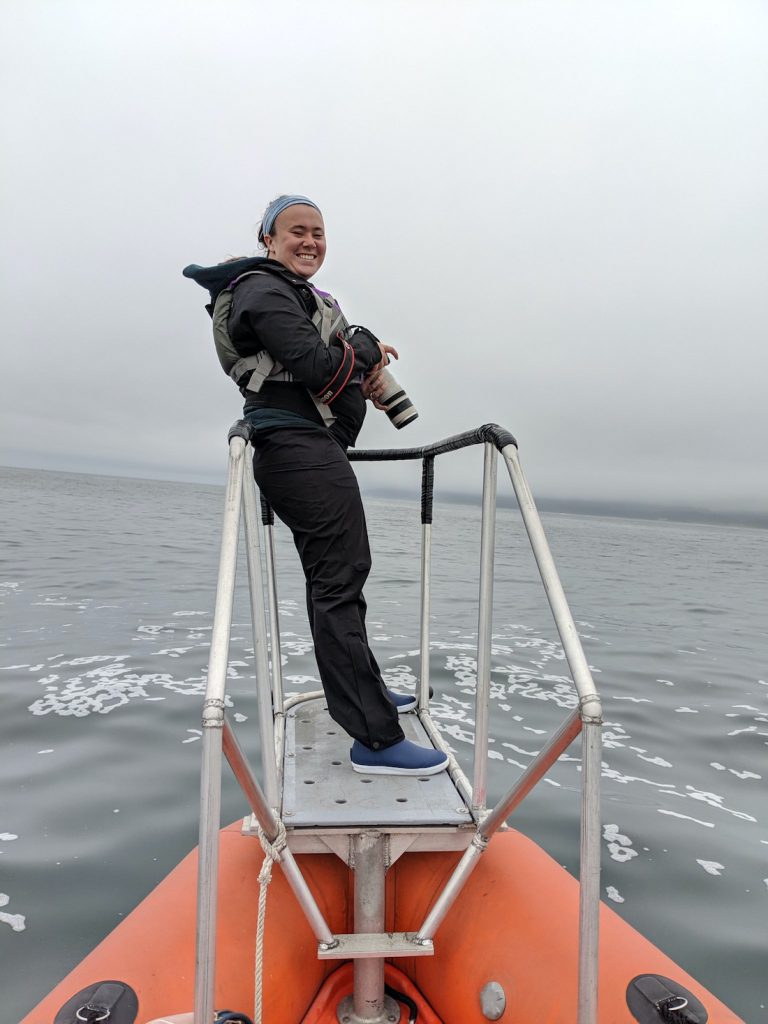
Leila taking photos of gray whales from Ruby’s bow pulpit. Photo: Leigh Torres
2019 Port Orford team members Anthony & Lisa collecting prey samples from research kayak ‘Robustus’.
Gray whale fluke. Photo: Lisa Hildebrand.
The GEMM Lab’s fieldwork was not just restricted to gray whales. After last year’s successes aboard the NOAA ship Bell M. Shimada, Alexa and Dawn both boarded the ship again this year as marine mammal observers for the May and September cruises, respectively. They spied humpback, blue, sperm, and fin whales, as well as many dolphins and seabirds, adding to the GEMM Lab’s growing database of megafauna distribution off the Oregon coast.
Alexa observing on the R/V Shimada in May 2019, all bundled up. Image Photo: Alexa Kownacki
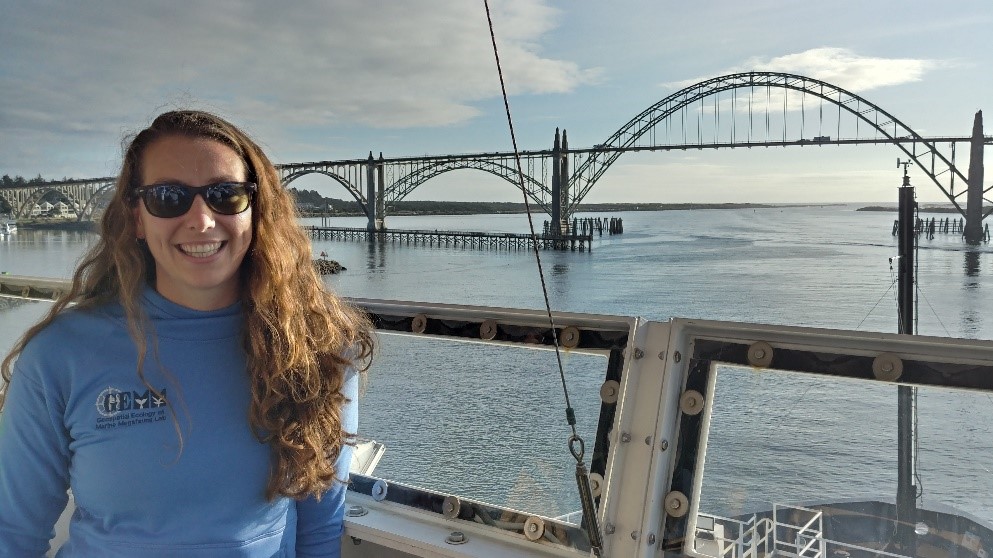
Dawn Barlow on the flying bridge of NOAA Ship Bell M. Shimada, heading out to sea with the Newport bridge in the background. Photo: Anna Bolm.
After winning the prestigious L’Oréal-UNESCO For Women in Science fellowship and the inaugural Louis Herman Scholarship, GEMM Lab grad Solène Derville lead her first research cruise aboard the French R/V Alis. She and her team conducted line transect surveys and micronekton/oceanographic sampling over several seamounts to try to solve the mystery of why humpbacks hang out there. We are also very excited to announce that Solène will be returning to the GEMM Lab as a post-doc in 2020! She will be creating distribution models of whales off the coast of Oregon with the data collected by Leigh during helicopter flights with the US Coast Guard. The primary aim of this work is to identify potential whale hotspots in an effort to avoid spatial overlap with fisheries gear and reduce entanglement risk.
Solène soaking wet after spending several hours observing cetaceans and seabirds on R/V Alis. Photo: Jérôme Jambou
A group of bottlenose dolphins observed over one of the seamounts. Photo: Elodie Vourey
Solène at the L’Oréal ceremony in the French National Museum of Natural History in Paris. Photo: Jean-Charles Caslot
Switching the focus from marine mammals to seabirds, Rachael has had an extremely busy year of field work all across the globe. She island-hopped from Midway (Hawaiian Northwest island) to the Falkland Islands in the first half of the year, and is currently overwintering on South Georgia, where she will be until end of February. Rachael is tracking albatross at all three locations by tagging individual birds to understand movements relative to fishing vessels and flight energetics.
Albatross chick. Photo: Rachael Orben
Recording data. Photo: V. Ternisien
Albatross chick and mother. Photo: Rachael Orben.
Besides several field efforts, the GEMM Lab was also busy disseminating our research and findings to various audiences. Our conferences kicked off in late February when Leigh and Rachael both flew to Kauai to present at the Pacific Seabird Group’s 46th Annual Meeting. In the spring, Leila, Dawn, Alexa, Dom, and myself drove to Seattle where the University of Washington hosted the Northwest Student Society of Marine Mammalogy chapter meeting and we all gave talks. Additionally, the Fisheries & Wildlife grad students in the lab also presented at the department’s annual Research Advances in Fisheries, Wildlife, and Ecology conference. Later in the year, Dom and I attended the State of the Coast conference where Dom was invited to participate in a panel about the holistic approaches to management in the nearshore while I presented a poster on preliminary findings of my Master’s thesis. Most recently, the entire GEMM Lab (bar Rachael) flew to Barcelona to present at the World Marine Mammal Conference (WMMC).
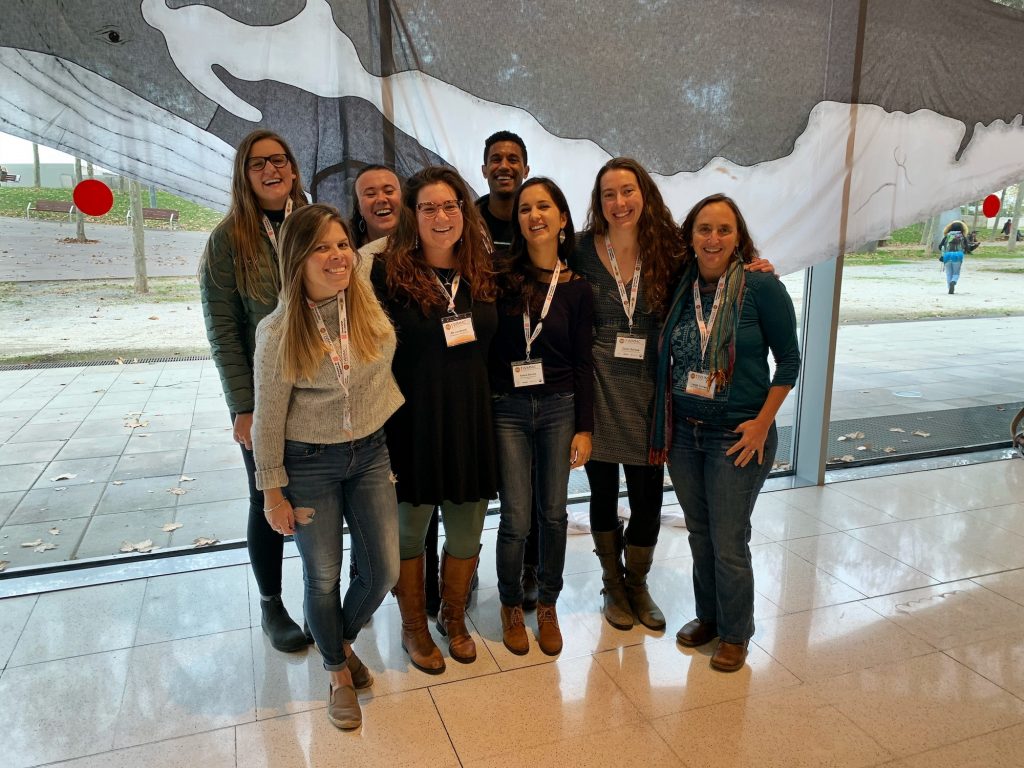
GEMM Lab at the WMMC. Photo: Karen Lohman
Our science communication and outreach efforts were not just restricted to conferences though. Over the course of this year, the GEMM Lab supervised a total of 10 undergraduate and high school interns that assisted in a variety of ways (field and/or lab work, data analyses, independent projects) on a number of projects going on in the lab. Leigh and Dawn boarded the R/V Oceanus in the fall to co-lead a STEM research cruise aimed at providing high school students and teachers hands-on marine research. Dawn and I were guests on Inspiration Dissemination, a live radio show run by graduate students about graduate research going on at OSU. Our weekly blog, now in its fifth year, reached its highest viewership with a total of 14,814 views this year!
The GEMMers were once again prolific writers too! The 13 new publications in 10 scientific journals include contributions from Leigh (7), Rachael (6), Solène (2), Dawn (2), and Leila (1). Scroll down to the end of the post to see the list.
Academic milestones were also reached by several of us. Most notably and recently, Dom successfully defended his Master’s thesis this past week – congratulations Dom!! Unsurprisingly, he already has a job lined up starting in January as a Science Officer with the California Ocean Science Trust. Dom is the 6th GEMM Lab graduate, which after just five years of the GEMM Lab existing is a huge testament to Leigh as an advisor. Leila, who is in the 4th year of her PhD, anticipates finishing this coming March. We also had three successful research reviews – I met with my committee in late March to discuss my Master’s proposal, while Alexa and Dawn met with their committees in the summer to review their PhD proposals. All three reviews were fruitful and successful. And we want to highlight the success of a GEMM Lab grad, Florence Sullivan, who started a job in Maui with the Pacific Whale Foundation in September as a Research Analyst.
Dom during his MS seminar. Photo: Leila Lemos
Post-defense happiness. Photo: Karen Lohman
Leigh was recognized for her expertise in gray whale ecology and was appointed to the IUCN Western Gray Whale Advisory Panel (WGWAP). The western gray whales are a critically endangered population. At one point in the 1960s, the population was so scarce that they were believed to have been extinct. While this concern did not prove to be the case, the population still is not doing well, which is why the IUCN formed WGWAP to provide advice on the conservation of the western gray whales. Leigh was appointed to the panel this year and traveled to Switzerland and Russia for meetings.
Clara aboard Ruby on her first day of gray whale field work in Oregon. Photo: Leigh Torres
We are excited about a new addition to the lab. Clara Bird started her MS in Wildlife Science in the Department of Fisheries & Wildlife this fall. She jumped straight into field work when she came in early September and got a taste of the Pacific. Clara joins us from the Duke University where she did her undergraduate degree and worked for the past year in their Marine Robotics and Remote Sensing Lab. Clara is digging into the gray whale drone footage collected over the last four field seasons and scrutinize them from a behavioral point of view.
If you are reading this post, we would like to say that we really appreciate your support and interest in our work! We hope you will continue to join us on our journeys in 2020. Until then, happy holidays from the GEMM Lab!
GEMM Lab at the beginning of June with some permanents GEMMs and some temporary summer GEMM helpers.
Barlow, D. R., M. Fournet, and F. Sharpe. 2019. Incorporating tides into the acoustic ecology of humpback whales. Marine Mammal Science 35:234-251.
Barlow, D. R., A. L. Pepper, and L. G. Torres. 2019. Skin deep: an assessment of New Zealand blue whale skin condition. Frontiers in Marine Science doi.org/10.3389/fmars.2019.00757.
Baylis, A. M. M., R. A. Orben, A. A. Arkhipkin, J. Barton, R. L. Brownell Jr., I. J. Staniland, and P. Brickle. 2019. Re-evaluating the population size of South American fur seals and conservation implications. Aquatic Conservation: Marine and Freshwater Ecosystems 29(11):1988-1995.
Baylis, A. M. M., M. Tierney, R. A. Orben, et al. 2019. Important at-sea areas of colonial breeding marine predators on the southern Patagonian Shelf. Scientific Reports 9:8517.
Cockerham, S., B. Lee, R. A. Orben, R. M. Suryan, L. G. Torres, P. Warzybok, R. Bradley, J. Jahncke, H. S. Young, C. Ouverney, and S. A. Shaffer. 2019. Microbial biology of the western gull (Larus occidentalis). Microbial Ecology 78:665-676.
Derville, S., L. G. Torres, R. Albertson, O. Andrews, C. S. Baker, P. Carzon, R. Constantine, M. Donoghue, C. Dutheil, A. Gannier, M. Oremus, M. M. Poole, J. Robbins, and C. Garrigue. 2019. Whales in warming water: assessing breeding habitat diversity and adaptability in Oceania’s changing climate. Global Change Biology 25(4):1466-1481.
Derville, S., L. G. Torres, R. Dodémont, V. Perard, and C. Garrigue. 2019. From land and sea, long-term data reveal persistent humpback whale (Megaptera novaeangliae) breeding habitat in New Caledonia. Aquatic Conservation: Marine and Freshwater Ecosystems 29(10):1697-1711.
Fleischman, A. B., R. A. Orben, N. Kokubun, A. Will, R. Paredes, J. T. Ackerman, A. Takahashi, A. S. Kitaysky, and S. A. Shaffer. 2019. Wintering in the western Subantarctic Pacific increases mercury contamination of red-legged kittiwakes. Environmental Science & Technology 53(22):13398-13407.
Holdman, A. K., J. H. Haxel, H. Klinck, and L. G. Torres. 2019. Acoustic monitoring reveals the times and tides of harbor porpoise (Phocoena phocoena) distribution off central Oregon, U.S.A. Marine Mammal Science 35:164-186.
Kroeger, C., D. E. Crocker, D. R. Thompson, L. G. Torres, P. Sagar, and S. A. Shaffer. 2019. Variation in corticosterone levels in two species of breeding albatrosses with divergent life histories: responses to body condition and drivers of foraging behavior. Physiological and Biochemical Zoology 92(2):223:238.
Loredo, S. A., R. A. Orben, R. M. Suryan, D. E. Lyons, J. Adams, and S. W. Stephensen. 2019. Spatial and temporal diving behavior of non-breeding common murres during two summers of contrasting ocean conditions. Journal of Experimental Biology and Ecology 517:13-24.
Monteiro, F., L. S. Lemos, J. Fulgêncio de Moura, R. C. C. Rocha, I. Moreira, A. P. Di Beneditto, H. A. Kehrig, I. C. A. C. Bordon, S. Siciliano, T. D. Saint’Pierre, and R. A. Hauser-Davis. 2019. Subcellular metal distributions and metallothionein associations in rough-toothed dolphins (Steno bredanensis) from southeastern Brazil. Marine Pollution Bulletin 146:263-273.
Orben, R. A., A. B. Fleischman, A. L. Borker, W. Bridgeland, A. J. Gladics, J. Porquez, P. Sanzenbacher, S. W. Stephensen, R. Swift, M. W. McKown, and R. M. Suryan. 2019. Comparing imaging, acoustics, and radar to monitor Leach’s storm-petrel colonies. PeerJ 7:e6721.
Yates, K. L., …, L. G. Torres, et al. 2019. Outstanding challenges in the transferability of ecological models. Trends in Ecology & Evolution 33(10):790-802.
By Lisa Hildebrand, MSc student, OSU Department of Fisheries and Wildlife, Geospatial Ecology of Marine Megafauna Lab
During the summer of 2017 I was an intern for Cascadia Research Collective (CRC), a non-profit organization based out of Olympia, Washington, that conducts research on marine mammal behavior, ecology, and population status along the western US coast and around Hawaii. My internship was primarily office-based and involved processing photographs of humpback and blue whales along the US west coast to add to CRC’s long-term photo-identification catalogues. However, I was asked to join a research project investigating the behavioral and physiological responses of four dolphin species in southern California (Fig. 1). The research project is a collaborative effort lead by Dr. Brandon Southall and involves researchers from CRC, Kelp Marine Research, NOAA’s Southwest Fisheries Science Center, and SR3. Since my internship with CRC, there have been three pilot efforts and one full field effort of this project, called the SOCAL Tagless Behavioral and Physiological Response Study (BPRS), and I have been a part of all of them.
A
B
C
D
The marine environment is stressed out, and so are the millions of flora and fauna that inhabit the global ocean. Humans are a big contributor to this stress. During the last few decades, we have produced more and more things that have ended up in the ocean, whether by choice or by chance. Plastic pollution has become a pervasive and persistent problem, especially after the discovery that when large plastic items are exposed to UV light and seawater they break down into smaller pieces, termed micro- and nano-plastics (Jambeck et al. 2015). Increased demand for oil and gas to supply a growing human population has led to much more marine oil and gas exploration and exploitation (World Ocean Review 2013). Since 1985, global container shipping has increased by approximately 10% annually (World Ocean Review 2010) and it is estimated that global freight demand will triple by 2050 (International Transport Forum 2019). The list of impacts is long. Our impact on the earth, of which the ocean makes up 71%, has been so extreme that expert groups suggest that a new geological epoch – the Anthropocene – needs to be declared to define the time that we now find ourselves in and the impact humanity is having on the environment (Lewis and Maslin 2015). While this term has not been officially recognized, it is irrefutable that humans have and continue to alter ecosystems, impacting the organisms within them.
Noise is an impact often overlooked when thinking about anthropogenic effects in the marine environment, likely because we as humans do not hear much of what happens beneath the ocean surface. However, ocean noise is of particular concern for cetaceans as sound is their primary sense, both over long and short distances. Sound travels extremely efficiently underwater and therefore anthropogenic sounds can be propagated for thousands of kilometers or more (Weilgart 2007a). While it is widely agreed upon that anthropogenic noise is likely a significant stressor to cetaceans (Weilgart 2007b; Wright et al. 2007; Tyack 2008), very few studies have quantified their responses to noise to date. This knowledge gap is likely because behavioral and physiological responses to sound can be subtle, short-lived or slowly proliferate over time, hence making them hard to study. However, growing concern over this issue has resulted in more research into impacts of noise on marine mammals, including the GEMM Lab’s impacts of ocean noise on gray whales project.
The most extreme impact of sound exposure on marine mammals is death. Mass strandings of a few cetacean species have coincided in time and space with Navy sonar operations (Jepson et al. 2003; Fernández et al. 2005; Filadelfo et al. 2009). While fatal mass strandings of cetaceans are extremely troubling, they are a relatively rare occurrence. A cause for perhaps greater concern are sub-lethal changes in important behaviors such as feeding, social interactions, and avoidance of key habitat as a result of exposure to Navy sonar. All of these potential outcomes have raised interest within the U.S. Navy to better understand the responses of cetaceans to sonar.
The SOCAL Tagless BPRS is just one of several studies that has been funded by the U.S. Office of Naval Research to improve our understanding of Navy sonar impact on cetaceans, in particular the sub-lethal effects described earlier. It builds upon knowledge and expertise gained from previous behavioral response studies led by Dr. Southall on a variety of marine mammal species, including beaked whales, baleen whales, and sperm whales. Those efforts included deploying tags on individual whales to obtain high-resolution movement and passive acoustic data paired with controlled exposure experiments (CEEs) during which simulated Navy mid-frequency active sonar (MFAS) or real Navy sonar were employed. Results from that multi-year effort have shown that for blue whales, responses generally only lasted for as long as the sound was active and highly dependent on exposure context such as behavioral state, prey availability and the horizontal distance between the sound source and the individual whale. Blue whales identified as feeding in shallow depths showed no changes in behavior, however over 50% of deep-feeding whales responded during CEEs (Southall et al. 2019).
The SOCAL Tagless BPRS, as the name implies, does not involve deploying tags on the animals. Tags were omitted from this study design because tags on dolphins have not had high success rates of staying on for a very long time. Furthermore, dolphins are social species that typically occur in groups and individuals within a group are likely to interact or react together when exposed to an external stimuli. Therefore, the project integrates established methods of quantifying dolphin behavior and physiology in a novel way to measure broad and fine-scale group and individual changes of dolphin behavior and physiology to simulated Navy MFAS or real Navy sonars using CEEs.
During these tagless CEEs, a dolphin group is tracked from multiple platforms using several different tools. Kelp Marine Research is our on-shore team that spots workable groups (workable meaning that a group should be within range of all platforms and not moving too quickly so that they will leave this range during the CEE), tracks the group using a theodolite (just like I do for my Port Orford gray whale project), and does focal follows to record behavior of the group over a period of time. Ziphiid, one of CRC’s RHIBs, is tasked with deploying three passive acoustic sensors to record sounds emitted by the dolphins and to measure the intensity of the sound of the simulated Navy MFAS or the real Navy sonars. Musculus, the second CRC RHIB, has a dual-function during CEEs; it holds the custom vertical line array sound source, which emits the simulated Navy MFAS, and it is also the ‘biopsy boat’ tasked with obtaining biopsy samples of individuals within the dolphin group to measure potential changes in stress hormone levels. And last but not least, the Magician, the third vessel on the water, serves as ‘home-base’ for the project (Fig. 3). Quite literally it is where the research team eats and sleeps, but it is also the spotting vessel from which visual observations occur, and it is the launch pad for the unmanned aerial system (UAS) used to measure potential changes in group composure, spacing, and speed of travel.
A
B
C
D
The project involves a lot of moving parts and we are careful to conduct the research with explicit monitoring and mitigation requirements to ensure our work is carried out safely and ethically. These factors, as well as the fact that we are working with live, wild animals that we cannot ‘control’, are why three pilot efforts were necessary. Our first ‘official’ phase this past October was a success: in just eight days we conducted 11 CEEs. Six of these involved experimental sonar transmissions (two being from real Navy sonars dipped from hovering helicopters) and five were no-sonar controls that are critical to be able to experimentally associate sonar exposure with potential response. There are more phases to come in 2020 and 2021 and I look forward to continue working on such a collaborative project.
For more information on the project, you can visit Southall Environmental Associates project page, or read the blog posts written by Dr. Brandon Southall (this one or this one).
For anyone attending the World Marine Mammal Conference in Barcelona, Spain, there will be several talks related to this research:
Dr. Brandon Southall will be presenting on the Atlantic BRS on beaked whales and short-finned pilot whales on Wednesday, December 11 from 2:15 – 2:30 pm
Dr. Caroline Casey will be presenting on the experimental design and results of this SOCAL Tagless BPRS project on Wednesday, December 11 from 2:30 – 2:45 pm
All research is authorized under NMFS permits #16111, 19091, and 19116 as well as numerous Institutional Animal Care and Use Committee and other federal, state, and local authorizations. More information is available upon request from the project chief scientist at Brandon.Southall@sea-inc.net.
Literature cited
Fernández, A., J. F. Edwards, F. Rodríguez, A. Espinosa de los Monteros, P. Herráez, P. Castro, J. R. Jaber, V. Martín, and M. Arbelo. 2005. “Gas and fat embolic syndrome” involving a mass stranding of beaked whales (Family Ziphiidae) exposed to anthropogenic sonar signals. Veterinary Pathology 42(4):446-457.
Filadelfo, R., J. Mintz, E. Michlovich, A. D’Amico, P. L. Tyack, and D. R. Ketten. 2009. Correlating military sonar use with beaked whale mass strandings: what do the historical data show? Aquatic Mammals 35(4):435-444.
Jambeck, J. R., R. Geyer, C. Wilcox, T. R. Siegler, M. Perryman, A. Andrady, R. Narayan, and K. L. Law. 2015. Plastic waste inputs from land into the ocean. Science 347(6223):768-771.
Jepson, P. D., M. Arbelo, R. Deaville, I A. P. Patterson, P. Castro, J. R. Baker, E. Degollada, H. M. Ross, P. Herráez, A. M. Pocknell, F. Rodríguez, F. E. Howie II, A. Espinosa, R. J. Reid, J. R. Jaber, V. Martin, A. A. Cunningham, and A. Fernández. 2003. Gas-bubble lesions in stranded cetaceans. Nature 425:575.
Lewis, S. L., and M. A. Maslin. 2015. Defining the Anthropocene. Nature 519:171-180.
Southall, B. L., S. L. DeRuiter, A. Friedlaender, A. K. Stimpert, J. A. Goldbogen, E. Hazen, C. Casey, S. Fregosi, D. E. Cade, A. N. Allen, C. M. Harris, G. Schorr, D. Moretti, S. Guan, and J. Calambokidis. 2019. Behavioral responses of individual blue whales (Balaenoptera musculus) to mid-frequency military sonar. Journal of Experimental Biology 222: doi. 10.1242/jeb.190637.
Tyack, P. L. 2008. Implications for marine mammals of large-scale changes in the marine acoustic environment. Journal of Mammalogy 89(3):549-558.
Weilgart, L. S. 2007a. The impacts of anthropogenic ocean noise on cetaceans and implications for management. Canadian Journal of Zoology 85(11):1091-1116.
Weilgart, L. S. 2007b. A brief review of known effects of noise on marine mammals. International Journal of Comparative Psychology 20(2):159-168.
Wright, A. J., N. A. Soto, A. L. Baldwin, M. Bateson, C. M. Beale, C. Clark, T. Deak, E. F. Edwards, A. Fernández, A. Godinho, L. T. Hatch, A. Kakuschke, D. Lusseau, D. Martineau, M. L. Romero, L. S. Weilgart, B. A. Wintle, G. Notarbartolo-di-Sciara, and V. Martin. Do marine mammals experience stress related to anthropogenic noise? International Journal of Comparative Psychology 20(2):274-316.
By: Alexa Kownacki, Ph.D. Student, OSU Department of Fisheries and Wildlife, Geospatial Ecology of Marine Megafauna Lab
When I first learned of the critically endangered vaquita in
early 2015, there were an estimated 97 individuals remaining as reported by CIRVA*
(Morell
2014). I was a recent graduate with a bachelor’s degree in Wildlife, Fish,
and Conservation Biology, and I, of all people, had never heard of the vaquita.
Today, there are an estimated 19 vaquita left (Roth 2019).
Digital painting of a vaquita mother with her calf (Image Source: Aquarium of the Pacific).
The vaquita (Phocoena sinus) is a small porpoise endemic to the Sea of Cortez in the northern region of the Gulf of California, Mexico. It is the most endangered marine mammal and has been for many years, and yet, I had not heard of the vaquita. It wasn’t until I listened to a lunchtime seminar hosted by NOAA Fisheries, that I heard about the porpoise. As a young scientist, “in the field”, I was shocked to realize that I was just learning about an animal, let alone a cetacean, actively going extinct in my lifetime. I believe it’s our job to inform those around us of news in our expertise, and I had failed. I wasn’t informed. As much as I tried in the past four years to describe the decline of the smallest cetacean to anyone who’d listen, I was only reaching a few people at a time. But, today, the vaquita is finally capturing the public’s eye thanks to celebrity support and a feature-length film.
A rare photo of a vaquita (Image Source: Tom Jefferson via the Marine Mammal Center)
From executive producer, Leonardo DiCaprio, comes the Sundance Film Festival Audience Award winner, “Sea of Shadows”. The story of the vaquita truly is an “eco-thriller” and one worth watching. This is not your typical plot line of an endangered species tragically going extinct without action. The vaquita’s story boasts big-name players, such as the Mexican Navy, internationally recognized scientists, Mexican cartels, Chinese mafia, celebrities, the National Marine Mammal Foundation, and Sea Shepherd. At the center of this documentary is the elusive vaquita. The vaquita is not hunted, in fact, this species is not desirable for fisherman. The animal is not aggressive and, in contrast, is notoriously shy, only surfacing to breathe. Furthermore, its name roughly translates into “little cow” because of the rings around its eyes and its docile nature. So, why is this cute creature on the road to extinction? The answer: the wrong place at the wrong time.
“Sea of Shadows” official trailer by National Geographic
The vaquita occupy a small part of the Sea of Cortez where totoaba (Totoaba macdonaldi), a large fish in the drum family, is also endemic. If you’re wondering what a small porpoise and a large fish have in common, then you’d be close to recognizing that is the key to understanding this tragedy. Both species are roughly the same size, one to two meters in length with similar girths. The totoaba, although said to have tender meat, is caught for only one organ: the swim bladder. Now referred to as the “cocaine of the sea”, the dried swim bladders of the totoaba are sold to Mexican cartels who then export the product to China. Once in China, illegal markets sell the swim bladders for up to $100,000USD. Unfortunately, the nets used to illegally catch totoaba, also catch the vaquita. The porpoise has no economic value to the fishermen and therefore are tossed as bycatch. The vaquita is the innocent bystander in a war for money and power.
A man displays the catch from an illegal gillnet, including the totoaba in his arms, and a vaquita, below, that was bycatch (Image Source: Omar Vidal via Aquarium of the Pacific/NOAA Fisheries).
Watching a charismatic species severely decline because of human greed is horrific. The film, however, focuses on the effort of a few incredible organizations that band together in the fight to save the vaquita. Moreover, the multimillion-dollar project, Vaquita CPR, is still ongoing. On a more positive note, in October of 2019, scientists spotted six vaquita during continued conservation and monitoring efforts (Blust & Desk 2019). The path to saving a critically endangered species, especially one that is thought not to do well in captivity, is challenging. The vaquita’s recovery path has many complicated connections which for what appears to be an uphill battle. But, we, the people, are responsible for this. We must support research and conservation by using our voice to share what is happening, for a porpoise and for the world.
*Comité Internacional para la Recuperación de la Vaquita (International
Committee for the Recovery of the Vaquita)
Citations:
Blust, Kendal,
and Fronteras Desk. “Photo Sparks Increased Concern over Fishing in Vaquita
Refuge.” Arizona Public Media, 25 Oct. 2019,
https://news.azpm.org/p/news-topical-nature/2019/10/25/160806-photo-sparks-increased-concern-over-fishing-in-vaquita-refuge/.
Morell,
Virginia. “Vaquita Porpoise Faces Imminent Extinction-Can It Be Saved?” National Geographic, 15 Aug. 2014,
https://www.nationalgeographic.com/news/2014/8/140813-vaquita-gulf-california-mexico-totoaba-gillnetting-china-baiji/.
Roth, Annie.
“The ‘Little Cow’ of the Sea Nears Extinction.” National Geographic, 17 Sept. 2019,
https://www.nationalgeographic.com/animals/2019/09/vaquita-the-porpoise-familys-smallest-member-nears-extinction/#close.
1Masters Student in Marine Resource Management, 2Doctoral Student in Integrative Biology
Five years ago, the North Pacific Ocean
experienced a sudden increase in sea surface temperature (SST), known as the
warm blob, which altered marine ecosystem function and structure (Leising et
al. 2015). Much research illustrated how the warm blob impacted pelagic
ecosystems, with relatively less focused on the nearshore environment. Yet, a
new study demonstrated how rising ocean temperatures have partially led to
bull kelp loss in northern California. Unfortunately, we are once again observing
similar warming trends, representing the second largest marine heatwave
over recent decades, and signaling the potential rise of a second warm blob. Taken
together, all these findings could forecast future warming-related ecosystem
shifts in Oregon, highlighting the need for scientists and managers to consider
strategies to prevent future kelp loss, such as reintroducing sea otters.
In northern California, researchers observed a dramatic
ecosystem shift from productive bull kelp forests to purple sea urchin barrens.
The study, led by Dr. Laura Rogers-Bennett from the University of California,
Davis and California Department of Fish and Wildlife, determined that this
shift was caused by multiple climatic and biological stressors. Beginning in
2013, sea star populations were decimated by sea star wasting
disease (SSWD). Sea stars are a main predator of urchins, causing their
absence to release purple urchins from predation pressure. Then, starting in
2014, ocean temperatures spiked with the warm blob. These two events created
nutrient-poor conditions, which limited kelp growth and productivity, and allowed
purple urchin populations to grow unchecked by predators and increase grazing
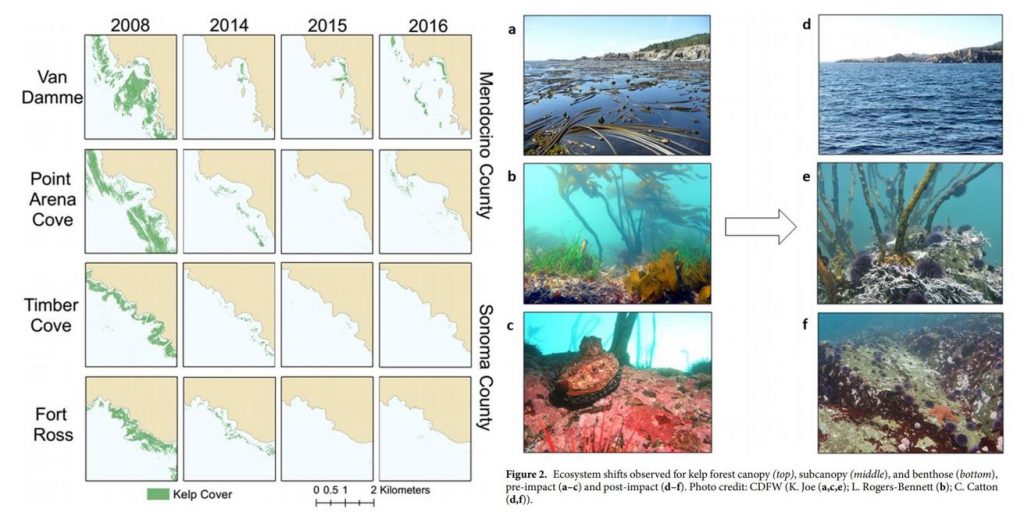
on bull kelp. The combined effect led to approximately 90% reductions in bull
kelp, with a reciprocal 60-fold increase in purple urchins (Figure 1).
Figure 1. Kelp loss and ecosystem shifts in northern California (Rogers-Bennett & Catton 2019).
These changes have wrought economic challenges as
well as ecological collapse in Northern California. Bull kelp is important habitat
and food source for several species of economic importance including red
abalone and red sea urchins (Tegner & Levin 1982). Without bull kelp, red
abalone and red sea urchin populations have starved, resulting in the subsequent
loss of the recreational red abalone ($44 million) and commercial red sea
urchin fisheries in Northern California. With such large kelp reductions,
purple urchins are also now in a starved state, evidenced by noticeably smaller
gonads (Rogers-Bennett & Catton 2019).
Biogeographically, southern Oregon is very similar
to northern California, as both are composed of complex rocky substrates and
shorelines, bull kelp canopies, and benthic macroinvertebrates (i.e. sea
urchins, abalone, etc.). Because Oregon was also impacted by the 2014-2015 warm
blob and SSWD, we might expect to see a similar coastwide kelp forest loss
along our southern coastline. The story is more complicated than that, however.
For instance, ODFW
has found purple urchin barrens where almost no kelp remains in some
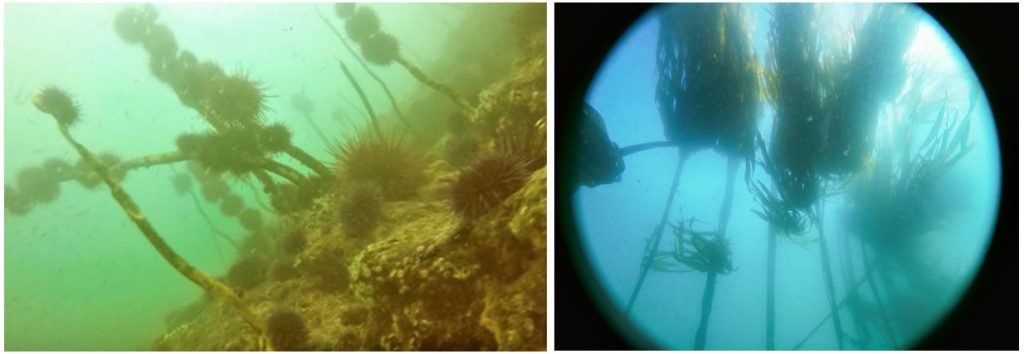
localized places. The GEMM Lab has video footage of purple urchins climbing up
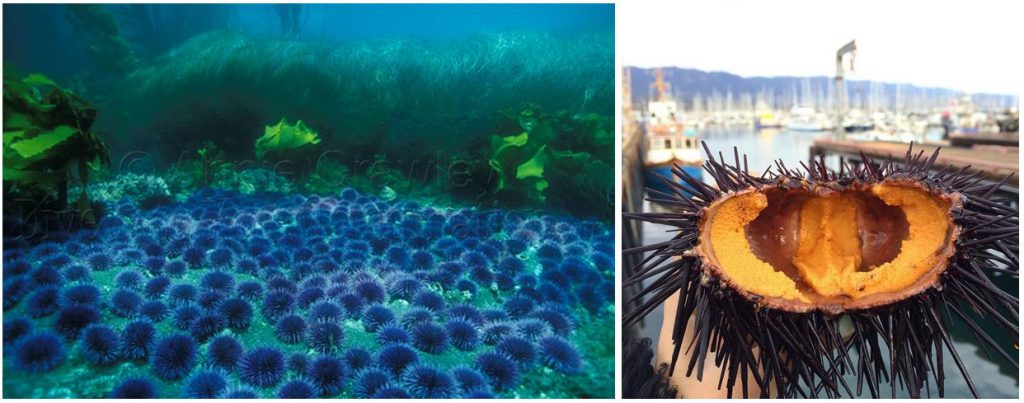
kelp stalks to graze within one of these barrens near Port Orford, OR (Figure 2,
left). In her study, Dr. Rogers-Bennett explains that this aggressive sea
urchin feeding strategy is potentially a sign of food limitation, where
high-density urchin populations create intense resource competition. Conversely,
at sites like Lighthouse Reef (~45 km from Port Orford) outside Charleston, OR,
OSU and University of Oregon divers are currently seeing flourishing bull kelp
forests. Urchins at this reef have fat, rich gonads, which is an indicator of
high-quality nutrition (Figure 2, right).
Satellites can detect kelp on the surface of the
water, giving scientists a way to track kelp extent over time. Preliminary
results from Sara Hamilton’s Ph.D. thesis research finds that while some kelp
forests have shrunk in past years, others are currently bigger than ever in the
last 35 years. It is not clear what is driving this spatial variability in
urchin and kelp populations, nor why southern Oregon has not yet faced the same
kind of coastwide kelp forest collapse as northern California. Regardless, it
is likely that kelp loss in both northern California and southern Oregon may be
triggered and/or exacerbated by rising temperatures.
Figure 2. Left: Purple urchin aggressive grazing near Port Orford, OR (GEMM Lab 2019). Right: Flourishing bull kelp near Charleston, OR (Sara Hamilton 2019).
The reintroduction of sea otters has been proposed
as a solution to combat rising urchin populations and bull kelp loss in Oregon.
From an ecological perspective, there is some validity to this idea. Sea otters
are a voracious urchin predator that routinely reduce urchin populations and
alleviate herbivory on kelp (Estes & Palmisano 1974). Such restoration and
protection of bull kelp could help prevent red abalone and red sea urchin starvation.
Additionally, restoring apex predators and increasing species richness is often
linked to increased ecosystem resilience, which is particularly important in
the face of global anthropogenic change (Estes et al. 2011)
While sea otters could alleviate grazing pressure
on Oregon’s bull kelp, this idea only looks at the issue from a top-down, not bottom-up,
perspective. Sea otters require a lot of food (Costa 1978, Reidman & Estes
1990), and what they eat will always be a function of prey availability and
quality (Ostfeld 1982). Just because urchins are available, doesn’t mean otters
will eat them. In fact, sea otters prefer large and heavy (i.e. high gonad
content) urchins (Ostfeld 1982). In the field, researchers have observed sea
otters avoiding urchins at the center of urchin barrens (personal
communication), presumably because those urchins have less access to kelp beds than
on the barren periphery, and therefore, are constantly in a starved state (Konar
& Estes 2003) (Figure 3). These findings suggest prey quality is more
important to sea otter survival than just prey abundance.
Purple urchin quality has not been widely assessed
in Oregon, but early results show that gonad size varies widely depending on
urchin density and habitat type. In places where urchin barrens have formed,
like Port Orford, purple urchins are likely starving and thus may be a poor
source of nutrition for sea otters. Before we decide whether sea otters are a
viable tool to combat kelp loss, prey surveys may need to be conducted to
assess if a sea otter population could be sustained based on their caloric
requirements. Furthermore, predictions of how these prey populations may change
due to rising temperatures could help determine the potential for sea otters to
become reestablished in Oregon under rapid environmental change.
Recent events in California could signal
climate-driven processes that are already impacting some parts of Oregon and could
become more widespread. Dr. Rogers-Bennett’s study is valuable as she has quantified
and described ecosystem changes that might occur along Oregon’s southern
coastline. The resurgence of a potential second warm blob and the frequency
between these warming events begs the question if such temperature spikes are
still anomalous or becoming the norm. If the latter, we could see more
pronounced kelp loss and major shifts in nearshore ecosystem baselines, where function
and structure is permanently altered. Whether reintroducing sea otters can
prevent these changes will ultimately depend on prey and habitat availability
and quality, and should be carefully considered.
References:
Costa, D. P. 1978. The ecological energetics,
water, and electrolyte balance of the California sea otter (Enhydra lutris).
Ph.D. dissertation, University of California, Santa Cruz.
Estes, J. A. and J.F. Palmisano. 1974. Sea
otters: their role in structuring nearshore communities. Science. 185(4156):
1058-1060.
Estes et al. 2011. Trophic downgrading of planet Earth. Science. 333(6040): 301-306.
Harvell et al. 2019. Disease epidemic and a
marine heat wave are associated with the continental-scale collapse of a
pivotal predator (Pycnopodia helianthoides). Science Advances.
5(1).
Konar, B., and J. A. Estes. 2003. The stability of
boundary regions between kelp beds and deforested areas. Ecology. 84(1):
174-185.
Leising et al. 2015. State of California Current
2014-2015: impacts of the warm-water “blob”. CalCOFI Reports. (56):
31-68.
Ostfeld, R. S. 1982. Foraging strategies and prey
switching in the California sea otter. Oecologia. 53(2):
170-178.
Reidman, M. L. and J. A. Estes. 1990. The sea
otter (Enhydra lutris): behavior, ecology, and natural history. United
States Department of the Interior, Fish and Wildlife Service, Biological
Report. 90: 1-126.
Rogers-Bennett, L., and C. A. Catton. 2019. Marine
heat wave and multiple stressors tip bull kelp forest to sea urchin barrens. Scientific
Reports. 9:15050.
Tegner, M. J., and L. A. Levin. 1982. Do sea
urchins and abalones compete in California? International Echinoderms
Conference, Tampa Bay. J. M Lawrence, ed.
By: Alexa Kownacki, Ph.D. Student, OSU Department of Fisheries and Wildlife, Geospatial Ecology of Marine Megafauna Lab
Marine mammals are challenging to study for many reasons, and
specifically because they inhabit the areas of the Earth that are uninhabited
by people: the oceans. Monitoring marine mammal populations to gather baselines
on their health condition and reproductive status is not as simple as trap and
release, which is a method often conducted for terrestrial animals. Marine
mammals are constantly moving in vast areas below the surface. Moreover,
cetaceans, which do not spend time on land, are arguably the most challenging
to sample.
One component of my project, based in California, USA, is a health assessment analyzing hormones of the bottlenose dolphins that frequent both the coastal and the offshore waters. Therefore, I am all too familiar with the hurdles of collecting health data from living marine mammals, especially cetaceans. However, the past few decades have seen major advancements in technology both in the laboratory and with equipment, including one tool that continues to be critical in understanding cetacean health: blubber biopsies.
Biopsy dart hitting a bottlenose dolphin below the dorsal fin. Image Source: NMFS
Blubber biopsies are typically obtained via low-powered crossbow with a bumper affixed to the arrow to de-power it once it hits the skin. The arrow tip has a small, pronged metal attachment to collect an eraser-tipped size amount of tissue with surface blubber and skin. I compare this to a skin punch biopsies in humans; it’s small, minimally-invasive, and requires no follow-up care. With a small team of scientists, we use small, rigid-inflatable vessels to survey the known locations of where the bottlenose dolphins tend to gather. Then, we assess the conditions of the seas and of the animals, first making sure we are collecting from animals without potentially lowered immune systems (no large, visible wounds) or calves (less than one years old). Once we have photographed the individual’s dorsal fin to identify the individual, one person assembles the biopsy dart and crossbow apparatus following sterile procedures when attaching the biopsy tips to avoid infection. Another person prepares to photograph the animal to match the biopsy information to the individual dolphin. One scientist aims the crossbow for the body of the dolphin, directly below the dorsal fin, while the another photographs the biopsy dart hitting the animal and watches where it bounces off. Then, the boat maneuvers to the floating biopsy dart to recover the dart and the sample. Finally, the tip with blubber and skin tissue is collected, again using sterile procedures, and the sample is archived for further processing. A similar process, using an air gun instead of a crossbow can be viewed below:
GEMM Lab members using an air gun loaded with a biopsy dart to procure marine mammal blubber from a blue whale in New Zealand. Video Source: GEMM Laboratory.
Part of the biopsy process is holding ourselves to the highest standards in our minimally-invasive technique, which requires constant practice, even on land.
Alexa practicing proper crossbow technique on land under supervision. Image Source: Alexa Kownacki
Blubber is the lipid-rich, vascularized tissue under the
epidermis that is used in thermoregulation and fat storage for marine mammals. Blubber
is an ideal matrix for storing lipophilic (fat-loving) steroid hormones because
of its high fat content. Steroid hormones, such as cortisol, progesterone, and
testosterone, are naturally circulating in the blood stream and are released in
high concentrations during specific events. Unlike blood, blubber is less
dynamic and therefore tells a much longer history of the animal’s nutritional
state, environmental exposure, stress level, and life history status. Blubber
is the cribs-notes version of a marine mammal’s biography over its previous few
months of life. Blood, on the other hand, is the news story from the last 24
hours. Both matrices serve a specific purpose in telling the story, but blubber
is much more feasible to obtain from a cetacean and provides a longer time
frame in terms of information on the past.
A simplified depiction of marine mammal blubber starting from the top (most exterior surface) being the skin surface down to the muscle (most interior). Image Source: schoolnet.org.za
I use blubber biopsies for assessing cortisol, testosterone,
and progesterone in the bottlenose dolphins. Cortisol is a glucocorticoid that
is frequently associated with stress, including in humans. Marine mammals
utilize the same hypothalamic-pituitary-adrenal (HPA) axis that is responsible
for the fight-or-flight response, as well as other metabolic regulations.
During prolonged stressful events, cortisol levels will remain elevated, which
has long-term repercussions for an animal’s health, such as lowered immune
systems and decreased ability to respond to predators. Testosterone and
progesterone are sex hormones, which can be used to indicate sex of the
individual and determine reproductive status. This reproductive information
allows us to assess the population’s composition and structure of males and
females, as well as potential growth or decline in population (West et al.
2014).
Alexa using a crossbow from a small boat off of San Diego, CA. Image Source: Alexa Kownacki
The coastal and offshore bottlenose dolphin ecotypes of interest in my research occupy different locations and are therefore exposed to different health threats. This is a primary reason for conducting health assessments, specifically analyzing blubber hormone levels. The offshore ecotype is found many kilometers offshore and is most often encountered around the southern Channel Islands. In contrast, the coastal ecotype is found within 2 kilometers of shore (Lowther-Thieleking et al. 2015) where they are subjected to more human exposure, both directly and indirectly, because of their close proximity to the mainland of the United States. Coastal dolphins have a higher likelihood of fishery-related mortality, the negative effects of urbanization including coastal runoff and habitat degradation, and recreational activities (Hwang et al. 2014). The blubber hormone data from my project will inform which demographics are most at-risk. From this information, I can provide data supporting why specific resources should be allocated differently and therefore help vulnerable populations. Further proving that the small amount of tissue from a blubber biopsy can help secure a better future for population by adjusting and informing conservation strategies.
Literature Cited:
Hwang, Alice, Richard H Defran, Maddalena Bearzi, Daniela. Maldini, Charles A Saylan, Aime ́e R Lang, Kimberly J Dudzik, Oscar R Guzo n-Zatarain, Dennis L Kelly, and David W Weller. 2014. “Coastal Range and Movements of Common Bottlenose Dolphins (Tursiops Truncatus) off California and Baja California, Mexico.” Bulletin of the Southern California Academy of Sciences 113 (1): 1–13. https://doi.org/10.3390/toxins6010211.
Lowther-Thieleking, Janet L.,
Frederick I. Archer, Aimee R. Lang, and David W. Weller. 2015. “Genetic
Differentiation among Coastal and Offshore Common Bottlenose Dolphins, Tursiops
Truncatus, in the Eastern North Pacific Ocean.” Marine Mammal Science 31
(1): 1–20. https://doi.org/10.1111/mms.12135.
West, Kristi L., Jan Ramer, Janine L. Brown, Jay Sweeney, Erin M. Hanahoe, Tom Reidarson, Jeffry Proudfoot, and Don R. Bergfelt. 2014. “Thyroid Hormone Concentrations in Relation to Age, Sex, Pregnancy, and Perinatal Loss in Bottlenose Dolphins (Tursiops Truncatus).” General and Comparative Endocrinology 197: 73–81. https://doi.org/10.1016/j.ygcen.2013.11.021.
By Mia Arvizu, Marine Studies Initiative (MSI) & GEMM Lab summer intern, OSU junior
Part 1: The Green Life Jacket
The swells are churning and for once my stomach is calm. I take advantage of it while I can, and head out on the kayak. Another beautiful day, another good data set. After about three hours in the kayak and a long paddle fighting winds and swells, we arrive at TC1. That’s short for Tichenor Cove Station 1. I’m fairly tired by now but my teammate and I are determined to finish all stations today. GPS says we arrived, and I paddle against any slight movement to keep us on station. It’s getting more difficult though, so I check in with Anthony, one of the high school interns this summer. “Anthony, have you sent the GoPro camera down yet?” I take a quick look back peering over my green life jacket. Red flash, and I know it’s on. Anthony sends it down, and I watch as it plunges into depths I couldn’t see on my own. I’m confident it’s doing its job.
Kayaking on the Port Orford coast collecting prey data on the foraging ecology of whales and collecting information on the abundance of sea urchins. Source: A. Howe.
Part 2: The GoPro Dive
The green life jacket is familiar, but there’s a different soul, a different face every year. It’s the same month though. August – the month of whales.
Red flash, I’m on, and it’s my time to shine. The scientists debrief me on my latest mission, and I’m alive. “Secchi depth .75 meters.” Hmm, low visibility. This may be a tough one. “Station TC1” One of my favorites but challenging no doubt. “Time is 10:36. 5, 6, 7, 8…” I’m ready. A flush of swirling water surrounds me as I plunge into the depths of a different realm. I’m cocooned in the beauty of an ocean so blue, so majestic, so entrancing. Oh, the mission! Right, I need to stay focused. They lurk all around but with sand clouding the water, I can barely see. I just need one good visual of the purple spikes and the swaying green leaves, and the mission will be complete. I glance just to the left and oh my!
Sea urchins actively foraging on kelp at station TC1 in Tichenor Cove. Source: GEMM Lab.
A giant purple spike comes too close. I barely caught a glimpse of it. I need a better shot, but I only have so much control especially with these undercurrents. I’m ready now though. I peer through the sediment and nothing, but one quick swivel to the right shows me what I feared and what the green life jackets predicted: The purple spikes have grown too many and reduced the swaying greens down to half chewed, severed, scared dead masses. I thought their hypothesis was right, but I didn’t expect this degree of damage. It’s so frightening I almost look away.
But I don’t. I have a mission. So, I look straight ahead documenting the scene. I haven’t seen it this bad in the past years. I wonder what the green life jackets will do about this. I feel a tug, and I’m reeled in. I guess I’ll find out.
GoPro video taken from tandem research kayak during 2019 gray whale field season in Tichenor Cove, Port Orford. Source: GEMM Lab.
Part 3: The Science, how I see it
After collecting data in the kayak, I go back to the field station ready to do data processing. I grab the GoPro and take a look at the video from TC1. I’m both amazed and terrified for the surrounding habitat from what I see. Sea urchins seem to have been actively foraging on kelp stalks.
Last summer, around this time, a previous intern pointed out that he was witnessing damaged kelp and a notable number of urchins in the GoPro videos. Thus, the GEMM Lab is looking into the relationship between kelp health and sea urchin abundance in Port Orford, which can have significant trophic cascades for the rest of the ecosystem, including whales and their zooplankton prey. The hypothesis is that if sea urchin populations increase in number they may actively forage on kelp, reducing the health of that habitat. Many creatures depend on this habitat including zooplankton which whales feed on. I have looked at videos from past years and the temporal difference in the abundance of urchins is stark. A detailed methodology for the project and our pending results will be featured in a later post, but for now this story is unfolding before our eyes and the GoPro’s lens as well.
Part 4: The Transformation from STEM to STEAM
I hope you enjoyed these short stories. As the writer, it was nice to express the ecological phenomena I’ve learned about in the last few weeks between sea urchins and kelp in this creative and artistic outlet. Especially since I feel science can be rigid at times. It can be easy to lose myself in numbers and large datasets. However, by tying together the arts and STEM (Science, Technology, Engineering, Mathematics), there is more space for well-rounded inquiry and expressive results. STEAM, which is STEM with the Arts included, is not a new movement. Examples of STEAM are preserved in the past and is ongoing in present examples. A great example of how the sciences and arts are merged together is in the songs of Aboriginal Australians. These songs can take hours to recite fully and are full of environmental knowledge such as species types, behavior of animals, and edible plants. The combination of art and STEM is also displayed in the modern age and is shown in Leah Heiss’s work to create jewelry that helps measure cardiac data and also helps diabetics administer their insulin.
This is one of Leah’s feature blends of biotechnology and jewelry. It measures cardiac data and is primarily beneficial for patients at risk of heart attacks. Source: Leah Heiss.
There are many ways in which the two subjects can merge together, making each other stronger and better. As a well-rounded student pursuing Environmental Science and interested dance and writing, I am comforted to know that STEAM can allow me to blend my interests.
By Donovan Burns, Astoria High School Junior, GEMM Lab summer intern
The term zooplankton is used to describe a large number of creatures; the exact definition is any animal that cannot move against a sustained current in the marine environment. There are two main types of plankton: holoplankton and meroplankton. Meroplankton are organisms that are plankton for only part of their life cycle. So this makes most sea creatures plankton, for instance, salmon, sunfish, tuna, and most other fish are meroplankton because they start out their lives as plankton. Holoplankton are plankton that remain plankton for their whole lives, these include mysid shrimp, most marine worms, and most jellyfish.
I have spent a good deal of time this summer looking through a microscope at the zooplankton we have captured during sampling from our research kayak, trying to distinguish and identify different species. Telsons, the tail of the tail, are what we use to identify different types of mysid shrimp, which are a primary gray whale prey item along the Oregon coast and the most predominant type of zooplankton we capture in our sampling. For instance Neomysis is a genus of mysid shrimp and is one of the two most abundant zooplankton species we get. Their telsons end with two spikes that are somewhat longer than the spikes on the side of the telson. This look is distinct from Holmesimysis sculpta, the other of the two most abundant zooplankton species we get, which have four-pronged telsons with varying sizes of spikes along the sides of the telson. Alienacanthomysis macropsis is identified by both their long eye stalks and their rather bland rounded telson.
Holmesimysis sculpta
Neomysis
Alienacanthomysis macropsis
Caprellidae. Source: R. Norman.
However, creatures that are not mysid shrimp cannot be identified this way. Like gammarids, they look like fleas. We have only found one kind of gammarid here in Port Orford this year, Atylus tridens. There are other types but that is the only type we have found this year. After that, we have Caprellidae, also known as skeleton shrimp. They are long and stalky, and have claws in every spot where they could have claws.
Copepod. Source: L. Hildebrand.
Then there are copepods. Copepods are tiny and have long antennae that string down to the sides of their bodies. We also have been seeing lots of crab larvae. I have also seen a couple of polychaete worms, which are marine worms with many legs and segments. The only reason I was able to identify them as polychaetes is due to my marine biology class at Astoria High School where we identified these worms using microscopes before.
We also have had some trouble identifying somethings. For instance, we have found a few individuals of a type of mysid shrimp with a rake-like tail that we are still trying to identify. Also, we have captured some jellyfish that we are not trying to identify. When the kayak team gets back in from gathering samples, we freeze the samples to kill and preserve the critters in them. This process turns the jellyfish to mush, so they are hard to identify.
Mystery mysid with rake-like tail.
To identify these zooplankton and other critters, we put them into a Petri dish and under a dissection scope, at which point we use forceps to move and pivot creatures. If a jellyfish had just eaten another plankton, we have to cut it open to get the plankton out so we can identify it.
Sometimes we have large samples of thousands of the same creature, in this case, we would normally sub-sample it. Sub-sampling is when we take a portion of a sample and identify and count individual zooplankton in that sub-sample. Then we multiply those counts by the portion of the whole sample to get the approximate total number that are in that sample. For instance, say we had a rather large sample, we would take a tenth of that sample and count what is in it. Say we count 500 individuals in that tenth. We would then multiply 500 by ten to get the total number in that whole sample.
Then there are some plankton that we do not catch, like large jellyfish. The kayak team has gotten photos of a giant jellyfish that was nearly a meter long.
Jellyfish seen by the kayak team. Source: L. Hildebrand.
All in all, Port Orford has an amazing and diverse population of marine life. From gray whales to thresher sharks to mysid shrimp to copepods to jellyfish, this little ecosystem has pretty much some of everything.