Small Whales, Big Questions: my journey into marine science

Gavin Vierra, TOPAZ/JASPER High School Intern, North Bend High School

Hello! I am Gavin Vierra, a high school intern for the TOPAZ/JASPER project. I am in my junior year at North Bend High School. I tried my hardest to join this program because of my fascination with marine animals, from big to small (even the microscopic zooplankton.) My fascination with Polar gigantism (which you’ll hear more about in the following paragraph) is what fueled my desire to learn more about marine science, leading me to find a way into this field. Mr. Prince, my history teacher, knew about my interest in marine science and encouraged me to apply for this internship. After reading papers and undergoing the interview with Celest and Dr. Torres, I got the internship. This thrilled me so much, I ran through the front doors of my school and instantly informed Mr. Prince about the success.

            (left image) Mill rocks, Port Orford: showcasing 4 of the 6 stations at Mill Rocks. (right image) Grant (left), our kayak instructor, at the Port Orford port, teaching TOPAZ/JASPER intern Adrian and I (the right kayak) how to kayak.

(photo credit for the image on the left: Gavin Cada)

A concept I am particularly interested in learning about within marine science is the phenomenon known as “polar gigantism”, an unusual phenomenon that occurs in Antarctic fauna resulting in abnormally large body sizes (Catlin M Shisido, H Arthur Woods et al. 2019), compared to their conspecifics in warmer environments. This pattern is evident in these taxa: Sea spiders (pycnogonids), giant Antarctic Sea spider (Colossendeis megalonyx) (Catlin M Shisido, H Arthur Woods et al) Polychaetae worm (Phylum Annelida) (Amy L Moran, H Artur Woods et al). Hypotheses for polar gigantism are highly debated, but a more commonly discussed hypothesis is the Oxygen hypothesis. Since polar waters are lower in temperature, this allows for higher dissolved oxygen availability, eliminating the previous oxygen ceiling marine organisms typically face and increasing the potential for larger body size.

Although Polar gigantism is researched in invertebrates such as sea spiders (pycnogonids) and ectothermic species (Catlin M Shisido, H Arthur Woods et al. 2019), I find deviations of typical body sizes in a population to be intriguing. Earlier in the field season, our team leader, Celest, gave our team a short presentation introducing our focal species: the Pacific Coast Feeding Group (PCFG) gray whale. Here is where I learned the PCFG female gray whale is 1 meter shorter than the Eastern North Pacific (ENP) female gray whale, while the PCFG male gray whale is 0.5 meters shorter than the ENP male gray whale. To my surprise, body size can actually have a critical effect on a species livelihood. For example, being small may help the PCFG gray whales forage in more rocky or shallow areas. However, being small could also present challenges, such as less surface area to pack on blubber (a.k.a. energy reserves) which could impact their life history stages (learn more from this previous blog post by K.C. Bierlich). The GEMM Lab has also documented that the smaller size of PCFG whales compared to ENP whales may lead to lower calving rates (Pirotta et al. 2025), which could influence population abundance (read more at this previous blog).

 Alongside presentations, a significant part of our internship has been participating in weekly research reading circles, where each week we are assigned past research publications from the GEMM Lab to read. During each session, each of the interns discuss the findings of the papers and any questions that come up. For our last reading circle, we discussed two papers, one of which was: “Zoop to poop: assessment of microparticles in gray whale zooplankton prey and fecal matter reveal high daily consumption rates” by Torres et. al. 2023. An interesting finding from this publication was the difference in estimated amount of microparticles consumed by gray whales depending on the type of zooplankton species. Ideally, if a gray whale consumes its  estimated required daily amount of zooplankton or more, these individuals should increase blubber stores and, in turn, grow into a larger body size. Which could have a negative effect on their health via “false” caloric intake, harming their blubber stores and energy. Having learned that the PCFG gray whales are shorter compared to the ENP gray whales, a question that has riddled my mind is whether this high level of microparticle consumption by PCFG gray whales could potentially create a  “false” caloric intake (makes whales feel full when they are not), and affect their overall blubber accumulation, thus contributing to their shorter length compared to ENP whales? This hypothesis makes me then wonder how this pattern may affect their population reproduction and if there be a threshold of microparticle consumption to where PCFG gray whales will not making their annual migrations?
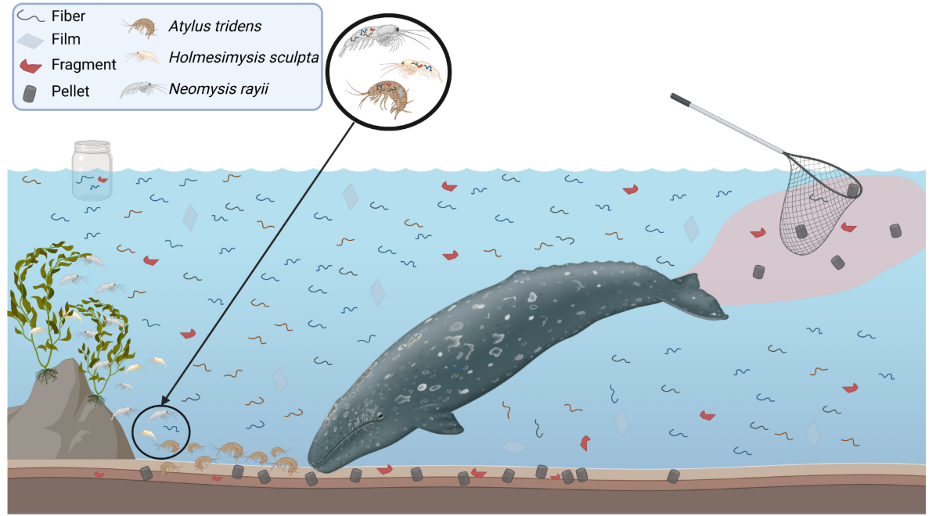
Figure taken from Torres et al. 2023 showing a schematic of a PCFG gray whale feeding in Oregon coastal waters on zooplankton (Atylus tridens, Holmesimysis sculpta, Neomysis rayii) with secondary consumption of mixed microparticles, including fiber, film, fragments, and pellet fragments of microplastic.

Questions such as these are a consistent norm throughout this internship, and I am so happy to have been given the opportunity to be a part of it. The TOPAZ/JASPER project has been my first real introduction to research, and it has been amazing so far—from net tow sampling off the kayak to observing from the cliff and even spending a few hours identifying zooplankton. Our weekly reading circle sessions have been very fun, as we each get to share ideas and questions as they arise with every new publication.  Without a doubt, this experience has been truly awesome. I’ve gotten to become immersed in the true nature of the field I want to study, as well as work with amazing people that have broadened my worldview. If I had some advice to any young inspiring marine scientists, it’s to pursue this dream with no retreat, and do all in your power to make it happen.
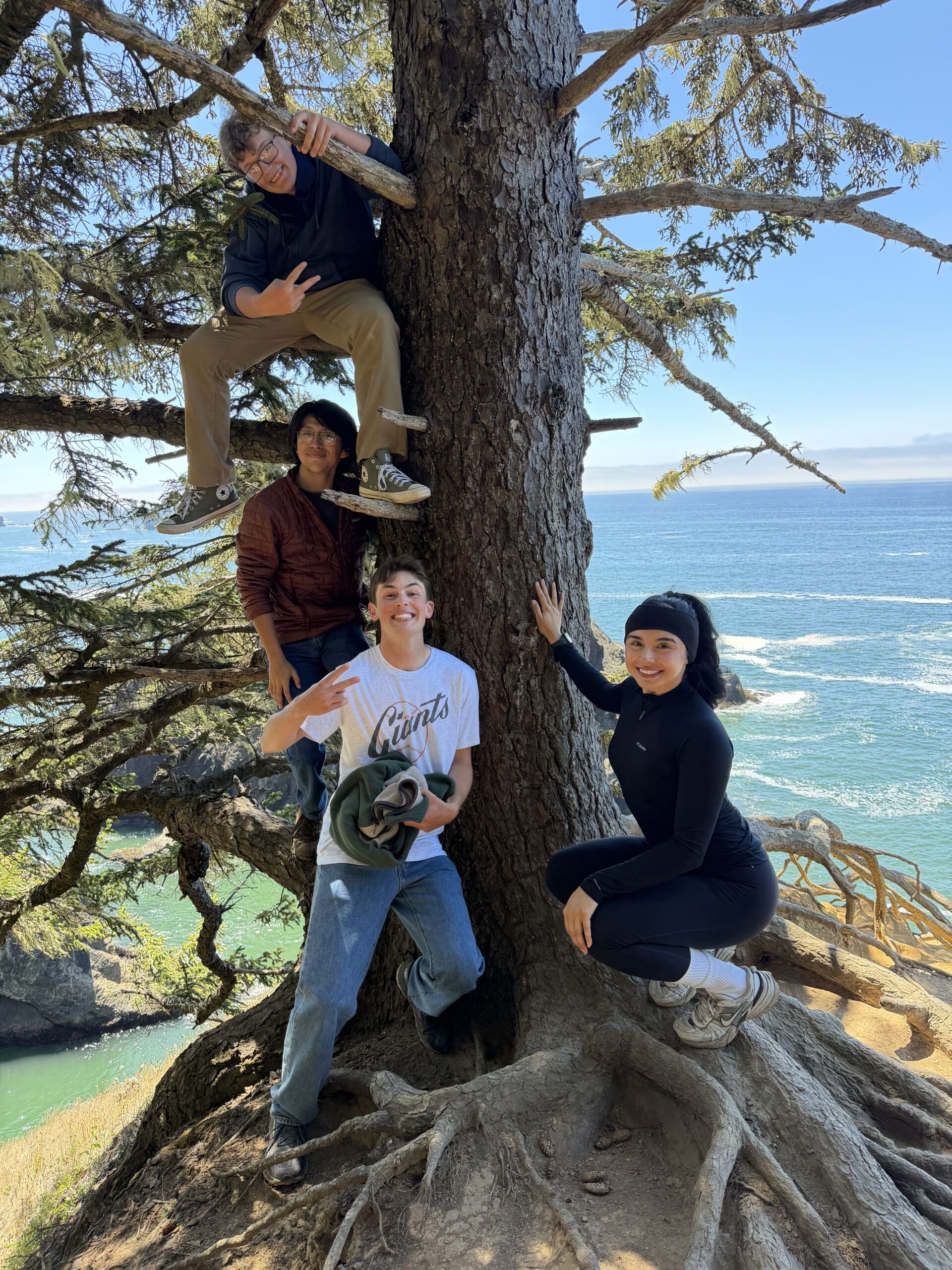
(top branch to the left) is me Gavin Vierra , (middle branch to the left) is Adrian Ruiz, (and at the bottom left) is Owen Fewell, (on the bottom right) is our team leader Celest Sorrentino.

REFERENCES

Moran, A. L., & Woods, H. A. (2012). Why might they be giants? Towards an understanding of polar gigantism. The Journal of Experimental Biology, 215(12), 1995–2002. https://doi.org/10.1242/jeb.067066

Pirotta, E., New, L., Fernandez Ajó, A., Bierlich, K. C., Bird, C. N., Buck, C. L., Hildebrand, L., Hunt, K. E., Calambokidis, J., & Torres, L. G. (2025). Body size, nutritional state and endocrine state are associated with calving probability in a long‐lived marine species. Journal of Animal Ecology, 94(7), 1422–1434. https://doi.org/10.1111/1365-2656.70068

Shishido, C. M., Woods, H. A., Lane, S. J., Toh, M. W. A., Tobalske, B. W., & Moran, A. L. (2019). Polar gigantism and the oxygen–temperature hypothesis: A test of upper thermal limits to body size in Antarctic Pycnogonids. Proceedings of the Royal Society B: Biological Sciences, 286(1900), 20190124. https://doi.org/10.1098/rspb.2019.0124

Torres, L. G., Brander, S. M., Parker, J. I., Bloom, E. M., Norman, R., Van, J. E., Lasdin, K. S., & Hildebrand, L. (2023). Zoop to poop: Assessment of microparticle loads in gray whale zooplankton prey and fecal matter reveal high daily consumption rates. Frontiers in Marine Science, 10. https://doi.org/10.3389/fmars.2023.1201078

A Summer of Crustacean Investigation

By Matoska Silva, OSU Department of Integrative Biology, CEOAS REU Program

My name is Matoska Silva, and I just finished my first year at Oregon State University studying biology with a focus in ecology. This summer will be my first experience with marine ecology, and I’m eager to dive right in. I’m super excited for the opportunity to research krill due to the huge impacts these tiny organisms have on their surrounding ecosystems. The two weeks I’ve spent in the CEOAS REU so far have been among the most fun and informative of my life, and I can’t wait to see what else the summer has in store for me.

Figure 1. Matoska presents his proposed research to the CEOAS REU program.

I’ve spent most of my life in Oregon, so I was thrilled to learn that my project would focus on krill distribution along the Oregon Coast that I know and love. More specifically, my project focuses on the Northern California Current (NCC, the current found along the Oregon Coast) and the ways that geographic distribution of krill corresponds to climatic conditions in the region. Here is a synopsis of the project:

The NCC system, which spans the west coast of North America from Cape Mendocino, California to southern British Columbia, is notable for seasonal upwelling, a process that brings cool, nutrient-rich water from the ocean depths to the surface. This process provides nutrients for a complex marine food web containing phytoplankton, zooplankton, fish, birds, and mammals (Checkley & Barth, 2009). Euphausiids, commonly known as krill, are among the most ecologically important zooplankton groups in the NCC, playing a vital role in the flow of nutrients through the food web (Evans et al., 2022). Euphausia pacifica and Thysanoessa spinifera are the predominant krill species in the NCC, with T. spinifera mainly inhabiting coastal waters and E. pacifica inhabiting a wider range offshore (Brinton, 1962). T. spinifera individuals are typically physically larger than E. pacifica and are generally a higher-energy food source for predators (Fisher et al., 2020). 

Temperature has been previously established as a major factor impacting krill abundance and distribution in the NCC (Phillips et al., 2022). Massive, ecosystem-wide changes in the NCC have been linked to extreme warming brought on by the 2014-2016 marine heatwave (Brodeur et al., 2019). Both dominant krill species have been shown to respond negatively to warming events in the NCC, with anomalous warm temperatures in 2014-2016 being linked to severe declines in E. pacifica biomass and with T. spinifera nearly disappearing from the Oregon Coast (Peterson et al., 2017). Changes in normal seasonal size variation and trends toward smaller size distributions in multiple age groups have been observed in E. pacifica in response to warming in northern California coastal waters (Robertson & Bjorkstedt, 2020). 

The El Niño-Southern Oscillation (ENSO) is a worldwide climatic pattern that has been linked to warming events and ecosystem disturbances in the California Current System (McGowan et al., 1998). El Niño events of both strong and weak intensity can result in changes in the NCC ecosystem (Fisher et al., 2015). Alterations in the typical zooplankton community accompanying warm water conditions and a decline in phytoplankton have been recorded in the NCC during weak and strong El Niño occurrences (Fisher et al., 2015). A strong El Niño event occurred in 2023 and 2024, with three-month Oceanic Niño Index means reaching above 1.90 from October 2023 to January 2024 (NOAA Climate Prediction Center, https://www.cpc.ncep.noaa.gov/data/indices/oni.ascii.txt).   

Figure 2. A graph of the ONI showing variability across two decades. Retrieved from NOAA at https://www.climate.gov/news-features/understanding-climate/climate-variability-oceanic-nino-index 

While patterns in krill responses to warming have been described from previous years,  the effects of the 2023-2024 El Niño on the spatial distribution of krill off the Oregon coast have not yet been established. As climate models have predicted that strong El Niño events may become more common due to greenhouse warming effects (Cai et al., 2014), continuing efforts to document zooplankton responses to El Niño conditions are vital for understanding how the NCC ecosystem responds to a changing climate. By investigating krill spatial distributions in April 2023, during a period of neutral ENSO conditions following a year of La Niña conditions, and April 2024, during the 2023-2024 El Niño event, we can assess how recent ENSO activity has impacted krill distributions in the NCC. In addition to broader measures of ENSO, we will examine records of localized sea surface temperatures (SST) and measurements of upwelling activity during April 2023 and 2024.

Understanding spatial distribution of krill aggregations is both ecologically and economically relevant, with implications for both marine conservation and management of commercial fisheries. Modeling patterns in the distribution of krill species and their predators has potential to inform marine management decisions to mitigate human impacts on marine mammals like whales (Rockwood et al., 2020). The data used to identify krill distribution were originally collected as part of the Marine Offshore Species Assessments to Inform Clean Energy (MOSAIC) project. The larger MOSAIC initiative centers around monitoring marine mammals and birds in areas identified for possible future development of offshore wind energy infrastructure. The findings of this study could aid in the conservation of krill consumers during the implementation of wind energy expansion projects. Changes in krill spatial distribution are also important for monitoring species that support commercial fisheries. Temperature has been shown to play a role in the overlap in distribution of NCC krill and Pacific hake (Merluccius productus), a commercially valuable fish species in Oregon waters (Phillips et al., 2023). The findings of my project could supplement existing commercial fish abundance surveys by providing ecological insights into factors driving changes in economically important fisheries.

Figure 3. The study area and transect design of the MOSAIC project, during which active acoustic data was collected (MOSAIC Project, https://mmi.oregonstate.edu/marine-mammals-offshore-wind). 

I’m very grateful for the chance to work on a project with such important implications for the future of our Oregon coast ecosystems. My project has a lot of room for additional investigation of climate variables, with limited time being the main constraint on which processes I can explore. There are also unique methodological challenges to address during the project, and I’m ready to do some experimentation to work out solutions. Wherever my project takes me, I know that I will have developed a diverse range of skills and knowledge of krill by the end of the summer.

Loading

References

Brinton, E. (1962). The distribution of Pacific euphausiids. Bulletin of the Scripps Institution of Oceanography, 8(2), 51-270. https://escholarship.org/uc/item/6db5n157 

Brodeur, R. D., Auth, T. D., & Phillips, A. J. (2019). Major shifts in pelagic micronekton and macrozooplankton community structure in an upwelling ecosystem related to an unprecedented marine heatwave. Frontiers in Marine Science, 6. https://doi.org/10.3389/fmars.2019.00212 

Cai, W., Borlace, S., Lengaigne, M., van Rensch, P., Collins, M., Vecchi, G., Timmermann, A., Santoso, A., McPhaden, M. J., Wu, L., England, M. H., Wang, G., Guilyardi, E., & Jin, F. F. (2014). Increasing frequency of extreme El Niño events due to greenhouse warming. Nature Climate Change, 4, 111–116. https://doi.org/10.1038/nclimate2100 

Checkley, D. M., & Barth, J. A. (2009). Patterns and processes in the California Current System. Progress in Oceanography, 83, 49–64. https://doi.org/10.1016/j.pocean.2009.07.028 

Evans, R., Gauthier, S., & Robinson, C. L. K. (2022). Ecological considerations for species distribution modelling of euphausiids in the Northeast Pacific Ocean. Canadian Journal of Fisheries and Aquatic Sciences, 79, 518–532. https://doi.org/10.1139/cjfas-2020-0481 

Fisher, J. L., Peterson, W. T., & Rykaczewski, R. R. (2015). The impact of El Niño events on the pelagic food chain in the northern California Current. Global Change Biology, 21, 4401–4414. https://doi.org/10.1111/gcb.13054 

Fisher, J. L., Menkel, J., Copeman, L., Shaw, C. T., Feinberg, L. R., & Peterson, W. T. (2020). Comparison of condition metrics and lipid content between Euphausia pacifica and Thysanoessa spinifera in the Northern California Current, USA. Progress in Oceanography, 188, 102417. https://doi.org/10.1016/j.pocean.2020.102417

McGowan, J. A., Cayan, D. R., & Dorman, L. M. (1998). Climate-ocean variability and ecosystem response in the Northeast Pacific. Science, 281, 210–217. https://doi.org/10.1126/science.281.5374.210 

Phillips, E. M., Chu, D., Gauthier, S., Parker-Stetter, S. L., Shelton, A. O., & Thomas, R. E. (2022). Spatiotemporal variability of Euphausiids in the California Current Ecosystem: Insights from a recently developed time series. ICES Journal of Marine Science, 79,   1312–1326. https://doi.org/10.1093/icesjms/fsac055 

Phillips, E. M., Malick, M. J., Gauthier, S., Haltuch, M. A., Hunsicker, M. E., Parker‐Stetter, S. L., & Thomas, R. E. (2023). The influence of temperature on Pacific hake co‐occurrence with euphausiids in the California Current Ecosystem. Fisheries Oceanography, 32, 267–279. https://doi.org/10.1111/fog.12628

Peterson, W. T., Fisher, J. L., Strub, P. T., Du, X., Risien, C., Peterson, J., & Shaw, C. T. (2017). The pelagic ecosystem in the Northern California Current off Oregon during the 2014–2016 warm anomalies within the context of the past 20 years. Journal of Geophysical Research: Oceans, 122(9), 7267–7290. https://doi.org/10.1002/2017jc012952 

Robertson, R. R., & Bjorkstedt, E. P. (2020). Climate-driven variability in Euphausia pacificasize distributions off Northern California. Progress in Oceanography, 188, 102412.https://doi.org/10.1016/j.pocean.2020.102412