
W22 Undergraduate of the Quarter – Sarah Gernhart
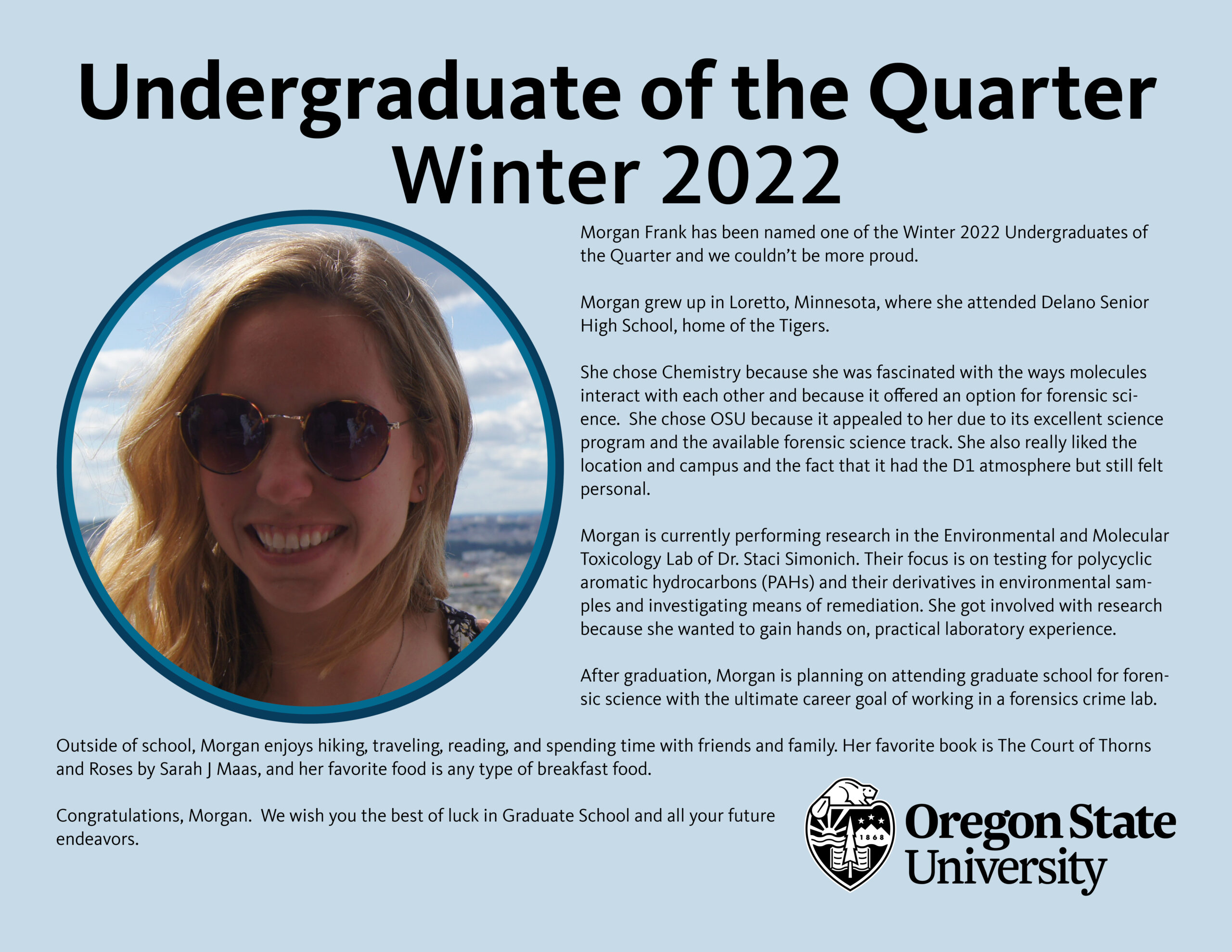
Chloe Ramsperger has been named one of the Fall 2021 Undergraduates of the Quarter, and we couldn’t be more thrilled. Chloe grew up in Redlands, California, where she attended Redlands High School, home of the Terriers.
When asked why Chloe chose Chemistry, she said, “Ever since I was young, I have had a growing passion for forensic science. Having access to television, I would constantly watch crime shows such as Crime Scene Investigation and Criminal Minds, wishing I was the investigator or the forensic scientist solving the crime. I never thought that wish could become my reality. With my growing interest in forensic science, I entered Oregon State University (OSU) as a chemistry major with an option in forensics. At the height of the Coronavirus pandemic, financial hardships forced me to take a step back from research, so I started working at a dental office. While working there, I realized how much I missed doing research and that chemistry was something that brought me joy and it was something I could always look forward to. At that moment I quickly realized the medical field is not where I wanted my career to be, leading me to believe I should be and want to pursue a Ph.D. in chemistry.

During her junior year of high school, her uncle flew her up to Oregon to visit universities in the Pacific Northwest. While visiting OSU, she fell in love with the campus, and she knew it would allow for innovation and give her the best education in comparison to other schools. Her decision was made.
She is currently doing research in Dr. Kyriakos Stylianou‘s Materials Discovery Lab (MaD Lab), which has considerable expertise in the synthesis and characterization of metal-organic frameworks (MOFs). Over the summer, Chloe received the Summer Undergraduate Research Experience (SURE) fellowship, by which she began researching numerous organic transformations that could benefit from the use of a heterogenous catalysis. While looking at the hydrocyanation for the conversion of alkenes to nitriles, she stumbled upon the Strecker synthesis for amino acids. She found a considerable amount of published research on this one-pot synthesis, but nothing seemed to involve the use of a MOF exhibiting strong Brønsted acidity that does not compromise the framework, be an environmentally friendly synthetic route, and be cost effective. While this work is still in its early steps, this preliminary work has demonstrated a successful conversion and high percent yield using a MOF with Brønsted acid sites. These preliminary results were used as the basis for the development of the project proposed for the NSF Graduate Research Fellowship Program.
Chloe was at a poster presentation session for careers in chemistry, Dr. Rich Carter asked her where she saw herself in the future, to which she answered, “a forensic odontologist”. At that point he told her about Dr. Dipankar Koley’s research group, in which they used electrochemical techniques to fabricate sensors and different polymers to study dental plaque biofilms and restorative dental materials. She immediately sought out a research position in his lab because she knew she would gain valuable experience to prepare her for graduate school and become an independent researcher and mentor.
After graduation, Chloe hopes to work in industry for the remainder of the 2021-2022 school year then move onto graduate school to pursue a Ph.D. in Organic chemistry.
Outside of school Chloe loves to rock climb, hike, play volleyball, and listen to music.
In closing, Chloe stated, “though my academic career seems to be entrenched, by copious opportunities I have received, it could not have been done without the academic support from my mentors and encouragement from my parents. My undergraduate career at Oregon State University has solidified my ambition to become an educator, mentor, and communicator to transform chemistry.”
Elias “Eli” Henderson has been named one of the Fall 2021 Undergraduates of the Quarter and we couldn’t be prouder.
Eli was born and raised in Eugene, Oregon, and graduated from South Eugene High School, home of the Axe. He stated that he likes all science, but chemistry is, “so cool with so many different applications that it seems like a good place to begin.” When asked why he chose OSU, Eli said it was mostly a financial decision. “I didn’t want to pay out of state tuition and OSU has a good science program so I knew it would be a good fit.”

Eli said he wanted to get into doing science that wasn’t in the form of the normal courses. He wanted to be able to have a goal for some project that he could study on his own time. To that end, Eli is currently researching with Marilyn Mackiewicz in the Mack Lab. The Mack Lab focuses on making metallic based nanoparticles for biomedical applications. Eli works specifically with Nickel. “I have been working on making Nickel nanoparticles that are suspended in water.
While he’s not 100% sure what his plans are post-graduation, he is currently working towards a focus in education, and contemplating getting a masters on his way to a teaching license to teach high school.
Outside school, Eli likes to rock climb and explore Corvallis. When he’s exploring, he likes to find the small stores around town and see what is going on.
His favorite book is The End of Boys by Peter Hofmeister, a book he says he’s just finished re-reading. The author was his English teach in high school, and is about the author’s life growing up in Eugene. “It feels very familiar to me,” Eli says. His favorite food is the curry at Thai Chili. He likes to go in on Fridays, saying it’s a good way to wrap up the week.
Eli says he’s really appreciative of this opportunity, and we’re so happy to be able to provide it for him.

In Prof. David Ji’s research team at OSU, students are thinking big. To find solutions to the devastating threats of climate crises requires a panoramic view of the challenges and the entire paradigm of research effort. Fortunately, Ji research team is armed with one of the most powerful tools in generating new knowledge and novel solutions for energy storage technologies: chemistry.
A PROBLEM WORTH SOLVING
Global warming, climate change, and environmental pollution represent the most significant challenges of our time. In order for the society to make the transition from fossil fuel energy resources to cleaner, more renewable sources of energy, new grid-level energy storage systems are indispensable. These new energy storage systems need to have excellent longevity as well as have high energy and power densities to enable the widespread installation of renewables as the cost-effective alternatives to the conventional, pollution-intensive sources of energy. Currently, the market-dominating battery technologies suffer from significant safety, toxicity, and resource availability issues. As such, Ji research team focuses on novel battery chemistries that incorporate abundant materials and unique electrochemical mechanisms. Student researchers in the Ji team think outside-the-box and advance the knowledge to tackle these problems in unconventional ways.
INNOVATIVE SOLUTIONS
Ji research team thrives at the edge of knowledge. “Pushing the boundaries of what is known about chemical bonding in ionic solids will lead to future groundbreaking discoveries,” says Ji. The research group has been a pioneer in the development of novel ion-storage mechanisms in solids for electrochemical energy storage since it began at OSU in 2012. They have contributed significantly to the development of new aqueous battery systems and novel electrocatalysts for fuel cells. Their studies on the electrochemical behaviors of unique charge carriers in solids and electrolytes have helped surface a roadmap toward research for next-generation storage batteries. “The overarching goal of our research is to construct a new paradigm of storage batteries,” says Ji. “We look at problems within the battery field from the perspective of a chemist and holistically design new electrochemical systems for energy storage at the level of new chemical reactions, which is beyond a typical approach of materials science.” The team is known for cutting-edge research in providing fundamentals and innovative solutions to long-standing problems.
COMMITMENT TO SERVICE
Every student who has joined the Ji research team is passionate about helping others. “A large reason we study battery chemistry is that we want to make the world a better place and are concerned about the devastating effects of climate change,” says Sean Sandstrom, a graduate student in the Ji group. The group currently consists of a postdoc, ten graduate students, including exchange students, and three undergraduate research assistants. “We hope to not only train but also to inspire the next generation of scientists to dream big and tackle grand challenges,” says Ji.

If you ask Richard Nafshun, he’ll say that one of the quickest ways to get teenagers interested in chemistry is to put on a good show. The idea was foremost on his mind when he collaborated with local middle school teachers and Oregon State graduate students to put on the “Chemistry Show,” at the LaSells Stewart Center this spring.
And when upwards of 1200 middle-schoolers and their families showed up, he was glad he had made things interesting. The senior instructor of chemistry at Oregon State is passionate about teaching and outreach.
“We had lots of fun with exploding balloons,” he says. “So you take an uninflated balloon, hook it up to the hydrogen tank, and tie it off. You have it on a string, tape a candle to a meter stick, put the candle underneath the balloon… and BOOM!”
It wasn’t the only time sparks flew during the show’s 20 demonstrations, but for Nafshun, who holds both a master’s degree in science education and a Ph.D. in inorganic chemistry from Oregon State, the spectacle is only part of the process—learning is the other.
For the past 15 years, Nafshun has dedicated himself to creating better chemistry classes for students, especially in the lecture setting. He’s pioneered online chemistry education at Oregon State, created outreach programs for K-12 students and mentored the next generation of chemistry teachers and professors.
And he has been successful, too. Not only has Nafshun won numerous teaching awards, Oregon State students regularly approach Nafshun and tell him they remember his outreach events from their grade school or middle school years. Some even come back to volunteer with programs they experienced as grade schoolers.
“That’s a real cyclic thing,” he says. “To say, ‘Wow. You were in this program, and now you’re teaching where you’ve been taught. And you’re going to be a teacher in the future.’ It makes me feel wonderful.”
A Collaborative Experience
Nafshun discovered his passion for teaching when he was a chemistry undergraduate at California State University, Stanislaus. He was one of the few students there asked to serve as a teaching assistant—a rare thing at a university with no graduate program.
“I absolutely fell in love with being a teacher,” he says.
That love was further cemented when, that summer, Nafshun took a job working for a group that did cholesterol testing in eggs and dairy products. Although he saw value in the work, he wanted to be a part of something more collaborative.
“While the chance for development and research was there, it seemed very independent and isolated,” Nafshun says. “It didn’t seem as though I was going to be part of an institutional process to make something happen.”
Bringing passion to a profession
Now, Nafshun focuses his research on instructional methods for the large classroom, and teaches general chemistry. Many of the lessons he creates for the lecture hall reflect what he loved about chemistry as a high school student—group projects that rely on teamwork and exploration rather than rote memorization.
“It was all that time after school meeting with fellow students, and accomplishing a project and doing scholarship that I found fabulous,” he says.
Nafshun also mentors students in CH 607, his college chemistry-teaching seminar. He wants them to have the experience of engaging students in the lecture setting as well.
“We develop curriculum and labs. And then the beautiful part about it is these graduate students take over the class from one week,” Nafshun says. “So they work on a unit. They prepare. We talk about what demonstrations to do, teaching methods, everything.”
Since 1997 Nafshun has mentored nearly 20 students in the seminar setting—some of whom have gone on to use some of the methods Nafshun taught them at institutions like Evergreen, The Ohio State University, the University of Portland and Seattle Pacific, to name a few.
“I hope they’re bringing engaging instructional techniques, doing good student questioning and application-based instruction,” he says. “I hope that they’re focusing on students working in small groups. I honestly think there’s a balance in the lecture hall.”
A Home for Science
Nafshun’s input into the classroom experience isn’t the only thing that works for his students—the new Linus Pauling Science Center, which was completed in 2011, does as well. There are only seats for 178 students in the building’s lecture hall, which helps facilitate the application of some of Nafshun’s lecture content in introductory chemistry classes.
And because some of the Center’s cutting-edge research facilities like the electron microscopy lab and the nuclear magnetic resonance facility are on the main floor and encased in glass, students get a more immediate and exciting view of research in the moment.
“This year they’re coming out of the woodwork and asking about undergraduate research opportunities,” Nafshun says. “You walk down the hall and see fundamental research, stuff that matters today. Students see it, too.”
Access for Everyone
One of Nafshun’s more recent projects has been collaborating with colleagues in chemistry and computer science to develop a curriculum of general chemistry labs that are delivered online. They are currently being used in Oregon State’s Ecampus chemistry program, and Nafshun hopes that other universities might use the curriculum, too.
For Nafshun, online labs are the way of the future, and online education is a way for people to have access to education who wouldn’t otherwise, like deployed military personnel and people living in rural areas.
“I started the Ecampus chemistry program nine years ago, and saw the enrollment in the online program go from two students to 600 a term,” he says.
As for the next Chemistry Show, Nafshun is trying to figure out if there’s a venue in Corvallis that will hold an even bigger crowd.

Popular Mechanics’ prediction took considerably more than 10 years to come true, but today’s flat-panel screens have gone well beyond that early vision. Some of them are nearly as big as a living room wall. They bring us unimaginably sharp detail, from the spots on butterfly wings to the grimace on a linebacker’s face.
This technology — whether hooked up to your cable feed, DVD player, wi-fi or computer — is also becoming integral to daily life. It increasingly provides the platforms on which we shop, share photos, read books, keep up with friends, play games, manage finances and work. In 2011, the global flat-panel screen industry shipped more than $120 billion worth of products, enough to cover nearly 16,000 football fields.
However, our love of flashy high-res has a dark side. Manufacturing the semiconductors behind these electronic systems produces waste, lots of it. “The electronics and solar industries build devices where the materials input is very high relative to what ends up in the product. There’s tremendous amounts of waste and very high energy input,” says Doug Keszler, Oregon State University chemist.
Keszler and a team of scientists and engineers at Oregon State and the University of Oregon are leading a national consortium bent on greening the flat-panel display industry. In their future, windows, mirrors, walls and counters could display messages and harvest solar energy. “We’re trying to turn this industry into a truly zero-waste proposition while improving performance,” says Keszler, a principal scientist in the Center for Sustainable Materials Chemistry (CSMC). “We’d like to do electronics the size of a wall. The question is: How do you do that efficiently without producing even more waste?”
Startups Provide Jobs
The CSMC has already produced significant results: a metal-insulator-metal diode (a kind of electronic switch) that outperforms the fastest silicon-based semiconductors; water-based manufacturing techniques that reduce waste and improve productivity; high-resolution fabrication processes that forge thinner electronic components. With research roots going back more than a decade at OSU and UO, the center has spun off two startup companies, generated more than a dozen U.S. patents and developed an educational partnership to inspire more Oregon high school students to attend college. It also helps graduates to create their own careers. In cooperation with the National Collegiate Inventors and Innovators Alliance, CSMC students join business leaders in the chemical and electronics industries to identify commercial opportunities stemming from research.
“About two-thirds of all Ph.D. graduates in the physical sciences now find their first job in a startup company,” says Keszler. “There is very little education to prepare students for that career path. We train them to recognize market value in their research, so they can work effectively with entrepreneurs and business development people.”
Two startups have already hired the center’s graduates. Amorphyx (www.amorphyx.com) is commercializing a new electronics manufacturing process that limits the production of unwanted industrial byproducts. Moreover, it trims a six-part process to two steps, offering the possibility of tripling production capacity in an existing facility.
In collaboration with another spinoff, Inpria (www.inpria.com), the center has broken a barrier in high-resolution circuitry, going below the 20-nanometer scale and enabling computer chips to accommodate more functions at higher speeds.
These achievements reflect gains reported by Oregon State engineer John Wager, physicist Janet Tate, graduate student Randy Hoffman and other researchers as early as 2003. They noted that transparent thin-film transistors made of zinc oxide could lead to new kinds of liquid-crystal displays, the dominant type of flat-panel screen. In 2006, HP licensed the technology and has been developing applications in collaboration with OSU.
At UO in 2003, researchers in Darren Johnson’s chemistry lab discovered a solution-based process for making nanoclusters, leading to the possibility that new semiconductors could be made without hazardous chemicals. Jason Gatlin, the UO graduate student who discovered the process, instigated a new UO-OSU collaboration when he shared his findings at a conference sponsored by the Oregon Nanoscience and Microtechnologies Institute.
“We’re pushing the boundaries of science and seeing things no one has ever seen before,” says Keszler. “There’s a lot of joy in the intellectual exchanges in such a diverse group.”
To attract more young scientists to their journey, CSMC students will begin working with Hermiston High School teacher Lisa Frye and her chemistry classes this fall. They will provide support, advanced instruction and resources to inspire high-school students to consider careers in science.
“What we’re after over the next 10 years,” says Keszler, “is to put the (industrial) ecosystem together that allows you to print electronics on flexible glass. They will be high performance, durable, and include applications such as solar collectors.”
We’ve come a long way from the futuristic idea of hanging TV screens like paintings on the walls of our homes.
When Sam Bartlett, an Oregon State University senior in chemistry, put on his lab coat, goggles and latex gloves in the summer of 2010, he didn’t expect to wind up helping organic chemists around the world.

With guidance from Chris Beaudry, assistant professor of chemistry, he developed the most efficient and productive method yet reported for a fundamental step commonly used to synthesize new molecules.
Bartlett and Beaudry published their findings in October in the Journal of Organic Chemistry. The research has already drawn the attention of pharmaceutical scientists and has potential in fields from nanotechnology to biochemistry.
“If you’re a synthetic chemist and you want to build complicated molecular architectures – a pharmaceutical, a new material for nanotechnology, a new probe for a biological system – you need to make new chemical bonds,” Beaudry said. “This oxidation is convenient to do, very mild, operationally simple and high yielding. It is the solution to this problem.”
Bartlett’s discovery started with a chance meeting. The student from Corvallis, Oregon, was taking an advanced chemistry course from Beaudry and happened to meet the professor in the Interzone, an off-campus coffee shop. “I asked him if he had any research opportunities in his lab,” Bartlett said.
“I suggested that Sam look into this problem,” Beaudry recalled. “There was some indication that we had a lead hit on how to solve it. Sam took it and ran with it.”
The problem was to convert one commonly used compound (beta-hydroxyketone) to another (beta-diketone). Both are fundamental starting points in the synthesis of more complex organic molecules. Previous methods produced unwanted byproducts and only 30 to 35 percent of the desirable molecule, says Beaudry.
Bartlett found that an oxidant called IBX (o-iodoxybenzoic acid) converts nearly 100 percent of the beta-hydroxyketone to the beta-diketone, thus saving chemists time – and simplifying the synthesis process.
Bartlett, who graduated from Crescent Valley High School, is applying for graduate school, where he intends to focus on synthetic organic chemistry.
“I just like the search for new knowledge,” said Bartlett. “There’s a lot we still don’t know. There are problems out there we still need to solve. Even if I don’t find a solution, I’m contributing to the scientific community.”
Bartlett had support for his research from two programs: the Undergraduate Research, Innovation, Scholarship & Creativity program sponsored by the OSU Research Office, and a Howard Hughes Medical Institute fellowship. He is continuing to work in Beaudry’s lab in the new Linus Pauling Science Center on steps to make a natural plant compound that has potential anti-fungal and anti-inflammatory properties.