Cultures of collaboration in forest management

Meredith Jacobson is a Master’s student in the Forest, Ecosystems and Society Department of OSU’s College of Forestry who studies collaborative partnerships in forest management. She describes her thesis work here at Oregon State as a qualitative case study on the concept of “Anchor Forests”, an idea developed by the Intertribal Timber Council that would involve creating large regions of forest management and stewardship, collaborating across ownership boundaries. Within this brief statement, there’s a lot to unpack.

Early in her undergraduate experience in forestry at UC Berkeley, Meredith became interested in how to engage communities in managing their natural resources. After working a few seasons in the field, she wanted to find a way to combine her interest in social justice with her love of forests. So she came to OSU to study collaborative forest governance. As she gained exposure to this field under the guidance of her advisors Dr. Reem Hajjar and Dr. Emily Jane Davis, she soon learned that a lot of work needs to be done to make collaboration more effective, equitable, and just. She also found that most models of forest collaboration are not doing a good job engaging with Native communities, the original stewards of the land. 

Backpacking through the Plumas National Forest, one of the first places where Meredith first learned about wildfire-adapted landscapes.

Meredith then learned about the Intertribal Timber Council’s vision for Anchor Forests, which proposes that Tribes are uniquely positioned to be leaders and conveners of cross-boundary forest management. Core to the Anchor Forest concept is a need to generate long-term commitments on the part of many landowners to actively manage land, in order to sustain investments for infrastructure like sawmills while creating healthy and wildfire-resilient landscapes. Early in her time at OSU, Meredith had the opportunity to speak with leaders involved in developing the Anchor Forest concept, who expressed to her that while Anchor Forests have not been fully implemented on the ground, the vision holds a lot of potential. From these conversations, she developed a project intended to document why this idea emerged, what it could be used for in the future, and how we might learn from it.

The Intertribal Timber Council released an Executive Summary of the Anchor Forest Pilot Project in 2016, which studied a group of pilot communities in central and eastern Washington. Around this time, a couple journal articles were published and Evergreen Magazine released a video series about Anchor Forests. Meredith hopes that her work can generate more conversation at OSU and in the field of collaborative forest governance about the potential of this concept and vision.

Diving into this topic, Meredith has found it to be more complicated than meets the eye. There are logistical, institutional, and social barriers to making an idea like this work. Her data collection has included interviewing those involved in developing the Anchor Forest concept, analyzing published documents and reports, and looking at online media coverage of Tribal forest policies and laws that could enable the cross-boundary work needed to make Anchor Forests happen. Through her analysis, she wants to understand what is unique about this concept and what barriers need to be overcome to realize its potential. She’s also looking at what types of narratives or stories are used to portray Tribes as effective leaders and land stewards.

Meredith says that one of the most interesting things she’s learned so far is that among the ten people she’s talked to, there has not been one unified perspective on what makes the Anchor Forest idea unique and what hope it holds for the future. 

“I think that this reflects how this idea takes different shapes and meanings depending on the local context where it would be implemented. With a concept as broad as this, it’s important to remember that every community has its own distinct history, ecology, and economy. And every Tribe is unique in their culture, values, needs, and interests, but non-Native folks tend to overlook that. ”

The property line between federal and private forests in the northern Sierra Nevada highlights differences in post-fire management approaches, and the challenges of working across ownership boundaries.

Perhaps this is why the concept itself is so difficult to define. However, one common theme emerging from land managers across the West: that shifting leadership and power to Tribes could be a critical part of the solution to increasingly urgent challenges like wildfire affecting forests on a landscape scale.

Meredith presents her findings to the Intertribal Timber Council on Tuesday. To hear more about her journey to grad school and how she is navigating her own identity as a non-native person engaging in indigenous partner research, tune in on Sunday, December 1st at 7 PM on KBVR Corvallis 88.7 FM or stream live

Putting years and years of established theory to the test

A lot of the concepts that scientists use to justify why things are the way they are, are devised solely based on theory. Some theoretical concepts have been established for so long that they are simply accepted without being scrutinized very often. The umbrella species concept is one such example as it is a theoretical approach to doing conservation and although in theory it is thought to be an effective strategy for conserving ecosystems, it is actually very rarely empirically tested. Enter Alan Harrington, who is going to test its validity empirically.

Alan is a 2nd year Master’s student in the Department of Animal and Rangeland Sciences working with Dr. Jonathan Dinkins. Alan’s research and fieldwork focuses on three species of sagebrush- steppe habitat (SBSH) obligate songbirds: the Brewer’s sparrow, sagebrush sparrow, and sage thrasher. Being a SBSH obligate means that these three birds require sagebrush to fulfill a stage of their life-history needs, namely during their breeding season. However, by studying these three species, Alan is aiming to tackle a broad conservation shortcut as he is trying to figure out whether the umbrella species conservation approach has worked in the SBSH where conservation is guided by the biology of the greater sage-grouse (GSG), which has been termed an umbrella species for sagebrush habitat for many years.

An umbrella species, a close cousin to keystone or an indicator species, is a plant or animal used to represent other species or aspects of the environment to achieve conservation objectives. The GSG is such a species for the SBSH. However, the SBSH is an expansive habitat found across 11 western US states and two Canadian province that covers several millions acres of land. Hence, the question of whether one species alone can be used to manage this large habitat is a valid one. Furthermore, SBSH has been declining dramatically over the last decades. In fact, it is one of the fastest declining habitats in North America. This decrease in available sagebrush habitat has led to the decline in GSG populations since European settlement and the GSG requires SBSH to fulfill its life-history needs. Thus, populations of other birds that require the SBSH have been declining too, like sagebrush-obligate songbirds.

Alan using binoculars to survey for songbirds to determine their abundances.

The state of Oregon, like many other western US states, are concerned about protecting SBSH and GSG because they are both quickly declining and songbirds are extremely sensitive to changes in the environment responding quickly to them. Within the last 10 years, the GSG was petitioned to be listed under the Endangered Species Act by several expert groups due to the severity of the decline. Both times, the petitions were designated warranted however were precluded from listing. This issue of declining SBSH and declining GSG populations is made more complicated by the fact that most SBSH also doubles as rangeland for grazing cattle or SBSH is often used for agriculture. Thus, the petitioning for trying to get the GSG listed as endangered caused stakeholders in Oregon to get involved in this situation since the listing of the GSG as endangered could result in very radical management changes for the SBSH, limiting agricultural and land use of this habitat.

Map of Alan’s study area.

As you can see, the topic is not a simple, straightforward one, however Alan is already two years into getting the data to answer some of his questions. Alan’s fieldwork takes place in eastern Oregon in a study area that is 1.4 million acres big. Naturally, he doesn’t survey every single foot of that massive area. Instead he and his lab mates (three of them work together during the field season to collect data for all of their projects) have 147 random point locations, which are located within five Priority Areas of Conservation (PAC), designated by the Oregon Department of Fish & Wildlife as core conservation areas based on high densities of breeding GSG. The field season is from May to July and Alan often puts in 80-hour work weeks to get the job done. For his data collection, Alan does random nest transect surveys at each of the 147 locations for the three sagebrush obligate songbird species, as well as collecting abundance data on any songbird he sees at each random point location. These two methods are also done for GSG UTM locations so that Alan can compare data between them and the songbirds. On top of this, Alan received a grant from the Oregon Wildlife Foundation to purchase iButton temperature loggers to deploy into songbird nests. Along with trail cameras, these will help Alan identify events indicative of nest success or nest failure.

Alan will start his first round of analyses this winter and he’s looking forward to digging into the data that he and his lab mates have worked hard to collect. Ultimately, Alan hopes that his research will make a difference, not just for the sagebrush steppe habitat, his three songbird species, or the greater sage-grouse, but also within other ecosystems. The umbrella species concept is used in all aspects of ecology and so hopefully his findings will be applicable beyond his field of study. 

To hear more about Alan’s research and also about his journey to OSU and more on his personal background, tune in on Sunday, November 24 at 7 PM on KBVR Corvallis 88.7 FM or stream live

If you can’t wait until then, follow Alan’s lab on Twitter!

Also, check out this recent publication that Alan played a big role in devising and writing while he was at the University of Montana in the Avian Science Center. The project tested auditory survey methodologies and how methodology can help reduce survey issues like misidentification and double counting of bird calls/signals. 

Finding the Tipping Point

Sustainable Fishing – A Case Study of Cooperation

We are really good at catching fishing. While the number of fish being commercially caught is ranges from 4-55%, the fact-of-the-matter is that overfishing is an issue in need of attention. The answer isn’t simply that less fishing needs to occur, it is much more nuanced than that – Is there a way to have more fish and seafood, provide jobs for those in the fishing industry, and make the oceans healthier? Sustainable fishing practices seek to manage this issue, but how are those practices informed? Responsible resource management is just one example of how not cooperating (overfishing) will deplete our resources. What do we know about cooperation? Can we quantify the tipping point?

Cheaters Never Prosper, Or Do They?

This week’s guest, Bryan Lynn, a second-year PhD student co-advised by Dr. Patrick De Leenheer in the Department of Integrative Biology and Martin Schuster in Microbiology studies the evolution of cooperation. To do this, Bryan scales his work way down to microorganism level. Evolutionary theory has been largely based on the Darwinian premise of the survival of the fittest, but Bryan’s research is challenging this – not cooperating makes you more fit as an individual, but is that best for the group as a whole? 

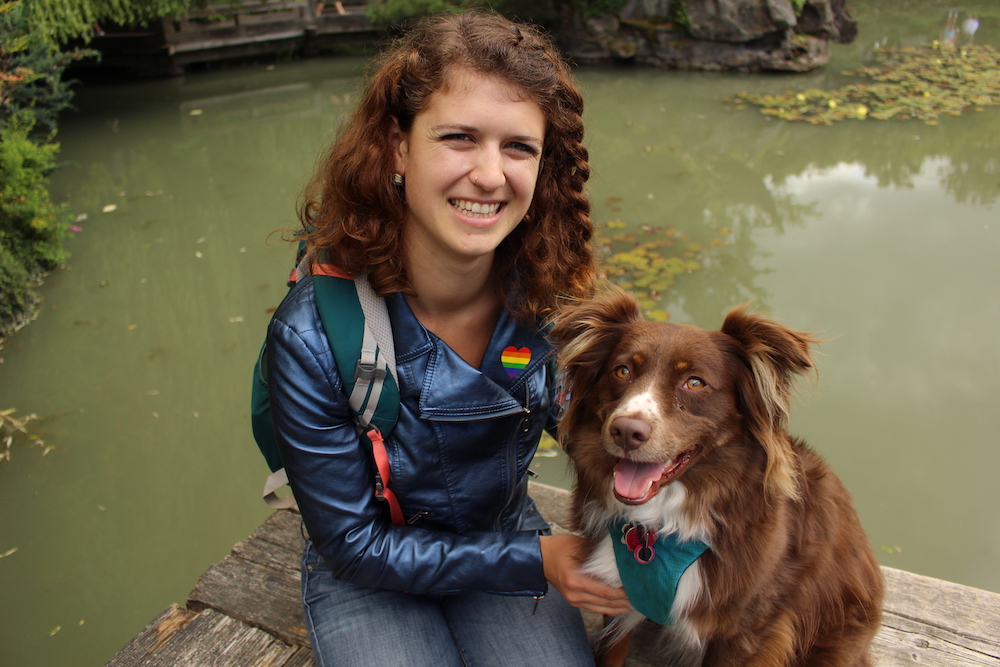
Bryan’s queer and trans identities inspires him to engage in both LGBT+ outreach and taking selfies with signs that have the word “gay” in them.

Using the bacteria Psuedomonas aeruginosa as a model organism, Bryan is able to manipulate the behavior of the bacteria and study what happens in a chemostat system – a device which allows the bacteria to grow continuously with a constant input of a food source and output of the mixed solution – making it an excellent metaphor for life.  When there are finite resources available, questions can be asked about how the bacteria cooperate with each other in different scenarios. For example, Bryan mutates some of the bacteria to be so-called “cheaters,” as they do not make an enzyme and thus do not expend energy but reap all the benefits as the non-cheater bacteria. Using mathematical models, Bryan is able to simulate different conditions and put a number to the tipping point where the community is no longer able to persist in a steady state. 

The Path to Math

Bryan spent many years as a Le Cordon Bleu-trained pastry chef before deciding he wanted to change careers and find something with better pay and benefits. Bryan returned to community college in Minnesota and started taking math courses, as they were a relevant start to any STEM field should he decide to switch majors, but he never did. Bryan eventually transitioned to the University of Massachusetts in Boston where he earned his bachelor’s degree in math.

As an undergraduate Bryan took courses in evolutionary game theory, which allowed him to find a way to bridge math theory to a real-world application. During his time in Boston, Bryan also had the opportunity to intern at the MIT Bates Radiation Facility to study proton lasers used for cancer treatments, as well as complete an Oracle Fellowship where he began a research project investigating the evolution of cooperation through ostracism. This research opened up Bryan to world of math biology, which ultimately led him to pursue a PhD at Oregon State. After graduate school Bryan hopes to continue research in academia and provide representation for the LGBT+ in STEM fields. 

Join us on Sunday, November 17 at 7 PM on KBVR Corvallis 88.7 FM or stream live to learn more about Bryan’s math biology research, non-traditional journey to graduate school, and LGBT+ activism. 

To learn more about Bryan’s research, check out his publication:

https://www.sciencedirect.com/science/article/abs/pii/S0025556419303785?

You don’t look your age: pruning young forests to mimic old-growth forest

“I’m always looking at the age of the forest, looking for fish, assessing the light levels. Once you’ve studied it, you can’t ignore it.” Allison Swartz, a PhD student in the Forest Ecosystems and Society program in the College of Forestry at Oregon State, is in the midst of a multi-year study on forest stream ecosystems. “My work focuses on canopy structure—how the forest age and structure influences life in streams,” says Allison. “People are always shocked at how many organisms live in such a small section of stream. So much life in there, but you don’t realize it when you’re walking nearby on the trail.”

Three scientists holding large nets stand in a rocky forest stream. One wears a backpack with cable coming out of it.
No, that’s not a Ghostbuster backpack! Here, Allison is using an electrofishing device that stuns fish just long enough for them to be scooped up, measured, and released. From left to right: Allison Swartz, Cedar Mackaness, Alvaro Cortes. Photo credit: Dana Warren

Following a timber harvest, there is a big increase in the amount of light reaching the forest floor. The increase in light also results in an increase in stream temperatures. Fish such as salmon and trout, which prefer cold water, are very sensitive to temperature changes. Since these fish are commercially and recreationally important, Oregon’s water quality regulations include strict requirements for maintaining stream temperatures. As a result, buffer areas of uncut forest are left around streams during timber harvests. These buffer areas, like much of the forests in the Pacific Northwest, and in the United States in general, can be characterized as being in a state of regeneration. Dense, regenerating stands of trees from 20-90 years old, are sometimes called second-growth forest. These forests tend to let less light through than an old growth forest does. Allison’s work focuses on how life in streams responds to differences in forest growth stage.

A Pacific giant salamander – a top-level stream predator and common resident of Oregon’s forest streams. Photo credit Allison Swartz.

The definition of the term old-growth forest depends on which expert you ask, and there is even less agreement on the concept of second-growth forest. Nevertheless, broadly speaking an old-growth forest has a wide range of tree species, ages, and sizes, including both living and dead trees, and a complex canopy structure. Openings in the canopy from fallen trees allow a greater variety of plant species to be established, some of which can only take root under gaps in the canopy but which can persist after the gap in the canopy is filled with new trees. The tightly-packed canopy limits the amount of light that can reach the forest floor, including the surface of the streams that Allison studies.

Forest stream near Yellowbottom Recreation Area, Oregon. Credit: Daniel Watkins

Allison’s research project is focused on six streams in the MacKenzie river basin, which includes private land owned by the Weyerhaeuser company, parts of the Willamette National Forest, and federal land. At some of these sites, after an initial survey, gaps were cut into the forest canopy to mimic light availability in an old growth forest. Sites with cut canopies were paired with uncut areas along the same stream. The daily ebb-and-flow of aquatic species is monitored by measuring the oxygen content of the water. The aquatic and terrestrial ecosystems have mainly been studied separately, she explained, but the linkages between these systems are complex. Measurements of vertebrate species are carried out using electrofishing techniques. “We do vertebrate surveys which infludes a few species of fish and Pacific giant salamanders. We measure and weight them and then return them to the stream,” Allison explained.

Measuring cutthroat trout. Photo credit Allison Swartz.

Over the last few years, Allison has spent three months of the summer living and working at one of her research sites, the HJ Andrews Experimental Forest. “We didn’t have much in terms of internet the first few years, so you connect with people and with the environment more,” Allison said. 

Allison never expected to be in a college of forestry. Her background is in hydrology, and she spent some time working for the United States Geological Survey before beginning graduate work. She has enjoyed being part of a research area with such direct policy and management impacts. “We all use wood, all the time, for everything. So we can’t deny that we need this as a resource,” says Allison. “It’s great that we’re looking at ways to manage this the best we can—to make a balance for everybody.”

Allison’s Apple Podcast Link

Tsunami Surfing and the Giant Snot

Sam Harry’s research is filled with bizarre scientific instruments and massive contraptions in an effort to bring large natural events into the laboratory setting. 

Sam Harry, second year PhD candidate in Civil Engineering

“There’s only a couple like it in the world, so it’s pretty unique”. Unique may be an understatement when describing what may be the largest centrifuge in North America. A centrifuge is a machine with a rapidly rotating container that can spin at unfathomable speeds and in doing so applies centrifugal force (sort of like gravitational force) to whatever is inside. This massive scientific instrument– with a diameter of roughly 18 feet– was centerpiece to Sam’s Master’s work studying how tsunamis affect boulder transport, and the project drew him in to continue studying the impact of tsunamis on rivers for his PhD. 

But before we jump ahead, let’s talk about what a giant centrifuge has to do with tsunamis. Scientists studying tsunamis are faced with the challenge of scale; laboratory simulations of tsunamis in traditional water-wave-tank facilities are often difficult and inaccurate because of the sheer size and power of real tsunamis. By conducting experiments within the centrifuge, Sam and his research group were able to control body force within the centrifuge environment and thus reduce the mismatch in fluid flow conditions between the simulated experiment and real-life tsunamis. 

When tsunamis occur they cause significant damage to coastal infrastructure and the surrounding natural environment. Tsunamis hit the coast with a force that can move large boulders– so large, in fact, that they aren’t moved any other way. Researchers can actually date back to when a boulder moved by analysing the surrounding sediments, and thus, can back calculate how long ago that particular tsunami hit. However, studying the movement of massive boulders, like tsunamis, is not easily carried out in the lab. So, Sam used a wave maker within, of course, the massive centrifuge to study the movement of boulders when they are hit with some big waves. 

Sam’s work space. The Green dye added to the water within the glass tank is what gives this tank it’s name: The Giant Snot

As Sam was completing his Master’s an opportunity opened up for him to continue the work that he loves through a PhD program in civil engineering with OSU’s wave lab. Now Sam conducts his research using the “glass tank”, which, as the name alludes to, is a glass tank roughly the size of a commercial kitty pool that is used to contain the water and artificial waves the lab generates for their research. There are actually three glass tanks of varying sizes. The largest tank, which is larger than a football field, is used for more “practical applications”. Sam gives us the example of a recent study in which researchers built artificial sand dunes inside of the tank, let vegetation establish, and then hit the dunes with waves to study how tsunamis impact that environment. (Legend has it that the largest tank was actually surfed in by one of the researchers!)

Sam’s smaller glass tank, though, is really meant for making precision measurements to better study waves. He uses lasers to measure flow velocity and depth of water to build mathematically difficult, complex models. Essentially, his models are intended to be the benchmarks for numerical simulations. Sam, now into his second year of his PhD, will be using these models in his research to study the interaction between tsunamis and rivers, with the goal of understanding the movement and impact of tsunamis as they propagate upstream.

To learn more about tsunamis, boulders, rivers, and all of the interesting methods Sam’s lab uses to study waves, tune into KBVR 88.7 FM on Sunday, November 3rd at 7pm or live stream the show at http://www.orangemedianetwork.com/kbvr_fm/. If you can’t join us live, download the episode from the “Inspiration Dissemination” podcast on iTunes!

Over sixty years digging and we’re still finding new ‘dirt’ on HJ Andrews

One kilometer. Or roughly ten football fields. That’s the extent of the area over which Karla Jarecke, a Ph.D. candidate in the College of Forestry’s Department of Forest, Ecosystems & Society can feasibly navigate her way through the trail-less HJ Andrews Experimental forest to collect the data she needs in a typical day of field work. Imagining a football field is perhaps not the best way to appreciate this feat, nor envision the complex topography that makes up this coniferous forest on the western flanks of the Cascade mountains, roughly 50 miles East of Eugene. But these characteristics are precisely what have made this forest valuable to scientists since 1948 and continue to make it the ideal place for Karla’s research.

Experimental watersheds like the HJ Andrews forest were established initially to understand how clear-cutting influenced forest drainage and other ecosystem processes such as regrowth of plants and change in nutrients in soils and streams. This was during the time when timber-take was increasing and we still had little understanding of its ecosystem effects. Karla’s work is also forward-thinking, but less on the lines of what will happen to drainage when trees are removed and more focused on understanding the availability of water for trees to use now and in the future. She wants to know what influence topography has on plant water availability in mountainous landscapes.

Meter deep soil pits at Karla’s field site.

Back to bushwhacking. The answer to Karla’s research question lies beneath the uneven forest floor. Specifically, in the soil. Soil is the stuff made up of weathered rock, decomposing organic material and lots of life but it is also the medium through which much of the water within a forest drainage moves. Across her study area, Karla has 54 sites where she collects data from sensors that measure soil moisture at two different depths. These steel rods send electrical currents into the ground, which depending on how quickly they travel can tell her how much water is present in the soil. She also keeps track of sensors that measure atmospheric conditions, like temperature and air humidity. This information builds on the incredible sixty-year data set that has been collected on soil moisture within HJ Andrews, but with a new perspective.

Digging soil pits on steep slopes occasionally required stacking logs at the base of a tarp to prevent the soil from sliding down the hill.
Photo credit: Lina DiGregorio

Karla explains that there have been long-standing assumptions surrounding elevation gradients and their control on water availability in a forest system. This understanding has led to modeling tools currently used to extrapolate soil moisture across a landscape. But so far, her data show huge variability on surprisingly small scales that cannot be explained by gradient alone. This indicates that there are other controls on the spatial availability of soil moisture in such mountainous terrain.

“We’re finding that model doesn’t work really well in places where soil properties are complicated and topography is variable. And that’s just the first part of my research.”

The next phase of Karla’s work seeks to evaluate tree stress in the forest and determine if there are any connections between this and the variability she is finding in soil moisture across spatial scales. True to the complex nature of the landscape, this work is complicated! But to Karla, it’s important. Growing up in the mid-west, Karla came to know water as “green” and when she moved West, first to fulfill an internship in Colorado and then to pursue her graduate work here in the Pacific Northwest, she was (and still is) amazed by the abundance of clean, clear rivers and streams. And it’s something she doesn’t ever want to take for granted.

Karla and her sister Stephani snowshoeing on Tumalo Mountain in the Cascade Range of central Oregon.

To find out more about Karla’s research and her journey from farming in Italy to studying soil, tune in on Sunday, October 27th at 7 PM on KBVR 88.7 FM, live stream the show at http://www.orangemedianetwork.com/kbvr_fm/, or download our podcast on iTunes.

Karla’s episode on Apple Podcasts

Monkeying around in the lab to find a good egg

In vitro fertilization (IVF) treatment is a procedure in which a woman’s mature eggs are removed via surgery, combined with sperm in a petri dish in a lab, and then the fertilized egg is placed in the uterus to continue growing into an embryo. Unfortunately, IVF is not covered by all insurance companies and is successful less than 50% of the time. Consequently, undergoing IVF can be a significant burden financially, physically, and emotionally for those who seek out this procedure.

What makes a “good” fertilizable egg? In this week’s special episode, we’re joined by Sweta Ravisankar, a 5th year PhD candidate in the Cell and Developmental Biology program at OHSU (Oregon Health & Science University), who is trying to answer this question in hopes that being able to screen for the “more likely to succeed” eggs, will lower the economic, financial, and physical hurtles of IVF.

Sweta works at the at Oregon National Primate Research Center, OHSU within the division of Reproductive and Developmental Sciences OHSU. She is a graduate student mentored jointly by Dr Shawn Chavez and Dr. Jon D. Hennebold.

The Hennebold lab studies reproduction before the egg is fertilized. This stage involves studying the female reproductive system, the oocyte (egg) itself, and the development of the follicle (region that holds the immature eggs) before ovulation (dropping of immature egg into the ovary). In contrast, the Chavez lab looks at what happens after fertilization such as chromosome abnormalities and how these abnormalities effect embryo development. This joint mentorship allows Sweta to study a more complete story of development.

Screenshot from a video of development from 1C stage to a blastocyst stage. Complex human being development can be traced back to these 120-150 cells implanting in the uterus.
Sweta is always excited to share her science!

Looking at reproduction from these two perspectives allows Sweta to correlate the environment the egg exists in with how the embryo develops. For example, what is the impact of a western style diet (high in fat) on the biochemistry and development of follicles and embryos long term? How does polycystic ovarian morphology (POM) mimicked by prolonged exposure to high fat diet and high testosterone levels in females impact reproductive success at the biomolecular level?

Will work when needed: in the lab on a weekend with a cast on my foot (visible on the left leg).

Being at the Oregon National Primate Center, Sweta’s model organism is the “Rhesus macaque” monkey. These monkeys have a genome ~97.5% similar to humans, meaning that the work she does is very relevant and translatable to humans. Working with the monkeys also means that her research is variable depending on the day. The monkeys will sometimes undergo treatments similar to those done in human IVF (in vitro fertilization) clinics, including surgeries to collect eggs for further research. After harvesting these eggs, they can be fertilized and the cells’ growth, division, and development can be monitored in a plate. When these experiments are not taking place, Sweta conducts various molecular biology experiments.

Sweta has become a true Pacific northwestener: hiking in rain with her husband through the Washington Park, Portland, OR. 


In India, Sweta completed her Bachelor’s degree at Dr. D. Y. Patil university in biotechnology and her first Master’s at SRM Institute of Science and Technology. During this time, Sweta happened to have several of family and friends undergoing IVF treatments and also worked in a fertility clinic for a time, bringing her attention to scientific needs within this field. Sweta then completed a second Master’s in Biological Sciences with a fellowship from the California Institute for Regenerative Medicine, and fell in love with fertility-related research during an internship at Stanford where she worked on embryo development. Her passion for this field of research led her to OHSU.

In addition to a being an accomplished researcher, Sweta is also an accomplished Indian Classical Dancer! She teaches bharatanatyam dance classes out of her home and travels around the US to perform. Long term, she hopes to continue research and also run a dance company.

Sweta will be presenting a piece on “depression” to work towards mental health awareness October 25th through 27th. The piece will be in Bharatanatyam and presented as a part of the 12th residency performance at N.E.W. 

Sweta writes her own blog posts about her journey through grad school which can be found here: 

  1. https://blogs.ohsu.edu/studentspeak/2017/09/11/it-is-possible-to-make-sad-not-even-seasonal/
  2. https://blogs.ohsu.edu/studentspeak/2018/07/24/phd-is-more-than-your-research/
  3. https://blogs.ohsu.edu/studentspeak/2019/04/18/never-give-up-there-is-a-bright-day-out-there-drudnischay/

To hear more about Sweta’s graduate work, personal struggles, and classical Indian dance moves, tune in on Sunday, October 20th at 7 PM on KBVR 88.7 FM, live stream the show at http://www.orangemedianetwork.com/kbvr_fm/, or download our podcast on iTunes!

Giving therapy-resistant cancer cells a taste of their own medicine

The use of chemotherapy to fight various forms of cancer in the human body has been a successful method for decades, but what happens when it fails? This question strikes a personal note for Martin Pearce, a Ph.D. candidate in the Department of Environmental and Molecular Toxicology at Oregon state University. Prior to his graduate work, both of his grandmothers were diagnosed with breast cancer. One successfully went through treatment and although the other initially responded well to chemotherapy, years later the cancer cells reappeared and there was no other treatment available.

Martin in the lab, running one of many Western Blots.

The academic system in the United Kingdom, from where Martin hails, encourages undergraduate students to take what is termed a “placement year” between their second and third years to gain practical experience. At the time of his grandmother’s returning prognosis, Martin was in the second year of his studies at University of the West of England Bristol which had a connection with East Carolina University in the States. Although deviating somewhat from his initial advanced level courses in business, the opportunity to work full time in a biomedical sciences lab at a university renowned for its medical research provided just the right place for Martin to spend the following year.

Martin’s time in North Carolina was not only practical but a reminder of his experience with biology in secondary school. His teacher was a doctor and she encouraged him to pursue a career in a biomedical field. While biology wasn’t his easiest subject, Martin was inspired by his mentor and enjoyed the challenge. Today, he is fully committed to this challenge as a key member in Dr. Siva Kolluri’s Cancer Biology lab group at Oregon State University researching new strategies to target the cancer cells that continue to grow after treatment with chemotherapeutic agents.

Current members of Dr. Siva Kolluri’s Cancer Biology Laboratory group.

Their work involves screening tens of thousands of compounds against such resistant cancer cells that express a particular group of proteins called the Bcl-2 family of proteins. The lab has discovered a novel compound that binds specifically to the Bcl-2 family of proteins that are consistently expressed in therapy-resistant cancer cells and cause them to change shape. One of the fundamental principles of cell and molecular biology is the relationship between structure and function. Change the structure of a molecule and its function within a cell can completely transform. In the case of the Bcl-2 family of proteins, this literally means life or death for the cell.

Protected within the typical expression of a Bcl-2 protein is a region Martin describes as a “death domain”; if this domain is exposed, it induces cell death. Cell death or ‘apoptosis’ is a naturally occurring process in biology. Without apoptosis in the early stages of human development, we would all have webbed fingers! Martin and his team have discovered a compound capable of binding to a Bcl-2 protein, causing it to unfold and expose its death domain. Thus, the protein transforms from one that protects the resistant cancer cell into one that kills it.  

Example of Breast cancer cells that are resistant to chemotherapeutic agent Taxol, that are responsive to compound Bcl-2 Functional Converter (BFC). Blue dots are cancer cell colonies.

Demonstrating the effectiveness of this pathway at the cellular level is remarkable, but Martin explains even the years it has taken to reach this stage are just the beginning of a very long process until it can be used to treat people with cancer. Beyond discovery, through the work of his Ph.D. Martin has realized other critical steps in developing effective cancer treatments that occur outside of the lab. For example, once a compound has been identified that successfully binds to a target protein, medical researchers must work with a patent attorney to protect their work and generate funding. Without patent protection, new drugs can’t be developed.

The dedication to ‘translational research’ or science that is specifically designed to be applied in improving health outcomes is what drew Martin to work with Dr. Kolluri in the first place and continues to inspire his plans for the future. Drawing back to his early interest in business, after finishing his Ph.D., Martin intends to explore a career as a patent attorney.

“This way I can be involved in the most exciting part of the process for me and be a part of people being at the edge of achieving what I was initially inspired in this career to achieve.“

Lifelong Bristol City F.C. supporters, Martin and his dad at Ashton Gate Stadium.

To hear more about Martin’s graduate work and insights into translational research, tune in on Sunday, October 13th at 7 PM on KBVR 88.7 FM, live stream the show at http://www.orangemedianetwork.com/kbvr_fm/, or download our podcast on iTunes!

What ties the Panama Canal, squeaky swing sets, and the Smithsonian together? Birds of course!

Have you ever wondered why you see birds in some places and not in others? Or why you see a certain species in one place and not in a different one? Birds have wings enabling them to fly so surely we should see them everywhere and anywhere because their destination options are technically limitless. However, this isn’t actually the case. Different bird species are in fact limited to where they can and/or want to go and so the question of why do we see certain birds in certain areas is a real research question that Jenna Curtis has been trying to get to the bottom of for her PhD research.

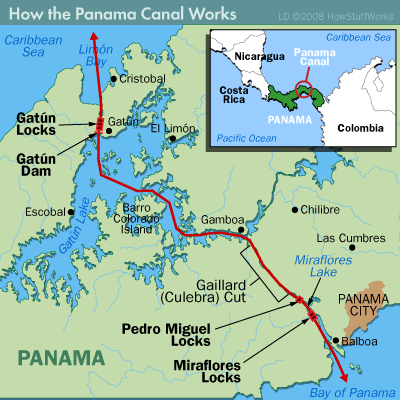
Jenna is a 4th year PhD candidate working with Dr. Doug Robinson in the Department of Fisheries & Wildlife. Jenna studies bird communities to figure out which species occur within those communities, and where and why they occur there. To dial in on these big ecological questions, Jenna focuses on tropical birds along the Panama Canal (PC). PC is a unique area to study because there is a large man-made feature (the canal) mandating what the rest of the landscape looks and behaves like. Additionally, it’s short, only about 50 miles long, however, it is bookended by two very large cities, Panama City (which has a population over 1 million people) and Colón. Despite the indisputable presence and impact of humans in this area, PC is still flanked by wide swaths of pristine rainforest that occur between these two large cities as well as many other types of habitat.

Barro Colorado Island can be seen in the centre of the Panama Canal.

A portion of Jenna’s PhD research focuses on the bird communities found on an island in the PC called Barro Colorado Island (BCI), which is the island smack-dab in the middle of the canal. To put Jenna’s research into context, we need to dive a little deeper into the history of the PC. When it was constructed by the USA (1904-1914), huge areas of land were flooded. In this process, some hills on the landscape did not become completely submerged and so areas that used to be hilltops became islands in the canal. BCI is one such island and it is the biggest one of them in the PC. In the 1920s, the Smithsonian acquired administrative rights for BCI from the US government and started to manage the island as a research station. This long-term management of the island is what makes BCI so unique to study as we have studies dating back to 1923 from the island but it has also been managed by the Smithsonian since 1946 so that significant development of infrastructure and urbanization never occurred here.

Large cargo vessels pass next to BCI on their transit of the Panama Canal

Now back to Jenna. Over time, researchers on the island noticed that fewer bird species were occurring on the island. There are now less species on the island than would be expected based on the amount of available habitat. Therefore, Jenna’s first thesis chapter looks at which bird species went extinct on BCI after the construction of PC and why these losses occurred. She found that small, ground-dwelling, insectivore species were the group to disappear first. Jenna determined that this group was lost because BCI has started to “dry out”, ecologically speaking, since the construction of PC. This is because after the PC was built, the rainforest on BCI was subjected to more exposure from the sun and wind, and over time BCI’s rainforest has no longer been able to retain as much moisture as it used to. Therefore, many of the bird species that like shady, cool, wet areas weren’t able to persist once the rainforest started becoming more dry and consequently disappeared from BCI.

Another chapter of Jenna’s thesis considers on a broader scale what drives bird communities to be how they are along the entire PC, and what Jenna found was that urbanization is the number one factor that affects the structure and occurrence of bird communities there. The thing that makes Jenna’s research and findings even more impactful is that we have very little information on what happens to bird communities in tropical climates under urbanization pressure. This phenomenon is well-studied in temperate climates, however a gap exists in the tropics, which Jenna’s work is aiming to fill (or at least a portion of it). In temperate cities, urban forests tend to look the same and accommodate the same bird communities. For example, urban forest A in Corvallis will have pigeons, house sparrows, and starlings, and this community of birds will also be found in urban forest B, C, D, etc. Interestingly, Jenna’s research revealed that this trend was not the case in Panama. She found that bird communities within forest patches that were surrounded by urban areas were significantly different to one another. She believes that this finding is driven by the habitat that each area may provide to the birds. 

Jenna has loved birds her entire life. To prove to you just how much she loves birds, on her bike ride to the pre-interview with us, she stopped on the road to smash walnuts for crows to eat. Surprisingly though, Jenna didn’t start to follow her passion for birds as a career until her senior year of her undergraduate degree. The realization occurred while she was in London to study abroad for her interior design program at George Washington University in D.C. where on every walk to school in the morning she would excitedly be pointing out European bird species to her friends and classmates, while they all excitedly talked about interior design. It was seeing this passion among her peers for interior design that made her realize that interior design wasn’t the passion she should be pursuing (in fact, she realized it wasn’t a passion at all), but that birds were the thing that excited her the most. After completely changing her degree track, picking up an honor’s thesis project in collaboration with the Smithsonian National Zoo on Kori bustard’s behavior, an internship at the Klamath Bird Observatory after graduating, Jenna started her Master’s degree here at OSU with her current PhD advisor, Doug Robinson in 2012. Now in her final term of her PhD, Jenna hopes to go into non-profit work, something at the intersection of bird research and conservation, and public relations and citizen science. But until then, Jenna will be sitting in her office (which houses a large collection of bird memorabilia including a few taxidermized birds) and working towards tying all her research together into a thesis.

To hear more about Jenna’s research, tune in on Sunday, October 6th at 7 PM on KBVR 88.7 FM, live stream the show at http://www.orangemedianetwork.com/kbvr_fm/, or download our podcast on iTunes!

Proteins run the show (except when they unfold and cause cataracts)

Your eye lenses host one of the highest concentrated proteins in your entire body. The protein under investigation is called crystallin and the investigator is called Heather Forsythe.

Heather is a 4th year PhD candidate working with Dr. Elisar Barbar in the Department of Biochemistry and Biophysics. The Barbar lab conducts work in structural biology and biophysics. Specifically, they are trying to understand molecular processes that dictate protein networks involving disordered proteins and disordered protein regions. To do this work, the lab uses a technique called nuclear magnetic resonance (NMR). NMR is essentially the same technology as an MRI, the big difference being the scale at which these two technologies measure. MRIs are for big things (like a human body) whereas NMR instruments are for tiny things (like the bonds between amino acids which are the building blocks of proteins). Heather employed OSU’s NMR facility (which has an 800 megahertz magnet and is on the higher end of the NMR magnetic field strength range) to investigate what the eye lens protein crystallin has to do with cataracts.

Your eye completely forms before birth, and the lens of the eye that helps us see is made of a protein called crystallin. This protein is essential to the structure and function of the eye, but it cannot be regenerated by the body so whatever you have at birth is all you will ever have. However, in the eye lens of someone affected by cataracts, the crystallin proteins become unfolded and then aggregate together. They stack on top of each other in a way that they are not supposed to. A person with cataracts will suffer from blurry vision, almost like you’re looking through a frosty or fogged-up window. While the surgery to fix cataracts (which basically takes out the old lens and puts in a new, artificial one) is pretty straight-forward and not very invasive, it isn’t easily accessible or affordable to a lot of people all over the world. Cataracts is attributed to causing ~50% of blindness worldwide, likely due to the fact that not everyone is able to take advantage of the simple surgery to fix it. Therefore, understanding the molecular, atomic basis of how cataracts happens could result in more accessible treatments (say a type of eye drop) for it worldwide.

This is where Heather comes in. There are different types of crystallin proteins and Heather zeroed in on one of them – gamma-S. Gamma-S is one of the most highly conserved proteins (meaning it hasn’t changed much over a long time) among all mammals, which tells us that it’s super important for it to remain just the way it is. Gamma-S makes up the eye lens by stacking on top of itself, making a brick wall of sorts ensuring that the eye lens retains its structure. However, research prior to Heather’s found that with increased age there is an increase in a modification called deamidation, which occurs in the unstructured loops of the gamma-S protein. Deamidation is a pretty minor change and is common in proteins all over the body, however in the eye lens if too much of it happens it no longer is a minor issue since it starts to disrupt the structure and protein-protein interactions of the eye lens. Heather’s collaborators at Oregon Health Sciences University found that there are two sites on the gamma-S protein (sites 14 and 76) where these deamidation events increase the most in cataracts-stricken eyes. It’s been known for a while that this deamidation is associated with cataracts however we never knew why it is associated with cataract formation because the changes caused by this modification were seemingly minor. This is how the Barbar Lab, and Heather specifically, became connected to this work since they specialize in studying unstructured proteins and protein regions, such as the loops present in gamma-S.

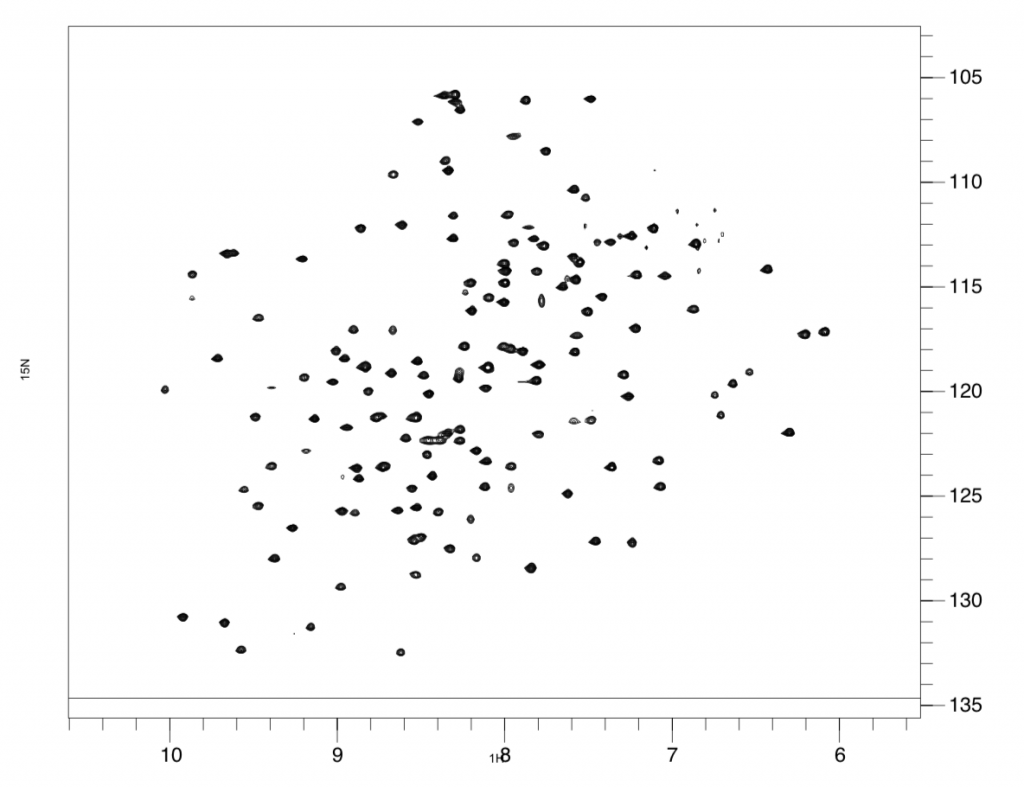
An example of an “1H(x-axis) 15N(y-axis) HSQC” spectra, aka, the fingerprint of a protein. This spectra is of WT gamma-S crystallin.

These deamidation changes are mimicked in the lab by creating two different mutants of the gamma-S protein’s DNA. Heather then compared the two mutants with the normal DNA by putting them through a series of experiments using the trusty NMR. The NMR is basically a large magnet that can make use of the magnetic fields around an atom’s nucleus to determine protein structure and motions. When Heather puts a protein sample into the NMR, the spins of the atomic nuclei will either align with or against the magnetic field of the NMR’s magnet. The NMR spits out spectra, which look like a square with lots of polka dots. This is essentially the fingerprint of the protein, unique to each one and extremely replicable. Heather can analyze this protein fingerprint since the different polka dots represent different amino acids in the gamma-s protein. Heather can compare spectra of the two mutants to the spectra of the normal protein to see whether any of the dots have moved, which would signal a change in the position of the amino acids.

After running experiments which measure protein motions at various timescales, from days to picoseconds, Heather discovered significant changes in protein dynamics when either site 14 or 76 was deamidated, however at different timescales. What this discovery means is that if both of these mutations are associated with cataracts and they are changing the same regions of the gamma-S protein, then these regions are likely central to changes resulting in cataracts. Therefore, research could be directed to target these regions to perhaps come up with solution to prevent and/or solve cataracts in a non-surgical way. The results of Heather’s study were recently published in Biochemistry.

Heather with her dog Piper.

Heather is from Arkansas where she completed her high school and undergraduate education. Living in a single-parent, non-academic home at this time, it took Heather a long time to figure out how to navigate the scientific and college-application scene, as well as even coming to the realization that science was something she was good at and could pursue. Despite receiving scholarships for college, she still had to work multiple jobs while in high school and college to have enough money for car-payments and gas to get to extra-curricular activities and volunteer jobs in the science field; things critical for graduate school applications. As a result, Heather is a strong advocate for inclusivity, striving to make things like science and college in general more accessible to low-income and diverse students. Heather’s decision to leave Arkansas and come to the PNW was inspired by advice she received from her undergraduate advisor who told her “not to go anywhere where you wouldn’t want to live. You will learn to love research, whatever it ends up being, but if you live in an environment that you don’t find fulfilling, then you are going to suffocate.”. Following this advice has lead Heather to where she is now – the senior in her lab where she has become a mentor to undergraduates, makes Twitter-famous Tik Tok videos (see below), goes on adventures with her dog Piper, and publishes cutting edge structural biology research.

Heather and her undergraduate mentee performing The Git Up in the lab.

To learn more you can check out the Barbar Lab website and Twitter page.

To hear more about Heather’s research, tune in on Sunday, September 29th at 7 PM on KBVR 88.7 FM, live stream the show at http://www.orangemedianetwork.com/kbvr_fm/, or download our podcast on iTunes!