Here at Inspiration Dissemination we are adapting to the global pandemic’s ever changing obstacles. Because of COVID we are unable to be in the booth this week. That means no interviews. But we will have interviews starting next week.
Bryan is Ph.D. candidate in Integrative biology researching the evolution of cooperation using bacteria and math. You can read more about Bryan and his research here when he was a guest on ID.
Grace is a Ph.D. candidate in microbiology studying the relationship between the gut microbiome and behavior. You can read more about Grace and her research here when she was a guest on ID.
Miriam is a Ph.D. candidate in history and philosophy of science. She studies the history of antibiotic resistance in the United States and the Soviet Union during the Cold War. You can read more about Miriam and her research here when she was a guest on ID.
What’s that? Another awesome way to learn about graduate student experiences at OSU?
In collaboration with the Graduate School, Inspiration Dissemination is proud to announce Oregon State University’s annual Grad Inspire event set to take place at the end of April 2022. The event, where a few hand-selected graduate students share their research in a short 10 minute talk, will be in person (COVID dependent) in the MU Ballroom. Video streaming and live captions will be available for anyone who cannot attend in person. For the most up to date information, please visit this website.
Are you a grad student? Are you doing awesome things? We want to hear from you.
We are always interested in hearing from graduate students at OSU. If you are interested in joining the show, click on the “New Guest Sign Up” tab at the top of this page.
Thanks to everyone for your patience as we navigate doing live radio during COVID.
How could an equation developed by a German mathematician in 1909 help Micronesian conservation networks plan for the future in the face of climate change?
In this week’s episode, we interview Dr. Steven Johnson, a graduate of Oregon State University’s Geography graduate program. Steven completed his doctorate earlier in 2021, under the guidance of Dr. James Watson, a professor in the College of Earth, Ocean, and Atmospheric Sciences. He’s now a postdoctoral fellow at Arizona State University. During his time at Oregon State, the focus of his work was oceans. “I study the ocean – in particular, people’s relationship with the ocean. The condition of the ocean has implications for people all over the world and millions depend on it for their livelihood,” he explains.
Steven Johnson, a recent graduate of OSU and now a postdoctoral fellow at Arizona State University
“There used to be this idea that the ocean was ‘too big to fail’, but Oregon State University Distinguished Professor and White House Deputy Director for Climate and the Environment Jane Lubchenco made the point that ‘the ocean is too big to fail, but too big to ignore,’” Steven recounts. “Not a single part of the ocean has not been impacted by people.” Plastic waste, rising temperatures, increasing acidification, and other byproducts of human activity have been changing the ocean as we know it, and it will continue to worsen if the problem can’t be solved. One challenge that arises as a result of these changes is the future of aquatic resource management and conservation programs, which are designed to work in current ocean and climate conditions.
So how does Steven’s research tackle these problems? In the first chapter of his thesis, he developed a novel model for predicting the way the ocean will change due to climate change. This approach is titled the Ocean Novelty Index, or the ONo Index. The Ocean Novelty Index quantifies the relative impact of climate change across all parts of the ocean, using a statistical metric applied to six different ocean surface variables (chlorophyll, O2, pH, sea surface temperature, silica, and zooplankton.) The metric is derived from the Hellinger distance, developed by a German mathematician in 1909, which is a nonparametric analysis that measures the similarity and dissimilarity between two distributions and their overlap. The baseline, or ‘normal’, conditions are derived from the period between 1970-2014, a 50 year period which recognizes 1970 as the birth of the modern Western climate movement. The model can then be used to assess and predict what climate change will do to one part of the ocean, and compare it to how that part of the ocean looked previously. The model better encapsulates the dynamic and unpredictable changes of the ocean resulting from climate change, as opposed to just rising temperatures.
In addition to the development of this climate change index, Steven’s research also focused on conservation networks and initiatives across Micronesia, the Caribbean, and Southeast Asia. These networks and cooperatives are collaborative efforts between regional governments to meet certain conservation goals, taking into account the differing social, cultural, and economic needs of the different countries involved. Part of Steven’s work has focused on applying the ONo index on a local scale, to help determine what changes may occur in the regions as well as where. What will the regions of these networks look like at different points as the climate changes, and how can we create strong policies and political relationships in these cooperatives and their respective countries to ameliorate potential issues in the future? Steven discusses these topics and more with us on this week’s ID podcast.
If you are interested in learning more about the ONo index and Steven’s work, you can read his paper here.
This week we have on the show Dr. Bo Wu – he recently graduated from Oregon State University with a Ph.D. from the Electrical Engineering department where he developed new sensors to monitor three different neurotransmitters that are correlated with our stress, mood, and happiness. Even though so much of our bodily functions rely on these neurotransmitters (cortisol, serotonin, dopamine), there are no current commercial or rapid techniques to monitor these tiny molecules. Since the majority of innovations in University settings never gets beyond the walls of the Ivory Tower, Bo wanted to design sensors with functionality and scalability in mind. Those basic principles are why Bo was attracted to joining the lab of Dr. Larry Cheng; instead of innovations sitting on university shelves their innovations must be designed to bring to market. Using nano-fabrications technology, Bo developed sensors that are about the size of a thumbnail to provide rapid and accurate measures of different neurotransmitters to be used outside the hospital setting. The promise of having these mini-molecules be measured as a point of care diagnostic (i.e. measured by the patient) is an exciting advancement in the medical field.
This innovation is not the only one coming from Bo; with the help of a colleague, they designed a product for researchers to easily reformat academic research papers for submission to other journals. If you didn’t know, submitting manuscripts to different journals takes an immense amount of time because of the formatting changes required. But these are tedious and can take a week or longer that can be used for crucial research experiments. While this service was originally designed for Engineering publications, the COVID-19 pandemic showed them there was a greater and more immediate need. With so many people losing their jobs, they re-designed the software to help people create and re-imagine their resumes for job applications. Their website, WiseDoc.net is now geared toward helping job seekers build stronger resumes, but Bo and his team expects to return to the original idea of re-formatting papers for academic publications but will expand to those beyond just Engineering journals. Thanks to Oregon State’s Advantage Accelerator Program, Bo and his co-founder were able to refine their product and acquire seed money to get the website off the ground, which now employs a small international team to maintain and improve its services. If you have questions for Bo about starting your own business, being an international student, or the Advantage Accelerator program, you can contact him by email wubo[at]oregonstate[dot]edu.
Did you miss the show on Sunday, you can listen to Bo’s episode on Apple Podcasts!
You’re probably pretty familiar with a thing called antibiotics. You’ve most likely been prescribed them for a number of bacterial infections you may have had over the course of your life. Antibiotics are typically broad-spectrum, which can be good if the exact ailment a person is suffering from is uncertain. However, it can also be bad given that broad-spectrum antibiotics don’t just kill the bad bacteria, but they kill the good ones too. On top of this, antibiotic resistance is a pervasive issue. Alternatively, bacteriophages, which are viruses that attack bacteria, can be used to treat bacterial infections too. Bacteriophages are extremely effective at killing off a specific bacteria that you want to target. For example, there is a bacteriophage that specifically kills cholera, and nothing else. However, you have most likely never been treated with a bacteriophage for a bacterial infection. Why? Well, to understand that we’ve got to go back to the Cold War era (and even a little further). Enter Miriam Lipton, a PhD candidate in the College of Liberal Arts, whose research focuses on exactly this question.
There is speculation that the Cold War is the reason that there are these two ways to treat bacterial infections (antibiotics and bacteriophages), and Miriam is interested in this speculation as well as understanding how U.S. and Soviet scientists dealt with bacterial infections in real time during the Cold War period. To do this, Miriam is examining scientific papers and pharmaceutical trade journals from that time (1947-1991) to understand how scientists on either side thought about bacterial infections, their treatments, and antibiotic resistance. This quest has taken (or will take) Miriam to a number of different research institutions, including the Eliava Institute in Tbilisi, Georgia, Caltech in California, and the American Institute of the History of Pharmacy in Wisconsin. Reading scientific publications can be difficult enough as it is, however Miriam faces an added challenge of having to read many of the Soviet publications in Russian. Luckily, Miriam’s background lends itself quite well for this difficult task as one of her triple major’s during her Bachelor’s degree was Russian and she has a Master’s in Russian Studies from the University of Oregon, all of which have led to a good proficiency of the Russian language.
Miriam’s program at OSU is called History of Science and is quite rare. In fact, it is one of only four such programs in the country and Miriam is one of only four in her cohort at OSU. She is simultaneously a historian and a scientist on a mission to better understand past perceptions and thoughts of scientists about bacterial infections, to hopefully inform the present and future. Especially given the rise of antibiotic resistance across the globe.
Listen to the podcast episode of the show here to dive deep into the history of bacterial infection science!
Hospitals can provide a wide variety of lab tests to better understand our ailments. But have you ever wondered what happens to the sample after it’s in your doctor’s test-tube but before you get results? The answer is usually complicated and slow lab work; requiring lots of individual little steps to isolate and measure some specific molecule in your body. (Think of PCR-based COVID-19 tests). But not all tests require lab work.
You’re probably familiar with some paper-based diagnostic tools like checking the chlorine or pH level of your swimming pool. These are “dipsticks” of special papers and suitable for large volume samples. But what if you only have a couple drops to spare? For example, a diabetic is usually monitoring their blood’s glucose molecules with only a few drops of blood on special paper, then adding that paper to a measuring device. But you still need that small electronic device to know your blood glucose levels! This device requirement makes testing and diagnosis less accessible to people around the world. What if you could make a paper-based diagnostic tool, that works with tiny volumes, but doesn’t need any other equipment, or fancy software, or a trip to the hospital to get your answer? This is exactly why researchers are excited about paper-based microfluidic devices.
Pregnancy tests are one of the best examples (See Figure 2.4) of how researchers have automated a complex laboratory test onto a single device someone can purchase from any local pharmacy, at a relatively low cost, to get an answer within minutes, inside their own home. These tests actually measure a specific hormone, but it’s presented as a color indicator. Inside the device is porous media, to help move the sample, and a few different reagents in a specific order that generate the chemical reactions so you can see your test result as an easy to interpret color. No extra fancy machines, no hospital visit, rapid results, and relatively affordable disposable devices make pregnancy tests a success story. But this was commercialized in 1988, and urine samples are generally thought to be larger volume samples. There are still many more potential uses of paper-based diagnostic tools, using small-volume blood samples, yet to be developed.
This evening we have Lael Wentland, a PhD candidate in the College of Engineering, who is discussing her ongoing research on developing paper-based microfluidic tests for rare diseases. A central pillar of her work is to make healthcare more sustainable and accessible for a greater number of people, but especially those in more remote settings. The World Health Organization has an ASSURED criteria for the development of more paper based diagnostics to help guide researchers. The ASSURED criteria principles require the device be: Affordable, Sensitive, Specific, User friendly, Rapid and Robust, Equipment free and Deliverable to end users.
Using this framework, Lael has already developed one tool to monitor a metabolic disorder, and continues to work on another rare biomolecule. She started her research at OSU on phenylketonuria, a metabolic disorder where your body cannot breakdown a key amino acid (phenylalanine) found in foods. If you get too little of this amino acid, your body can’t make all the proteins it needs for growth, repair, or maintenance. Too much of this amino acid can cause seizures and developmental delays. Keeping close tabs on this phenylalanine is needed for people with this disorder because you can alter your diet to suit your body and remain healthy. But the current tests to monitor this amino acid is not as readily available as one may need. This is why Lael worked to make a paper-based microfluidic device that would adhere to the ASSURED criteria to make this more accessible for anyone. Lael was way past the proof-of-concept stage of her device, and was already recruiting subjects to test their blood using her new device when COVID-19 become prominent in March 2020. That’s one reason she pivoted to monitoring another rare disorder using similar principles.
We’ll get into that, and so much more, Sunday 7pm on 88.7FM KBVR.
Did you miss the show Sunday night? You can listen to Lael’s episode on Apple Podcasts!
“I always loved science class and science questions, and I went to science camps – but as a kid I didn’t really put it together that being a scientist was a career or something other than sitting at a microscope in a lab coat,” Our guest this week, Dr. Samara Haver, has come a long way from not realizing the myriad of careers in science when she was a child. She now works as a marine acoustician, researching underwater soundscapes and ocean noise to understand the repercussions for marine ecosystems and animals, such as humpback and blue whales.
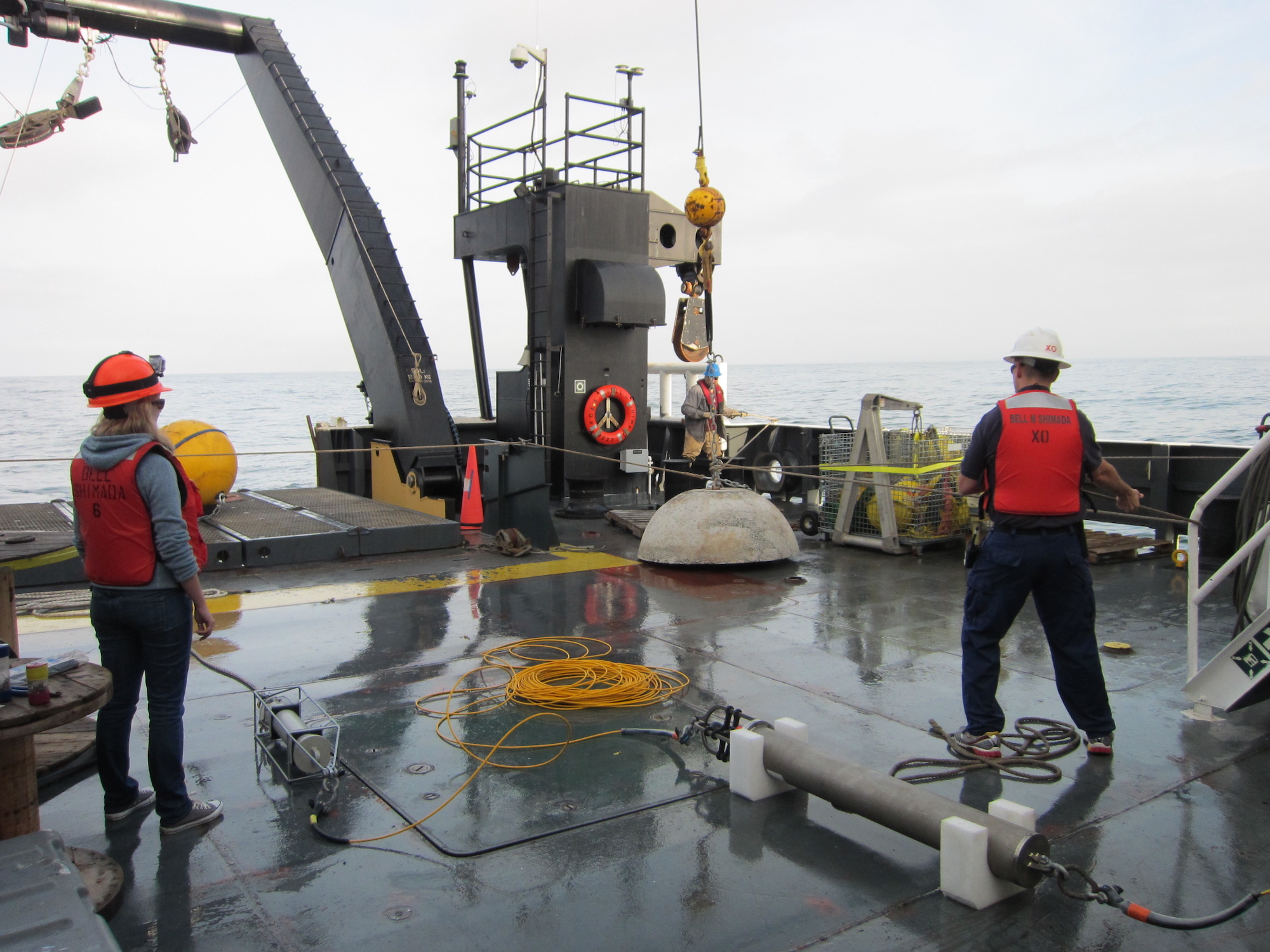
Noise Reference Station deployment in Channel Islands National Marine Sanctuary (Near Santa Barbara/LA, CA). Source: S. Haver.
Samara is a recent graduate from Oregon State University (OSU) having completed both her Masters and PhD in the Department of Fisheries, Wildlife, and Conservation Sciences (FWCS). She is continuing at OSU as a postdoctoral scholar in FWCS, where she is advised by Dr. Scott Heppell and works within the OSU/National Oceanic and Atmospheric Administration (NOAA) Cooperative Institute for Marine Ecosystem and Resources Studies. Her dissertation research focused on underwater recordings from 12 diverse and widespread marine habitats in U.S. waters. Data from each site was recorded by stationary hydrophone (underwater microphones), a calibrated array collectively named the NOAA/National Park Service Ocean Noise Reference Station Network (NRS). The NRS is an ongoing multi-agency collaborative effort to record underwater sound throughout the U.S. to understand about the differences and similarities of soundscapes in U.S. waters, and provide information to managers about protected species. The 12 locations are deployed along west and east coasts of the U.S., as well as in the northern and southern hemispheres, and includes locations within U.S. National Marine Sanctuaries and U.S. National Parks. One of the primary objectives of this highly collaborative and nation-wide comparison was to quantify comparable baselines of ocean noise in U.S. waters. When the NRS was first established, there weren’t any other U.S. research groups collecting passive acoustic data in these widespread locations using identical time-aligned recorders. Thus, the NRS provided new and comparable information to NOAA and the NPS about the levels and sources that contributed to underwater sound.
Prepping a Noise Reference Station, with concrete anchor, acoustic release, hydrophone, and float for deployment near Olympic Coast National Marine Sanctuary, near Washington state. Source: S. Haver.
Hence, Samara’s PhD research revolved around analyzing the recordings from the 12 NRSs to explore several questions regarding differences in U.S. soundscapes, including baleen whale presence which she was able to identify by their unique vocalizations. Many marine animals, including baleen whales, evolved to rely on sound as their primary sensory modality to survive in the dark environment of the ocean. Unlike humans, who rely heavily on sight, whales must find food, communicate, navigate, and avoid predators using sound. However, the ocean has become a noisy place, primarily because of increased anthropogenic (human-caused) activity, such as shipping, marine construction, and seismic surveys, to name a few. To best understand how noise is affecting the life history of baleen whales and their habitats, we need to understand how loud the ocean is, how much noisier it’s getting, and what is generating the noise.
Looking through the “big eye” binocular to search for marine mammals in the North Atlantic. Source: S. Haver.
Samara has become an expert in characterizing and understanding ocean soundscapes, uncovering a lot about the differences and similarities in U.S. soundscapes. To hear about what exactly she learned during her PhD and what management implications her results have on protected species and habitats, tune in on Sunday, November 7th at 7 PM on KBVR 88.7 FM, live stream the show, or download Samara’s episode on Apple Podcasts!
Don’t want to wait until then? You can check out Samara’s publications on her GoogleScholar or follow her on Twitter!
Jason J. Dorsette is a Black man with a family full of civil rights activists and leaders with a rich history in the NAACP (National Association for the Advancement of Colored People). As he described, “I was a country boy from the Jim Crow South and went to Oregon.” The NAACP of his upbringing did not exist here in Corvallis; literally, there was no collegiate branch in the Pacific Northwest when he arrived in 2014. Feeling like he didn’t belong, he helped to start the Oregon State University-NAACP branch in February of 2015 and continues to be involved in a variety of ways on campus and in the community. We briefly discussed his PhD research – Race Spaced Theory – that provides a geographical lens on Critical Race Theory. Because Jason is such a busy person, we had to keep the interview brief, but we hope to have him on the show again. As a reminder, the Corvallis-Albany NAACP branch is hosting the Freedom Fund as a fundraising event on November 6th at the Student Experience Center on Oregon State University’s campus. Hosted by Lisa Hildebrand and Adrian Gallo.
Due to time limitations, we couldn’t dive too deep in his research. But because Critical Race Theory has been in the news, consider reading/listening to a couple resources below. In an article in the New Yorker titled The void that critical race theory was created to fill, the origins of CRT could be credited to Derrick Bell: “a forty-year old civil rights attorney [who] became the first Black professor to gain tenure at Harvard Law School”. He left the school in 1980, nine years after gaining tenure, because he was frustrated at the lack of additional Black professors being hired. In his absence, law students protested, noting the classes he taught needed a Black professional of his caliber. Harvard rejected the students’ requests. Two students at the time, Kimberley Crenshaw and Mari Matsuda, designed an alternative course to supplement the lost learning that Derrick Bell provided. The textbook Crenshaw and Matsuda used for their alternative course was a book produced by Bell titled: Race, Racism, and American Law. That alternative course at Harvard from the 1970’s as well as other contributions from legal scholars and theorists from around the country, led to the start of Critical Race Theory. As Lauren Michele Jacon writes: “The core premises of critical race theory—that the invention and reinvention of race enable the status quo, and that liberal solutions prove insufficient—have been applied in recent decades within fields from education to disability studies.” More colloquially, CRT uses history and law to understand why – even after the Civil Rights era laws – Black people and African-Americans continued to face ongoing discrimination enabled by the state. For a more recent understanding of how CRT has been mis-represented, consider reading the Slate Magazine article titled “This Critical Race Theory Panic is a Chip Off the Old Block”, by Gillian Frank and Adam Laats.
Juneteenth – The Emancipation Proclamation was signed in 1863 to free enslaved people, allowing them to fight in the civil war. The war concluded in 1865, but the Confederate states were still not freeing slaves. It was not until the 19th of June in 1865 that Union soldiers rode into a remote area of Texas to formally announce their freedom. A quarter-million enslaved people resided in the state of Texas, but they likely had no idea they were freed two years ago. Juneteenth celebrates this more well known and advertised emancipation that spread across the Confederate states. Consider reading about Juneteenth in the Atlantic Magazine pieces titled: The Quintessential Americanness of Juneteenth by Van R. Newkirk, or What the Push to Celebrate Juneteenth Conceals by Kellie Carter Jackson.
NAACP Freedom Fund is being held on November 6th at the Student Experience Center at OSU’s campus. You can also watch past keynote speakers at the Corvallis/Albany NAACP Branch YouTube channel.
Did you miss the interview on Sunday night? Listen to Jason’s interview on Apple podcast (released every Monday)!
In a rapid fire interview Rebecca Mostow, a PhD Candidate in the Integrative Biology Department, connects her research on beachgrass along the coastline of the Pacific Northwest and Dune, the new film adapted from a SciFi book series. The book series envisions a planet with constantly shifting sand dunes, an idea that the books’ author originally had when he visited Oregon’s sand dunes in the 1950’s. During this time period, federal and local agencies were planting a variety of plant and tree species to keep the sand dunes stable; making the lives of coastal communities less … sandy. It worked!
Some people would consider it a real-life example of terraforming. This concept is exemplified by a character in the Dune series named Pardot Kynes, a plant ecologist helping locals adapt to their sandy-desert environment through their knowledge of plants as a sand dune stabilizer. In real life, there have been trade-offs between more stable sand dunes that are helpful for local communities limiting coastal erosion, but at the detriment of two currently threatened birds who depend on sand dunes that are constantly shifting in the winds. We discuss Rebecca’s findings of a new hybridized grass as part of her PhD, an iNatiuralist community science project mapping more of these beachgrasses, and its implications for how to manage ecosystems and communities moving forward.
Rebecca and her lab have already done lots of SciComm ’s work! See below for more links to their awesome work:
Oregon State University press release on Rebecca’s journal article detailing the new hybrid beachgrass.
GeekWire story on the overlap between the SciFi series and Rebeccas’s research.
A writer-hiker interviewed Rebecca as they explored one of her field sites along Oregon’s coastline.
A local TV story on the implications of the hybrid grass species.
Did you miss the interview on Sunday night? Listen to Rebecca’s interview on your podcast player of choice (episodes released every Monday)!
Greetings all — It’s been nearly 20 months since we’ve been back in the radio booth. Science has not stopped, but we as a team needed a break. Some of us on the Inspiration Dissemination team have graduated, some spent weeks at sea following whales, while others pivoted to research COVID-19 itself.
It has been a wild ride, but we’re happy to be back doing regular shows again, even happier to have the opportunity to continue podcasting and learning from our fellow graduate students. Want to be on the show? Fill out our form on the website and we’ll get you scheduled.
Stay curious y’all, <3 The ID Team
You can now listen to this episode through Apple Podcasts!
Cedric Hagen, a doctoral candidate in the College of Earth, Ocean, and Atmospheric Sciences, spends a lot of time thinking about fossils. He’s not a paleontologist, though: don’t expect to find him digging up a Tyrannosaurus Rex. For one thing, dinosaurs lived much too recently–a measly 66 million years ago, in the case of the T. rex. Cedric’s work takes him much, much further back in time to the beginning of the Cambrian era, which began over 500 million years ago.
PhD candidate Cedric Hagen (photo by Hannah O’Leary)
While the Cambrian era is not the beginning of life on earth (for that, you’d need to go back a staggering 3.5 billion years) the Cambrian era is important because that is the time when many of the major forms of life appeared. This includes, for example, spongelike animals, burrowing worms, creatures with carbonate shells, reef-forming animals, and arthropods like the remarkably successful trilobites. The apparent rapid increase in the diversity of life at this time is termed the Cambrian explosion.
Trilobite. Public domain image from Wikimedia Commons, accessed 5/17/2020. Ellipsocephalus Hoffi detail (Cambrian Trilobite) (Fig. 31) (b), from “The ancient life-history of the earth” (Page 85)
As you may imagine, there are numerous challenges to studying life from so long ago. One of the major challenges is that there simply aren’t very many samples in existence. Part of the problem is that although the rocks at the ocean floor are old from a human standpoint, since oceanic crust is continually formed at mid-ocean ridges and destroyed at deep-sea trenches, there’s a hard limit on the age of fossils you can find at the sea floor. Oceanic crust is at most about 200 million years old throughout most of the world’s oceans. While there are a few places in the Mediterranean that date back around 340 million years, even that is a couple hundred million years too young. Only at isolated locations on the continents are there places where Cambrian carbonate rock formations exist. “You can think of these as reefs, really old reefs,” Hagen said.
Carbonate rocks outcropping in the southern Nopah Range, Death Valley, CA (photo by Cedric Hagen)
Before the advent of carbon isotope and radiometric dating, geologists had to base their ordering of the fossil record on relative positioning in layers of rock and fossil co-occurrence. Sedimentary rock forms as layers of material (strata) pile up over time. So, the more strata above a fossil, the further back in time the fossil formed. If you find multiple fossils in one area, this is a reliable way to place the fossils in chronological order—that is, of course, if those layers haven’t been jumbled up by earthquakes, landslides, or tectonic folding in the meantime. An additional help is that the events that lead to fossilization, such as a mudslide, frequently result in many organisms being fossilized together. If the same species is found at two sites, it is likely that the two sites represent the same era. This lets scientists pin approximate dates on the co-occurring fossils.
Photo of folded limestone layers in Provo Canyon, Utah. Photo by Kerk Philips (Wikimedia Commons, public domain. Accessed 5/17/2020)
Radiometric dating allows precise measurement of age based on the decay of radioactive material. As radioactive material decays, atoms of one element are transformed into another. For example, uranium decays (through a convoluted process) into lead. Measuring the relative abundance of each element allows one to calculate the age of the sample. Since these rocks are made in part from the remnants of carbon-shelled organisms, they also record the amount of particular isotopes of carbon that were present at the time that the organism died. Since the relative abundance of carbon isotopes varies slowly through time, the pattern of carbon isotope concentrations in a sample of carbonate rock is like a record of the rock’s position in time.
“We’ve pulled together these records that have different chunks of time, and we’re trying to correlate them to a single high resolution record that we know the time of so we can know the order of the fossils, ” Hagen says. “What we’ve started to find is that the uncertainty in these measurements is quite large, larger than previously anticipated—there’s a lot of different places and times where things could have evolved.”
Prior to this research, scientists lined up carbon isotope chronologies visually. Hagen has been working on numerical algorithm that allows a computer to identify possible matches between rock samples from different parts of the world. “We’re cataloging libraries of possibilities,” says Hagen. “Are there twenty [possible arrangements]? Are there two? What could we do as geologists to go into the field and pick one or two of those and narrow down this uncertainty?”
To hear more about Cedric’s research, tune in on Sunday,May 15th at 7 PM on KBVR 88.7 FM. You can live stream the show, or, if you miss it, you can download this episode and most of our earlier shows as podcasts on iTunes.