The Most Important Part of an Observation Is the Conversation

by Christopher Ervin

When I learned I would be a graduate teaching assistant during the second year of my MA program, I began observing my course professors, often noting strategies to emulate but sometimes practices to guard against. I don’t remember exactly what I observed, but I suspect a kindly literature professor reading directly from lecture notes landed on the “don’t” list. And seeing the impact of our facilitator calling on us by name and asking prompting, open questions, found its way to the “do this” list. Those early memories of learning how to teach from their examples have faded, but I absolutely know that talking to them about their teaching was not part of my process. I never scheduled any formal observations or requested follow-up conversations with my professors about why they were doing the things I observed. So, rather than hearing from them about their teaching, I took from those observations my own interpretations of their teaching styles, which I then placed within the context of what I anticipated my approach would be.

In the years since, I’ve had the opportunity to observe hundreds of graduate teaching assistants, writing consultants, peers, and mentors in both formal and informal contexts. I’ve also been observed (formally) dozens of times as a teacher and facilitator. In all my experiences observing and being observed, I’ve found the conversations, before and after, to be the cornerstone of a successful observation experience.

The Conversation Before

The conversation before an observation might be brief, but it’s no less important than the follow-up. The conversation preceding the observation serves several purposes, but overall, the first conversation, combined with the follow-up, wraps the observation in what I hope is a positive and caring interaction.

I have four goals for those initial conversations. First, I hope to learn what the person I’m observing would like me to focus my attention on during the observation. Organization of material? Clarity of explanation? Facilitation of group discussion? Interaction with participants, or interaction between participants? I lead the initial conversation with this goal-setting process, which also helps to empower and center the person I’m observing, and to dismantle some of the power dynamic inherent in an observation.

Second, I want to be sure the person I’m observing understands my process. Since I take copious notes, I want them to know that in advance. This is also when I tell them whether I’ll be taking notes on a laptop or tablet because I hope to avoid the impression that I am disengaged or multitasking. (It’s also when I invite them to share their preference with me—if they prefer I take handwritten notes, they can tell me then.) I also share the evaluation form/rubric if I’ll be using one (for evaluative observations, there’s usually some kind of university/department-mandated form).

Additionally, I hope the person I’m observing leaves the initial meeting knowing how the observation is going to be used. In some contexts, it’s clear (tenure file, for example). Elsewhere, the person being observed might know only that they’re being required to have an observation of their class/meeting, etc.—for example, when I observe faculty/staff I supervise as part of the evaluation process. In that case, they might not be sure who will have access to that observation report (if there is a formal report), how it might be used, and where it will “live” after the observation. Likewise, I ask them how they plan to use the report I share with them (teaching portfolio, for example) so that I have an opportunity to write a report that works for their purposes.

Finally, I do my best to be sure we both leave the meeting feeling excited—or at least not anxious—about the upcoming observation. Some of us dread being observed, and that anxiety can shape the class, meeting, etc. Strategically nudging the power balance back toward the person I’m observing—to the degree that such a shift can happen—by centering their goals and self-identified growth areas goes a long way to help them anticipate a productive and valuable experience.  In the end, I hope the initial conversation clears away some of the anxiety and sets the person I’m observing up for a really successful class, meeting, etc.

The Follow-Up Conversation

The follow-up conversation is typically what one might think of in the context of an observation. My approach is to reserve most of the time during the conversation for the person I’ve observed, giving them space to make meaning for themselves while I act as a sounding board for that meaning-making. As with the conversation before the observation, I enter the follow-up with a few specific goals.

First, I want to share what I noticed based on their self-identified goals. If they asked me to pay attention to how their students were interacting, I’ll have drawn a discussion map that shows who was speaking, and to whom, and how often. If they wanted me to focus my attention on a new approach to small-group work, I will have taken copious notes based on what I hear and see in the small groups. I consider this part a reflecting-back process, like I am a mirror they’ve been able to hold up to their teaching.

Second, I always offer genuine, specific praise and validation and talk about why I felt a particular approach or activity worked well. The value of praise can’t be understated. It not only confirms for the person being observed what they hope is working well, but it also often identifies for them approaches or strategies they might not have noticed about themselves.

Third, I hope to contribute some interpretation or additional meaning making about the class, meeting, etc. Non-judgmental question-asking serves as the cornerstone of this part of the follow-up conversation, but direct observations and notes are interspersed. If the initial conversation served its purpose, my direct observations during the follow-up should land well.

Ultimately, the conversation will be shaped by the relationship I have with the person being observed—if I am their supervisor, we might find opportunity to talk through a couple of specific approaches or behaviors that don’t align with the expectations of the position. If I am not their supervisor, we might focus primarily on formative types of evaluative suggestions, like when a faculty member is interested in hearing my perspective about how their discussion prompts landed with their students.

Remembering that Observations Enact Actual and Perceived Power Dynamics

Even with the most productive of conversations before and after the observation, I remain keenly aware that an existing power structure determines who is observed, who gets to observe, why they observe, in what context someone is observed, and what implications might arise from the observation. The fact that a faculty member or staff might invite a colleague or supervisor to observe them doesn’t erase the power dynamic between those individuals. Imagine the scenario in which a department head is applying for promotion to full professor and needs to be observed by faculty they supervise—just one example of how complex the power dynamic can become when we are invited to make formally observe others.

Exploring Student Communication through Fall Survey Engagement

by Clare Creighton

In April 2020, a small team of folks from Student Affairs and Academic Affairs designed and administered a survey to undergraduate, Corvallis-campus based students to better understand the student experience during the transition to remote learning. Since then, this team has conducted four additional surveys to gain insights into students’ experiences and perspectives.

In late October 2022, we initiated the fifth survey in this series and received responses from 2600 students. We will be releasing the full findings within the next few weeks, but I wanted to pull out a few key points that piqued my curiosity on the broader question: “What should communication look like between students and OSU?” Fortunately for all involved, I’m not the one answering this question. In fact, the Constituent Relationship Management (CRM) team is engaging in that work right now, and that group will review the responses on a few questions they helped design. For the scope of this blog, I want to highlight some areas of curiosity that came up relative to that theme of communicating with students:

  1. I coded the question “What support do you think you most need so you can be successful this year at OSU?” – the top two themes were financial support and academic resources, but many students used that space to give feedback on a specific course or instructor. The survey isn’t designed for local feedback of that sort, so I interpret this to mean we have a gap in our communication structure. How do we empower students to talk to their instructors? And, when needed (although rare), what mechanisms are in place for students when genuine issues with an instructor arise? I am intrigued by the feedback form the College of Science has in place and wonder what the role this form or others like it might play in supporting interaction between students and instructors.
  2. Near the end of the survey we asked “What do you wish we would have asked about in this survey?” Erin Bird coded these responses, and I saw in those themes an opportunity to do more to hear from students. They asked that OSU ask more about their experience as a student, ask questions about their mental health, and check in on them more. We don’t need to survey students more to create spaces for them to feel heard and to convey that they matter to the university. What opportunities already exist for students to share about their experience, or for an instructor, advisor, or support personnel to indicate interest in how they’re doing? What would that look like?
  3. At the end of the survey, we asked students to leave their name and email address if they’d like to receive follow-up information and resources. Getting email outreach after finishing a survey isn’t an ideal way to connect, and yet 33% of our respondents were interested in additional communication at the end of the survey. There is a clear interest for students in timely information about resources. I am curious where the appropriate home might be for an “I want outreach/help/information” request within our university ecosystem.
  4. The overall survey response rate was low (under 20%)—lower, in fact, than the other surveys in the series. On the other hand, the students who completed the survey gave rich and robust responses. When asked to define success, over 2100 respondents offered up 35,000 words. With both of those data points in mind, I am curious: how can we create routine mechanisms for students to share feedback that will be reviewed and shared more broadly?

I may have just offered four reasons not to administer a large-scale survey, but I actually believe wholly in this effort (and want to increase the response rate).  But a survey alone can’t accomplish our communication needs, and I believe that students and administrators, faculty, and staff would benefit from more nuanced conversation. For students, the value is in learning about resources in a timely fashion, an ability to give input and share their experience, and, at times, be checked-in on. From OSU’s perspective, having student input and perspective is vital in key success initiatives, effective communication, and our overall understanding of what needs and concerns exist.

We can and are working on large-scale communication through the CRM project and survey efforts like this, but I don’t want to lose sight of the ways we can do the work of communication at the small scale too. Individual people – student support personnel, advisors, instructors can play an important role here through day-to-day conversations with students. This week I’m going to pay attention to the conversations I’m having, and identify places where checking-in, inviting perspective, and offering resources can show up within existing dialogues.

For those interested in the full results of the survey, Erin Bird, Maureen Cochran, and I will be presenting as part of the FYI Friday series on Friday, February 3rd, at 1:00 pm via Zoom. Registration is required. If you are unable to attend, a recording will be available in Box along with the final report.

10 Ways to Check-In with Students during the Term

When teaching, course evaluations can provide a snapshot of students’ experiences which can be used to improve the course in future terms. That feedback is after the course has ended though. During the term, checking in with students about their experience of the course can provide helpful information that can allow for flexibility and adaptation to meet the needs of specific students or make adjustments that benefit the entire class. While formative assessment is always helpful to see how students are progressing in their learning, checking in on their experience of the course can offer a different kind of awareness and insight into opportunities for student support. In addition, being responsive after checking in can demonstrate your care for students and your willingness to work together to co-create a positive class experience. Including anonymous check-in options can also help students feel safer sharing about experiences or offering authentic feedback.

Here are a few ideas for how you can check in with students and gain valuable information to support your planning and pedagogy:

  1. Q&A Time: Save 5 minutes at the start of one class session each week for open question time. Encourage students to bring questions during that time or give them space to talk with a partner about a question before asking.
  2. Stop, Start, Continue: Hand out 3×5 cards and ask students to respond to Start, Stop, Continue prompts.
    • What’s something they’d like to start happening in the course?
    • What’s something they’d like to stop happening in the course?
    • What practice do they appreciate and want to continue?
  3. Anonymous Qualtrics Survey: Include a link to an anonymous Qualtrics survey in your syllabus and remind students about the link throughout the term. Invite them to share about how they’re experiencing the course throughout the term.
  4. Process Memos: When students submit assignments during the term, plan for a few of those assignments to include process memos where students reflect on their process and next steps in learning. Don’t grade process memos, or, grade only as complete/incomplete to encourage authentic reflection.
  5. Midterm Survey: Share an anonymous survey (hand out in class or distribute link online) half-way through the term with questions about specific elements of the course (e.g., class sessions, office hours, assignments, etc.). After surveying students, provide an overview of what you’ve learned and any adjustments you’re making to the course in response.
  6. Clearest and Muddiest Point: Start some class sessions by asking students to talk together and share out about what their clearest and muddiest points are. You can also do this anonymously using tools like Poll Everywhere or Mentimeter.
  7. Conferences: If you teach a course where individual or small group conferences are feasible, having 1:1 conversation can help you learn about students’ experiences and provide space for follow-up questions. Sharing a few prompts for students to think on prior to the conversation can be a great way to help students prepare to share experiences.
  8. Sticky Note Takeaways or Exit Tickets: Occasionally hand out a sticky note at the start of class, and have students write a takeaway or insight from the class session; make a connection between past and current content; or share how the day’s lecture, discussion, or activities landed for them. This can be particularly useful for understanding what students are learning and how they’ve experienced a new activity you’ve tried in class.
  9. Ungraded Reflection: Low-stakes, brief assignments with a guiding prompt can be a quick way for students to reflect in class and give you a sense of what students are thinking about or learning at a key point in the term.
  10. Submit an Exam Question: Ask students to submit questions and offer that 2-3 of the questions from class will end up on the exam itself. This provides insight into what students view as key concepts or challenging aspects of course. You can then be mindful of what does and doesn’t show up in submitted questions as you support students in preparing for the upcoming exams.

Reflection Practice #countsaswork

by Anna Bentley

One of the most important meetings I have at work is one you might not expect. Since July 2021, the professional staff in the Academic Success Center & Writing Center have established a practice of synchronous, individual reflection and writing time, which is scheduled every other week for one hour. Originally, this began as a way to think about our work in a different way and potentially find threads of interest for content for The Success Kitchen, though there has never been any obligation to produce anything. This is a completely voluntary space where folks are free to reflect and write about whatever they choose.

Here’s how it works. First, we check in with each other briefly, and then we leave the meeting to reflect and write for 40 minutes. There are prompts to guide us if we want to use them, but we are free to write about anything we choose. After 40 minutes, we rejoin the meeting and take turns sharing as much or as little as we want about what we wrote.

Example prompts:

  1. What is something a student has said or shared recently that you’d like to think more about or reflect on?
  2. Talk about a recent leadership experience that’s on your mind. What was meaningful to you about that experience? If there were any challenges, how did you work through them?
  3. What’s a favorite memory from your own learning experiences (in any context)? What made that experience valuable and important to you?

Through writing and reflection, we make space to generate ideas and insights, process experiences and emotions, deepen our awareness and understanding, make meaning and connections, feed creative energy, and develop our writing skills. I certainly have benefited from our collective reflection time. Before this, I had never had a writing practice, and I used to feel intimidated by a blank page. Now I find joy in writing freely and have grown more confident in my writing skills. I’ve used the time to write about work, draft articles like this for The Success Kitchen, journal and process emotions, make goals and lists, and even write poetry and fiction.

It’s been a gift to explore many facets of writing without any obligation to produce or perform, and it’s positively impacted the way I work. A few months ago, I began supervising a team of student staff after going many years without supervising anyone. I’ve used our reflection practice to unpack and discover my values around how I show up as a supervisor, a colleague, a parent, and a friend. Having the time to intentionally articulate who I want to be has made a difference in my relationships and my journey as a supervisor.

Beyond the practice of writing, what has made our reflection practice particularly powerful is what we get out of sharing with each other. Any of us could write on our own, but doing this together and sharing allows us to make connections and offer support to each other. Listening to my colleagues’ reflections inspires me and leads us to exploring ideas we otherwise may not have considered. We sometimes find, coincidentally, that our reflections are related, and we generate new ideas by hearing each other’s perspectives. Sometimes we share the emotions and challenges we’re experiencing, and our colleagues support us through that. Perhaps that is what I love the most about reflection and sharing – that it can be whatever kind of space you want or need it to be in that moment, and we’re able to connect on a different level than we can in other spaces.

As a unit, we find meaning in processing what we’re experiencing, articulating our ideas, sharing with each other, validating what each of us brings to the table, and supporting each other as whole people. To make this a reality, we put this on our calendars and count this as work. I’m energized by this practice, excited to see what’s possible, and curious to hear what beautiful, powerful ideas others have within them.

Tales from Adventures Emailing First-Year Students in Fall

by Sarah Norek

Part of my role at the Academic Success Center includes drafting and sending the Transition Communication Campaign (TCC) emails to all incoming first year (FY) and new-to-OSU students. It’s one of my very favorite projects to work on and learn from, and offers a lot to consider and explore.

For folks unfamiliar with the TCC, I begin emailing students in their first term at OSU, and continue throughout the entirety of their first academic year (here’s an example from week 2). Content is timely to each week in the term and covers academic support and advising information; resource spotlights; and processes, strategies and tools. Messages are sent via Marketing Cloud using student lists created through Banner, and emails go out each Sunday as well as the Wednesday before add/drop deadlines.

During Academic Year 2022, we wanted to look more closely at the FY engagement with emails throughout fall 2021. To do this, we used reports from Marketing Cloud to determine students who received all 13 messages (a total of 3596 students), we looked at patterns of engagement (opens and clicks), and we also invited folks to participate in focus groups or complete a brief survey. We learned so much! It was so much fun! And a lot of what we learned was counter to what I’d thought to be true, which was delightful and curious and exciting. Here are some of my favorite perception shifts:

  • I thought students weren’t opening emails, but when we looked at reports, it turns out that they were: 69% of students opened 8 or more of the TCC messages in fall, and about 25% of students opened all 13!
  • I didn’t expect students to return to the messages, but the average opens per messages was two; and, on average, 41% of students opened the messages two, three, or four times. Students found reason to revisit the content.
  • I was pretty sure receiving duplicate information would be a total turn-off. In our focus groups, students shared that they’d received similar messaging from other sources (at times ahead of the TCC’s arrival), but also shared they still found value in the campaign, even if it was redundant, especially for students who might not be getting this content elsewhere.
  • I was under the impression that the email’s organizational sections were more for me and my drafting process, but it turns out that students used the sections too, as signposts to focus their content consumption.
  • I was convinced my subject lines were boring (and I don’t think what I learned means they aren’t). I started each subject line with the week in the term, a move that felt uninspiring but also helped with my organization process. Lo and behold, students shared that they appreciated the naming of the week because it helped orient them within the term.
  • I’d had a feeling that the messages were too long, but continued to draft under the (old? outdated? incorrect?) impression that folks were willing to scroll; students said that, no, the messages were too long (especially when accessed via phone), so much so that certain sections were never reached. Noted!
  • Even though I focused most of my energy on the body of the message, the two sections folks went to most were Important Deadlines, at the top of the emails (highlighting deadlines for registration, change of grading basis, course changes, etc.), and Upcoming Opportunities at the end of the email (naming events, engagement opportunities, workshops, etc.).

Are these all the ways I felt surprised and delighted by the data? Nope. Do I wish we could’ve heard from each of the 3596 students who received the 13 total messages? I do. But still, we learned a bunch! And, I think what we learned could contribute to conversations and thinking around how campus communicates with students, how to be effective in our communications, and how to encourage engagement. This fall I’ve made changes to our TCC messages based on last year’s learning; already I’ve noticed higher open and click-through rates, and I’m totally pumped to see how engagement plays out for the rest of the year. More data to consider! More questions to ask! I’m not excited, you are!

New Book on Studying Lands in January

by Clare Creighton

I had the opportunity last week to connect with Dr. Regan Book cover for Study Like a Champ by Regan A.R. Gurung and John Dunlosky. Cover includes a picture of a brain lifting weightsGurung, Psychology Professor and Executive Director of the Center for Teaching & Learning here at OSU about his upcoming book Study Like a Champ: The Psychology-Based Guide to “Grade A” Study Habits. Coming in January from the American Psychological Association’s LifeTools Series, Study Like a Champ aims to equip students with tools and information to improve their approach to college-level learning. Regan collaborated with a former colleague from the University of Washington, Dr. John Dunlosky, combining their strengths from lab-based cognition research, college classroom research, and decades of university teaching experience.

For Regan, that’s what feels particularly special about this book. In the field of cognitive science there is a lot of information available about effective studying and learning, but not much of it makes it into a format that is accessible for students who in their busyness wouldn’t have time to weed through dense scientific journal articles (my words, not Regan’s) or books written primarily for educators. With years of teaching experience, Regan is excited to bring specific strategies to students based on what he’s learned working with college students in the classroom. This practical classroom setting has prepared him to frame strategies in a way that students can use.

Two of the concepts discussed in “Study Like a Champ” are spaced practice and retrieval practice. Spaced practice refers to the act of spreading out learning/studying sessions over time to allow memory consolidation to take place, which is more effective than cramming. Retrieval practice is the technique of trying to recall information without reminders or visual cues. Instead of looking at something and feeling like you know it, you actually test yourself to see if you can recall that information without looking at it. Learning about spaced practice or retrieval practice is useful, but Regan says he wanted to make sure students knew how to do those things as well. Regan shared with me that he used to mention retrieval practice in his psychology classes, but now he goes a step further to ensure that students understand what he means and how to do that, and get to experience it through the course design. For example, students in his intro psych class get to practice information recall every class period.

According to Regan, the goal of this book is to “provide students with the latest cognitive science on how to learn effectively and efficiently, in a way that translates jargony science into practical information they can use immediately after reading.”

I like the idea of giving students more information about what effective studying looks like, backed-up by research and information from the field of psychology. That’s one of our primary goals in the Academic Success Center and we work on this through different programs (the Learning Corner, ALS 116, Academic Coaching, Supplemental Instruction). What excites me about this book is the conversations it invites.

Like Regan, I see possibilities for conversations about studying happening across campus. If students, faculty, and staff are better equipped with the language of effective study strategies, we can have more conversations about studying and integrate it into our work. Planning, note-taking, and learning happen beyond the classroom as well which makes information about how we learn relevant to everyone. Myths about learning styles and other learning practices are pervasive and the antidote in my mind is in this book and other sources that provide practical information on what works and what doesn’t.

When “Study Like a Champ” is released in January, I’ll be reading it and thinking of how to get this information in the hands of students. Maybe it’s new content for the Learning Corner, maybe it’s a student staff meeting on the topic of studying, or reviewing the orientation content from our OSU Welcome event. I’ve requested the OSU Libraries purchase this text once it releases and I offer an invitation here to each of you for further conversation about how to integrate these concepts into our work with students.

Building a “New Normal” at the Academic Success Center & Writing Center

by Chris Gasser

Grey clouds, early sunsets, drivers cutting each other off at the Harrison Bridge; for the first time in two years, things almost look normal at Oregon State. As we return to campus it is easy to forget that we just spent the last two years in higher ed. surviving, both in a literal and figurative sense. Throughout the emergency measures of the COVID-19 pandemic, there was a strong sense (and a lot of anxiety) about what the new normal would look like. At the Academic Success Center & Writing Center, we spent a lot of time thinking about how we could create something new and better, rather than returning to how things were. We heard it a lot, “we can’t go back to the way things were”, and we embraced that.  One overarching question we found helpful was “what have we done differently during the COVID-19 pandemic that was better than what we were doing before?” This question, combined with specific questions focused on important areas of our work, led us to these strategies:

  • Prioritizing health for student staff and participants over service delivery and numbers
    • Do our policies and practices encourage staff to come to work when sick or students to access services when sick? How and where might we change/impact that behavior?
  • Seeking out employee feedback in major (and minor) decisions
    • What decisions are we making about student staff and service delivery? Do people affected by our decisions have an opportunity to inform those decisions? When and how are we inviting feedback from student staff?
  • Delivering clear guidance and processes on valuable resources for our community
    • What information might not be getting to students? How can we use our platforms as supervisors and program leaders to support students in understanding and navigating policies and resources? What messaging can we proactively highlight and signal boost to the benefit of student staff?
  • Focusing on community— building relationships within our teams and with our campus partners
    • What are we doing to foster relationships amongst our team? How do we create a sense of community and belonging across modalities? How often does community building show up as a part of our agendas and structured time?
  • Creating a culture of support where staff and students are encouraged to bring their humanity, with all the messiness that it involves
    • What do we convey to students about the way their lives show up in their work? What space do we make for sharing about their lives outside of work? How do we define professionalism in a way that lets them be autonomous human beings and not robots?

While we don’t suggest that we are perfect, in our return to campus or otherwise, we are excited that our new normal is a more compassionate one. It’s more nuanced, more human. We value flexibility, intentionality, and sometimes saying no when our plates are full. We’ve done a lot of thinking about the new normal we want to create. We share some of that thinking in our annual report, and we invite you to read it here.

Increasing Motivation through Behavioral Activation

by Anna Bentley

Behavioral activation is a common approach to treating depression that involves improving mood by engaging in pleasurable or rewarding activities. These behaviors disrupt the cycle of inactivity that fuels and prolongs depression. Behavioral activation strategies can vary for everyone, but may include things like writing in a journal, going out for coffee, hiking, or watching a movie with a friend.

You don’t need to be experiencing depression to benefit from behavioral activation. The same strategies that improve our mood also help prevent burnout and increase productivity at work or school when we’re feeling stuck, overwhelmed, or unmotivated. Here are the steps to practice this approach:

  1. Identify activities that bring you pleasure. There are several activity lists online that can be used for inspiration, or you can make your own list from scratch. If using a pre-made list, start by highlighting the activities you really enjoy and that reliably bring you pleasure. Cross off the things that aren’t for you.
  2. Rate the activities you identified by how easy they are to complete and how rewarding they are. This worksheet can help you complete this. For me, I found that sitting down for a fresh cup of coffee is very easy for me to complete but has short-lived rewards, while going on a long hike is highly rewarding yet more difficult to complete.
  3. Schedule activities that will give you positive experiences in your day. Here’s another tool you can use to schedule these activities, or you can use our weekly calendar. Start with simple activities that are easiest to integrate into your day, and build from there. You might start by just adding one rewarding activity in the morning, building that routine, and then adding more activities over time.

A core principle behind why behavioral activation works is that action often precedes emotion. Sometimes at work or at school, we want to wait until we’re motivated before we start a project. However, the action of engaging in a rewarding activity can give us the energy we need to fuel our work. Maybe you’ve had an experience where you found yourself more vibrant and energized once you got going on a project, even though you were initially reluctant to start.

Next time you notice a lack of motivation or the temptation to procrastinate, I invite you to consider how you can bring pleasure into the experience. Here are a few rewarding activities that I sometimes schedule into my day while I’m working on campus:

  • Start the day with a fresh cup of coffee, and take a minute to really savor it before starting my work.
  • Write down my intention for the day as soon as I get into the office.
  • Listen to a special Spotify playlist whenever I’m completing a repetitive task.
  • Have walking meetings with my colleagues when possible.
  • Go on a short walk around campus during my lunch break. Sometimes I like to visit a building I’ve never been inside before, or I like to take pictures of beautiful things I discover on campus, like trees, flowers, and artwork.
  • Send an email to campus partners I haven’t spoken with for a while, just to say hello.
  • Doodle in my notebook between back-to-back meetings for a quick mental reset.

Intentionally integrating these pleasurable and rewarding activities into my day gives me the boost of energy I need when I’m feeling unmotivated. What activities bring you energy, help clear your mind, or inspire inspiration? What would it look like to schedule those activities into your work? Share your ideas with us in the comments!

Benefits of SI for Students Retaking Courses

by Chris Gasser

As many of you know, Supplemental Instruction (SI) is an academic support program that offers peer-led, collaborative, group, study tables for historically challenging courses. In Fall 2021, SI underwent a significant expansion, which allowed us to do some pretty cool analyses, focusing on students who were retaking courses.

Context

A common criticism of SI data is that the program is based on an opt-in model, which means that our impact data is always subject to self-selection bias. The criticism suggests that it is possible that only the most successful students may opt in to SI, skewing impact data in favor of SI. In an effort to better understand SI’s impact while trying to account for this possibility, I performed an analysis of students retaking courses. By focusing only on a retaking population, I hoped to minimize any effect from the most successful students, assuming that retaking a course demonstrated a certain level of academic difficulty.

Methodology

For all SI supported courses in AY 21-22, I pulled the course grades for all students enrolled in the courses. I then pulled the most recent course grade for anyone who had previously taken the course at OSU and received a course grade. This gave me a list of 1,949 students who were retaking courses that SI supported in AY 21-22. Of those 1949, 1382 had previously earned an A-F course grade, and 567 had previously earned a W grade. I focused on these two populations in the analysis.

Results

Here are a few of the key results from the analysis of students retaking courses.

Among students who previously earned a course grade, students who completed SI earned a higher course grade than students who did not participate in SI.

Line graph showing both groups starting at 0.71 for their previously earned course grade average. Students who completed SI earned a course grade of 2.29, while students who did not participate earned a 1.77 average.

When looking at the first grade that students earned, both students who later completed SI (attended 4+ times) and students who did not use SI earned the same course average of .71 in their previous attempt at the class. This was a good indication that there was similarity between the groups. When looking at their subsequent grades, students who did not participate in SI earned a new average of 1.77. For students who did complete SI, their new average was 2.29—a difference of .52 grade points, or a half of a grade point higher than the average for students who did not participate in SI.

SI made a meaningful impact on the number of students passing the course

While SI helps students earn higher course grades, the boxplots tell an interesting story: in both analyses the SI 4+ 25% quartile ends at 1.7 (C-), which is the mean of the No SI groups. Not only do we see students in SI earning higher average (mean and median) course grades, we also see a much lower number of students below that 1.7 threshold. This provides evidence that SI both helps students earn higher course grades and increases the number of students who pass the class.

Boxplot showing students who participated in SI, and had previously earned a grade A-F, had a higher median course grade and a more narrow distribution most noticeable on the lower tail- suggesting a greater effect at lower course points.   Boxplot showing Si complete students who had previously earned a W, had a higher median course grades and a more narrow distribution most noticeable on the lower tail- suggesting a greater effect at lower course points.

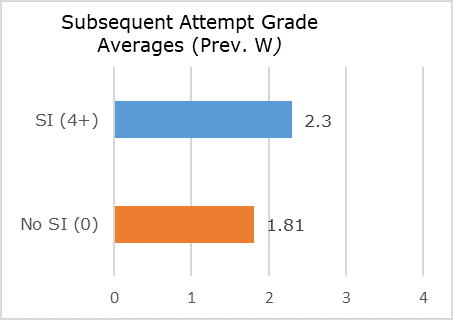
Among students who previously earned a W, students who completed SI earned a higher course grade than students who did not participate in SIBar graph comparing subsequent course grade average for students who previously earned a W.  SI 4+ students earned a course grade average .49 grade points higher than their non-SI peers.

A common idea on campus is that students who earn a W grade should not be included in analyses with students who earn a D/F, because students may withdraw from a course for reasons outside of academic difficulty. Separating this group out, we still see a similar effect in mean course grade: for students who completed SI, an average grade increase of .49 higher than students who did not participate.

Discussion/ Conclusions

Focusing on this narrow population allows us to compare data among students who may have more in common while also avoiding any skewing effect of our highest achieving students. What we see is strong evidence for the efficacy of the SI program, especially for students retaking courses. The effect on students’ course grades was even more pronounced in this analysis than a separate analysis for students not retaking the course, which prompts me to think more about how we get students retaking courses in to SI early. It also makes me wonder if we might better support our students retaking courses through building out a more robust support structure (of which, SI could be a part). There is more to this report than I can share here, and I would love to chat with you in more detail about my process and findings. If you’re interested in hearing more, interested in new ways to assess student success, or interested in thinking about how we better support our retaking students, please reach out. I’d love to chat (chris.gasser@oregonstate.edu).

Onboarding Student Employees

by Clare Creighton

September is a common time for onboarding student employees, and across the Academic Success Center and Writing Center, we brought on 37 new student employees this fall. In the next few months, we’ll be reflecting on the training we delivered, assessing the experience for student staff, and identifying any changes for the next round. We asked some of our new employees what they appreciated in their onboarding experience, and this is what they shared with us:

  1. It was emphasized to us that the best way to learn is by doing. I was relieved to know I don’t have to be any sort of expert before starting my job!
  2. I have really enjoyed that you guys have created a safe space for us to learn how to do something new without judgement. I feel like I can learn better and quicker in an environment that doesn’t punish me for making a mistake, especially when I’m learning something new.
  3. The time we spent to get to know the other student staff members—community and support for each other was and continues to be part of the ASC’s core values!
  4. I loved the emphasis on validation and praise, and how our jobs not only revolve around the writing process, but also around instilling confidence in the writer and their abilities.
  5. I appreciated that I was able to interact and train with returning [peer leaders] since it allowed me to start getting to know everyone and not feel isolated on my first day of leading tables.
  6. I liked that our training incorporated both individual work from canvas and group sessions over zoom and in person. This gave me the chance to get comfortable with the material on my own, and then help build a community with my coworkers.
  7. The room to make mistakes I had while onboarding for coaching contributes to the majority of the skills I use in coaching today!
  8. I have really appreciated the support and encouragement along the way. Putting in the effort to at least know all our names and check in every now and then when we’re in between tables is a great way to make us feel like an actual person, not just an employee!
  9. The training for my position was done in a way that allowed me to connect with, practice, and discuss with other students as we all learned from each other and together.
  10. I appreciated how training established early on that everyone is a writer, and that the most important thing a consultant can do is encourage. I found the focus on empowerment to be a very refreshing and reassuring framework.

Do you onboard student staff in your role? We enjoy conversation about training and supporting student employees and would love to exchange ideas with you. We’re also eager to make folks aware of the open source online training modules “Introduction to Student-Centered Peer Education” that we use in training. Email Clare Creighton clare.creighton@oregonstate.edu) to start a conversation.