All the buzz recently has been about Generative AI, and for good reason. These new tools are reshaping the way we learn and work. Within the many conversations about Artificial Intelligence in Higher Ed a common thread has been appearing regarding the other AI–Academic Integrity. Creating and maintaining academic integrity in online courses is a crucial part of quality online education. It ensures that learners are held to ethical standards and encourages a fair, honest, and respectful learning environment. Here are some strategies to promote academic integrity and foster a culture of ethical behavior throughout your online courses, even in the age of generative AI.
Create an Academic Integrity Plan
Having a clear academic integrity plan is essential for any course. Create an instructor-only page within your course that details a clear strategy for maintaining academic integrity. This plan might include a schedule for revising exam question banks to prevent cheating, as well as specific measures to detect and address academic dishonesty (plagiarism or proctoring software). In this guide, make note of other assignments or places in the course where academic integrity is mentioned (in the syllabus and/or particular assignments), so these pages can be easily located and updated as needed. By having a plan, you can ensure a consistent approach across the course.
Exemplify Integrity Throughout the Course
It is important to weave academic integrity into the fabric of your course. Begin by introducing the concept in your Start Here module. Provide an overview of what integrity means in your course, including specific examples of acceptable and unacceptable behavior. This sets the tone for the rest of the course and establishes clear expectations. On this page, you might:
Offer resources and educational materials on academic integrity for learners, such as guides on proper citation and paraphrasing.
Include definitions of academic dishonesty, such as plagiarism, cheating, and falsification.
Provide guidance on how learners might use generative AI within the class, including what is and is not considered acceptable.
Add scenarios or case studies that allow learners to discuss and understand academic integrity issues, specifically related to the use of generative AI.
Connect academic integrity with ethical behavior in the larger field.
Provide a place for learners to reflect on what it means for them to participate in the course in a way that maximizes their learning while maintaining academic integrity.
Throughout the course, continue to reinforce these ideas. Reminders about academic integrity can be integrated into various lessons and modules. By articulating the integrity expectations at the activity and assignment level, you provide learners with a deeper understanding of how these principles apply to their work.
Set Clear Expectations for Assignments
When designing assignments, it is important to be explicit about your expectations for academic integrity. Outline what learners should and should not do when completing the task. For instance, if you do not want them to collaborate on a particular assignment, state that clearly. Provide examples and resources to guide learners on how to properly cite sources or avoid plagiarism. Be specific with your expectations and share why you have specific policies in place. For instance, if you want to discourage the use of generative AI in particular assignments, call out the ways it can and cannot be used. As an example, you might tell learners they can use generative AI to help form an outline or check their grammar in their finished assignment, but not to generate the body text. Share the purpose behind the policy, in this case it might be something about how a writing assignment is their opportunity to synthesize their learning and cement specific course concepts. This kind of transparency shows respect for the tools and the learning process, while also clearly outlining for learners what is acceptable.
Encourage Conversations About Integrity
Creating opportunities for learners to engage in discussions about academic integrity can help solidify these concepts in their minds. You can incorporate forums or discussion boards where learners can share their thoughts and experiences related to integrity. This also gives them a chance to ask questions and seek clarification on any concerns they may have. Encourage open dialogue between instructors and learners regarding academic integrity and any related concerns. These conversations can also extend beyond the classroom, exploring how integrity applies in your field or career paths. By connecting academic integrity to real-world scenarios, you help learners understand its relevance and importance in their professional lives.
Foster a Supportive Learning Environment
A supportive learning environment can help reinforce academic integrity by making learners feel comfortable asking questions and seeking guidance. Offer resources like definitions, guides, or access to mentors who can provide additional support. When learners know they have access to help, they are more likely to adhere to integrity standards. With generative AI in the learning landscape, we will inevitably encounter more “gray areas” in academic integrity. Be honest with your learners about your concerns and your hopes. Being open to conversations can only enhance the learning experience and the integrity in your courses.
We all play a role in cultivating a culture of academic integrity in online courses. By documenting a clear plan, weaving integrity into the course content, setting clear expectations, encouraging conversations, and providing support, you can create an environment where honesty and ethical behavior are valued and upheld. This not only benefits learners during their academic journey but also helps them develop skills and values that will serve them well in their future careers.
A few years ago, I was taking a Statistics class that was dreaded by most students in my graduate program. Upon starting, I discovered with pleasure that the instructor had introduced a new textbook, called An Adventure in Statistics: The Reality Enigma by Andy Field. The book followed a story-telling format and featured an outlandish science-fiction type plot, humor, colorful graphics, and comic-book snippets.
The merits of storytelling have been widely discussed, and that’s not what I want to talk about here. Rather, I’d like to highlight a specific element that I believe made a great contribution to the book’s instructional value: most of the content is presented through the dialogue between the main character, Zach, who needs to learn statistics, and various mentors, in particular one professor-turned-cat. The mentors guide Zach through his learning journey by explaining concepts, answering his queries, and challenging him with thought-provoking points. This makes the content more approachable and easier to understand as we, the students, struggle, ask questions, and learn together with Zach.
I believe that using dialogues—in particular of the student-tutor type—instead of monologues in instructional materials is an underutilized method of making difficult concepts more accessible. It is not a topic that has been researched much, but I did encounter a few interesting references.
One term that is often used to refer to this type of learning—by observing others learn—is “vicarious learning”. It was introduced in the 1960’s by Bandura, who showed that learning can happen through observing others’ behavior. Later, it was also used to talk about learning through the experiences of others or through storytelling (Roberts, 2010).
I was interested specifically in the effectiveness of student-tutor dialogue, which is a type of vicarious learning, and I found two articles that presented research on this topic.
Muller, Sharma, Eklund, and Reiman (2007) used instructional videos on quantum mechanics topics for second year physics students. In one condition, the video was a regular presentation of the material. In the other, the video was a semi-authentic dialogue between a student and a tutor, and incorporated alternative conceptions that physics students might hold, in combination with Socratic dialogue. The authors found significantly better outcomes on the post-test for the dialogue treatment.
Chi, Kang, and Yaghmourian (2017) conducted two studies that also featured physics concepts. They compared the effects of student-tutor dialogue videos versus lecture-style monologue videos, using the same tutors and the same supporting multimedia presentations. They, too, found increased learning for the students who watched the dialogue videos. They also found that students who watched the dialogue videos seemed to engage more in solving problems, generating substantive comments, and interacting constructively with their peers. The researchers offered some possible explanations for why this was the case: the incorrect statements and questions of the tutee triggered a more active engagement; tutees can serve as a model of learning; tutees make errors which are followed by tutor feedback – what they call “conflict episodes” that may motivate students to try harder.
Creating tutorial dialogue videos is time consuming and more difficult than making regular lectures. So, it is certainly not practical to use them on a large scale. However, it may be worth considering them for those areas where students struggle a lot.
Let us know if you’ve tried vicarious learning in any shape or form!
References:
Bandura A, Ross D, Ross S (1963) Vicarious reinforcement and imitative learning. Journal of Abnormal and Social Psychology 67(6): 601–607.
Chi, M. T., Kang, S., & Yaghmourian, D. L. (2017). Why students learn more from dialogue- than monologue-videos: Analyses of peer interactions. Journal of the Learning Sciences, 26(1), 10-50.
Muller, D. A., Sharma, M. D., Eklund, J., & Reimann, P. (2007). Conceptual change through vicarious learning in an authentic physics setting. Instructional Science, 35(6), 519–533. http://www.jstor.org/stable/41953754
Roberts, D. (2010). Vicarious learning: A review of the literature. Nurse Education in Practice, 10(1), 13-16.
I was recently reminded of a conference keynote that I attended a few years ago, and the beginning of an academic term seems like an appropriate time to revisit it on this blog.
In 2019, Dan Heath, a bestselling author and senior fellow at Duke University’s CASE Center, gave a presentation at InstructureCon, a conference for Canvas users, where he talked about how memories are formed. He explained that memories are composed of moments. Moments, according to Heath, are “mostly forgettable and occasionally remarkable.” To illustrate, most of what I’ve done today–dropping my kids off at spring break camp, replying to emails, going to a lunchtime yoga class, and writing this blog post–will largely be forgotten by next month. There is nothing remarkable about today. Unremarkable is often a desirable state because it means that an experience occurred without any hiccups or challenges.
Heath went on to describe what it is that makes great experiences memorable. His answer: Great experiences consist of “peaks,” and peaks consist of at least one of the following elements: elevation, insight, pride, or connection. He argued that we need to create more academic peaks in education. Creating peaks, he contends, will lead to more memorable learning experiences.
So, how do we create these peaks that will lead to memorable experiences? Let’s explore some ideas through the four approaches outlined by Heath.
Elevation. Elevation refers to moments that bring us joy and make us feel good. You might bring this element into your course by directly asking students to share what is bringing them joy, perhaps as an icebreaker. Sharing their experiences might also lead to connection, which is another way (see below) to create peaks that lead to memorable experiences.
Insight. Insight occurs when new knowledge allows us to see something differently. Moments of insight are often sparked by reflection. You might consider making space for reflection in your courses. Creativity is another way to spark new insights. How might students engage with course concepts in new, creative ways? To list off a few ideas, perhaps students can create a meme, record a podcast, engage in a role play, or write a poem.
Pride. People often feel a sense of pride when their accomplishments are celebrated. To spark feelings of accomplishment in your students, I encourage you to go beyond offering positive feedback and consider sharing particularly strong examples of student work with the class (after getting permission–of course!) Showcasing the hard work of students can help students to feel proud of their efforts and may even lead to moments of joyful elevation.
Connection. Connection refers to our ties with other people. Experiencing connection with others can feel deeply rewarding. As I mentioned above, asking students to share their experiences with peers is one way to foster connection. In Ecampus courses, we aim to foster student-student and student-teacher connection, but I encourage you to explore other opportunities for students to make meaningful connections. Perhaps students can get involved with their communities or with colleagues, if they happen to have a job outside of classes. Students could connect with their academic advisors or the writing center to support their work in a course. There are many ways to foster connections that support students in their learning!
It’s easy to focus on delivering content, especially in online courses. This was one of Heath’s overarching points. The key, however, to creating memorable learning experiences is to take a student-centered approach to designing and facilitating your course.
I invite you to start the term off by asking yourself: How can I create more moments of elevation, insight, pride, and connection for my students? It might be easier than you think.
References:
Heath, D. (2019, July 10). Keynote. InstructureCon. Long Beach, CA.
Seems like an easy question to answer, right? I might not give it a second thought.
Yet, as an online course developer, I sometimes find myself in conversations with co-developers where I realize I’ve been working under a different assumption about what a lecture is. And that’s fine, I kind of like having my preconceptions challenged. I wanted to share a little of that experience.
Our media development team has one of the stricter definitions of lecture, a specific kind of video recording. They have to, they are handling hundreds of videos every term. It’s essential for them to be able to sort media into the most efficient pipeline. Makes sense.
However, when I am working with subject matter experts, instructors, co-developers, etc. … I have found it useful to stay more flexible regarding many definitions. Sometimes errors in assumptions can open a door for discourse. It has certainly been a creative challenge. As an example, I’ll reminisce a little about a couple of my favorite mistaken assumptions about lectures. Ah yes, I remember it like it happened just this last Fall ….
I helped develop an upper-division online course centered on technology for educators. My first mistaken assumption was going in all ready to talk about video lecturing. The instructor on this co-development was a podcaster and wanted to deliver lectures in that format. I’ve had other instructors who preferred podcast lectures, no worries there. Some instructors see podcasts as a more portable kind of lecture or an alternative way to access the content. Students can listen to lectures on the go or download the lecture for offline listening. We just had to make sure to include transcripts for accessibility instead of captioning.
Also, I got to design the following playback interfaces to make them look more ‘podcasty’.
As you’ve probably guessed, there was a second mistaken assumption on my part. I was thinking the podcasts were the lectures. The podcasts are pieces of a larger “discourse given before an audience or class especially for instruction”. (Miriam-Webster: lecture and discourse). For our course, this discourse might be composed of multiple media element types.
The instructor wanted each ‘lecture’ to be a curated collection of learning elements focusing on specific topics; podcasts, video, reading, even Padlet posts. Part of the pedagogy here is to immerse them, as students, in a variety of technologies in the lectures that they may be using as educators. Together, we collaborated to find the most effective way to present all of this material as discrete lectures. Below is what we came up with. Would you still consider these lectures?
Interestingly, I don’t think we’ve quite strayed far from the Merriam-Webster definitions:
lecture: A discourse given before an audience or class especially for instruction
discourse: Formal and orderly and usually extended expression of thought on a subject. Connected speech or writing
While the course did include some interactive learning elements, these were not incorporated into lectures. It’s an interesting thought though.
How would you incorporate interactive exercises into lectures?
Does that still work within the definitions given above?
Maybe we can stretch the definition a little more. (Hmm. Perhaps in another blog post)
My takeaway here is that a lecture doesn’t have to be something given before a live class, or a simple narrated PowerPoint video online. As a course developer, my goal is to support my co-developer’s vision. But I am also serving the learning needs of students. As an online course developer, I have more flexibility about what a lecture can be. It makes sense to be open to more possibilities. I look forward to having more of these conversations with co-developers.
Editor’s Note: This is a guest blog post by Skye Nguyen. Skye completed an Instructional Designer internship at Ecampus in Fall 2024 and graduated with an Instructional Design certificate from OSU in Spring 2024.
Support for students is a key component in increasing the likelihood of student success. Students can encounter various types of barriers, such as technical issues or glitches and learning curves of these technologies when taking classes, and even more so when taking online classes. Educause highlights that the expectation of the learning environment is changing to Learning Spaces (Learning Spaces, n.d.). These Spaces not only hold space for traditional classrooms but are morphing to include more virtual presence.
To ensure a smooth transition we should incorporate support for students into the course design. By bringing more awareness and consideration into more instances of these learning spaces we enhance students’ chances of accessing these support resources. This increases the likelihood of a student avoiding a barrier altogether or getting connected to the right institutional support that can directly aid them in overcoming barriers to their success.
In my current role at Lane Community College, I work with instructors directly in a support capacity. I frequently receive inquiries about how they can aid student success in online and blended (hybrid) courses. Many courses already include an institutional statement or guide about student support either in the course or on the syllabus, but because they are ubiquitous and separate from their coursework and learning experience, students may not think to access those resources. Here are four strategies for enhancing support in an online or blended course by increasing the visibility, context, and redundancy of resources.
Consider the Types of Barriers Your Students Might Face
The types of barriers vary between institutions, colleges, programs, and even between classes and generally fall under two major categories: internal and external barriers to the course.
External barriers, such as financial stress, food insecurity, homelessness, childcare, or mental health issues, while not directly tied to the action of partaking in and submitting online coursework, can affect the student’s overall ability to succeed in school. Usman & Banu (2019) highlight that some of the effects of financial stress specifically can lead to poorer academic performance. These barriers impact the students’ quality of life, and their ability to be successful students in all of their courses. Ensuring students have access to support resources they will utilize in the course, as well as support resources for barriers they may be experiencing outside of the course will increase the student’s likelihood of success.
The internal barriers to the course can cause unneeded stress and can be more easily addressed with a little bit of care and foresight. It is important to keep in mind that students taking online classes will have different levels of experience with taking online courses even at the specific institution. This is especially important to keep in mind when thinking about instructional technologies they will be required to utilize for coursework in addition to the LMS (e.g. Blackboard, Canvas). For example, not all institutions use OneDrive as their cloud-based storage. Students may have encountered Google Drive, Box, or Dropbox and be unfamiliar with OneDrive. At the course level, not all classes utilize discussion forums, or you might have a student for whom this is their first online course at this institution, and they might be unfamiliar with the way discussion boards work in this LMS compared to another.
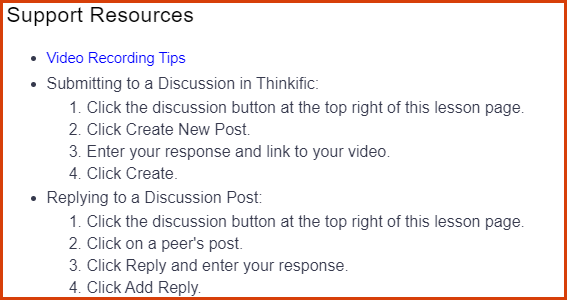
How this works in course design: Pair resources together based on processes or types of resources when they are needed for a specific activity. For example, if an assignment requires a student to submit a video, it is important to make sure there are resources for every step of the process, from creation to submission. Pairing the instructions for the activity with tutorials on how to record a video, upload the video to the institution’s streaming platform (e.g. Kaltura, YouTube), and share the video link provides students with all the resources, right when they need them
Figure 1: A process shown with each step linking out to a tutorial.
Think about Multiple Formats
Support can be offered in various formats, each one useful in different ways. By providing multiple formats you can directly improve Universal Design for Learning (UDL) even more throughout the course. This can look like providing a how-to video but also adding a link to a help article with text instructions below that video.
Consider integrating the following common resources into your course to enhance student support:
Help articles from the institution or platform (i.e. Canvas, Microsoft, Kaltura).
Video tutorials from the institution, Microsoft, or user communities.
Support Service contact information such as name of service, purpose, email, and phone. This could be student technology help desks or coaching and counseling services for example.
You can think of these types of resources when building your support framework throughout the course for students.
How This Works in Course Design: Ideally, students should be provided resources for every situation in multiple formats. A help article might be suitable for a short process needed across a wide range of people or for use in multiple courses. In-page instructions might be beneficial for providing quick guidance on completing an assignment directly within a course. Consider the situation, available resources for creation or storage, and the context in which students will need support to determine the most effective format.
Figure 2: A help article linked to the top of support resources for video tips, and instructions directly on the assignment page in the support resources for using discussions.
Be Mindful of Visibility
Students should not have to go digging to find the resources they need. Support should always be visible, easily accessible, and located where students will need them, when they need them. For instance, having support resources that students will need regularly or are more general should be included in the syllabus and at the top of the course. This will enable students to start the course with those resources in hand.
For resources that are connected to activities students may only need once, or require more in-depth instruction, place those resources where they are needed and when they are needed. For example, if you want students to know how to share a document in a discussion forum activity, provide the information within the activity itself.
How This Works in Course Design: Support resources need to be integrated seamlessly into both the course design and the course content. Avoid making support obtrusive to the activity, as it may distract from the content such as “Support” in red text at the top of the page. Instead, make it intentional and readily accessible. For instance, placing support information right before the first step of a process, such as at the end of assignment instructions but before the submit button, ensures it is conveniently located for students. This practice pulls on UDL guidelines where redundancy and providing information in multiple places improves the learning experience for these skills (UDL: The UDL Guidelines, n.d.).
Don’t forget the course instructor or facilitator!
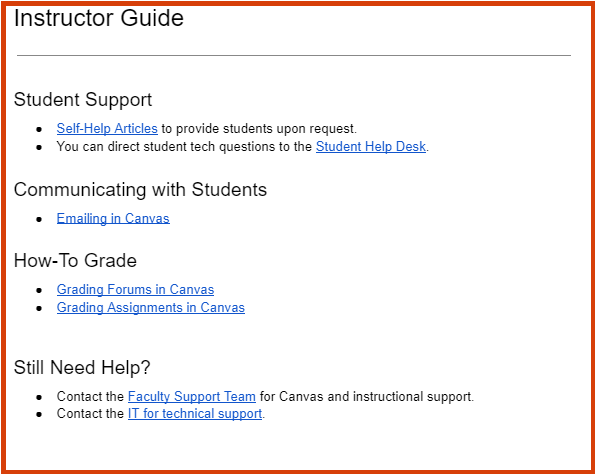
Sometimes instructional designers design courses with a developer who might not be teaching the course. The instructor may be unfamiliar with the support resources, why they are being included, and what they are expected to do with them. A well-supported instructor can create a more effective online learning experience. By establishing a resource space for course instructors, such as an Instructor Guide, you can provide instructors with a 1-stop shop for support even before they encounter difficulties. Faculty also have access to technical support options that students do not have, such as a Help Desk or faculty support team. Ensuring faculty are aware of all of their support options enables instructors to focus on their tasks, knowing they have resources available when they need them.
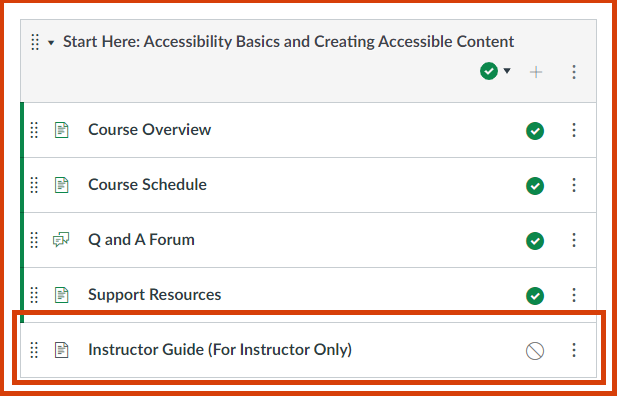
How This Works in Course Design: An example of this is creating an instructor guide which not only gives them links to resources to support students but gives them an area to find resources for running the course or troubleshooting a common issue. This could be in a hidden page resource marked “For Instructor Only” at the top of the course.
Figure 3: Instructor guide example in the LMS course itself with links to important resources for instructors such as common student support resources, how to communicate with students, how to grade, etc.
Figure 4: Instructor guide as a hidden page resource at the bottom of a start here section in an online course in Canvas.
That’s it! These are just a few ways to improve support, and there are many others. The key takeaway here is to always consider the specific course design needs when designing the support framework during course development
Usman, M., & Banu, A. (2019). A Study on Impact of Financial Stress on Students’ Academics. Journal of Business & Economic Policy, 6(1). https://doi.org/10.30845/jbep.v6n1p7
While attending a panel presentation by students pursuing degrees online, I heard one of the student panelists share something to the effect of, “Oh, I don’t do Office Hours. However, instead of Office Hours, one of my instructors had these ‘Afternoon Tea’ sessions on Zoom that I loved to attend when it worked with my schedule. She answered my questions, and I feel like she got to know me better. She was also available to meet by appointment.” What wasn’t revealed was why this student wouldn’t attend something called “Office Hours” but did attend these other sessions. Did “Office Hours” sound too formal? Was she unsure of what would happen during office hours, or unsure of what the purpose was? Did she think office hours was something students only went to if they were failing the course? The student didn’t say.
There is some mystery around why this student wouldn’t attend office hours, and her comment reminded me of what I had read in Small Teaching Online: Applying Learning Science in Online Classes, by Flower Darby and James Lang (available digitally through the Valley Library if you are part of the OSU community). In Small Teaching Online, under the section titled, “Get Creative with Virtual Office Hours,” several tips are highlighted for how to enhance participation in office hours. Here is a summary of a few of those tips presented in this book, which are based on Lowenthal’s 2017 study (pp. 119-121, Darby & Lang, 2019):
Rename office hours to sound more welcoming: “Afternoon Tea,” “Consultations,” or “Coffee Breaks” are some ideas to consider (p. 188, Lowenthal, 2017).
To enhance participation, plan just 3-4 well-timed sessions instead of weekly office hours, and announce them early in the term. For timing, think about holding a session before or after a major assessment or project milestone is due, for example.
Collect questions ahead of time, and make office hours optional.
Additionally, outside of office hours, remind students that you are available to meet with them individually by appointment since students’ schedules vary so widely.
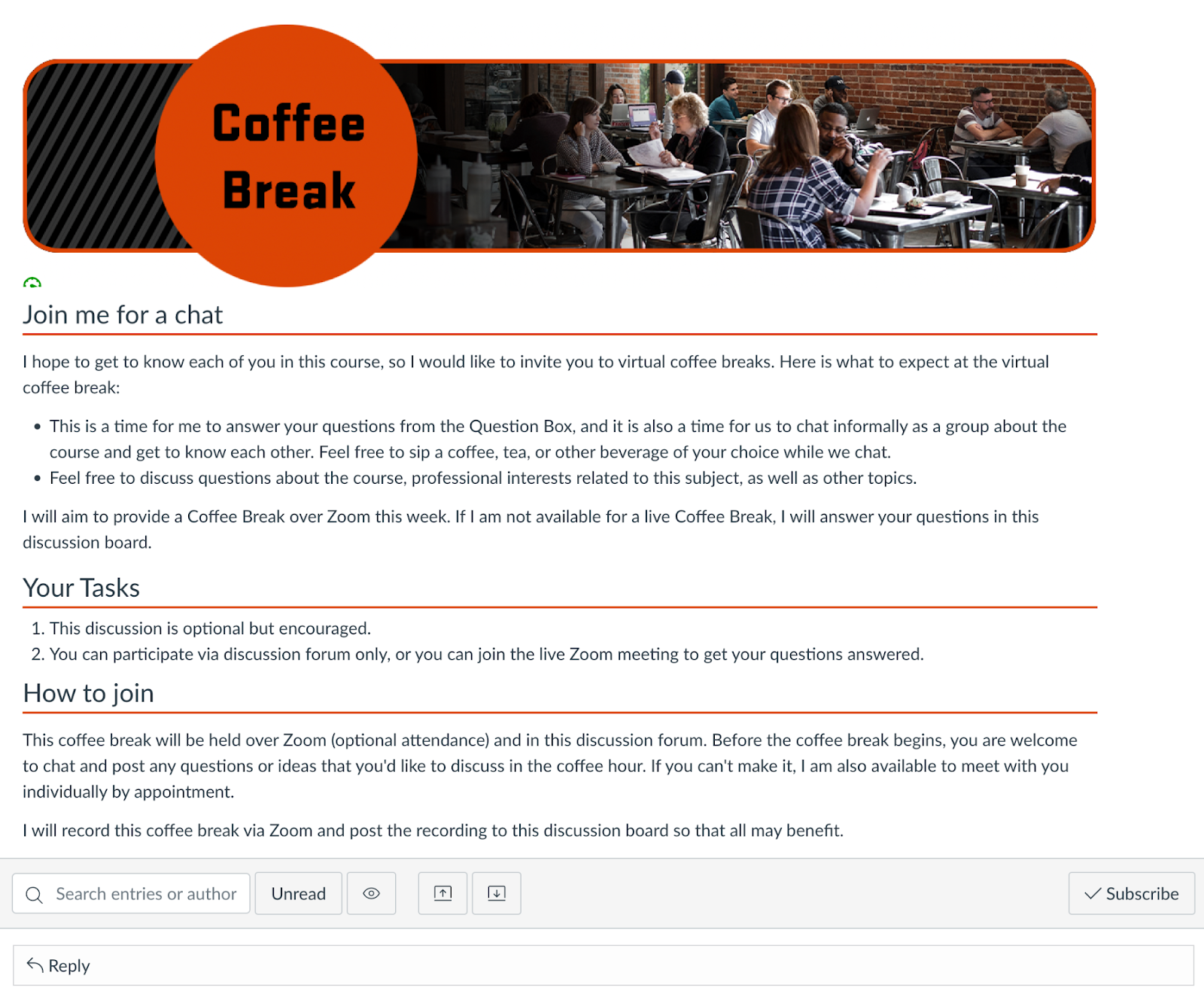
Putting these tips into practice, here is what the redesigned office hours can look like in an asynchronous online course, where this “Coffee Break” happens three times in the term and is presented in the LMS using the discussion board tool or the announcements feature as needed:
What I like about this design is that the purpose and expectations of the session are explained, and it is flexible for both students and faculty. The “Coffee Break” is presented in an asynchronous discussion board so that students’ questions can be collected ahead of time and at their convenience. Further, if something comes up with the faculty and the live “Coffee Break” is canceled, the faculty can answer questions asynchronously in the discussion board. There is also a reminder that students are invited to make a separate appointment with their instructor at a time that works for them.
Have you tried rebranding your office hours? How did it go?
References
Darby, F., & Lang, J. M. (2019). Small teaching online : applying learning science in online classes (First edition.). Jossey-Bass, a Wiley Brand.
Lowenthal, P. R., Dunlap, J. C., & Snelson, C. (2017). Live Synchronous Web Meetings in Asynchronous Online Courses: Reconceptualizing Virtual Office Hours. Online Learning (Newburyport, Mass.), 21(4), 177-. https://doi.org/10.24059/olj.v21i4.1285
As a follow-up to discussing equity in grading and group work, Feldman (2019) offers a compelling case against the use of extra credit. “But wait a minute,” I can hear you saying, “Extra credit is optional—students have to opt-in if they want to do it! And it can be fun! What’s wrong with that?” Many instructors may think of extra credit as a way to benefit students and give them extra opportunities in a course, especially at the end of a term, to improve their grade, take on additional challenges, and demonstrate additional skills they have learned. (I know I thought about extra credit that way at one time!) However, there is more at play with extra credit than you might think. Let’s return to Feldman’s three pillars of equitable grades:
“They are mathematically accurate, validly reflecting a student’s academic performance.
They are bias-resistant, preventing biased subjectivity from infecting our grades.
They motivate students to strive for academic success, persevere, accept struggles and setbacks, and to gain critical lifelong skills” (Feldman, p. 71).
With these three pillars in mind, let’s examine some potential issues with extra credit:
Accuracy: There are many ways extra credit can obscure what information a grade includes. First, it can be used to incentivize certain behaviors, which obscures a grade by not assessing academic performance or learning. (For example, extra credit for turning things in on time.) Second, it can obscure whether a grade reflects what students know by turning grades into a commodity (more about this below). In this way, grades are a reflection of how many points students are able to accumulate, not necessarily how much they have learned or whether they have met all of a course’s learning outcomes.This kind of extra credit can unintentionally signal to students that their behavior and non-academic performance in a course is more important than their learning.
Bias: Sometimes extra credit is awarded to incentivize students to participate in extra events or opportunities, like attending a webinar, guest lecture, local event, etc. However, in addition to treating grades like a commodity, this kind of incentive also makes it difficult for students without outside resources or help to engage. What about students without the money for event tickets, transportation, child or family care, and/or without the time away from work, family, etc.? They are unable to participate, even if they want to, due to external factors outside of their control. And often these are the students who could potentially benefit the most from additional points if they are already struggling because of these exact conditions. For extra credit that provides extra challenges beyond the course materials, only the students already doing well will be able to participate and benefit from the opportunity, additionally shutting out students who are already behind.
Motivation: Having extra credit, especially at the end of the course, can also be damaging to student motivation, as it places an emphasis on grades and points instead of learning. For example, some students may prioritize obtaining a desired grade above learning important content, while other students may use extra credit to bolster a weak area they were unable to fully grasp, thereby giving up on learning that material entirely. Both of these potential mindsets set students up to focus on a product (grade) more than learning and any future perspectives they might have about their learning.
One additional issue of extra credit to consider is the additional work and time on instructors for both designing additional assignments and grading the extra work, especially at the end of a term when there is usually a plethora of assignments, exams, and projects to grade.
“If the work is important, require it; if it’s not, don’t include it in the grade.”
Feldman, p. 122.
So, what options can we give students that are more equitable as an alternative to extra credit? Instead of creating additional assignments, allow students to revise and resubmit work. This shift can help support students by encouraging them to learn from past mistakes, build on their learning, and see their growth over time. Revisions and resubmissions don’t have to only happen at the end of the term, so instructors can also consider timing of revisions based on course design, formative and summative assessment timing, and their own workloads. It also helps students who may be struggling with outside barriers to have additional attempts to complete work they may have missed. It also means that students cannot opt-out of important work or concepts because they cannot substitute those points from other areas of the course. Lastly, it saves the instructor time from designing and implementing additional assignments and complicated grading setups at the end of a term when instructors are often the busiest. While the use of extra credit is often from a place of good intentions, I hope this brief outline helps recontextualize how it may have a larger, negative impact in your course than you may have initially thought, as well as a strategy for replacing it in your course designs.
One of the most common concerns that instructors raise about teaching online is how to engage students in meaningful interactions. Online discussion boards is the default for simulating the types of conversations that take place in a classroom, albeit the online environment favors written communication in the form of posts and replies. These written posts may be the easiest ways of communication in online learning environments offering students less overwhelming experiences and more opportunities for critical thinking and building community (see benefits of discussion boards). However, written communication is not the only way in which students can interact with one another -images, audio, or video can increase engagement and motivation. Still, these options are not intuitively built into online discussion forums.
The discussion board option appears to be boring and demotivating -it sounds more like a chore than an activity where students build community and participate in the exchange of ideas and perspectives – where they grow intellectually and as individuals. Online discussions can turn into spaces for dialogue, debates, and community. How do we design these spaces so that students engage and interact more meaningfully? Well, let’s explore a tiered approach to spark engagement in online discussions.
Tier 1: Revamp Discussion Boards
Consider the Community of Inquiry framework (CoI) in facilitating deep, engaging, and meaningful learning. The three elements of this framework can be used to design discussion boards: social presence, cognitive presence, and teaching presence. Ragupathi (2016) describes these presences in online courses as follows: “Social presence that will encourage students to present their individual personalities/profiles, help them identify with the community, communicate purposefully and function comfortably in a trusted environment; (2) Cognitive presence that will get students to introduce factual, conceptual, and theoretical knowledge into the discussion and be able to construct/confirm meaning through sustained reflection and discourse; and (3) Teaching presence to provide necessary facilitation of the learning process through effective discussion.” (p. 4). Social presence in particular can be achieved through discussions (although not the only tool) to promote a sense of connection and community.
Apart from a strong foundation on a sense of connection and community that the CoI promotes, the structure of the discussion assignment plays an important role. To this effect, “structure” and “why” are the key
Revise Structure and Format
Establish a clear purpose and add value to the participation/contribution:
Instructor-led: contextualize the outcomes, make explicit expectations
Student-led: ask students to share their takeaways from the discussion participation (e.g., reflection, embedded in assignments)
Connect the content to the discussion assignment (e.g., ask students to refer back or cite previous readings/videos completed in the weekly content)
Clearly set expectations for:
Grading criteria (e.g., provide a rubric or grading guidelines)
Timeframe
Resources (e.g., from the course or external)
What is a “good post” (e.g., provide an example, describe an example that does not meet expectations)
Clarify terminology (e.g., link to a glossary of terms)
The next tier is to augment the opportunities that discussion boards offer. Structure and creativity will intertwine in layers to turn discussions into collaborative spaces. Here, there is greater emphasis on community as a place where students take a more active role, embrace challenges, and own their contribution role as active participants in building knowledge together.
Start with setting the discussion board as a place for a conversation:
Introductions: encourage students to use additional elements to introduce themselves to the class (e.g., images, videos, goals, expectations). With the caveat that it is optional so they feel comfortable choosing what and how to share.
Create discussion scenarios/questions/prompts that elicit more than one response:
Post first before you see previous posts
Students post follow-up questions and bring additional examples. Students reply to more than 2 peers who have not received replies yet
Encourage students to bring their experiences, outside readings, and additional resources to share
Encourage posts in different formats (e.g., video, images, infographics, mindmaps)
Student-facilitated discussions:
Create small groups and ask students to select a leader (rotate leadership role) Alternatively, randomly assign a leader
Student leaders post summaries of discussions in small groups and/or in whole-class discussions
Set expected participation:
A minimum number of responses (1 post; 2 replies; number of posts in total)
Consider self-paced discussions and encourage students to post a certain number of posts throughout the term or week. (Caveat: the first few students that post might need to wait until others post)
Create a learning community for future assignments:
Students share initial drafts, outlines, and research topics and ask for comments/feedback. Alternatively, students post their initial work and share their goals, and ideas about how it is relevant. Students are encouraged to read the shared work or not.
The linearity that many discussion board platforms have could make the interaction feel inauthentic, boring, and tedious to navigate. An alternative to a linear discussion is the concept of social annotations and collaborative spaces where students intersect transversally and with multimodal elements.
Social Annotations: students can add comments, post questions, vote, and interact with peers over learning materials such as readings, videos, visuals, and websites. Students interact and collaborate based on interests and questions they have while studying the content. You can use social annotations as a learning tool.
Asynchronous conversations: increase the collaborative nature of group work with multimodality where students not only post and reply but also create their own content for others to comment on. Explore asynchronous conversations in VoiceThread.
Collaborative work: online discussions do not have to be about posts and replies only. Students can engage in meaningful conversations through collaborative work. For example, students can do collaborative assignments, interact synchronously or asynchronously, and comment on each others’ contributions. Some web platforms you can explore include Microsoft Whiteboard and Miro.
Tier 4: Unleash the Discussion Boards
While discussion boards are mainly associated with asynchronous learning environments, discussions can play an important role in hybrid learning. You may be wondering why when we know that one of the underlying features of hybrid learning is to use the class time for active learning, collaborative and team activities, increased participation, and social interaction. But these activities do not have to end when the class time is over. Discussions can help keep students engaged in the class topics and activities after the in-person experience. Any of the tier approaches described above could be integrated seamlessly into hybrid learning to give continuity to class conversations, prep for future in-person activities, foster metacognitive and reflection skills, and strengthen social presence.
*Note: The use of other tools outside of the Canvas learning management system will require a careful evaluation of accessibility and privacy policies.
Engaged learning design helps students comprehend the learning materials and apply the newly learned knowledge and skills to new contexts. Jessie Moore proposed six key principles for engaged learning, namely: * “Acknowledging and building on students’ prior knowledge and experiences; * Facilitating relationships, including substantive interactions with faculty/staff mentors and peers, and development of diverse networks; * Offering feedback on both students’ work-in-progress and final products; * Framing connections to broader contexts, including practice in real-world applications of students’ developing knowledge and skills; * Fostering reflection on learning and self; and * Promoting integration and transfer of knowledge” (Moore 2021; Moore, 2023).
This blog will showcase three course design projects using engaged learning principles to overcome design challenges, including challenging content, lack of student motivation, and/or difficulty transferring knowledge.
Design Case #1 Engaged learning Principle: Acknowledging and building on students’ prior knowledge and experiences Design Challenge: Students are non-accounting majors and need more motivation to study accounting. Design Solution: College students have all bought textbooks and paid bills for college education, even though they may not have any accounting training before. Building on students’ prior knowledge of bill paying and textbook purchases, the instructor created a mock-up student-run company and assigned students to work with accounting related to students’ activities, such as buying and selling textbooks and offering tutoring services, in order to make learning materials of “BA 315 Accounting for Decision Making” relevant and meaningful to students. The instructor also collaborated with Ecampus media team to create an online monopoly simulation game modified with Oregon State University themes to further engage students in accounting practices.
Design Case #2 Engaged Learning principle: Facilitating relationships, including substantive interactions with faculty/staff members and peers and developing diverse networks. Engaged Learning principle: Offering feedback on students’ work-in-progress and final products. Engaged learning principle: Fostering reflection on learning and self. Engaged learning principle: promoting integration and transfer of knowledge. Design Challenge: trauma-informed helping skills are challenging to teach in HDFS 462 online. Design Solution: Building on students’ prior knowledge and experiences (Discussion board activities)
The course developer used case study and group case discussion on developing a plan to help a client; Students individually practice attending and listening with single-word responses. Instructor provides feedback on both group work and individual work. Also, instructor Modeling the empowerment process with recorded videos, students practicing helping skills, and the instructor offering feedback on students’ helping skills practices with peer partners in the classmates. Connections to Broader contexts and promoting integration and transfer of knowledge: students practice helping skills with non-classmate clients; and instructor provides feedback.
Design Case #3 Engaged Learning Principle: Framing connections to broader contexts, including practice in real-world applications of students’ developing knowledge and skills. Design Challenge: There is a lack of full access to construction sites especially for students in CE 427 Online Course to get hands-on experience and understand construction site structure fundamentals. Design Solution: the instructor and instructional designer collaborated with the media team to design an interactive simulation called Clickable Structure to help students understand the most difficult concepts in the course: elements of structures and how various pieces relate to each other. The Clickable Structure simulation enables students to see each group of structures layer by layer according to their functions and the corresponding equations needed for calculations of weight bearing, etc.
What we see versus what students in CE 427 needs to learn
As a Reflection Tool Another way to use the six principles of engaged learning is to change the statements in the principles to a list of questions for students to reflect: 1. What prior knowledge do I bring to this topic? 2. What new knowledge and skills I learned about this topic? How are these new concepts and skills and principles and relationships related to each other? How does individual pieces of information connect to make sense? 3. What feedback did I receive from instructor and classmates that gives me insights to this topic? 4. How is this topic related to broader contexts of main learning outcomes of this course or real-world applications? 5. How could I use what I learned about this topic into real-world application? 6. What new understandings did I gain from this reflection activity?
If you find these six principles of engaged learning meaningful and have adopted or adapted them in your teaching and learning, I encourage you to share with us (email tianhong.shi@oreognstate.edu) so we can build a collection of engaged learning cases and examples.
This article has its roots in a discussion I had with an Ecampus intern about going on the job market. This intern is working in an academic technologies role at a higher ed institution already, but also getting the Instructional Design certificate here at OSU. It was my first time thinking about what the growth of instructional design certificate and degree credentials means for all instructional designers. Very few of the instructional designers I’ve met and worked with here or at my previous institutions actually have degrees in instructional design, including myself. The field of instructional design emerged out of a specific institutional and educational need in higher education and corporate education, which makes for an ever-growing, ever-changing, but always innovative membership. How do we, as a field, continue to be inclusive of all instructional designers, regardless of their academic or educational backgrounds?
One potentially positive fact is that academia moves very slowly, so we have some time to strategize. Instructional design is still an emerging speciality within higher education, with each institution classifying that role differently, and providing that role with different levels of support. Some institutions, even today, do not have any instructional designers. Current research indicates that this must change. One of the best sources of data about the field of instructional design in higher education and instructional designers is the Changing Landscape of Online Education (CHLOE) Project. The participants in the CHLOE survey are “the senior online officer at each participating institution.” This survey pool recognizes the variance in organizational structures at different institutions by focusing on the COO’s purview. In the 2019 CHLOE 3 survey, it was reported that the median number of instructional designers employed at 2-year colleges, and public and private 4-year institutions, was four, regardless of enrollment or institution size. In CHLOE 7, one of the conclusions was that “insufficient instructional design staffing may be one of online learning’s most serious long-term vulnerabilities,” with only 10% of Chief Online Officers surveyed describing their ID capacity as sufficient for their current needs, and only 3% believing they would be able to meet anticipated need.
These findings signal that universities should be moving towards a significant fiscal investment in hiring instructional designers. Joshua Kim wrote a few key takeaways from the CHLOE 7 in CHLOE 7: The Present and Future of Instructional Design Capacity. Kim predicts that universities will need to not only hire more instructional designers, but that these roles will need to be hybrid or remote to attract the post-pandemic workforce. In addition to hybrid and remote options, Kim posits that, “Forward-thinking universities may find that they need to start offering star non-faculty educators the same recognition and incentives that have long been necessary to recruit and retain star tenure-line faculty.” But what does this mean for instructional designers? How would an instructional designer even be able to become identified as a “star” within the field or even at a specific institution?
Understanding Branding for Faculty and Non-Faculty Educators
Circling back to my initial inquiry about what instructional designers can do to ensure the field stays inclusive, I believe an individual enterprise will have a collective impact that will benefit the largest number of people: personal branding. In What’s the Point of a Personal Brand? Executive coach Harrison Monarth uses the story of his client, Mike, to illustrate how important it is for employees to think about how personal branding is now a strategy for gaining visibility within organizations, and that visibility is now a key component when employers are thinking about promotion. Monarth observes that “In high-performing organizations, at certain levels, everyone is exceptional. To clearly differentiate your value and what you bring to the table, you need to do more than have a good reputation. You need to have an outstanding personal brand.” Having a brand isn’t the same thing as being a celebrity, although I think many would agree that there are celebrities in every field, even instructional design.
Creating a personal brand is a successful career strategy outside of the corporate world as well, and one of the fields that is encouraging faculty to think about branding is not, as one might think, business but medicine. In 2019, the Academic Medicine blog published Knowing Your Personal Brand: What Academics Can Learn From Marketing 101, the purpose of which was to persuade medical professionals that a brand identity can be empowering. According to the article,
[K]nowing one’s academic brand can (1) help faculty members approach projects and other responsibilities through the lens of building or detracting from that brand, (2) provide a framework for determining how faculty members might best work within their institutions, and (3) help faculty members better understand and advocate their own engagement and advancement.
Although this article specifically speaks to and about academic teaching faculty, Instructional designers at institutions are often placed in the professional faculty role, along with librarians or program directors, and have many of the same professional demands on their job descriptions. As former faculty, I can attest that both of my careers have included independent research, departmental service, and conference or publication responsibilities.
Finding Your Personal Brand
If a brand is defined as opinions that people have about you based on your work, it is important to be self-aware, and intentional about the work that you do. Creating your brand can be a difficult task if, like me, you have a variety of experiences and interests. It requires self-reflection about one’s accomplishments and body of work as a whole, and the need to generalize what are sometimes very disparate activities. In Using Your Personal Mission Statement to INSPIRE and Achieve Success, an article published in Academic Pediatrics, the official journal of the Academic Pediatric Association, the authors describe a framework for building a personal mission statement (INSPIRE):
Identify Your Core Values
Name the Population You Serve
Set Your Vision
Plan How You Will Achieve Your Vision
Identify Activities That Align With Your Mission
Review, Revise, and Refine Your Mission Statement
Enlist Others to Help You Accomplish Your Mission
A slimmed down version of this same framework can be a helpful starting point for creating a brand identity. It enables you to identify your core values, name the population you serve, and identify activities that support those values and populations. But unlike a mission statement, this framework is best completed in reverse; a backwards brand design, if you will. (Sidenote: Instructional designers love to do things backwards). I call this framework SIFT:
Start with your experience and accomplishments
Identify keywords or topics
Frame your work and interests
Tie everything together
I believe that SIFT-ing has the potential to be a reflective process that will lead to a changing self-awareness of different types of instructional designers, for ourselves, and collectively.
Start with your experience and accomplishments
The best place to begin is with your complete resume or CV. It might be tempting to start with the tailored version you used to get your last position, but you don’t want to limit your view to only things that you think are relevant to instructional design. I can trace some elements of my brand back to my undergraduate and graduate degrees. I also include my two years as a contracted captioner for 3play and Rev within the same brand. Finding a brand that encompasses all that you are will only be successful if you use the most complete picture of yourself.
Identify keywords or topics
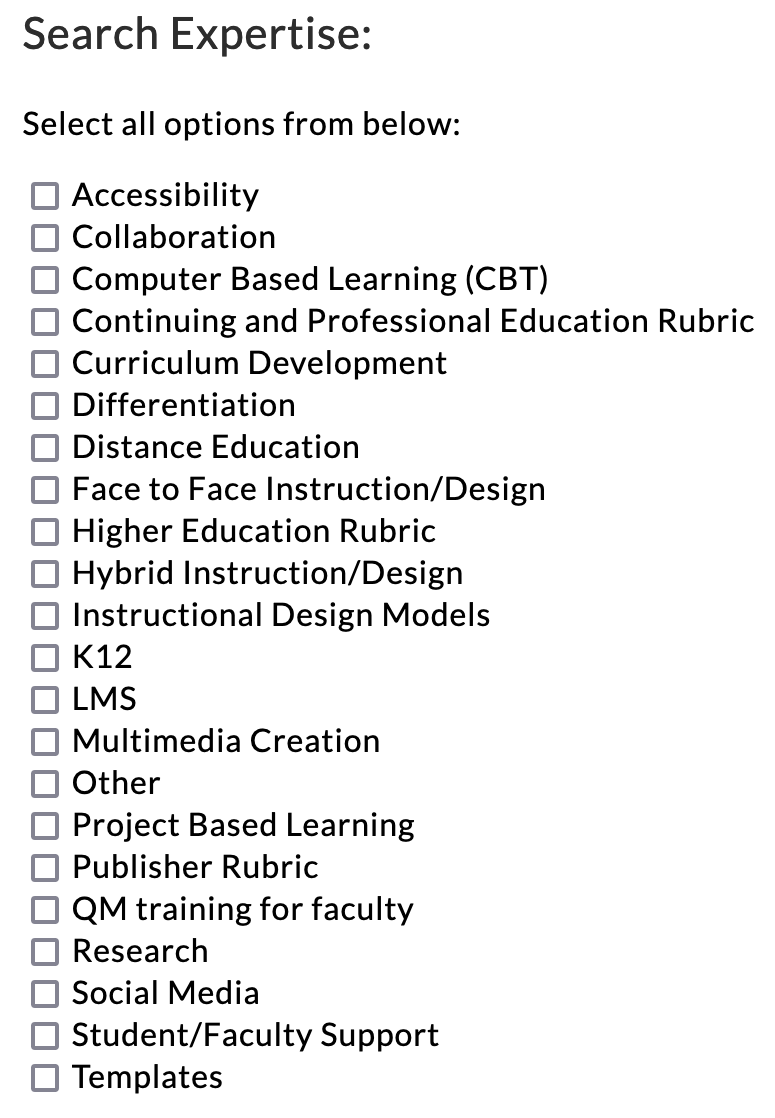
Your brand is more than just the places that you’ve worked at, the committees you’ve served on, and projects you’ve worked on. To understand your brand, you should begin by identifying a perspective, or positionality, that informs the decisions you’ve made in the past, however unconsciously that might have been, and looks towards the future. Keywords can be a useful next step, but you will want to avoid the potential to find yourself trapped within categories! In a field like medicine, there are already established research interests and specialties. As a field, instructional design hasn’t reached the point of specialization, but we are trending towards accepting that there are too many topics that fall under the broad umbrella of instructional design for everyone to be experts in everything. For example, the Quality Matters Instructional Designers Association has 21 expertise categories that you can select from when joining the association that others can use to find you to connect with you.
A screencapture of the list of categories from the QM IDA website
When I first joined the QM IDA, I didn’t know what boxes to check, or even what some of these categories were. And since they are presented without explanation, the criteria for self-identification are unclear. I can check almost all of these boxes as things I have experience in—with the exception of K12 and the Continuing and Professional Education Rubric, but is experience the same thing as expertise? It might be my imposter syndrome talking, but I am more inclined to identify with interests than areas of expertise. (Sidenote: I still haven’t checked any boxes.)
Frame your work and interests
I hadn’t noticed a pattern to my interests while I was doing them, but by reflecting on my professional journey, I realized that I could trace one interest all the way back to my undergraduate honors thesis, through to my current career as an instructional designer. I’ve always had an interest in communities and the community spaces they inhabit—especially if they are online. Community doesn’t appear on QM’s list of categories, but it is the lens through which I approach many of the categories on that list. Accessibility, Computer-Based Learning, Distance Education, Hybrid instruction/Design, LMS, Multimedia Creation, Problem-Based Learning—all of these categories need to address questions of community by addressing inclusivity, access, equity, and authentic student-student and student-teacher interactions. Community is the keyword I use to frame my research interests and approach to instructional design, in all of its various forms.
Tie everything together
If you go to my LinkedIn profile, you’ll see that I have “Humanities girl in an instructional technology world” as my headline. That’s my brand. You might notice that it does not include “instructional design” or “community.” But at the same time, by labeling myself a humanist, I am evoking the words associated with humanities and humanism–things like communities, kindness, compassion, human potential, and the arts. Technology is often viewed either as the savior of humanity, or its destruction. In reality, of course, it’s both. By framing myself as a humanist working with technology, I am clueing people in that my perspective on technology will incorporate potential negative impacts for people. The playful nature of the headline i.e. using “girl” to rhyme with “world” also reveals my personality. Compare this headline with something like, “I am interested in humane approaches to technology used in education.” It’s true, but it doesn’t tell you about me as a person outside of my interests.
Being “On Brand”
To declare a brand is not to limit your interests, nor should it be criticized as promoting a non-interest in other topics. Another observation from Kim is that instructional designers are likely very busy, and overstretched. In his words, there is “a significant mismatch between institutional demand for instructional design services and the available supply.” To avoid burnout, instructional designers need to be strategic with the projects they commit to. A brand can also help you be selective about which conferences you attend, or committees you serve on. Being “on brand” can be a way of focusing your energy, and also a touchstone of your identity.
Using the SIFT framework, you can reflect on your professional values, and your professional goals. One of my colleagues in the field is an accessibility expert, and gets called in to consult on all things related to accessibility in addition to her daily work as an instructional designer. She recently became a certified Accessibility Professional with the IAAP, and this credential is visible on her LinkedIn profile as an emblem of her brand. Knowing her brand allowed her to appeal to her institution to allow her this opportunity that enriches not only her own skillset, but the prestige of her institution by having an IAPP certified accessibility professional on their staff. In that sense, personal branding can also help institutions build diverse departments that are teams of specialists.
To return to the three benefits of branding for faculty outlined in the Academic Medicine article, knowing my brand helps me decide where to devote my limited bandwidth by pursuing professional activities that are “on brand” for me. I can also use my brand to search for specific opportunities that will build my brand, even if those fall outside the typical skillset of instructional designers. However, moving towards a “branding” mindset also benefits my colleagues, who are equally, individually, uniquely talented, and should be recognized for their specialties and allowed to follow their passions, rather than be constrained to their job duties. As instructional design teams at universities grow, having a team of specialists can also help alleviate burnout by allowing people to play to their strengths. This can ensure that instructional design remains a space where all career pathways are valid and not contingent on specific credentials.