Look out the window of a car driving along Oregon’s coastal highway 101 and you will see many roadside signs indicating the boundaries of the coastal tsunami zone. Natural phenomena can cause massive amounts of damage to the communities that happen to lie in their paths, the effects of which can last days, months, and even years beyond the actual event. In the wake of disaster, people are often unable to access necessary resources or are left stranded waiting for help. Community design and engineering don’t always take into account the personal lived needs of those within the community, therefore a human centered approach is needed to compliment quantitative disaster projections and more accurately predict the most effective plan for community recovery.
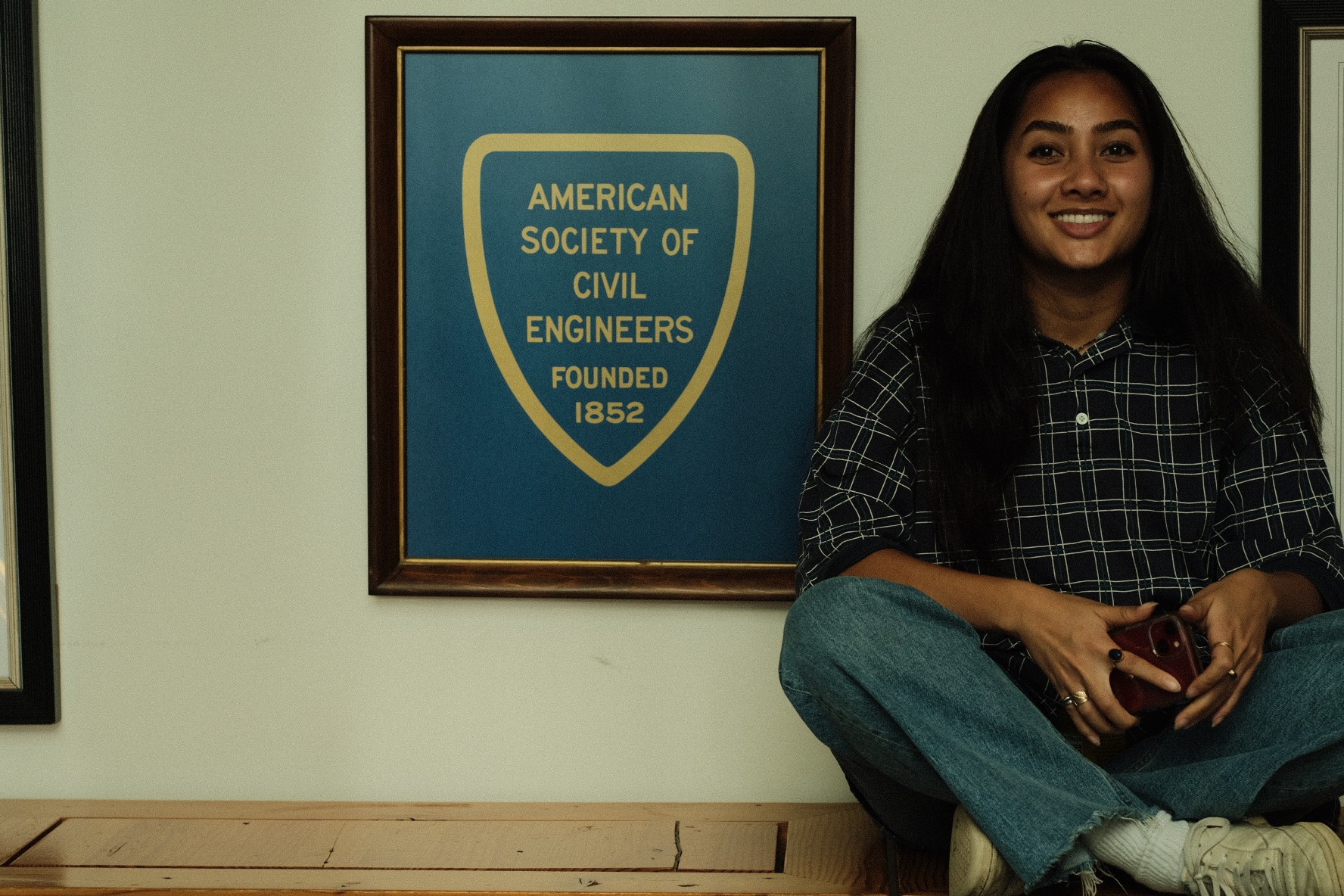
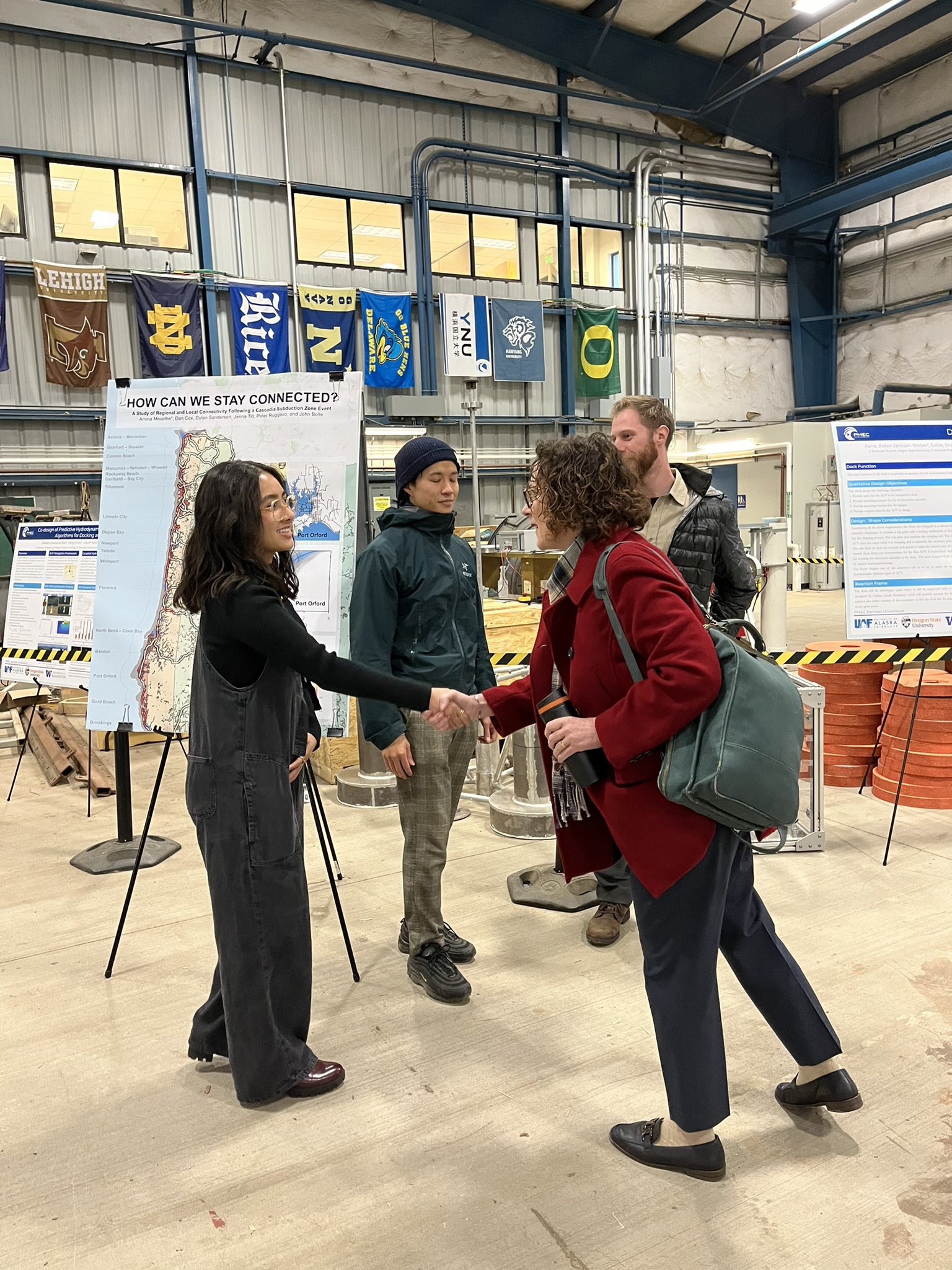
This is where engineering and social science collide. Our guest this week is Amina Meselhe, a 2nd year PhD student in the School of Civil and Construction Engineering. Amina’s current PhD project involves simulating the damage and recovery trajectories for the Cascadia Subduction Zone in the event of a tsunami. Her self-described research goal is to “create tangible outcomes for people to hold onto”. Her acute awareness for disaster preparedness comes from the fact that she grew up in Louisiana seeing the damage that hurricanes can cause and the lasting effects they have on people.
Tune into KBVR 88.7 FM at 7:00 pm PST on March 8th to hear Amina talk about what she is doing to improve the preparedness of communities along the Oregon coast, the research methods used by engineers to incorporate social science into their designs, and why “natural disaster” is a taboo term in the field.
Sam Harry’s research is filled with bizarre scientific instruments and massive contraptions in an effort to bring large natural events into the laboratory setting.
Sam Harry, second year PhD candidate in Civil Engineering
“There’s only a couple like it in the world, so it’s pretty unique”. Unique may be an understatement when describing what may be the largest centrifuge in North America. A centrifuge is a machine with a rapidly rotating container that can spin at unfathomable speeds and in doing so applies centrifugal force (sort of like gravitational force) to whatever is inside. This massive scientific instrument– with a diameter of roughly 18 feet– was centerpiece to Sam’s Master’s work studying how tsunamis affect boulder transport, and the project drew him in to continue studying the impact of tsunamis on rivers for his PhD.
But before we jump ahead, let’s talk about what a giant centrifuge has to do with tsunamis. Scientists studying tsunamis are faced with the challenge of scale; laboratory simulations of tsunamis in traditional water-wave-tank facilities are often difficult and inaccurate because of the sheer size and power of real tsunamis. By conducting experiments within the centrifuge, Sam and his research group were able to control body force within the centrifuge environment and thus reduce the mismatch in fluid flow conditions between the simulated experiment and real-life tsunamis.
When tsunamis occur they cause significant damage to coastal infrastructure and the surrounding natural environment. Tsunamis hit the coast with a force that can move large boulders– so large, in fact, that they aren’t moved any other way. Researchers can actually date back to when a boulder moved by analysing the surrounding sediments, and thus, can back calculate how long ago that particular tsunami hit. However, studying the movement of massive boulders, like tsunamis, is not easily carried out in the lab. So, Sam used a wave maker within, of course, the massive centrifuge to study the movement of boulders when they are hit with some big waves.
Sam’s work space. The Green dye added to the water within the glass tank is what gives this tank it’s name: The Giant Snot
As Sam was completing his Master’s an opportunity opened up for him to continue the work that he loves through a PhD program in civil engineering with OSU’s wave lab. Now Sam conducts his research using the “glass tank”, which, as the name alludes to, is a glass tank roughly the size of a commercial kitty pool that is used to contain the water and artificial waves the lab generates for their research. There are actually three glass tanks of varying sizes. The largest tank, which is larger than a football field, is used for more “practical applications”. Sam gives us the example of a recent study in which researchers built artificial sand dunes inside of the tank, let vegetation establish, and then hit the dunes with waves to study how tsunamis impact that environment. (Legend has it that the largest tank was actually surfed in by one of the researchers!)
Sam’s smaller glass tank, though, is really meant for making precision measurements to better study waves. He uses lasers to measure flow velocity and depth of water to build mathematically difficult, complex models. Essentially, his models are intended to be the benchmarks for numerical simulations. Sam, now into his second year of his PhD, will be using these models in his research to study the interaction between tsunamis and rivers, with the goal of understanding the movement and impact of tsunamis as they propagate upstream.
To learn more about tsunamis, boulders, rivers, and all of the interesting methods Sam’s lab uses to study waves, tune into KBVR 88.7 FM on Sunday, November 3rd at 7pm or live stream the show at http://www.orangemedianetwork.com/kbvr_fm/. If you can’t join us live, download the episode from the “Inspiration Dissemination” podcast on iTunes!