Jose Aguilar is not here to help robots take over the world. In fact, the first year PhD student studying artificial intelligence says he’s actually working on the opposite–to ensure that AI systems are safe, and raise alarm when they’re not.
Aguilar’s research focuses on the theoretical and applied aspects of safe AI. In the theoretical realm, he tries to ensure probabilistically that a model is going to be safe. When that algorithm or model is used in a situation–like autonomous vehicles, for example–his work moves over to the application side.
And we really need safe AI! Listen to Selene and Jenna’s conversation with Jose to learn more about safe artificial intelligence and how Jose’s background of growing up in Mexico and moving to Oklahoma brought him to OSU.
Our next guest is Lauren Diaz, a fourth year PhD student in the Department of Fisheries , Wildlife and Conservation Sciences. Lauren is advised by Prof. Jim Peterson and focuses on the population dynamics of freshwater organisms.
Lauren studies rainbow trout, a widespread salmonid with important ties to recreational fishing and a complex life trajectory. The salmonid family of fish includes large species like Chinook salmon that are ecologically important food sources for both marine and terrestrial species including humans. Trout eggs hatch in freshwater but some juveniles undergo significant physiological changes and spend a large portion of their lifespan in the ocean before returning to the rivers to spawn. This ‘anadromous’ form of rainbow trout is called steelhead.
Lauren uses the Stanislaus River in California’s Central valley as a model system for understanding the impact of dams on the life histories of trout. The prominence of agriculture in the Central Valley has left its watersheds full of dams, irrigation systems and other human diversions. Monitoring fish populations throughout this complex network can be challenging due to a lack of standardization in monitoring systems. In response to this uncertainty, Lauren turns to computer simulations to shed light on the population dynamics of rainbow trout. Specifically, her simulations model the decision-making of individual fish in response to environmental stimuli. Lauren tweaks assumptions of the model such as the typical responses of trout to water depth, prey density, other fish, and tree coverage. In this way, population-level patterns emerge from a set of interpretable individual-level rules. Of particular interest to Lauren is the rate at which fish remain in the stream rather than becoming steelhead. Some preliminary evidence suggests that reduced seasonal fluctuations of water levels due to climate change could be suppressing the relative share of steelhead.
Lauren grew up in Miami, Florida, a place where encounters with tropical wildlife are part of everyday life. She was fascinated by reptiles and amphibians and became known as the “animal person” within her family and eventually studied herpetology during her undergraduate career at the University of Florida and a master’s degree at Clemson. An interest in hellbender salamanders, which live alongside rainbow trout in cool freshwater streams, led her to pursue the PhD at Oregon State. To hear more about her journey and research, tune in to KBVR 88.7 FM on Sunday, January 28th or shortly thereafter wherever you get your podcasts!
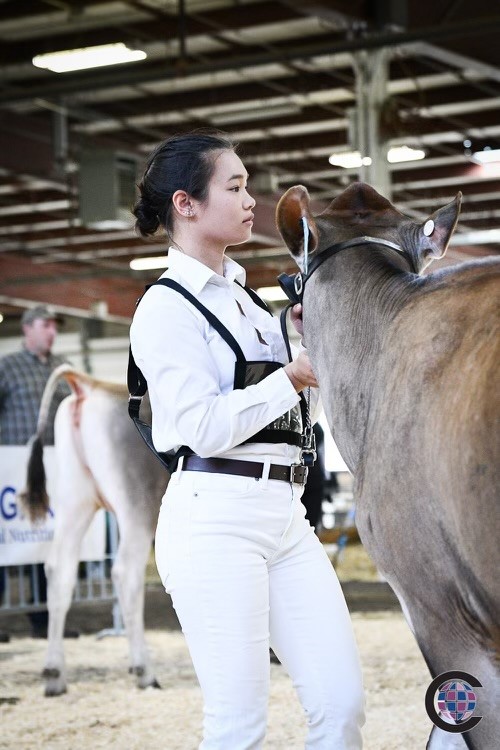
For those of us who consume dairy products, we often don’t give much thought to the trials and tribulations that had to be faced to get that product on the grocery shelves. It’s probably a fair assumption to say that most of us have never considered that cheese could explode, but that is the center of Madeleine Enriquez’s graduate research.
Madeleine (Maddie) is a master’s student in the laboratory of Joy Waite-Cusic, and she investigates dairy microbiology and spoilage, particularly mitigating “gas defects” in cheese. In semi-hard to hard cheeses certain microorganisms can cause build-up of gasses called “gas defects” which can eventually lead to blow-outs of the cheese in its packaging, or significant structural defects within the cheese (think Swiss cheese holes where they’re not supposed to be). Maddie works on practical and easy ways to mitigate these gas defects for small dairy farmers. Some of the variables include aging temperature, bioprotective cultures, or combinations of both.
Maddie’s interest in this particular area of food science originally stemmed from her grandfather, who was a dairy farmer. She went to the University of Connecticut for her bachelor’s degree in animal science. While there she participated in undergraduate research on dairy farms, particularly focusing on dairy microbiology later in her degree. This eventually led to her coming to Oregon State to further her education in dairy food science.
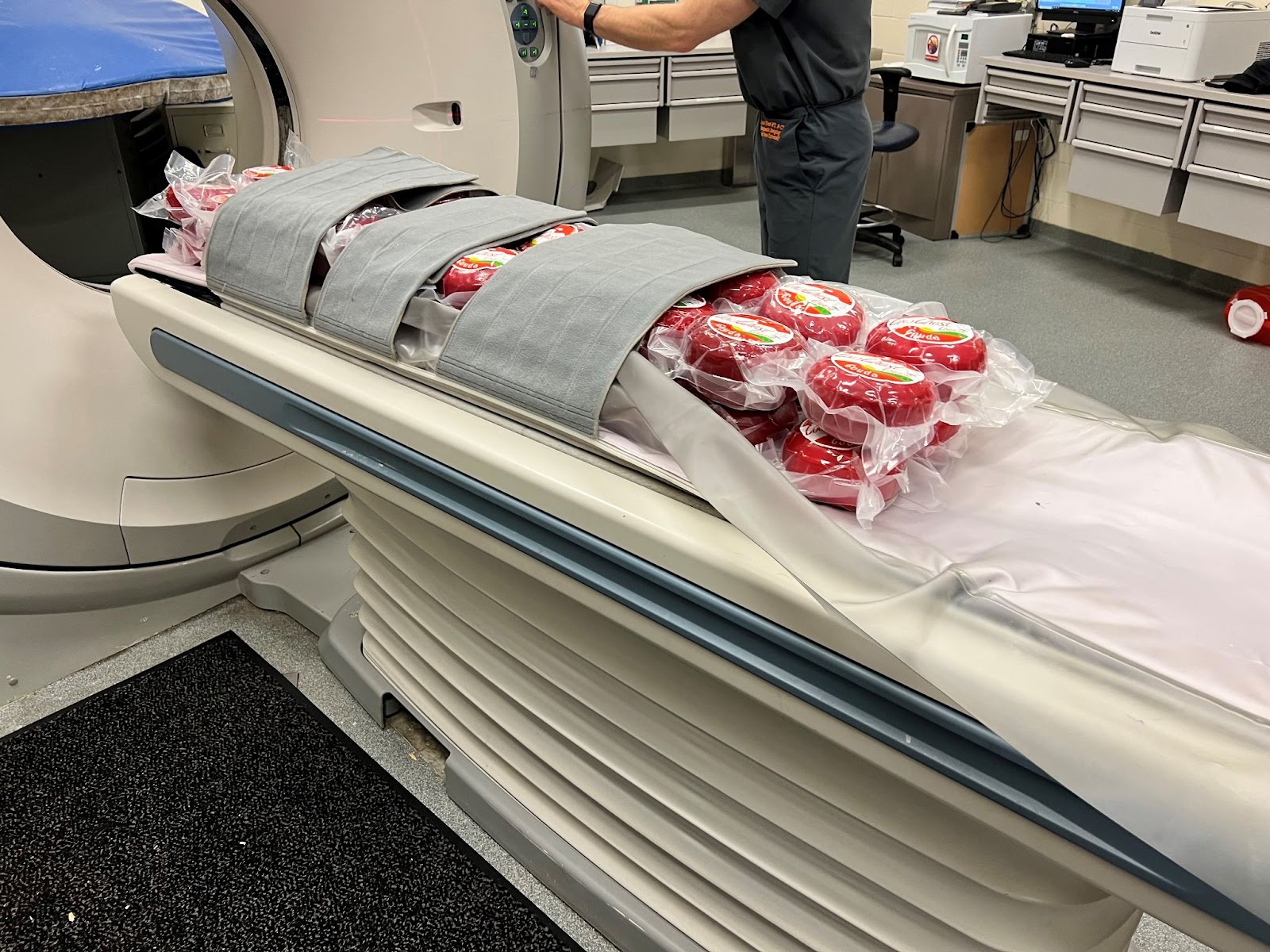
If you want to hear more about exploding cheese, making gouda on a weekly basis, and strapping wheels of cheese in for a CT scan, tune in for this episode of ID airing live on Jan 21, 2024.
Natalie Van Gelder wants to teach writing, but not necessarily to people who want to write.
The first-year MFA student in creative nonfiction recognizes writing as a tool for discovery–particularly as an exploration of self-discovery, and especially when it comes to better understanding neurodivergence.
Natalie’s writing contributes to the work of medical humanities and narrative medicine, both emerging fields that explore the humanities as tools for increasing empathy in medicine. Narrative medicine likewise recognizes the all-too-common disconnect between practitioners and their clients, and aims to incorporate storytelling into the practitioner-patient relationship. That might look like practitioners spending more time with patients, or asking them to write about family histories before asking about symptoms, knowing that through a thorough understanding of a patients’ background, more helpful information about their current conditions may emerge.
After graduating from California State University Bakersfield in 2008 with a degree in literature, Natalie worked in technical publications at NASA. She’s always loved science (and says if she wasn’t a writer she would be an entomologist) but it wasn’t until her MA program in creative writing at California State University Northridge that Natalie realized writing could be a tool of discovery and could help her better understand her own diagnoses.
Her graduate thesis “Desert Anxieties” was a hybrid work that explored her own neurodivergence. The paper was written in IEEE, a format commonly used for scientific publications. By using this style typically reserved for detached scientific observation, Natalie put herself as the work’s case study, interrogating the distanced treatment she typically received from doctors and psychiatrists.
Now, Natalie’s work continues to explore trauma studies and disability, especially neurodivergence as it presents as ADHD and autism. As a neurodivergent writer, Natalie is well aware of the power of writing as a way of interacting and making sense of the world. It’s a powerful tool that she wants to teach to people who may not be familiar with the practice.
“WIth Open Arms” (a photograph from Natalie’s MA thesis)
Currently, Natalie teaches WR 121, an introductory composition course that is typically populated by mostly STEM majors–and she loves it. While still only in the first term of her two-year program, Natalie hopes to work in the medical field after graduating, teaching writing to mental health practitioners and therapists, giving them resources to pass on to their clients about the power of writing as a tool for self-discovery.
Tune in Sunday 12/03 to hear Natalie talk about all this and more on KBVR 88.7, or catch the episode later on our podcast.
Our next guest is Matt Vaughan, a third year PhD student in Integrative Biology working with Prof. Sarah Henkel in the Benthic Ecology Lab. Matt originally hails from Melbourne, Australia and recently joined the ID team as a host. A major theme of his research interest is biological “disturbance and change”, meaning the impact of stressors on organisms and ecosystems.
Matt’s PhD research centers around invertebrate life found on the ocean floor, known to researchers as the “Benthic zone”. He focuses especially on ghost shrimp, a type of crustacean that builds burrows on the ocean floor. In the Pacific Northwest, ghost shrimp have historically inhabited estuaries, the areas where rivers flow into the sea. Within the last decade however, a significant population of ghost shrimp has arisen much farther than expected for the species, more than seven miles off the coast of Oregon and southern Washington. This mysterious colonization could have been spurred by environmental disruptions such as climate change, and the shrimp also represent a significant change in the local ecology of the ocean floor. Firstly, ghost shrimp burrows alter the habitat for preexisting invertebrate species, reducing stability on the seafloor. The large and intricate burrows are often in high densities, and the sand they kick up through their bioturbation can affect the survival and behavior of invertebrates like bivalves. Ghost shrimp burrows also oxygenate the sediment and host vibrant microbial communities, together altering the biogeochemistry of the ocean floor.
Matt (orange hat), surveying the latest floor sample
Matt studies these ecological dynamics by surveying the ocean floor during boat trips out of Newport. His team samples the bed using box cores to collect, identify and count the invertebrates. Matt then uses computational and statistical analysis to characterize the population structure of these areas, particularly seeking to tease out the differences in species distribution between areas with and without ghost shrimp burrows. Ghost shrimp are also relatively large compared to other invertebrates in the area, so their arrival provides a significant potential food source for larger marine life like sturgeon and even gray whales. In the rest of his PhD, Matt hopes to model this trophic impact in the long term.
Spooky
To hear more about Matt’s research and how his travels to the Great Barrier Reef and Southeast Asia helped him discover his love for science, tune into KBVR 88.7 tonight at 7pm or listen soon after wherever you get your podcasts.
This week on ID we interview El Rose, a talented first year MFA student of non-fiction in the School of Writing, Literature and Film. El draws on their background growing up in rural Arkansas to write about topics of class, immigration, intergenerational trauma, identity, and the intersection of it all.
Their work falls primarily within the realm of memoir. ‘Memoir’ is derived from the French word ‘mémoire’, which means ‘reminiscence’ or ‘memory’. Memoir falls into the category of non-fiction but is ultimately a subjective narrative in which the author remembers experiences, emotions, and events from a certain event or period in their life. Memoirs focus on conveying their perception of these memories in a way that is emotionally truthful but isn’t necessarily factual.
El began their journey in writing at the University of Memphis, although they’ve been writing in one manner or another for most of their life. They spent eight years between finishing undergrad and coming to OSU, working through the ranks in the food industry and eventually becoming an owner of a cafe in the Portland area. Through a series of perfectly timed events, and their own desire to make more space to take their writing seriously, El came to OSU to set out on the grad school journey.
To hear more about how writing a memoir works, as well as El’s journey from Arkansas to Oregon, tune in this Sunday, November 12th live on 88.7 FM or on the live stream. Missed the show? You can listen to the recorded episode on your preferred podcast platform!
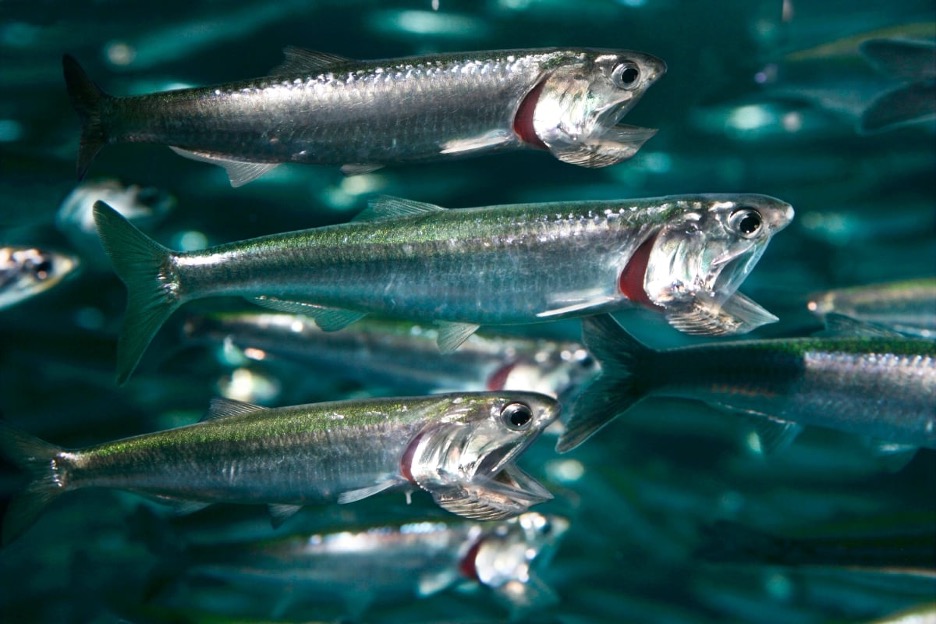
Trophic ecology studies how energy flows through food webs; basically who is eating whom in an ecosystem. Understanding the structure of feeding relationships among species in a system helps us to understand why populations may fluctuate in terms of abundance or distribution at different times. These dynamics are particularly important to consider in the face of a changing climate as conditions like increasing temperatures make resources less predictable. Our guest this week is Luke Bobay, who is trying to do exactly this for anchovy in the Pacific Ocean off the US West Coast.
Luke, a 3rd year PhD student in Integrative Biology, is researching the potential influences of climate change on anchovy abundance by studying its ecological effects on their early life stages. Anchovy are forage fish, which means they are eaten (aka foraged upon) by a lot of larger animals such as birds, marine mammals, other predatory fish, and humans. They are also short-lived and therefore we expect their population dynamics to respond pretty quickly to things that are happening in the environment.
For his research, Luke is looking at the larval stage of anchovy. He uses samples and plankton imagery data collected on weeks-long research cruises that Plankton Ecology Lab has conducted during the past six years, as well as samples collected by the National Oceanic and Atmospheric Administration (NOAA) since 1996. The samples that Luke uses are collected using large nets with a very fine mesh that enables the collection of tiny plankton. The imagery data are collected using a sampling technology unique to Luke’s lab called the In Situ Ichthyoplankton Imaging System (ISIIS). ISIIS uses a high-resolution camera to take images of the water column at a very high spatial and temporal scale, allowing the lab to basically take one long continuous image of what’s happening in the top 100 m of the ocean. These images are then run through an AI image classification model that automatically identifies and measures each individual plankter that is recorded. Both the net and the ISIIS also record data about the environment, such as temperature, salinity, and depth. By examining relationships between environmental conditions, the abundance of other plankton, and the abundance and other characteristics of anchovy larvae, Luke explores the factors that may contribute to variability in anchovy abundance.
In Situ Ichthyoplankton Imaging System (ISIIS)
To hear more about the day in the life of an anchovy, as well as Luke’s journey from OSU to another OSU, tune in this Sunday, November 5th live on 88.7 FM or on the live stream . Missed the show? You can listen to the recorded episode on your preferred podcast platform!
This week we are chatting with new ID host Selene Ross on her path to earning an MFA in fiction in the School of Writing, Literature, and Film. Inspired by her upbringing and life in northern California, Selene’s interest lies in looking deeper at why we believe what we believe, exploring power, women, and trust through short stories. What makes a short story different than a novel? In short stories, nothing has to change except everything to change, leading to a “surprising but inevitable” ending.
Selene began her journey at UC Santa Barbara studying Environmental Science and Sociology, focusing on the native plants of Central California. Straight from undergrad, she moved to Berlin, Germany on an au pair visa and became part of a vibrant community of writers and poets. After moving back to the U.S., Selene looked to radio as a way to do creative work and worked with various production companies prior to starting here at Oregon State. In wanting to stay connected with the audio world she is starting her own show on KBVR, Mystic Yarn, and joining us here at Inspiration Dissemination.
What does getting an MFA in creative writing look like? This program encompasses two main areas, writing workshops and more interdisciplinary “craft” classes. The workshop is where students submit original work and gather critiques from peers, while the “craft” classes are more generative, and a place to draw inspiration from other areas of creative expression, like poetry or non-fiction. The final hurdle is the thesis defense, which can take many forms depending on the area of focus. In Selene’s case, this will look like a collection of fiction short stories.
Tune in this week to hear all about her writing process, how she incorporates “spooky” into her writing, and listen to an excerpt from her work.
Per and polyfluoroalkyl substances, also known as PFAS, are widely used, long lasting chemicals, components of which break down very slowly over time. This is why you may have heard these substances called “forever chemicals.” Because of their widespread use in anything from firefighting foams to non-stick pan coating, and their persistence in the environment, many PFAS are found in the blood of people and animals all over the world. PFAS are found in water, air, fish, and soil at locations across the world and have been linked to harmful health effects, including various forms of cancer. However, the toxicity of these substances are not fully understood.
There are thousands of PFAS chemicals, and they are found in many different consumer, commercial, and industrial products, making it challenging to study and assess the potential human health and environmental risks. Additionally, it is challenging to accurately detect and quantify PFAS levels in environmental samples.
Esteban Hernandez is a chemistry PhD student conducting his research in the lab of Jennifer Field in the department of Environmental and Molecular Toxicology. His research focuses on developing fast and accurate detection techniques for PFAS. Specifically, he utilizes nuclear magnetic resonance spectroscopy (NMR), which provides an alternative to the canonical methods of PFAS detection such as mass spectroscopy. Esteban has found that utilizing NMR this way allows for detection of different varieties of PFAS, which had previously not been detectable with other methods. This has big implications for the field of PFAS research and environmental testing.
Esteban comes from a part of North Carolina that has been highly impacted by environmental PFAS contamination, sporting the title of the second worst drinking water in the country behind Flint, Michigan. His research has a very personal connection to his history and where he comes from. However, researching forever chemicals was not always his plan. He started his undergraduate journey as a theater major at Mars Hill University, eventually finding his way to chemistry and the University of North Carolina. In his undergraduate research at UNC he worked on developing an estrogen analog to help treat breast cancer. During his masters (also at UNC) he worked on synthesizing an anticancer compound originally found in sea cucumbers from the sea of Japan. Even when he came to OSU he didn’t initially think he would be working on PFAS detection. When he joined the Field lab, and consequently the field of PFAS research, he found the right fit for him. Tune in to Inspiration Dissemination this week to hear all about Esteban’s research and pathway to graduate school.
Getting to the bottom of what top predators in an ecosystem are eating is critical to understand how they may be influencing dynamics in the entire system and food web. But how do you figure out what a predator is eating if it’s hard to catch and collar or watch continuously? Easy, you use their poop! Ellen Dymit, a 4th year graduate student in the Department of Fisheries, Wildlife, and Conservation Sciences advised by Dr. Taal Levi, is our guest on the show this week and she is a poop-tracker extraordinaire!
For her PhD research, Ellen uses primarily non-invasive genetic methods to study large carnivores in two projects in Alaska and Central America. While the systems and carnivores she studies for these two projects are pretty different, the techniques she uses to analyze the collected scats are the same. The Alaska project is focused on determining what different wolf populations and packs across coastal Alaska are consuming, whether individuals are specialized in their feeding habits, and how large the populations are. The Central America project, which is based out of Guatemala, looks at a whole host of predators, including jaguars, pumas, and ocelots, to gain a better understand of the food web dynamics in the ecosystem.
One of Ellen’s extremely remote field camps in Alaska
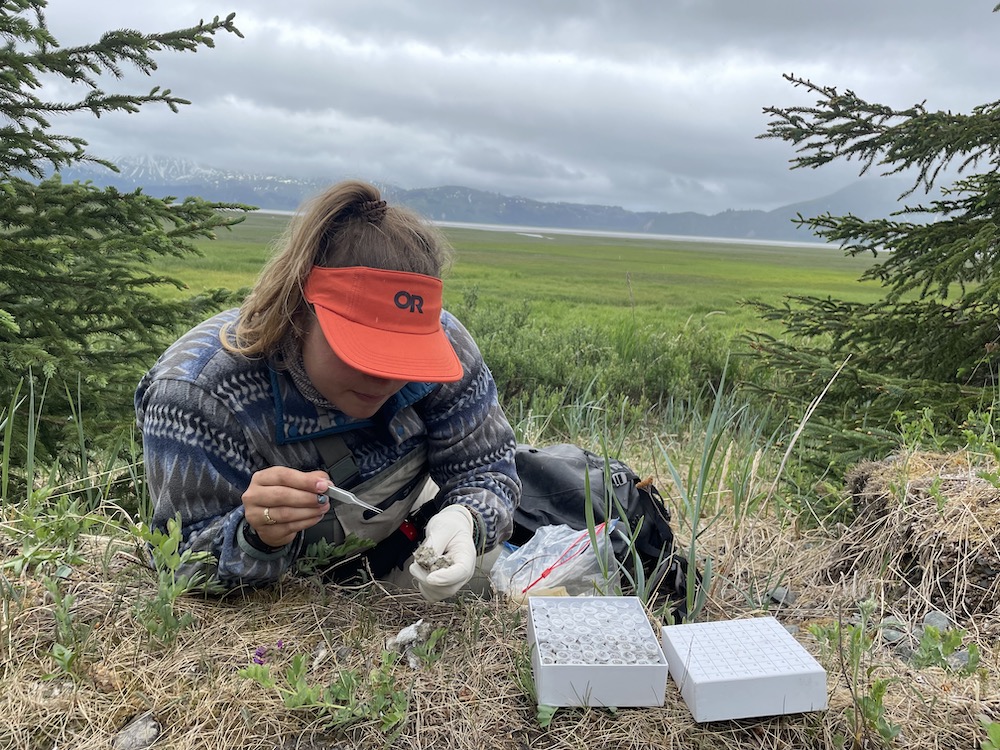
Both of these projects involve some unique challenges in the field that Ellen has had to learn to tackle. DNA can deteriorate pretty quickly, especially in warm Guatemalan temperatures, which is problematic when you’re trying to analyze it. Yet, Ellen’s lab has perfected methods over the last few years to work with neotropical samples. Ellen’s Alaska field work is incredibly remote as it’s just Ellen and one field technician roaming the Alaskan tundra in search of wolf scat. Accessing her field sites involves being flown in on a small fixed wing plane, where they are extremely space and weight-limited. Therefore, every single piece of gear needs to be weighed to ensure that the pilot has enough fuel to get to the site and back. As a result, Ellen isn’t able to collect the entire scat samples that she finds but can only take a small, representative sample.
Ellen sub-sampling a wolf scat
Ellen’s incredibly adventurous field work is followed by months spent in the lab processing her precious scat samples. So far, her results have revealed some pretty interesting differences in diet of wolf packs and populations across three field sites in Alaska. The Guatemalan project, which occurs in collaboration with the Wildlife Conservation Society Guatemala, is one of the first to analyze a large sample size of ocelot scats and the first to attempt DNA metabarcoding of samples collected in the neotropics.
To hear more details about both of these projects, as well as Ellen’s background and some bad-a$$ stories from her Alaskan field work, tune in this Sunday, October 15th live on 88.7 FM or on the live stream. Missed the show? You can listen to the recorded episode on your preferred podcast platform!