Natter’s Notes

Jean R. Natter, OSU Master Gardener

Many gardeners are trying to be environmentally sensitive in various ways, in particular, trying to conserve water use in the garden. Often, an in-ground sprinkler system (or hose-end device) is forsaken on behalf of soaker hoses or a drip sytem. Unfortunately, the entire project can go south in a hurry. Plants don’t thrive; some become puny, others wilt, and still others die.

Rather than explaining how to install a drip system, I’d rather discuss the guiding principles one must adhere to if the system is to be successful. In other words, if the gardener intends to obtain the abundant yield s/he expects. So, consider starting your first installation with a kit; it will contain all the needed parts and clear directions how to hook them up. Or, if you’re determined to dive in and set up everything from the start, you might want to obtain an instruction text or a manufacturer’s booklet, the latter often free at retail outlets, located with the irrigation supplies.

The important principles

Oh, yes. Here’s an overriding principle, whatever your method: On an individual dripline, always use component parts from the same brand because, unfortunately, one brand’s half-inch, etc., isn’t necessarily the same as another brand’s.

Disasters can be avoided by understanding a few basic principles, perhaps the most critical of which include the following:

– Output of an in-ground sprinkler system is gallons per minute.

– Output of a soaker or drip system is gallons per hour.

– Therefore, a drip system must run much longer than a sprinkler sytem to adequately supply plants.

– A drip system will put out uniform amounts of water per hour if pressure-compensated drippers are used.

– Further, it’s important that a drip line is on its own valve, not combined with sprinklers. To convert a sprinkler system to drip, all heads must be either changed to drip or capped off.

Soaker hoses

With soaker hoses, the output is inherent in the product. Output will be the same the length of the hose as long as it is on level ground and the water pressure is only sufficient to make the hose sweat. If a soaker hose sprays, the plants at the far end of the hose will receive less water than those at the beginning. Then, too, the hose may burst. (The exceptions are hoses which are designed to spray.)

Even though soaker hoses aren’t pressure-compensated, gardeners can gain that advantage from a commercially available plastic drip hose which has built-in pressure-compensated drippers at specified intervals. (Just make certain the intervals match the spacing for the plants at hand.)

Watering principles

These principles concern the plants and planting media:

– At sunrise, a plant’s root system should be fully moist and ready to meet the day. With elevated temperatures, stomates close; water uptake slows and may stop.

– Whenever you water, moisten the entire rootzone. In general, rootzones for seasonal vegetables and flowers go to 10- to 12-inches deep, trees and shrubs to 18 inches.

– As a vegetable ages from seedling to maturity, its root sytem gradually enlarges, both deep and wide. Irrigation frequency and duration must also increase. Similarly, with young trees, as the years go by, the number of drippers must increase, as must duration of irrigation.

– Water movement in soils (and container mixes) relies on pore size: The bigger the pores the better, and faster, the drainage.

The larger the soil pores, the more rapidly water moves. Sandy soil has large soil pores and must be watered frequently to maintain moisture within the rootzone. (It’s very similar with potting mixes.) In contrast, the small pores of clay limit water penetration; several on-off cycles may be required to moisten the roots and avoid surface runoff. Over all, the same amount of water is required for both kinds of soils.
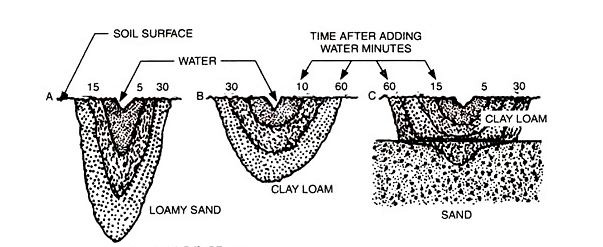
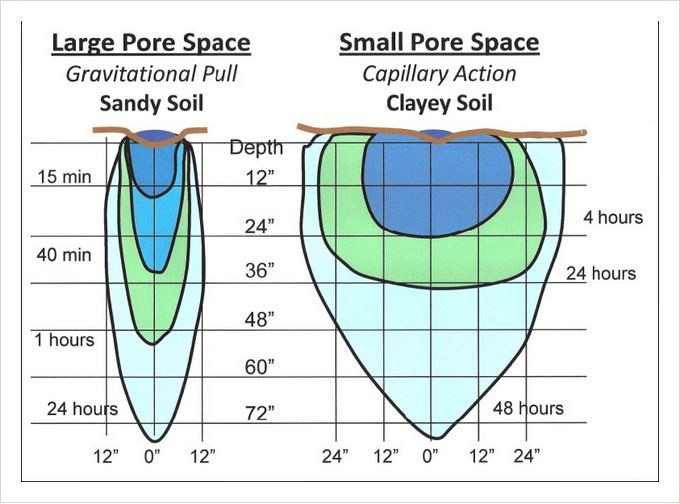
Illustration showing water movement in soils: loamy sand, clay loam, and sand.
When water is applied as a point source, as in drip irrigation, it moves downward and laterally, according to the basic characteristics of the soil. Here, equal amounts of water were applied to each of the 3 points. Notice at the far right, what occurs when a “drainage layer” is added. Consider a layer of a different texture to be a “barrier.”
Illustration showing water movement through sand vs clay.

When water is applied as a point source, as in drip irrigation, it moves downward and laterally, according to the basic characteristics of the soil. In sandy soils and potting mixes, water moves downward in a narrow profile. The much smaller pores of clay soil results in a shallow but broad profile. Such profiles mean that more drippers are needed per unit area of sandy soil than in clay-based soils. (Source: “Drip Irrigation for the Yard and Garden”)

Questions and answers

Q: How long should I water?

A: Long enough to moisten the entire rootzone; on average to about a foot deep. To know for certain, go outdoors, stick a trowel in the soil or potting mix, and look.

Q: How often should I water?

A: Often enough to maintain moisture throughout the rootzone, thereby avoiding wilt. To know for certain, go outdoors, stick a trowel in the soil, and look.

 (A vegetable that wllts won’t be able to produce the abundant yields it could otherwise. This is true in spite of the plant’s apparent recovery after you dashed over to water it.)

Q: Is it true that a drip system is 90 to 95 percent efficient?

A: It might be that efficient; the answer is to moisten the entire root system but to avoid excessive runtimes such as 24 or 48 hours.

Fun for gardeners: Run a watering test.

Each gardener must determine for his/her own soil runtime and frequency for their own soil. And realize that it varies among containers, raised beds, and inground plantings. Run the drip system for an hour, stop for an hour, then check the soil with a trowel. How deep and wide did the water go?

Resources

– How-to booklets from suppliers available at retail outlets with drip irrigation supplies

– “Drip Irrigation for Every Landscape and All Climates” by R. Kourik (2nd edition; Metamorphic Press)

– “Drip Irrigation in the Home Landscape” – University of California; 2015

– “Drip Irrigation for the Yard and Garden” R. Troy Peters, Ph.D. WSU http://irrigation.wsu.edu/Content/FAQs-Tutorials/Basics-of-Plant-Soil-Water-Relations-Tutorials.php#irrigationScheduling

Dandelion wreath hanging on a wooden fence post.
Photo: Pixabay

Everything that slows us down and forces patience, everything that sets us back into the slow circles of nature is a help. Gardening is an instrument of grace.  – May Sarton


With well wishes to you and yours!

During this challenging time, the metro area Master Gardener program reaches out with wishes for health and wellness to you and yours!  Although so much of life seems to be upside-down right now, we can find comfort doing what we love to do – gardening!  As Master Gardeners, we certainly recognize that gardening is an act of optimism that can bring solace in a time of uncertainty.

Get your hands into the soil, sow a seed, plant a seedling, harvest a bouquet of early spring bloomers, plan your summer vegetable garden, and watch the dandelions unfurl! 


OSU Extension Resources Support Gardeners

OSU Extension Service offers a wealth of resources to support Master Gardeners and all those seeking to successfully and sustainable garden at home.  Here are a few great resources for you to share with your family and friends who are hunkering down at home.

An Educators Guide to Vegetable Gardening
https://beav.es/4f3

FREE Through April – Master Gardener Online Short Course – Vegetable Gardening Series   
https://beav.es/4fU

Gardening with Kids
https://beav.es/4fw

How to build your own raised bed cloche 
https://beav.es/4NB

Nurturing Mason Bees in your Backyard in Western Washington
https://beav.es/4f5

To peruse a wide array of OSU Extension Service gardening focused publications go to: https://extension.oregonstate.edu/gardening


Master Gardener Volunteer Activities Suspended

As announced in March, due to the evolving COVID19 situation, all Master Gardener volunteer activities are cancelled or postponed until further notice. This includes all Master Gardener clinics (phone, Farmers Markets, and special events), classes, workshops, demonstration gardens, Speakers Guild presentations, fundraisers, and in-person meetings/lectures/speakers.  In addition, our Spring Recertification event scheduled for Saturday, May 16, is cancelled.

OSU Extension Service is working to make communities safe.  As OSU provides more guidance in coming weeks, we will provide updates.

With the cancellation of volunteer activities, and knowing the many challenges people are facing, we are waiving volunteer requirements for 2020.  When volunteer activities resume, we encourage those who volunteer, to report any volunteer hours served this year, by September 30, 2020.

We encourage Master Gardeners to take advantage of the many online continuing education opportunities.  Updates will be sent via email and/or posted in this monthly newsletter.


Delve Deep Into Insect Agroecology

Would like to delve deeper into the study of entomology?  Dr. Gail Langellotto, professor, Oregon State University, and Statewide Master Gardener Program Coordinator has offered a wonderful continuing education opportunity for OSU Master Gardeners.

Gail has made recordings of her Entomology/Horticulture (Insect Agroecology) University course available for Master Gardeners to view.  This class delves into ecological theory, and considers how this theory applies to the design and management of sustainable agroecosystems. 

To view the lectures use the links below.  

Note: you can toggle your view of the lecture by using the arrows on the screen (top right corner) to adjust from either, a larger view of the presenter, or of the slide presentation.

Oregon State University – ENT/HORT 444/544 (Insect Agroecology)

Lecture 1: The Importance of Insect Diversity: 
https://media.oregonstate.edu/media/t/0_yqb73rzq

Lecture 2: Bottom Up Regulation of Herbivores (Plant Nutrition):
https://media.oregonstate.edu/media/t/0_wkovk0un

Time spent viewing the lectures counts as continuing education hours for perennial Master Gardeners.


Gardening with Native Plants and the Oregon Flora Project

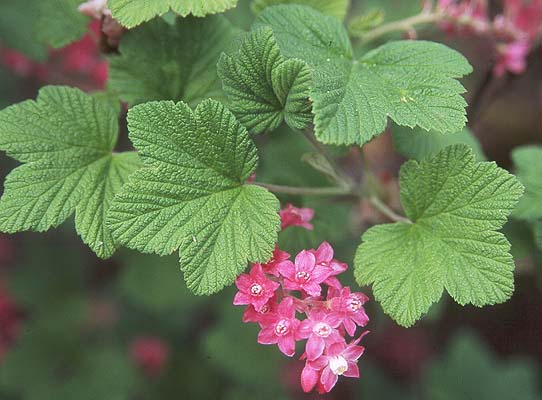
Red flowering current

The 2020 Master Gardener Advanced Training Webinars continue on Tuesday, April 21, at 11am, highlighting native plants and the Oregon Flora Project.  Join Dr. Linda Hardison, as she focuses on how to integrate native plants into your home garden. Dr. Hardison will also introduce resources behind the Oregon Flora Project, sharing a sneak peek at the new Gardening with Natives web portal. Register for the live webinar at: https://beav.es/4NL A recording of the webinar will be posted a few days following the webinar.

To view past webinars, go to: https://beav.es/44T   All Master Gardener Advanced Training webinars can be counted as 1-hour of continuing garden education credit.


2020 In-class Training Wraps-up Online!

Our 2020 Master Gardener training was a great 6 and 1/3 week run!  Our instructors guided our new class of trainees, covering many key sustainable gardening concepts and practices.  In response to the COVID-19 crisis and following University direction, we made the necessary pivot to offer the remaining training classes on-line via Zoom.  Trainees have had the opportunity to delve into care of landscape ornamentals, and tree fruits to complete their required hours of in-person instruction.

We greatly appreciate the flexibility and continued enthusiastic engagement of trainees, as we changed course in the interest of the well-being of all.

With the suspension of volunteer activities, we look forward to our 2020 trainees beginning their volunteer internship when Master Gardener in-person activities resume.


Utmost Thanks to Our Stellar Instructors!

Our Master Gardener training offers the best in solid, research-based horticulture curriculum thanks to the knowledge and generosity of our instructors!  We extend our sincere thanks to all of our instructors, for educating and inspiring our 2020 Master Gardener trainees and perennial Master Gardeners.  We are grateful to our instructors for the time they spent preparing, teaching and engaging all who attended the classes.  Thank you!

  • Neil Bell
  • Chip Bubl
  • Sally Campbell
  • Amanda Davis
  • Brooke Edmunds
  • Claudia Groth
  • Monica Maggio
  • Heather Stoven

Thanks also to Margaret Bayne and Jane Collier for preparing to present their great hands-on, plant problem diagnostics training for the final week of class and to Jean Natter for preparing her informative household pests presentation!


Hearty THANKS, to Our Class Coordinators!

“Wisdom is knowing what to do next; virtue is doing it.”  – David Starr Jordan

Hearty THANKS, to our class coordinators!

There is no doubt we have a wise and virtuous team of volunteer coordinators for our three Master Gardener training venues!  We give a big shout out of thanks to Louise Gomez-Burgess and Marti Farris (Hillsboro class), Cindy Manselle (Oregon City class), and Beven Peters (Portland class); who along with their supportive team of volunteer’s displayed beyond measure dedication that made for a very successful Master Gardener training! 

Many thanks also, to our AV teams for keeping the audio and PowerPoints going! Larry Schick and Marty Royster (Hillsboro), Laura Huckaba (Oregon City) and Rich Becker (Portland).

Each volunteer team attended to the biggest and tiniest details to ensure a successful training and a welcoming venue for the new trainees.  Thanks for compiling, hauling, setting-up, announcing, assisting Interns, spreading out the amazing hospitality tables, and cleaning up the last crumb before turning off the lights.  We are grateful for your generous commitment, assistance and attentiveness!

Special thanks to Marilyn Frankel for lifting, packing and hauling PNW books across county lines!


Deep gratitude to our supporting Chapters!

Thank you to the Clackamas, Multnomah and Washington County Chapters for their financial support of the Metro MG training classes.  The facility, hospitality and parking fees would prohibit training happening in such great venues.  Thank you for your constant and generous support of the OSU Metro Master Gardener training program.  Your contributions make such positive and vital difference to the Master Gardener program!


April Garden Checklist

Here are some great home gardening projects, in our April ‘Garden Checklist’ video.

Blooming Narcissus
Photo: Pixabay


Spring has returned.
The Earth is like a child that knows poems.”

– Rainer Maria Rilke


Yes, spring is in the air! With the first day of spring nearing it is time to dust off your OSU Master Gardener badge and get ready for a new slate of MG activities and volunteer opportunities.

Time to reach out and engage in the myriad of Master Gardener clinics, projects and special events.  Return to your favorite Master Gardener activity or try something new! Look for opportunities on CERVIS and in upcoming newsletters and emails.  New MG clinics and events are added every week.

2020 Master Gardener trainees you will have the opportunity to learn about the many volunteer opportunities, week #7 – following which you will be able to register for the activities of your choice.


2020 Master Gardener: In-class Training Home Stretch!

Our 2020 Master Gardener training is humming down the home stretch with just two weeks remaining of our in-class training.  We are grateful to our team of inspiring instructors and extend our hearty thanks to the teams of Perennial MG volunteer coordinators at our three sites!


To our 2020 class of trainees.  We are excited to have you joining our program of committed garden educators.  Soon you will be out in the community actively practicing and sharing your newfound knowledge.

Possibilities will abound with a wide-range of volunteer opportunities.  You will hear about the many OSU approved offerings during week #7 of class.  We hope you will dig in, have fun, and share your passion for gardening with fellow MGs and the gardening public.  This is an opportunity to further your garden education and to gain confidence in teaching others how to sustainably and successfully garden.


Key Training Details for 2020 MG Interns:

  • Complete the three required training modules plus the corresponding quizzes, and two additional modules of your choice, along with the quizzes, by March 31, 2020.
  • Complete the online final exam by March 31, 2020. The exam will be available starting March 15th. Please, allocate three to five hours to complete this online learning experience.  You can stop and start the exam, and you can complete the exam in multiple sessions (be sure to save your work).  A score of 70 percent or more is required on the test in order to start volunteering at Master Gardener clinic activities (answering the public’s garden questions). You will receive a grade on the exam upon submission via Canvas.  The exam is open book.  Feel free to refer to your online modules, Sustainable Gardening Handbook, in-class handouts, and confer with your fellow trainees.
  • For best selection, be sure to sign-up for your one required Workshop before March 31st. Soon after that date, the Workshop schedule will open to all Master Gardeners and the offerings will fill quickly.  You can sign up for up to two workshops.  Workshop sign-up will open on Saturday, March 7.
  • Hear about the many volunteer opportunities during Week #7. This will be your opportunity to meet the volunteer coordinators and learn how to sign-up for volunteer activities via CERVIS (our online volunteer system). You will have access to sign-up for the volunteer activities starting, March 14.

Special Message for “Perennial Master Gardeners”

Perennial Master Gardeners, please join-in welcoming and guiding our new class of eager Master Gardener trainees by signing up for shifts at the Master Gardener phone clinics, area farmers markets, and other remote clinics.  We hope to have one Perennial MG scheduled for each shift – to be there to support and guide Interns in their new role as a garden educator.

To sign up for phone, farmer’s markets, and remote clinic shifts go to CERVIS or contact the coordinator.

When signing up for CERVIS be sure to only sign-up for slots labeled “Perennial” in the next 2 months.  We want to give the Interns many opportunities to find slots at a variety of activities. 

All ‘current’ certified 2020 Perennial Master Gardeners have access to CERVIS.  If you are unable to access CERVIS, please contact Marcia McIntyre marcia.mcintyre@oregonstate.edu  

2020 trainees, you will have access to CERVIS on Saturday, March 15th, after the week #7 Resource Fair.


2020 Master Gardener Advanced Training Webinars

The ever popular OSU Extension Service Master Gardener Advanced Training Webinars are starting up for 2020. This month, Dr. Gail Langellotto, OSU Department of Horticulture, and our state-wide Master Gardener coordinator will present “Updates from the Garden Ecology Lab”, on Tuesday, March 17, 10AM.

Gail will share updates on the very latest research coming out of the OSU Garden Ecology Lab. Learn about efforts to create an urban bee guide, updates on identifying native plants that pollinators love the best, and meet the hardworking team of student research and faculty in the OSU Garden Ecology Lab.

The webinars are free and anyone is welcome to participate. Pre-register here.  Note: the presentation will be recorded.  If you can’t view the live webinar, a recording will be available a week or so after the event.

If you missed any previous webinars from previous years the links are below for your viewing pleasure.

Each webinar viewed counts as 1-hour continuing education credit for Perennial Master Gardeners.

2019 Webinar Series https://beav.es/ZLx

2018 Webinar Series https://beav.es/45z

2017 Webinar Series https://beav.es/45K


Get Ready!  It’s Plant Sale Season!

Our supporting associations the Clackamas, Multnomah, and Washington County Chapters of the Oregon Master Gardener Association are serving up plant sales galore!  Be sure to mark your calendars to join in the fun volunteering and shopping to your heart’s content! Plant sale coordinators will be at Master Gardener training Week #7, in the afternoon, to sign-up volunteers or contact the individual Chapters for more information.


Snow drop flowers emerging through snow.

“Green thoughts emerge from some deep source of stillness which the very fact of winter has released.” – Mirabel Osler

With thoughts of spring, now’s the time to consider how you would like to serve and grow this gardening season in your role as an OSU Master Gardener.  Will it be at our many community service events or expanding your gardening know-how through continuing education opportunities?

Now is a good time to sign-up for our Master Gardener office helplines (via CERVIS,).  Farmers Market schedules open over the next several weeks, so please check back if the event you are looking for has yet to be posted.

It is also the perfect time to help welcome and usher in the new class of Master Gardener trainees.  Come sit in on one of the MG training sessions (here’s the schedule).  Introduce yourself to a trainee.  Learn what interests brought them to our training program. Share your passion for gardening and the Master Gardener program with those new to the program.

2020 Trainees, stay tuned, you will be receiving details regarding volunteering during week #6 and #7.


2020 Master Gardener Training Underway!

The last week in January marked the start of our 2020 metro-area OSU Master Gardener training as we welcomed 200 new Master Gardener trainees!  Over the span of 8 weeks, we will cover a wide range of core home gardening topics presented by stellar group of horticulture experts.  Perennial favorite instructors are joining the 2020 training…Margaret Bayne, Sally Campbell, Jane Collier, Claudia Groth, Monica Maggio, Weston Miller, and Jean R. Natter. In addition, we are thrilled to have four OSU Extension faculty members from neighboring counties joining us…Neil Bell, Chip Bubl, Brooke Edmunds, Heather Stoven.

Each AM or PM session attended counts as 3 hours of continuing education credit for 2020.

For those perennial Master Gardeners, who attend training class, please take the time to say hello to new trainees and welcome them to the Master Gardener program.


The training sites and days are:

Tuesdays, February 4 – March 17, 9AM to 4PM
Hillsboro United Methodist Church, 168 NE 8th Avenue, Hillsboro

Thursdays, February 6 – March 19, 9AM to 4PM
Museum of the Oregon Territory, Museum of the Oregon Territory 3rd floor- 211 Tumwater Drive, Oregon City

Fridays, February 7 – March 20, 9AM to 4PM
Multnomah County Headquarters, Multnomah County Headquarters – 501 SE Hawthorne Blvd., Portland


‘A Diverse Garden is a Healthy Garden’
Diversity, Equity, and Inclusion in your role as an OSU Master Gardener volunteer.’  

Understand the concepts of diversity, equity and inclusion. Learn skills to recognize unconscious bias and build skills to practice inclusive and equitable principles in community engagement.

This year our metro area OSU Master Gardener program will be hosting four Diversity, Equity and Inclusion trainings facilitated by the City of Portland, Office of Equity and Human Rights. The first three trainings will take place during week #4 of Master Gardener training at all three class locations, with the forth training taking place at our Spring Recertification training.

  • Tuesday, February 18, 2020 from 9:00am – 12:00pm at the Master Gardener training class in Hillsboro
  • Thursday, February 20, 2020 from 9:00am – 12:00pm at the Master Gardener training class in Oregon City
  • Friday, February 21, 2020 from 9:00am – 12:00pm at the Master Gardener training class in SE Portland
  • Saturday, May 16, 2020 from 9:00am to 12:00pm at Spring Recertification, Clackamas Community College (Gregory Forum). Doors open at 8:00am

Register to secure a Diversity, Equity, and Inclusion training class slot! To accommodate Perennial Master Gardeners at the February Diversity, Equity and Inclusion MG training classes – we will be sending out an email to register for a class slot.  Perennial MGs look for the email invitation from Marcia McIntyre on Tuesday, February 11th

Attending this class fulfills the Diversity, Equity and Inclusion training requirement for the metro area OSU Master Gardener Program.

Attendance at one of the Diversity, Equity and Inclusion trainings is required to be a certified metro-area OSU Master Gardener, beyond September 30, 2020.  To receive credit for attending, be sure to sign-in at the training you attend.


2020 Master Gardener Advanced Training Webinars

Hand holds I-pad which has a photo of kale and the title 'Garden Ecology Lab'.
Photo: OSU, Garden Ecology Lab

A stellar line-up of Master Gardener Advanced Training webinars are in store for the coming year.  Produced by OSU Extension’s Brooke Edmunds, these informative webinars have become a favorite go-to resource for Master Gardener continuing education. The webinars are open and free to all.

One hour of continuing garden education can be counted for each webinar viewed.  If you can not view the webinar live – please check back to the webinar website a few days later to watch a recording.  https://beav.es/44T

Updates from the Garden Ecology Lab (2020 edition!)
Presented by: Dr. Gail Langellotto
March 17th at 10am PT
Pre-register here: https://learn.extension.org/events/3737

Gardening with Native Plants and the OregonFlora Project
Presented by: Dr. Linda Hardison
April 21st at 10am PT
Pre-register here: https://learn.extension.org/events/3738

Winter Squash Research at OSU
Presented by: Dr. Alex Stone and Lane Selman
May 19th at 10am PT
Pre-register here: https://learn.extension.org/events/3761

Solve Pest Problems: A New Resource for Master Gardeners and the Public
Presented by: Weston Miller
July 16th at 10am PT
Pre-register here: https://learn.extension.org/events/3762

Additional webinars will be posted on the webinar website as they are scheduled – so check back.  https://beav.es/44T


February at the Master Gardener Helplines

Two Master Gardeners in an OSU Master Gardener helpline office look at an Office Information Binder

February is a great time to volunteer at the metro-area Master Gardener office helplines.  We get a surprising number of questions from gardeners itching to get out in their gardens. The pace of questions is slower in the winter, so it is a good time to come in, acquaint yourself with the resource library, and maybe even do some detective work regarding your own garden quandaries. Shifts are available for Perennial MGs on CERVIS or you can email the following coordinators to help you sign-up. 2020 Interns will have the opportunity to sign-up for MG helplines after Week #7 of MG training class.


Supporting the OSU Master Gardener Program through Chapter Membership

The metro-area OSU Master Gardener program has three vital and active Chapters (associations).  Each Chapter is part of the Oregon Master Gardeners Association, which was formed to support the OSU Master Gardener program. 

With the start of a New Year, our three metro-area Chapters have been accepting membership renewals.  Chapter membership is optional and not required to maintain active Master Gardener status. Many choose Chapter membership for the added benefits that these OSU Master Gardener supporting associations provide.  You can belong to any Chapter you would like.  Some Master Gardeners belong to multiple Chapters.  To renew your Chapter membership contact Chapters through their websites.

For those of you who took your MG training in 2019, during your training year you received complimentary Chapter membership in the county Chapter where you reside.  You now have the option of belonging to a Chapter.  The Chapters each have varying annual fees.  For more information, visit their websites:

Clackamas County Master Gardeners

Multnomah County Master Gardeners

Washington County Master Gardeners

2020 Master Gardener trainees this year you receive complimentary Chapter membership in the county in which you reside. Chapter events are open to all Master Gardeners from any county. Drop in a Lecture/Speaker Series, visit a Chapter education/demo garden or attend a special garden seminar hosted by a Chapter (for event details visit the Chapter websites above). Learn more about our supporting area Chapters and how you can get involved in your upcoming MG training classes.


NWREC Winter Vegetable Variety Field Day

Here is a great opportunity to learn about a wonderful array of winter vegetable varieties that can be successfully grown in the North Willamette Valley. The North Willamette Research and Extension Center’s Winter Vegetable Variety Field Day features the Eat Winter Vegetables project field & storage vegetables: Winter Squash, Brussels Sprouts, Purple Sprouting Broccoli, Garlic, Celeriac, Radicchio, Cauliflower & Cabbage. 

Join in an afternoon field walk and discussions on organic variety selections and production with plant breeders, researchers, Extension agents, seed companies, farmers, and other agricultural professionals. We will be outside for part of the event, please dress accordingly.

WHEN: Thursday, February 13 from 2:00 – 4:30 pm.

WHERE: North Willamette Research and Extension Center, 15210 NE Miley Rd, Aurora, OR

WHAT: Check out the agenda for the day HERE.

The Field Day is free and open to the public. Bring your friends and family. No RSVP required 


Blue Lake Garden Hands-on Gardening Opportunities

Master Gardener deadheads spent blossoms at Blue Lake Park Discovery Garden.

Mark your calendars for select Thursdays (10am to 2pm) for hands-on gardening opportunities at the Blue Lake Discovery Garden! 

Work alongside fellow Master Gardeners and assist in making the garden a treasured stop for Blue Lake Park visitors.  Tools provided.  Free park admission. A few February and March shifts are open now – check back for more to shifts to come. Perennial MGs register on CERVIS today. 2020 Trainees will have the opportunity to sign up Week #7 of MG training classes.

By Margaret Bayne, OSU Extension Staff-retired, OSU Master Gardener

PNW Disease Managment Handbook. Image: OSU

History of the PNW Plant Disease Management Handbook. https://bit.ly/2t6AUI3

Realism of Harvard’s Glass Flowers still dazzles. (Tracee M. Herbaugh, phillytrib.com) https://bit.ly/35bSgRV

More on the Harvard Glass flowers: (Photobotanic.com) https://bit.ly/36nZuCs

Soil or dirt? It’s really up to you. (GardenProfessors.com) https://bit.ly/2rxVq3T

Soil myth busting for extension educators: reviewing the literature on soil structure and functionality. (Linda Chalker-Scott, WSU; A.J. Downer, U of CA via NACAA) https://bit.ly/2YCDAZF

Plants emit sounds too high for human ears when stressed out. (Iflscience.com) https://bit.ly/2PzOQlk

The dynamic details of unusual plants captured in singular moments by photographer Helene Schmitz.  Stunning. (Thiscolossal.com) https://bit.ly/2RG8DT4

Growing camouflage. “…there are at least two groups of arthropods that take their camouflage to a whole new level by actively growing miniature gardens on their bodies.”  (indefenseofplants.com) https://bit.ly/36nZTEW

Lichen. Photo: OSU

The unexpectedly weird and beautiful world of lichens.  “Lichens are not what you think they are.  Not plant, not fungus-they are one of a kind.” (Jaymi Heinbuch, MNN.com) https://bit.ly/2P7tCw8

A mushroom is saving millions of bees from a deadly virus. “Researchers suspect the mushroom either boosts their immune system or somehow fights the viruses.” (John Vibes via themindunleashed.com) https://bit.ly/2LHKszQ

Is fertilizer a friend or foe to disease-causing organisms? (Gardenprofessors.com) https://bit.ly/2P8lQSB

Roots. Photo: Linda Chalker-Scott

The myth of fragile roots. (Linda-Chalker-Scott, WSU) https://bit.ly/2rCtXy3

Dung Beetles navigate bia the Milky Way, first known in Animal Kingdom. (Christine Dell’Amore, Nationalgeorgraphic.org) https://bit.ly/2LFEdfE

More on Dung Beetles (VIDEO): The dance of the dung beetle. (Marcus Byrne, Tedtalk, via youtube.com) https://bit.ly/38qaVvo

Pine needles with a light frost.
Photo: Pixabay

“Nature has undoubtedly mastered the art of winter gardening and even the most experienced gardener can learn from the unrestrained beauty around them.” 

~Vincent A. Simeone


Happy 2020 Master Gardeners!

Best New Year wishes to the metro area OSU Master Gardeners!  With the official start of winter, we hope you are enjoying the slower pace, with time to reflect and plan for your coming new year!  We hope those plans include how you would like to serve as an OSU Master Gardener. 

Do you plan to volunteer at your usual volunteer venue?  Or will you explore and try something new?  Perhaps you would like to volunteer with the Master Gardener Speakers Guild making presentations on gardening topics? Maybe you will lend a hand and trowel at a chapter Demonstration Garden, offer garden advice at one of the Master Gardener helpline offices, or volunteer at your favorite farmers market? 

There are many opportunities throughout the year!  You can find volunteer openings on CERVIS, with new postings added every month or check in with the three area chapters for opportunities.

We look forward to seeing you in 2020, wearing your OSU Master Gardener hat, sharing your passion for gardening, dispensing reliable gardening advice and serving our community!


2020 Master Gardener Training Begins!

Our annual metro area OSU Master Gardener training is a great opportunity to refresh your knowledge and boost your skills.  This year we are expanding the in-person classes to 8 weeks starting the last week in January and running through March.  All Master Gardeners are welcome to attend training sessions. Each AM or PM session attended counts as 3 hours continuing garden education credit for 2020.

The training sites and days are:

Tuesdays, January 28 – March 17, 9AM to 4PM
Hillsboro United Methodist Church,
168 NE 8th Avenue, Hillsboro

Thursdays, January 30 – March 19, 9AM to 4PM
Museum of the Oregon Territory,
Tumwater room, 3rd floor- 211 Tumwater Drive, Oregon City

Fridays, January 31 – March 20, 9AM to 4PM
Multnomah County Headquarters,
Board chambers, 1st floor – 501 SE Hawthorne Blvd., Portland.

A great line-up of core Master Gardener training subjects will be presented by Margaret Bayne, Chip Bubl, Sally Campbell, Jane Collier, Claudia Groth, Monica Maggio, Weston Miller and Jean R. Natter.  In addition, we are excited to have OSU Extension faculty Neil Bell, Brooke Edmunds and Heather Stoven joining us as presenters.


2020 Master Gardener Training Registration

Thank you for spreading the word about the metro area OSU Master Gardener training!  Registration has been going at a brisk pace!

For the first time in recent memory, the Portland training venue filled after only 2 weeks of open registration!  Registration for the Oregon City and Hillsboro locations has also been strong.  Only a couple dozen class-slots remain.  Urge anyone interested in 2020 MG training to register today to avoid missing an opportunity.  Metro-area Master Gardener website for easy online registration.


‘Active and Certified’ OSU Master Gardener Status for 2020

This month we are updating each Master Gardener’s status in CERVIS for the 2020 season.  A volunteer’s status will remain “Active and Current” in the CERVIS system if the annual requirements have been met.

Those MGs who have fulfilled the annual requirements will receive a 2020 Master Gardener sticker to display on their badges.  See photo.

For a list of the annual requirements.  Please visit the volunteer portal page https://beav.es/ZjK


New Requirements for 2020

As a reminder, there are two new requirements for metro area OSU Master Gardeners in 2020.  The requirements are detailed below:

  1. Youth Safety & Compliance – Oregon State University is committed to offering a physically, psychologically and emotionally safe environment for youth that might attend a Master Gardener event or interact with Master Gardeners serving at a public event. Metro-area Master Gardeners are required to complete the Youth Safety and Compliance training.

    To take the training read the Basic Training (2 pages) and sign the Certification Form. Return the form to the MG program office: 200 Warner-Milne Road, Oregon City, OR 97045 If you would like to sign the Youth Safety & Compliance Certification Form via DocuSign please request the form via this link: https://forms.gle/JMoE6JprpCoxjXW86
  2. Diversity, Equity, and Inclusion training – Key to your role in providing exceptional customer service for the public and a kind and welcoming environment for fellow volunteers, we are requiring that Master Gardeners take part in a new training in the coming year. The goal of this training is to increase your skills to share space, leadership, and power with individuals who bring unique lived experiences, skills and values.

The Diversity, Equity, and Inclusion training will be offered on the following dates in 2020:

  • Tuesday, February 18, 2020 from 9:00am – 12:00pm at the Master Gardener training class in Hillsboro
  • Thursday, February 20, 2020 from 9:00am – 12:00pm at the Master Gardener training class in Oregon City
  • Friday, February 21, 2020 from 9:00am – 12:00pm at the Master Gardener training class in SE Portland
  • Saturday, May 16, 2020 from 9:00am to 12:00pm at Spring Recertification, Clackamas Community College (Gregory Forum). Doors open at 8:00am

Attendance at one of the Diversity, Equity and Inclusion trainings is required to be a certified metro-area OSU Master Gardener, beyond September 30, 2020.  To receive credit for attending, sign-in at the training you attend.


Winter at the Master Gardener Helplines

Winter is a great time to volunteer at the metro-area Master Gardener office helplines.  We get a surprising number of questions from gardeners itching to get out in their gardens. The pace of questions is slower in the winter, so it is a good time to come in, acquaint yourself with the resource library, and maybe even do some detective work regarding your own garden quandaries. Shifts are available on CERVIS or you can email the following coordinators to help you sign-up.

Three OSU Extension Master Gardener volunteers are all smiles while volunteering in the Clackamas Co. Master Gardener helpline office.

Fall Recertification Certificate of Appreciation Recipients

By Margaret Bayne, OSU Extension Staff-retired, OSU Master Gardener


A home gardener’s guide to soils and fertilizers. (Craig Cogger, WSU) https://bit.ly/32DUNCs

Honey bee collection, Gail Langellotto, OSU

Unpopular opinion: Saving Honeybees does very little to save the bees. (Gail Langellotto-Rhodaback, Garden Ecology Lab Blog, OSU) https://bit.ly/2QcuGzL

Video:Leafhoppers and friends. Fun to watch! Andreas Kay; via Zfrank1, Youtube) https://bit.ly/2Xb00Ah

More fun videos of insects and other critters by Andreas Kay. (Andreas Kay, Youtube)
https://bit.ly/32CU1FP

Why plants panic when it rains. (Harvey Millar, U of Western Australia, via phys.org) https://bit.ly/350bvNX

VIDEO: What do earwigs do with those pincers anyway? (Deep Look, via Youtube) https://bit.ly/2QdH1ny

Nearly a million cannibalistic ants trapped in Polish weapon bunker make long-anticipated escape. (Iflscience.com) https://bit.ly/2CzO1TE


The myth of Winter watering “Decrease fall irrigation to force landscape plants into winter dormancy.” (Linda Chalker-Scott, WSU) https://bit.ly/34UDrmg

The process of leaf color change. (Harvard Forest, Harvard University) https://bit.ly/2Xb0mqB

VIDEO: Zombie roaches and other tales of parasites. (Ed Young, Ted Talk; Ted.com) https://bit.ly/2O9MXv5

Woodboring beetle, NCIP, OSU

Learn about wood boring beetles. (NPIC, OSU) https://bit.ly/32BPoM4

Treated wood fact sheet. (NPIC, OSU) https://bit.ly/34UDDC0

VIDEO: Water movement in soils- Impermeable layers and water movement.  “Celebrating Dr. Walter Gardner’s life and workwith newly restored clips from his classic film, Water Movement in Soils.” (Decagon Devices, YouTube) https://bit.ly/33RSblX

Soil and plant nutrients, an online course. (NCSU) https://bit.ly/32F4Bfl

The remarkable world of insect galls. (Joe Boggs, Ohio State U) https://bit.ly/2CzRrpv

VIDEO: Meet the dust mites, tiny roommates that feast on your skin.  You may think that you’ve got the house to yourself, but chances are you have about 100 different types of animals living with you. Many of them are harmless, but a few can be dangerous in ways you wouldn’t expect.” (Deep Look, via pbs.org) https://to.pbs.org/2qM8LF7

A new pesticide is all the buzz.  “The EPA has approved the first-ever bee-distributed pesticide for the US market.” (Rachel Fritts, Arestechnica.com) https://bit.ly/2rBLjKZ

Nutrient value of compost. (PPT, UC Davis) https://bit.ly/33GsiVP

Excess phosphorus from compost applications in urban gardens creates potential pollution hotspots. (Gaston Small, et al; IOP Science, Iop.org) https://bit.ly/371R3hd

Shiny geranium, Ben Legler, King County, WA

Shiny geranium identification and control. (King County.gov) https://bit.ly/2X914Vk

Many plants are naturally GMO, research finds. (Joan Conrow, Alliance for Science, Cornell U) https://bit.ly/2Oa2Di1