Ecampus students have access to a number of online resources to support their academic success at OSU. Receiving guidance and feedback on their writing assignments can be helpful across courses, throughout their planning and revision process. In this post, we will share more information about the current writing resources available to students, no matter where they are located, along with resources for faculty.
OSU Writing Center
The OSU Writing Center supports any type of writing project, during any stage of the writing process. Instructors can share this resource with students, or even integrate the writing center’s support as a step to receive guidance and feedback from a consultant in coordination with a class assignment.
Online Writing Support (OWS)
According to the OWS website, both written feedback and virtual support (held over Zoom) are available to all OSU community members, including Ecampus students.
Any OSU community member can submit writing for written feedback or schedule a Zoom appointment. This includes students, faculty, staff, and alumni. However, graduate students working on dissertations, theses, IRB applications, grant applications, manuscripts, and other advanced graduate projects should connect with the Graduate Writing Center for support.
Students can choose one of the following appointment types when they submit their request online:
Consultation (50 minutes, Zoom)
Written Feedback (Replies are usually within 24 hours, Email)
Scheduling options for Online Writing Support (OWS)
The Writing Center’s website includes answers to common questions. Here are some of the responses to questions students might have about this resource:
How often can I use Online Writing Support?
You can request written feedback on up to three writing projects (or three drafts of the same project) per week. You can make Zoom appointments as often as you like. We welcome repeat writers as we enjoy being a part of your writing process. You cannot schedule an appointment more than two weeks in advance, but we invite you to work with us often.
What kind of writing can I submit for written feedback?
You can submit any kind of writing, as long as it doesn’t exceed 25 double-spaced pages (around 6,250 words). Ideally, for longer projects, you should be prepared to request several written feedback consultations, each focusing on a different section of the project.
How can I provide my instructor with confirmation that I used Online Writing Support?
All OWS consultations will receive an email confirmation after the appointment occurs or after the feedback has been sent to you—usually the next morning. If your instructor requests confirmation that you sought assistance from the OWS, you may forward or capture a screen shot of the confirmation email.
For more information about the type of support the Writing Center provides, please see their overview video below.
An overview of the resources provided by the OSU Writing Center and how to submit requests via the website
Academic Success Center – Writing Resources
Student Resources
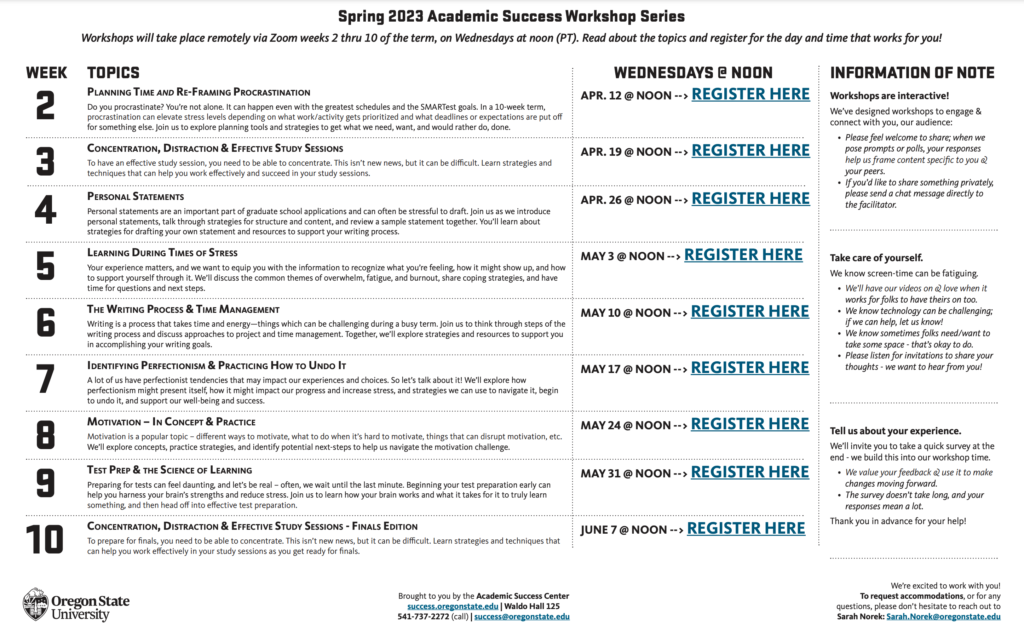
Academic Success Workshop Series – Each term the ASC hosts a series of workshops on a variety of topics. Their remote series is available for online registration and hosted via Zoom.
For the Spring 2023 term, the workshop schedule is listed below and features a writing-focused workshop in Week 6.
The details of the workshop series, along with links to register, are available on the Remote Workshop Series website.
The Learning Corner – The learning corner provides a number of online tools, such as guides and fillable worksheets, to support students in reaching their academic goals.
Services & Programs – Supplemental Instruction (SI) is available for certain courses via Zoom, as well as academic coaching support.
Faculty Resources
A number of faculty support options are offered on the Faculty Resources page, including an optional Canvas module, PowerPoint slides, and a sample Syllabus statement. The Online Writing Support group and Academic Success Center partner with faculty to collaborate on assignments and course-specific tips for implementing writing support for their online students.
A term paper is a common final assignment, but does the final assignment have to be a paper? The answer depends on the type of course and the learning outcomes. If the final assignment can be an alternative to the term paper, we can consider other types of assignments that allow students not only to accomplish the learning outcomes, as expected, but also to engage more deeply with the content and exercise critical thinking. A caveat related to the discipline is important here. Fields that require a writing component may necessarily rely on the term paper which can be scaffolded through a set of stages. For assignments with a sequence of tasks, refer to staged assignments (Loftin, 2018) for details on how to design them.
A first step in moving towards considering other types of assessments is to self-reflect on the purpose of the course and what role it will play in students’ learning journeys. You can use some of the following questions as a guide to self-reflect:
Focus level
Initial self-questions
Course
What is the nature of the course (e.g., practice-based, reading-intense, general education, writing-intensive, labs, etc.)? What are the outcomes? What level do the outcomes target (e.g., recall, analysis, evaluation)?
Discipline
What do people in the discipline I teach regularly do in the work environment? Do they: write grants? or develop lesson plans? write technical reports? write articles or white papers? build portfolios? demonstrate skills? and so on… Do all students need to complete the final assignment in the same format or can the format vary (e.g., paper, presentation, podcast)?
Taking some time to reevaluate the assessment practices in your course might be beneficial for your students who seek meaningful learning opportunities and expect relevant assignments (Jones, 2012; ). Students might also welcome variety and flexibility in how they learn and be evaluated (ASU Prep Digital, 2021; Soffer et al., 2019).
Let’s explore alternative and authentic assessments next.
Alternative assessments
Alternative authentic assessments tend to focus on high-order and critical thinking skills –skills much appreciated these days. These assessments aim to provide more effective methods of increasing knowledge, fostering learning, and analyzing learning (Anderson, 2016; Gehr, 2021). Research also suggests that authentic assessments can increase students’ employability skills (Sotiriadou et al., 2019). However, the implementation of alternative assessments needs to transcend the status quo and become a critical element that allows instructors and students to focus on societal issues, acknowledge the value of assessment tasks, and embrace these assessments as vehicles for transforming society (McArthur, 2022). A student-centered environment also challenges educators to search for alternative assessments to make the learning experience more meaningful and lasting –fostering student agency and lifelong learning (Sambell & Brown, 2021).
Authentic assessments
I recall that when I was learning English, some of the types of practices and assessments did not really equip me to use the language outside the classroom. I thought that I would not go around the world and select choices from my interlocutors as I used to do through the language quizzes in class. I have been motivated by the Task-Based Language Teaching framework to focus on designing tasks (for learning and assessment) that help students use their knowledge and skills beyond the classroom –more useful and realistic tasks.
Authentic assessments provide students with opportunities to apply what they learn to situations that they likely will encounter in their daily life. These situations will not be well-structured, easy to solve, and formulaic (like the English language practices I had); to the contrary, these situations will be complex, involve a real audience, require judgment, and require students to use a repertoire of skills to solve the problems and tasks (Wiley, n.d.).
As you may see, alternative and authentic assessments can overlap, giving educators options to innovate their teaching and providing students opportunities to increase interest and engagement with their learning process. Below, you will see a collection of ideas for assessments that go beyond the term paper and give room for course innovations, learning exploration, and student agency.
Examples of Alternative and Authentic Assessments
You can select one or more assessments and create a sequence of assignments that build the foundation, give students an opportunity to reflect, and engage students in the active application of concepts. Diversifying the types of assessment practices can also serve as an inclusive teaching approach for your students to engage with the course in multiple ways (McVitty, 2022).
Introduction to New Concepts
students to these new ideas by designing simple and direct tasks such as:
Listen to podcasts, watch documentaries/films: write summaries or reviews
Conduct field observations: report what was observed, thoughts, and feelings
Create fact sheets and posters: share them with peers and provide comments
Study a case: write a report, design a visual abstract, create a data visualization or presentation
Create an infographic or digital prototype: present it to peers for feedback
Write a short newspaper article: contribute to the class blog, post it on the class digital board
Provide insights and comments: contribute with annotations and posts (e.g., Perusall, VoiceThread)
Reflective Practice
Reflection allows students to think further about their own learning process. If you are looking for activities to instill in students higher-order thinking skills and metacognitive skills, you can consider designing one of the tasks below. Remember to provide students with guiding questions for the reflection process.
Review assignments and describe the learning journey: Create a portfolio with reflective notes
Develop an understanding of concepts by identifying areas of difficulty and feedforward goals: write a weekly learning log, create a learning journey map/graph
Describe your learning experience through personal reflection: write an autoethnography
Connect course concepts and activities to learning experiences: create a think-out-loud presentation, podcast, or paper
Self-assess learning and progress: take a quiz, write a journal, create a learning map: “from here to there”)
Theory Application
Demonstrate a solid understanding of key elements, theory strengths, and weaknesses: write an application paper to explore lines of inquiry, create an infographic connecting theory and examples, write an article or artifact critique through the lens of the theory
Dissect a theory by identifying and organizing the key components of theoretical frameworks: develop a theory profile document or presentation (instructor can create a dissect theory template)
Anchor course concepts in the literature: write a position paper, a response paper, or a commentary for a journal.
The list of alternative and authentic assessments provided above is not exhaustive and I would welcome your comments and suggestions for the activities that you might have designed or researched for your online or hybrid courses. I would love to hear more about your approaches and thoughts on alternative and authentic assessments.
References
Anderson, M. (2016). Learning to choose, choosing to learn: The key to student motivation and achievement. ASCD.
Gher, L. (2021, March 11). How using authentic digital assessments can benefit students. Edutopia. https://www.edutopia.org/article/how-using-authentic-digital-assessments-can-benefit-students/#:~:text=With%20this%20method%20of%20assessment,of%20the%20comments%20and%20responses.
Jones, S. J. (2012). Reading between the lines of online course evaluations: Identifiable actions that improve student perceptions of teaching effectiveness and course value. Journal of Asynchronous Learning Networks, 16(1), 49-58. http://dx.doi.org/10.24059/olj.v16i1.227
Jopp, R., & Cohen, J. (2022). Choose your own assessment–assessment choice for students in online higher education. Teaching in Higher Education, 27(6), 738-755. https://doi.org/10.1080/13562517.2020.1742680
Loftin, D. (2018, April 24). Staged assignments. [Oregon State University Ecampus blog post] https://blogs.oregonstate.edu/inspire/2018/04/24/staged-assignments/
McArthur, J. (2022). Rethinking authentic assessment: work, well-being, and society. Higher Education, 1-17. https://link.springer.com/article/10.1007/s10734-022-00822-y
Soffer, T., Kahan, T. & Nachmias, R. (2019). Patterns of Students’ Utilization of Flexibility in Online Academic Courses and Their Relation to Course Achievement. International Review of Research in Open and Distributed Learning, 20(3). https://doi.org/10.19173/irrodl.v20i4.3949
Sotiriadou, P., Logan, D., Daly, A., & Guest, R. (2020). The role of authentic assessment to preserve academic integrity and promote skill development and employability. Studies in Higher Education, 45(11), 2132-2148. https://doi.org/10.1080/03075079.2019.1582015
Sambel, S., & Brown (2021). Covid-19 assessment collection. Assessment, Learning, and Teaching in Higher Education. https://sally-brown.net/kay-sambell-and-sally-brown-covid-19-assessment-collection/
Wiley University Services. (n.d.). Authentic assessment in the online classroom. https://ctl.wiley.com/authentic-assessment-in-the-online-classroom/
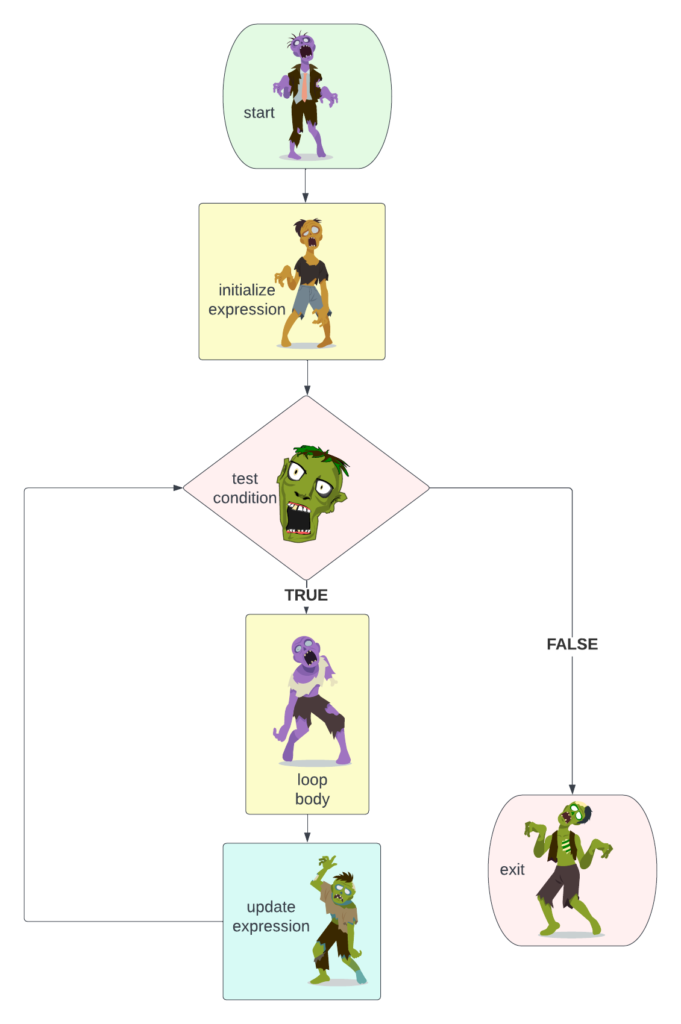
I was recently assigned to be the Instructional Designer for an introductory programming course here at OSU. While working with the instructor, I was happy to see his inventiveness in assessment design. As one example, the instructor created an assignment to introduce loops, a block of code in a computer program that repeats while a condition is true. Here’s how he described the assignment to the students:
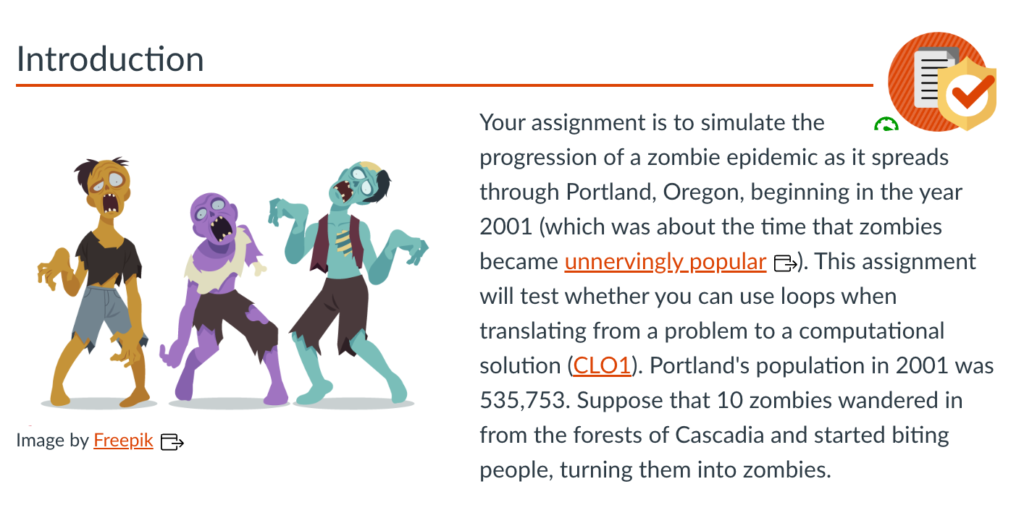
Your assignment is to simulate the progression of a zombie epidemic as it spreads through Portland, Oregon, beginning in the year 2001 (which was about the time that zombies became unnervingly popular). This assignment will test whether you can use loops when translating from a problem to a computational solution.
(Scaffidi, 2019)
I was excited about the design possibilities this introduced to a usually dry topic. Zombies! I built the page in our LMS, Canvas, and was excited to review it with him.
“Isn’t this fun?” I asked, showing him the assignment page I had created:
“I guess so,” he said, “is there any research to indicate that decorative graphics support learning?” he asked me. I guess that’s fair to ask, even if it was a bit of a buzzkill.
I had no idea if including cool pictures was a research-based best practice in online course design. While I really wanted it to be true and felt like it should be true, I could not immediately cite peer-reviewed studies that supported the use of zombie images to improve learner engagement; I had never seen such research. But, I was determined to look before our next meeting.
The instructor’s research challenge led me to discover Research Rabbit. Research Rabbit is a relatively new online platform that helps users find academic research. Research Rabbit has users organize found research into collections. As articles are added to a collection, Research Rabbit helps identify related research.
Without realizing how much time I was exploring, four hours quickly passed in which I was wholly engrossed in the search to justify including a zombie picture in one assignment for one instructor. Below, I will share a few of the features that enamored me with Research Rabbit and why I continue to use it regularly.
Why I love Research Rabbit
Visualization of Search Results
Rather than combing through reference lists at the bottom of a paper, you can quickly view any works cited by a paper you have selected or change views and get a list of articles that have cited the selected document. Those results are presented in a list view, a network view, or on a timeline.
A Tool for Discovery
Research Rabbit starts generating suggested additions as soon as you add a paper to a collection. The more papers you add, the more accurate these recommendations become. It works somewhat like personalized Netflix or Spotify recommendations (ResearchRabbit, n.d.), helping you discover research you may not have been aware of in this same area of study.
Using their discovery functionality, you can identify clusters of researchers (those that have published together or frequently cite each other’s work). You can also use the “Earlier Work” option to see when research on a particular topic may have started and identify foundational papers in the field. Looking for “Later Work” helps you find the latest research and stay current on your research topic.
Free Forever
The Research Rabbit founders explain their reasoning for keeping their tool Free Forever as follows:
Why? It’s simple, really.
Researchers commit years of time, energy, and more to advance human knowledge. Our job is to help you discover work that is relevant, not to sell your work back to you.
(Research Rabbit FAQ)
Research Rabbit Syncs Collections to Zotero
I would have lost a lot of enthusiasm for Research Rabbit if I had to manually add each new paper to my Zotero collection. But Research Rabbit integrates with Zotero, and automatically syncs any designated collections. If you use a different reference tool, you can also export Research Rabbit collections in common bibliographic formats.
A Tool for Sharing and Collaboration
Once you have created a collection, you can invite other researchers to view or edit a collection based on the permissions you set. Collaborators can also add comments to individual items. Research Rabbit also gives you an opportunity to create public collections that can be shared with a custom link.
How to Explore Research Rabbit on Your Own
The feature set of Research Rabbit is beautifully demoed on the Research Rabbit website. From there, you can explore how to visualize papers, discover author networks, and start building collections. There is also a growing list of introductory and instructional videos by the academic community online.
So What Happened with the Zombies?
You can review some of the research yourself by checking out my Research Rabbit Collection of Articles on Visual Design in Online Learning. Much to my delight, after conducting my (4-hour) search, I did find some research-based evidence that aesthetics improved engagement and recall (Deanna Grant-Smith et al., 2019). Many of the studies, however, also suggested that visuals in online courses should also have some instructional function and help communicate ideas to avoid cognitive overload (Rademacher, 2019).
Deanna Grant-Smith, Timothy Donnet, James Macaulay, Renee Chapman, & Renee Anne Chapman. (2019). Principles and practices for enhanced visual design in virtual learning environments: Do looks matter in student engagement?https://doi.org/10.4018/978-1-5225-5769-2.ch005