“Mathematics compares the most diverse phenomena and discovers the secret analogies that unite them.” — Joseph Fourier
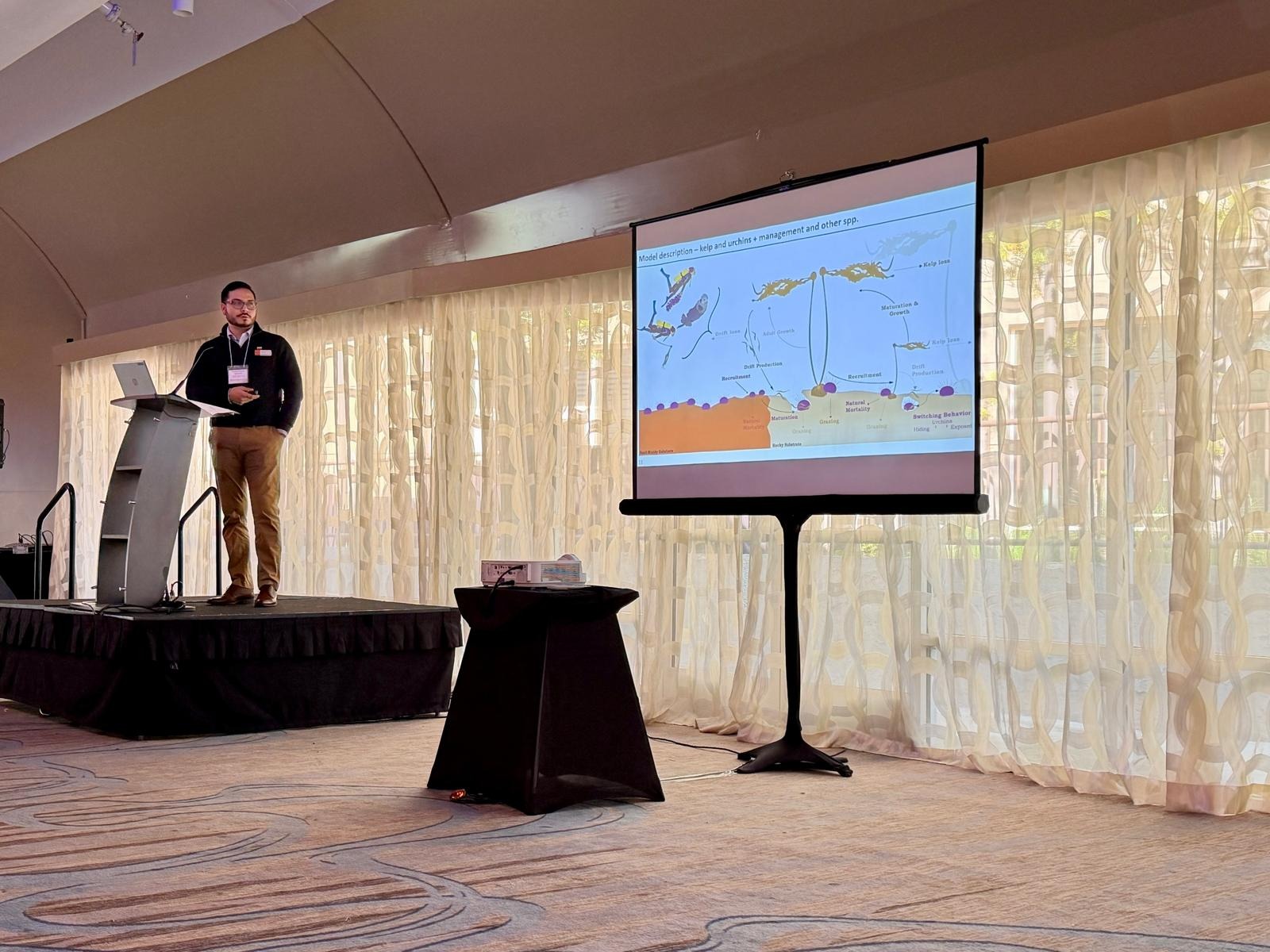
Mathematical modeling has become an essential tool across all disciplines of science. Models are built and applied in everything from astrophysics to food science. Andrés Pinos-Sánchez, a masters student in the Department of Fisheries, Wildlife and Conservation Sciences in the lab of Will White, uses modeling to investigate the population dynamics of bull kelp and sea urchins on the Oregon coast. The goal of his research is to determine what’s the best pathway to recover kelp forests in Oregon, which are in drastic decline due to rising sea temperatures and overpopulation of purple sea urchins. The decline of bull kelp in Oregon’s coastal ecosystems is detrimental to several species, like rockfish which make up a large part of the commercial fishery in Oregon.

Andrés has been able to model the outcome of different kelp restoration tactics, determining the best potential course of action before having to step foot in the field. Modeling these restoration tactics potentially saves Oregon taxpayers and conservation groups millions of dollars and saves our environment from unintended consequences.
Tune in to KBVR 88.7FM on January 18th at 7PM to hear all about modeling population dynamics, the intricacies of preparing a system for restoration, and the pros and cons of sea otter reintroduction in Oregon. You can also check out the show on streaming services or wherever you get podcasts.
Written by Hannah Stuwe
