Author Archives: Hannah Stuwe

Exploding Cheeses and Microbes at Work

For those of us who consume dairy products, we often don’t give much thought to the trials and tribulations that had to be faced to get that product on the grocery shelves. It’s probably a fair assumption to say that most of us have never considered that cheese could explode, but that is the center of Madeleine Enriquez’s graduate research. 

Madeleine (Maddie) is a master’s student in the laboratory of Joy Waite-Cusic, and she investigates dairy microbiology and spoilage, particularly mitigating “gas defects” in cheese. In semi-hard to hard cheeses certain microorganisms can cause build-up of gasses called “gas defects” which can eventually lead to blow-outs of the cheese in its packaging, or significant structural defects within the cheese (think Swiss cheese holes where they’re not supposed to be). Maddie works on practical and easy ways to mitigate these gas defects for small dairy farmers. Some of the variables include aging temperature, bioprotective cultures, or combinations of both. 

Maddie’s interest in this particular area of food science originally stemmed from her grandfather, who was a dairy farmer. She went to the University of Connecticut for her bachelor’s degree in animal science. While there she participated in undergraduate research on dairy farms, particularly focusing on dairy microbiology later in her degree. This eventually led to her coming to Oregon State to further her education in dairy food science. 


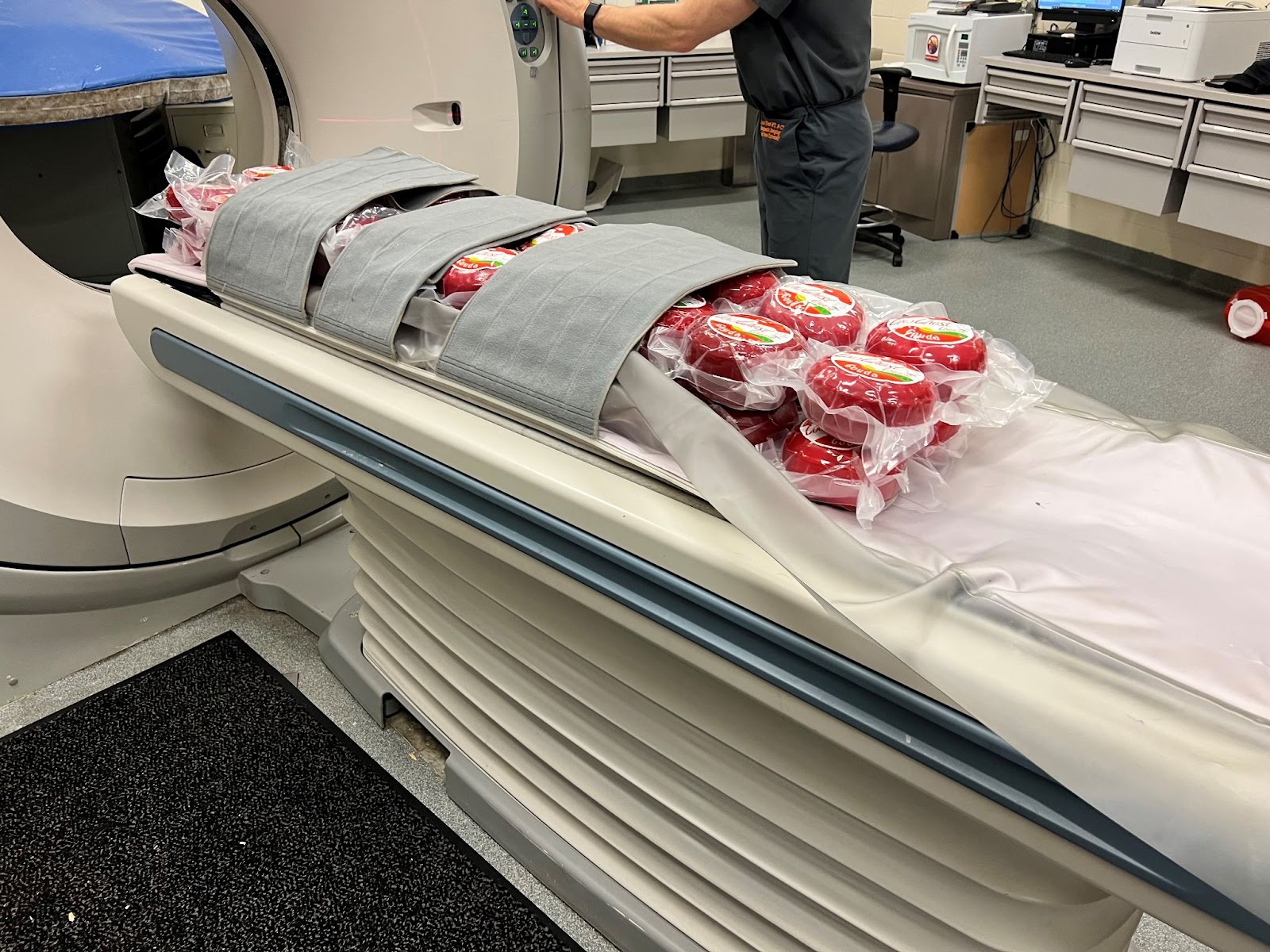
If you want to hear more about exploding cheese, making gouda on a weekly basis, and strapping wheels of cheese in for a CT scan, tune in for this episode of ID airing live on Jan 21, 2024.

Forever Chemicals: How can we better detect PFAS?

Per and polyfluoroalkyl substances, also known as PFAS, are widely used, long lasting chemicals, components of which break down very slowly over time. This is why you may have heard these substances called “forever chemicals.” Because of their widespread use in anything from firefighting foams to non-stick pan coating, and their persistence in the environment, many PFAS are found in the blood of people and animals all over the world. PFAS are found in water, air, fish, and soil at locations across the world and have been linked to harmful health effects, including various forms of cancer. However, the toxicity of these substances are not fully understood. 

There are thousands of PFAS chemicals, and they are found in many different consumer, commercial, and industrial products, making it challenging to study and assess the potential human health and environmental risks. Additionally, it is challenging to accurately detect and quantify PFAS levels in environmental samples. 

Esteban Hernandez is a chemistry PhD student conducting his research in the lab of Jennifer Field in the department of Environmental and Molecular Toxicology. His research focuses on developing fast and accurate detection techniques for PFAS. Specifically, he utilizes nuclear magnetic resonance spectroscopy (NMR), which provides an alternative to the canonical methods of PFAS detection such as mass spectroscopy. Esteban has found that utilizing NMR this way allows for detection of different varieties of PFAS, which had previously not been detectable with other methods. This has big implications for the field of PFAS research and environmental testing. 

Esteban comes from a part of North Carolina that has been highly impacted by environmental PFAS contamination, sporting the title of the second worst drinking water in the country behind Flint, Michigan. His research has a very personal connection to his history and where he comes from. However, researching forever chemicals was not always his plan. He started his undergraduate journey as a theater major at Mars Hill University, eventually finding his way to chemistry and the University of North Carolina. In his undergraduate research at UNC he worked on developing an estrogen analog to help treat breast cancer. During his masters (also at UNC) he worked on synthesizing an anticancer compound originally found in sea cucumbers from the sea of Japan. Even when he came to OSU he didn’t initially think he would be working on PFAS detection. When he joined the Field lab, and consequently the field of PFAS research, he found the right fit for him. Tune in to Inspiration Dissemination this week to hear all about Esteban’s research and pathway to graduate school.