Joe Hodge at a community event, photo by Amanda Woodlee
“I became a Master Gardener to learn to rid my pumpkins and squash of squash bugs. My desire to get the most of my veggies seemed right in line with the Master Gardener program. What I have learned is that you have to have fun in the garden, even making challenging things into a game – turning the squash bug mission into ‘seek and destroy’ can actually be fun. Yes, I’m a little crazy, and my opinion is that most good master gardeners are also.
My most proud moment as a Master Gardener was when an article about my gardening career went into the East Oregonian local paper shortly after I received County Master Gardener of the Year award. My mother, who has dementia, was a daughter of an expert gardener whose gardening skills helped them make it through the Depression. Mom still has enough mental capacity to process a newspaper story, and enough love to express to me how proud her Dad would be. Hopefully, I have enough generosity to give to my sons what my parents have given me.
Seed to Supper is so important because the skills it teaches are so beneficial for everyone’s physical, mental, and spiritual health. Physically, gardeners stay in shape in the garden. Mentally, you have to use math and science in planning out your garden – your brain can get a good workout. Spiritually, the feeling of giving away fresh vegetables to friends and family is as uplifting as any I know. The Seed to Supper course I’m helping teach now is about 3/4 full of beginning gardeners. If we can teach these folks to embrace gardening, we’ve not only given them an activity they can be happy with, but we will have improved their health immensely. The Seed to Supper course is the most valuable class happening in my town now, by far.”
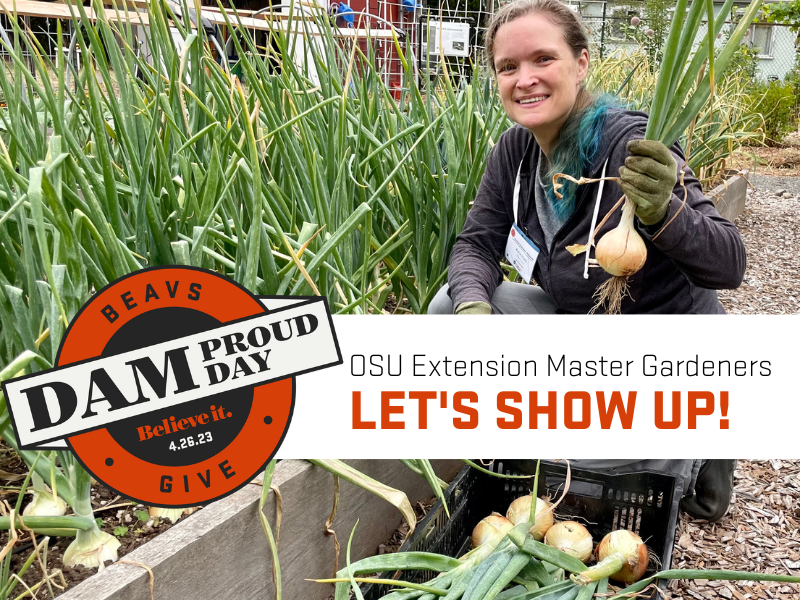
This is but one of the many stories of the OSU Extension Master Gardener program we’re sharing this month in honor of Dam Proud Day. On April 26, Beavers everywhere will come together to support the things we do best: transformative educational experiences and life-changing research.
We are excited to be raising support specifically for our Seed to Supper program and updating our foundational resource, the “Sustainable Gardening Handbook” to reflect current knowledge. Please join us in gathering your friends and colleagues to give to support the Master Gardener Program on Dam Proud Day, at any donation level. See you (online) April 26th!
Stormi in front of the OSB Pollinator Bed at the Yachats Demo Garden in May 2022
Stormi wanted to up her plant growing game, and maybe make some friends in the process. When she found the Master Gardener program, she says “I feel like I’ve found a community.”
Stormi is heavily involved in her local community work of Master Gardeners working to help preserve the threatened Oregon Silverspot Butterfly (OSB). In a partnership with the Lincoln Soil and Water Conservation District (LSWCD) Stormi worked with fellow Master Gardeners “to conduct very small-scale “tests” that could help increase the adult OSB’s feeding area and determine how far adult OSBs will travel. I took this on as my Apprentice project last year and led the incorporation of OSB Pollinator beds in our Lincoln City and Yachats Demo Gardens. When this opportunity came up in my own county, it spoke to me, and I raised my hand. It was a meaty project for me to get into. We live in a beautiful area of Oregon and want to preserve what we have. Anything I can do to keep the OSB alive and thriving is a very good thing.”
This is but one of the many stories of the OSU Extension Master Gardener program we’re sharing this month in honor of Dam Proud Day. On April 26, Beavers everywhere will come together to support the things we do best: transformative educational experiences and life-changing research.
We are excited to be raising support specifically for our Seed to Supper program and updating our foundational resource, the “Sustainable Gardening Handbook” to reflect current knowledge. Please join us in gathering your friends and colleagues to give to support the Master Gardener Program on Dam Proud Day, at any donation level. See you (online) April 26th!
This photo was taken by fellow MG, Bonnie Coulter, and accompanies my byline when I write periodically for the Roseburg News Review in the Ask a Master Gardener feature.
“I have been a gardener since my grandmother first cupped her hand over mine to tuck pansies into her flowerbeds, showing me the sweet face in each blossom.”
Julie is most proud of “Being part of a community of people who value service to others, who share a love of continually learning and applying new things, and who dig gardens as much as I do. Master Gardeners are some of the most supportive people I know. They love sharing freely what will help other gardeners succeed.”
“Our world is changing, and with that change comes the need for new and sustainable practices. Master Gardeners serve as a powerful and accessible liaison between University research and academia, and community practice. Master Gardeners are our neighbors, our friends, the one down the street who will help us repair our garden tools, or share a plant or a tip, or help us find resources for our gardening issue of the moment. They are the ones who will be there to laugh (and sometimes cry) right along with us at every stage of the gardening process.”
This is but one of the many stories of the OSU Extension Master Gardener program we’re sharing this month in honor of Dam Proud Day. On April 26, Beavers everywhere will come together to support the things we do best: transformative educational experiences and life-changing research.
We are excited to be raising support specifically for our Seed to Supper program and updating our foundational resource, the “Sustainable Gardening Handbook” to reflect current knowledge. Please join us in gathering your friends and colleagues to give to support the Master Gardener Program on Dam Proud Day, at any donation level. See you (online) April 26th!
On April 26, 2023, Master Gardeners and supporters will come together to show our belief in the Master Gardener program and Oregon State University’s Dam Proud Day. This 24-hour period is dedicated to celebrating the accomplishments of the Oregon State community, including supporting Master Gardeners, and stretching ourselves toward our aspirations.
As a featured fund on Dam Proud Day, we have a special opportunity to raise money to support our work.
On one day, can you imagine what we could do together?
Here’s how Master Gardener volunteers, past and present, can help NOW.
1. Help us tell the Master Gardener story. Share your story by participating in our storytelling campaign. Reach out to LeAnn at leann.locher@oregonstate.edu to receive 3 questions for you to answer, and to send in a photo. We’ll be sharing these over the coming weeks to highlight all that Master Gardeners do. Your stories tell the story of the Master Gardener program!
2. Follow OSU Extension Master Gardener on social media. www.facebook.com/OSUMG and @mastergardenersOSU on instagram. Share our stories and posts about Dam Proud Day with your friends and followers.
3. Show up on April 26th and make a donation online signaling your support for the Master Gardener program. It’s all online, all on one day.
On one day, we can show up for gardening and Master Gardeners in Oregon!
Master Gardeners and their demonstration gardens are invited to participate in a “grow along” event this growing season. “Grow along” with thousands of Oregonian households who are participating in the Grow This! Gardening Challenge, an initiative of SNAP-Ed and Food Hero. (Last year 93,138 Oregonians participated!) These beginning gardeners can learn from you, see the same plants they are growing in your demonstration gardens, and discover the incredible resource they have with local Master Gardeners and the educational gardens you care for.
What you’ll do:
-Grow one or more of the following plants (preferably by seed) in your local Master Gardener demonstration garden.
Kale
Tomatoes
Herbs
Lettuce
Zinnias
-Share via email 2-3 updates a month of the progress, including photos, tips, challenges, and/or advice for growing these plants.
-Offer Grow This! participants the opportunity to drop by during your garden work days to talk with Master Gardeners, and visit your gardens.
Some examples of updates shared in 2022:
What you’ll receive:
-Your growing updates and open garden opportunities will be shared through the Grow This! Newsletter, the Food Hero social media channels, as well as the OSU Master Gardener social media channels.
-Increased recognition of the value and assets of local demonstration gardens.
-Connection to a local audience eager to learn how to grow their own food and begin gardening, many for the first time.
Other ideas:
-Some demonstration gardens may want to plan special open house events around growing these five types of plants, such as “learn how to plant your new seedlings” or “how to build your own tomato cage out of recycled materials.”
-Share a video how-to from your garden, demonstrating how your team direct sows zinnias.
-Share photos of your educational signage for growing these plants, or growing in containers.
We are excited to highlight the many demonstration gardens across the state to an eager and large audience seeking to grow healthy food on a budget.
The Grow This! Garden Challenge is a call to action to families, schools and other groups to garden together and eat what we grow. Participants receive free seeds, a monthly garden newsletter with new, simple ideas for growing; tips on harvesting, seed-starting, seed-saving and pollinators; recipes; and more. This is a project of Food Hero, whose mission is to help low-income Oregonians improve their health by increasing their consumption of fruits and vegetables, and is an initiative of Oregon Supplemental Nutrition Assistance Program Education (SNAP-Ed) program, developed by Oregon State University Extension Service and funded jointly by OSU Extension Service, Oregon Department of Human Services, and the United States Department of Agriculture Food and Nutrition Service.
We are excited to celebrate the good work of OSU Extension Master Gardener volunteers. Please remember that May 15th is the due date for all Oregon Master Gardener Association (OMGA) awards. You can learn more about the awards on the OMGA website. (Check back as links are added). All awards should be submitted electronically.
This year, there is also a new county and statewide award, recommended by the MG Growing and Belonging Committee and approved by the OMGA Board of Directors at the November 2022 meeting. This new award, called the Growing and Belonging Award, will recognize volunteers who have significantly contributed in advancing diversity, inclusion, access, and/or equity among Master Gardener volunteers and clientele. Examples and more information about the Growing & Belonging Awards are here.
Ready to get started nominating? Here are the nomination forms:
Remember that all award nominations must be COLLABORATIVELY prepared, working with your local Master Gardener Association and your local Master Gardener Program staff.
County Master Gardener awards are decided upon at the local level. This includes County Master Gardener of the Year, County Behind the Scenes, and County Growing and Belonging awards. Once nomination forms are submitted to the statewide office, we use this information to prepare certificates, press release announcements, and posters that are displayed at that annual Master Gardener statewide conference, known as Mini-College.
Note that County Master Gardener award winners are not automatically advanced to consideration for statewide awards. A separate nomination form is needed.
Statewide awards are nominated by county Master Gardener Programs and Associations. This includes Statewide Master Gardener of the Year, Statewide Behind the Scenes, and Statewide Growing and Belonging. Nomination forms are then distributed to the OMGA Awards committee for review, scoring, and discussion, to ultimately determine a winner for each award. This year, the awards committee consists of past winners of the Statewide Master Gardener of Year, including Jane Moyer (2022), Susan Albright (2021), and Chris Rusch (2021). Committee members also include past winners of the Statewide Behind the Scenes Award, including Sherry Sheng (2022) and Sue Ryburn (2021). The Statewide Master Gardener Program Coordinator, Gail Langellotto, serves as committee chair.
We are looking forward to receiving your nominations, and reading about the wonderful work you have done across the state, by supporting aspiring, novice, and experienced gardeners.
Please submit your nominations before or on May 15th deadline!
What does it mean to grow our work inclusively? To create an environment where everyone belongs? Let’s find out, together, with our new Growing & Belonging County, and Statewide Awards.
In addition to our Master Gardener of the Year, and Behind the Scenes awards, 2023 marks the first year recognizing and celebrating the volunteers who have significantly contributed in advancing diversity, inclusion, access, and/or equity among Master Gardener volunteers and the communities we work with.
Unlike our longstanding awards of Master Gardener of the Year, and Behind the Scenes awards, these awards do not recognize the length of time served as a Master Gardener, but instead, the impact their work has made in creating a belonging environment, inclusive of diverse communities such as race, ethnicity, culture, abilities, sexual orientation, gender identity, and/or growing our volunteer work in traditionally under-invested communities. The best of these projects are co-created with the individuals being served, listening to their needs, and responding with a project that meets those needs.
Some examples:
Launched a new Seed to Supper course at a local low-income housing community.
Organized a seed swap with the organizers of Juneteenth and helped on site.
Introduced a training for fellow volunteers around the importance of the use of pronouns and supporting our transgender community.
Created a partnership with a local day-hire advocacy group to provide plant identification training in Spanish to day laborers.
Worked with the organizers and clients of a local homeless services center for the best way Master Gardeners could help or partner together to create a community garden.
Identified needs for ensuring accessibility for all attendees when attending in-person, outdoor events. Developed a checklist of accessibility options to be used by Master Gardeners in planning these events.
All of these examples center work in partnership with other organizations that have trusted relationships with their communities.
What: County, and Statewide Growing and Belonging Award
Why: This award comes as a recommendation made by your Master Gardener Growing & Belonging Committee. It was approved by the OMGA Board of Directors at the November 2022 meeting.
How:
Work collaboratively with local Master Gardener Program staff and your local Master Gardener Association.
Does nominating someone for a county award automatically put them in a pool of nominees for the statewide award? No. That is a common misconception. Like our other awards, separate nominations are needed. County nominations are automatically awarded. Statewide nominations go on to a committee for review. You can enter the same person for both county and for state.
We are excited to introduce these new awards and to celebrate the good work of OSU Extension Master Gardener volunteers.
Hello! This is your Winter Update from your statewide Growing & Belonging committee. Four times a year we publish on the program news blog, sharing our work, findings, and resources to help keep you informed and engaged in creating a local Master Gardener program and association experience that is one of growing and belonging.
Events
Thank you to the 75 Master Gardener volunteers, faculty, and staff who gathered last month to view Dirt! The Movie on Dr. Martin Luther King Jr.’s Day of Service. Dr. Gail Langellotto shared reflections on the movie and several Master Gardeners offered their thoughts on the movie as well. I encourage you to read your fellow Master Gardeners’ words in the comments section but will share here a bit of what Donna Leveridge-Campbell wrote:
Dirt! The Movie…resonated with me in so many ways, both in my long-held beliefs and gut feelings, and that there was much synchronicity with things I have read and taken to heart. For myself, I have been considering ways I can support the dissemination of this important information and world-view in order to bring about the much-needed changes to bring health to our soils and biomes, and to our human communities.
A quote from Robin Wall Kimmerer in her phenomenal book, Braiding Sweetgrass: Indigenous Wisdom, Scientific Knowledge, and the Teachings of Plants, that kind of sums up where I am at in my life these days is, “The most important thing each of us can know is our unique gift and how to use it in the world.” Another quote I love from this book is, “I taught my daughters to garden so that they would always have a mother to love them, long after I am gone.”
Do you or someone you know garden to connect to your culture? We would love to share your story. The Culture of Gardening storytelling site, a project of the Growing & Belonging committee, is a beautiful collection of photos and stories told in the gardener’s own words, of gardening to connect us to our heritage and foods specific to our own cooking. Please consider sharing your story or nominating a fellow gardener to be interviewed and featured. Our stories are powerful, healing, and insightful. Please email LeAnn LeAnn.Locher@OregonState.edu to be connected to the project: we promise to make it an easy and fun experience!
Webinar series: Culturally Inclusive Teaching in the Garden. A six-part series from February – June exploring ways to celebrate and center culture through garden-based learning. “Garden education is increasingly recognized as an interdisciplinary approach that integrates academic goals, health and wellness, place-based education, and community connections and relationships. However, a discussion of culture is often missing in garden-based education. To validate and celebrate the interests and experiencesof our students, we will delve deep into the significance of culture as it relates to food and gardens and also as it relates to the diverse populations with whom we work.”
A wonderful resource for all garden educators, and that certainly includes Master Gardeners!
Exhibit at the High Desert Museum in Bend: Creations of Spirit. Six Plateau artists created works recognizing and containing the spirit of their maker and will have ongoing relationships with contemporary communities. These six pieces are meant to be borrowed and used by the community. Learn more about this innovative and thoughtful project.
“A lot of times it’s hard because baskets are cherished and put behind glass and they’re never out. That’s what I really liked about this project. The basket is going to be out there and useful. It’ll wear, it’ll get dirty, and it’ll have marks of age that define its history.” – Joe Feddersen, member of the Confederated Tribes of Colville Reservation
Podcast Black Food: Liberation, Food Justice and Stewardship. Listen to this important conversation between Karen Washington and Bryant Terry on how Black Food culture is weaving the threads of a rich African agricultural heritage with the liberation of economics from an extractive corporate food oligarchy. The results can be health, conviviality, community wealth, and the power of self-determination.
Call to Action for Master Gardener Associations: Here is a wonderful book to pre-order for your Master Gardener resource library. A new children’s book by Warm Springs Elder Linda Meanus, is set to be published by Confluence and OSU Press in June 2023. Learn more about Native American history through a first-hand account, “My Name is LaMoosh” is also a reminder that Indigenous people continue to maintain a cultural connection to the land and river that gave them their identity. Preorder here.
We encourage Master Gardener volunteers to share the information and resources in this winter update with others, including your fellow volunteers. Read and together discuss these resources, consider organizing a listening session of the podcast or a group trip to an exhibit, or purchasing these publications for your Master Gardener resource library. Thank you for contributing to a growing and belonging environment in your Master Gardener program.
Yesterday, Oregon State University (OSU) kicked off their 41st annual Martin Luther King, Jr. commemoration event. For the fourth consecutive year, the OSU Extension Master Gardener program hosted a commemoration event. A total of 174 people, from Oregon to Brooklyn, NYC attended a screening of Dirt! The Movie. For the second year in a row, the College of Agricultural Sciences Dean, Dr. Staci Simonich, attended the event.
In advance of the movie, we shared three questions that we asked attendees to reflect upon during the movie. In an effort to spur discussion, I wanted to share my answers to these three questions. I invite you to share your answers, in the comments section of this blog post.
Question #1: Dirt! The Movie demonstrates some of the unjust systems surrounding agriculture and how our most impoverished communities are most greatly impacted. How is this seen in your region of Oregon? Who are some of these communities being impacted?
Gail’s Answer to Question #1: In the movie, we saw the stories of farmers who moved from regenerative agricultural practices to a resource-extractive approach to agriculture. The switch left soils depleted, and in extreme cases resulted in desertification, or the degradation of soil properties such that they can no longer sustain life. With soils depleted, farming families moved to urban areas in search of work. However, a lack of jobs and opportunities often resulted in many families from this urban to rural migration ending up in slums.
In truth, I had a hard time connecting this aspect of the movie to what I have seen in Oregon. I could connect it to events of the past, such as the Dust Bowl, which was catalyzed by a decade long drought in the 1930s, farming submarginal lands, and economic conditions that caused farmers to abandon soil conservation practices to reduce costs. The loss of livelihoods, caused millions of people to migrate west in search of work. The hopelessness of the situation was deftly and artfully captured by John Steinbeck in The Grapes of Wrath.
In truth, I think of access to greenspace as a fundamental human right. In the Biophilia hypothesis, E. O. Wilson argues that humans have an innate connection to nature. This idea was expanded upon by Richard Louv, when coined the term ‘Nature Deficit Disorder’, and warned us of the harm that can come when children lose a connection to nature.
The idea that we all benefit from contact with soil and the natural world was touched upon in the movie. Whether it was the ‘GreenTeam’ planting trees in New York City, or gardeners growing vegetables in correctional facilities, many of those interviewed described the healing they felt through gardening.
Second, if access to greenspace is a fundamental human right, as I believe it is, we must continually challenge ourselves within the Extension Master Gardener Program to answer these questions:
Where are we working?
Who benefits from our work?
Who may not have easy access to land, where they can garden?
How can we expand or re-envision our work, so that everyone can get their hands in the dirt?
Question #2:The King Center’s 2023 observance is titled “It starts with me.” Master Gardener volunteers are community educators: what responsibility do we have, as individuals and as a collective, to ensure our work strives to remove the inequities of Oregon’s different communities.
Gail’s Answer to Question #2: Many of the folks who attended last night’s movie screening typed ‘I want to be a hummingbird’ (or something similar) into the chat. If you missed last night’s screening, you can view the excerpt where Wangari Maathi tells the story of the hummingbird and the fire, below.
Over the past three years, in particular, I’ve tried to advance equity in the Extension Master Gardener program and equity in the communities that we serve. Perhaps my biggest regret, now that I know that I will be leaving the program, is that I will not be able to do this work as I had previously envisioned. But I’m also eager to do this work in ways I might not have ever imagined, in the past. I’m active on our College’s Culture, Equity, Diversity, and Inclusion committee. I’m co-leading the first Strategic Action Plan for Inclusive Excellence for our College. Through these committees, I’ve learned a lot about the hardships that college students face today. I am eager to continue to grow my knowledge and skills as a teacher, in ways that promote successful and fun learning environments for all.
Question #3: The relationship between dirt and conflict is centered in the movie. Martin Luther King Jr. used the power of words and acts of nonviolent resistance to achieve seemingly-impossible goals. What can gardeners be inspired by knowing this?
Gail’s Answer to Question #3: As an introverted scientist, I long discounted the power of words and imagery to make a difference. Afterall, shouldn’t the outcomes of my statistical tests be all that you need to see? (Joking.)
Having the immense good fortune of working with LeAnn Locher for the past 2 and a half years changed my mind on this matter. Words matter. Over the past few years, we have worked to grow our comfort in conversation around difficult issues. We have embedded equity and inclusion in our programmatic vision and values. We have prioritized cultural connection as an important are of work in the garden. [You can read more about our mission, vision, values, and priorities, here.]
But even the most moving of words are meaningless, without effective follow through. And this is where I challenge you, dear gardeners. Think about what dirt means to you. Think about how you can grow a love for gardening, wildlife, soils, and the natural world in others ~ not by heavy-handed instruction, but by actively listening and meeting people where they are. From the garden-curious, to those ready to hit the ground running but without easy access to a garden plot or materials, to those who have gardened for many years and in many places ~ the biggest and greatest calling of Extension Master Gardener Programs (in my opinion) is to make this world a better place by growing more gardeners.
If access to greenspace is a fundamental human right . . . everyone who has the desire to do so should be able to access and grow a garden.
If you’ve made it this far in the post, I would love to hear your thoughts on the three questions that were posed, or on the movie screening. Please feel free to leave a comment on this post. Note that we moderate comments, to keep spam posts off of this blog. Once we have a chance to review a comment and ensure it is not spam (even if it is a negative comment!) we approve posting.
As part of OSU’s 41st Annual Dr. Martin Luther King, Jr. Commemoration 2023, the OSU Extension Master Gardener program is proud to host an online movie screening of Dirt! The Movie.
We’ll be screening the movie online with an opportunity to chat with other attendees throughout the movie. No registration required. Free.
About Dirt! The Movie Made from the same elements as the stars, plants and animals, and us, “dirt is very much alive.” Though, in modern industrial pursuits and clamor for both profit and natural resources, our human connection to and respect for soil has been disrupted. “Drought, climate change, even war are all directly related to the way we are treating dirt.” DIRT! the Movie—directed and produced by Bill Benenson and Gene Rosow and narrated by Jaime Lee Curtis—brings to life the environmental, economic, social and political impact that the soil has. It shares the stories of experts from all over the world who study and are able to harness the beauty and power of a respectful and mutually beneficial relationship with soil. DIRT! the Movie is simply a movie about dirt. The real change lies in our notion of what dirt is. The movie teaches us: “When humans arrived 2 million years ago, everything changed for dirt. And from that moment on, the fate of dirt and humans has been intimately linked.” But more than the film and the lessons that it teaches, DIRT the Movie is a call to action.
Three questions for attendees to reflect upon prior to the movie:
Dirt! The Movie demonstrates some of the unjust systems surrounding agriculture and how our most impoverished communities are most greatly impacted. How is this seen in your region of Oregon? Who are some of these communities being impacted?
The King Center’s 2023 observance is titled “It starts with me.” Master Gardener volunteers are community educators: what responsibility do we have, as individuals and as a collective, to ensure our work strives to remove the inequities of Oregon’s different communities.
The relationship between dirt and conflict is centered in the movie. Martin Luther King Jr. used the power of words and acts of nonviolent resistance to achieve seemingly-impossible goals. What can gardeners be inspired by knowing this?
About OSU’s 41st Annual Dr. Martin Luther King, Jr. Commemoration 2023