
The Dedicated Community Members Who Make The Garden Ecology Lab’s Work Possible
by Anna Janowski
PART 3: SHERRY SHENG
From publishing educational materials to heading the Garden Ecology League, the Garden Ecology Lab’s work is firmly rooted in community outreach and engagement. What we do is possible because of the support of the community we serve: their donations and volunteer hours, their interest in our results, their willingness to let us conduct research in the gardens they work so hard to grow. This blog series highlights the amazing work these community members do in and around their gardens.
Sherry Sheng is a Master Gardener in every sense of the title.
Sheng, whose name and work are deservedly well-known among gardeners in Oregon, has been building up her garden—which sits on the shore of the Willamette River—for over twenty years. After her retirement from a career in public education—including positions leading the Oregon Zoo and the Seattle Aquarium—in 2004, she became a Master Gardener almost immediately, starting in 2005. She’s also become involved with the Garden Ecology Lab over that time, contributing to the lab’s efforts to make their research findings widely accessible.
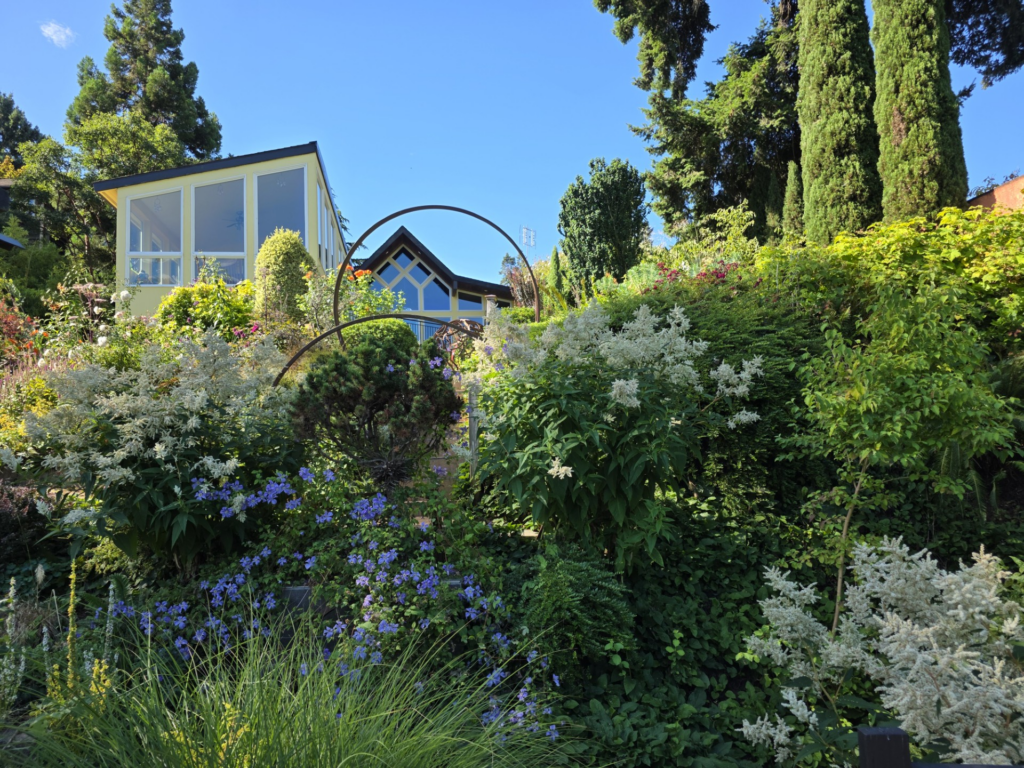
Sheng’s garden is a work of art and a labor of love. The tall greenery that borders the driveway gives way to a beautiful array of flowers along the paths leading behind the house. Each twist and turn of the concrete and gravel walkways presents visitors with a new display of thriving plant life.
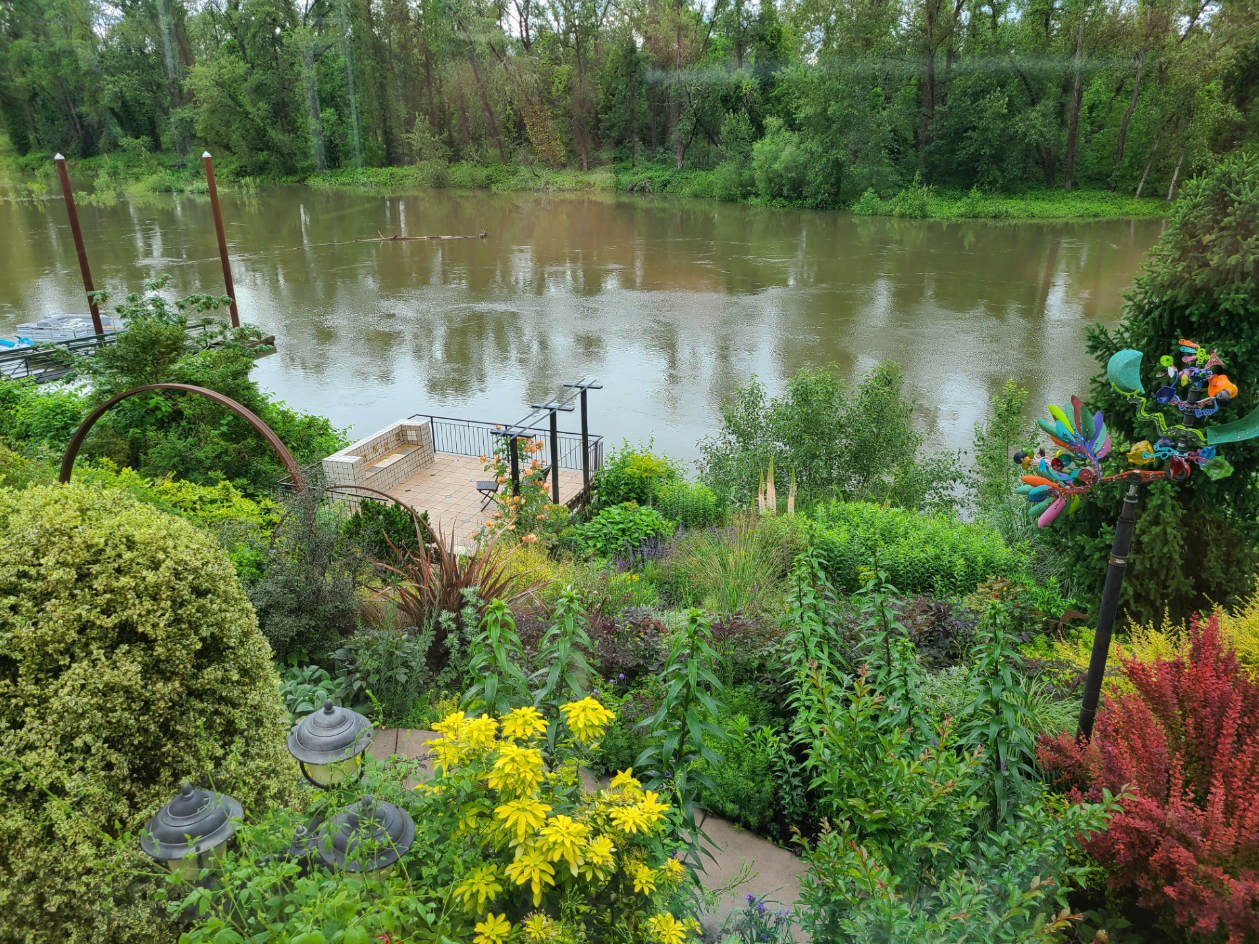
Natural as the artistry of the garden may seem, nothing about its construction was easy. The garden surface plummets 20 vertical feet between its upper section and the edge of the river. This makes for a 60-degree incline; gardening on such a steep hill is a strenuous undertaking. Sheng recounts the physically demanding experience of installing a retaining wall halfway down the slope, a task that required her to remove the ivy and blackberries that had been dominating the property, dig out space for the wall, and carry and stack heavy stones. Planting and maintenance are also more complicated than they would be on a flatter, more accessible surface. Figuring out what she wanted from her space was just as tricky.
The slope of Sheng’s back garden. A walkway is hidden among the tall plants. Photo credit: Sherry Sheng.
But Sheng has always been up for the challenge. She expanded her gardening knowledge in any way she could, whether it was by reading books and magazines, taking classes, or learning from fellow Master Gardeners and other gardening experts. And she experimented, trying out different arrangements of plants to learn what worked for her.
The product of her efforts is a garden defined by expertise and intentionality. Plants are located in spaces that provide them the conditions they need to thrive, but Sheng also carefully considers qualities of a plant such as color, height and flowering season when choosing what to plant where. She layers ground-cover plants with grasses and shrubs underneath trees and balances variety in her plantings with the cohesiveness that comes from repetition.
Garden art is also a critical component of the overall scene. A variety of sculptures, glasswork, and other pieces complement the plants, adding even more visual depth and variety to an already vibrant canvas. She has incorporated artistic elements in more subtle ways, too, like the patterned arrangement of river rocks around the water feature in the upper garden.
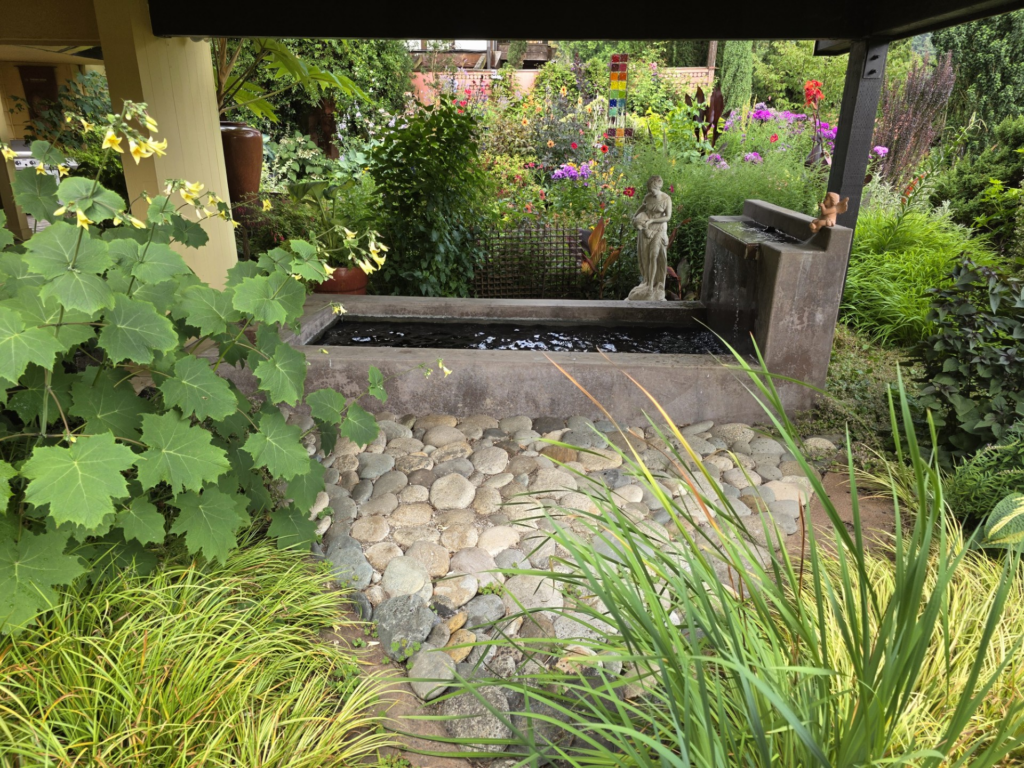
The water feature under the back deck of the house. Photo credit: Sherry Sheng.
On top of the aesthetics of the garden, she aims to reflect the natural richness of the surrounding ecosystems. This, she says, contributes to both “the overall beauty and the ecological function of the garden,” making it a “diverse habitat and visually engaging environment.”
This doesn’t mean she restricts herself to native plants; her garden contains sections of both native and ornamental species. The native plants are mainly concentrated where they’ll do the most ecological good—on the lowest level of the garden, which is right up against the riverbank and in close proximity to a great blue heron rookery. Upon learning from the Garden Ecology Lab that Douglas’ aster and goldenrod attract a diversity of native bees, Sheng created a pollinator garden with large drifts of both.
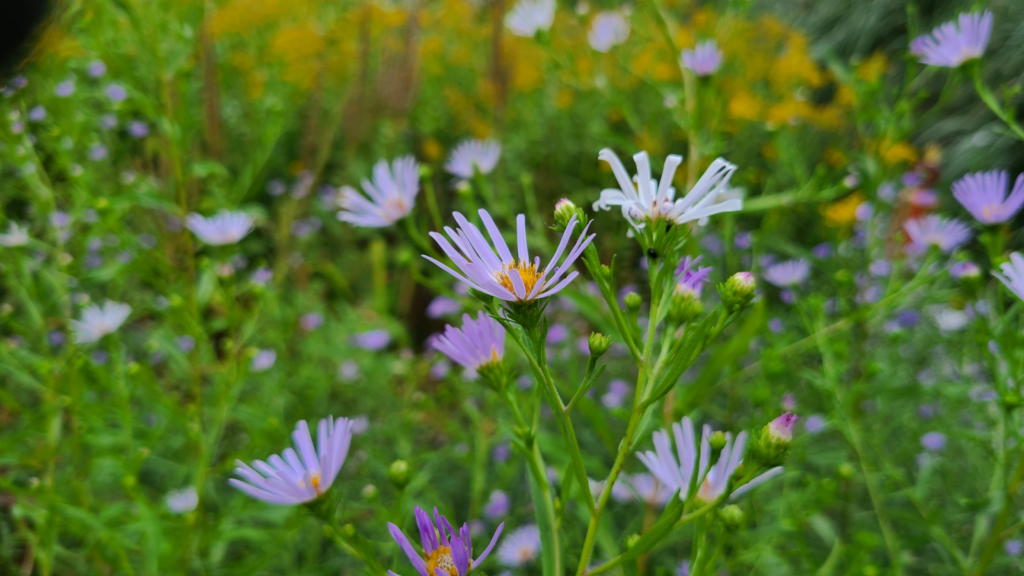
Douglas’ aster blooms in Sheng’s pollinator garden, with goldenrod in the background. Photo credit: Sherry Sheng.
In the upper levels of the garden, Sheng favors plants with large leaves, such as windmill palm, hardy banana, and rice paper plant, to evoke a tropical setting. In the front garden—the area visible from the street—she focuses on bright colors. “This invites passersby to wander into the driveway,” she explains.
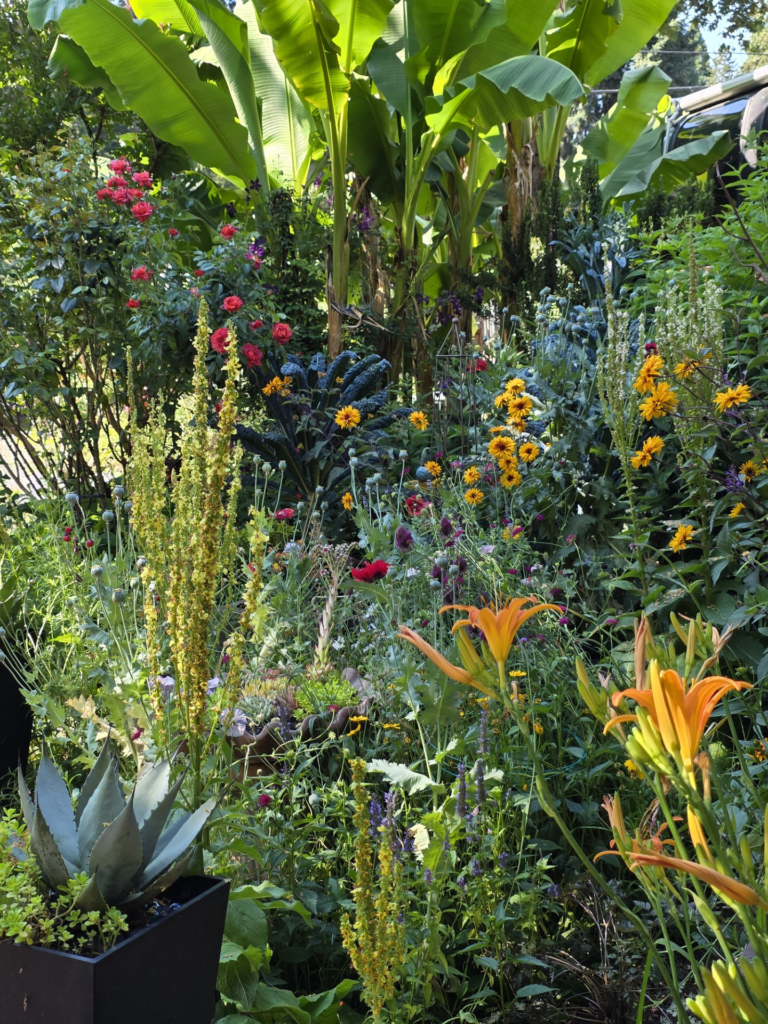
A section of Sheng’s garden in bloom. Photo credit: Sherry Sheng.
It’s no surprise that Sheng wants to spark curiosity among the people around her. Science communication and outreach are core to her work, whether it’s her past professions or her current involvement in the gardening community. As past director of the Oregon Zoo and the Seattle Aquarium, Sheng has a strong commitment to public education, which has remained a priority for her after her retirement. Upon becoming a Master Gardener, she started 10-Minute University, a program that translates garden-related research into practical advice for gardeners through videos, handouts, and webinars, among other formats. Sheng reports that the program has grown dramatically over the past two decades—the content now reaches about 20,000 users each year, and it won the 2017 edition of the International Search for Excellence award, which recognizes outstanding community service and extension work by Master Gardeners.
Her involvement with the Garden Ecology Lab is in a similar vein. She works to get knowledge of the lab’s findings into the gardening community.
Sheng hasn’t simply taught others about gardening; she’s learned a lot over that time frame, too. When she started her current garden in 2000, she didn’t have a clear idea of what she wanted from it. She experimented with different plants and styles, making several major redesigns to the garden before she settled on its current setup.
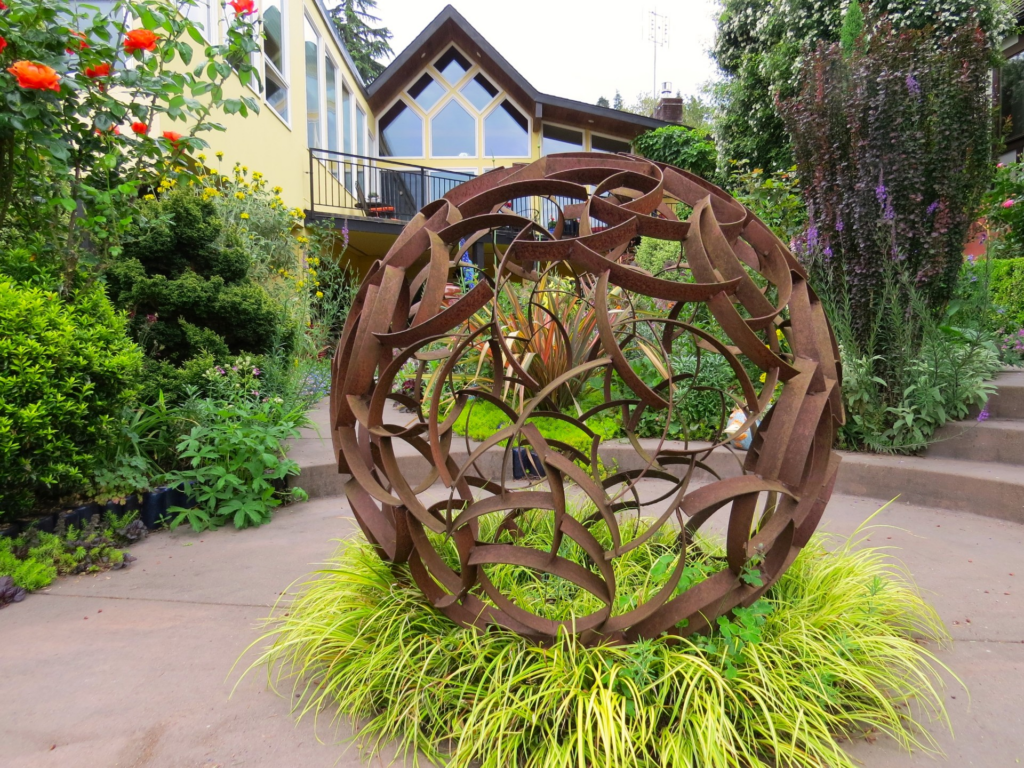
A metal sculpture sits in Sheng’s back garden, providing a centerpiece to the paths and plants radiating out around it. Photo credit: Sherry Sheng.
Even after all these years designing and building the garden, Sheng hasn’t run out of ideas. “It is difficult to sit for long” while resting in the garden, she says, “because, as I look around, new ideas pop into my head and I am ready to start the next project.”
And those ideas won’t sit idle any more than Sheng herself will. She’ll work to make them happen—and the end result is sure to be something she’ll be proud of.
Thanks to Gail Langellotto for supporting this project, Nina Miller and Taylor Janecek for their assistance with the research and writing process, and to the featured gardeners for the information and photographs they provided.
Works Cited
Pokorny, Kym. The Oregonian. [Portland], 23 July 2008, www.oregonlive.com/hg/2008/07/marv_bondarowiczthe_oregoniana.html.