David P. Turner / July 16, 2025
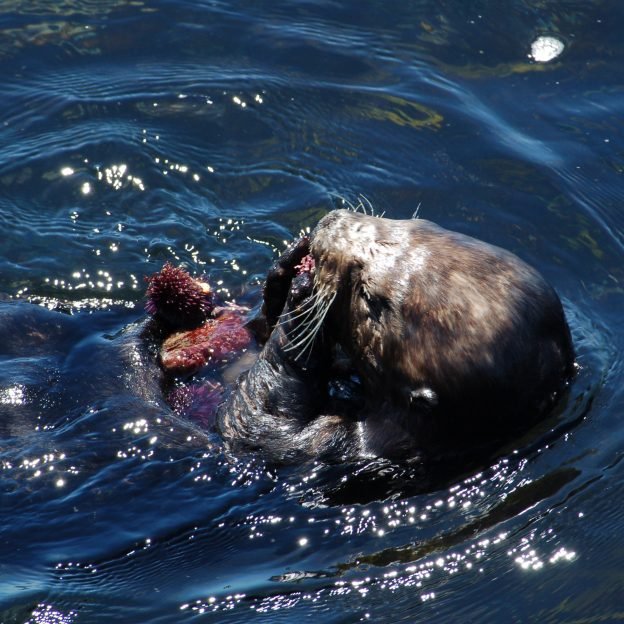
Sea otter consuming sea urchins. Photo Credit: matt “smooth” thooth knoth through Flickr via Creative Commons License.
Introduction
The Shifting Baseline Syndrome (SBS) holds that successive generations of natural resource managers tend to have a different image of what is natural.
The concept was originally proposed by a fisheries biologist (Daniel Pauly) who observed it in the context of declines in commercially harvested fish populations.
The obvious management significance of SBS is that population targets for restoration of natural ecosystems might be too low.
Here I will visit application of the SBS concept to ecological processes rather than just state variables like population size and biodiversity.
First though, I note that one might ask if the term “baseline” even has meaning anymore.
We know that virtually all natural processes are now altered by human actions to some degree. Also, that anthropogenic climate change and the 6th Extinction will play out over centuries, and will be largely irreversible. Everything measurable about ecosystems is shifting, hence in some sense there are no baselines. Which makes it a good time to hone in on how best to use the SBS concept.
Case Studies of SBS in Relation to Ecological Processes
1. Effects of Predation in Terrestrial and Marine Ecosystems
“Trophic cascade” effects of losing the upper trophic level in an ecosystem are common in terrestrial, as well as marine, ecosystems but are not always obvious.
A land manager coming anew to Yellowstone National Park in the 1980s ̶ after extirpation of wolves ̶ and encountering overgrazing along streams, might not appreciate the regulatory role of wolves on the elk population (a major herbivorous species). The baseline for the process of predation on elk had shifted, but the land manager might miss it.
A survey of kelp abundance along the coast of the Pacific Northwest US in the late 20th century would have found little kelp. This form of marine plant is of great ecological importance because it provides food and protection for young fish. A major control on kelp abundance is the presence of sea urchins. They prowl the ocean floor and consume dead and live kelp plants. A major control on sea urchin abundance is predation by sea otters. The otters are able to overcome sea urchin spines and feast on their internal organs. Unfortunately, sea otter fur is quite valuable and the otters in the Pacific Northwest were hunted to local extinction by around 1910. As a consequence, urchin barrens ̶ where little kelp is found ̶ have formed from an overpopulation of sea urchins, with corresponding effects on fish populations. As kelp faded from the near shore environment in the 20th Century, wildlife managers may have begun to think kelp was naturally found only at low density in these waters (a case of SBS). Restoration of sea otter predation on sea urchins, and better management of other sea urchin predators, is helping recreate more vibrant, kelp-friendly, marine ecosystems.
2. Effects of Declining Invertebrate Diversity on Decomposition
Ecosystem ecologists commonly study rates of leaf litter decomposition by enclosing fallen leaves in a mesh bag and leaving the bag on the soil for an extended period. The rate of change in dry weight is then a metric for decomposition rate. One might assume that the results of a litter bag study reflect natural or baseline conditions. But such is no longer the case.
A critical factor that is moving this bar is the “insect apocalypse”. The process of decomposition (i.e. decay of foliage, roots, wood) is driven in part by invertebrates such as insects and slugs, and the process is slowed by a decline in invertebrate biodiversity.
Driving forces in the decline of insect biodiversity include land use change, pesticides, and effects of climate change. Desynchronization in the interactions among insect species, and between insect species and local plants, can significantly impact local populations.
Slowed decomposition means slower release of nutrients and possibly slower plant growth. Thus, by altering state variables such as the diversity of invertebrates, we are altering critical process rates, possibly on a massive scale. But detecting and tracking these rate changes is difficult.
3. Effects of Deforestation on Regional Evapotranspiration
Large areas of the Amazon Basin have been deforested in recent decades. A key process altered by deforestation is the transpiration of water, i.e. loss of water through leaf stomata. Where canopy leaf area is decreased, transpiration decreases and because around 50% of precipitation in a rain forest is recycled from previous rain events (by way of transpiration), the loss of forest leaf area associated with regional deforestation tends to induce a decline in regional precipitation. Decreased precipitation in the Amazon Basin is projected to impact native vegetation and agriculture.
The principle of “stationarity” in climate research is similar to that of “baseline” in ecological studies. Climatologists aspire to describe the statistical properties (e.g. mean and variability) for properties like precipitation and temperature for a given region. The climate is designated as stationary if these statistical properties are stable over time. If those properties are drifting, as in the case of fossil-fuel-emissions-driven climate change, the climate is said to be non-stationarity and hence less predictable.
If ecological baselines are shifting and the climate is losing stationarity, natural resource managers require strong monitoring programs to track changes, and new adaptive strategies to avoid ecosystem degradation.
Conservation Strategies in the Face of SBS
A growing awareness of shifting ecological process rates, and the possible consequences, has helped inspire several conservation strategies.
Rewilding
The original “rewilding” concept emphasized “cores, corridors, and carnivores”. Advocates pointed to degraded ecosystems and attributed the problem to the decline or absence of specific processes, e.g. predation. The full range of trophic interactions was seen as fundamental to shaping the structure and function of ecosystems and landscapes. Human interventions such as hunting were not considered a substitute for natural processes such as predation.
The reintroduction of wolves to the Yellowstone region is an iconic case of rewilding. But the theory has also been applied in the case of background processes like decomposition. Here, transfer of invertebrates and microbes from undisturbed to disturbed sites helps restore decomposition rates.
The theory of rewilding is still under development but a core principle is to keep ecosystems “wild” – meaning to insure the continuous operation of all natural processes needed to drive the self-organization that is characteristic of complex systems.
Nature-Based Solutions (NBS)
Large areas of land and ocean provide services to humans – notably food, wood, water filtration, and recreation. These working ecosystems are clearly no longer natural, yet they contribute to biosphere metabolism and are worth managing as such.
Human interventions and impacts are often altering these ecosystems, sometimes with limited reference to natural processes e.g. the full range of impacts form cattle grazing on public rangelands in the western US is poorly understood. An NBS management approach aims to restore and monitor core ecological processes needed to provide ecosystem services to humans and to support thriving ecosystems as parts of the biosphere.
NBS is a conservation framework with an “overarching goal to address global societal challenges”. It tends to be applied at large scales and require significant human management intervention. On the human side, delivering ecosystem services and comprehensive stakeholder involvement are core objectives. On the ecological side, the emphasis is on management of natural processes. Restoration and management of mangrove forests is a good example because it requires intensive site manipulation that ultimately provides services like carbon sequestration and coastline protection from storm surges.
Both private sector and public sector efforts at sustainability are increasingly framed in terms of a nature – centered perspective.
Conclusions
Anthropogenically-driven non-stationarity in the physical environment, and shifting baselines for both state variables and ecological processes, are increasingly relevant to natural resources management. Conservation frameworks like rewilding and Nature-Based Solutions provide adaptive strategies for managing under these contemporary conditions. Governmental support for monitoring and restoration at multiple scales is required.