Peak Carbon Dioxide Emissions and Peak Carbon Dioxide Concentration

David P. Turner / April 22, 2025 (update)

Figure 1.  Projections of CO2 emissions and concentration.  Image Credit NOAA

In 2020, a remarkable speculation circulated in the cybersphere to the effect that global emissions of carbon dioxide (CO2) from fossil fuel combustion may have peaked in 2019.  Considering that recent formal projections generally indicated increasing emissions through 2030 or longer, this assertion was striking.  It matters because CO2 emissions determine the growth in the atmospheric CO2 concentration, which in turn influences the magnitude of global warming.

The atmospheric CO2 concentration is currently around 425 ppm (up from a preindustrial value of around 280 ppm) and is rising at a rate of 2-3 ppm per year.  The consensus among climate scientists is that rapid greenhouse-gas-driven climate change will be harmful to the human enterprise on Earth.  It would be good news indeed if CO2 emissions were on the way down.

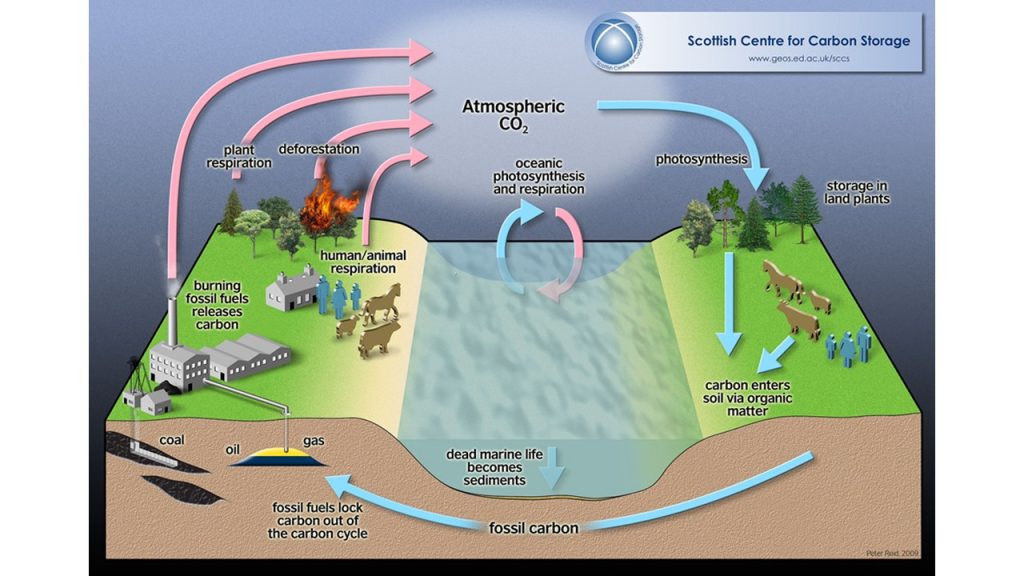
Estimates for annual global CO2 emissions are produced by assembling data on consumption of coal, oil, and natural gas, as well as data on production of cement and effects of land use.  The sum of fossil fuel and cement emissions is termed Fossil Fuel & Industry emissions (FF&I).  Land use, land use change, and forestry (LULUCF) is mostly the net effect of carbon emissions from deforestation and carbon sequestration from afforestation/reforestation.  Total anthropogenic emissions are the net of FF&I and LULUCF.  Two independent estimates of CO2 sources and sinks (GCP and IEA) differ slightly.

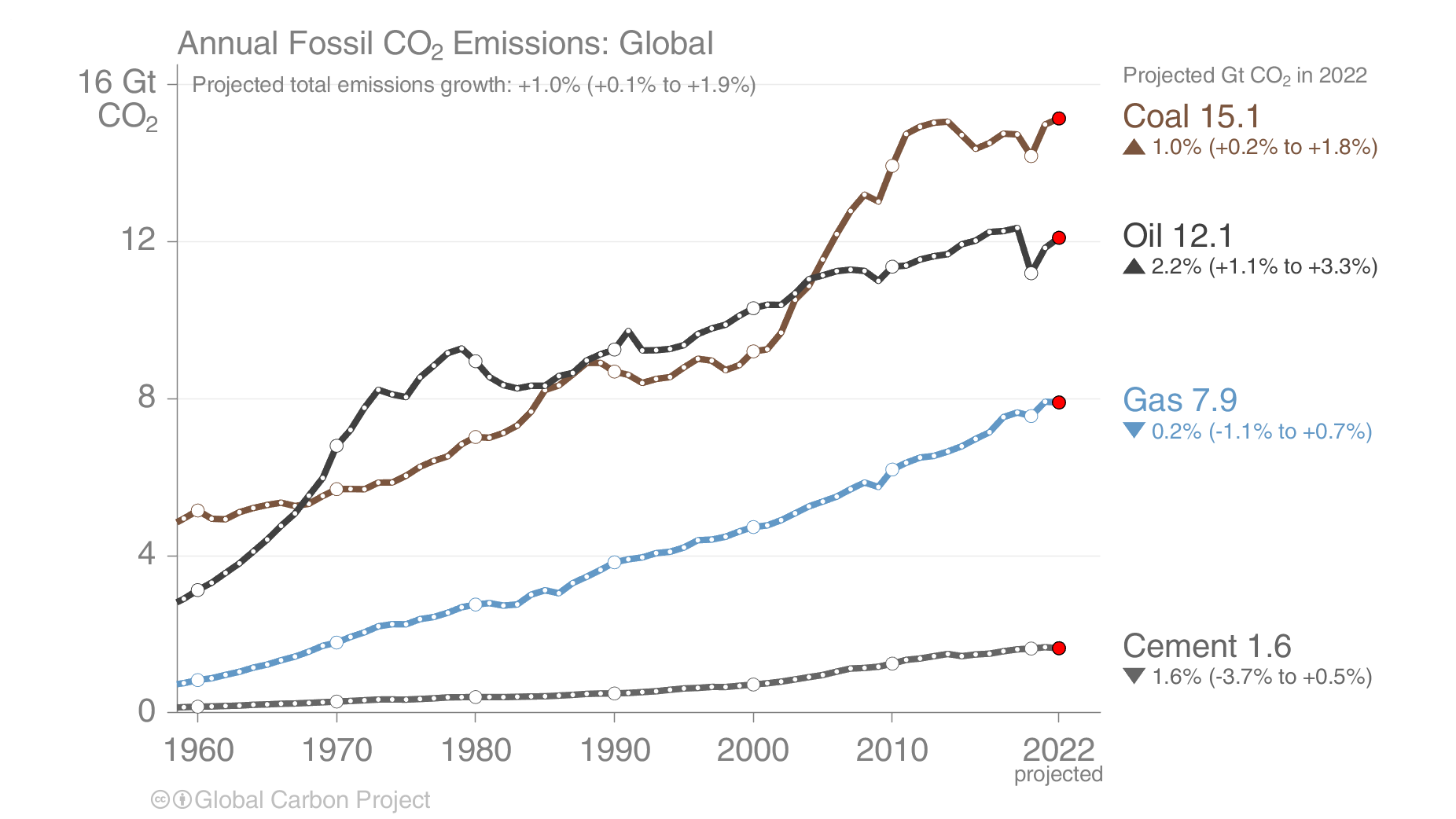
The suggestion that peak fossil fuel emissions occurred in 2019 held true in 2020 and again in 2021 and 2022, but 2023 saw a 1.1% increase over 2019. Emissions rose another 0.8% in 2024. 

Intriguingly, a decline in LULUCF compensated for the increase in fossil emissions such that total anthropogenic emissions remained the same in 2023 as 2022 (11.1 GtC yr-1).  The net source was 11.3 GtC yr-1 in 2024.

Several specific observations points towards lower emissions in the near-term future.

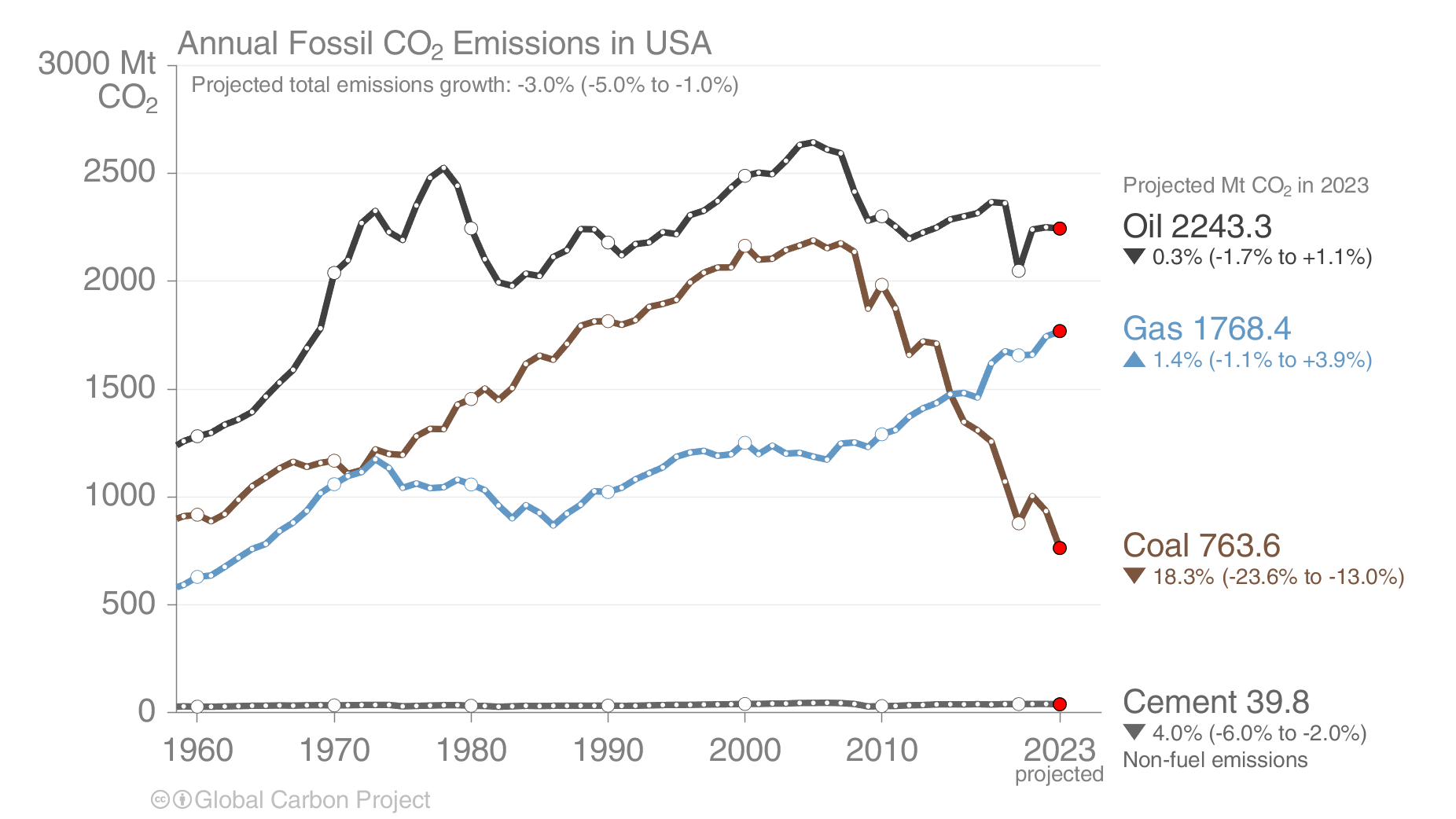
1.  Global coal emissions declined from 2012 to 2019 but have risen above 2012 in recent years, primarily due to increases in India and China.  However, coal emissions declined 18.3% in the US and 18.8% in the EU in 2023. The declines continued in 2024. Aging coal-powered electricity plants in the U.S. are being replaced with plants powered by natural gas (more efficient that coal) or renewable energy.  Some coal plants have been prematurely retired.  A gradual phase out in global coal consumption is being driven by the price advantage of renewable energy, impacts of coal emissions on the climate and human health, and the reluctance of insurance companies to cover new coal-based power plant construction.  China has agreed to stop financing the construction of coal power plants in developing nations and India has pledged to stop approving new domestic coal burning plants.

2. Global oil demand in 2020 fell 7.6% from 2019 because of Covid-19. It partially recovered in 2021, 2022, and 2023, then in 2024 rose above the level in 2019.  Structural changes such as reduced commuting and business-related flying mean that some of the demand reductions associated with Covid-19 have persisted.  Vehicles powered by electricity and hydrogen rather than gasoline are on the ascendancy, sparked in part by governmental mandates to phase in zero emissions vehicles. Global oil demand may peak around 2030.

3.  Even a near-term peak in natural gas consumption, at least in the US, is being discussed.  The GCP budget for 2022 showed a 0.2% decline in global gas emissions and for 2023 a 0.5% increase.  The increase in 2024 was 2.4%. Projections for long-term natural gas demand are highly uncertain and subject to assumptions about national policies related to climate change mitigation. Generally, the price advantage of renewable sources will increasingly weigh against fossil-fuel-based power plants.  The growing importance of energy security at the national level also argues against dependence on imported fossil fuels.  Ramped up production of renewable natural gas could substitute for fossil natural gas in some applications.

It is likely that the approaching peak in total fossil fuel use will be driven by diminishing demand rather than lack of supply.

Currently about half of FF&I emissions remain in the atmosphere, with the remainder sequestered on the land (e.g. in vegetation and soil) and in the ocean.  The land sink has been increasing in response to 1) high CO2 enhancement of photosynthesis and plant water use efficiency, and 2) policy driven impacts on land management (e.g. more reforestation and afforestation).

However, the annual increase in the atmospheric CO2 concentration for 2024 was 3.6 ppm, the largest such increase ever recorded. This extraordinary bump up in concentration was mostly driven by drought impacts on forest carbon sources and sinks.

Once fossil fuel emissions begin decreasing and fall by half − and assuming the net effect of increasing CO2 and climate warming is still substantial carbon uptake by the land and ocean − the atmospheric CO2 concentration will peak and begin to decrease.  The year of peak CO2 concentration could be as early as 2040 (see carbon cycle projection tool below).

On the other hand, there is plenty that might go wrong with this optimistic scenario.  As climate change intensifies, the net effect on land and ocean sequestration could be a decline in carbon uptake.  On land, carbon sources such as permafrost melting and forest fires will be stimulated by climate warming.  In the ocean, warming will intensify stratification, thereby reducing carbon removal to the ocean interior.  The steady increase in the ocean carbon sink since around 2000 has stalled in recent years, for poorly understood reasons.  If fossil fuel emissions are not significantly abated in the coming decades, the CO2 concentration could still be rising in 2100 (Figure 1).

Recommended:  Interactive CO2 Emissions and Concentration Projection Tool.

The Second Revival of Gaia

January 11, 2020/David P. Turner

Gaia was originally a figure from Greek mythology: the mother goddess who gave birth to the sky, the mountains, and the sea.  Gaia was adopted by the Romans when they conquered the Mediterranean basin, but her myth was largely abandoned with the ascendency of Christianity by the third century CE.

The first revival of Gaia was a product of the nascent Earth system science community in the 1970s.  Atmospheric chemist James Lovelock was impressed by the finding of geologists that life had persisted on Earth for over 3 billion years despite a 25% increase in the strength of solar radiation (associated with an aging sun), and numerous catastrophic collisions with asteroids.  He also understood that the chemistry of the atmosphere − which provides oxygen for animal respiration, protection from toxic solar UV-B radiation, and influences the global climate − was maintained by the metabolism of the biosphere. 

These observations led him to suggest that the Earth as a whole was in a sense homeostatic, it was able to maintain certain life enhancing properties in the face of significant perturbations.    

In casting around for a name to give this organism-like version of the planet, he was inspired by author William Golding to revive the term Gaia.  Lovelock and microbiologist Lynn Margulis went on to write many influential peer-reviewed papers, and later books, on Gaia.

By the 1990s, the question of what regulated the functioning of the Earth system had become of more than academic interest.  Earth system scientists had observed that the Earth system was changing and begun to worry about possible impacts of those changes on the human enterprise.  Concentrations of greenhouse gases were rising, stratospheric ozone was declining, and a wave of extinctions was sweeping the planet. 

Geoscientists were initially intrigued by the Gaia Hypothesis about planetary homeostasis, hoping perhaps that Gaian homeostasis might save us from ourselves.  But by around 2000 they had largely rejected Gaia as an entity.  Many of the feedbacks in the Earth system (see my Teleological Feedback blog) were positive (amplifying climate change) rather than negative (damping), hence not contributing to homeostasis.

The second revival of Gaia came predominantly from scholars in the humanities.  Historians typically begin human history about 10,000 years ago when humans adopted an agricultural way of life.  However, the discovery that humans have recently begun to alter the global environment on a geologic scale changes everything (as activist Naomi Klein says).  The Earth system is no longer a benevolent background state that will provide a growing humanity with unlimited resources.  Earth has a Gaian history that is now imposed upon by human history.  The new field of Big History aims to juxtapose the geologic and anthropocentric time frames.

Historians needed a term to evoke an Earth system that in a sense has its own agency, and scholars like science historian Bruno Latour and philosopher Isabelle Stengers settled on Gaia.  They emphasized Gaia not as a nurturing mother, but rather a force that will smack humanity down if the current trajectory of global environmental change continues.

In a recent hybrid interpretation, geoscientist Tim Lenton and humanities scholar Bruno Latour have dubbed the newly revived Gaia as Gaia 2.0.  This version refers to an Earth system on which a sentient species has evolved and begun to alter the planet but has collectively taken on the project of developing an advanced technological civilization (a technosphere) that will live on the planet sustainably.  That means comprehensive renewable energy, nearly closed material cycling, conservation of biodiversity to support the background metabolism of Gaia 1.0, implementation of multiple strategies to moderate climate change, and forms of governance that facilitate self-regulation at multiple scales.

Gaia 2.0 is the combination of the pre-human Gaian Earth system and the recently emergent technosphere.

The Teleological Feedback

January 6, 2020/David P. Turner

Earth system scientists commonly refer to feedbacks in the climate system. 

A feedback loop within a system means that a change in one part or component of the system induces a change in another component that either amplifies (positive feedback) or dampens (negative feedback) the initial change. 

The classic positive feedback related to global climate change and the Earth system is that warming of the global climate caused by increasing greenhouse gas concentrations in the atmosphere results in reduction in snow cover and sea ice, which causes less reflectance of solar radiation, and hence more absorption of solar radiation by Earth’s surface, and more warming.  A potential negative feedback is if warming increases evaporation, which causes more clouds, which reflect more solar radiation, and hence cool the climate.  Most of the feedbacks in the climate system are positive.

By burning fossil fuels and pushing up the atmospheric CO2 concentration, humanity is unintentionally warming the global climate and inducing multiple climate system feedbacks.

A big question is whether humanity can collectively begin to purposefully impact the Earth system in the form of a negative feedback to climate change, i.e. begin to slow down the rise in greenhouse gas concentrations and even begin to draw down those concentrations.  This willful action would be a teleological feedback to our unintended warming of the Earth system by way of greenhouse gas emissions.

Teleological feedback. The segmented line indicates the potential for a deliberate societal influence on the Earth system.

A disturbing paradox about current climate change is that by increasing the atmospheric CO2 concentration, humanity has shown that we are the equivalent of a geological force.  But humanity thus far is not organized enough to purposefully shape the Earth system. 

What we don’t have is much political will to reduce greenhouse gas emissions, nor the right international institutions to manage a global scale response. 

Political will comes from lots of sources, but maybe the most likely source is that as more and more people experience extreme weather events, sea level rise, and the other impacts of climate change, they will support mitigation efforts (e.g. a carbon tax).  Australia in 2020 appears to be a test case for this proposition.

Also, we might hope for political leaders who understand the situation and are committed to doing something about it.

Regarding global environmental governance, the size and strength of relevant international institutions are incommensurate with the challenge of global environmental change.  At the very least, a stronger United Nations Environmental Program or a new U.N. World Environmental Organization is needed.

Recommended Reading

Lenton, T. 2016. Earth System Science: A very short introduction. Oxford University Press.

Recommended Audio/Video

Joni Mitchell, They Paved Paradise

Discovery of the Technosphere

Earth System Science Discovery of the Technosphere

January 5, 2020/David P. Turner

The field of Earth System Science is a relatively young and is still working out how best to characterize Earth’s parts.  A key difficulty is with including the human dimension in a comprehensive description of the contemporary Earth system.  Earth scientists like to think in terms of the Earthly spheres and their interactions, e.g. the geosphere, atmosphere, hydrosphere, and biosphere.  By way of its industrial might, the global human enterprise recently has begun to exert an influence on the Earth system that is the equivalent to one of these spheres – effectively we have become a “geologic force”.  One proposal for characterizing this newly evolved global scale presence is to call it the “technosphere”.

To gain an appreciation for the meaning of technosphere, it helps to draw an analogy to the term biosphere.  We consider the biosphere to consist of all life on Earth.  It lives on energy, mostly in the form of solar radiation that is converted to biomass by photosynthesis, and it has a throughput or cycling of mass, mostly in the form of carbon and essential nutrients.

The Earth system existed before the origin of life and the evolution of the biosphere.  But once in place, the biosphere began exerting a strong influence on the chemistry of the atmosphere and the ocean, as well as on the global climate. 

Likewise, the technosphere is a globe-girdling network of artifacts −including all machines, buildings, and electronic devices – that lives on energy, mostly derived from fossil fuels, and has a throughput of mass (food, fiber, minerals).  The technosphere is growing rather irrepressibly, and like the biosphere before it, has begun to alter the global climate.

In a systems-oriented worldview, we try to differentiate parts and wholes, and to understand their relationship.  Generally, a part does not control the whole.  Thus, a critical feature of the technosphere is that humans are only a part of it, and correspondingly humanity cannot fully control it.  The technosphere is said to have agency, its own agenda.  It thrives on ever greater flows of energy and mass, which is not surprising when you realize that capitalism is its operating system.

Now that Earth system science has “discovered” the technosphere, we can study its structure, properties, dynamics, and how it interacts with the rest of the Earth system.  An awareness that we serve the technosphere as much as it serves us may help us redesign and rebuild it in a way that makes a human-occupied Earth system more sustainable.

Recommended Reading

Earth’s ‘technosphere’ now weighs 30 trillion tons

Zalasiewicz, J., et al. 2017. Scale and diversity of the physical technosphere: A geological perspective. Anthropocene Review. 4:9-22.

Will Steffen , Katherine Richardson, Johan Rockström, Hans Joachim Schellnhuber, Opha Pauline Dube, Sébastien Dutreuil, Timothy M. Lenton and Jane Lubchenco. 2020. The emergence and evolution of Earth System Science. Nature Reviews, Earth and Environment, January 2020).

Haff, P. 2014. Humans and technology in the Anthropocene: Six rules. Anthropocene Review. 1:126-136.

Recommended Video

Daily world air traffic

Recommended Audio/Video

Bruce Cockburn, If a Tree Falls