Clathrin Label

Protein: Clathrin

Artist: Audrey Riesen

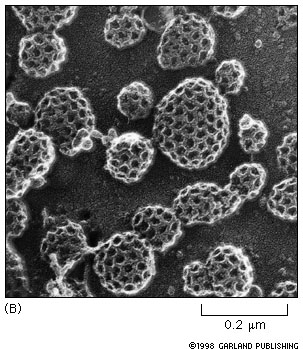
You wouldn’t want to go out into the elements without the proper outerwear – and neither do the vesicles that carry cargo such as enzymes throughout the interior of the cell. These vesicles wear a coat of their own – a delicate and beautiful polyhedral lattice formed when numerous three-armed clathrin triskelions join forces. So, my dears, grab your hats! We’re going out!

Posted in Student posts | Leave a comment

Prion Label

Protein: Prion

Artist: Dan Cheung

What’s the difference between a prion and a mystery box? The box. Prion (pronounced pre-on) is a protein found throughout the body, but its function to the organism is still a mystery to the scientific community. In their misfolded state, however, prions act like cults: They convert normal prions into pathogenic forms, causing deadly neural diseases, such as Creutzfeldt-Jakob disease in humans and the more notorious mad cow disease. Unfortunately, there is no cure for prion diseases.

Posted in Student posts | Leave a comment

Label for Dronpa

Protein: Dronpa

Artist: Thi Nguyen

A careful balance between dark and light, dronpa can switch from a “bright” state and a “dark” state by switching the wavelength of light that is focused on it. It is named after a fusion of the Ninja term for vanishing, dron, and photoactivation, pa. This lovely protein fluoresces with exposure to irradiation to 400nm of light but returns to a nonfluorescent state with 480nm of light.

Posted in Student posts | Leave a comment

Alpha Helices in Unexpected Places

I ran across these crazy kelp lamps created by artist Julia Lohmann when I was looking up images for an art project… pretty interesting. I don’t know if I would put it in my house, but still a cool idea.

You can read a little more about her kelp constructs idea here: http://www.inhabitat.com/2008/05/01/lamps-made-from-seaweed-julia-lohmanns-kelp-constructs/

Posted in Student posts | Leave a comment

Label for Dead Box Protein

Protein: Dead Box Protein 5

Artist: Callia Palioca

Like a hand carefully untangling precious jewelry, the Dead Box Protein 5 unravels RNA strands. Found in many organisms and performing many functions, it primarily serves as an RNA helicase that enables the newly formed RNA strand after transcription to be functional. Here, as the protein opens and closes it moves the RNA through coming out as a beautiful and ordered molecule. Although old and weary, this protein is certainly not just a “dead” box.

I’m relatively sure of the accuracy of this label. If there are any edits for clarity or science or overuse of “RNA”, just let me know!

Posted in Student posts | Leave a comment

Ubiquitin

Protein: Ubiquitin

Artist: Minhazur Sarker

Garbage: it’s all around us, even in our body! Ubiquitin is a special protein that functions to eliminate the proteins we do not need anymore.  A link, via a covalent attachment,  joins ubiquitin proteins together and when 4 are strung together, they move the garbage protein to a proteasome, which runs the process of destruction.

Posted in Student posts | Leave a comment

Label

Protein: Calcitonin

Artist: Nathan Forster

Bones are a surprisingly dynamic part of an organism’s body in that it is constantly being torn down and built back up by the combined efforts of osteoclasts and osteoblasts. Calcitonin, a molecule produced by the thyroid gland, is the protein responsible for both calcium uptake and telling the osteoblasts to build up new bone. This protein is often prescribed in order counter the effects of osteoporosis.

Posted in Student posts | Leave a comment

Talk about God’s Work of Art!

Posted in Student posts | 1 Comment

Venue problem…

So I inquired about the MU glass cases yesterday, and I found that not only do you have to rent them out (as in paying…) but they’re booked a year out. So…MU is out. However, the lovely woman I talked to recommended we try LaSells, since they have glass display cases. What do you all think?

Posted in Student posts | 1 Comment

Paper protein models?

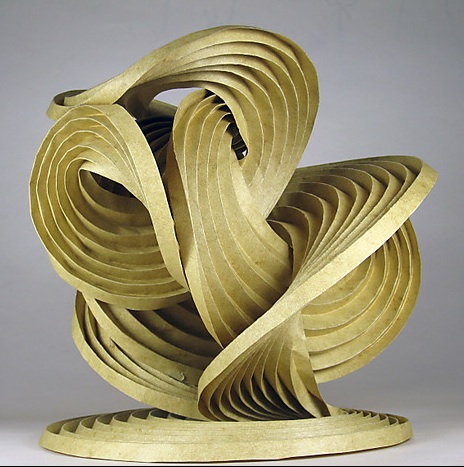
Remember how Pauling first modeled the alpha helix?  By discovering the optimum folding of a sheet of paper. Easy, if you know origami.

Here’s a “when art meets science” video explanation from Robert Lang, a highly inventive sort of person…

PS  The above two photos are clipped from a Washington Post article this morning entitled “When origami meets rocket science”, penned by Rachel Saslow)

Posted in Student posts | Leave a comment

Exhibit labels

As agreed on Monday, let’s each post the labeling information for our portraits.  Try to have this done by Friday.  Here’s a template you can use, in italics:

Protein:  Hemoglobin

Artist:  Phil McFadden

Take a breath… where did it go?  Hemoglobin, the vividly red oxygen-carrying protein of our blood, has carried it away to your heart and beyond.  Here I portray hemoglobin in the shape of our four-chambered heart.  Two of the subunits, shown as red, still hold onto their oxygen, tightly bound to iron.  The other two subunits, shown as blue, have let go of their oxygen.  So get ready… soon it will be time to take another breath.

No need to post any pictures, but the above label refers to a portrait idea that would juxtapose the following two representations:

(Picture of the 4-chambered heart from www.pted.org; hemoglobin by Goodsell)

Posted in Student posts | Leave a comment

New protein!

The uncertainty and ambiguity of the structure of dystrophin has finally hit me as being impossibly hard to build. Abstract freedom with designing a protein that has yet to be fully figured out is scary. In conclusion, I decided to choose a new protein. Unfortunately, pikachurin‘s structure has yet to be discovered, and  so I settled with a  new protein of choice, dronpa. It is a man-made protein mutant of green fluorescent proteins from coral. I thought its ability to switch from a fluorescent to non-fluorescent state was pretty sweet. Maybe I’ll use glow in the dark material to make my protein.

Posted in Student posts | Leave a comment

Food??

Hi guys,

So I was thinking, do you all want me to bring snacks to class from next Monday and on? I have a lot of money to spend on my dining dollars and would be willing to bring in McNary’s varieties of bagels one day with a bunch of cream cheese and then maybe some sandwiches if you have orders. Just let me know what you think and what you want!

I know I’m always hungry around class time and hope to stop your tummys from growling too!

Thanks,

Callia

Posted in Student posts | 2 Comments

Proteins, gah…..Proteins, gah……Smoothies, YAY!!!!!

Alright guys! So I checked up on the Bubble Tea/Smoothie place on Monroe and 14th. It opens at 11:30am on Wednesdays….this is a problem for sure. If somehow we are able to meet this (would mean we would hang out outside and then grab smoothies and be done) then its fine by me. But I suggest Yogurt Extreme which is up the street on Monroe. Its a great little place. I understand Dr. McFadden is not such a fan and for the most part, I am not a HUGE fan of it but it beats the heck out of waiting outside for smoothies.

Just my 2 cents! (Valuable 2 cents if you aks me 😛 ) If this is also not a good choice, then we could potentially go to one of the dining halls on campus and get ice cream but that would be TOTALLY boring. Again, my 2 cents. GO GO GO guys! Make a decision!

P.S. I just want smoothies or something, come on!!!

Posted in Student posts | 1 Comment

HIV protease, woof woof!

Perryman, et al (2005) labeled the enzyme as if it were a bulldog.

Posted in Student posts | Leave a comment

Here’s another one!

I have added a link to “May_k” on our side-bar of protein artists —>

Below is the p53 tumor promoter (2OCJ) in a dancing mood!

Posted in Student posts | Leave a comment

Interesting pictures

Hey guys,

I found this on the internet and thought it was sorta cool.

http://may-k.livejournal.com/

Posted in Student posts | 1 Comment

Ideas for the Dead Box?

Hey guys, so I was browsing around a craft store the other week and I found a plain wooden box. What I am thinking about for my protein portrait is to decorate the box to look old and dirty, somewhat like a treasure chest. Then, with the lid open, I was going to suspend the protein structure with fishing line or twine. That’s as far as I have gotten. What do you think? I’ve been trying to think of ways to incorporate the function of the protein (which I still need to research more about). Perhaps relating items inside of the box to the RNA helicase function. I don’t know yet. Any ideas?

Posted in Student posts | 1 Comment

Clathrin Videos – As Promised :)

I was wondering how the clathrin triskelions all fit together to form the cage, and this neat video cleared it up for me:

Clathrin Cage Formation

Also, this cracked me up:

Clathrin Performance Art!

Posted in Student posts | 1 Comment

ATP Synthase

ATP Synthase – by Min’s definition, a gigantic protein. (Actually, probably by anyone’s standard.) It puts the might in mightochondria – or would, if mitochondria was spelled that way. A very cool, multi-functional protein that can generate membrane potential one way and ATP the other.

Here’s a picture from wikipedia:

My problem is that I can’t find anything from the protein data bank – only tiny parts of it. Does anyone have ideas?

Posted in Student posts | Tagged | 1 Comment

Here is the Calcitonin Molecule I wish to make.

 I was thinking of making it out of salmon bones

Posted in Student posts | 1 Comment

Dystrophin

The folding of the alpha helices was aesthetically appealing when I first saw it. So… I’m not a hundred percent sure I am really happy with this protein but I thought it’s function is pretty sweet. The protein deals with muscular dystrophy. The deficiency of this protein is the root cause of it according to wiki. Let’s hope it’s right.

http://en.wikipedia.org/wiki/Dystrophin

Posted in Student posts | 1 Comment

Ovalbumin

Ovalbumin seems like it would be a challenge to put together, but it looks like it would also be a lot of fun. The challenge now is to master pretzel and pastry making before I actually start putting my project together. If anyone finds any art made out of baked goods, please send a link my way. (= Thanks!

Posted in Student posts | 2 Comments

Prion

As I have noted in class earlier, I wanted to do something microbiology related mainly because I took MB 230H last term. After flipping through some pages from my textbook, a familiar section caught my attention in the virus chapter: prions. These are not viruses, but they can cause diseases. The interesting thing about prions is that they are essentially free-floating proteins.

According to Wikipedia, that’s the normal prion protein in humans. There are many variations in the protein data bank, but I haven’t chosen one yet.

Yay, I’m making progress!

Posted in Student posts | 2 Comments

Harmonin, A Hearing Protein

Well, I mentioned that I wanted to choose a protein with some connection to music.  After doing a bit of browsing around on Google Scholar, I came across the structural protein harmonin.  This protein helps to maintain the structure of stereocillia, the small hairs in the inner ear that detect sound waves and ultimately make hearing possible.

Here is an image of one domain of the protein.  It incorporates a decent number of beta strands, but it contains relatively few alpha helices.

I had mentioned that I may consider wrapping guitar strings around drum sticks to form the alpha helices; however, since the helices in this protein are relatively short and drum sticks are very sturdy, I will likely choose something else to form the alpha helices, which will allow me to use drum sticks as part of the scaffold instead.

Materials being considered:

*Guitar strings to represent chains not organized into secondary structures

*Guitar picks, glued end-to-end in an arrow-like fashion, to represent beta strands

*Speaker wire to represent alpha helices (I may swap the role of guitar string and speaker wire, as guitar strings would probably keep the helical shape longer and better)

*Drum sticks as the major structural material (i.e. pillars to hold up the model)

*Saxophone reeds as the minor structural material

*LOTS of Super-Glue!

Let me know what you think!

Posted in Student posts | 2 Comments

Ubiquitin

I was sitting there this morning wondering what protein to do. I don’t know very many proteins and after researching the ones I did know…..I found out they were HUGE! However, I did find ubiquitin. All I knew is that this protein labels other proteins to be disposed of, which in a sick way I found really cool. I want to use ubiquitin as my protein for this class but am VERY unsure on how to go about finding a good picture of it. I found one on wikipedia but come on let’s be real….no credibility.

http://en.wikipedia.org/wiki/Ubiquitin

Posted in Student posts | 1 Comment

Protein…alpha version

This is the protein that I am thinking of modeling thus far.  It’s pretty and varies beta, alpha, beta, alpha, etc.  I’m not entirely sure what it is used for except that it is a DEAD-box protein.  I’ll probably try to incorporate the function into my artistic medium of choice, as well as emphasize the structural pattern.

Posted in Student posts | 1 Comment

Domain Search

Hey guys,

So if you are still searching for a protein and want to look in each of the CATH or SCOP domains, you can do it from the Protein Data Bank instead of waiting for their individual sites to load.  If you go to the homepage at www.pdb.org , on the left hand panel there is a spot to browse the database.  If you click on that link, there are tabs near the top of the page that lets you search by biological processes involved, molecular function, domain, etc.  Just thought it might help, good luck!

http://www.pdb.org/pdb/browse/browse.do?t=5&useMenu=no

Posted in Student posts | 1 Comment

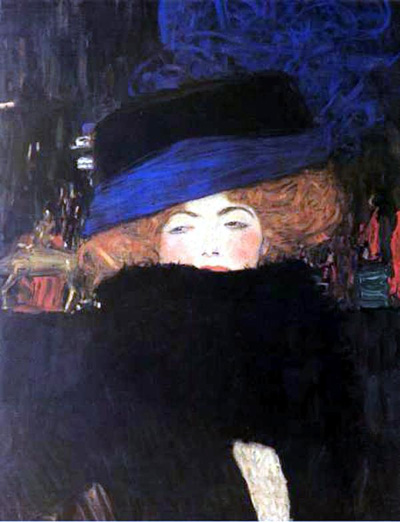
Painters and hats

Edgar Degas and Gustav Klimt really knew fashion hats…

Posted in Student posts | Leave a comment

Clathrin!

Here are some pretty pictures of clathrin for you all! I’m thinking it would be epic to model a partially formed clathrin coated vesicle by creating a retro-styled hat out of clathrin triskelions. Very high fashion, don’t you think?

Posted in Student posts | Leave a comment

presentation tomorrow

I just got this email from the art dept. and thought this sounded pretty cool!  I can’t go, but I thought others might be interested.

Acclaimed documentary filmmaker Jane Nisselson will give a presentation on Filming a Visual History of the Molecule at The Valley Library, Thursday April 8th. The hour-long presentation will be in the Autzen Room on the 2d floor of the library beginning at 2pm. This talk is a summary of Ms. Nisselson’s month-long research in the Library’s Special Collections unit. Jane Nisselson is a professional film maker from New York City

Clifford S. Mead

Head of Special Collections

Posted in Student posts | 2 Comments

Spirals indeed

Callia made a good suggestion.  Check out the spirals she found.  On Wednesday, we’ll practice making left-handed and right-handed spirals since you’ll need that skill to build alpha helices with the proper handedness.

Posted in Student posts | Leave a comment

aha!

So I’m finally getting around to posting.
Here’s a pretty interesting example of a crossover between science and art… and alcohol.
http://bioalloy.org/o/projects/microbe.html

Posted in Student posts | 1 Comment

I’m alive!!…

Hi y’all,

I found these pretty pictures.  I wonder if proteins have these kind of spirals…

http://spiral.gallery.sytes.org/

SMILE! =)

Posted in Student posts | Leave a comment

Whuddup, keeds!

Yup, looks like it works.

Anywhom…I’m an avid musician, so I’ll probably be looking for a protein linked to music somehow. We’ll see what happens.

Posted in Student posts | Leave a comment

Testing…testing, 1, 2, 3…

:]

Posted in Student posts | 1 Comment

Obligatory First Post

I’m not sure what kind of proteins are in eggs, but I suppose that’s what research is for — if I find something good, I might end up making a portrait of that. If I finally master a sugar cookie recipe, I might end up baking my final project.

Just one question: can we eat it if I do?

Posted in Student posts | Leave a comment

First Try at posting

I have no idea what protein to do.

Posted in Student posts | Leave a comment

Good idea about the banana

Posted in Student posts | Leave a comment

Good Evening World :)

This is my attempt at a post. Although this may not exactly be protein related, I thought this artwork would brighten everyone’s day. A Love Letter For You. Wouldn’t it be sweet if there was a love letter for OSU?

Posted in Student posts | Leave a comment