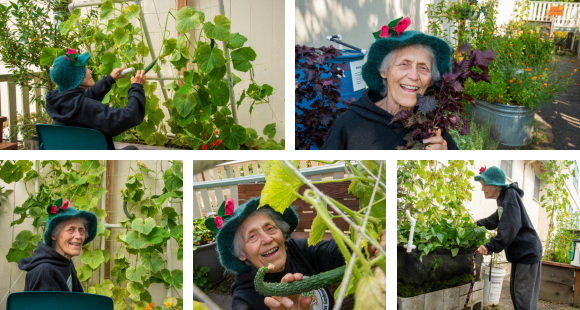
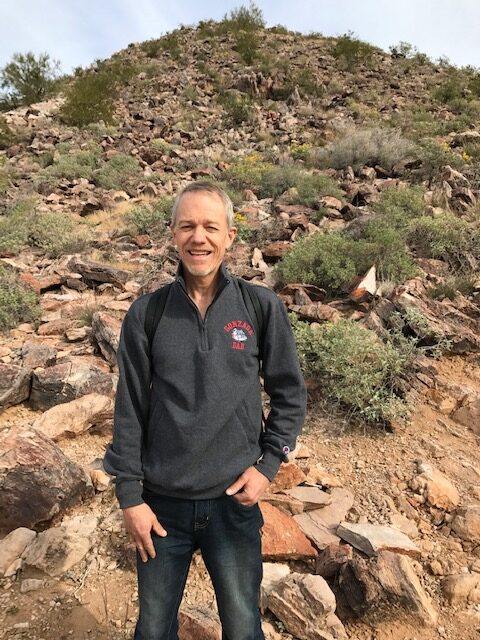
Meet Joe Hodge, Master Gardener volunteer

For Joe Hodge, the best thing about being a Master Gardener volunteer is “I feel like I’m giving back to my community. I’m not super involved with leadership or charitable organizations in my hometown, but with Master Gardeners, I feel like I’m a part of so many people learning. I know that I’m a valuable person who can help others live their lives better.”

Coaching and cheering on new volunteers is what Joe is most proud of: “I remember Master Gardener training as being a bit stressful with the huge amount of information coming our way (like drinking out of a firehose). So when our local chapter does Master Gardener training for new volunteers each year, I make sure to join our weekly Question and Answer Zoom meetings, hoping I can get across to the trainees that they really are special.

The friends who I have who are also Master Gardeners are the kinds of friends who you stay friends with.

I’m lucky enough to garden in a community garden, and when you see the others gardening alongside you, it always brightens up your day. The physical benefits of gardening are fairly obvious, but we sometimes forget about how talking to others about how your garden is growing, or about your plans for next year’s garden, can be so beneficial for your mental state.

It feels like the world is more divisive than ever, and Master Gardener volunteers do the opposite of that – we bring people together, people from all different backgrounds become closer once they start gardening.

Being a Master Gardener has not only allowed me to help others, but it has sharpened my own gardening skills.

A fun part of gardening is giving your excess away. I will list them into categories, starting with FAMILY. My nearest family member is 180 miles away, and you would think that might make it extra challenging, but not so in this day of efficient coolers.

Next, NEIGHBORS. I live in a good sized apartment complex, and it’s very rewarding and easy to give away vegetables to my neighbors so that they do not go to waste.

Also, FRIENDS. At my age, I go to a lot more meetings than parties, so during harvest season I hope to bring some produce to a meeting to give away – very easy.

Lastly, and for me this category is not so common to give away but just as rewarding as any, is BUSINESSES. The employees at the businesses are just as appreciative and smile just as much as anybody. It’s become a habit for me to drop extra tomatoes to the office workers of my property manager’s office. When a certain employee there sees me in late summer or early fall, she is always smiling when I walk in because she knows I am bringing in tomatoes, and she absolutely loves tomatoes. Only one time has she not shared with the rest of the office, because that year my tomatoes were absolutely gorgeous.

My garden is next to the hospital, and when I have zinnias I like to take them next door. The receptionists in the ER department have a stressful job and I think the flowers make their day better.

I know the library employees well, and I like to bring them kale and other yummy, healthy vegetables.

Going to our local food bank to make a drop-off is important, and I leave feeling good every single time.

It might sound like I’m trying to make giving things from my garden away my only focus each year, and I while that would be great, it’s not quite true. It just happens to work out that every year, when you plant your garden, you don’t realize that a certain vegetable or flower is going to produce way more than you thought it would. The very last thing in the world that I want to do is let something go to waste. Giving it away becomes incredibly easy to do, and really quite rewarding. It’s a part of gardening that I never could have envisioned when I first started. And now, it’s become an integral part of each season. Being a Master Gardener has made all of this possible – thank you, OSU Extension, for improving the lives of so many!”

P.S. This year marks the 50th anniversary of the OSU Extension Master Gardener Program — and early giving is now open for Dam Proud Day. If this program has shaped your life, your garden or your community, consider making a gift today to help support the next 50 years. We’re also collecting stories from current and past Master Gardener volunteers. Share your story with us: Beav.es/mgstory 

Growing together for 50 years: Meet Sue Ryburn, Washington County Master Gardener volunteer

For 50 years, OSU Extension Master Gardener volunteers have grown more than gardens. They’ve grown partnerships, learning opportunities and community across Oregon.

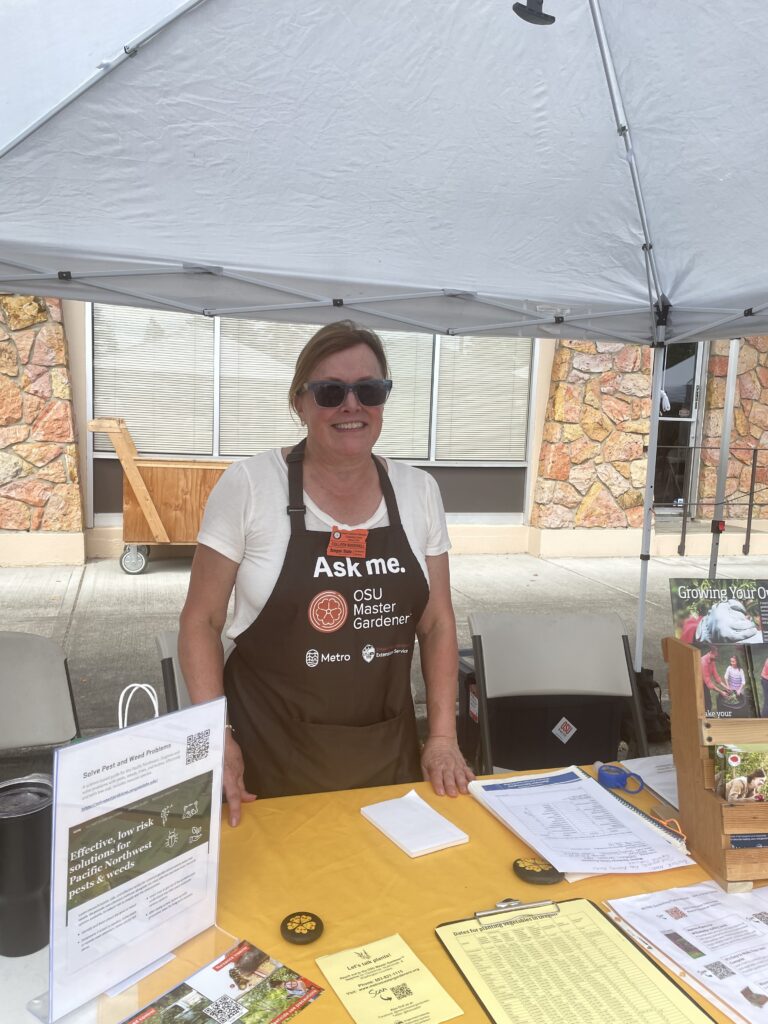
Sue Ryburn became an OSU Extension Services Master Gardener volunteer in 2012. The seed was planted years earlier — when her sister handed her a brochure from the Master Gardener volunteer booth at the Beaverton Farmer’s Market.

In her own words, Sue shares her journey.


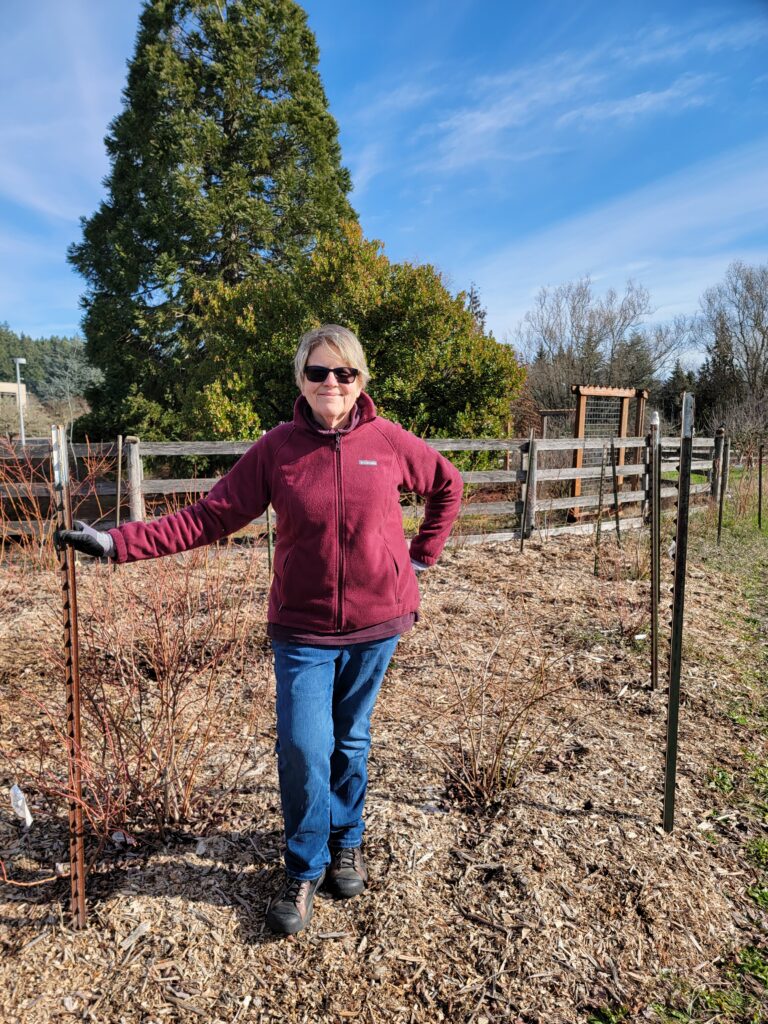
Sue in the garden, wearing sunglasses and gardening gloves, ready to garden.

A seed planted years before

I became an OSU Extension Service Master Gardener volunteer in 2012. Years earlier, knowing my love of gardening, my sister had given me a Master Gardener brochure she picked up from the Master Gardener booth at the Beaverton Farmer’s Market. I had not heard of Master Gardeners before, though the information caught my interest. I tucked the idea away and would need to wait five years until I retired to have time to pursue the Master Gardener program.

Early in the training I found that several principles of the program aligned with my values — relying on research-based information, promotion of sustainable gardening, service to the community and life-long learning.

The best part of being a Master Gardener volunteer has been learning about sustainable gardening, which is a very large tent, and then sharing information in a variety of venues. And, most importantly, to do this with a group of dedicated Master Gardeners with support from the staff at OSU Extension Service.

Building places for learning

Among the things I feel most proud of as a Master Gardener volunteer is helping to establish our two Washington County Master Gardener Association gardens — the Learning Garden at Jenkins Estate and the Education Garden at PCC Rock Creek, where I spend much of my volunteer time.

Our gardens provide hands-on and didactic learning opportunities on a broad range of sustainable gardening experiences. We have partnered with several organizations with similar missions to share information and help expand our outreach options. This partnering extends to other OSU Extension programs such as the Oregon Bee Atlas, the Oregon Naturalist program and Food Hero, where some Master Gardeners also participate. It just seems to make sense to collaborate with other groups who are all rowing in the same direction.

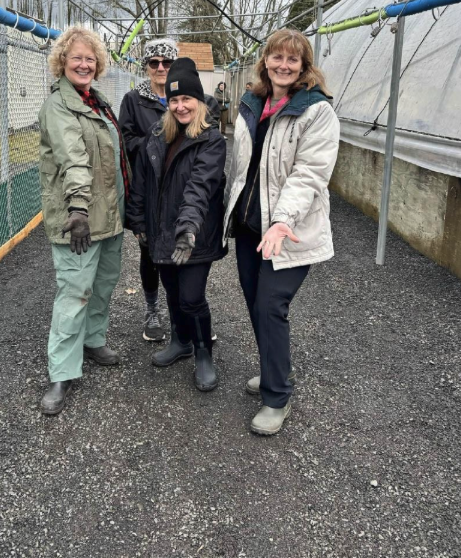
Our relationship with Portland Community College (PCC), and in particular the Landscape Technology Department (LAT), is invaluable. The LAT Department is located on the Rock Creek (RC) campus near the site of the Education Garden. We use LAT classroom, greenhouse, hoophouse and pole barn space for our educational outreach, plant propagation and big Gardenfest Plant Sale activities.

We enjoy opportunities to work with students and faculty at PCC and schools in our community. The work that we do to care for both our gardens creates an outdoor classroom for many of our educational outreach activities.

Working as a team

As MG Program volunteers we know that we work in teams — really none of us can accomplish what we do alone. Each week there is something that happens to remind me of the generosity of time, knowledge, goodwill and camaraderie of Master Gardeners.

Gardening is a great way to help put things into perspective and to have an impact on the environment in a world when sometimes it seems there is so much happening that might seem beyond the influence of just one person.

Health, hope and perspective

We don’t have to look far to find evidence that gardening is good for our mental and physical health. There is something enriching about placing a plant in the soil, caring for it and admiring how incredible the natural world functions.

It is rewarding to introduce children to the world of mason bees and explain their important role in pollination. There is a sense of satisfaction seeing the tree that you planted mature over the years. And there are helpful lessons learned, even when sometimes things just don’t quite work out.

Collective impact

I value being part of an organization that promotes programs such as Seed to Supper, Garden Future, Grow 1 Give 1 (a WCMGA program), and, like our Learning Garden, the many demonstration gardens across the state donating to food banks the food grown in our gardens.

One of the things I most value about being a Master Gardener is being part of something that collectively has a positive impact across the state because of the generosity of so many volunteers and dedicated staff.


As we celebrate 50 years of the OSU Extension Master Gardener Program, we are honoring the volunteers who have shaped this program through their knowledge, generosity and partnership. Stories like Sue’s remind us that our impact grows when we grow together. If you are a Master Gardener volunteer, we invite you to share your story. And if you know someone whose journey, leadership or dedication deserves to be recognized, please nominate them.

Growing together: a neighborhood garden story

At the heart of the OSU Extension Master Gardener volunteer program is something powerful: the idea that when we grow plants, we grow connections. This guest post, written by Master Gardener volunteer Sarah W. in Portland, is a shining example of that spirit in action.

While taking the Master Gardener training, Sarah began to apply what she was learning and applied it in the most generous way—by organizing her entire neighborhood block to garden together. Inspired by community-supported agriculture and grounded in the knowledge she gained from the program, she helped coordinate a shared vision: plant together, harvest together, and build deeper community ties through the act of growing food.

Sarah’s story is a clear reflection of the ripple effect the program can have—on individuals, families, and neighborhoods. It’s a reminder that when someone gains skills and confidence through the Master Gardener Program, they take those gifts into the world and plant seeds of change far beyond the classroom.

We’re honored to share Sarah’s story with you.


woman wearing plaid shirt and jeans, holding a large head of lettuce, just harvested from the garden she's standing in, along with two small children.

Why master gardening?

It’s a question I tried to answer repeatedly during the spring of 2024, as I attended Zoom class during kid soccer practice, puzzled out the calendar for every farmer’s market in the Portland Metro area, and marveled at the poised, knowledgeable, and involved perennial Master Gardeners I met at every turn. What was I trying to prove, and did I belong?

Indeed, the moment a few weeks ago before I pressed send on a spreadsheet garden planner covering my entire neighborhood, I wondered – is this why? Am I too much, or not enough?

My whole life, I’ve been what people indulgently call “a do-er”. I love a good idea, but more than that, I love plotting a good idea into being. I have also been called persistent – not to say stubborn – by those who love me. And my kids know that when I say, “five minutes until we go”, they can happily play for 15 while I chat up a new group of parents and lose track of time.

This is all to say that when my neighbor pitched the idea of a block-wide project where we crossed community-supported agriculture with a community garden spread across multiple yards, my husband correctly predicted I’d be in deep. He knows me.

The idea was simple. What if we each planted something different, and then brought together the harvest to share? Having just read about an inspired project in Los Angeles, it was an easy sell. The project formed quickly, based on the training fresh in my mind.

If any neighborhood was set up for this challenge, it was my little block, which hosted weekly line dances through COVID lockdowns and painted our street to commemorate the connection during those years. We’re a neighborhood where repeated gestures of kindness have created runners, and underground network that shoots up random acts of support you never thought to ask for.

Yet at its core, this project was about pooling individual effort for the collective – an ideal but challenging in the details. Nonetheless, we set off. At a potluck, we mapped individual plots into a single farm. On the south side of the street, better sun but smaller beds. On the north side, shade, but retirees who had time to build beds or move container tomatoes to track the sun. We calendared workdays, I ordered seeds, and we mixed fertilizer and pressed seeds into four-inch pots together. And yes, I emailed a beautifully color-coded spreadsheet where my eight-year-old and I mapped space, time, crop, and affection into a sharable format. So many things about this project are imperfect. But it’s an answer to the persistent question about why I became a Master Gardener. What kind of community is possible in this fast-paced and fragmented world? This week, it’s pak choi and kale thinnings. It doesn’t matter if we pool our plots for different reasons. When we arrive curious, open-hearted, offering care and whatever we have on hand – the connection follows.


Are you building community and connections through gardening? 2026 will mark the 50th anniversary of the Master Gardener volunteer program in Oregon: we would love to share your stories of community and connection. Please email leann.locher@oregonstate.edu if you’d like to share your story.