

Small Farms, Community Horticulture — Yamhill County
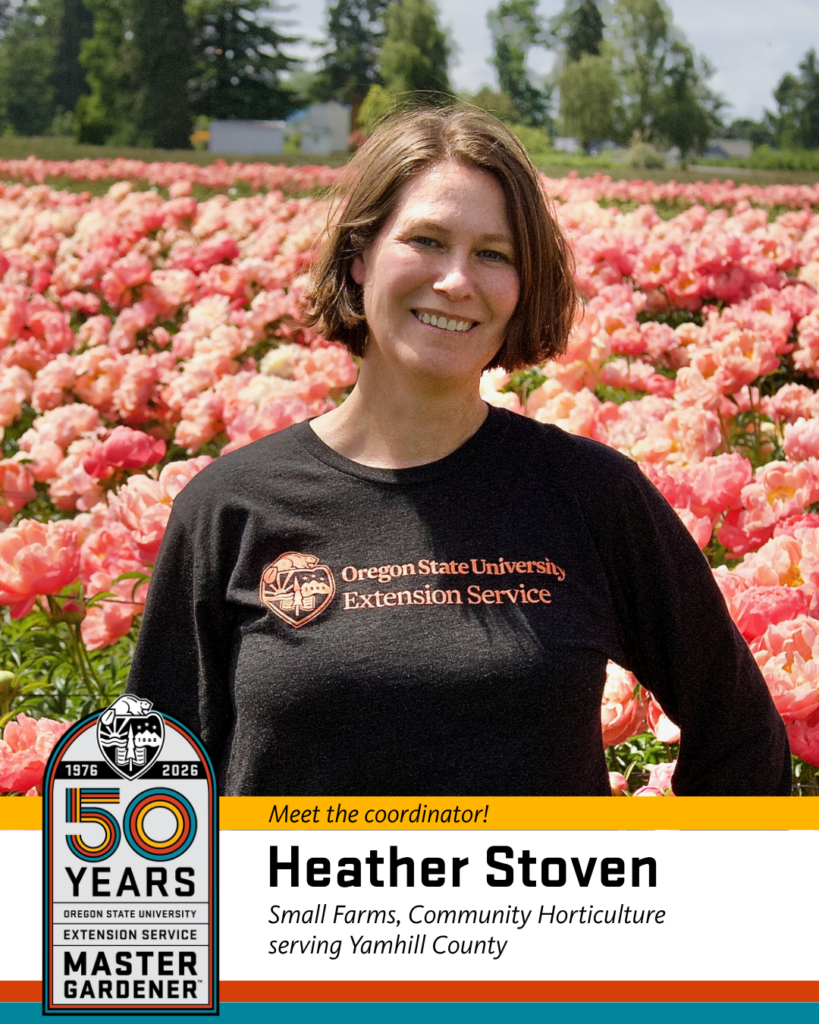
In celebration of the 50th anniversary of the OSU Extension Master Gardener volunteer program, we’re featuring stories about coordinators and volunteers. Let’s get to know Heather Stoven and hear about her path to Extension, what makes gardening in Yamhill county unique and collaborations that make the program possible.
With a background spanning plant production, pest management, research, and Extension, Heather brings a broad horticultural perspective to her work with gardeners, Master Gardeners, and small farmers in Yamhill County. Her work combines horticultural knowledge with community education and problem-solving.
Quick facts
Position: Small Farms, Community Horticulture
Region: Yamhill County
Education: M.S. in Plant Protection and Pest Management from UC Davis; undergraduate degree in general biology
Favorite insects: Native bees and the California Prionus beetle
Beginner plant recommendation: Yarrow
Background
Heather has always been interested in plants and horticulture. Before joining her current position, she worked in the nursery industry and as a research assistant at Oregon State University. Her current position appealed to her because it brought together several of her interests: horticulture, Extension, and community work. Her background in nursery production, pest management, and research also gives her practical experience that she can draw on when helping people diagnose plant problems and identify pests.
Heather studied general biology as an undergraduate before earning her M.S. in Plant Protection and Pest Management from UC Davis, where she focused on insects and integrated pest management.
Gardening in Yamhill County
Yamhill County is part of the mid-Willamette Valley, with a relatively mild climate. Winters generally aren’t too cold, summers aren’t extremely hot, and the region receives substantial winter rainfall. The area’s soils can have a relatively high clay content and hold a lot of water. Combined with the mild climate, these conditions allow gardeners to grow a wide range of plants successfully.
Favorite garden lesson
Heather’s own garden has taught her that sometimes the right plant simply isn’t the right plant for a particular space. She and her husband once bought a gunnera, sometimes called dinosaur food, because of its enormous leaves. While gunnera can grow in the Willamette Valley under the right conditions, it prefers a wet environment, and their yard isn’t irrigated very much. Despite trying to keep it watered, the plant eventually died.
The experience reinforced the importance of choosing plants that fit the conditions of a particular garden.
“I’ve learned to just accept that, you know, there’s… there’s certain things that I can grow and some I can’t grow.”
Her own garden has since focused more on drought-tolerant, Mediterranean plants and pollinator-friendly plants that fit her lower-water approach.
Supporting volunteers
For Heather, one of the most inspiring things about Master Gardeners is their dedication and enthusiasm for gardening. She enjoys talking with volunteers about plants and seeing how willing they are to contribute to their community. Recently, when a support person stepped down, Master Gardeners were eager to step up and help keep things moving. Their willingness to ask what they can do and take an active role in the program is something Heather appreciates.
Community partnerships
Heather works with several community partners, including Parks and Recreation, food access organizations, and Virginia Garcia. One long-standing partnership is with YCAP, the Yamhill Community Action Partnership. YCAP has supported Extension’s community gardening work for about a decade, particularly through the Garden to Table program.
The partnership has included helping develop programs, writing grants to support raised beds and plant starts for gardeners, providing background information, and assisting with marketing. Together, these efforts help make gardening education and resources more accessible in the community.
Quick questions
Favorite insect: Native bees. Heather enjoys watching the native bees that visit her drought-tolerant pollinator garden and intentionally grows plants that provide nectar and pollen for a variety of beneficial insects.
“I love watching all the native bees and growing plants that attract bees.”
She also has a soft spot for the California Prionus beetle, a large native beetle whose size can surprise gardeners and new Master Gardeners.
Plant recommendation for beginners
Yarrow. Heather chose yarrow because it is a tough, low-maintenance plant that doesn’t require extra irrigation once established and provides resources for beneficial insects, including native bees, beneficial wasps, and syrphid flies. It can spread, however, so gardeners should give it enough space and be prepared to manage it.
More work from Heather Stoven can be found here: [click here]
This is part of a series of stories we are featuring about the people of the OSU Extension Master Gardener volunteer program in celebration of our 50th anniversary. With +1,800 amazing volunteers and 30 faculty and staff we hope you are as inspired as we are by their dedication joy and impact that they make across the state.
If you’d like to share your Master Gardener story, we’d love to hear from you! Submit your volunteer story here: https://beav.es/mgstory