
This blog post is a continuation from “Refining Rubrics & Assessments: AI as Design Support – Part 1“.

Using AI to Refine Rubric Language

In the previous post, I gave an assignment prompt to Copilot (as that’s the recommended tool at Oregon State University) and asked it to complete the task. For reference, here is the task.

Rubrics are often the weakest link in assessment design, particularly when descriptors rely on vague phrases like “meets expectations” or “demonstrates understanding.” One way to evaluate rubric clarity is to ask AI to self-assess its own response using the rubric criteria.

If the model can plausibly justify a high score despite shallow reasoning or inconsistent logic, the rubric may not be clearly distinguishing levels of performance. More precise rubrics specify what evidence matters and how quality differs, emphasizing reasoning, coherence, and alignment with course concepts rather than polish or length. Clear criteria benefit students, but they also make it harder for superficially strong work to masquerade as deep learning.


Rubric Analysis Prompt (Click to expand)

You are now acting as an external assessment reviewer, not a student.
You will be given:

  1. An assignment prompt
  2. A grading rubric
  3. A model-generated student submission (your own prior response)

Your task is not to grade the submission.
Instead, critically evaluate the rubric itself by answering the following:

  1. Rubric Vulnerabilities
    • Identify specific rubric criteria or descriptors that allow a high score to be justified through fluent but shallow reasoning.
    • For each vulnerability, explain what kind of weak or superficial evidence could still plausibly receive a high score under the current wording.
  2. Distinguishing Performance Levels
    • For at least three rubric categories, explain why the difference between “Excellent” and “Good” (or “Good” and “Satisfactory”) may be ambiguous in practice.
    • Describe what concrete evidence a human grader would need to reliably distinguish between those levels.
  3. AI Self-Assessment Stress Test
    • Using your own generated submission as an example, explain how it could convincingly argue for a high score even if underlying understanding were limited.
    • Point to specific rubric language that enables this justification.
  4. Rubric Strengthening Recommendations
    • Propose revised rubric language that makes expectations more explicit and evidence-based.
    • Emphasize observable reasoning, causal explanation, constraint awareness, or conceptual boundaries rather than general phrases such as “demonstrates understanding” or “well-justified.”

Constraints:

  • Do not rewrite the assignment prompt.
  • Do not assume access to course-specific lectures or materials.

Focus on how the rubric functions as an assessment instrument, not on pedagogy or student motivation.

Tone:
Analytical, critical, and concrete. Avoid generic advice.


You could use this directly by attaching a rubric, assessment prompt, and “submission”, or modifying it to your own situation.

Here is a section of the results it gave, along with the “thinking” section expanded to see the process of the generated answer:
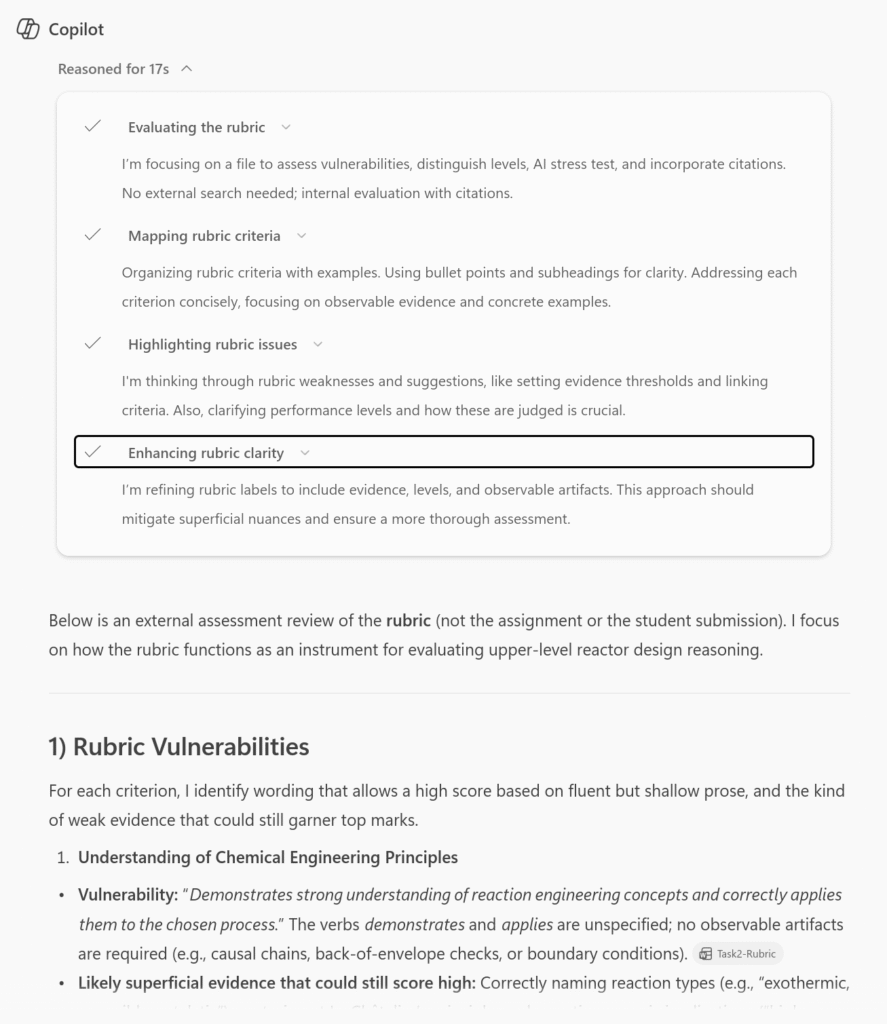

(Copilot gave me an enormous amount of feedback, as expected because the rubric included a lot of generic language.)


Rethinking “Higher-Order Thinking” in an AI-Rich Environment

Frameworks like Bloom’s Taxonomy remain useful, but AI complicates the assumption that higher-order tasks are automatically more resistant to outsourcing. AI can analyze, evaluate, and even create convincing responses if prompts are static and unconstrained.

What remains more difficult to outsource is judgment. Assignments that require students to choose among approaches, justify those choices, identify uncertainty, or explain when a method would fail tend to surface understanding more reliably than tasks that simply ask for analysis or synthesis. When reviewing AI-generated responses, a helpful question is: What would a human need to know to trust this answer? Designing assessments around that question shifts the focus from output to accountability.

Instructors can strengthen authenticity by introducing under specified scenarios, realistic limitations, or prompts that require students to articulate how they would evaluate the reliability of their own results. These design choices don’t prevent AI use, but they make it harder to succeed without understanding when and why an answer might be wrong.


An Iterative Design Loop for Assessments and Rubrics

Using AI as an assessment design diagnostic and refinement tool can work best as an iterative process. Draft the assignment and rubric, test them with AI, analyze how success is achieved, and revise accordingly. The goal is not to reach a point where AI “fails,” but rather a point where success requires engagement with disciplinary concepts and reasoning. This mirrors quality-assurance practices in other domains: catching misalignment early, refining specifications, and retesting until the design reliably produces the intended outcome. Importantly, this loop should be finite and purposeful, not an endless escalation.

Conclusion

using AI in assessment design is not about surveillance or enforcement. It is a transparency tool. When instructors acknowledge that AI exists and design accordingly, they reduce the incentive for adversarial behavior and increase clarity around expectations. Being open with students about the role of AI (what is permitted, what responsibility cannot be delegated, and how understanding will be evaluated) helps maintain trust while preserving academic standards. The credibility of online and in-person education alike depends not on stopping students from using tools, but on ensuring that passing a course still signifies meaningful learning.

Takeaway Cheat Sheet

  • Think of AI as support, not a villain.
  • Stress‑test early: run the rubric through a model for verification before you hand it to students.
  • Refine granularity: precise descriptors = clearer expectations.
  • Target higher‑order thinking: embed authentic scenarios.
  • Iterate, don’t stagnate: keep the loop tight but finite.
  • Mind ethics: disclose, de‑bias, and set realistic limits.

Four students working together on a project

A term paper is a common final assignment, but does the final assignment have to be a paper? The answer depends on the type of course and the learning outcomes. If the final assignment can be an alternative to the term paper, we can consider other types of assignments that allow students not only to accomplish the learning outcomes, as expected, but also to engage more deeply with the content and exercise critical thinking. A caveat related to the discipline is important here. Fields that require a writing component may necessarily rely on the term paper which can be scaffolded through a set of stages. For assignments with a sequence of tasks, refer to staged assignments (Loftin, 2018) for details on how to design them.

A first step in moving towards considering other types of assessments is to self-reflect on the purpose of the course and what role it will play in students’ learning journeys. You can use some of the following questions as a guide to self-reflect:

Focus levelInitial self-questions
Course What is the nature of the course (e.g., practice-based, reading-intense, general education, writing-intensive, labs, etc.)?
What are the outcomes?
What level do the outcomes target (e.g., recall, analysis, evaluation)?
Discipline What do people in the discipline I teach regularly do in the work environment? Do they: write grants? or develop lesson plans? write technical reports? write articles or white papers? build portfolios? demonstrate skills? and so on…
Do all students need to complete the final assignment in the same format or can the format vary (e.g., paper, presentation, podcast)?

Taking some time to reevaluate the assessment practices in your course might be beneficial for your students who seek meaningful learning opportunities and expect relevant assignments (Jones, 2012; ). Students might also welcome variety and flexibility in how they learn and be evaluated (ASU Prep Digital, 2021; Soffer et al., 2019). 

Let’s explore alternative and authentic assessments next.

Alternative assessments

Alternative authentic assessments tend to focus on high-order and critical thinking skills –skills much appreciated these days. These assessments aim to provide more effective methods of increasing knowledge, fostering learning, and analyzing learning (Anderson, 2016; Gehr, 2021). Research also suggests that authentic assessments can increase students’ employability skills (Sotiriadou et al., 2019). However, the implementation of alternative assessments needs to transcend the status quo and become a critical element that allows instructors and students to focus on societal issues, acknowledge the value of assessment tasks, and embrace these assessments as vehicles for transforming society (McArthur, 2022). A student-centered environment also challenges educators to search for alternative assessments to make the learning experience more meaningful and lasting –fostering student agency and lifelong learning (Sambell & Brown, 2021).

Authentic assessments

I recall that when I was learning English, some of the types of practices and assessments did not really equip me to use the language outside the classroom. I thought that I would not go around the world and select choices from my interlocutors as I used to do through the language quizzes in class. I have been motivated by the Task-Based Language Teaching framework to focus on designing tasks (for learning and assessment) that help students use their knowledge and skills beyond the classroom –more useful and realistic tasks. 

Authentic assessments provide students with opportunities to apply what they learn to situations that they likely will encounter in their daily life. These situations will not be well-structured, easy to solve, and formulaic (like the English language practices I had); to the contrary, these situations will be complex, involve a real audience, require judgment, and require students to use a repertoire of skills to solve the problems and tasks (Wiley, n.d.). 

As you may see, alternative and authentic assessments can overlap, giving educators options to innovate their teaching and providing students opportunities to increase interest and engagement with their learning process. Below, you will see a collection of ideas for assessments that go beyond the term paper and give room for course innovations, learning exploration, and student agency.

Examples of Alternative and Authentic Assessments

You can select one or more assessments and create a sequence of assignments that build the foundation, give students an opportunity to reflect, and engage students in the active application of concepts. Diversifying the types of assessment practices can also serve as an inclusive teaching approach for your students to engage with the course in multiple ways (McVitty, 2022).

Introduction to New Concepts

students to these new ideas by designing simple and direct tasks such as:

  • Listen to podcasts, watch documentaries/films: write summaries or reviews
  • Conduct field observations: report what was observed, thoughts, and feelings
  • Create fact sheets and posters: share them with peers and provide comments
  • Study a case: write a report, design a visual abstract, create a data visualization or presentation
  • Create an infographic or digital prototype: present it to peers for feedback
  • Write a short newspaper article: contribute to the class blog, post it on the class digital board
  • Provide insights and comments: contribute with annotations and posts (e.g., Perusall, VoiceThread)

Reflective Practice

Reflection allows students to think further about their own learning process. If you are looking for activities to instill in students higher-order thinking skills and metacognitive skills, you can consider designing one of the tasks below. Remember to provide students with guiding questions for the reflection process

  • Review assignments and describe the learning journey: Create a portfolio with reflective notes
  • Develop an understanding of concepts by identifying areas of difficulty and feedforward goals: write a weekly learning log, create a learning journey map/graph 
  • Describe your learning experience through personal reflection: write an autoethnography
  • Connect course concepts and activities to learning experiences: create a think-out-loud presentation, podcast, or paper
  • Self-assess learning and progress: take a quiz, write a journal, create a learning map: “from here to there”)   

Theory Application

  • Demonstrate a solid understanding of key elements, theory strengths, and weaknesses: write an application paper to explore lines of inquiry, create an infographic connecting theory and examples, write an article or artifact critique through the lens of the theory
  • Dissect a theory by identifying and organizing the key components of theoretical frameworks: develop a theory profile document or presentation (instructor can create a dissect theory template)
  • Anchor course concepts in the literature: write a position paper, a response paper, or a commentary for a journal. 

Application Tasks

  • Guided interviews with professionals
  • Digital and augmented reality assets
  • Grant/funding applications
  • Project/conference proposals
  • Annotated bibliographies, article critiques
  • Reviews (e.g., music, videos, films, books, articles, media)
  • Oral discussion group exam (e.g., cases, scenarios, problem-solving) w/reflection
  • Conduct Failure Mode and Effect Analysis studies/simulations
  • Book newsletter, blog, and book live event Q&A (e.g., students plan the Q&A)
  • Create a student-led OER
  • Patchwork Screencast Assessment (PASTA) Reflections

The list of alternative and authentic assessments provided above is not exhaustive and I would welcome your comments and suggestions for the activities that you might have designed or researched for your online or hybrid courses. I would love to hear more about your approaches and thoughts on alternative and authentic assessments.

References

Anderson, M. (2016). Learning to choose, choosing to learn: The key to student motivation and achievement. ASCD.

ASU Prep Digital. (2021). Why Do Students Prefer Online Learning? https://www.asuprepdigital.org/why-do-students-prefer-online-learning/ 

Gher, L. (2021, March 11). How using authentic digital assessments can benefit students. Edutopia. https://www.edutopia.org/article/how-using-authentic-digital-assessments-can-benefit-students/#:~:text=With%20this%20method%20of%20assessment,of%20the%20comments%20and%20responses.

Jones, S. J. (2012). Reading between the lines of online course evaluations: Identifiable actions that improve student perceptions of teaching effectiveness and course value. Journal of Asynchronous Learning Networks, 16(1), 49-58. http://dx.doi.org/10.24059/olj.v16i1.227

Jopp, R., & Cohen, J. (2022). Choose your own assessment–assessment choice for students in online higher education. Teaching in Higher Education, 27(6), 738-755. https://doi.org/10.1080/13562517.2020.1742680

Loftin, D. (2018, April 24). Staged assignments. [Oregon State University Ecampus blog post] https://blogs.oregonstate.edu/inspire/2018/04/24/staged-assignments/

McArthur, J. (2022). Rethinking authentic assessment: work, well-being, and society. Higher Education, 1-17. https://link.springer.com/article/10.1007/s10734-022-00822-y

McVitty, D. (2022). Building back learning and teaching means changing assessment. Wonkhe Ltd.  

Soffer, T., Kahan, T. & Nachmias, R. (2019). Patterns of Students’ Utilization of Flexibility in Online Academic Courses and Their Relation to Course Achievement. International Review of Research in Open and Distributed Learning, 20(3). https://doi.org/10.19173/irrodl.v20i4.3949

Sotiriadou, P., Logan, D., Daly, A., & Guest, R. (2020). The role of authentic assessment to preserve academic integrity and promote skill development and employability. Studies in Higher Education, 45(11), 2132-2148. https://doi.org/10.1080/03075079.2019.1582015

Sambel, S., & Brown (2021). Covid-19 assessment collection. Assessment, Learning, and Teaching in Higher Education. https://sally-brown.net/kay-sambell-and-sally-brown-covid-19-assessment-collection/

Wiley University Services. (n.d.). Authentic assessment in the online classroom. https://ctl.wiley.com/authentic-assessment-in-the-online-classroom/