
NOTE: Prunella vulgaris ssp. lanceolata is native to the Pacific Northwest (and much of the rest of the U.S.), unlike the straight vulgaris, which is Eurasian.
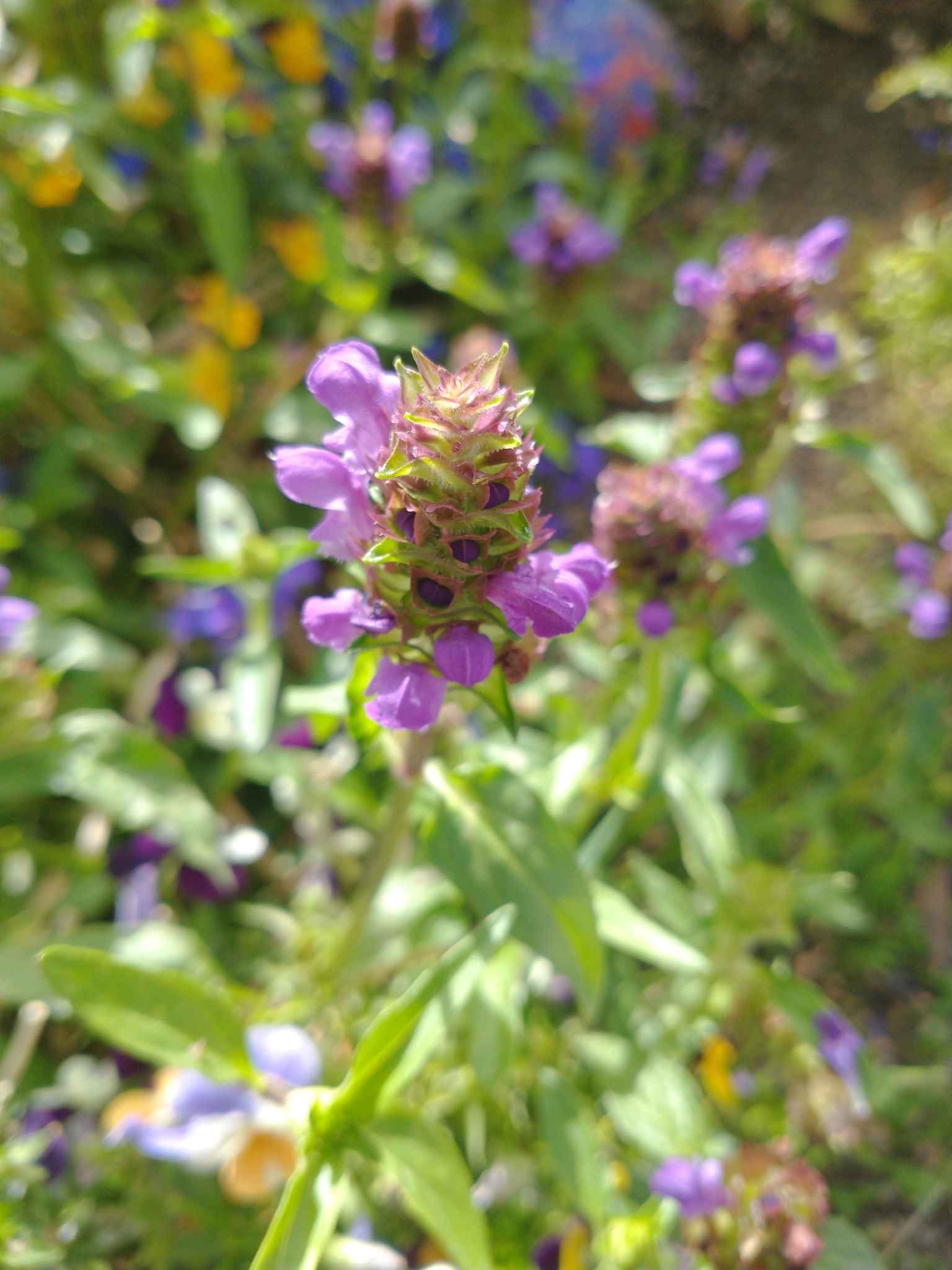
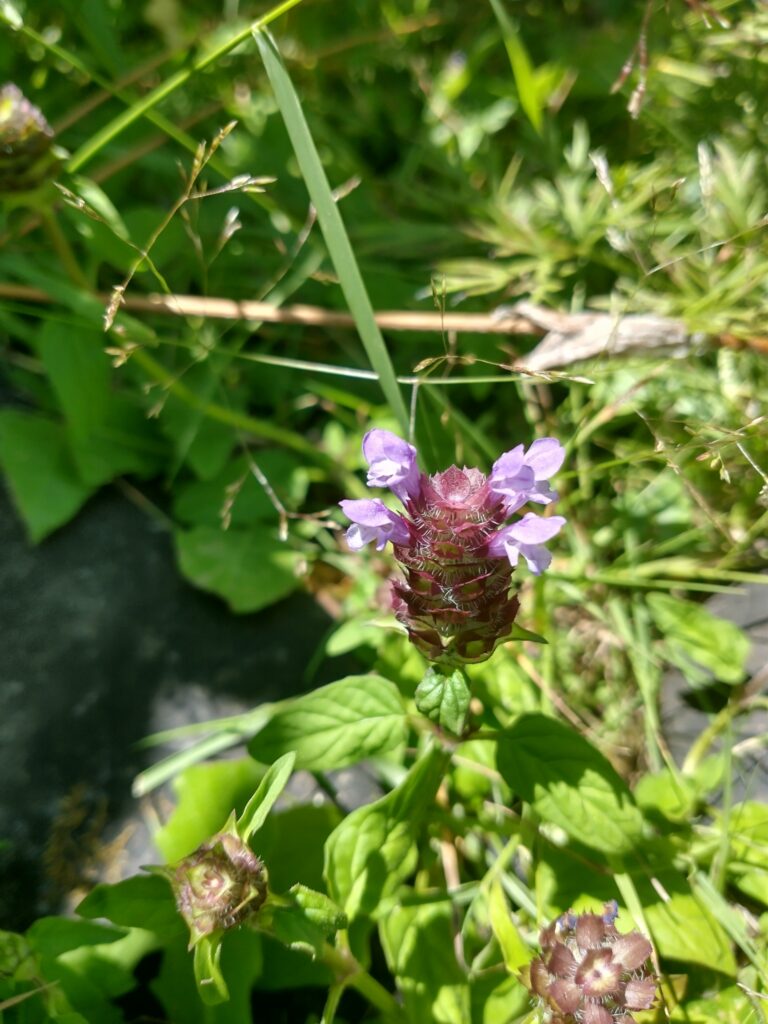
This week, we will be featuring common self-heal, Prunella vulgaris. Other common names include heal-all, woundwort, heart-of-the-earth, carpenter’s herb, brownwort, and blue curls. This perennial, low growing, herbaceous flowering plant has a native range that extends from the lower 48 states to Alaska, Europe, Asia, and Africa. Spikes arise from this low growing plant that have many overlapping flowers that range in coloration from light lilac purples to dark almost blue (1). As a member of the mint family (Lamiaceae), these plants have square stems, a rather distinct characteristic of mints (but not always!). Although it is often considered a weed in lawns, it is a welcome addition to most gardens. In fact, during some of our research this summer (you can read about that here: Science Behind the Scenes: Pacific Northwest Pollinator Gardens), it was one of the top 10 most commonly planted species in all of our garden study sites.
Prunella vulgaris is edible and has a rich history of medicinal use all over the world, especially for sore throats. The name Prunella is derived from the word ‘Brunella’, which is a derivative of the German name for diphtheria (die Bräune), which it was used as a treatment for (3). Prior to colonization of the Americas, the Indigenous peoples of the Pacific Northwest used the juice of the plant to treat boils on the skin as a salve, and teas and infusions for sore throats (4). It has also been used as medicine across the world, such as traditional Chinese medicine, and is still a common ingredient in Chinese herbal teas.
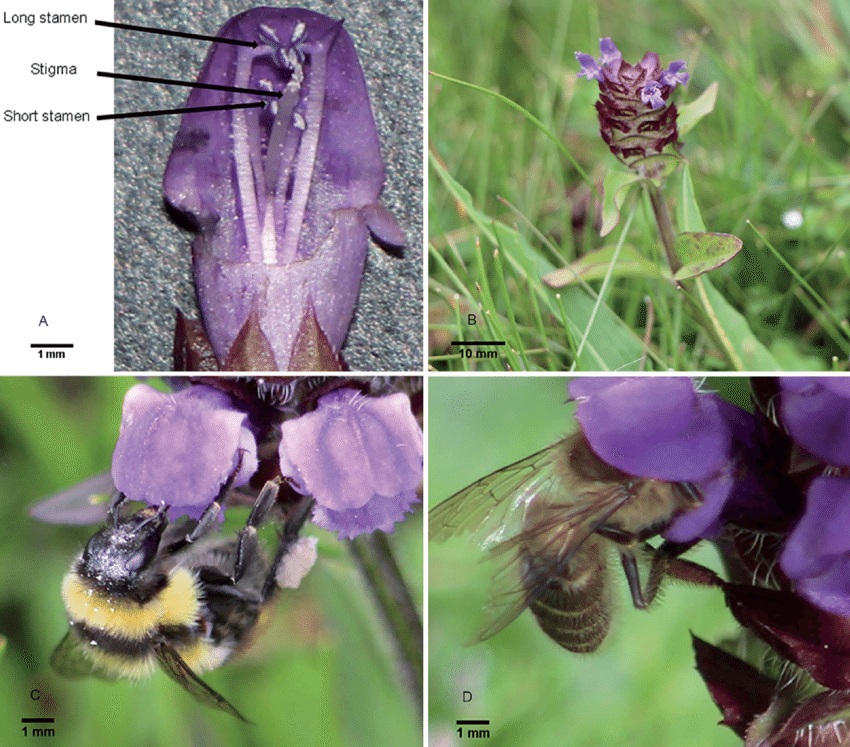
As with many plants in the mint family, bumblebees are pretty big fans. Other bee genera that are commonly found on these plants are Ceratina, Lasioglossum, and Anthidium (5). Common self-heal is a hardy, self-seeding plant that can find a place in any garden and can also enhance turfgrass lawns with floral resources to support diverse wild bee communities (6). To encourage more blooms and manage self-seeding, try deadheading in areas you’d not like the plant to spread to, and these plants will make for a pleasant botanical understory for your garden.
References:
- TWC Staff. (2023). Plant database: Prunella vulgaris. Wildflower Center. Accessed 15 December 2025 from: https://www.wildflower.org/plants/result.php?id_plant=PRVU
- Ling TC, Wang L-L, Zhang Z-Q, et al. 2017. High autonomous selfing capacity and low flower visitation rates in a subalpine population of Prunella vulgaris (Lamiaceae). Plecevo. 150(1):59–66. https://doi.org/10.5091/plecevo.2017.1274
- Gledhill D. 2008. The names of plants. 4th ed. Cambridge: Cambridge University Press.
- Fagan D. 2019. Wildflowers of Oregon: A Field Guide to over 400 Wildflowers, Trees, and Shrubs of the Coast, Cascades, and High Desert. 1st ed. Blue Ridge Summit: Globe Pequot Press, The.
- Basman A, Rampton RW, Melathopoulos A, Best LR. MELITTOFLORA | College of Agricultural Sciences. Melittoflora Version 1.0. [cited 2025 Dec 15]. Available from: https://agsci.oregonstate.edu/bee-atlas/melittoflora
- Wolfin J, Watkins E, Lane I, et al. 2023. Floral enhancement of turfgrass lawns benefits wild bees and honey bees (Apis mellifera). Urban Ecosyst. 26(2):361–375. https://doi.org/10.1007/s11252-023-01339-7




3 Comments
Add Yours →Can you tell us about lanceleaf self heal (lanceolata)? Is this our Oregon native subspecies? Is there any difference in native bees visiting lanceolata versus the straight species?
Hi Leslie,
Those are some great questions! According to the USDA and Flora of the Pacific Northwest (2nd edition), Prunella vulgaris var/ssp. lanceolata circumboreal and is native to Oregon, native to North America and most of the Northern Hemisphere. Prunella vulgaris var/ssp. vulgaris is noted to be a Eurasian introduction. Along with some slight differences in leaves, the lanceolata form tends to grow a bit higher with more erect stems, while the vulgaris subspecies/variety tends to grow lower to the ground (and are slightly weedier). There is some published work from 1963 (Relationships between two subspecies in a population of Prunella Vulgaris L., by Andrew P. Nelson) that notes that they readily and easily cross pollinate with each other producing normal seeds. As far as differences in which pollinator species these forms support, there is less information available. There is some information that the Prunella vulgaris var/ssp supports bumblebees in their native region (please note I am only inferring here based on the region of the study, the research does not note a particular variety or subspecies. See reference at bottom of comment), and the native form looks to support similar bee types, such as bumblebees and even Osmia (sources 5 and 6 in the blog post). For more information on bees species collected from this plant, I recommend using the Melittoflora tool (it’s very cool!). However, I have not been able to find any research comparing the differences of each form in their ability to support pollinators. Most recent research I’ve been able to find here in North America are examining common self-heal as a pollinator resource supplement to clover lawns.
My view is that most one should try and plant the native form, which most of the available ones will be, and with the possibility of cross pollination it will probably be harder and harder to distinguish between the two. Although they have some differences, the varieties/subspecies are likely naturally occurring (instead of artificially bred varieties, or nativars). Since the plant is so widespread, there are up to 5 different var/ssp. across the world (and likely more).
Tial C Ling, Lin-Lin Wang, Yong-Ping Yang, Yuan-Wen Duan, Differences in floral traits and flower visitation rates in mating systems in Prunella vulgaris (Lamiaceae), Journal of Plant Ecology, Volume 15, Issue 1, February 2022, Pages 39–56, https://doi.org/10.1093/jpe/rtab063
Thank you Taylor! People ask me if they should weed out the non-native Prunella from their gardens. They’re so hard to tell apart. I usually just say to let it be. There are worse “weeds”. I do love to plant lanceolata as a groundcover. It looks beautiful combined with Erigeron speciosus with purple and blue blooming at the same time and just full of pollinators.