
Students in Dr. Marisa Chappell’s History 363 “Women in U.S. History” class spent the final three weeks of Fall Quarter 2025 in OSU’s Special Collections and Archives Research Center exploring women’s impact on our university.
By Finnian Sweeney

The Co-Signers Engineering Students’ Wives’ Club existed at OSU from 1958 to 1977. The members of the club created scrapbooks to document their activities and achievements. This post focuses on the first years of the Co-Signers club, encompassing the period between 1958 and 1963 covered in the club’s first scrapbook. The flyers, newspaper clippings, images, and other objects contained offer a window into the purposes of the organization. Over the course of its existence, the club sought to promote friendships among the wives of engineering students at Oregon State University. The formula pictured above appears at the top of the Co-Signers recruitment flyer for the 1958-59 school year, which is one of the first items encountered in the scrapbook.[1] It is telling in that it is an equation to produce engineering wives. This reveals another purpose of the club: to create ideal engineering wives.
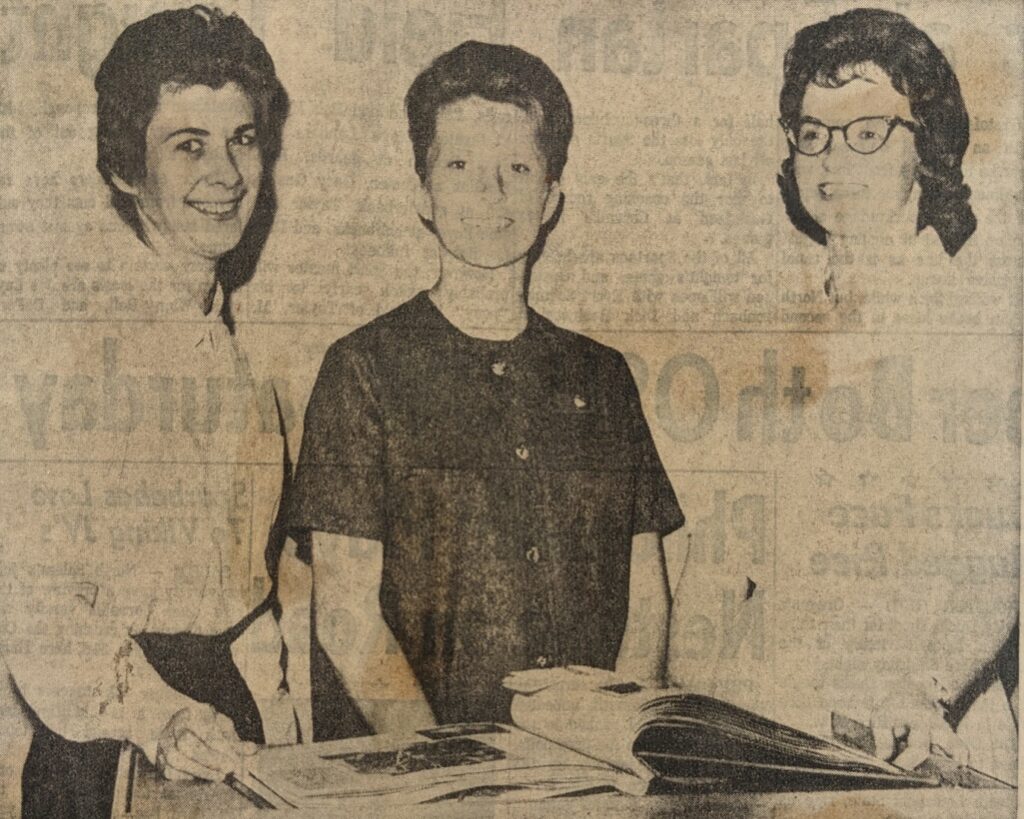
The materials in this scrapbook record a variety of activities the club engaged in, such as teas, social events, and holiday parties. The Co-Signers also engaged in charity work and held a variety of fundraising events for the club itself and for a scholarship they awarded to a married engineering student.
Some of the most interesting materials, however, concern the types of speakers that attended club meetings. Meetings featured talks by an interior decorator and a nursery school representative, as might be expected from a period where middle-class women were mainly expected to be housewives. More surprisingly, Co-Signers meetings regularly featured interviewers from major employers in the engineering field, including representatives from Lockheed Martin, NASA, and even a recruiter for the CIA. College of Engineering Dean George W. Gleeson was also a regular speaker. Dean Gleeson spoke annually at the club’s first meeting of each school year and seems to have been very supportive of the club. In fact, the 1958-59 recruitment flyer suggests that the creation of the club may have been partly inspired by an informal talk from the dean on members’ “role as a future engineer’s wife,” which seems to have been the topic of his annual talks, as well.[2] Gleeson’s wife Barbara also served as one of the club’s two advisors in its early years, alongside Louise Coopey, wife of another engineering faculty member.[3] All this suggests that Dean Gleeson felt it was important to prepare not only his students, but also their wives, for the engineering field, and that this view was shared by major employers in the industry.
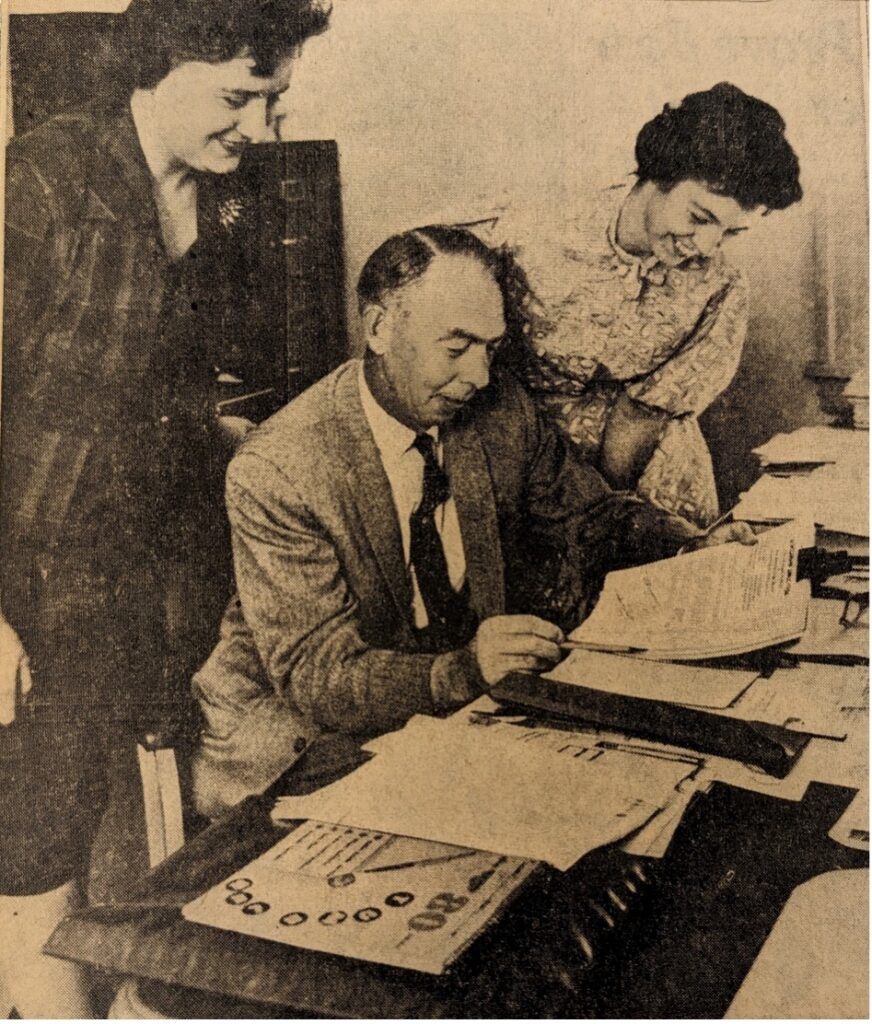
The Co-Signers Club is indicative of larger patterns in the way married middle-class women at the time were expected and encouraged to support their working husbands. It is clear from the activities the Co-Signers engaged in, the way they worded their materials, and of course the name of their club that they saw their support and participation as important to the success of their husbands’ careers. This idea was encouraged and promoted by Dean Gleeson and by industry representatives. The club fits into a pattern identified by the scholar Hanna Papanek in 1973 of what she called “two-person single careers” in the American middle class.
These careers employed only the husband, but made implicit or explicit demands for supporting labor of various kinds from wives. Job interviewers like the ones that regularly addressed the Co-Signers would consider whether applicants’ wives would be “suitable” for the demands of their husbands’ positions. Papanek considered these two-person careers to be a “social control mechanism that serves to derail the occupational aspirations” of women and encourages them to seek “vicarious achievement” through the careers of their husbands. Papanek said that “the wife’s involvement with her husband’s career frequently begins before the career itself, during the stage when he is undergoing the advanced training so typical of these middle-class careers,” and that “the barely latent function of many colleges” was to prepare women to support a two-person career, giving additional context to Dean Gleeson’s support for the Co-Signers Club.[4]
Indeed, many wives in this period abandoned or did not pursue independent careers in favor of becoming housewives and providing direct and indirect support to their husbands’ careers. Researchers have shown that some of these women reported later in life that they would in hindsight have preferred to pursue careers of their own. It is important to note, however, that many of these same women also made their support roles central to their identities and derived satisfaction from supporting their husbands. Like the Co-Signers, many of them also engaged in social or service activities that at first glance appeared unrelated to their husbands’ careers, even to the women themselves, but that nonetheless were part of the work they did to support their husbands and families.[5]
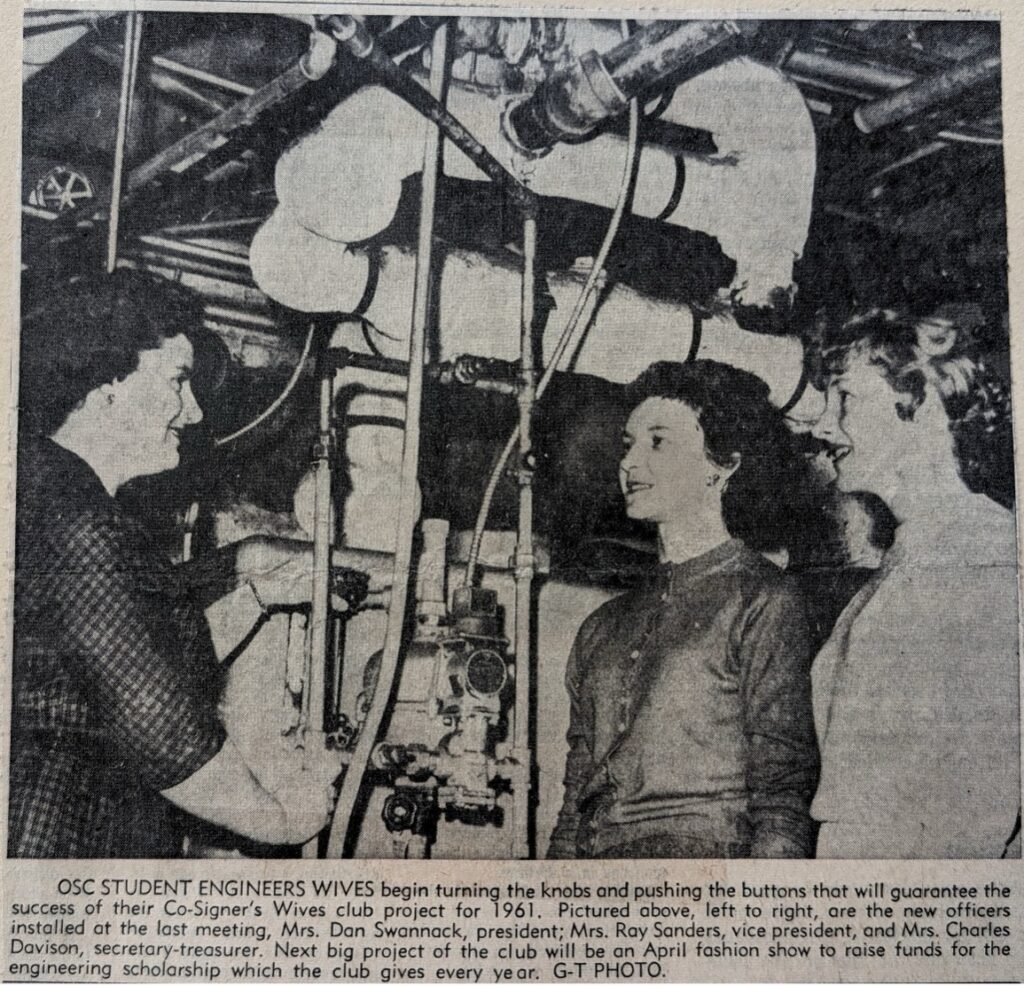
In another article from 1979, Papanek defined the category of “family status production,” arguing that much of the work women did in various societies went unrecognized but produced value for their family units in the form of enhanced social status, often aiding their husbands’ careers. This status production work includes not only career support, but also social activities that enhanced their families standing in their community.[6]The social, fundraising, and charitable work of the Co-Signers can perhaps be viewed through this lens and may have helped to raise the profile of their husbands within the OSU engineering community, especially as the routine local newspaper coverage of the club’s activities referred to members mostly by their husband’s names, as was typical for the time.
Betty Friedan famously complained in her landmark 1963 book The Feminine Mystique that women were defined solely by their relationships to men.[7] In 1964, Friedan wrote that many women had through independent careers unlocked a “fourth dimension” beyond the three dimensions of the traditional female identity as a wife, a mother, and a homemaker. They had begun to see themselves as full people and members of society through independent careers. Even though many women had thought they were happy, there was still a yearning for independent achievement in many of them, and there were real psychological consequences to defining themselves solely in relation to their husbands, for example as “engineering wives.”[8]
The Co-Signers Club provides an excellent real-world example of the way the pattern of two-person single careers played out at Oregon state and show us the ways in which women sought to add meaning to their lives when society defined success for women as being a devoted wife and mother. Women were encouraged to define themselves in relation to their husbands’ careers, and the co-signers sought to find fulfillment in being the wives of engineers. This work focuses on the early years of the club, but it would be interesting to examine some of the later material from the 1970s to see how the rise of second-wave feminism, the entry of more women into the engineering field, and the decline in the number of married engineering students from the 1958 population of 380 (about half of engineering students at the time) changed the nature of the club in its later years.[9]
[1] Co-Signers Engineering Students’ Wives’ Club 1958-59 School Year Flyer.
[2] Co-Signers Engineering Students’ Wives’ Club 1958-59 School Year Flyer.
[3] Co-Signers Engineering Students’ Wives’ Club, Valentine to Engineers Wives, 1962m Series 4, Box 2, Folder 2.1, MSS Co-signers Collection, SCARC.
[4] Hanna Papanek, “Men, Women, and Work: Reflections on the Two-Person Career,” American Journal of Sociology 78, no. 4 (1973): 852–72.
[5] Eliza K. Pavalko and Glen H. Elder, “Women behind the Men: Variations in Wives’ Support of Husbands’ Careers,” Gender and Society 7, no. 4 (1993): 548–67.
[6] Papanek, Hanna. “Family Status Production: The ‘Work’ and ‘Non-Work’ of Women.” Signs 4, no. 4 (1979): 775–81.
[7] Betty Friedan, The Feminine Mystique (W.W. Norton & Company, 1963).
[8] Betty Friedan, “Woman: The Fourth Dimension,” Ladies’ Home Journal (June 1964), 48-55.
[9] Co-Signers Engineering Students’ Wives’ Club 1958-59 School Year Flyer.