
Students in Dr. Marisa Chappell’s History 363 “Women in U.S. History” class spent the final three weeks of Fall Quarter 2025 in OSU’s Special Collections and Archives Research Center exploring women’s impact on our university.
By Kylie Abbey-Zanni
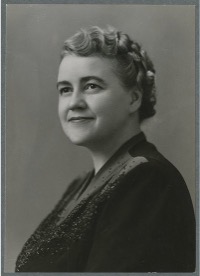
In the Buena Maris Mockmore Papers held in OSU’s Special Collections and Archives Research Center I found a fourteen-page report from 1960 titled “Hanford – In Retrospect.” In the report, Maris wrote about her time as Director of Women’s Activities at the Hanford Nuclear site, a Manhattan Project complex located along the Columbia River in southern Washington, during World War II. As Hanford recruited and employed thousands of women workers, its managers recognized what Maris called “the need for someone who could care for the welfare of several thousand women workers.”[1]
They turned to Maris, who took a year-long leave from her position as Dean of Women at Oregon State College, from September 1943 to September 1924, to serve as Director of Women’s Activities at Hanford. The report shows how she professionalized women’s welfare work and labor during wartime. Using her position at Hanford, Maris worked to set women workers up for success not only during the war but also afterwards, challenging the widespread assumption that women were temporary workers who would return home once the wartime emergency ended.
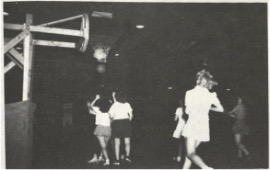
Maris came into her position as Director of Women’s Activities at Hanford due to the unprecedented number of women entering the workforce, including newly available jobs in the defense industry, during World War II. A production site for plutonium needed for American atomic bombs, Hanford was a massive enterprise. At its peak in 1944, Hanford employed more than 51,000 workers, including four thousand women. With. large numbers of men serving in the military, defense plants sought out women to serve in a variety of roles including equipment inspectors, construction and general staff positions.
Maris’ report offers much more than just administrative notes. Instead, it reads very like to the diary of a woman managing a workplace in a new environment. She describes the living conditions Hanford’s women employees endured, such as overcrowded dormitories, the desert climate, and feelings of isolation. Maris’s solution for these struggles was something she called “purposeful engagement,” making available opportunities for women workers to get involved in recreational activities that served the community. She brought in Red Cross volunteer programs and church services and activities, for example, to help “curb boredom.”[2] These efforts were touted in promotional coverage in various newspapers. An article titled “New Deans a Queen!,” for example, portrayed Maris as a very warm woman who was heavily committed and involved in women’s development. “To satisfy needs of such a large group of employees… church facilities had to be provided. This wasn’t the specific responsibility of the supervisor of women’s activities… However, the tent for Catholic services was no longer adequate – some of the parishioners sitting on benches well out beyond the open end of the tent in the sagebrush.”[3] Providing adequate facilities for church services was not in Maris’s job description, but she was committed to the welfare Hanford’s women and took up the issue anyway. In a newspaper tribute decades later, reporter Laurie Williams referred to Maris as “Hanford’s mom for a year” and highlighted how women at Hanford thrived under her supervision, many of them going on to have careers after the war.[4]
Another later treatment discussed Maris’s promotion of volunteer activities. In “The Hanford Site: an Anthology of Early Histories,” M.S. Gerber wrote that “Mrs. Maris also organized a library, started a Red Cross chapter that still functions in Richland today, and scheduled a special daily bus with a late return to and from Pasco so that women could break the monotony of camp life.”[5] In addition to these organized programs, Maris worked endlessly to ensure these women kept their morale up and their lives as normally as possible. Maris was well suited to this role. After earning her undergraduate degree in Home Economics and Child Development, she earned a Master’s in Science at OSC in 1939 and went on to teach and serve as Dean of Women at OSC from 1941 to 1948 (excepting her year at Hanford).
Maris’s approach echoed similar work by middle-class women reformers in the first half of the twentieth century. During the Progressive era, reformers feared that young, unmarried women’s entry into urbanized labor markets and access to commercialized leisure put them at moral risk. Reformers from groups such as the Young Women’s Christian Association and the Travelers Aid Society believed these women needed supervised, structured recreation, from chess clubs and church services and supervised outings and supervised boarding houses.[6] Maris was able to reproduce this at Hanford, carrying on traditional ways of bringing leisure to working women. These sources show how Maris not only monitored Hanford’s workplace and leisure culture but also heavily shaped and contributed to it.
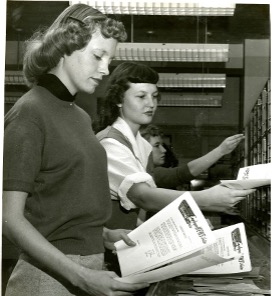
Some histories of women’s labor in World War II emphasized its temporary nature. They argue that while the wartime emergency opened up new kinds of jobs to women, these opportunities were largely foreclosed when servicemen returned after the war.[7] Other scholarship paints a more complicated picture. Claudia Goldin argued that women’s labor during World War II sparked a long-term shift in societal norms and expectations.[8]Several contributors to Joanne Meyerowitz’s reassessment of postwar gender roles argued that women continued to advance, particularly in feminized professions such as nursing, teaching, and social work.[9]
Maris’s impact on Hanford’s women workers seems to have played a small role in this larger phenomenon. Laurie Williams’s article “Women Came to Hanford to Make a Difference” detailed how women continued to grow in their career fields following their time at Hanford and credits Maris for building their confidence and capacities.[10] Maris modeled women’s leadership, showing that women could manage and direct the workforce, not just join it. Her work at Hanford not only illustrates wartime necessity but also shows how war-time need opened paths towards long-term employment for women. She proved herself as a wartime professional who demonstrated that women managers were not temporary but rather individuals who could carry their skills outside of the war. Maris’ story and impact fits into the broader transformation of women in the United States at the time. WWII made women’s labor more visible and necessary while women like Maris worked to make it more sustainable. Her role in Hanford serves as a reminder that the war created both women workers and women leaders.
“Hanford – in Retrospect” captured the story of a woman who reshaped wartime labor at a singular site. By establishing a variety of programs, a sense of community, and professional pathways, Buena Maris helped to normalize women in long-term paid labor, not just during the war but after it, as well. Her story invites further questions and research about Oregon State College and the larger history of women, war, and labor. Did federal agencies recognize, or even use Maris’s model? What role did race, class, and religion play in shaping women’s lives and labor at Hanford? How did OSC benefit from Maris’s Hanford experience after she returned? Maris opened the door for women to continue growing in the professional workplace and her papers ensure we can look back on and evaluate her impact.
[1] Buena Maris, “Hanford – In Retrospect,” December 8, 1960, series 3, box 2, folder “Manhattan Project: Hanford, 1960-1962,” Buena Maris Mockmore Papers (hereafter Mockmore Papers), Special Collections and Archives Research Center, Corvallis, Oregon.
[2] Maris, “Hanford – In Retrospect.”
[3] “New Deans a Queen! New Dean Promises OSC Friendliness,” undated newspaper clipping, series 2, box 1, folder “Newsclippings re: Speeches and Presentations Given by Mockmore [Iowa and Oregon] circa 1940-1965,” Mockmore Papers.
[4] Laurie Williams, “Hanford’s Mom for a Year, Buena Maris Made Desert a Home for Women Workers,” newspaper clipping, October 31, 1993, series 3, box 2, folder “Manhattan Project: Hanford 1945,” Mockmore Papers.
[5] M.S. Gerber, “The Hanford Site: An Anthology of Early Histories,” October 1993, series 3, box 2, folder “Manhattan Project 1998-2010,” Mockmore Papers.
[6] Joanne Meyerowitz, Women Adrift: Independent Wage Earners in Chicago, 1880-1930 (University of Chicago Press, 1988).
[7] Ruth Milkman, “Gender, Consciousness, and Social Change: Rethinking Women’s World War II Experience,” Labor History 28, no. 1 (1987): 3–18; Marjorie Miller, “Working Women and World War II,” Journal of American Studies 14, no. 2 (1980): 123–141.
[8] Claudia Goldin, “The Role of World War II in the Rise of Women’s Employment,” Quarterly Journal of Economics 106, no. 4 (1991): 1497-1542.
[9] Joanne Meyerowitz, Not June Cleaver: Women and Gender in Postwar America, 1945-1960 (Temple University Press, 1994).
[10] Laurie Williams, “Women Came to Hanford to Make a Difference,” newspaper clipping, October 31, 1993, series 3, box 2, folder “Manhattan Project: Hanford 1945,” Mockmore Papers.