
Students in Dr. Marisa Chappell’s History 363 “Women in U.S. History” class spent the final three weeks of Fall Quarter 2025 in OSU’s Special Collections and Archives Research Center exploring women’s impact on our university.
By Dylan Brady
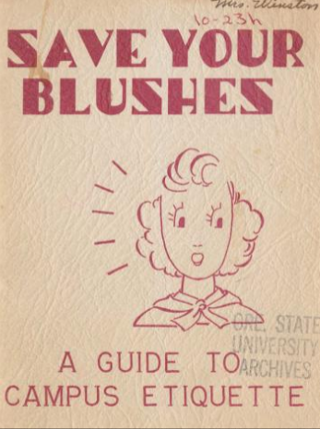
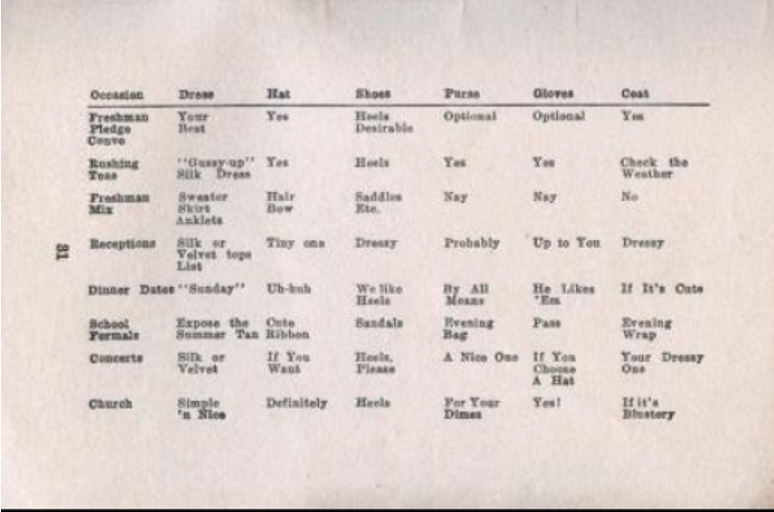
In OSU’s Special Collections and Archives Research Center, I was surprised to find a 1939 guide published by the Etiquette Board of Associated Women Students of Oregon State College called “Save Your Blushes,” which details the do’s and don’ts for incoming women students. One one page, for example, the guide instructs women students in how to act in the dining halls, from seating arrangements to conversation topics.[1] The guidebook tells women students what they should wear and how they should act on dates. In a section called “Fruit for the Beach Combers,” it offers advice – for example, “there are very few emergencies that justify breaking a date” – and referring to potential dates as “fruits” or “livestock.”[2]
The guide includes tips on mundane matters that I was surprised a college organization would even care about, such as how women are supposed to walk with men. A section called “Round Bout” advises, “if a girl and boy are walking together, the girl should always be on the man’s right.”[3] Many of the pieces of advice offered in the guide seem, to the modern eye, like an odd effort to dictate the daily actions of women students.
Associated Women Students (AWS) was a national organization with chapters at universities across the country. Each chapter shared a set of goals: to “regulate all matters pertaining to the welfare of women students, to further the spirit of unity and service, to increase a sense of individual responsibility, and to create and maintain high standards and ideals for the women students of the university.”[4] AWS served as a campus umbrella organization for all women’s groups, societies, and clubs, sponsoring events such as nickel hops, carnivals, and women’s weekends.[5] The constitution of OSC’s AWS noted that every woman on campus was allowed to become a member and participate creating cooperation among women across campus and the AWS.[6]
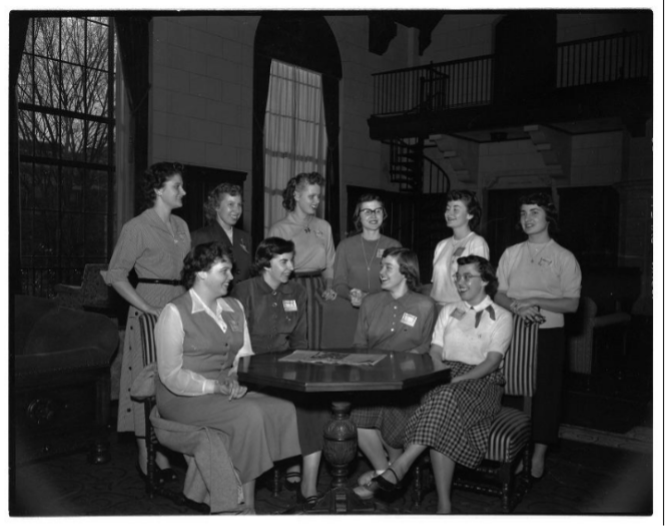
AWS worked closely with OSC’s administration to promote what its members viewed as the safety and well-being of women students and the campus community. A 1959 AWS pamphlet declared, “In the college community, closing hours and other regulations are made and observed in the best interests of the health and welfare of the women students and to meet expressed wishes of parents for social supervision.”[7] Here, the AWS promotes a common approach at the time in which college and university leadership acted in loco parentis, or “in the place of the parent.” As a legal scholar described it, “in its fullest form the doctrine of in loco parentis permits colleges to devise, implement and administer student discipline and to foster the physical and moral welfare of students.”[8] It was a primary focus for many of these organizations to regulate the behavior of the female students on campus because these regulations are were what they believed were necessary to succeed not just in college, but their future life. These regulations were harmonious to the roles women were expected to play in the family and community in the mid-twentieth century.
Throughout the AWS’s existence, they produced many coed codes to serve as guides for women on campus, designed to shape their behavior. This coincides with their belief that, “In every phase of life the individual lives within certain regulations, which are necessary for the welfare and harmony of the group.”[9] They emphasized the college rule that women students secure permission from a parent or guardian, filed with the Dean of Women, before leaving campus.[10] They also promoted the rule that women were barred from entering men’s dormitories.[11] AWS and the administration worked to impose a broad range of rules on women student behavior.
The fact that it was women students themselves, through AWS, that advocated and publicized these rules and regulations suggests an emphasis on peer pressure as one key enforcement mechanism. The historian Babette Faehmel argues that if women on college campuses did not follow the behavior rules set out for them, they would be socially ostracized.[12] AWS guides emphasize that students must follow certain social conduct to remain “in accordance with standards of decency.”[13] Even as these guides sought to restrict women’s freedom, they insisted that conformity was “a sure recipe of happiness at college.”[14] These guides promoted a vision of womanhood rooted in acceptable social behavior, preparing women students to become good hostesses, conversationalists, and wives.
Similar handbooks and guides circulated on college campuses in the 1920s and 1930s and continued to shape college life during and after World War II. Historian Donna J. Drucker, who researched similar women’s organizations at Purdue University in the 1939-1940 academic year, found that they “aimed to prepare young women to face whatever experiences lay ahead—whether that meant eating oysters or preparing for war—with grace.”[15] In the postwar period, as more women could afford higher education, American culture both praised women’s college attendance and promoted domesticity.[16] Even as more women attended college, the expectation was that they would devote their adult lives to managing children and a home and supporting their husbands’ careers. AWS leaders, then, tried to prepare college women for this future role. As Helen Lefkowitz Horowitz wrote about Scripps College’s expectations of its students (all women) in this period, “graduates might combine work (‘contribution’) with marriage and children (‘fullest and richest life’).”[17]
Of course, on college campuses nowadays there are still rules and regulations that many must follow, but nothing that compares to the ones female students had to follow before the 1960s. College organizations do have a job in some ways to help foster student growth, not just for career goals but also for living a. healthy and contributing life. However, there is a limit to how far these restrictions should go in order serve the best interests of the students. These handbooks and organizations, even with their best interests in mind, served to control women students’ behavior and mold them for a limited future after college – marriage and motherhood. Regulations imposed by administrators and the promotion and enforcement of these regulations by fellow students limited the freedom of women students to be who they wanted to be and to express themselves. This small look at college life in mid-twentieth-century cannot capture the complexities of women students’ perspectives and lives living within this system. But it suggests that in this period, colleges sought to mold women students to fit a very narrow role in society rather than to develop and pursue their own, individual goals and aspirations.
[1] “Save Your Blushes, 1939,” Oregon Digital, 9, Accessed 2025-12-04. https://oregondigital.org/concern/documents/fx71cn310.
[2] “Save Your Blushes, 1939.”
[3] “Save Your Blushes, 1939.”
[4] Betsey Creekmore, “Associated Women Students – Volopedia,” Volopedia, September 24, 2018, https://volopedia.lib.utk.edu/entries/associated-women-students/.
[5] Historical Publications of Oregon State University, Oregon State University. “The Beaver 1948” Oregon Digital. Accessed 2025-11-22. https://oregondigital.org/concern/documents/0g354f54.
[6] Associated Women Students, A.W.S. Handbook, 1930-31, Series 1, Box 1, Folder 2, Associated Women Students Handbooks, Special Collection and Archives Research Center, Oregon State University, Corvallis, Oregon.
[7] OSU Special Collections & Archives Research Center, Oregon State University. “AWS and Administrative Regulations for Women, 1959” Oregon Digital. Accessed 2025-12-10, https://oregondigital.org/concern/documents/fx71cn38x.
[8] Theodore C. Stamatakos, “The Doctrine of In Loco Parentis, Tort Liability and the Student-College Relationship,” Indiana Law Journal 65, no. 2 (1990): 474.
[9] OSU SCARC, “AWS and Administrative Regulations for Women, 1959,” Oregon Digital.
[10] Ibid.
[11] OSU SCARC, “AWS and Administrative Regulations for Women, 1959,” Oregon Digital.
[12] Babette Faehmel, College Women in the Nuclear Age: Cultural Literacy and Female Identity, 1940–1960 (New Brunswick, NJ: Rutgers University Press, 2011), 31.
[13] Historical Publications of Oregon State University, “AWS and Administrative Regulations for Women, 1960,” Oregon Digital, accessed December 10, 2025, https://oregondigital.org/concern/documents/fx71cn396.
[14] Historical Publications of Oregon State University, “Coed Code, 1946–1947,” Oregon Digital, accessed December 11, 2025, https://oregondigital.org/concern/documents/fx71cn353.
[15] Donna J. Drucker, “‘In a Sense, It Is a Game’: Women’s Dormitory Life at Purdue University, 1939–1940,” Indiana Magazine of History 113, no. 1 (2017): 15, https://doi.org/10.5378/indimagahist.113.1.0001.
[16] Lynn D. Gordon, “The Gibson Girl Goes to College: Popular Culture and Women’s Higher Education in the Progressive Era, 1890–1920,” American Quarterly 39, no. 2 (1987): 211–30, https://doi.org/10.2307/2712910.
[17] Helen Lefkowitz Horowitz, “Designing for the Genders: Curricula and Architecture at Scripps College and the California Institute of Technology,” Pacific Historical Review 54, no. 4 (1985): 439–61, https://doi.org/10.2307/3639569.