
Students in Dr. Marisa Chappell’s History 363 “Women in U.S. History” class spent the final three weeks of Fall Quarter 2025 in OSU’s Special Collections and Archives Research Center exploring women’s impact on our university.
By Connor Grattan
A 1967 edition of the Portland-based Catholic newspaper, The Catholic Sentinel, touted the work being done by the Newman Center at Oregon State University, founded just two years earlier. The author viewed Center’s work, or apostolate, as both a great start for and possibly the beginning of a major conversion effort on campus. Moreover, the article praises, above all else, the Newman Center’s ability to connect with and integrate into the daily life of students; the author expressed hope that these efforts would promote the values of the Catholic Church and convert non-Catholic students to the faith.[1]
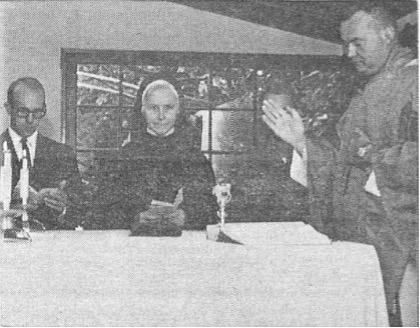
The founding of the Newman Center at Oregon State University, one arm of a national Catholic apostolate organization, came at a time of immense change within the Catholic Church ushered in by the Second Vatican Council of the early to mid 1960s, in which Pope John XXIII declared that the Church should focus more on apostolicism and spreading the message of Catholicism through means other than specific calls to holiness from clergy. As the Newman Center worked to appeal to a new generation of students, its message nevertheless remained shaped by the Church’s longstanding patriarchal ideologies and practices. At a time when the Catholic Church grappled with evolving ideas about sexuality, marriage, and gender roles, the apostolic efforts by the Newman Center remained shaped by traditional and ideologically conservative gender ideals.
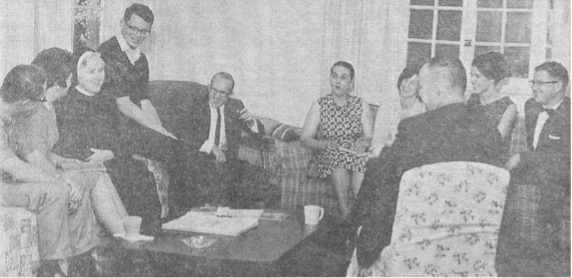
The Catholic Sentinel article suggested the hope that the Newman Center would create a new and growing commitment to the Church among OSU students. It discussed Center’s physical footprint on campus by noting the buildings it occupied; touted the priests, nuns, and student leaders who did the Center’s work; and highlighted the Center’s many recent campus events. It reassured readers that the Newman Center was using its budget wisely, particularly on efforts to recruit students to Catholicism. Finally, the article expressed optimism that the Center could launch theology or religion classes to further Catholicize the student body.
One barrier to that goal might be the Newman Center’s gender politics. The Center represented a conservative branch of the Catholic church and structured many of its apostolicisms around strict and discriminatory ideas of gender normativity and the idealization of heterosexual marriage. On example of the Newman apostolate was the rental housing the Center provided for students which gave preference to married couples.[2] In May 1968, the Center imposed a restriction on “girls” renting its properties; alongside the decision was this statement: “Because of problems in the past with girl renters it was again stated that no girls will be rented apartments and/or rooms in the Newman Rentals.”[3] This outright denial to rent to women was surprising to me; I had assumed that the advancements in civil rights in the 1960s would have ended this kind of discrimination. At the same time, the Center sponsored discussions addressing the liberalization of attitudes such as “Is pre-marital sex O.K.?,” “Is legalized abortion right?”, and “Is God dead?”[4] While we don’t know how these discussions turned out, the Newman Center’s commitment to traditional values likely led to conclusions that challenged the growing sexual liberalization in American society.
The 1960s was a time of change for Catholicism, marked by Pope John XXIII’s call for the Church to conform to the ideas of “aggiornamento,” or the bringing-up-to-date of the apostolate.[5] This meant an expansion into more areas outside of parishes and clergy. Many Catholics remained committed to conservative ideologies around sexuality and gender. In 1972, my mother was born into a devout Catholic family, and her childhood and adolescence were rooted in Catholic communities and their common faith. My mom told me about the underlying family pressures that she felt when she was going to college, especially the expectation that she find a husband. Her mother, as well as other women in her life, had met their husbands at college, and in some ways that created a pattern to follow. On top of that, there was a general understanding, as my mom put it, that women of the time knew that their husbands’ studies and career came before their own.[6] Even in the 1970s, these pressures were still around despite broader changes in American society.
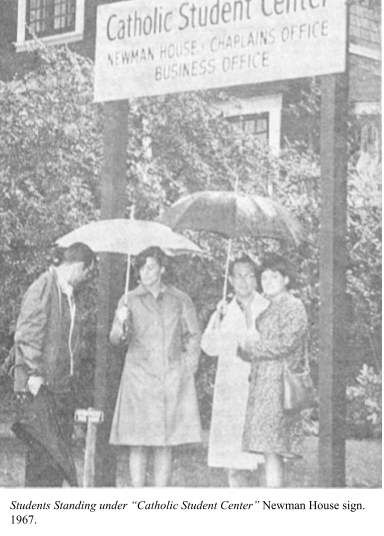
This context may explain the Newman Center’s policies and projects. Women who wanted to focus on their own career and who showed no interest in finding a husband had no place in the Newman rentals. The historian Philip Gleason notes that the Catholic Church in the United States feared the changing national culture, which was becoming increasingly secular and liberalized.[7] The recurring discussion of using classes to convert non-Catholic students makes much more sense in an era where the future of the Catholic church was uncertain. The Center acted not as an outpost of stability for OSU students who are attempting to answer the pressing questions of that era; instead, it offered guidance to those who had already subscribed to the Church’s ideas of what was morally just and unjust. Single women not being allowed in the rentals would not appeal to liberal students, nor would the glorification of traditional gender roles appeal to LGBTQIA+ students or others who oppose these ideologies.
Perhaps this explains the Newman Center’s many proposals to use classes to connect to the student body and perhaps gain new converts. There are many discussions of this tactic in leadership meeting minutes, an idea first introduced in a 1965 “Ten Year Projection” for the Center, when leaders expressed a belief that lessons in the Catholic faith were needed regardless of whether or not they would be offered through curriculum.[8] In another case, someone suggested using students in an architecture class to design a potential building for the Center while acting as ambassadors of sorts, furthering fellow students’ knowledge of the Center and Catholicism. They viewed this as a way to garner more support on campus.[9] In a way, it seems that the Center’s leaders hoped to create a quasi-Jesuit-style college for OSU students. One of the Center’s main goals in the second half of the 1960s was to create a “Catholic church on campus,” yet another way to spread Catholicism throughout the student body.[10]
My research into the Newman Center at Oregon State University in the 1960s surprised me. The staunch support of marriage, sexual conservatism, and heteronormativity aligned with the ideals of the Catholic Church but seem out of step with the era’s liberalizing culture. In the midst of mass movements for civil rights and women’s rights, the Newman Center denied housing to women; it is difficult to know if this conservatism helped or hindered its efforts to convert more students to the Catholic faith. If I could further this project, I would try to interview students who attended OSU in the late 1960s and ask them how they viewed the Newman Center. Some pieces of history are lost because they are not recorded, and this includes students’ perception of the Newman Center’s early years.
[1] “Newman Apostolate Grows at Corvallis,” Catholic Sentinel, October 13, 1967, Box 1, Memorabilia Collection, Special Collections and Archives Research Center, Oregon State University, Corvallis, Oregon.
[2] Newman Center Minutes of Meetings, December 1968, Box 1, Newman Foundation of Oregon State Records, SCARC.
[3] Newman Center Minutes of Meetings, May 17, 1968, Box 1, Newman Foundation of Oregon State Records, SCARC.
[4] Talk to Be Given…,” 1968, Box 3, Newman Foundation of Oregon State Records, SCARC.
[5] S.J. Achutegrui, “The Second Vatican Council,” Philippine Studies 10, no. 4 (December 1962), 523.
[6] Annie Grattan interview with author, December 4, 2025.
[7] Philip Gleason, “Catholicism and Cultural Change in the 60s,” Review of Politics 34, no. 4 (January 1972): 91-107.
[8] “Ten Year Project” Box 3, Newman Foundation of Oregon State Records, SCARC.
[9] Mrs. Sitton to Newman Foundation, 1965, Box 3, Newman Foundation of Oregon State Records, SCARC.
[10] “Talk to be Given to People Called Together for the Purpose of Starting Some Type of Booster Organization for the O.S.U. Newman Center,” 1968, Box 3, Newman Foundation of Oregon State Records, SCARC.