
Students in Dr. Marisa Chappell’s History 363 “Women in U.S. History” class spent the final three weeks of Fall Quarter 2025 in OSU’s Special Collections and Archives Research Center exploring women’s impact on our university.
By Eliza Thompson
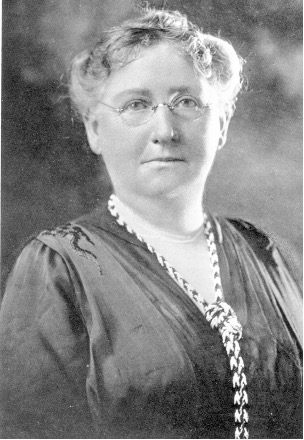
It was at the sixth annual meeting of the Home Economics Association in 1913 when Sarah Louise Arnold gave her President’s Address. “Tonight I shall speak particularly to the younger members of our Association—to you who are entering upon your life work,” she began. “You are discovering and weighing the results of your earlier efforts. You, we trust, will succeed where we have failed, will build upon our foundations, will reach the Promised Land which we have dimly seen, afar off.”[1]
And what does she go on to say to these younger members? What does she predict, like an inspired prophet, for the future of home economics? “The time will come and come soon,” she said, near the end of her speech, “when we shall be absolutely sure that the sanity and safety of our state institutions depends upon the sanity and safety of our homes. Then the state will say to all of its girls, ‘Your life does not belong to yourself as an individual; it belongs to all of us, all together. We need you at your best; we need you to be wise and strong and good, for the sake of all of us. You have a great contribution to make to the general welfare and the common good.’”[2]
One hundred and twelve years later, while sorting through the Ava Milam Clark papers at Oregon State University’s Special Collections and Archives Research Center, I stood, staring at a typed copy of this speech, stunned by these words. Your life does not belong to you. It belongs to us all.
When I first dove into research about the early years of home economics at OSU, I expected a very cookie-cutter curriculum, a one-size-fits-all approach. I suppose, deep down, I was expecting classes on how to greet your husband back from work with a martini. How to bend down to vacuum under furniture without messing up your hairdo. How to hold your baby in one hand and apply your lipstick with the other. And, to be clear, the home economics department was homogenous in many ways. For one, the student body was racially uniform, almost entirely white (the first known African American graduate of OSU, Carrie Halsell, didn’t graduate until 1926).[3] Still, I was humbled by just how much thought and discussion was put into acknowledging all the different variables that would go into the study of home economics.
Home Economics as a field is closely linked to the land grant system in American higher education. Oregon State University is a land grant college. As explained by William Robbins in The People’ School: A History of Oregon State University, “[g]rants of land to support education date to the colonial period, and the practice transferred seamlessly after the American Revolution to the new United States …. For state support for higher education, however, the Morrill Act offered a different approach, providing grants of land to promote the education of the individual classes.”[4] According to a Middlebury college blog post analyzing a project binder of 1918 graduate, Bessie C. Jennings: “[a]lthough principles of domesticity were being taught as early as the mid 19th century, the term ‘home economics’ was not applied to this area of study until the early 20th century.”[5] This was because the universities established as a result of the Morrill Act were open to women as well as men and were thus “mandated to foster research and instruction in practical areas of endeavor . . . associated with home economics.”[6] Because home economics was so new, how it was characterized in the late 1800s and early 1900s was extremely significant.
In her Presidents’ Address, Arnold discussed how important it is to know and understand the people to whom you teach home economics and how you need a comprehensive view of the individual to do so. Arnold speaks of meeting a little girl who was often left to her own devices. “I thought as I looked in the child’s face, ‘How little I know of experiences like hers! How much I should have to learn before I could teach her as I ought?”[7]
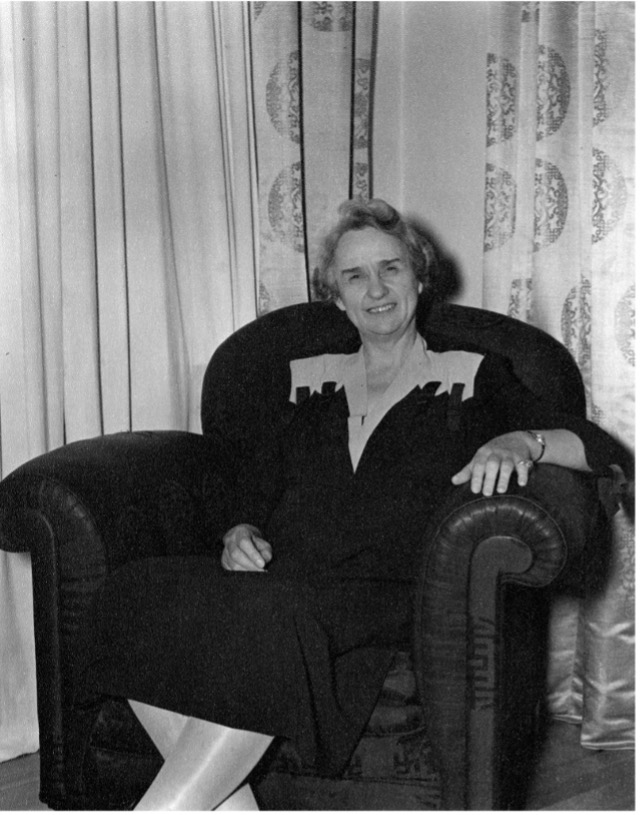
Nuance could also be seen in how much was covered by home education. We see this in the work of Ava Milam Clark (1884 -1976), Dean of Home Economics at OSU from 1917-1950. She traveled abroad where she studied various cultures in order to know how best to teach home economics,[8] and with more unconventional works, such as her Boy Scouts cookbook for camping.[9]
The question now is: just how nuanced did these programs get? How far did this embrace of variety go? In many ways, early home economics, at least at OSU, took diversity and individuality seriously, but there is one crucial aspect where the room for nuance was more limited: Attitude.
As Sarah Louise Arnold explained in her paper, “Concerning Institutional Management,” a home-economics student would have been, at this time, asked to carry out many tasks.[10] At a certain point, then, what became important was less the ability to carry out these tasks and more about the willingness to do so and the way in which to go about it.[11]
It has been evident from the beginning that the institutional worker most in demand is the woman of maturity and experience, who has developed in other fields the qualities which are essential to success in institutional administration. … The demands upon the department go to show a wide variety of opportunities in institutional administration, which no single course of instruction could adequately meet. One might definitely prepare students to administer college dormitories; the same student, however, will be confronted by requests to become a dietitian, in the sense of adviser concerning diets;—or she will be asked to buy, cook, and serve diets and teach classes of nurses at the same time;—or she may be urged to take complete charge of a lunchroom, a tea room, the stewardship of a hospital, or the administration of a children’s home;— she may be asked to mother and manage a Welcome House; she may be called upon to administer the house of residence of the Y. W. C. A., or the small community which is the modern form of the orphan asylum . . . . Letters of inquiry invariably place personality first, experience second, and training third. These three essentials, all right, give us the ideal woman, who shall administer the ideal institution.[12]
This shows us that the trailblazers of home economics were very deliberate about this demand for a certain personality type in their students.
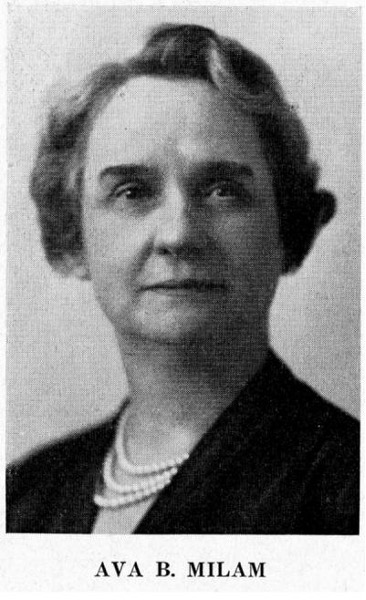
Not only was personality seen as the most important trait in a student of the home economics department, but the fostering of this specific type of woman was, in many ways, the central goal of these programs. In an article about her life, Milam was quoted saying: “While I do not in any way minimize the importance of teaching, food and nutrition, clothing and home management, I do believe a home economist’s greatest service comes in the influencing of attitudes and values. These must supersede all else!”[13]
Arnold says something similar in her 1910 “Certain Phases of Instruction in Institutional Management”:
It is evident that there is an urgent demand for women of native ability, mature experience, social aptitude, good judgement, promptness in meeting emergencies, and sound business sense, to direct institutional housekeeping . . . . It is clear that many of these qualities must be contributed by the individual. They cannot be secured by a fixed course of study in school or college. On the other hand, they may be developed by wise tuition. And, further, opportunities may be provided for such observation, such practice under expert guidance, such interpretation of accumulated experience, as will/fortify the worker and prevent her from making the mistakes of the novice. This, I take it, has been the purpose of the various courses in institutional management which have been hitherto provided.[14]
This obsession with women’s behavior wasn’t limited to the home economics department. According to The Experience of Women’s Higher Education at Oregon Agricultural College 1870-1916 by Katrina Anne Knewtson, in 1910, training at OSU was introduced for women students that “‘included a series of personal interviews with the dean and lectures for the physical, moral, and spiritual development of young women at the university.’ In one example given in the catalog, a lecture focused on the cardinal points of good manners at the table, in school, on telephones, the correct carriage, and the proper position in sitting and standing.”[15]
This need for social uniformity was undoubtedly influenced by the First World War. In a 1918 Report of the Home Economics Department of Education, it is said that
[t]he department of Home Economics Education has not been unmindful of its duty towards winning the war. . . . At the State Teachers meetings, Home Economics Association meetings, and others, and through literature distributed to the Home Economics teachers throughout the state, the department has cooperated with other departments to establish the right ideals and attitudes among the teachers who in turn should work the same spirit among their pupils and in their communities.[16]
According to historian Patricia Albjerg Graham, for many land-grant colleges, creating “character” in students was a particular focus during WWI. These colleges “stressed teaching on the part of the faculty, not research, and envisioned the molding of students’ characters rather than merely transmitting knowledge for knowledge’s sake as a principal and legitimate activity of the college.”[17]
I ask you, now, to think back to Arnold’s words, the idea that women’s lives do not belong to themselvesbut that, instead, women must sacrifice for the collective good. Always having a positive attitude is an example of such a sacrifice. It’s easy to see how this sacrifice would be expected during a world war: to stay chipper and happy for the boys overseas. The truth is, however, that this expectation for a continuous pleasantness that expands to both appearance and attitude is something that women today still face—to never complain, to be sweet and placid and—I’ll say it—maternal in all aspects of life no matter the stress they are under. It is interesting but not surprising, then, that this would be the invariable requirement of home economic students at Oregon State University in the early 1900s.
[1] Sarah Louise Arnold, “President’s Address,” 1913, Ava Milam Clark Papers, box 4, folder 2, Special Collections and Archives Research Center, Oregon State University, Corvallis, Oregon (hereafter SCARC).
[2] Arnold, “Address,” 10-11.
[3] “Historic Moments of Black Excellence at Oregon State University,”mSpecial Collections & Archives Research Center website, https://scarc.library.oregonstate.edu/omeka/exhibits/show/historic-moments-of-black-exce/carrie-halsell—osu-s-first-b (accessed December 10, 2025).
[4] William Robbins, The People’s School : A History of Oregon State University (Oregon State University Press, 2017), 14.
[5] “Household Management Project,” Home Economics and Household Management: The American Middle-Class Home, January 26, 2016, https://sites.middlebury.edu/homeec/history-of-home-economics/.
[6] Middlebury student body, Household Management.
[7] Arnold, “Address,” 6.
[8] Milam, Ava, Untitled, 1922, Correspondence 1920-1922, box 1, folder 2, Ava Milam Clark Paper, Special Collections and Archives Research Center, Oregon State University, Corvallis, Oregon.
[9] Milam, Ava B., and Ruth McNary Smith. “Camp cookery.” Corvallis, OR: College Bulletin Extended series, 1913.
[10] Arnold, Sarah Louise “Concerning Institutional Management,” 1912, “A Model for Branch Association of Home Economics” Sarah Louise Arnold, 1910-1943, box 4, folder 2, Ava Milam Clark Papers, SCARC.
[11] Arnold, “Concerning,” 1-5.
[12] Arnold, “Concerning,” 1-5.
[13] Hoyt, Isabell Murray, “DEAN AVA B. MILAM of Corvallis, Oregon,” 1947, MSS- Ava Milam Clark, box 4, folder 7, “Reports, Speeches, and Articles on Home Economics at OSU, 1917, 1969,” SCARC.
[14] Arnold, Sarah Louise “Certain Phases of Instruction in Institutional Management,” 1910, “A Model for Branch Association of Home Economics” Sarah Louise Arnold, 1910-1943, box 4, folder 2, Ava Milam Clark Papers, Special Collections and Archives Research Center, Oregon State University, Corvallis, Oregon.
[15] Katrina Anne Knewtson. “The Experience of Women’s Higher Education at Oregon Agricultural College 1870-1916,” 1995, Scholars Archive.
[16] Hatty R. D., “Report of the Home Economics Department of Education,” 1918, Correspondence 1903-1919, box 1, folder 1, Ava Milam Clark Papers, SCARC.
[17] Patricia Albjerg Graham. “Expansion and Exclusion: A History of Women in American Higher Education.” Signs: Journal of Women in Culture and Society 3, no. 4 (July 1978): 762.