Tag Archives: HST363

Personality First: Limitations in Nuance for Oregon State University’s Early Home Economics Department

Students in Dr. Marisa Chappell’s History 363 “Women in U.S. History” class spent the final three weeks of Fall Quarter 2025 in OSU’s Special Collections and Archives Research Center exploring women’s impact on our university.

By Eliza Thompson
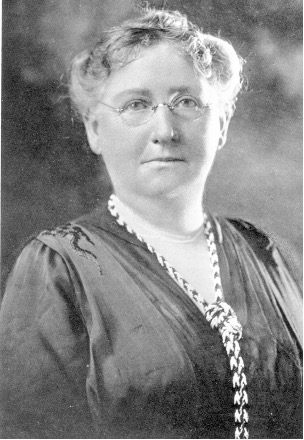
Black and white portrait of white woman with glasses and a patterned necklace.
“Photograph of Sarah Louise Arnold,” Suffrage at Simmons, accessed December 4, 2025.

It was at the sixth annual meeting of the Home Economics Association in 1913 when Sarah Louise Arnold gave her President’s Address. “Tonight I shall speak particularly to the younger members of our Association—to you who are entering upon your life work,” she began. “You are discovering and weighing the results of your earlier efforts. You, we trust, will succeed where we have failed, will build upon our foundations, will reach the Promised Land which we have dimly seen, afar off.”[1]

And what does she go on to say to these younger members? What does she predict, like an inspired prophet, for the future of home economics? “The time will come and come soon,” she said, near the end of her speech, “when we shall be absolutely sure that the sanity and safety of our state institutions depends upon the sanity and safety of our homes. Then the state will say to all of its girls, ‘Your life does not belong to yourself as an individual; it belongs to all of us, all together. We need you at your best; we need you to be wise and strong and good, for the sake of all of us. You have a great contribution to make to the general welfare and the common good.’”[2]

One hundred and twelve years later, while sorting through the Ava Milam Clark papers at Oregon State University’s Special Collections and Archives Research Center, I stood, staring at a typed copy of this speech, stunned by these words. Your life does not belong to you. It belongs to us all.

When I first dove into research about the early years of home economics at OSU, I expected a very cookie-cutter curriculum, a one-size-fits-all approach. I suppose, deep down, I was expecting classes on how to greet your husband back from work with a martini. How to bend down to vacuum under furniture without messing up your hairdo. How to hold your baby in one hand and apply your lipstick with the other. And, to be clear, the home economics department was homogenous in many ways. For one, the student body was racially uniform, almost entirely white (the first known African American graduate of OSU, Carrie Halsell, didn’t graduate until 1926).[3] Still, I was humbled by just how much thought and discussion was put into acknowledging all the different variables that would go into the study of home economics.

Home Economics as a field is closely linked to the land grant system in American higher education. Oregon State University is a land grant college. As explained by William Robbins in The People’ School: A History of Oregon State University, “[g]rants of land to support education date to the colonial period, and the practice transferred seamlessly after the American Revolution to the new United States …. For state support for higher education, however, the Morrill Act offered a different approach, providing grants of land to promote the education of the individual classes.”[4] According to a Middlebury college blog post analyzing a project binder of 1918 graduate, Bessie C. Jennings: “[a]lthough principles of domesticity were being taught as early as the mid 19th century, the term ‘home economics’ was not applied to this area of study until the early 20th century.”[5] This was because the universities established as a result of the Morrill Act were open to women as well as men and were thus “mandated to foster research and instruction in practical areas of endeavor . . . associated with home economics.”[6] Because home economics was so new, how it was characterized in the late 1800s and early 1900s was extremely significant.

In her Presidents’ Address, Arnold discussed how important it is to know and understand the people to whom you teach home economics and how you need a comprehensive view of the individual to do so. Arnold speaks of meeting a little girl who was often left to her own devices. “I thought as I looked in the child’s face, ‘How little I know of experiences like hers! How much I should have to learn before I could teach her as I ought?”[7]
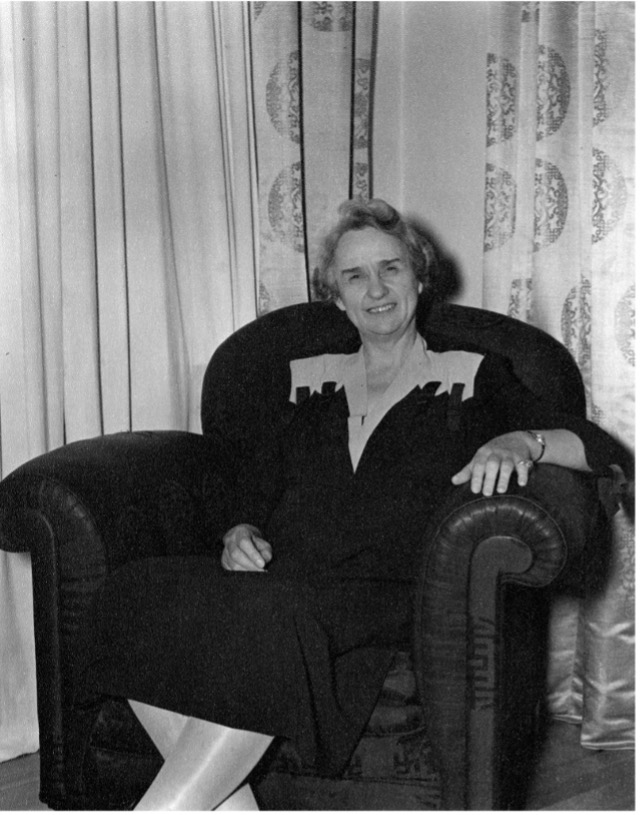
A white woman sits in a large armchair, smiling, with patterned curtains in the background.
Ava Milam Clark, Dean of the School of Home Economics. OSU Special Collections & Archives Research Center, Oregon State University, Oregon Digital accessed 2023-12-10.

Nuance could also be seen in how much was covered by home education. We see this in the work of Ava Milam Clark (1884 -1976), Dean of Home Economics at OSU from 1917-1950. She traveled abroad where she studied various cultures in order to know how best to teach home economics,[8] and with more unconventional works, such as her Boy Scouts cookbook for camping.[9]

The question now is: just how nuanced did these programs get? How far did this embrace of variety go? In many ways, early home economics, at least at OSU, took diversity and individuality seriously, but there is one crucial aspect where the room for nuance was more limited: Attitude.

As Sarah Louise Arnold explained in her paper, “Concerning Institutional Management,” a home-economics student would have been, at this time, asked to carry out many tasks.[10] At a certain point, then, what became important was less the ability to carry out these tasks and more about the willingness to do so and the way in which to go about it.[11]

It has been evident from the beginning that the institutional worker most in demand is the woman of maturity and experience, who has developed in other fields the qualities which are essential to success in institutional administration. … The demands upon the department go to show a wide variety of opportunities in institutional administration, which no single course of instruction could adequately meet. One might definitely prepare students to administer college dormitories; the same student, however, will be confronted by requests to become a dietitian, in the sense of adviser concerning diets;—or she will be asked to buy, cook, and serve diets and teach classes of nurses at the same time;—or she may be urged to take complete charge of a lunchroom, a tea room, the stewardship of a hospital, or the administration of a children’s home;— she may be asked to mother and manage a Welcome House; she may be called upon to administer the house of residence of the Y. W. C. A., or the small community which is the modern form of the orphan asylum . . . . Letters of inquiry invariably place personality first, experience second, and training third. These three essentials, all right, give us the ideal woman, who shall administer the ideal institution.[12]

This shows us that the trailblazers of home economics were very deliberate about this demand for a certain personality type in their students.
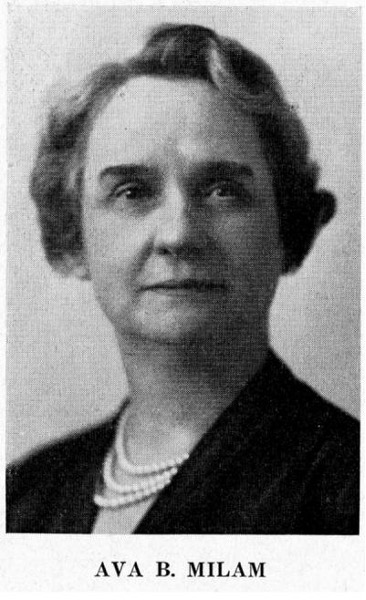
Not only was personality seen as the most important trait in a student of the home economics department, but the fostering of this specific type of woman was, in many ways, the central goal of these programs. In an article about her life, Milam was quoted saying: “While I do not in any way minimize the importance of teaching, food and nutrition, clothing and home management, I do believe a home economist’s greatest service comes in the influencing of attitudes and values. These must supersede all else!”[13]

Arnold says something similar in her 1910 “Certain Phases of Instruction in Institutional Management”:

It is evident that there is an urgent demand for women of native ability, mature experience, social aptitude, good judgement, promptness in meeting emergencies, and sound business sense, to direct institutional housekeeping . . . . It is clear that many of these qualities must be contributed by the individual. They cannot be secured by a fixed course of study in school or college. On the other hand, they may be developed by wise tuition. And, further, opportunities may be provided for such observation, such practice under expert guidance, such interpretation of accumulated experience, as will/fortify the worker and prevent her from making the mistakes of the novice. This, I take it, has been the purpose of the various courses in institutional management which have been hitherto provided.[14]

This obsession with women’s behavior wasn’t limited to the home economics department. According to The Experience of Women’s Higher Education at Oregon Agricultural College 1870-1916 by Katrina Anne Knewtson, in 1910, training at OSU was introduced for women students that “‘included a series of personal interviews with the dean and lectures for the physical, moral, and spiritual development of young women at the university.’ In one example given in the catalog, a lecture focused on the cardinal points of good manners at the table, in school, on telephones, the correct carriage, and the proper position in sitting and standing.”[15]

This need for social uniformity was undoubtedly influenced by the First World War. In a 1918 Report of the Home Economics Department of Education, it is said that

[t]he department of Home Economics Education has not been unmindful of its duty towards winning the war. . . . At the State Teachers meetings, Home Economics Association meetings, and others, and through literature distributed to the Home Economics teachers throughout the state, the department has cooperated with other departments to establish the right ideals and attitudes among the teachers who in turn should work the same spirit among their pupils and in their communities.[16]

According to historian Patricia Albjerg Graham, for many land-grant colleges, creating “character” in students was a particular focus during WWI. These colleges “stressed teaching on the part of the faculty, not research, and envisioned the molding of students’ characters rather than merely transmitting knowledge for knowledge’s sake as a principal and legitimate activity of the college.”[17]

I ask you, now, to think back to Arnold’s words, the idea that women’s lives do not belong to themselvesbut that, instead, women must sacrifice for the collective good. Always having a positive attitude is an example of such a sacrifice. It’s easy to see how this sacrifice would be expected during a world war: to stay chipper and happy for the boys overseas. The truth is, however, that this expectation for a continuous pleasantness that expands to both appearance and attitude is something that women today still face—to never complain, to be sweet and placid and—I’ll say it—maternal in all aspects of life no matter the stress they are under. It is interesting but not surprising, then, that this would be the invariable requirement of home economic students at Oregon State University in the early 1900s.


[1] Sarah Louise Arnold, “President’s Address,” 1913, Ava Milam Clark Papers, box 4, folder 2, Special Collections and Archives Research Center, Oregon State University, Corvallis, Oregon (hereafter SCARC).

[2] Arnold, “Address,” 10-11.

[3] “Historic Moments of Black Excellence at Oregon State University,”mSpecial Collections & Archives Research Center website, https://scarc.library.oregonstate.edu/omeka/exhibits/show/historic-moments-of-black-exce/carrie-halsell—osu-s-first-b (accessed December 10, 2025).

[4] William Robbins, The People’s School : A History of Oregon State University (Oregon State University Press, 2017), 14.

[5] “Household Management Project,” Home Economics and Household Management: The American Middle-Class Home, January 26, 2016, https://sites.middlebury.edu/homeec/history-of-home-economics/.

[6] Middlebury student body, Household Management.

[7] Arnold, “Address,” 6.

[8] Milam, Ava, Untitled, 1922, Correspondence 1920-1922, box 1, folder 2, Ava Milam Clark Paper, Special Collections and Archives Research Center, Oregon State University, Corvallis, Oregon.

[9] Milam, Ava B., and Ruth McNary Smith. “Camp cookery.” Corvallis, OR: College Bulletin Extended series, 1913.

[10] Arnold, Sarah Louise “Concerning Institutional Management,” 1912, “A Model for Branch Association of Home Economics” Sarah Louise Arnold, 1910-1943, box 4, folder 2,  Ava Milam Clark Papers, SCARC.

[11] Arnold, “Concerning,” 1-5.

[12] Arnold, “Concerning,” 1-5.

[13] Hoyt, Isabell Murray, “DEAN AVA B. MILAM of Corvallis, Oregon,” 1947, MSS- Ava Milam Clark, box 4, folder 7, “Reports, Speeches, and Articles on Home Economics at OSU, 1917, 1969,” SCARC.

[14] Arnold, Sarah Louise “Certain Phases of Instruction in Institutional Management,” 1910,  “A Model for Branch Association of Home Economics” Sarah Louise Arnold, 1910-1943, box 4, folder 2,  Ava Milam Clark Papers, Special Collections and Archives Research Center, Oregon State University, Corvallis, Oregon.

[15] Katrina Anne Knewtson. “The Experience of Women’s Higher Education at Oregon Agricultural College 1870-1916,” 1995, Scholars Archive.

[16] Hatty R. D., “Report of the Home Economics Department of Education,” 1918, Correspondence 1903-1919, box 1, folder 1,  Ava Milam Clark Papers, SCARC.

[17] Patricia Albjerg Graham. “Expansion and Exclusion: A History of Women in American Higher Education.” Signs: Journal of Women in Culture and Society 3, no. 4 (July 1978): 762.

Preparing for a Two-Person Career: The Early Years of The Co-Signers Engineering Students’ Wives’ Club at Oregon State

Students in Dr. Marisa Chappell’s History 363 “Women in U.S. History” class spent the final three weeks of Fall Quarter 2025 in OSU’s Special Collections and Archives Research Center exploring women’s impact on our university.

By Finnian Sweeney

Co-Signers Engineering Students’ Wives’ Club 1958-59 School Year Flyer, October 1958, Series 4, Box 2, Folder 2.1, MSS Co-signers Collection, Special Collections and Archives Research Center, Oregon State University, Corvallis, Oregon (hereafter SCARC).

The Co-Signers Engineering Students’ Wives’ Club existed at OSU from 1958 to 1977. The members of the club created scrapbooks to document their activities and achievements. This post focuses on the first years of the Co-Signers club, encompassing the period between 1958 and 1963 covered in the club’s first scrapbook. The flyers, newspaper clippings, images, and other objects contained offer a window into the purposes of the organization. Over the course of its existence, the club sought to promote friendships among the wives of engineering students at Oregon State University. The formula pictured above appears at the top of the Co-Signers recruitment flyer for the 1958-59 school year, which is one of the first items encountered in the scrapbook.[1] It is telling in that it is an equation to produce engineering wives. This reveals another purpose of the club: to create ideal engineering wives.

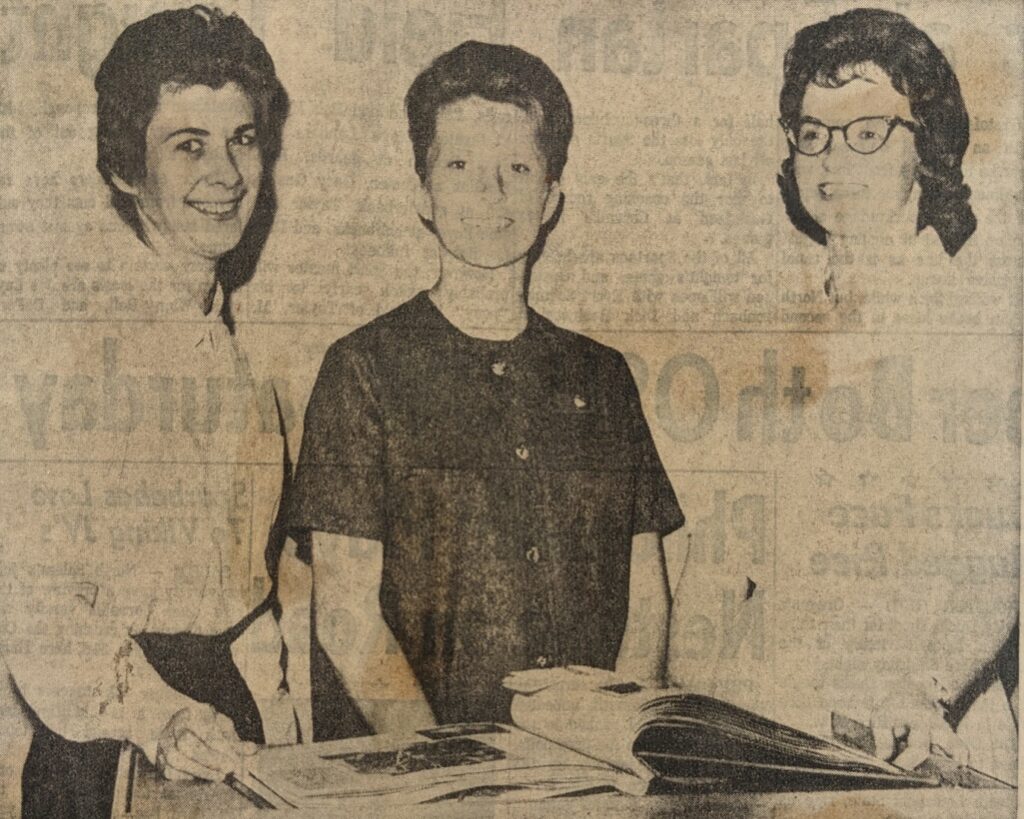
Three white women standing together in an old newspaper clipping.
Image: (L-R) Co-Signers Secretary-Treasurer Jan Richartz, President Myra (sometimes given as Myrn or Myrin) Cox, and Vice President Virginia Griffith pictured with the same scrapbook used as the basis for this piece, 1962 or 1963 (Corvallis Gazette-Times). “New Officers,” Corvallis Gazette-Times clipping, 1962 or 1963, Series 4, Box 2, Folder 2.1, MSS Co-signers Collection, SCARC.

The materials in this scrapbook record a variety of activities the club engaged in, such as teas, social events, and holiday parties. The Co-Signers also engaged in charity work and held a variety of fundraising events for the club itself and for a scholarship they awarded to a married engineering student.

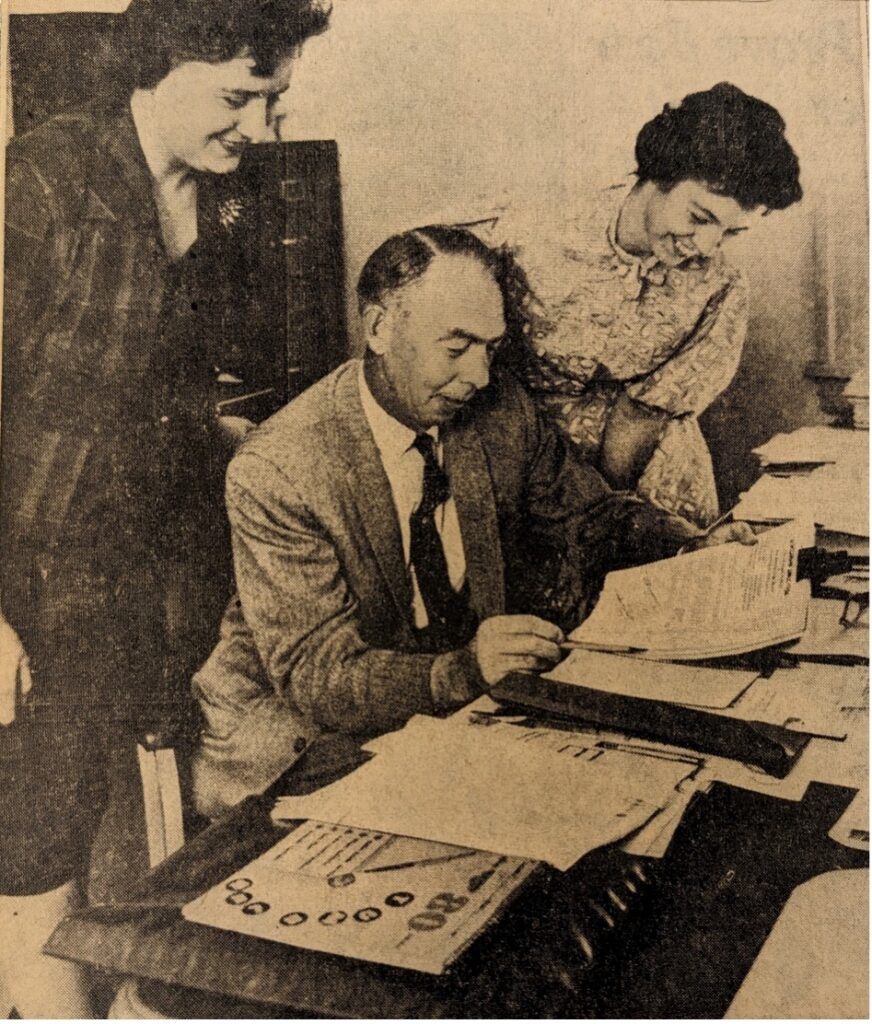
Some of the most interesting materials, however, concern the types of speakers that attended club meetings. Meetings featured talks by an interior decorator and a nursery school representative, as might be expected from a period where middle-class women were mainly expected to be housewives. More surprisingly, Co-Signers meetings regularly featured interviewers from major employers in the engineering field, including representatives from Lockheed Martin, NASA, and even a recruiter for the CIA. College of Engineering Dean George W. Gleeson was also a regular speaker. Dean Gleeson spoke annually at the club’s first meeting of each school year and seems to have been very supportive of the club. In fact, the 1958-59 recruitment flyer suggests that the creation of the club may have been partly inspired by an informal talk from the dean on members’ “role as a future engineer’s wife,” which seems to have been the topic of his annual talks, as well.[2] Gleeson’s wife Barbara also served as one of the club’s two advisors in its early years, alongside Louise Coopey, wife of another engineering faculty member.[3] All this suggests that Dean Gleeson felt it was important to prepare not only his students, but also their wives, for the engineering field, and that this view was shared by major employers in the industry.

Three white people reviewing documents at an office desk.
Image: (L-R) Co-Signers Secretary-Treasurer Norma June Swannack, Dean Gleeson, and Co-Signers President Sharon Morris make arrangements for the Co-Signers scholarship, October 1960. (Corvallis Gazette-Times). “The Social Whirl,” Corvallis Gazette-Times clipping, October 1960, Series 4, Box 2, Folder 2.1, MSS Co-signers Collection, SCARC.

The Co-Signers Club is indicative of larger patterns in the way married middle-class women at the time were expected and encouraged to support their working husbands. It is clear from the activities the Co-Signers engaged in, the way they worded their materials, and of course the name of their club that they saw their support and participation as important to the success of their husbands’ careers. This idea was encouraged and promoted by Dean Gleeson and by industry representatives. The club fits into a pattern identified by the scholar Hanna Papanek in 1973 of what she called “two-person single careers” in the American middle class.

These careers employed only the husband, but made implicit or explicit demands for supporting labor of various kinds from wives. Job interviewers like the ones that regularly addressed the Co-Signers would consider whether applicants’ wives would be “suitable” for the demands of their husbands’ positions. Papanek considered these two-person careers to be a “social control mechanism that serves to derail the occupational aspirations” of women and encourages them to seek “vicarious achievement” through the careers of their husbands. Papanek said that “the wife’s involvement with her husband’s career frequently begins before the career itself, during the stage when he is undergoing the advanced training so typical of these middle-class careers,” and that “the barely latent function of many colleges” was to prepare women to support a two-person career, giving additional context to Dean Gleeson’s support for the Co-Signers Club.[4]

Indeed, many wives in this period abandoned or did not pursue independent careers in favor of becoming housewives and providing direct and indirect support to their husbands’ careers. Researchers have shown that some of these women reported later in life that they would in hindsight have preferred to pursue careers of their own. It is important to note, however, that many of these same women also made their support roles central to their identities and derived satisfaction from supporting their husbands. Like the Co-Signers, many of them also engaged in social or service activities that at first glance appeared unrelated to their husbands’ careers, even to the women themselves, but that nonetheless were part of the work they did to support their husbands and families.[5]

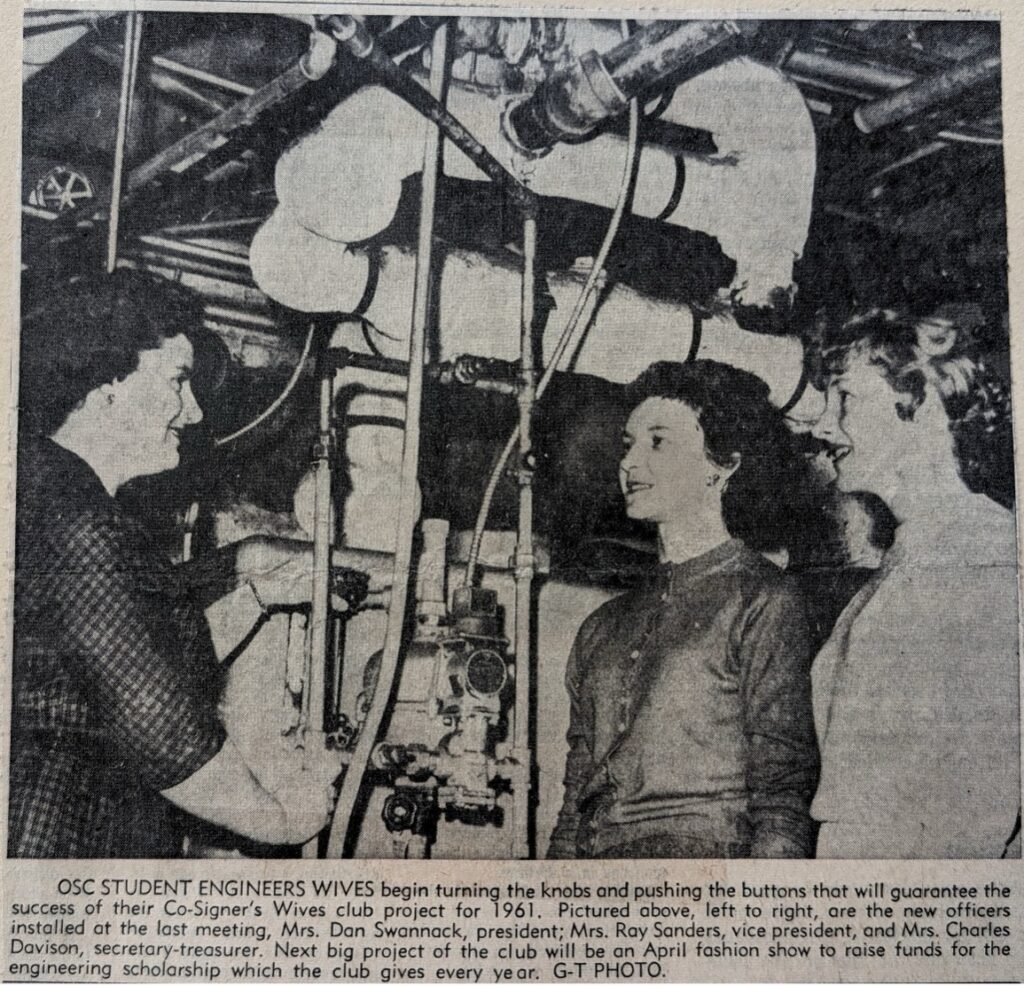
In another article from 1979, Papanek defined the category of “family status production,” arguing that much of the work women did in various societies went unrecognized but produced value for their family units in the form of enhanced social status, often aiding their husbands’ careers. This status production work includes not only career support, but also social activities that enhanced their families standing in their community.[6]The social, fundraising, and charitable work of the Co-Signers can perhaps be viewed through this lens and may have helped to raise the profile of their husbands within the OSU engineering community, especially as the routine local newspaper coverage of the club’s activities referred to members mostly by their husband’s names, as was typical for the time.

Three white women stand in front of a complex array of industrial pipes and machinery.
Image: Co-Signers officers depicted in the Corvallis Gazette-Times, 1961. Note that Norma June Swannack (now club president), Bonnie Sanders, and Nancy Davison are identified by their husband’s names. The officers appear next to unidentified machinery, perhaps on a tour of a university engineering facility. “OSC Engineers’ Wives,” Corvallis Gazette-Times clipping, 1961, Series 4, Box 2, Folder 2.1, MSS Co-signers Collection, SCARC.

Betty Friedan famously complained in her landmark 1963 book The Feminine Mystique that women were defined solely by their relationships to men.[7] In 1964, Friedan wrote that many women had through independent careers unlocked a “fourth dimension” beyond the three dimensions of the traditional female identity as a wife, a mother, and a homemaker. They had begun to see themselves as full people and members of society through independent careers. Even though many women had thought they were happy, there was still a yearning for independent achievement in many of them, and there were real psychological consequences to defining themselves solely in relation to their husbands, for example as “engineering wives.”[8]

The Co-Signers Club provides an excellent real-world example of the way the pattern of two-person single careers played out at Oregon state and show us the ways in which women sought to add meaning to their lives when society defined success for women as being a devoted wife and mother. Women were encouraged to define themselves in relation to their husbands’ careers, and the co-signers sought to find fulfillment in being the wives of engineers. This work focuses on the early years of the club, but it would be interesting to examine some of the later material from the 1970s to see how the rise of second-wave feminism, the entry of more women into the engineering field, and the decline in the number of married engineering students from the 1958 population of 380 (about half of engineering students at the time) changed the nature of the club in its later years.[9]            


[1] Co-Signers Engineering Students’ Wives’ Club 1958-59 School Year Flyer.

[2] Co-Signers Engineering Students’ Wives’ Club 1958-59 School Year Flyer.

[3] Co-Signers Engineering Students’ Wives’ Club, Valentine to Engineers Wives, 1962m Series 4, Box 2, Folder 2.1, MSS Co-signers Collection, SCARC.

[4] Hanna Papanek, “Men, Women, and Work: Reflections on the Two-Person Career,” American Journal of Sociology 78, no. 4 (1973): 852–72.

[5] Eliza K. Pavalko and Glen H. Elder, “Women behind the Men: Variations in Wives’ Support of Husbands’ Careers,” Gender and Society 7, no. 4 (1993): 548–67.

[6] Papanek, Hanna. “Family Status Production: The ‘Work’ and ‘Non-Work’ of Women.” Signs 4, no. 4 (1979): 775–81.

[7] Betty Friedan, The Feminine Mystique (W.W. Norton & Company, 1963).

[8] Betty Friedan, “Woman: The Fourth Dimension,” Ladies’ Home Journal (June 1964), 48-55.

[9] Co-Signers Engineering Students’ Wives’ Club 1958-59 School Year Flyer.

No Vacancy: The Gendered History of The Newman Center at Oregon State University

Students in Dr. Marisa Chappell’s History 363 “Women in U.S. History” class spent the final three weeks of Fall Quarter 2025 in OSU’s Special Collections and Archives Research Center exploring women’s impact on our university.

By Connor Grattan

A 1967 edition of the Portland-based Catholic newspaper, The Catholic Sentinel, touted the work being done by the Newman Center at Oregon State University, founded just two years earlier. The author viewed Center’s work, or apostolate, as both a great start for and possibly the beginning of a major conversion effort on campus. Moreover, the article praises, above all else, the Newman Center’s ability to connect with and integrate into the daily life of students; the author expressed hope that these efforts would h promote the values of the Catholic Church and convert non-Catholic students to the faith.[1]

Four white individuals at a table covered with a white tablecloth in a formal setting, with windows and foliage in the background.
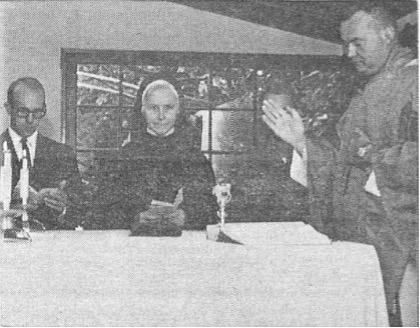
Mass being celebrated in the library-chapel at the edge of OSU’s campus, 1967. “Newman Apostolate Grows at Corvallis.”

The founding of the Newman Center at Oregon State University, one arm of a national Catholic apostolate organization, came at a time of immense change within the Catholic Church ushered in by the Second Vatican Council of the early to mid 1960s, in which Pope John XXIII declared that the Church should focus more on apostolicism and spreading the message of Catholicism through means other than specific calls to holiness from clergy. As the Newman Center worked to appeal to a new generation of students, its message nevertheless remained shaped by the Church’s longstanding patriarchal ideologies and practices. At a time when the Catholic Church grappled with evolving ideas about sexuality, marriage, and gender roles, the apostolic efforts by the Newman Center remained shaped by traditional and ideologically conservative gender ideals.

A group of white people gathered in a living room, seated around a coffee table with a newspaper and cup, in a black and white photo.
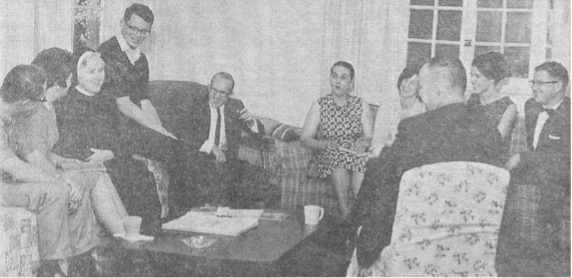
Meeting of clerical leadership and student officers at Newman Center, 1967. “Newman Apostolate Grows at Corvallis.

The Catholic Sentinel article suggested the hope that the Newman Center would create a new and growing commitment to the Church among OSU students. It discussed Center’s physical footprint on campus by noting the buildings it occupied; touted the priests, nuns, and student leaders who did the Center’s work; and highlighted the Center’s many recent campus events. It reassured readers that the Newman Center was using its budget wisely, particularly on efforts to recruit students to Catholicism. Finally, the article expressed optimism that the Center could launch theology or religion classes to further Catholicize the student body.

One barrier to that goal might be the Newman Center’s gender politics. The Center represented a conservative branch of the Catholic church and structured many of its apostolicisms around strict and discriminatory ideas of gender normativity and the idealization of heterosexual marriage. On example of the Newman apostolate was the rental housing the Center provided for students which gave preference to married couples.[2] In May 1968, the Center imposed a restriction on “girls” renting its properties; alongside the decision was this statement: “Because of problems in the past with girl renters it was again stated that no girls will be rented apartments and/or rooms in the Newman Rentals.”[3] This outright denial to rent to women was surprising to me; I had assumed that the advancements in civil rights in the 1960s would have ended this kind of discrimination. At the same time, the Center sponsored discussions addressing the liberalization of attitudes such as “Is pre-marital sex O.K.?,” “Is legalized abortion right?”, and “Is God dead?”[4] While we don’t know how these discussions turned out, the Newman Center’s commitment to traditional values likely led to conclusions that challenged the growing sexual liberalization in American society.

The 1960s was a time of change for Catholicism, marked by Pope John XXIII’s call for the Church to conform to the ideas of “aggiornamento,” or the bringing-up-to-date of the apostolate.[5] This meant an expansion into more areas outside of parishes and clergy. Many Catholics remained committed to conservative ideologies around sexuality and gender. In 1972, my mother was born into a devout Catholic family, and her childhood and adolescence were rooted in Catholic communities and their common faith. My mom told me about the underlying family pressures that she felt when she was going to college, especially the expectation that she find a husband. Her mother, as well as other women in her life, had met their husbands at college, and in some ways that created a pattern to follow. On top of that, there was a general understanding, as my mom put it, that women of the time knew that their husbands’ studies and career came before their own.[6] Even in the 1970s, these pressures were still around despite broader changes in American society.

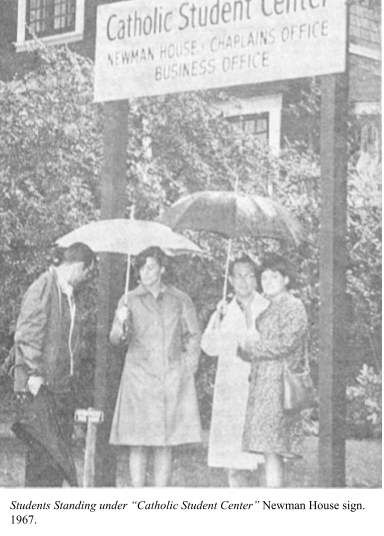
Four white people standing under umbrellas in front of a Catholic Student Center sign, 1967.

This context may explain the Newman Center’s policies and projects. Women who wanted to focus on their own career and who showed no interest in finding a husband had no place in the Newman rentals. The historian Philip Gleason notes that the Catholic Church in the United States feared the changing national culture, which was becoming increasingly secular and liberalized.[7] The recurring discussion of using classes to convert non-Catholic students makes much more sense in an era where the future of the Catholic church was uncertain. The Center acted not as an outpost of stability for OSU students who are attempting to answer the pressing questions of that era; instead, it offered guidance to those who had already subscribed to the Church’s ideas of what was morally just and unjust. Single women not being allowed in the rentals would not appeal to liberal students, nor would the glorification of traditional gender roles appeal to LGBTQIA+ students or others who oppose these ideologies.

Perhaps this explains the Newman Center’s many proposals to use classes to connect to the student body and perhaps gain new converts. There are many discussions of this tactic in leadership meeting minutes, an idea first introduced in a 1965 “Ten Year Projection” for the Center, when leaders expressed a belief that lessons in the Catholic faith were needed regardless of whether or not they would be offered through curriculum.[8] In another case, someone suggested using students in an architecture class to design a potential building for the Center while acting as ambassadors of sorts, furthering fellow students’ knowledge of the Center and Catholicism. They viewed this as a way to garner more support on campus.[9] In a way, it seems that the Center’s leaders hoped to create a quasi-Jesuit-style college for OSU students. One of the Center’s main goals in the second half of the 1960s was to create a “Catholic church on campus,” yet another way to spread Catholicism throughout the student body.[10]

My research into the Newman Center at Oregon State University in the 1960s surprised me. The staunch support of marriage, sexual conservatism, and heteronormativity aligned with the ideals of the Catholic Church but seem out of step with the era’s liberalizing culture. In the midst of mass movements for civil rights and women’s rights, the Newman Center denied housing to women; it is difficult to know if this conservatism helped or hindered its efforts to convert more students to the Catholic faith. If I could further this project, I would try to interview students who attended OSU in the late 1960s and ask them how they viewed the Newman Center. Some pieces of history are lost because they are not recorded, and this includes students’ perception of the Newman Center’s early years.


[1]  “Newman Apostolate Grows at Corvallis,” Catholic Sentinel, October 13, 1967, Box 1, Memorabilia Collection, Special Collections and Archives Research Center, Oregon State University, Corvallis, Oregon.

[2] Newman Center Minutes of Meetings, December 1968, Box 1, Newman Foundation of Oregon State Records, SCARC.

[3] Newman Center Minutes of Meetings, May 17, 1968, Box 1, Newman Foundation of Oregon State Records, SCARC.

[4] Talk to Be Given…,” 1968, Box 3, Newman Foundation of Oregon State Records, SCARC.

[5] S.J. Achutegrui, “The Second Vatican Council,” Philippine Studies 10, no. 4 (December 1962), 523.

[6] Annie Grattan interview with author, December 4, 2025.

[7] Philip Gleason, “Catholicism and Cultural Change in the 60s,” Review of Politics 34, no. 4 (January 1972): 91-107.

[8] “Ten Year Project” Box 3, Newman Foundation of Oregon State Records, SCARC.

[9] Mrs. Sitton to Newman Foundation, 1965, Box 3, Newman Foundation of Oregon State Records, SCARC.

[10] “Talk to be Given to People Called Together for the Purpose of Starting Some Type of Booster Organization for the O.S.U. Newman Center,” 1968, Box 3, Newman Foundation of Oregon State Records, SCARC.

In Loco Parentis: Controlling College Women’s Behavior in the Mid-Twentieth Century

Students in Dr. Marisa Chappell’s History 363 “Women in U.S. History” class spent the final three weeks of Fall Quarter 2025 in OSU’s Special Collections and Archives Research Center exploring women’s impact on our university.

By Dylan Brady

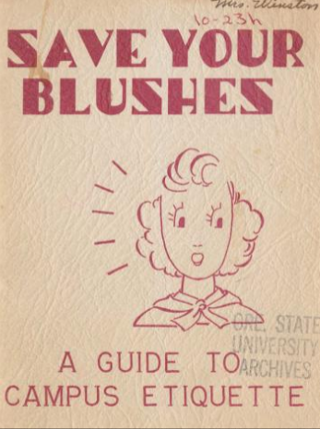
Booklet titled "Save Your Blushes: A Guide to Campus Etiquette" with an illustration of a surprised woman.

In OSU’s Special Collections and Archives Research Center, I was surprised to find a 1939 guide published by the Etiquette Board of Associated Women Students of Oregon State College called “Save Your Blushes,” which details the do’s and don’ts for incoming women students. One one page, for example, the guide instructs women students in how to act in the dining halls, from seating arrangements to conversation topics.[1] The guidebook tells women students what they should wear and how they should act on dates. In a section called “Fruit for the Beach Combers,” it offers advice – for example, “there are very few emergencies that justify breaking a date” – and referring to potential dates as “fruits” or “livestock.”[2]

The guide includes tips on mundane matters that I was surprised a college organization would even care about, such as how women are supposed to walk with men. A section called “Round Bout” advises, “if a girl and boy are walking together, the girl should always be on the man’s right.”[3] Many of the pieces of advice offered in the guide seem, to the modern eye, like an odd effort to dictate the daily actions of women students.

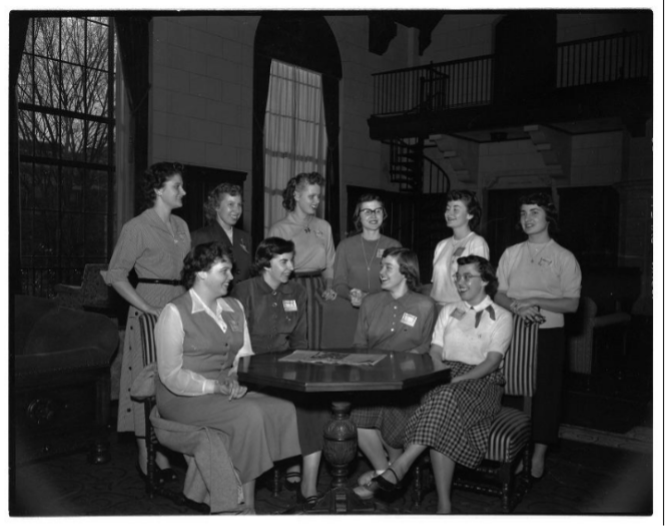
Associated Women Students (AWS) was a national organization with chapters at universities across the country. Each chapter shared a set of goals: to “regulate all matters pertaining to the welfare of women students, to further the spirit of unity and service, to increase a sense of individual responsibility, and to create and maintain high standards and ideals for the women students of the university.”[4] AWS served as a campus umbrella organization for all women’s groups, societies, and clubs, sponsoring events such as nickel hops, carnivals, and women’s weekends.[5] The constitution of OSC’s AWS noted that every woman on campus was allowed to become a member and participate creating cooperation among women across campus and the AWS.[6]

Group of nine white women around a table in a room with a large window and spiral staircase.
Associated Women Students officers from nine different colleges gather at a workshop in the Memorial Union found in Oregon Digital in the Historical Images of Oregon State University. Historical Images of OSU, “AWS Officers Workshop,” Oregon Digital, accessed Nov. 22, 2025.

AWS worked closely with OSC’s administration to promote what its members viewed as the safety and well-being of women students and the campus community. A 1959 AWS pamphlet declared, “In the college community, closing hours and other regulations are made and observed in the best interests of the health and welfare of the women students and to meet expressed wishes of parents for social supervision.”[7] Here, the AWS promotes a common approach at the time in which college and university leadership acted in loco parentis, or “in the place of the parent.” As a legal scholar described it, “in its fullest form the doctrine of in loco parentis permits colleges to devise, implement and administer student discipline and to foster the physical and moral welfare of students.”[8] It was a primary focus for many of these organizations to regulate the behavior of the female students on campus because these regulations are were what they believed were necessary to succeed not just in college, but their future life. These regulations were harmonious to the roles women were expected to play in the family and community in the mid-twentieth century.

Throughout the AWS’s existence, they produced many coed codes to serve as guides for women on campus, designed to shape their behavior. This coincides with their belief that, “In every phase of life the individual lives within certain regulations, which are necessary for the welfare and harmony of the group.”[9] They emphasized the college rule that women students secure permission from a parent or guardian, filed with the Dean of Women, before leaving campus.[10] They also promoted the rule that women were barred from entering men’s dormitories.[11] AWS and the administration worked to impose a broad range of rules on women student behavior.  

The fact that it was women students themselves, through AWS, that advocated and publicized these rules and regulations suggests an emphasis on peer pressure as one key enforcement mechanism. The historian Babette Faehmel argues that if women on college campuses did not follow the behavior rules set out for them, they would be socially ostracized.[12] AWS guides emphasize that students must follow certain social conduct to remain “in accordance with standards of decency.”[13] Even as these guides sought to restrict women’s freedom, they insisted that conformity was “a sure recipe of happiness at college.”[14] These guides promoted a vision of womanhood rooted in acceptable social behavior, preparing women students to become good hostesses, conversationalists, and wives.

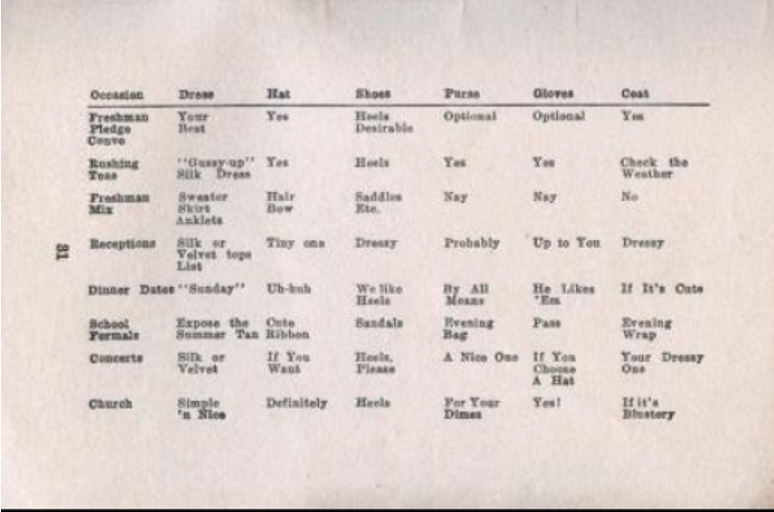
A chart listing attire suggestions for various social occasions.
A page inside the coed code for the 1944-45 school year explaining what women should and should not wear for certain school events. OSU SCARC, “Coed Code, 1944–1945,” Oregon Digital, accessed Dec. 10, 2025.

Similar handbooks and guides circulated on college campuses in the 1920s and 1930s and continued to shape college life during and after World War II. Historian Donna J. Drucker, who researched similar women’s organizations at Purdue University in the 1939-1940 academic year, found that they “aimed to prepare young women to face whatever experiences lay ahead—whether that meant eating oysters or preparing for war—with grace.”[15] In the postwar period, as more women could afford higher education, American culture both praised women’s college attendance and promoted domesticity.[16] Even as more women attended college, the expectation was that they would devote their adult lives to managing children and a home and supporting their husbands’ careers. AWS leaders, then, tried to prepare college women for this future role. As Helen Lefkowitz Horowitz wrote about Scripps College’s expectations of its students (all women) in this period, “graduates might combine work (‘contribution’) with marriage and children (‘fullest and richest life’).”[17]

Of course, on college campuses nowadays there are still rules and regulations that many must follow, but nothing that compares to the ones female students had to follow before the 1960s. College organizations do have a job in some ways to help foster student growth, not just for career goals but also for living a. healthy and contributing life. However, there is a limit to how far these restrictions should go in order serve the best interests of the students. These handbooks and organizations, even with their best interests in mind, served to control women students’ behavior and mold them for a limited future after college – marriage and motherhood. Regulations imposed by administrators and the promotion and enforcement of these regulations by fellow students limited the freedom of women students to be who they wanted to be and to express themselves. This small look at college life in mid-twentieth-century cannot capture the complexities of women students’ perspectives and lives living within this system. But it suggests that in this period, colleges sought to mold women students to fit a very narrow role in society rather than to develop and pursue their own, individual goals and aspirations.


[1] “Save Your Blushes, 1939,” Oregon Digital, 9, Accessed 2025-12-04. https://oregondigital.org/concern/documents/fx71cn310.

[2] “Save Your Blushes, 1939.”

[3] “Save Your Blushes, 1939.”

[4] Betsey Creekmore, “Associated Women Students – Volopedia,” Volopedia, September 24, 2018, https://volopedia.lib.utk.edu/entries/associated-women-students/.

[5] Historical Publications of Oregon State University, Oregon State University. “The Beaver 1948” Oregon Digital. Accessed 2025-11-22. https://oregondigital.org/concern/documents/0g354f54.

[6] Associated Women Students, A.W.S. Handbook, 1930-31, Series 1, Box 1, Folder 2, Associated Women Students Handbooks, Special Collection and Archives Research Center, Oregon State University, Corvallis, Oregon.

[7] OSU Special Collections & Archives Research Center, Oregon State University. “AWS and Administrative Regulations for Women, 1959” Oregon Digital. Accessed 2025-12-10, https://oregondigital.org/concern/documents/fx71cn38x.

[8] Theodore C. Stamatakos, “The Doctrine of In Loco Parentis, Tort Liability and the Student-College Relationship,” Indiana Law Journal 65, no. 2 (1990): 474.

[9] OSU SCARC, “AWS and Administrative Regulations for Women, 1959,” Oregon Digital.

[10] Ibid.

[11] OSU SCARC, “AWS and Administrative Regulations for Women, 1959,” Oregon Digital.

[12] Babette Faehmel, College Women in the Nuclear Age: Cultural Literacy and Female Identity, 1940–1960 (New Brunswick, NJ: Rutgers University Press, 2011), 31.

[13] Historical Publications of Oregon State University, “AWS and Administrative Regulations for Women, 1960,” Oregon Digital, accessed December 10, 2025, https://oregondigital.org/concern/documents/fx71cn396.

[14] Historical Publications of Oregon State University, “Coed Code, 1946–1947,” Oregon Digital, accessed December 11, 2025, https://oregondigital.org/concern/documents/fx71cn353.

[15] Donna J. Drucker, “‘In a Sense, It Is a Game’: Women’s Dormitory Life at Purdue University, 1939–1940,” Indiana Magazine of History 113, no. 1 (2017): 15, https://doi.org/10.5378/indimagahist.113.1.0001.

[16] Lynn D. Gordon, “The Gibson Girl Goes to College: Popular Culture and Women’s Higher Education in the Progressive Era, 1890–1920,” American Quarterly 39, no. 2 (1987): 211–30, https://doi.org/10.2307/2712910.

[17] Helen Lefkowitz Horowitz, “Designing for the Genders: Curricula and Architecture at Scripps College and the California Institute of Technology,” Pacific Historical Review 54, no. 4 (1985): 439–61, https://doi.org/10.2307/3639569.

Buena Maris, the Hanford Nuclear Site, and Women’s Wartime Labor

Students in Dr. Marisa Chappell’s History 363 “Women in U.S. History” class spent the final three weeks of Fall Quarter 2025 in OSU’s Special Collections and Archives Research Center exploring women’s impact on our university.

By Kylie Abbey-Zanni

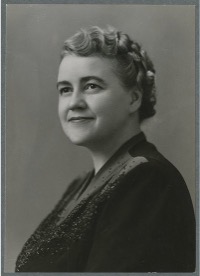
Black and white portrait of a white woman with styled hair and a slight smile.
Buena Maris, 1945

In the Buena Maris Mockmore Papers held in OSU’s Special Collections and Archives Research Center I found a fourteen-page report from 1960 titled “Hanford – In Retrospect.” In the report, Maris wrote about her time as Director of Women’s Activities at the Hanford Nuclear site, a Manhattan Project complex located along the Columbia River in southern Washington, during World War II. As Hanford recruited and employed thousands of women workers, its managers recognized what Maris called “the need for someone who could care for the welfare of several thousand women workers.”[1]

They turned to Maris, who took a year-long leave from her position as Dean of Women at Oregon State College, from September 1943 to September 1924, to serve as Director of Women’s Activities at Hanford. The report shows how she professionalized women’s welfare work and labor during wartime. Using her position at Hanford, Maris worked to set women workers up for success not only during the war but also afterwards, challenging the widespread assumption that women were temporary workers who would return home once the wartime emergency ended.

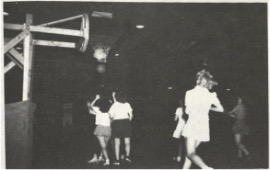
People playing basketball indoors under low lighting.
Women at Hanford playing in a basketball morale tournament as part of the site’s recreation program; “The Hanford Site: An Anthology of Early Histories”

Maris came into her position as Director of Women’s Activities at Hanford due to the unprecedented number of women entering the workforce, including newly available jobs in the defense industry, during World War II. A production site for plutonium needed for American atomic bombs, Hanford was a massive enterprise. At its peak in 1944, Hanford employed more than 51,000 workers, including four thousand women. With. large numbers of men serving in the military, defense plants sought out women to serve in a variety of roles including equipment inspectors, construction and general staff positions.

Maris’ report offers much more than just administrative notes. Instead, it reads very like to the diary of a woman managing a workplace in a new environment. She describes the living conditions Hanford’s women employees endured, such as overcrowded dormitories, the desert climate, and feelings of isolation. Maris’s solution for these struggles was something she called “purposeful engagement,” making available opportunities for women workers to get involved in recreational activities that served the community. She brought in Red Cross volunteer programs and church services and activities, for example, to help “curb boredom.”[2] These efforts were touted in promotional coverage in various newspapers. An article titled “New Deans a Queen!,” for example, portrayed Maris as a very warm woman who was heavily committed and involved in women’s development. “To satisfy needs of such a large group of employees… church facilities had to be provided. This wasn’t the specific responsibility of the supervisor of women’s activities… However, the tent for Catholic services was no longer adequate – some of the parishioners sitting on benches well out beyond the open end of the tent in the sagebrush.”[3] Providing adequate facilities for church services was not in Maris’s job description, but she was committed to the welfare Hanford’s women and took up the issue anyway. In a newspaper tribute decades later, reporter Laurie Williams referred to Maris as “Hanford’s mom for a year” and highlighted how women at Hanford thrived under her supervision, many of them going on to have careers after the war.[4]

Another later treatment discussed Maris’s promotion of volunteer activities. In “The Hanford Site: an Anthology of Early Histories,” M.S. Gerber wrote that “Mrs. Maris also organized a library, started a Red Cross chapter that still functions in Richland today, and scheduled a special daily bus with a late return to and from Pasco so that women could break the monotony of camp life.”[5] In addition to these organized programs, Maris worked endlessly to ensure these women kept their morale up and their lives as normally as possible. Maris was well suited to this role. After earning her undergraduate degree in Home Economics and Child Development, she earned a Master’s in Science at OSC in 1939 and went on to teach and serve as Dean of Women at OSC from 1941 to 1948 (excepting her year at Hanford).

Maris’s approach echoed similar work by middle-class women reformers in the first half of the twentieth century. During the Progressive era, reformers feared that young, unmarried women’s entry into urbanized labor markets and access to commercialized leisure put them at moral risk. Reformers from groups such as the Young Women’s Christian Association and the Travelers Aid Society believed these women needed supervised, structured recreation, from chess clubs and church services and supervised outings and supervised boarding houses.[6] Maris was able to reproduce this at Hanford, carrying on traditional ways of bringing leisure to working women. These sources show how Maris not only monitored Hanford’s workplace and leisure culture but also heavily shaped and contributed to it.

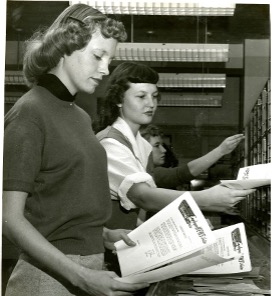
White women sorting newsletters.
Women at Hanford distributing employee newsletters by and for the workers; nps.gov website article “(H)our History Lesson: Hanford Site Workers in Tri-Cities, Washington.”

Some histories of women’s labor in World War II emphasized its temporary nature. They argue that while the wartime emergency opened up new kinds of jobs to women, these opportunities were largely foreclosed when servicemen returned after the war.[7] Other scholarship paints a more complicated picture. Claudia Goldin argued that women’s labor during World War II sparked a long-term shift in societal norms and expectations.[8]Several contributors to Joanne Meyerowitz’s reassessment of postwar gender roles argued that women continued to advance, particularly in feminized professions such as nursing, teaching, and social work.[9]

Maris’s impact on Hanford’s women workers seems to have played a small role in this larger phenomenon. Laurie Williams’s article “Women Came to Hanford to Make a Difference detailed how women continued to grow in their career fields following their time at Hanford and credits Maris for building their confidence and capacities.[10] Maris modeled women’s leadership, showing that women could manage and direct the workforce, not just join it. Her work at Hanford not only illustrates wartime necessity but also shows how war-time need opened paths towards long-term employment for women. She proved herself as a wartime professional who demonstrated that women managers were not temporary but rather individuals who could carry their skills outside of the war. Maris’ story and impact fits into the broader transformation of women in the United States at the time. WWII made women’s labor more visible and necessary while women like Maris worked to make it more sustainable. Her role in Hanford serves as a reminder that the war created both women workers and women leaders.

“Hanford – in Retrospect” captured the story of a woman who reshaped wartime labor at a singular site. By establishing a variety of programs, a sense of community, and professional pathways, Buena Maris helped to normalize women in long-term paid labor, not just during the war but after it, as well. Her story invites further questions and research about Oregon State College and the larger history of women, war, and labor. Did federal agencies recognize, or even use Maris’s model? What role did race, class, and religion play in shaping women’s lives and labor at Hanford? How did OSC benefit from Maris’s Hanford experience after she returned? Maris opened the door for women to continue growing in the professional workplace and her papers ensure we can look back on and evaluate her impact.


[1] Buena Maris, “Hanford – In Retrospect,” December 8, 1960, series 3, box 2, folder “Manhattan Project: Hanford, 1960-1962,” Buena Maris Mockmore Papers (hereafter Mockmore Papers), Special Collections and Archives Research Center, Corvallis, Oregon.

[2] Maris, “Hanford – In Retrospect.”

[3] “New Deans a Queen! New Dean Promises OSC Friendliness,” undated newspaper clipping, series 2, box 1, folder “Newsclippings re: Speeches and Presentations Given by Mockmore [Iowa and Oregon] circa 1940-1965,” Mockmore Papers.

[4] Laurie Williams, “Hanford’s Mom for a Year, Buena Maris Made Desert a Home for Women Workers,” newspaper clipping, October 31, 1993, series 3, box 2, folder “Manhattan Project: Hanford 1945,” Mockmore Papers.

[5] M.S. Gerber, “The Hanford Site: An Anthology of Early Histories,” October 1993, series 3, box 2, folder “Manhattan Project 1998-2010,” Mockmore Papers.

[6] Joanne Meyerowitz, Women Adrift: Independent Wage Earners in Chicago, 1880-1930 (University of Chicago Press, 1988).

[7] Ruth Milkman, “Gender, Consciousness, and Social Change: Rethinking Women’s World War II Experience,” Labor History 28, no. 1 (1987): 3–18; Marjorie Miller, “Working Women and World War II,” Journal of American Studies 14, no. 2 (1980): 123–141.

[8] Claudia Goldin, “The Role of World War II in the Rise of Women’s Employment,” Quarterly Journal of Economics 106, no. 4 (1991): 1497-1542.

[9] Joanne Meyerowitz, Not June Cleaver: Women and Gender in Postwar America, 1945-1960 (Temple University Press, 1994).

[10] Laurie Williams, “Women Came to Hanford to Make a Difference,” newspaper clipping, October 31, 1993, series 3, box 2, folder “Manhattan Project: Hanford 1945,” Mockmore Papers.

Promoting Physical Health for Women at Oregon State College during World War II

Students in Dr. Marisa Chappell’s fall 2023 History 363 “Women in U.S. History” class spent the final three weeks of Fall Quarter 2023 in OSU’s Special Collections and Archives Research Center exploring women in Camp Adair’s history.

By Brooklyn Blair, Grace Matteo, and Ruiqi Zhang

A January 20, 1928 issue of the Oregon State Barometer announces group photos for women’s athletic teams.

One of the expectations of women during World War II, including women at Oregon State College, was that they uphold and promote their own and others’ physical health in order to support the war effort. We discovered that women’s physical health was heavily promoted at OSC, both in the student newspaper and through various clubs and organizations dedicated to 1940s understandings of women’s physical well-being. While participation in athletics had a longer history at OSC, World War II prompted a specific emphasis on women’s physical conditioning.

We first became interested in this topic when we saw a section in the March 1942 issue of the Oregon State Barometer called “Women Leaders, Professor Stress Need for Conditioning.”

Discussion of the need for physical fitness, especially for women, took up nearly the entire fourth page of the March 24, 1942 issue of the Oregon State Barometer.

The section includes personal accounts from four women at OSC, all of whom call on readers to prioritize health and enlist in a new workout program for women. One author, Jean Ford, encourages readers to lose weight and “awaken muscles” and urges them to “sign up for the physical fitness program and stick to it” because “it’s your duty.” Toddy Gates, president of OSC’s Women’s Athletic Association, insists participating was the best way women could serve their country because it would prepare them to work in “emergency positions.” Mortar Board president Kay Serberg argued that a trained mind and body were equally important and that “new-fangled diets” were not an effective way to become healthy.[1] The article was accompanied by a poem celebrating OSC women’s role in fighting the war, which demanded their “strength” as well as courage.

This poem appeared amidst several articles under the heading “Women Prepare for War Work” on page 4 of the March 24, 1942 issue of the Oregon State Barometer.

We soon discovered other examples of women being urged to pursue fitness as an obligation in wartime. A 1943 OAC report on women’s intramural athletics, for example, stressed that athletic opportunities were important to help women maintain what was considered a proper figure. In another Barometer article, Dr. Eva M. Seen insisted that “emergency conditions will demand more vigorous, more strength and toughness of body than has been demanded of us during the past few years of soft living.” This included women, who “may not be drafted and have to face the rigid military tests of physical fitness, but they must face squarely and honestly the fact that they as well as the men must carry their share of the burden of defense.” Specifically, she asked OSC’s women students if they were physically fit enough to “meet the probable demands of long hours of labor in the fields, fruit orchards, vegetable gardens, canneries, canteen work, first aid stations or the strain of long confining hours in defense factories without the danger of physical strain or injury or complete physical breakdown?”[2]

These examples indicate that physical health was highly stressed for women during the war, but there remained conflict over the methods and meaning of women’s physical activity. Many advocated health as necessary for the war effort, but others tended to emphasize conditioning as a way to improve women’s appearance. For example, the historian Rachel Louise Moran notes, for example, that “women’s weights were sometimes a point of contention” in the Women’s Army Corp.”[3] Mark Ellner, meanwhile, has documented resistance to women’s participation in Olympic sports, quoting one leader insisting that the games “should be the sole purview of men,” leaving women to “crown . . . the winner with garlands, as was their role in ancient Greece.”[4]

Discussions of women’s physical health at World War II-era Oregon State College suggest that World War II might have been a historical turning point. The military and industrial requirements of the war seemed to provide new opportunities and promote new understandings of physical fitness and education for women. Did wartime demand for physical fitness affect how women thought about themselves, their bodies, and their roles in society? Perhaps it helped pave the way toward greater equality for women in athletics and the labor market later in the twentieth century.


[1] “Women Leaders, Professor Stress Need for Conditioning,” Oregon State Barometer, March 24, 1942, 4.

[2] Dr. Eva M. Seen, “Women Begin Fitness Program,” Oregon State Barometer, March 24, 1942, 1.

[3] Rachel Louise Moran, Governing Bodies: American Politics and the Shaping of the Modern Physique (Philadelphia, PA: University of Pennsylvania Press, 2018), 69.

[4] Mark Ellner, “A Critical Look at Women’s Role in Physical Education and Sport in the 1930s,” Educational Considerations 45, no. 2 (2020), 5.

Dances, Bands, and Pageants: Women and Entertainment at Camp Adair

Students in Dr. Marisa Chappell’s fall 2023 History 363 “Women in U.S. History” class spent the final three weeks of Fall Quarter 2023 in OSU’s Special Collections and Archives Research Center exploring women in Camp Adair’s history.

By Alexandra Collins, Brandon Cunningham, and Maitreya Lake

World War II was a trying time in the United States. Even though the country avoided much of the war’s physical destruction, American military and industrial participation created significant upheaval. Entertainment thus played an important role, offering feelings of comfort and community and lightening the load of challenging times. As we explored the various entertainment options for service members at Camp Adair, we were struck by the prominence of women. Women were essential in organizing events, performing, and participating in social activities. This was not new; women had historically been called upon to serve as morale-boosters for male soldiers, particularly during wartime. This was not different at Camp Adair.

A glamour shot of actress Strelsa Leeds, announcing her appearance at Camp Adair in the play “Junior Miss” in February 1943.

A striking example appeared in the Camp Adair Sentry, the camp’s newspaper, in February 1943. The newspaper announced a visiting performance of a Broadway production called “Junior Miss.” The show’s two headliners, Helen Eastman and Lucille Fetherston, play “two teenage girls who prance through three acts of devastating beauty” in a comedy that provides “hilarious and warm-hearted fun.” The description of the play emphasizes comfort and stability, while the caption beneath a glamorous headshot of actress Ellen Curtis refers to her as a “beauteous blond.”[1] Women often played a key role in performances for soldiers.[2]

Another example, captured a photograph, is the 1943 “Little Colonel” contest (see below).[3] The Oregon State Barometer, which included additional photographs, described a shooting contest among “girls” who were nominated on the basis of “beauty and personality alone.” The top shooters would earn titles using a diminutive form of military ranks, from “Little Colonel” for first place to “Little Second Lieutenant” for fifth, with winners announced at a “‘GI’ Military Ball,” where “Miss ‘Dead-Eye Dick’” would “Rule Over Dance.”[4]

“College women with 1903 Springfield rifles, circa 1943,” Oregon Digital.

A humorous article from the Barometer in October 1942 highlights the emphasis on women’s appearance, even outside of entertainment venues. In “Pigtails Irksome to Men, Says One With Keen Eye,” Normal Sholseth complained about women students’ hairstyles. “What has happened to those super-glamorous sweeping bobs?” he asked. “Okay, so it does take 15 minutes to put up the mop, but after all look in the mirror and see results.” Sholseth suggests that women’s appearance was important to men, the “fellow [who] rolls out of a warm bunk just to report to an 8 o’clock gym class,” the “harassed manhood of Oregon State.”[5] The article shows that ordinary women, not just entertainers, were being held to particular standards of feminine appearance and seen as a visual source of entertainment.

This photograph from the Sentry depicts the staff of one of several USO clubs in communities around Camp Adair. Camp Adair Sentry, October 8, 1943, 8.

Women also played a central role in organizing and participating in social activities for Camp Adair’s servicemen. Many women served as “hostesses” with the United Service Organization (USO), creating and staffing recreational spaces and generally providing female company for servicemen far from home. October 1942, the Barometer informed “co-eds who wish to volunteer” in hospitality programs at Camp Adair to fill out an application in the “dean of women’s office for membership in the Corvallis Victory volunteers,” through which they can “indicate interests in Junior Hostess groups, serve as dancing partners for service men at chaperoned dances” or “indicate preferences to serve as hostesses for handicraft, games or other recreational activities at the USO center.” The article also noted that “some evidence of family sanction should be on file in the dean of women’s office, for those girls who plan to accept invitations to officers’ dances at the camp or to volunteer to go to enlisted men’s dances.”[6] The job of hostess was discussed by Barbara Martin in a book of collected memories of Camp Adair. Martin described her experience living near Camp Adair as a young woman and noted that many local girls saw the influx of servicemen as an opportunity to expand their circle of friendships and romantic opportunities. In fact, Martin would end up marrying a serviceman who was stationed at Camp Adair.[7]

The various examples of women as entertainment at Camp Adair point to the different kinds of roles they played. The historian Meghan Winchell argues that the USO’s senior hostesses served as surrogate mothers to soldiers, providing the physical and emotional comforts of home, while the USO “depended upon junior hostesses to use their beauty and sexual appeal to entice men into USO clubs.”[8] Women entertainers were also sexualized, and there was an emphasis on women appearing feminine and attractive to men, another way that women were used to emphasize the masculinity of male servicemembers.[9]


[1] “‘Junior Miss’ to Be Here Feb. 20,” Camp Adair Sentry, February 11, 1943, 1.

[2] Sherrie Tucker, “‘And, Fellas, They’re American Girls!’: On the Road with the Sharon Rogers All-Girl Band,” Frontiers: A Journal of Women’s Studies 16, no. 2/3 (1996): 128-160.

[3] “College women with 1903 Springfield rifles, circa 1943,” Oregon Digital.

[4] “‘Little Colonel’ Candidates Shoot It Out For Honor to Reign Over Military Dance,” Oregon State Barometer, April 30, 1943, 1.

[5] Norman Sholseth, “Pigtails Irksome to Men, Says One With Keen Eye,” Oregon State Barometer, October 24, 1942, 1.

[6] “College Officials Set New Policy For Camp Adair,” Oregon State Barometer, October 23, 1942, 1.

[7] Barbara Martin, “A View of History,” Camp Adair: 50 Years Ago (Dallas, OR: Polk County Museum Association, 1992), 61.

[8] Meghan K. Winchell, “‘To Make the Boys Feel at Home’: USO Senior Hostesses and Gendered Citizenship,” Frontiers: A Journal of Women’s Studies 25, No. 1 (2004), 200.

[9] Marilyn E. Hegarty, Victory Girls, Khaki-Wackies, and Patriotutes: The Regulation of Female Sexuality During World War II (New York, NY: New York University Press, 2010).

Mixed in Classification: The Paradox of Gender Roles in Media and the Mobilization of Women at Camp Adair

Students in Dr. Marisa Chappell’s fall 2023 History 363 “Women in U.S. History” class spent the final three weeks of Fall Quarter 2023 in OSU’s Special Collections and Archives Research Center exploring women in Camp Adair’s history.

By Maia Merims-Johnson, Gideon Lerner, and Matthew Johnson

Camp Adair was established in 1942 as a training camp during World War II, and its main source of media, the Camp Adair Sentry, launched on March 11, 1942. This military-run newspaper aimed to boost morale and foster communication in the camp. Women were front and center in the Sentry, and their portrayal forces us to reconcile with the paradox of the 1940s media, which presented both empowering and infantilizing depictions of women. The Sentry followed a similar pattern, both reflecting and challenging dominant gender norms. Camp Adair serves as a microcosm of women’s complex place in American society during World War II, as the photography in its newspaper demonstrates.

This photograph appeared in The Camp Adair Sentry on October 22, 1943. Featured in what was considered masculine clothing at the time and doing work considered men’s work, McPoil and Williams might be seen as empowered, challenging the limitations imposed on women. The caption seeks to undermine that potential, suggesting readers picture them in bathing suits and comparing their work to the role of wife.

A photograph in the October 22, 1943 issue of the Sentry provides insight into the complexities of gender in a workplace increasingly occupied by women during the war. It features Wanda McPoil and Alta Williams posed in front of an open-engine service vehicle.[1] The caption, “They Got Mixed in Classification,” implies that there had been a mistake in the women’s work assignment and that the notion of women serving as truck drivers or post engineers was inherently confusing. The caption conjures images of the women in bathing suits – “put a bathing suit on them and you’d swear these two girls should be on the beach at Waikiki” – before minimizing their labor with the comment that “they handle those ton-and-a-halfs as easily as if they were husbands.”[2] The language reflects the skepticism women faced when entering previously male-dominated industries during the war. The photograph is actually unusual for the newspaper in portraying the women wearing pants, flannel, and jackets; a majority of photographs in the Sentry featured women dressed in highly feminized clothing, many of them movie stars and other entertainers. By framing the photograph of women performing skilled manual trades, the reductive and patronizing comments in the caption mark McPoil’s and Williams’ work as unusual. This suggests that women entering these fields continued to face opposition, even if it was quieted by concerns for national defense.

Miss Ruth Kary was a Sentry Billfold Girl of the Week in March 1943. A typical glamour shot, the photograph is accompanied by a description of Kary as a “charm provider” for Boeing test pilots.

Visual media, a key component of wartime mobilization, clearly struggled to reconcile necessary changes to gender roles brought by the war and the expectations of pre-war gender constructs. As the author Adhis Chetty argued, the need for women’s labor in previously male-dominated jobs led American media provocateurs to challenge gendered expectations of labor that had dominated the national consciousness prior to the war. Propaganda “present[ed] the image of an empowered woman, able to accept responsibility for her life, and in a position to galvanize other women to take action for themselves.”[3] At the same time, unwilling to challenge the prevailing notion of women as subordinate to men, propagandists also emphasized images of women that marked them as unsuited to serious work and independence. The media scholar Steve Dillon argued that in the 1940s, in particular, “male heterosexual desire” was ubiquitous in media, which catered to the male gaze.[4]

The Camp Adair Sentry regularly portrayed women in aggressively gendered ways designed to appeal to male readers. For example, the “Billfold Girl of the Week” feature was specifically designed for the “boys” to ogle. Miss Ruth Kary, the Billfold Girl featured on March 11, 1943, was described as a “charm provider” for test pilots at Boeing Aircraft. The caption also included a Sergeant complaining about not seeing enough of Kary.[5]

The Associated Press photographer who snapped this picture, which appeared in the June 18, 1942 issue of the Sentry, thought it wise to frame the photograph from a low angle, allowing viewers to see up Dona Drake’s bathing skirt.

This rhetoric of entitlement around portrayals of women’s bodies not only reinforced but amplified the belief among readers at Camp Adair that women existed largely for male entertainment. Indeed, despite the many contributions women made to the functioning of Camp Adair, media portrayals are heavily skewed toward women’s appearance.

A particularly egregious example appeared in June 1942, when the Sentry featured an image of “movie-starlet Dona Drake” in a two-piece bathing suit, photographed from below (Figure 3).[6]

The visual portrayals of women in the Sentry reflect the challenges of wartime, which threatened to transform existing gender roles and power relations. Its seemingly confused and contradictory depiction of women can be understood as part of a larger national campaign designed, in Adhis Chetty’s words, “to persuade women to join the war waged by men and, in doing so, render loyal service to a male-dominated country in a male-dominated war.”[7]


[1] Claudia D. Goldin, “The Role of World War II in the Rise of Women’s Employment,” The American Economic Review 81, no. 4 (1991): 741-756.

[2] “They Got Mixed in Classification,” Camp Adair Sentry, October 22, 1943, 3.

[3] Adhis Chetty, “Media Images of Women During War: Vehicles of Patriarchy’s Agenda?” Agenda: Empowering Women for Gender Equity 59 (2004), 36.

[4] Steve Dillon, Wolf-Women and Phantom Ladies: Female Desire in 1940s U.S. Culture (Urbana-Champaign, IL: University of Illinois Press, 1998), 4.

[5] “Billfold Girl . . . of the Week,” Camp Adair Sentry, March 11, 1943, 9.

[6] “Catch!” Camp Adair Sentry, June 18, 1942, 5.

[7] Chetty, “Media Images of Women During War,” 36.

Adair Village Mothers Club: Invisible Community Builders in the Postwar Era

Students in Dr. Marisa Chappell’s fall 2023 History 363 “Women in U.S. History” class spent the final three weeks of Fall Quarter 2023 in OSU’s Special Collections and Archives Research Center exploring women in Camp Adair’s history.

By Molly Bransetter, Gracie Kreitzer, and Emma Miller

Aerial view of Adair Village, when it served as housing for married OSC students. Image from Oregon Digital, accessed December 7, 2023.
“Married students at Adair Village housing for veterans.” Image from Oregon Digital, accessed November 30, 2023.

After World War II, Oregon State College (OSC) established married student housing on the old Camp Adair military site, calling it Adair Village. Married student housing became a necessity in the years after World War II, when the Servicemen’s Readjustment Act of 1944, or GI Bill, gave returning soldiers the opportunity to pursue higher education subsidized by the federal government. Student enrollment across the country soared. A 1964 article in the New York Times noted that in response to the influx, including at OSC, where “returning veterans created [an] enrollment boom in the post-war years – nearly 7,500 students by 1947,” a growth that “continued through the 1950s.”[1] Many new students were married. A 1964 New York Times article noted that as late as 1961, “American universities provided housing for 47,780 married couples.”[2] OSC was no exception; it established Adair Village in 1946 to house students with families. Much like in the postwar era’s rapidly developing suburban neighborhoods, women in Adair Village took on homemaking and community building roles. Members of Adair Village’s Mothers Club were especially active, organizing dances and holiday parties, child care and early education, and fundraising activities. Through these activities, the Mothers Club brought residents of Adair Village together and created a sense of community.

We researched the Adair Village Mothers Club in archival collections and newspapers at SCARC. A 1956 dissertation by Dan Poling, who served as Dean of Men from 1947 through the early 1970s, chronicled the establishment and operation of Adair Village. Poling, who was pursuing a doctorate in Education at the University of Oregon, was exploring solutions to the problems facing married students, and discussed “the impact of World War II upon institutions of higher education.” We focused specifically on a section about Village activities, which describes in detail the events and clubs organized by Adair Village women. Poling describes the Mothers Club as providing recreational and educational activities such as sponsoring a play school and play center for Adair Village. As the club developed, though, its attention expanded beyond child care to other community needs.[3]

Mothers Club activities are chronicled in other sources, as well. Adair Village’s newspaper, Community Spirit, which was run by the Community Church Board, frequently discussed the activities of the Adair Village Mothers Club, which was very active. The newspaper chronicles its extensive community work, from holding thrift sales to hosting Saturday night dances.[4] The Adair Village Directory, published in late 1949, included the Mothers Club in its list of “Who’s Who” in the community.[5]

Archival and newspaper sources provide limited information about specific Mothers Club members or other women at the postwar Adair Village. The Adair Village Directory included a list of club officers: Jean Koester (President), Lorene Reid (Vice President), Jo Otto (Secretary), Ruth Osburne (Treasurer), Martha Hagan (Play School Coordinator), and Joyce Kelly and Virginia Nelson (teachers).[6] It appears that these and many women residing in Adair Village were not OSC students themselves but rather the wives of male students; they do not appear in university documents or published sources such as the Beaver Yearbook and the Daily Barometer.

This photo from the University of Chicago in 1961 illustrates the typical situation of married students in the postwar era: the husband was the student, while the wife served as primary caretaker of the children, community builders, and often engaged in paid work, as well. “Married Student Housing, 1961,” from “Married Women and the Postwar University,” On Equal Terms: Educating Women at the University of Chicago, Hanna Holborn Gray Special Collections Research Center, University of Chicago.

This invisibility suggests how much women’s community-building work went uncredited in the postwar period. The Mothers Club was open to all women, not just mothers, which also suggests how closely tied women’s identities and roles were to family and motherhood.

OSC and other universities responded to the needs of World War II veterans by expanding housing for married students and student families, and women’s unpaid labor turned that housing into communities. This history prompts many questions. How did these same universities respond to the growing enrollment of women, who outnumbered male undergraduates by the 1980s?[7] Oregon State University’s housing website notes that currently, applicants generally wait between sixteen and twenty-four months for family housing, suggesting that the need is significant.[8] Benton County, like most of the state, also has a severe shortage of child care slots.[9] Why are these needs seemingly so acute? And finally, how the labor of community building changed as women’s employment rates increased in the decades after World War II?


[1] Larry Landis, “Oregon State University,” Oregon Encyclopedia, accessed December 15, 2023.

[2] Allen Young, “Universities Across Country Spurred by Housing Demands of Married Students,” New York Times, January 16, 1964, 77.

[3] Dan Poling, “Adair Village: A Postwar Project in Community Living for Married Students of Oregon State College” (PhD dissertation, University of Oregon, 1956), Dan Poling Papers, Oregon State University Special Collections and Archives Research Center, Corvallis, OR (hereafter SCARC), 132-141.

[4] FIND THESE SPECIFIC ISSUES

[5] “Who’s Who at Adair Village,” Adair Village Directory (Adair Village, OR: Adair Village Council, 1949, SCARC, 3.

[6] “Who’s Who at Adair Village,” 3.

[7] Oksana Leukhina and Amy Smaldone, “Why Do Women Outnumber Men in College Enrollment?” On the Economy Blog (Federal Reserve Bank of St. Louis), March 15, 2022, accessed January 10, 2024.

[8]Family Housing Application,” Oregon State University, accessed December 5, 2023.

[9] Megan Pratt and Michaella Sektnan, “Oregon’s Child Care Deserts 2022: Mapping Supply by Age Group and Percentage of Publicly Funded Slots” (Oregon State University, College of Public Health and Human Sciences and Oregon Child Care Research Partnership, May 2023), accessed January 10, 2024.

Women’s Objectification in the Camp Adair Sentry

Students in Dr. Marisa Chappell’s fall 2023 History 363 “Women in U.S. History” class spent the final three weeks of Fall Quarter 2023 in OSU’s Special Collections and Archives Research Center exploring women in Camp Adair’s history.

By Emily Bakhshoudeh, London Hawes, and Maya Kirschenbaum

Women played many important roles at Camp Adair, a Benton County, Oregon World War II military training facility, but you wouldn’t know it by reading the camp’s official newspaper, the Camp Adair Sentry. Within its pages, women were valued largely for their beauty or simply relegated to the sidelines of the war effort. The sexualization and paternalistic treatment of Camp Adair women through events like the PX (post exchange) Girl Contest represents an intriguing counter-narrative to the popularly constructed story of heroic Rosie the Riveters assisting the Allied war effort.

This February 11, 1943 Camp Adair Sentry article discusses the PX girl contest, explaining to servicemen how they can elect their local PX manager to be the PX queen of the camp.
This article from the March 11, 1943 issue of the Sentry identifies the two finalists largely by their eye color.

The Camp Adair PX Girl Contest, held in 1943, exemplifies the objectification of women at the facility. A front-page column in the February 11 Sentry entitled “Elect Your PX Dream Girl!” discusses the voting rules for the contest and describes contestants, who were exclusively female PX managers, in sexualized terms solely based on their appearance. Directed at male service members, the article notes that the one who “rings your bell” could be “the cutie with the curves” or “the gal with the violet eyes, the miss with the miracle curves, the pretty little pumpkin with the pumpkins.”[1] Similarly, the March 11, 1943 edition of the Sentry focused on informing soldiers about voting for their favorite PX Girl and “celebrating” the beauty of female PX managers around the camp.[2] The same page features a conventionally attractive woman wearing a bathing suit posing seductively (see below). As with the prior month’s “PX Dream Girl” article, this photo’s caption characterizes the woman’s value in terms of her physical beauty.[3] While the Sentry does not tell us how the average soldier responded, it suggests how the officers who put the Sentry together viewed women. Women were sexualized and valued for their curves within its pages, and their importance to the war effort was mainly portrayed as gratifying the emotional and physical desires of soldiers. 

This front-page photo from the March 11, 1943 Camp Adair Sentry features a woman posed seductively with relatively little coverage of her body.
The winner of the PX Girl contest was announced in the March 18, 1943 issue of the Sentry.

The announcement of the PX Girl winner followed the same pattern. The March 18, 1943 issue reported Betty Frick, or “brown-eyed Betty,” succeeded in “getting the knob by 150 votes over pretty Dorothy Caldwell.”[4] As with previous depictions of contestants, this article refrains from commenting on any aspects of the women other than their physical attributes. Any mention of the winner’s personality, achievements, or contributions to the war effort are effaced. This kind of objectification was not confined to coverage of the PX Girl contest. For instance, the January 21, 1944 edition of the Sentry featured a photograph of Ruby Richards, fountain manager of PX 3, posing in a bathing suit (Figure 3). The caption described Richards as “lissome” and emphasized her vital statistics.[5]

This kind of objectification was common in the 1940s. According to historian Marilyn E. Hegarty, “magazines, movies, posters, and other media covertly and overtly urged wartime women to provide sexualized support for the military in various types of public and private entertainment.”[6] Historian Steven Dillon discusses the emergence of sexual culture during World War II by showing the rise in popularity of the sexualization of women in media consisting of film, magazines, comics, radio, and newspapers. This sexualization went beyond visual images. When discussing radio, for example, Dillon notes that “women are not just heard on the radio; they are viewed; even if listeners can’t see them, female characters are judged by what they look like.”[7] This phenomenon was not limited to the United States, either; scholar Marilyn Lake writes that “[a]dvertisements for cosmetics, fashioning a new sexualized femininity, incited [Australian] women to ‘reckless, red adventure’ and warned that ‘Fair Girls Ought to be Doubly Careful.”[8]

It is clear that objectification of women occurred on a large scale throughout the United States and beyond during World War II and was not limited to isolated locales such as Camp Adair. However, the consistent and government-approved sexualization of female camp members by the Camp Adair Sentry is a particularly salient example of the methods the military used to build troop morale and create gendered expectations of masculinity as well as femininity.


[1] “Elect Your PX Dream Girl! Contest Starts – The Rules,” Camp Adair Sentry, February 11, 1943, 1.

[2] “PX Girl Contest Judges Swamped,” Camp Adair Sentry, March 11, 1943, 1.

[3] “Positively Not GI,” Camp Adair Sentry, March 11, 1943, 1.

[4] “Betty Frick Winner of PX Girl Contest,” Camp Adair Sentry, March 18, 1943, 4.

[5] “No. 26: One Lump or Two, Sugar?”, Camp Adair Sentry 2, no. 40 (January 21, 1944).

[6] Marilyn E. Hegarty, “Patriot or Prostitute?: Sexual Discourses, Print Media, and American Women during World War II,” Journal of Women’s History 10, no. 2 (1998), 113

[7] Steven Dillon, Wolf-Women and Phantom Ladies: Female Desire in 1940’s US Culture (Albany, NY: SUNY Press, 2016), 4.

[8] Marilyn Lake, “The Desire for a Yank: Sexual Relations between Australian Women and American Servicemen during World War II,” Journal of the History of Sexuality 2, no. 4 (1992): 623.