Monthly Archives: April 2026

No Vacancy: The Gendered History of The Newman Center at Oregon State University

Students in Dr. Marisa Chappell’s History 363 “Women in U.S. History” class spent the final three weeks of Fall Quarter 2025 in OSU’s Special Collections and Archives Research Center exploring women’s impact on our university.

By Connor Grattan

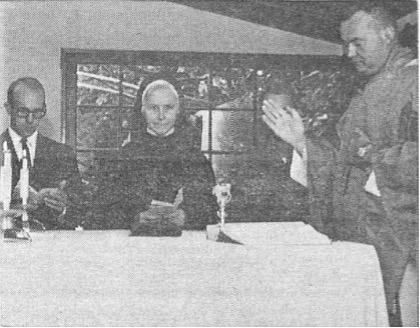
A 1967 edition of the Portland-based Catholic newspaper, The Catholic Sentinel, touted the work being done by the Newman Center at Oregon State University, founded just two years earlier. The author viewed Center’s work, or apostolate, as both a great start for and possibly the beginning of a major conversion effort on campus. Moreover, the article praises, above all else, the Newman Center’s ability to connect with and integrate into the daily life of students; the author expressed hope that these efforts would h promote the values of the Catholic Church and convert non-Catholic students to the faith.[1]

Four white individuals at a table covered with a white tablecloth in a formal setting, with windows and foliage in the background.
Mass being celebrated in the library-chapel at the edge of OSU’s campus, 1967. “Newman Apostolate Grows at Corvallis.”

The founding of the Newman Center at Oregon State University, one arm of a national Catholic apostolate organization, came at a time of immense change within the Catholic Church ushered in by the Second Vatican Council of the early to mid 1960s, in which Pope John XXIII declared that the Church should focus more on apostolicism and spreading the message of Catholicism through means other than specific calls to holiness from clergy. As the Newman Center worked to appeal to a new generation of students, its message nevertheless remained shaped by the Church’s longstanding patriarchal ideologies and practices. At a time when the Catholic Church grappled with evolving ideas about sexuality, marriage, and gender roles, the apostolic efforts by the Newman Center remained shaped by traditional and ideologically conservative gender ideals.

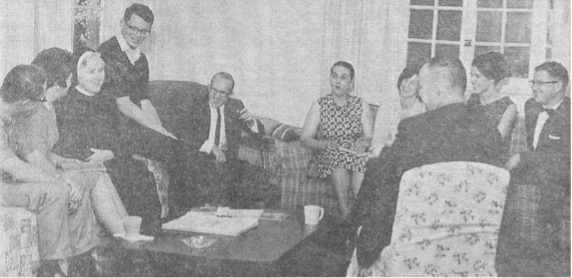
A group of white people gathered in a living room, seated around a coffee table with a newspaper and cup, in a black and white photo.
Meeting of clerical leadership and student officers at Newman Center, 1967. “Newman Apostolate Grows at Corvallis.

The Catholic Sentinel article suggested the hope that the Newman Center would create a new and growing commitment to the Church among OSU students. It discussed Center’s physical footprint on campus by noting the buildings it occupied; touted the priests, nuns, and student leaders who did the Center’s work; and highlighted the Center’s many recent campus events. It reassured readers that the Newman Center was using its budget wisely, particularly on efforts to recruit students to Catholicism. Finally, the article expressed optimism that the Center could launch theology or religion classes to further Catholicize the student body.

One barrier to that goal might be the Newman Center’s gender politics. The Center represented a conservative branch of the Catholic church and structured many of its apostolicisms around strict and discriminatory ideas of gender normativity and the idealization of heterosexual marriage. On example of the Newman apostolate was the rental housing the Center provided for students which gave preference to married couples.[2] In May 1968, the Center imposed a restriction on “girls” renting its properties; alongside the decision was this statement: “Because of problems in the past with girl renters it was again stated that no girls will be rented apartments and/or rooms in the Newman Rentals.”[3] This outright denial to rent to women was surprising to me; I had assumed that the advancements in civil rights in the 1960s would have ended this kind of discrimination. At the same time, the Center sponsored discussions addressing the liberalization of attitudes such as “Is pre-marital sex O.K.?,” “Is legalized abortion right?”, and “Is God dead?”[4] While we don’t know how these discussions turned out, the Newman Center’s commitment to traditional values likely led to conclusions that challenged the growing sexual liberalization in American society.

The 1960s was a time of change for Catholicism, marked by Pope John XXIII’s call for the Church to conform to the ideas of “aggiornamento,” or the bringing-up-to-date of the apostolate.[5] This meant an expansion into more areas outside of parishes and clergy. Many Catholics remained committed to conservative ideologies around sexuality and gender. In 1972, my mother was born into a devout Catholic family, and her childhood and adolescence were rooted in Catholic communities and their common faith. My mom told me about the underlying family pressures that she felt when she was going to college, especially the expectation that she find a husband. Her mother, as well as other women in her life, had met their husbands at college, and in some ways that created a pattern to follow. On top of that, there was a general understanding, as my mom put it, that women of the time knew that their husbands’ studies and career came before their own.[6] Even in the 1970s, these pressures were still around despite broader changes in American society.

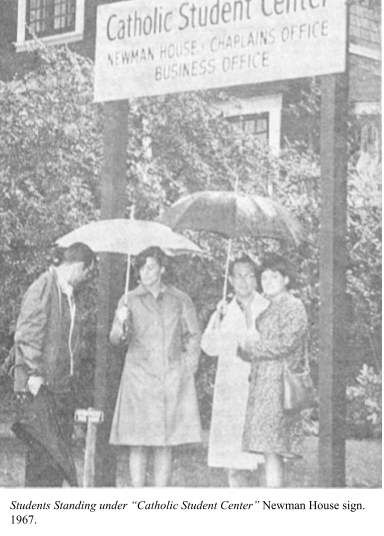
Four white people standing under umbrellas in front of a Catholic Student Center sign, 1967.

This context may explain the Newman Center’s policies and projects. Women who wanted to focus on their own career and who showed no interest in finding a husband had no place in the Newman rentals. The historian Philip Gleason notes that the Catholic Church in the United States feared the changing national culture, which was becoming increasingly secular and liberalized.[7] The recurring discussion of using classes to convert non-Catholic students makes much more sense in an era where the future of the Catholic church was uncertain. The Center acted not as an outpost of stability for OSU students who are attempting to answer the pressing questions of that era; instead, it offered guidance to those who had already subscribed to the Church’s ideas of what was morally just and unjust. Single women not being allowed in the rentals would not appeal to liberal students, nor would the glorification of traditional gender roles appeal to LGBTQIA+ students or others who oppose these ideologies.

Perhaps this explains the Newman Center’s many proposals to use classes to connect to the student body and perhaps gain new converts. There are many discussions of this tactic in leadership meeting minutes, an idea first introduced in a 1965 “Ten Year Projection” for the Center, when leaders expressed a belief that lessons in the Catholic faith were needed regardless of whether or not they would be offered through curriculum.[8] In another case, someone suggested using students in an architecture class to design a potential building for the Center while acting as ambassadors of sorts, furthering fellow students’ knowledge of the Center and Catholicism. They viewed this as a way to garner more support on campus.[9] In a way, it seems that the Center’s leaders hoped to create a quasi-Jesuit-style college for OSU students. One of the Center’s main goals in the second half of the 1960s was to create a “Catholic church on campus,” yet another way to spread Catholicism throughout the student body.[10]

My research into the Newman Center at Oregon State University in the 1960s surprised me. The staunch support of marriage, sexual conservatism, and heteronormativity aligned with the ideals of the Catholic Church but seem out of step with the era’s liberalizing culture. In the midst of mass movements for civil rights and women’s rights, the Newman Center denied housing to women; it is difficult to know if this conservatism helped or hindered its efforts to convert more students to the Catholic faith. If I could further this project, I would try to interview students who attended OSU in the late 1960s and ask them how they viewed the Newman Center. Some pieces of history are lost because they are not recorded, and this includes students’ perception of the Newman Center’s early years.


[1]  “Newman Apostolate Grows at Corvallis,” Catholic Sentinel, October 13, 1967, Box 1, Memorabilia Collection, Special Collections and Archives Research Center, Oregon State University, Corvallis, Oregon.

[2] Newman Center Minutes of Meetings, December 1968, Box 1, Newman Foundation of Oregon State Records, SCARC.

[3] Newman Center Minutes of Meetings, May 17, 1968, Box 1, Newman Foundation of Oregon State Records, SCARC.

[4] Talk to Be Given…,” 1968, Box 3, Newman Foundation of Oregon State Records, SCARC.

[5] S.J. Achutegrui, “The Second Vatican Council,” Philippine Studies 10, no. 4 (December 1962), 523.

[6] Annie Grattan interview with author, December 4, 2025.

[7] Philip Gleason, “Catholicism and Cultural Change in the 60s,” Review of Politics 34, no. 4 (January 1972): 91-107.

[8] “Ten Year Project” Box 3, Newman Foundation of Oregon State Records, SCARC.

[9] Mrs. Sitton to Newman Foundation, 1965, Box 3, Newman Foundation of Oregon State Records, SCARC.

[10] “Talk to be Given to People Called Together for the Purpose of Starting Some Type of Booster Organization for the O.S.U. Newman Center,” 1968, Box 3, Newman Foundation of Oregon State Records, SCARC.

In Loco Parentis: Controlling College Women’s Behavior in the Mid-Twentieth Century

Students in Dr. Marisa Chappell’s History 363 “Women in U.S. History” class spent the final three weeks of Fall Quarter 2025 in OSU’s Special Collections and Archives Research Center exploring women’s impact on our university.

By Dylan Brady

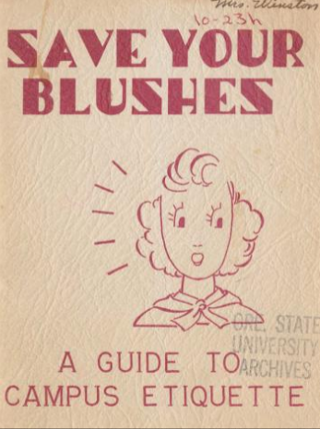
Booklet titled "Save Your Blushes: A Guide to Campus Etiquette" with an illustration of a surprised woman.

In OSU’s Special Collections and Archives Research Center, I was surprised to find a 1939 guide published by the Etiquette Board of Associated Women Students of Oregon State College called “Save Your Blushes,” which details the do’s and don’ts for incoming women students. One one page, for example, the guide instructs women students in how to act in the dining halls, from seating arrangements to conversation topics.[1] The guidebook tells women students what they should wear and how they should act on dates. In a section called “Fruit for the Beach Combers,” it offers advice – for example, “there are very few emergencies that justify breaking a date” – and referring to potential dates as “fruits” or “livestock.”[2]

The guide includes tips on mundane matters that I was surprised a college organization would even care about, such as how women are supposed to walk with men. A section called “Round Bout” advises, “if a girl and boy are walking together, the girl should always be on the man’s right.”[3] Many of the pieces of advice offered in the guide seem, to the modern eye, like an odd effort to dictate the daily actions of women students.

Associated Women Students (AWS) was a national organization with chapters at universities across the country. Each chapter shared a set of goals: to “regulate all matters pertaining to the welfare of women students, to further the spirit of unity and service, to increase a sense of individual responsibility, and to create and maintain high standards and ideals for the women students of the university.”[4] AWS served as a campus umbrella organization for all women’s groups, societies, and clubs, sponsoring events such as nickel hops, carnivals, and women’s weekends.[5] The constitution of OSC’s AWS noted that every woman on campus was allowed to become a member and participate creating cooperation among women across campus and the AWS.[6]

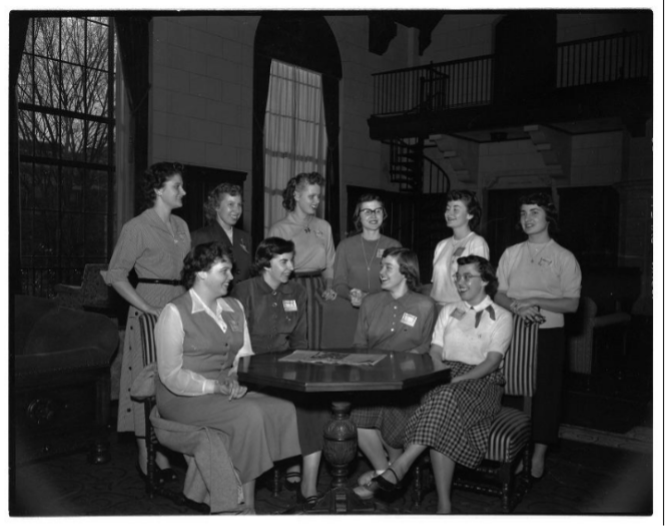
Group of nine white women around a table in a room with a large window and spiral staircase.
Associated Women Students officers from nine different colleges gather at a workshop in the Memorial Union found in Oregon Digital in the Historical Images of Oregon State University. Historical Images of OSU, “AWS Officers Workshop,” Oregon Digital, accessed Nov. 22, 2025.

AWS worked closely with OSC’s administration to promote what its members viewed as the safety and well-being of women students and the campus community. A 1959 AWS pamphlet declared, “In the college community, closing hours and other regulations are made and observed in the best interests of the health and welfare of the women students and to meet expressed wishes of parents for social supervision.”[7] Here, the AWS promotes a common approach at the time in which college and university leadership acted in loco parentis, or “in the place of the parent.” As a legal scholar described it, “in its fullest form the doctrine of in loco parentis permits colleges to devise, implement and administer student discipline and to foster the physical and moral welfare of students.”[8] It was a primary focus for many of these organizations to regulate the behavior of the female students on campus because these regulations are were what they believed were necessary to succeed not just in college, but their future life. These regulations were harmonious to the roles women were expected to play in the family and community in the mid-twentieth century.

Throughout the AWS’s existence, they produced many coed codes to serve as guides for women on campus, designed to shape their behavior. This coincides with their belief that, “In every phase of life the individual lives within certain regulations, which are necessary for the welfare and harmony of the group.”[9] They emphasized the college rule that women students secure permission from a parent or guardian, filed with the Dean of Women, before leaving campus.[10] They also promoted the rule that women were barred from entering men’s dormitories.[11] AWS and the administration worked to impose a broad range of rules on women student behavior.  

The fact that it was women students themselves, through AWS, that advocated and publicized these rules and regulations suggests an emphasis on peer pressure as one key enforcement mechanism. The historian Babette Faehmel argues that if women on college campuses did not follow the behavior rules set out for them, they would be socially ostracized.[12] AWS guides emphasize that students must follow certain social conduct to remain “in accordance with standards of decency.”[13] Even as these guides sought to restrict women’s freedom, they insisted that conformity was “a sure recipe of happiness at college.”[14] These guides promoted a vision of womanhood rooted in acceptable social behavior, preparing women students to become good hostesses, conversationalists, and wives.

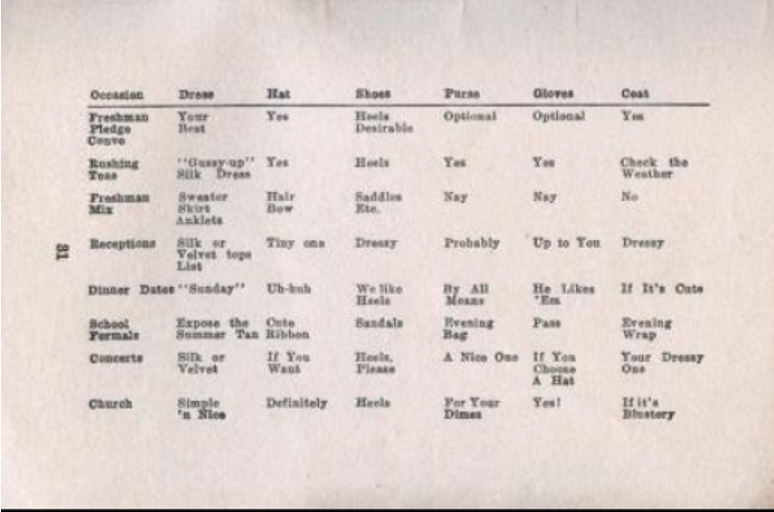
A chart listing attire suggestions for various social occasions.
A page inside the coed code for the 1944-45 school year explaining what women should and should not wear for certain school events. OSU SCARC, “Coed Code, 1944–1945,” Oregon Digital, accessed Dec. 10, 2025.

Similar handbooks and guides circulated on college campuses in the 1920s and 1930s and continued to shape college life during and after World War II. Historian Donna J. Drucker, who researched similar women’s organizations at Purdue University in the 1939-1940 academic year, found that they “aimed to prepare young women to face whatever experiences lay ahead—whether that meant eating oysters or preparing for war—with grace.”[15] In the postwar period, as more women could afford higher education, American culture both praised women’s college attendance and promoted domesticity.[16] Even as more women attended college, the expectation was that they would devote their adult lives to managing children and a home and supporting their husbands’ careers. AWS leaders, then, tried to prepare college women for this future role. As Helen Lefkowitz Horowitz wrote about Scripps College’s expectations of its students (all women) in this period, “graduates might combine work (‘contribution’) with marriage and children (‘fullest and richest life’).”[17]

Of course, on college campuses nowadays there are still rules and regulations that many must follow, but nothing that compares to the ones female students had to follow before the 1960s. College organizations do have a job in some ways to help foster student growth, not just for career goals but also for living a. healthy and contributing life. However, there is a limit to how far these restrictions should go in order serve the best interests of the students. These handbooks and organizations, even with their best interests in mind, served to control women students’ behavior and mold them for a limited future after college – marriage and motherhood. Regulations imposed by administrators and the promotion and enforcement of these regulations by fellow students limited the freedom of women students to be who they wanted to be and to express themselves. This small look at college life in mid-twentieth-century cannot capture the complexities of women students’ perspectives and lives living within this system. But it suggests that in this period, colleges sought to mold women students to fit a very narrow role in society rather than to develop and pursue their own, individual goals and aspirations.


[1] “Save Your Blushes, 1939,” Oregon Digital, 9, Accessed 2025-12-04. https://oregondigital.org/concern/documents/fx71cn310.

[2] “Save Your Blushes, 1939.”

[3] “Save Your Blushes, 1939.”

[4] Betsey Creekmore, “Associated Women Students – Volopedia,” Volopedia, September 24, 2018, https://volopedia.lib.utk.edu/entries/associated-women-students/.

[5] Historical Publications of Oregon State University, Oregon State University. “The Beaver 1948” Oregon Digital. Accessed 2025-11-22. https://oregondigital.org/concern/documents/0g354f54.

[6] Associated Women Students, A.W.S. Handbook, 1930-31, Series 1, Box 1, Folder 2, Associated Women Students Handbooks, Special Collection and Archives Research Center, Oregon State University, Corvallis, Oregon.

[7] OSU Special Collections & Archives Research Center, Oregon State University. “AWS and Administrative Regulations for Women, 1959” Oregon Digital. Accessed 2025-12-10, https://oregondigital.org/concern/documents/fx71cn38x.

[8] Theodore C. Stamatakos, “The Doctrine of In Loco Parentis, Tort Liability and the Student-College Relationship,” Indiana Law Journal 65, no. 2 (1990): 474.

[9] OSU SCARC, “AWS and Administrative Regulations for Women, 1959,” Oregon Digital.

[10] Ibid.

[11] OSU SCARC, “AWS and Administrative Regulations for Women, 1959,” Oregon Digital.

[12] Babette Faehmel, College Women in the Nuclear Age: Cultural Literacy and Female Identity, 1940–1960 (New Brunswick, NJ: Rutgers University Press, 2011), 31.

[13] Historical Publications of Oregon State University, “AWS and Administrative Regulations for Women, 1960,” Oregon Digital, accessed December 10, 2025, https://oregondigital.org/concern/documents/fx71cn396.

[14] Historical Publications of Oregon State University, “Coed Code, 1946–1947,” Oregon Digital, accessed December 11, 2025, https://oregondigital.org/concern/documents/fx71cn353.

[15] Donna J. Drucker, “‘In a Sense, It Is a Game’: Women’s Dormitory Life at Purdue University, 1939–1940,” Indiana Magazine of History 113, no. 1 (2017): 15, https://doi.org/10.5378/indimagahist.113.1.0001.

[16] Lynn D. Gordon, “The Gibson Girl Goes to College: Popular Culture and Women’s Higher Education in the Progressive Era, 1890–1920,” American Quarterly 39, no. 2 (1987): 211–30, https://doi.org/10.2307/2712910.

[17] Helen Lefkowitz Horowitz, “Designing for the Genders: Curricula and Architecture at Scripps College and the California Institute of Technology,” Pacific Historical Review 54, no. 4 (1985): 439–61, https://doi.org/10.2307/3639569.

Buena Maris, the Hanford Nuclear Site, and Women’s Wartime Labor

Students in Dr. Marisa Chappell’s History 363 “Women in U.S. History” class spent the final three weeks of Fall Quarter 2025 in OSU’s Special Collections and Archives Research Center exploring women’s impact on our university.

By Kylie Abbey-Zanni

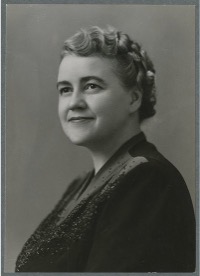
Black and white portrait of a white woman with styled hair and a slight smile.
Buena Maris, 1945

In the Buena Maris Mockmore Papers held in OSU’s Special Collections and Archives Research Center I found a fourteen-page report from 1960 titled “Hanford – In Retrospect.” In the report, Maris wrote about her time as Director of Women’s Activities at the Hanford Nuclear site, a Manhattan Project complex located along the Columbia River in southern Washington, during World War II. As Hanford recruited and employed thousands of women workers, its managers recognized what Maris called “the need for someone who could care for the welfare of several thousand women workers.”[1]

They turned to Maris, who took a year-long leave from her position as Dean of Women at Oregon State College, from September 1943 to September 1924, to serve as Director of Women’s Activities at Hanford. The report shows how she professionalized women’s welfare work and labor during wartime. Using her position at Hanford, Maris worked to set women workers up for success not only during the war but also afterwards, challenging the widespread assumption that women were temporary workers who would return home once the wartime emergency ended.

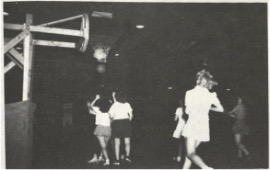
People playing basketball indoors under low lighting.
Women at Hanford playing in a basketball morale tournament as part of the site’s recreation program; “The Hanford Site: An Anthology of Early Histories”

Maris came into her position as Director of Women’s Activities at Hanford due to the unprecedented number of women entering the workforce, including newly available jobs in the defense industry, during World War II. A production site for plutonium needed for American atomic bombs, Hanford was a massive enterprise. At its peak in 1944, Hanford employed more than 51,000 workers, including four thousand women. With. large numbers of men serving in the military, defense plants sought out women to serve in a variety of roles including equipment inspectors, construction and general staff positions.

Maris’ report offers much more than just administrative notes. Instead, it reads very like to the diary of a woman managing a workplace in a new environment. She describes the living conditions Hanford’s women employees endured, such as overcrowded dormitories, the desert climate, and feelings of isolation. Maris’s solution for these struggles was something she called “purposeful engagement,” making available opportunities for women workers to get involved in recreational activities that served the community. She brought in Red Cross volunteer programs and church services and activities, for example, to help “curb boredom.”[2] These efforts were touted in promotional coverage in various newspapers. An article titled “New Deans a Queen!,” for example, portrayed Maris as a very warm woman who was heavily committed and involved in women’s development. “To satisfy needs of such a large group of employees… church facilities had to be provided. This wasn’t the specific responsibility of the supervisor of women’s activities… However, the tent for Catholic services was no longer adequate – some of the parishioners sitting on benches well out beyond the open end of the tent in the sagebrush.”[3] Providing adequate facilities for church services was not in Maris’s job description, but she was committed to the welfare Hanford’s women and took up the issue anyway. In a newspaper tribute decades later, reporter Laurie Williams referred to Maris as “Hanford’s mom for a year” and highlighted how women at Hanford thrived under her supervision, many of them going on to have careers after the war.[4]

Another later treatment discussed Maris’s promotion of volunteer activities. In “The Hanford Site: an Anthology of Early Histories,” M.S. Gerber wrote that “Mrs. Maris also organized a library, started a Red Cross chapter that still functions in Richland today, and scheduled a special daily bus with a late return to and from Pasco so that women could break the monotony of camp life.”[5] In addition to these organized programs, Maris worked endlessly to ensure these women kept their morale up and their lives as normally as possible. Maris was well suited to this role. After earning her undergraduate degree in Home Economics and Child Development, she earned a Master’s in Science at OSC in 1939 and went on to teach and serve as Dean of Women at OSC from 1941 to 1948 (excepting her year at Hanford).

Maris’s approach echoed similar work by middle-class women reformers in the first half of the twentieth century. During the Progressive era, reformers feared that young, unmarried women’s entry into urbanized labor markets and access to commercialized leisure put them at moral risk. Reformers from groups such as the Young Women’s Christian Association and the Travelers Aid Society believed these women needed supervised, structured recreation, from chess clubs and church services and supervised outings and supervised boarding houses.[6] Maris was able to reproduce this at Hanford, carrying on traditional ways of bringing leisure to working women. These sources show how Maris not only monitored Hanford’s workplace and leisure culture but also heavily shaped and contributed to it.

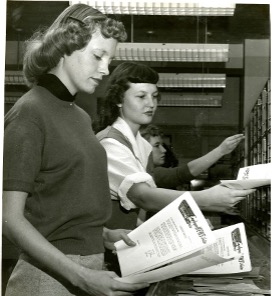
White women sorting newsletters.
Women at Hanford distributing employee newsletters by and for the workers; nps.gov website article “(H)our History Lesson: Hanford Site Workers in Tri-Cities, Washington.”

Some histories of women’s labor in World War II emphasized its temporary nature. They argue that while the wartime emergency opened up new kinds of jobs to women, these opportunities were largely foreclosed when servicemen returned after the war.[7] Other scholarship paints a more complicated picture. Claudia Goldin argued that women’s labor during World War II sparked a long-term shift in societal norms and expectations.[8]Several contributors to Joanne Meyerowitz’s reassessment of postwar gender roles argued that women continued to advance, particularly in feminized professions such as nursing, teaching, and social work.[9]

Maris’s impact on Hanford’s women workers seems to have played a small role in this larger phenomenon. Laurie Williams’s article “Women Came to Hanford to Make a Difference detailed how women continued to grow in their career fields following their time at Hanford and credits Maris for building their confidence and capacities.[10] Maris modeled women’s leadership, showing that women could manage and direct the workforce, not just join it. Her work at Hanford not only illustrates wartime necessity but also shows how war-time need opened paths towards long-term employment for women. She proved herself as a wartime professional who demonstrated that women managers were not temporary but rather individuals who could carry their skills outside of the war. Maris’ story and impact fits into the broader transformation of women in the United States at the time. WWII made women’s labor more visible and necessary while women like Maris worked to make it more sustainable. Her role in Hanford serves as a reminder that the war created both women workers and women leaders.

“Hanford – in Retrospect” captured the story of a woman who reshaped wartime labor at a singular site. By establishing a variety of programs, a sense of community, and professional pathways, Buena Maris helped to normalize women in long-term paid labor, not just during the war but after it, as well. Her story invites further questions and research about Oregon State College and the larger history of women, war, and labor. Did federal agencies recognize, or even use Maris’s model? What role did race, class, and religion play in shaping women’s lives and labor at Hanford? How did OSC benefit from Maris’s Hanford experience after she returned? Maris opened the door for women to continue growing in the professional workplace and her papers ensure we can look back on and evaluate her impact.


[1] Buena Maris, “Hanford – In Retrospect,” December 8, 1960, series 3, box 2, folder “Manhattan Project: Hanford, 1960-1962,” Buena Maris Mockmore Papers (hereafter Mockmore Papers), Special Collections and Archives Research Center, Corvallis, Oregon.

[2] Maris, “Hanford – In Retrospect.”

[3] “New Deans a Queen! New Dean Promises OSC Friendliness,” undated newspaper clipping, series 2, box 1, folder “Newsclippings re: Speeches and Presentations Given by Mockmore [Iowa and Oregon] circa 1940-1965,” Mockmore Papers.

[4] Laurie Williams, “Hanford’s Mom for a Year, Buena Maris Made Desert a Home for Women Workers,” newspaper clipping, October 31, 1993, series 3, box 2, folder “Manhattan Project: Hanford 1945,” Mockmore Papers.

[5] M.S. Gerber, “The Hanford Site: An Anthology of Early Histories,” October 1993, series 3, box 2, folder “Manhattan Project 1998-2010,” Mockmore Papers.

[6] Joanne Meyerowitz, Women Adrift: Independent Wage Earners in Chicago, 1880-1930 (University of Chicago Press, 1988).

[7] Ruth Milkman, “Gender, Consciousness, and Social Change: Rethinking Women’s World War II Experience,” Labor History 28, no. 1 (1987): 3–18; Marjorie Miller, “Working Women and World War II,” Journal of American Studies 14, no. 2 (1980): 123–141.

[8] Claudia Goldin, “The Role of World War II in the Rise of Women’s Employment,” Quarterly Journal of Economics 106, no. 4 (1991): 1497-1542.

[9] Joanne Meyerowitz, Not June Cleaver: Women and Gender in Postwar America, 1945-1960 (Temple University Press, 1994).

[10] Laurie Williams, “Women Came to Hanford to Make a Difference,” newspaper clipping, October 31, 1993, series 3, box 2, folder “Manhattan Project: Hanford 1945,” Mockmore Papers.