Follow Up

Hello again,

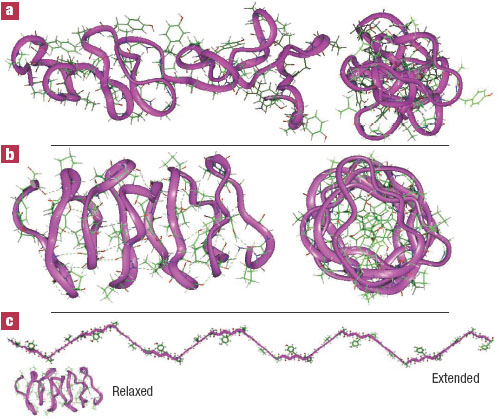
So last time I sort of described what my protein would look like as a model, but I think the picture I found makes it easier to understand.  When we were discussing the dynamic shapes some proteins have, I was intrigued, and realized that this could easily be applied to the spider capture silk protein I am working on.  Some flexible electric wire wrapped in silk could move pretty well, and would do a good job of illustrating what the protein actually does.

Spider Capture Silk Protein

Posted in Student posts | 2 Comments

Marshmallow Fondant

http://www.wilton.com/recipe/Rolled-Marshmallow-Fondant

Good luck!

Posted in Student posts | 4 Comments

Globe

Okay, I lied. Here’s a picture of what I’ve been working on.

-E

Posted in Student posts | Leave a comment

Ribosomes

I sketched out a blueprint for my project and it looks something like this.

I really like the carved styrofoam idea because letting the project suspend in water will give it the lifelike effect of moving inside the cell.

I am also trying to add DNA strands and polypeptides to the ribosome model.. something like these would work..

Notice the shoe lace has 4 alternating colors 🙂 how convenient.

In addition I was planning to add some sort of metal coat to the outside of the ribosome. Since the ribosome is a protein making “factory”, I felt making it look like metal would add a factory feel to the project. Something like wrapping it in aluminum or pennies (although I don’t know if it will sink if it gets too heavy from the pennies:

Anyways, hopefully everything works out well. Sorry I can’t make it to class on Monday because I think I have an ear infection that I need to get checked out.

Elvis

Posted in Student posts | 3 Comments

Views of integrase

HIV integrase (the recent molecule of the month) is known from its close structural kin.  The following is the abstract of the recent “putting it all together” article that appeared in the scientific journal Nucleic Acids Research (2009 by Cherepanov and colleagues):

“Establishment of the stable provirus is an essential step in retroviral replication, orchestrated by integrase (IN), a virus-derived enzyme. Until now, available structural information was limited to the INs of human immunodeficiency virus type 1 (HIV-1), avian sarcoma virus (ASV) and their close orthologs from the Lentivirus and Alpharetrovirus genera. Here, we characterized the in vitro activity of the prototype foamy virus (PFV) IN from the Spumavirus genus and determined the three-dimensional structure of its catalytic core domain (CCD). Recombinant PFV IN displayed robust and almost exclusively concerted integration activity in vitro utilizing donor DNA substrates as short as 16 bp, underscoring its significance as a model for detailed structural studies. Comparison of the HIV-1, ASV and PFV CCD structures highlighted both conserved as well as unique structural features such as organization of the active site and the putative host factor binding face. Despite possessing very limited sequence identity to its HIV counterpart, PFV IN was sensitive to HIV IN strand transfer inhibitors, suggesting that this class of inhibitors target the most conserved features of retroviral IN-DNA complexes.”

Now here’s a question for an artist:  How much of the so-called PFV complex (structure 3os1 in the PDB) should be portrayed?  The whole complex is exceedingly, well, complex!

The central subject
Here is a view showing just the A chains of 30s1 (without the multiple DNA strands that intertwine in the hole in the middle):

The outlying objects

Here are the B chains of 30s1.  (They lie on the outskirts of the above A chains which I’ve now made invisible:

Resemblance to other objects

Now here is the so-called “core integrase” that crops up when you search for “integrase” in the PDB (e.g. this is one of the chains you’ll see in the core integrase of structure 2×78):

The “core” integrase is essentially the same structure as the B chains that lies on the outskirts of the main complex.  You would think that a “core” is essential, and perhaps it is from a strictly scientific viewpoint, but perhaps not from the artistic viewpoint.  As an artist, we often choose to ignore the peripheral elements of a subject … we portray the face, not the torso … the flowers and vase, not the table legs (well, Cezanne paid close attention to the table legs, but I digress).

Sometimes less is more

Art is an expression.  Feel free to leave out portions of a complicated structure if it doesn’t excite your creativity.  Let your eye choose your subject. If scientific detail (important detail no doubt) gets in your way, trim it away as mere artistic clutter!  Here’s the whole integrase complex (magenta = A chains, azure = B chains, gray = DNA strands) … trim as necessary!

Posted in Student posts | Leave a comment

Game Plan

I’ve had my plan for what I wanted to do for awhile so I figured it’s about time I post about it. I am doing integrase because I’m very passionate about the HIV epidemic and integrase is how viruses are able to “integrate” their DNA into ours. I am trying to mix the artistic with the scientific on this project, and most of the components are symbolic. I purchased a globe which is meant to represent a helper Tcell, it is also a very straight forward symbol of how HIV has really integrated itself into our entire world, no gender, age, or ethnicity has gone untouched. To also demonstrate this point, I have covered the inside of the globe with pictures of people from all different demographics of the world. The CD4 receptor on the Tcell will be represented by a needle, which is also symbolic of how IV drug use has played a very large role in this epidemic. Attached to the receptor will be an HIV molecule, which I think I will probably make out of clay… The needle will be “injecting” red and black ribbon (in the shape of a double helix, which will be the viral DNA, I wanted it to be red and black because they are kind of menacing colors, whereas coming from the other side of the globe will be our human DNA, which I think I will do out of maybe sky blue and pale pink or white ribbon (colors of innocence?). In the middle the two strands of DNA will meet and that is where integrase will be, which I think I am going to make out of colored electrical wire, because it’s light and malleable. Coming out of the bottom of integrase will be DNA that is a mix of both ours and the viruses.

-Erica

Posted in Student posts | 2 Comments

2VH3 – Ranasmurfin

Hello Professor and Classmates,

I have decided to model Ranasmurfin (PBD ID: 2VH3).  I will mold a Brainy Smurf using gum paste/fondant and the base design will be cake forms that will be covered with colored gum paste. The Ranasmurfin protein  will be depicted using colored ribbons  and wire will connect the helicies and beta strands.

Ranasmurfin:

Posted in Student posts | 1 Comment

‘Master Watchman’ Inspiration

Found some inspiration for my double helix which my p53 protein will bind to:

http://biologyinculture.wordpress.com/2011/04/03/double-helix-in-public-spaces/

http://www.rogerallen.net/blog/archives/3523

My brother and I know how to weld and have access to a welder so I’m thinking i will use metal as my medium, possibly incorporating barbed wire, keys or locks and wire in the protein’s structure representing p53’s protective properties and role in tumor suppression.  I also liked  Nicole’s  idea of using firecrackers as my double helix, but i’m a little scared to mix welding and fireworks in a project (wouldn’t want my p53 protein to detonate and become damaged!!!!)


Posted in Student posts | 1 Comment

2WMC

I took a look at all the proteins that had been isolated from the pea plant, and definitely liked 2WMC the most as well! It fit the idea that I originally had of using the pea plant to model a protein that operates on Mendelian genetics and it should be simple enough to make a nice sculpture.

I plan to make the pea pods and any leaves out of modeling clay, and any vines out of an easily malleable metal wire. This wire would be spray painted before being included in my model. I want to have flowers in my sculpture, so I would really like to represent the isolated molecule as a pair of flowers, also which would be made of modeling clay.

Because pictures are nice, here is a picture of a sculpture an artist did, that is really pretty and reminds me of a protein.

Way better than anything I could do =)

Posted in Student posts | Leave a comment

Started making the cow out of clay.  Left a open section in the back (cant see it here) for the prions. Now to let it dry!

Posted in Student posts | 4 Comments

Protein Details

Hei,

I’ve decided on immunoglobulin for my molecule, since I got quite familiar with it in an immunology class and have been amazed by its versatility.  I think I’d like to model IGG, as it is involved in active immune responses and can be transferred from a mother to an unborn infant; IGA and IGM are polymeric and wouldn’t work as well, IGD is only produced by naive B-cells and isn’t as exciting, and IGE causes allergies. 

I’m not sure about the medium yet.  Since I work with garter snakes I’m trying to figure out how to work snake sheds into it.  Which brings me to my design idea- I’m working on a way to blend these two images:


~Anna

Posted in Student posts | Leave a comment

Tentative decision/choices

Hello everyone,

I have a pretty good idea of the materials I will use to build the structure (gum paste, food coloring, wire, and glitter are the most likely candidates) but I’m having a harder time deciding the protein I want to model.

Right  now the choices are between:

1. Ranasmurfin “a blue protein from the foam nests of a tropical frog”. The name and color of the protein remind me of one of the TV show “The Smurfs” and I was thinking of doing something along the lines of Brainy Smurf discovering the protein (depicted in secondary structure).

2. Epstein-Barr Virus. “Alice in Wonderland Syndrome” can present as an initial symptom of this virus.  In this case, I would like to present the protein structure (secondary structure) as one of the many oddities Alice stumbles upon in Wonderland (perhaps the structure could be in the garden with the talking flowers).

I would really appreciate any ideas, suggestions, or votes for which protein I should do. Thank you.

~Cheers

Posted in Student posts | Leave a comment

My Decision

Hey Everyone,

I was thinking about things that would be cool and artistic to make a protein structure out of, and fabric came to mind.  We had talked about spider silk in my chemistry class, and how it was so fine and yet 3x stronger than Kevlar, so I looked up spider silk proteins and found some cool pictures of what the proteins look like stretched out.  I was thinking that I could make the protein structure with silk, and the side chains could be the fake halloween spider webs because that’s what they look like 🙂 

–Kayla

Posted in Student posts | 1 Comment

Mind enriching video

Hey Dad!

This is Brian on Erica’s computer. We decided that it is pertinent that you show this video in class.

Love, Brian

73957-animated-gif-suddenly-ninja-squirrel.html

Posted in Student posts | 1 Comment

I think I have decided…

I think I’m going to do the protein alpha amylase, the enzyme responsible for breaking down starch for digestion. For my sculpture, I’m thinking of covering a basic pipe cleaner structure with cornstarch. Now I just need to find out how to make it more interesting color-wise (white would be too bland).

Posted in Student posts | 1 Comment

Figured out my protein (and my medium!)

Hi everyone,

It’s a bit early in the game, but I know what I am going to do!  I know prions have been done in this class before, but I think I can add a different artistic flare to it.

So there are normal and misfolded prions and I am choosing to depict both in the case of mad cow disease.  I would like to sculpt the head of a cow in which half of its face will be the “mad cow” and the other half will be the “happy cow.”  Where the brain should be, a normal PrP will be on the “happy cow” half and the misfolded PrPSC will be on the “mad cow” half.  The prions will be depicted in the secondary structure with alpha helices and beta strands. 

I am planning to use molding clay for the head, some paint, and some sort of wiring for the prions.  Im very excited to start!  Wish me luck!

Posted in Student posts | 3 Comments

FoldIt: Protein Folding Game

I feel that a lot of people would benefit and hopefully enjoy this game for both Mac and Windows platforms. It is free and is essentially solving puzzles of proteins and folding them correctly. If you get through all the tutorial levels you’ll have learned way more than you probably ever wanted about proteins.

FoldIt: Protein Folding Game

I currently have a comment in my “Comments” bin that address how to make a post after logging into the blog. I seem to be unable to “Accept” the comment so others can read it, but I can address it here. I misspoke in class about the link “Dashboard” being listed upon login, it’s actually termed “Site Admin” under the “Meta” title. Once you have clicked the Site Admin link it will direct you to your Dashboard, which is essentially your administrative hub for the blog and any others you have. On the left hand side there is a tab for “Posts.” Click that and then click “Add New,” which will pop up under the tab once clicked.

Hope this helps.

Tamsen.

Posted in Student posts | 1 Comment

HI!!!

I am not sure what protein I am interested in, but I am thinking about using glass beads to build it.

~Nicole~

Posted in Student posts | Leave a comment

Hello!

Howdy folks.  I think immunoglobulin is cool.

~Anna

Posted in Student posts | 1 Comment

Hello.

First time blogging; I have absolutely NO idea what I’m doing (blogging wise).  For my portrait, I’m planning on doing p53.  I’m planning on a 2-D portrait with the p53 protein as a guardian angel latching onto a segment of DNA.  Only, I’m going make the amino acids of the protein look like stars with a ghostly superimposed image of an guardian angel wrapped around it like a ghost, holding onto the segment of DNA which is going to also be star like– kind of like a segment of a galaxy.  I want it to look almost like a photograph taken by the Hubble… only as a protein interacting with DNA with a ghostly guardian angel being formed from the protein.    I also haven’t decided on the media, but I think it’ll be a mix between watercolor, ink, and digital correction.  Now, let’s just see if I can pull it off.  (Haha, I have never done anything like this before, artwise.  This isn’t going to turn out well.  I honestly think I’m biting off more that I can chew.)

Just in case I bored you all to sleep with my blah-blah, here’s a picture of me at the Lingshan Buddhist Temple in Wuxi, China.  There’s a pigeon on my head.   I think it’s kind of funny.

Lingshan Temple

Posted in Student posts | 1 Comment

Hi :)

I’ve been poking around the PDB and didn’t find anything I was immediately attracted to, so I googled “interesting protein names” and found a really funny site about proteins found in Drosophila melanogaster, the fruit fly.  Apparently fruit flies are so well known structure-wise that scientists thought it would be clever to name their proteins corresponding to the mutations they cause when missing or imperfect.  Here’s the link:  http://tinman.nikunnakki.info/?q=fruitfly.  I’m thinking about doing one of these if I can find a representation of what the protein looks like somewhere.

To complete the theme of my post 🙂

Posted in Student posts | 1 Comment

Thoughts

Hello.

I am very excited about the prospect of taking a more creative approach to the life sciences.

I really hope to find a protein used in the same pea plants that were originally used in Mendelian Genetics. My first thoughts are that I would really enjoy modeling a protein around the idea of a pea plant (although I would not use a pea plant as the actual medium). Pea pods as beta strands, leaves as beta sheets, vines as alpha helices. I feel that this would tie science with art together very well.

Posted in Student posts | 1 Comment

The big picture

Today let’s discuss protein form from the top down.  That is not the conventional direction taken in biochemistry courses where we usually begin with the elementary building blocks and work our way up.  (I’m fighting laryngitis this morning, so for this discussion, I’ll need all the  “media crutches” I can find.)

The birth of a protein

From Waltz of the Polypeptides, by Mara Haseltine

Protein structure classification

How many folds?

From 1D to 3D structure:  The protein folding problem.

The hierarchy of protein structure

Details

Posted in Student posts | 2 Comments

Hiiii.

Hey everybody, just wanted to check in and say hi.

I have chosen the protein integrase (not just because it’s the protein of the month on the database, I promise.) I’m really interested in viruses, and HIV specifically so I plan to do my project revolving around that.

I hope everyone had a great weekend. See you tomorrow!

-Erica :]

Posted in Student posts | Leave a comment

Hello

Thought I would check in!  I’m thinking of creating the tumor suppressor protein, p53.  This protein helps regulate the cell cycle and is important in preventing cancer.  It has often been referred to as the ‘guardian of the genome’  and the ‘master watchman’.  I’m not entirely sure how i will incorporate the proteins function and nicknames into the structure and material used, but i have a few ideas!  Just returned from a weekend of snowboarding at Mt. Hood, so i thought i would post a picture!

Looking forward to this class!

Casey – or Nicholas

Posted in Student posts | Leave a comment

Hi everyone

Hey guys, still looking at proteins at this point.  See you all tomorrow.

Posted in Student posts | Leave a comment

Hello

Hello Professor and fellow classmates,

I am still figuring out which protein I want to study,  but until then, I present to you:  dancing  penguins.

Happy Feet

Cheers!

Posted in Student posts | Leave a comment

Hi

I couldn’t really think of a clever title. Oh, well. I found out how to post, at least!

Still looking at the proteins. I’m not quite sure which one I want to do. In the meantime, here’s a stock photo of an orca so that I could practice uploading media.

Posted in Student posts | Leave a comment

Checking In

Just letting you guys know that I am registered and have now posted. I think I have decided on a protein, here is the link.

Here’s a picture of my breakfast to see how the photo uploader works.

Posted in Student posts | Leave a comment

Saying hello

Please follow these directions:

1.  Log in to this blog using your onid name (this is a university blog that only allows authors who have onid accounts).  Choose a username nickname for your blog posts, such as “phil”.

2.  Choose to create a new post, your first one!

3.  Write something.

4.  Publish it.

“Hello.  See you Monday.  Good bye.”

5.  In the future you will likely want to publish pictures, images and various other stuff related to the class.  While you are here, look around at the menu bar of blog tools you have at your disposal for crafting and editing posts.  The “Add media” tool is especially useful for inserting images of protein molecules and the ordinary things in the world that may inspire your artwork:

Posted in Student posts | Leave a comment

Photographs and summer exhibit

I have taken photos of everyone’s work of art.  You’ll find those posted here by summer’s end.  But if you are really dying to renew that special bond with your protein, you can find most of the artworks on display this summer in the Crips reading room in the Biochemistry Department (second floor ALS building).

Oh, and Min… I have something to tell you.  Your ubiquitin model was too realistic.  I set it up in the reading room as it was supposed to be positioned, in an office trash can.  It was a thing of beauty.  But then I discovered a week later that the custodian had thrown it away!  I imagine it is now in the landfill, diffusing around until it collides with a proteasome. 🙂

Ubiquitin. Bon voyage.

Posted in Student posts | Leave a comment

GFP label

GFP is composed of a barrel of beta sheets and a light-emitting chromophore within.  By teaming up with aequorin (which glows blue), GFP produces the eery green light that jellyfish are known for.  GFP has found many uses, from fluorescent microscopy to those creepy glow-in-the-dark cats.

Posted in Student posts | Leave a comment

The artistic process

All those weeks we sat in class talking about how we would make our proteins… and there I was, thinking I had a good idea of how mine would work out.

Wrong! While making the protein I encountered a lot of unexpected problems, not the least of which was the fact that paint did not look great on paper mache and it was hard to paint something so bulky!

So… my protein underwent a makeover… and now it’s the strangest looking protein around, but I like it! I hope the unexpectedness of the new design will not offend anyone.

Posted in Student posts | 1 Comment

Aaaand finally…!

Protein: ATP Synthase

Artist: Valerie Mullen

Imagine those lazy summer days ahead of you – nothing to do in a day but sip lemonade and sit in the garden reading. It seems as if you are expending a minimum amount of energy, but in truth your body is still producing massive quantities of ATP. In fact, ATP is needed for so many cellular functions that poisons stopping its production, such as cyanide, can kill you within 30 seconds. The powerhouse protein that makes everything possible is ATP Synthase: one of the most highly conserved, ubiquitous proteins you’ll find in nature, yet somehow we still don’t know the exact workings. Interested yet? Come take a closer look…

Posted in Student posts | Leave a comment

Pectin Lyase Label

Protein: Pectin Lyase

Artist: Karen Hoagland

You reach into the fruit bowl and pick up a juicy, bright red apple. You take a huge bite….yuck! A big rotten chunk of fruity flesh just spoiled your treat. Blame no other than pectin lyase, the protein that breaks down pectin in the middle lamella of that now-spoiled apple. But don’t get too down on pectin lyase…if it wasn’t busy breaking bonds, that apple would still be unripe and bitter!

Posted in Student posts | Leave a comment

Honors Weekly News

So I noticed as I was reading the summary for the show that we wrote down the wrong date (oh no!). Wednesday is actually June 2nd, and not June 3rd. I figure we can just ask whoever sends out the honors updates to adjust that when they sound out next week’s email.

Posted in Student posts | Leave a comment

Ovalbumin Label

Protein: Ovalbumin

Artist: Danika Kusuma

The fluff of a marshmallow, the taste of a pretzel, the white of an egg omelet… To say that this egg protein is not all it’s cracked up to be would be something of an outrageous fib! This supposed storage protein has multifarious uses, one of which creates that slight crispy texture to the surface of your humble pretzel. Isn’t it eggcellent?

Posted in Student posts | Leave a comment

Harmonin Label

Protein: Harmonin

Artist: Jason S. Lusk

Of all the myriad functions of proteins, among the most crucial to our existence is the ability of certain proteins working in tandem to allow us to preceive our world.    Harmonin is one link in a chain of structures that allow us to perceive the sounds around us, from a beautiful chord played on a guitar to the powerful roar of thunder.  This portrait is made from materials that would never have been formed without harmonin and other hearing proteins.

Posted in Student posts | Leave a comment

Pectin Lyase Presentation

Just a few links to better understand pectin lyase!

http://www.youtube.com/watch?v=EferhqiSy3E

http://www.rcsb.org/pdb/explore/explore.do?structureId=1IDK

Posted in Student posts | Leave a comment

Links for clathrin presentation!

Vesicle Formation Video:

http://www.youtube.com/watch?v=eRslV6lrVxY

Dynamin Animation:

http://www2.mrc-lmb.cam.ac.uk/groups/hmm/Dynamin/index.html

Posted in Student posts | Leave a comment