For 50 years, OSU Extension Master Gardener volunteers have grown more than gardens. They’ve grown partnerships, learning opportunities and community across Oregon.
Sue Ryburn became an OSU Extension Services Master Gardener volunteer in 2012. The seed was planted years earlier — when her sister handed her a brochure from the Master Gardener volunteer booth at the Beaverton Farmer’s Market.
In her own words, Sue shares her journey.
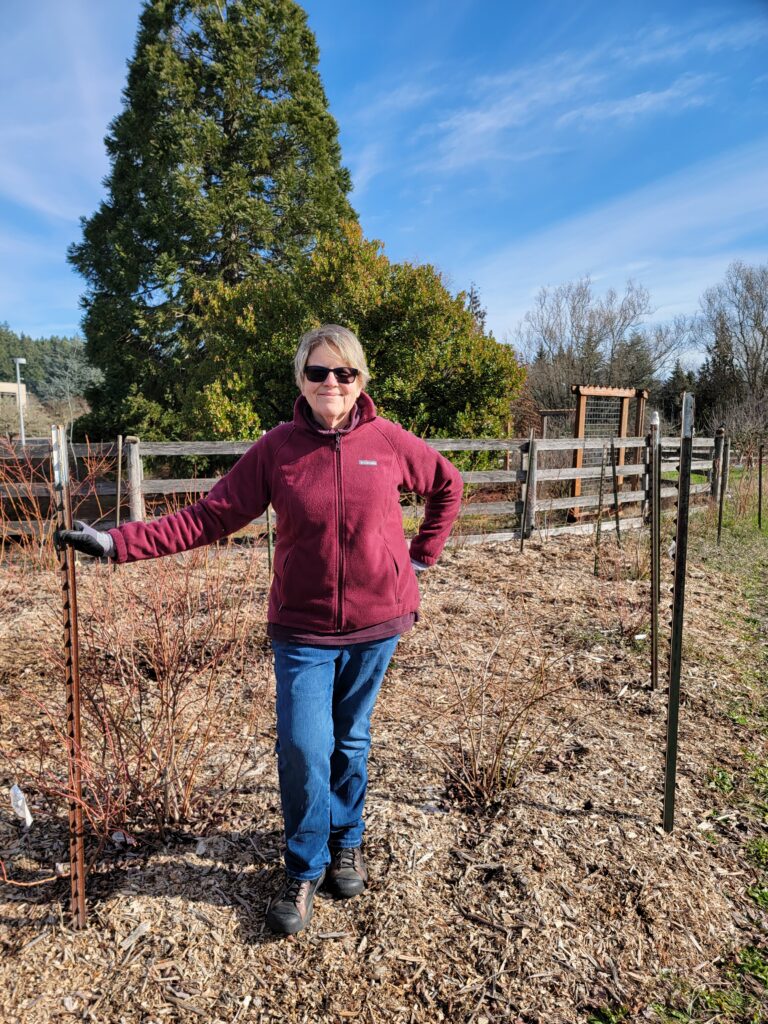
A seed planted years before
I became an OSU Extension Service Master Gardener volunteer in 2012. Years earlier, knowing my love of gardening, my sister had given me a Master Gardener brochure she picked up from the Master Gardener booth at the Beaverton Farmer’s Market. I had not heard of Master Gardeners before, though the information caught my interest. I tucked the idea away and would need to wait five years until I retired to have time to pursue the Master Gardener program.
Early in the training I found that several principles of the program aligned with my values — relying on research-based information, promotion of sustainable gardening, service to the community and life-long learning.
The best part of being a Master Gardener volunteer has been learning about sustainable gardening, which is a very large tent, and then sharing information in a variety of venues. And, most importantly, to do this with a group of dedicated Master Gardeners with support from the staff at OSU Extension Service.
Building places for learning
Among the things I feel most proud of as a Master Gardener volunteer is helping to establish our two Washington County Master Gardener Association gardens — the Learning Garden at Jenkins Estate and the Education Garden at PCC Rock Creek, where I spend much of my volunteer time.
Our gardens provide hands-on and didactic learning opportunities on a broad range of sustainable gardening experiences. We have partnered with several organizations with similar missions to share information and help expand our outreach options. This partnering extends to other OSU Extension programs such as the Oregon Bee Atlas, the Oregon Naturalist program and Food Hero, where some Master Gardeners also participate. It just seems to make sense to collaborate with other groups who are all rowing in the same direction.
Our relationship with Portland Community College (PCC), and in particular the Landscape Technology Department (LAT), is invaluable. The LAT Department is located on the Rock Creek (RC) campus near the site of the Education Garden. We use LAT classroom, greenhouse, hoophouse and pole barn space for our educational outreach, plant propagation and big Gardenfest Plant Sale activities.
We enjoy opportunities to work with students and faculty at PCC and schools in our community. The work that we do to care for both our gardens creates an outdoor classroom for many of our educational outreach activities.
Working as a team
As MG Program volunteers we know that we work in teams — really none of us can accomplish what we do alone. Each week there is something that happens to remind me of the generosity of time, knowledge, goodwill and camaraderie of Master Gardeners.
Gardening is a great way to help put things into perspective and to have an impact on the environment in a world when sometimes it seems there is so much happening that might seem beyond the influence of just one person.
Health, hope and perspective
We don’t have to look far to find evidence that gardening is good for our mental and physical health. There is something enriching about placing a plant in the soil, caring for it and admiring how incredible the natural world functions.
It is rewarding to introduce children to the world of mason bees and explain their important role in pollination. There is a sense of satisfaction seeing the tree that you planted mature over the years. And there are helpful lessons learned, even when sometimes things just don’t quite work out.
Collective impact
I value being part of an organization that promotes programs such as Seed to Supper, Garden Future, Grow 1 Give 1 (a WCMGA program), and, like our Learning Garden, the many demonstration gardens across the state donating to food banks the food grown in our gardens.
One of the things I most value about being a Master Gardener is being part of something that collectively has a positive impact across the state because of the generosity of so many volunteers and dedicated staff.
As we celebrate 50 years of the OSU Extension Master Gardener Program, we are honoring the volunteers who have shaped this program through their knowledge, generosity and partnership. Stories like Sue’s remind us that our impact grows when we grow together. If you are a Master Gardener volunteer, we invite you to share your story. And if you know someone whose journey, leadership or dedication deserves to be recognized, please nominate them.