

The following is a forthcoming publication from OSU Extension.
Safe plant propagation and plant sales
Plant sales, swaps and community fundraisers are popular ways to share plants, support organizations and connect with other gardeners. However, moving plants and soil is one of the most common ways invasive insects, plant diseases and weeds spread.
This article outlines best management practices for propagating and selling plants in ways that protect home gardens, farms and natural areas. While developed in collaboration with Oregon State University Extension and the Oregon Department of Agriculture, these practices apply broadly to garden clubs, nonprofits, community groups and home gardeners involved in plant sharing or sales.
Why plant sales and swaps spread pests
Soil and plant material can carry invasive insects, plant pathogens, nematodes and weed seeds. Many of these pests are microscopic or difficult to detect, even on healthy-looking plants.
Oregon has several active pest quarantines that restrict the movement of plants and soil, including pests such as Japanese beetle, emerald ash borer and invasive earthworms. While these regulations often focus on commercial nurseries, community plant sales and swaps can also spread pests if they do no follow best practices.
Preventing pest movement at the community level plays an important role in protecting gardens and natural ecosystems statewide.
Best practices for safe plant propagation and sales
Start with clean materials
- Use new or sanitized pots, trays and containers.
- Use commercial or sterilized planting media.
- Clean and sanitize benches, tools and equipment.
- Sanitize pruning tools between plants.
Why this matters: Clean containers, tools and growing spaces reduce the risk of spreading soil-borne diseases, insects and weed seeds.
Propagate only from clean plant sources
- Use commercially grown plant starts, seeds or bulbs.
- Take cuttings from healthy plants only and grow cuttings in sterile media.
- Do not sell or share plants dug from home gardens or landscapes (including “dig and divide” plants).
- Washing or dipping roots, bulbs, corms, or tubers is not an effective way to remove pests or pathogens.
Why this matters: Garden soil is a known pathway for spreading invasive pests, including soil-borne pathogens and microscopic organisms that cannot be removed through washing.
Commercial nurseries that dig plants from field soil are subject to regular inspections and regulatory oversight. Community plant sales typically do not have the same safeguards.
Inspect plants before sale or sharing
- Look closely for signs of disease, insect damage or infestation.
- Remove and discard plants that appear unhealthy.
- Seek help with plant diagnosis from local Extension offices or trusted resources such as Solve Pest Problems.
Early detection and removal of problem plants helps prevent pests from spreading to new locations.
Properly identify and label plants
- Confirm plant identity before selling or sharing.
- Cross-check plants against state and local noxious weed lists. For example, Oregon’s Noxious Weed Profiles and your local soil and water conservation district.
- Label plants with at least:
- Scientific name
- Common name
- Cultivar, if known
- Remove volunteer seedlings from containers before sale.
Why this matters: Accurate identification supports sustainable gardening and reduces the risk of accidentally distributing invasive or prohibited plants
Sanitation of tools and containers
Cleaning and sanitizing tools, containers and work surfaces is a critical step in reducing the spread of plant pests and diseases. Sanitation is most effective when surfaces are thoroughly cleaned before they are sanitized.
Plant debris, soil and organic matter can prevent sanitizing solutions from coming into contact with pathogens. Containers that previously held diseased plants should be discarded rather than reused.
Cleaning tools and containers
Before sanitizing, clean tools and containers to remove all visible soil and plant debris.
- Clean tools and containers using hot, soapy water.
- Use mechanical brushing or scrubbing to remove debris.
- Rinse thoroughly before applying any sanitizing solution.
Cleaning improves the effectiveness of disinfectants and reduces the risk of pathogen survival.
Sanitizing tools and containers
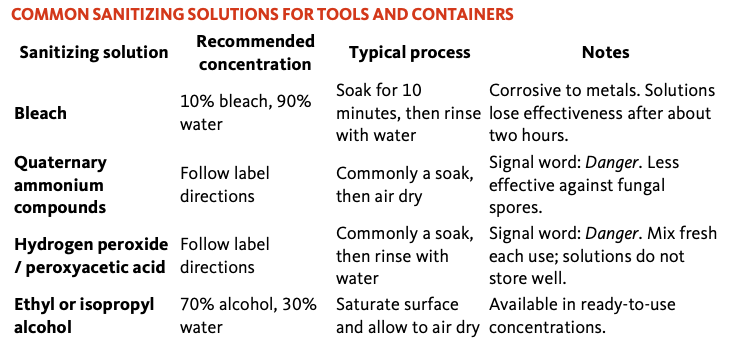
Several liquid solutions can be used to sanitize tools and containers. Many sanitizers are skin and eye irritants and must be handled carefully.
- Always wear appropriate personal protective equipment (PPE).
- Follow all label instructions.
- Mix solutions only as directed and only when needed.
Safe use tips for sanitizers
Sanitizers are regulated products and must be used correctly to protect people and the environment.
- Read and follow labels
Product labels provide legal use directions, safety instructions and required protective equipment. Using a product in a way not listed on the label is illegal and can be dangerous. - Wear protective equipment
Wear plastic gloves, long sleeves and pants, close-toed shoes, and socks when using any sanitizing solution. Use specific eye and respiratory protection as recommended on the label. - Keep children and pets away
Remove children, pets and non-essential people from the area during use. Store products securely out of reach. - Ensure good ventilation
When disinfecting indoors, open windows or use fans to improve airflow. - Never mix products
Mixing sanitizers can cause dangerous chemical reactions. - Clean up after use
Wash hands thoroughly and change clothing that may have been exposed before eating, drinking or smoking. - Dispose of products properly
Dispose of leftover products and containers according to label instructions and local hazardous waste guidelines. Never pour sanitizer solutions down drains or into the environment. - Prepare for emergencies
Review first aid instructions on the label before use. Keep the Poison Help line number readily available by posting it nearby and adding it as a contact in your phone: 1-800-222-1222.
Why this matters
Proper sanitation reduces the risk of spreading soil-borne diseases, invasive insects and other pests. Consistent cleaning and sanitizing practices help protect plants, gardeners and the broader environment.
Case study: jumping worms and soil movement
Jumping worms (Amynthas species) are invasive earthworms first reported in Oregon in 2016. Unlike beneficial earthworms, jumping worms rapidly consume organic matter, leaving soil compacted and depleted.
Jumping worms spread primarily through tiny cocoons in soil that are difficult to see. These cocoons can move with potted plants, mulch, compost and soil stuck to tools or footwear.
How to reduce the risk of spreading jumping worms
- Do not propagate, sell or share plants dug from gardens or landscapes.
- Use bare-root plants when possible.
- Avoid soil, compost or mulch from areas with known infestations.
- Brush soil from tools, shoes and equipment before moving between sites.
Preventing soil movement is one of the most effective ways to slow the spread of jumping worms and other soil-borne pests.
Case study: Crown and leafy gall in dahlias
Crown gall (Agrobacterium tumefaciens) and leafy gall (Rhodococcus fascians) are bacterial diseases that cause galls and distorted, excessive growth in dahlias. These aggressive pathogens can easily jump to dozens of other species, including roses, berries, fruit trees, and bedding plants. There is no cure for infected plants.
Symptoms of crown gall include galls on the base and/or crown of the plant, just above or below the soil line, and weakened or stunted plants. Leafy gall causes a dense cluster of shoots (aka witches’ broom) fused at the base of the plant, leafy galls, and abnormal growth.
Although galls may be found on any part of the dahlia, the bacteria spread primarily through plant wounds. Common vectors include insects, contaminated tools, infected soil, and contaminated water. Tubers can appear healthy while dormant, but they can introduce bacteria into the soil when planted.
Remediation is difficult. Because the bacteria persist in the soil, gardeners must leave beds unplanted or sow only non-susceptible plants for three years.
How to reduce the risk of spreading dahlia galls
- Do not sell or share tubers dug from home gardens or landscapes, as infections are invisible, at the genetic level, and cannot be treated with pesticides.
- Only acquire plants from reputable nurseries with certified pathogen-free stock.
- Clean and thoroughly disinfect tools between plants to prevent transmission. (One OSU researcher reported eradicating the bacterium from tools only after soaking them in disinfectant for 5 to 30 minutes.)
- Discard suspect/infected plants and 12 to 18 inches of surrounding soil in the trash; never compost them.
Licensing and regulatory considerations
In Oregon, nonprofit plant sales may require a temporary nursery license from the Oregon Department of Agriculture. Licensing helps identify plant sales in quarantine areas and supports statewide pest prevention efforts.
Community groups should review current state requirements before hosting plant sales or large plant-sharing events.
Protecting gardens and communities
Using these best practices helps protect Oregon’s landscapes, supports sustainable gardening and builds public trust in community plant sales. Whether you are hosting a large fundraiser or sharing plants with neighbors, careful propagation and handling make a meaningful difference.
Common pathogens and pests
Examples of soilborne pathogens in Oregon
- Phytophthora
- Verticillium
- Fusarium
- Rhizoctonia
- Nematodes
Examples of insect pests moved in soil
- Jumping worm
- Japanese beetle
- Oriental beetle
- Symphylans
Resources
- Oregon Department of Agriculture pest alerts
- Oregon Department of Agriculture Nursery Licensing (scroll down to “Temporary Nursery License” to find the application form)
- Oregon Invasive Species Council
- Solve Pest Problems
- Pacific Northwest Pest Management Handbooks
- Safe Procurement and Production Manual: A Systems Approach for the Production of Healthy Nursery Stock
Acknowledgments
This article is based on guidance developed through collaboration among Oregon State University Extension, Master Gardener volunteers and the Oregon Department of Agriculture.
Original development and review included contributions from Master Gardener volunteers Ruth Estrada and Linda Coakley; OSU Extension faculty Gail Langellotto and Brooke Edmunds; and Oregon Department of Agriculture specialists Chris Hedstrom (Insect Pest Prevention and Management) and Beth Myers-Shenai (Integrated Weed Management).
The guidance was updated in 2025 with input from Leslie Madsen, statewide OSU Extension Master Gardener Volunteer Program manager, and OSU Extension faculty and staff Erica Chernoh, Samantha Clayburn, Brooke Edmunds, Grace Florjancic and Janhvi Pandey.
References
Burgesser, K. (2025, December 16). Dahlias – Identifying Crown and Leafy Gall. The Coastal Gardener. University of California Agriculture and Natural Resources. https://ucanr.edu/blog/coastal-gardener/article/dahlias-identifying-crown-gall-and-leafy-gall
Král, M. (2023, June). You’ve got some gall! American Dahlia Society. https://www.dahlia.org/wp-content/uploads/2023/06/Galledfinal23-for-website.pdf
Lloyd, S. K. (2025, August 4). Dahlia gall disease: Unmasking crown gall and leafy gall. Dahlia Doctor. https://www.dahliadoctor.com/blogs/second-blog/dahlia-gall-disease-unmasking-crown-gall-and-leafy-gall
Pacific Northwest Pest Management Handbooks. (2025, March). Dahlia-Crown gall. Oregon State University. https://pnwhandbooks.org/plantdisease/host-disease/dahlia-crown-gall
Putnam, M. L. (2015, September 30). Crown Gall: Still Confounding Scientists and Growers Alike. GrowerTalks. https://www.growertalks.com/Article/?articleid=21821
Putnam, M. L. (2019, August 1). The lowdown on leafy gall. GrowerTalks. https://www.growertalks.com/Article/?articleid=24274
Stables, C., Moore, J., & Smith, E. (2024, February). Dahlias in Oregon: Planting for a parade of late-season blooms (FS 95). Oregon State University Extension Service. https://extension.oregonstate.edu/catalog/fs-95-dahlias-oregon#dahlia-diseases-and-pests
Warwick, N. (2023, March 23). Dahlia disease biology: Part 2 leafy gall- Rhodococcus fascians. Wild Horse Gardens. https://wildhorsegardens.com/dahlia-disease-biology-part-2-leafy-gall-rhodococcus-fascians/
Warwick, N. (2023, March 30). Dahlia disease biology part 3 – Crown gall (Agrobacterium tumefaciens aka Rhizobium radiobacter). Wild Horse Gardens. https://wildhorsegardens.com/dahlia-disease-biology-part-3-crown-gall/

Thank you. We are following these guidelines and appreciate the accuracy of these.
This is a very informative and interesting post. Thank you for sharing clear updated guidance and required steps for Master Gardener volunteer plant sales. Your posts are always helpful insightful.
Question: if a garden club has a one or two day booth at a fair or event, with items for sale including plants and starts from home gardens, are these sales subject to these restrictions? Not talking about a Master Gardener sponsored event -just a local club selling plants or starts.
Hi Katharine. See the link to applying for a temporary nursery license and check with the ODA to find if your particular set up has this requirement. Also, keep in mind the risk you run when sharing plants from your gardens, and inadvertently sharing invasive pests: that’s a sale no gardener would like to make.
All good advice, with one exception. Under the the heading:
“Use clean containers, tools and growing spaces”
you recommend “Use new or sanitized pots, trays and containers.”
I would remove the word “trays”. It makes no sense to have to sanitize trays that hold the sanitized pots. Are you worried the unsanitized trays will magically contaminate the soil through the bottoms of the sanitized pots? This requires a lot of unnecessary extra work for our plant sale…