A woman standing waist deep in a pool wipes the water from her eyes after being splashed by children.
Ashley gets splashed by day camp participants at the YMCA pool.
Photo credit: Lisa Parlette

Hi everyone! I’m Ashley Armstrong, intern for the OSU Extension 4-H Youth Development program in Josephine County this summer. This fall I’m headed into my senior year at OSU, majoring in agricultural science with minors in leadership and agricultural education. I graduated from 4-H in Josephine County back in 2020, and it was actually my time in the program and my trip to 4-H National Congress in 2021 that inspired me to do the work I am now, as well as to pursue a career in 4-H after graduation. My supervisor, Lisa Parlette, has already taught me so many things that will be incredibly useful in my future regarding things like program planning and delivery.

This last week we finished up our last day camp, and while they have been incredibly fun I am glad we will now have more time to prepare for our upcoming county fair. Of the three week-long camps that we held, my favorite was the Wonder of Water. We got to learn more about the water cycle, how Grants Pass filters water from the Rogue River for us all to use at home and how water moves. Plus, we got to go swimming every day. All of our youth participants seemed to have a wonderful time, and it was amazing to get connect with them and teach.

This summer is certainly a special one for 4-H in Josephine County, and I am so thankful for all of the public support I have been seeing throughout the county with my work. Lisa, Keith Hall (the 4-H program assistant,) and I have been hard at work preparing everything for fair, and we are incredibly excited for what is in store for our 4-H’ers this year. Our goal is to keep our participants happy, safe, and learning at fair to show Josephine County that 4-H is a place for all youth to thrive, be accepted as who they are, and to learn and grow both within their projects and within themselves. As a 4-H alumni from this county, I can tell you that is absolutely what this program is all about.

See you at the fair! It’s bound to be fun for the whole herd.

A smiling young woman in a gray shirt and khaki pants reaches over to touch plants.
Sophia Nowers on a recent farm tour.
Photo credit: Teagan Moran

Hello, my name is Sophia Nowers, and I am the summer intern for Oregon State University Extension Service’s Small Farms Program and Community Horticulture in Benton, Linn and Lane counties. I am a rising junior at OSU, where I am majoring in agricultural sciences. I hail from Alaska and love seeing all the different crops that can be grown in the Willamette Valley. In my internship, I work with OSU Extension faculty in the Small Farms Program and in Community Horticulture to publicize Extension activities, build small farm community networks and support Extension events in Linn, Lane and Benton counties. Most of my time is spent touring Master Gardener projects, interviewing farmers, researchers and volunteers and writing articles about OSU Extension events and programs.

I just started the fourth week of my internship and highlights so far include helping at the Oak Creek Center for Urban Horticulture Open House, touring the Benton County Master Gardeners’ demonstration garden at the Benton County Fairgrounds, and getting to see Commonplace Farms’ operation near Corvallis. It has been eye opening to see the research being done by OSU Extension and how it translates into useful knowledge for farmers, gardeners and the community.

My big project has been writing an article about the Dry Farming Accelerator Program for publication by OSU Extension. It has been fascinating to learn about the dry farming research that is being done at the university and how it is being shared in the broader Oregon farming and gardening community. The program brings together small farmers and hobbyist gardeners from across the state to do dry farm trials of tomatoes, squash and corn and share their dry farming experiences. It is great to see how the program combines research and community building, and it has given me some great ideas for my agriculture thesis!

In the rest of my internship, I am looking forward to seeing some local small farms, learning more about the Dry Farming Collaborative, tabling at the Benton County Fair and interviewing more Master Gardeners about their projects and activities. OSU Extension does so much in so many areas that there is always more to learn. I love how its work intersects with public health, environmental issues, water management and so much more. I can’t wait to get out there and learn!

Several children and a few adults reach down to pet ducks on the grass.
Petting ducks at the Kids’ Club: Intro to the Animal World event at Harney County Fairgrounds in Burns, Oregon
Photo credit: Tayleur Baker

Hello, my name is Tayleur Baker, and this year I am an intern at the OSU Extension office in Harney County! I will be an upcoming freshman at Oregon State University in the fall of 2023. I could not be more excited! Go Beavs! As a student majoring in agriculture and communication, I have been beyond grateful for the opportunity to work with the 4-H kids this summer and work with Harney County 4-H media. These two areas of the internship are my absolute favorite, as I love working with youth and advocating for the agriculture industry.

As a fifth-generational rancher in Harney County and an eight-year 4-H member, this position is as a way to serve and give back to my community. With Harney County being a predominantly agricultural area where the cows outnumber the people 14:1, I understand the importance of the industry and strive to promote agriculture sustainability for future generations. We all have the power to change the world if we dare to take the initiative, and I am confident that changing the world starts knee-deep in the community. While serving through this internship, I hope to grow as an individual, impact my community and empower others to use their skills to make a difference and shine.

Throughout the past month and a half, I have been able to write press releases for Harney County’s local newspaper and our extension website, draft social media posts for our 4-H media outlets, speak on the local radio about all things 4-H, help prepare for fair, attend Summer Conference, and help with awesome 4-H members and their projects.

Twelve young people stand in the archway of a large brick building.
Malheur County and Harney County Kids Team at OSU during the 4-H Summer Conference
Photo credit: Yolanda Diaz, Malheur County Extension intern

Last June, I was extremely grateful to be able to attend the 2023 4-H Oregon Summer Conference and connect with Malheur County, as well as help one local 4-H member bring her community service project to life. This student is an eighth grader at Crane, and she saw a need to educate youth in our town about agriculture and livestock. Through an “Intro to the animal world” event, this student was able to connect with our local Harney County Kids’ Club and teach about agriculture through a livestock animal show-and-tell at the Harney County Fairgrounds. This event was enjoyable for me due to its connection to agriculture, its ability to bridge the gap between consumers and producers, and the chance to grow next-generation leaders.

In the coming months, I will continue to prepare for the 2023 Harney County Fair and Rodeo in September and assist 4-H members with their projects. I look forward to the coming months and the adventures that they hold. Onto more memories ahead and the chance to strive to better myself, others, and my community!

Two people wearing mud boots stand at the edge of a field
Jasmin Lama and Aayusha Subedi (right) administering various fungicides to hemp plants on a local farm.
Photo credit: Achala KC

Hello, my name is Aayusha Subedi, and I am an Oregon State University Extension Service intern in Jackson County. I am a high school junior, and this is my first year working as an Extension intern. I am working in a plant pathology lab at the Southern Oregon Research and Extension Center in Central Point, Ore. with Achala KC, an Extension plant pathologist and assistant professor in the College of Agricultural Sciences, and her team. I am extremely excited to be taking part in this amazing opportunity. I am looking forward to learning about plant pathology research and exploring the commercial fields this summer.

Four people stand in front of a sunny vineyard.
Left to right, Aayusha Subedi, Jasmin Lama, Anupa Gaire, and Achala KC at the Woodhall vineyards in Monroe, OR.
Photo Credit: Aayusha Subedi

Throughout this internship, I will be working with another intern, Jasmin Lama. We will be conducting several projects, including pear disease diagnosis, hemp disease management, and grapevine red blotch virus (GRBV) detection. Within the first week, we started testing some treatments for hemp at a local farm. Furthermore, I was able to attend a OSU Extension Southern Oregon Pear Field Day, an Extension event organized by KC on July 6, where the participants were able to learn about all the different ways local and commercial farms operate and combat diseases such as fire blight on pears. My favorite part of this day was to tour the TreeTop processing factory in Medford. It was amazing to witness the fruit-processing journey and visit the farms in the community. On Friday July 7, we traveled to the Woodhall vineyard in Monroe, Ore., to collect 176 samples for grapevine trunk disease management research. A graduate research assistant, Anupa Gaire, is conducting a study as a part of her master’s program. It has been a unique experience helping her with the extensive process of collecting, processing and plating samples.

I am grateful to be an OSU Extension Intern and I cannot wait to learn and help this summer!

A cross section of a pear tree root.
Observing the root of a pear tree for symptoms.
Photo credit: Aayusha Subedi

Hello, I am Jasmin Lama, OSU Extension Service’s intern this summer in Jackson County. I am an upcoming junior in high school, and this experience is surreal, especially being able to work in the plant pathology lab in the OSU Southern Oregon Research and Extension Center in Central Point. I will be working alongside another intern, Aayusha Subedi; our supervisor Achala KC; and OSU graduate research assistant, Anupa Gaire. I’m very enthusiastic about this internship as this area of science is something I’ve always been interested in.

This summer, I’ll be working and assisting on three projects. My main project is disease diagnosis on pears, where we collected samples of dead, live and intermediate pear trees and plated them to observe what caused the pear trees to die. Towards the end of the internship, we are to complete a lab report on this project. Last week, I participated in a Pear Field Day where we went throughout the county and learned about other researchers and their processes. For example, our center expanded on the research that fire blight causes to pear trees and the process of treating it other than antibiotics. We even got the opportunity to visit Tree Top’s factory! It was incredible to see the processing of fruit.

Looking down rows of grapevines across a valley toward the trees.
The view from OSU’s Woodhall Vineyard in Monroe, Oregon.
Photo credit: Jasmin Lama.

The second project is grapevine red blotch virus (GRBV) detection in which we will be processing grapevine samples to assist with GRBV detection using molecular tools such as DNA extraction and polymerase chain reaction (PCR). The third project is hemp management in which we will be assisting a neighboring hemp farmer. There are five treatments we are testing over 45 plants in one field and 60 plants in another. We will also be assisting Anupa Gaire on her grapevine trunk disease management research. Up to this point, we have collected samples from two different fields. On July 7, we traveled to the Woodhall Vineyard located outside of Corvallis and collected 176 samples that were treated with different fungicides to test the efficacy of products to manage the disease.

I am so excited to see what I will learn more throughout this internship and continue my projects. Even though it has only been a few weeks, I have learned so much already and I’m thrilled to see what the next month brings!

A young man with a beard stands in front of a snowy forest
Back home and ready to work
Photo credit: Kieran King

Hello, my name is Kieran King, and I’m an intern with the OSU Extension Service this summer. I just finished my first year of college at OSU as a physics major, so I’m finally back home in Dallas. I’ll be working primarily on outreach for the Mid-Valley Small Farms Program with my supervisor Hayley White, as well as helping with the Olea research project.

So far, I’ve been able to work on my program’s newsletter for the month of June, where I’ve written information for farmers in an accessible format. I’ve also been working on outreach materials for the upcoming Small Farm School, as well as data entry for the Olea project. It’s been an interesting first week, and certainly a great start to this learning experience.

I don’t know the first thing about agriculture, but I decided to take this internship as a way to learn more about my community and to help the people in it. I’ve benefited from the hard work of local Polk and Marion County farmers my whole life, so it only seems fair that I put in work that might make their lives a little easier. I’ve already gained a deeper appreciation of the community in my own county through site visits to local farms. Seeing the amazing places and people in Polk County has made me excited for the rest of my internship! While I ultimately won’t end up in a public service or outreach-oriented job, it will definitely be a meaningful experience

Wide shot of a large mint field with farm in the background under a cloud streaked bright blue sky
Oregon peppermint field
Photo credit: Sprout Mahoney

Hi there! I am Sprout Mahoney, one of this summer’s crop of OSU Extension Service interns. While I have my senior year of Crop and Soil Science coming up, I will be working with Christy Tanner, the Linn County field crops specialist, for the next few months.

I got an early start this spring and have already helped with some research projects. Linn County is known for its grass seed and one of these projects has been based out of a local tall fescue field. Experimenting with different vole baits, observing signs of vole damage, and assessing drone imagery of the field via GIS software have been a few ways my learning has gotten out of the classroom and into some outdoor experience. I’ve assisted with different aspects of the research, from measuring samples to analyzing raw data for meaningful conclusions.

Closeup of a mint plant in a field
Mint plant
Photo credit: Sprout Mahoney

Another research project I worked on got me outdoors into some wonderful smelling mint fields! The peppermint grown in fields often becomes oil, a product that netted Oregon $34 million dollars in 2020. While mint in your garden may not have many pests thanks to its strong taste, the plants out in the field can be troubled by insects like loopers and cutworms. Monitoring these pests means using sticky traps baited with pheromone lures out in different fields and finding trends in their populations. This knowledge can help inform growers about the best times to treat pests and which species to focus on.

I am excited to be interning with Extension and working with local farmers. Agriculture always faces issues and I am interested in understanding people’s struggles and help bring solutions. I am especially looking forward to learning more about GIS applications in agriculture. I always want to know more about our soils!


Hello everyone! I’m Alyson Yates, and this summer I’ve had the pleasure of working with 4-H and agricultural Extension in Lake County for a second year. My internship concluded last week with the 103rd Lake County Fair and Roundup. 

After preparing for several weeks, my county fair week began with static 4-H exhibits. This year, our Lake County 4-H members entered projects in a large variety of areas, including floriculture, Legos, fused glass, photography, fiber arts, food preservation and more. I assisted as a clerk and got hands-on experience with check-in, interviews, judging, state fair qualifications and final set-up processes. 

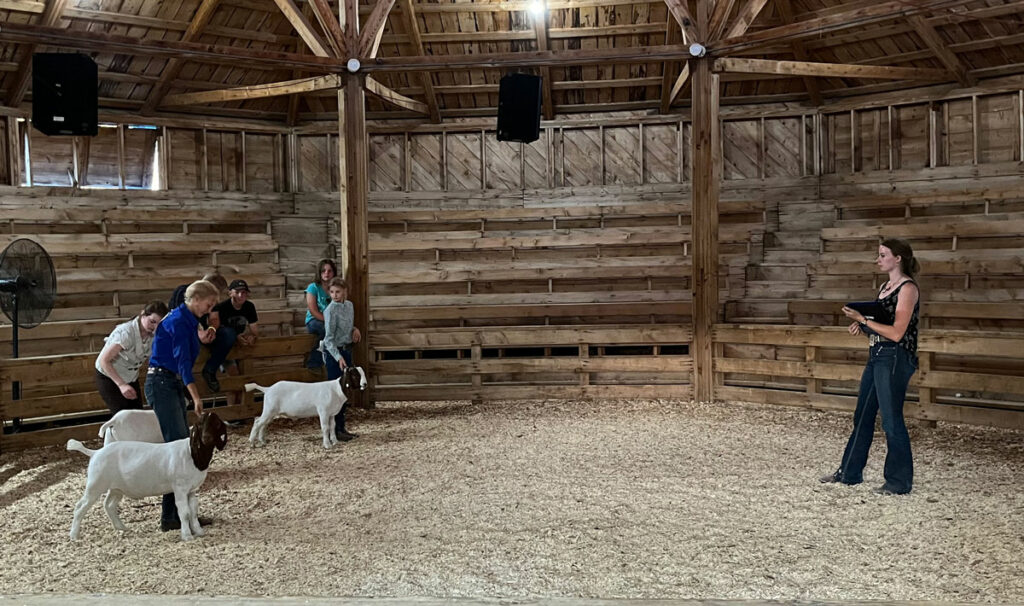
Three goats and their handlers stand facing a woman with a clipboard while others watch.
Alyson Yates judging meat goats in 4-H Round Robin showmanship.

I had a few different objectives throughout county fair week, both within my internship and through my volunteer position as a 4-H leader. One of my goals was to photograph all of our 4-H livestock shows for use in future publications and media. This was a continuation of the work I did last year, which I greatly enjoyed as it incorporated my love of photography into Extension. I covered shows for 10 different species this year, from swine to dairy cattle and everything in between. I am very happy with the photos I captured, and I am excited to see them used in future media! 

One of the challenges that we were faced with this year was Highly Pathogenic Avian Influenza (HPAI), also known as avian flu, in the state of Oregon. We had several poultry 4-H members in our county, and in order to maintain good biosecurity, non-market animals were not allowed at our county fair. To allow our poultry 4-H members to still show their knowledge and skills, we used stuffed “dummy birds” and a knowledge test for poultry showmanship. I worked closely alongside our small animal judge to coordinate this effort. Also, with the threat of Rabbit Hemorrhagic Disease (RHDV2) in the region, we worked hard to sanitize all contacted surfaces and keep visitors from touching the animals. As an Extension intern and county fair small animal superintendent, this was one of my top priorities during fair week.   

My final area of focus was preparing our annual 4-H Recognition Ceremony. This year we had six fantastic youth speakers who worked as our emcees, and one of my responsibilities was to help them create their scripts and practice their speaking roles.  

Additionally, I have spent the last month assisting with the re-installment of the Lake County Ambassador program, and it was an honor to welcome four youth leaders to the team at this event. Outside of my internship work, I also had a fantastic time judging meat goats in our Round Robin Showmanship competition.   

A black and white closeup view of the face of a dark colored cow with an ear tag that says Lake Co Fair.
A steer and showman in the Rancher’s Choice Market Beef show. Photo by Alyson Yates.

Looking back at everything I did with Extension this summer it is hard for me to believe that my internship has come to an end. I want to extend my thanks to all of the Lake County staff that I’ve worked with, who have given me so many valuable opportunities to learn and grow in Extension and beyond.  I am so grateful for the time I’ve spent working in Lake County, and I am confident that I will carry what I have learned into my future endeavors in Extension programming.  


This summer I’ve had the pleasure of working for the OSU Extension Small Farms Program with Teagan Moran in Linn, Lane, and Benton counties. Most of my time was spent helping organize our Military Veteran Farm Tour Series and attending farm tours of the Willamette Women’s Farm Network (WWFN).

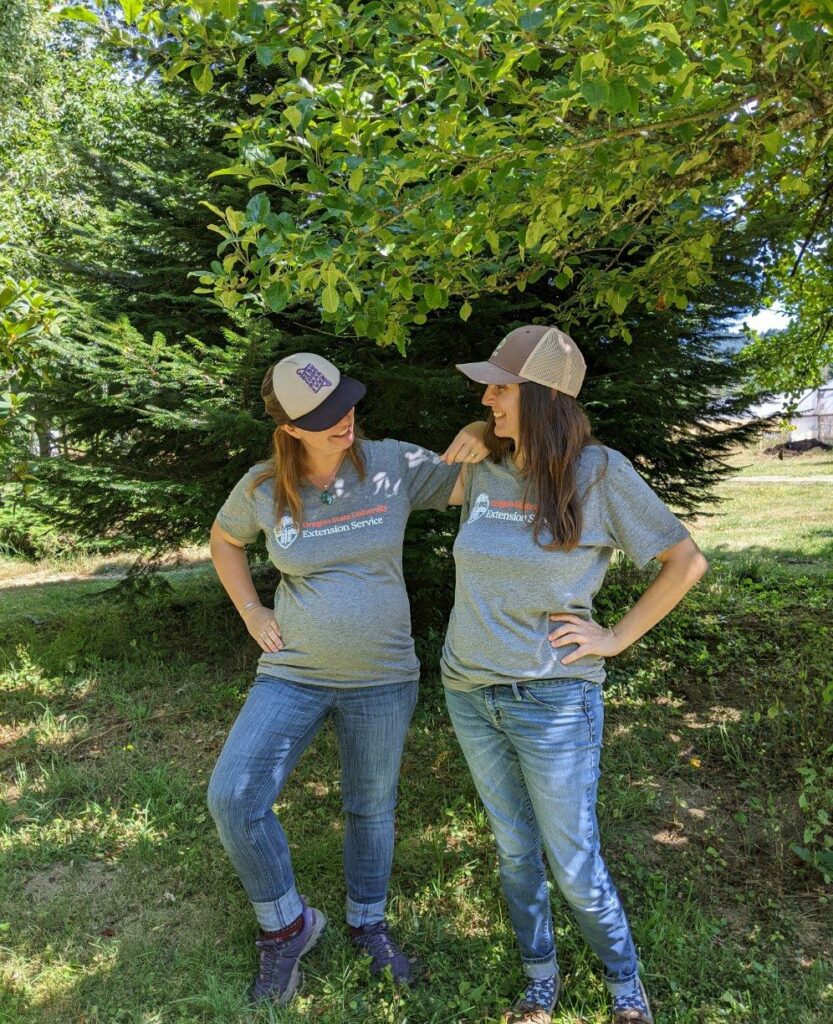
Two women in gray t-shirts and jeans stand next to each other, arm in arm, under a tree.
Crystal Kelso (right) with Teagan Moran, small farms coordinator in Benton, Lane and Linn counties.

I got to experience what it looks like to start out with a sheep farm using movable electrical fencing powered by solar panels, a dry farm that grows flowers and veggies alongside raising goats and poultry (and sampling some of the best goat cheese ever!) and wandering around a medicinal herb farm that has a roadside veggie stand and sells herbs to local businesses.  

I’ve met some amazing people and forged some long-term connections that I hope will carry over into both my personal and professional life. The farmers on these tours are thoughtful and caring about the land and their crops and animals. One thing they all had in common was the desire to connect with each other and give back to the community in a way that is sustainable and fulfilling. I think the overall theme was that these farmers are not doing this to get rich, but to feel good about what they are doing.                                                                                    

I have two more veteran farm tours to go to and will finish updating the agritourism farms list before I complete my internship. After that, I will stay on as a part-time student employee in the Small Farms Program while I finish my last year at OSU and receive my bachelor’s degree in horticulture/ horticulture therapy.  Wherever this path leads me, I am thankful for the time, experience and connections I’ve made with this internship. Having such a great mentor in Teagan to intern with has been super helpful, and she has been great about getting me connected to as many people as possible to help further my experience and career. Thanks again for the opportunity! 

Hi, my name is Nora Graham, and this is my last blog post for the summer. As my time interning at the Southern Oregon Research and Extension Center with OSU comes close to its conclusion, I thought I would share what a routine week looks like for me during my entomology internship.

I’m currently splitting my time between two researchers’ projects, and so on Mondays and Fridays I look for corn earworm larvae and eggs on hemp plants in Jackson County, as well as working towards my presentation and research paper I’ll be submitting for a separate OSU internship.

A person is standing in a field of tall hemp plants.
Nora Graham inspects hemp for corn earworm eggs.

On Tuesdays through Thursdays, I help with a wide variety of entomology tasks for pear and grape crops. Some of these weekly tasks include looking for treehoppers on grapevines that could potentially carry grapevine red blotch virus. We check coddling moth traps put up in pear orchards and count the number of male and female moths. We also collect and transfer earwigs from a peach orchard and put them in a pear orchard to see if they can act as a predator for pear psylla and two-spotted spider mites since they’re not able to do damage to pear crops.

It has been an incredible experience getting to work on so many diverse entomology projects. I had the opportunity to see how different orchards and vineyards operate, as well as getting to interact with a lot of knowledgeable people.