Hi, my name is Ashton Rask, and I am excited to introduce myself and be a part of the
OSU Extension services internship program. I am located in Columbia County, where I currently
reside. Though I am originally from the central valley of California, where agricultural roots run
deep. I have always been involved in some form of agriculture; I am a huge advocate for
agricultural education and take pride in being a part of a larger community. I was an active
member of 4H and FFA throughout my youth. I am entering my last year at Colorado State
University online, finishing my bachelor’s degree in Agricultural Business. From here I hope to
continue to be an advocate for agriculture and move forward in a career that is rewarding and
impactful.

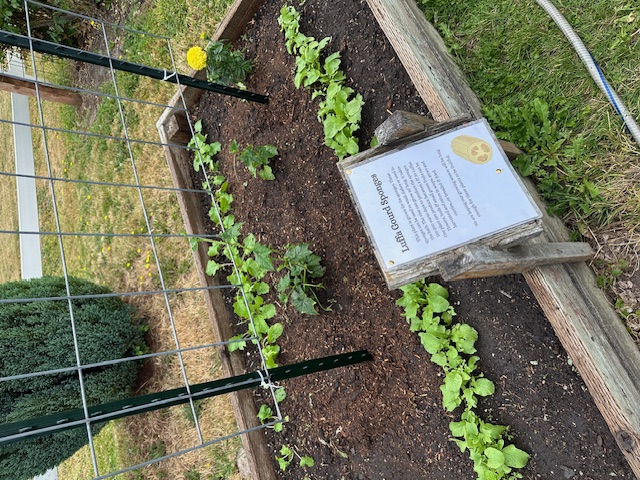
Garden sign displaying the Luffa in Columbia County’s demo garden. Photo: Ashton Rask

As I enter the 6th week of my internship here at OSU Extension, I have experienced a
number of exciting events. Including WIC/Snap-ED programming, Master Gardener events
along with viewing and lending a hand in our community & demo gardens. One of my recent
projects has been creating new signs to label our demo garden beds. This is a project that we
wanted to get done before our county fair, which is a goal we accomplished. I also had the
opportunity to sneak out of the office and get my hands dirty doing some weeding in our
experimental gardens located at the demo garden here in St. Helens.

I saw a need for signs to be made and placed in our demo garden. With the help of both
our agriculture Extension agent, Janhvi Pandey and A few of our master gardeners, who were
so kind to help me through this process, I was able to head out to the demo garden and learn
about all the things we are growing and showcasing. Our demo garden is flourishing, so having
proper signage to address people’s questions and celebrate the hard work of our community
members was important! Our demo garden has been a joy to work in over the past few weeks.
Watching all our unique plants and garden beds bloom and start to produce fruit has been
exciting. I am fortunate enough to be a small piece of this bigger puzzle and cannot wait to see
how our community members react throughout the fair and its showcasing.

These signs highlighted companion planting, our pollinator garden and our three sisters’
garden bed. Along with a really unique plant that has been introduced this year by a master
gardener, the Lofa plant! The Luffa plant is edible, but we often see it used in its sponge form!
Some signs needed to be created from scratch, whereas some just needed an updated look. I
spent about a week and a half creating these, printing and laminating them to help limit some
of the exposure from the elements, to hopefully make them last a while. From there I was able
to go out and place them on each plaque.

My name is Rachel Fuller, and I am an intern for the Oregon State University Extension Service
in Hood River County. This is my first time working with Extension, and my three weeks here
have already been very impactful. I am a senior at OSU, studying crop and soil science. Prior to
going to university, my background was primarily in small scale vegetable farms with a focus on
rural communities.

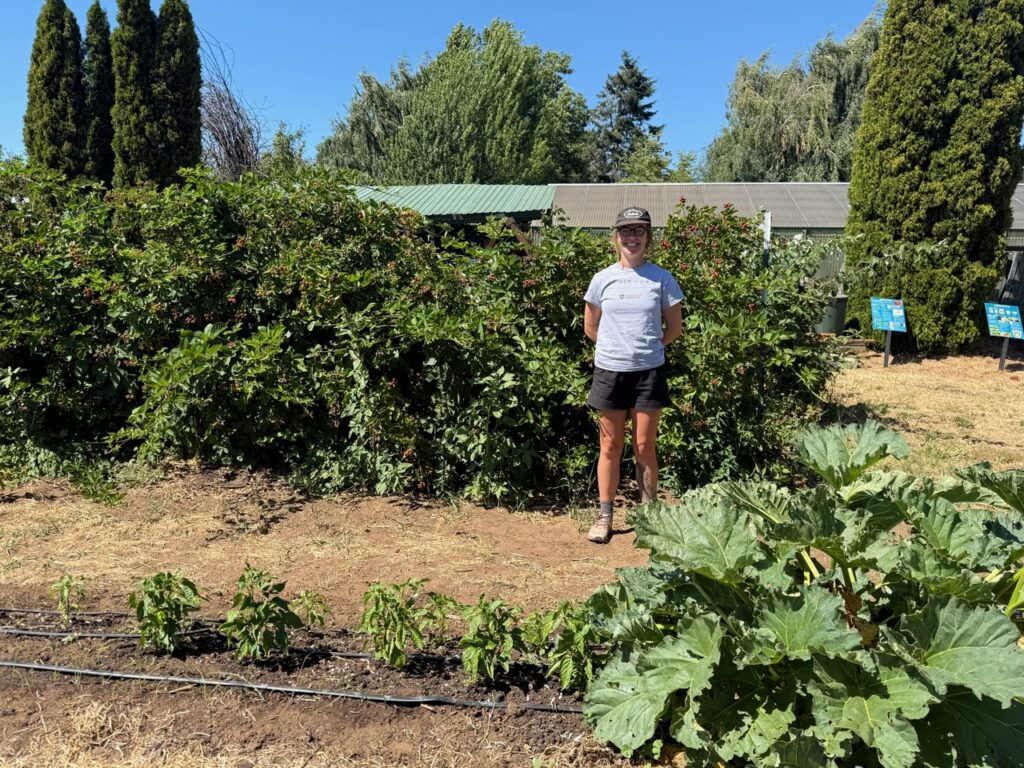
Rachel Fuller stands proudly in front of the FISH Food Bank Garden in Hood River County. Photo: Megan Wickersham

Through OSU Extension, I have been working at the FISH Food Bank Garden. The garden
produces vegetables that go straight to the food bank, providing the community with hyper-
local produce. The garden also serves as a classroom for groups of kids to learn about the
garden ecosystem.

In the garden I oversee the irrigation systems, plant health, harvesting, seeding/transplanting,
pest management, nutrient management and weekly flow of volunteers. I primarily work with
Master Gardener volunteers. They are a lovely bunch of people with a variety of passions,
knowledge and interests that I have learned a lot from already.

When I’m not in the garden, I have been working on projects in the Extension Office. I have
taken a grant writing class and am preparing to take the second course next week. After I have
completed this, my goal is to write a grant to create a funded Garden Manager position. In
addition, I have made a binder of garden lesson plans, created a record keeping system for the
garden and worked on systems to streamline the productivity of the garden.

The three weeks that I have been here have gone by so quickly and have been very enjoyable.
I’m excited for what the rest of the summer has in store!

Hello! My name is Aspen Bowling, and I’m currently serving as an intern with the Oregon State
University Extension Service Clatsop County, located in Astoria. This is my first year as an
Extension intern, and it’s already been an incredible opportunity to gain hands-on experience
that’s shaping my understanding of community-based agriculture and outreach. I just completed
my sophomore year at Oregon State University, where I’m majoring in agricultural science with
a minor in agricultural and natural resources communications. Agriculture has always been a big
part of my life as I grew up in California’s Central Valley, where I was actively involved in both 4-
H and FFA. Those early experiences helped spark my passion for ag education and community
engagement.

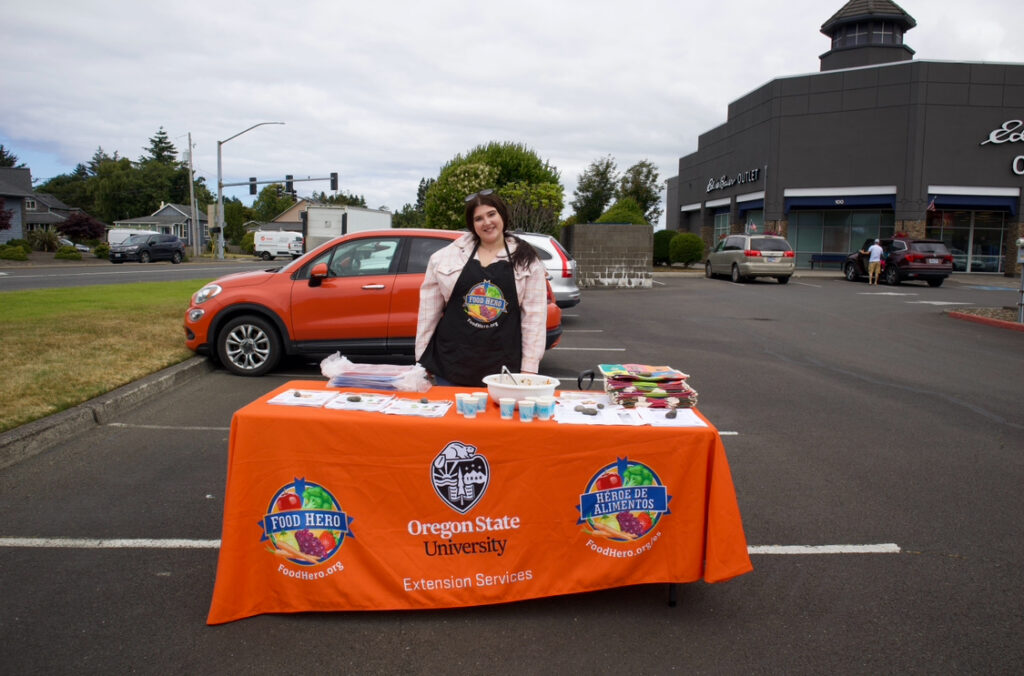
Aspen Bowling, an intern in Clatsop County, manages the Food Hero information table at a Mobile Produce Pantry event. Photo: Emily Reilly

Now wrapping up my third week with the Extension Service, I’ve had the chance to work
alongside our Small Farms and Master Gardener program coordinator, as well as our Family
and Community Health and SNAP-Ed coordinator. From checking cover crops and collecting
data to supporting mobile food banks, every day brings something new and meaningful.

One highlight so far has been participating in the Mobile Produce Pantry here in Clatsop
County. The local food bank packs up fresh produce and travels to different communities across
the county, distributing food at no cost to residents. At these events, I set up a Food Hero
information table where I share recipes, nutrition tips and quick facts about the produce being
distributed. We also prepare and offer samples of a featured Food Hero recipe, showing
community members simple, healthy ways to use the food they receive. It feels rewarding to see
how happy people get over their free fresh produce.

One of the more exciting projects I’ve been involved with is our cover crop data collection, which
supports local farmers in Clatsop County. Cover crops are important tools for improving soil
health, reducing erosion and managing pests and weeds, but farmers need localized data to
know what works best in our region. This data isn’t just for research but, it will be used to
develop practical, region-specific recommendations for local producers. We use this information
to organize farmer workshops and field days, where we can share results, demonstrate crop
varieties in action and offer guidance on how to integrate them.

This internship has already given me so many valuable experiences, and I’m looking forward to
what’s still to come. I’m proud to be a part of the OSU Extension team and excited to continue
supporting our local farmers and families!

My name is Jessalyn, and I am an Oregon State University Extension Service Groundwater
Protection intern based in Benton County. I am currently working on my second bachelor’s
degree from Oregon State University, double majoring in soil science and sustainability. I’m
excited to spend my summer engaging with local communities and learning more about
groundwater and public health. I spent the past decade moving around the United States while I
was in the Air Force and am now enjoying being back in Oregon, close to where I grew up in
McMinnville.

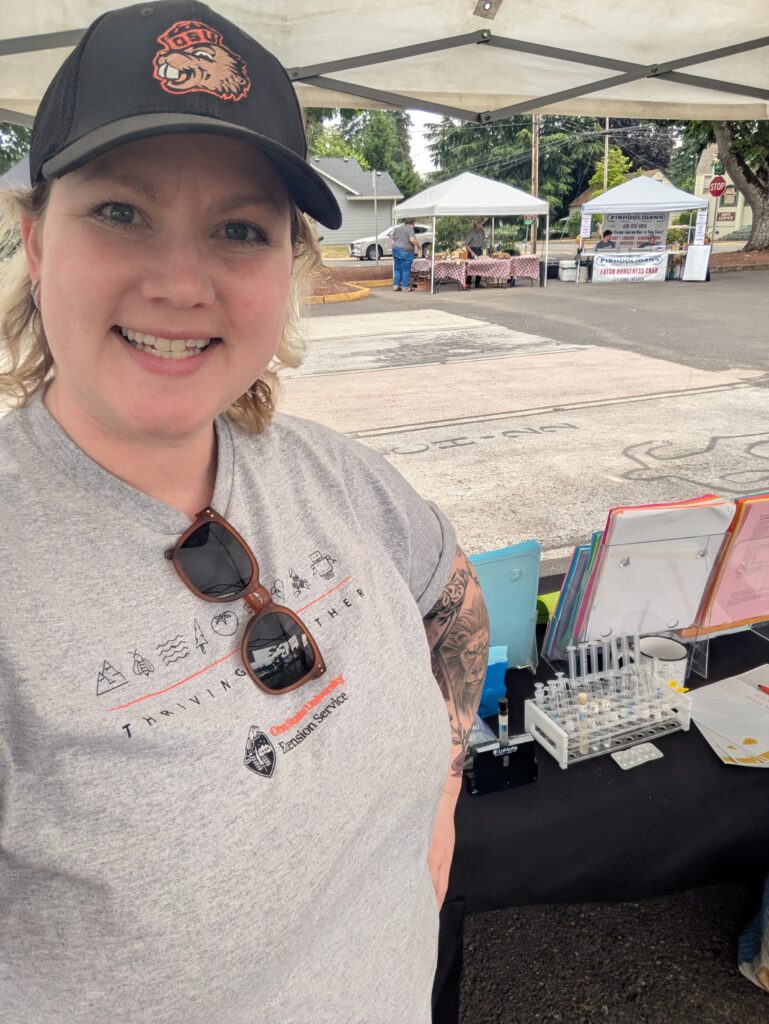
Jessalyn Horton at the Sweet Home Farmer’s Market. Photo: Jessalyn Horton

I first got an idea of the role Extension plays in my Soil 101 class this past fall, and thought it
sounded like an incredible community resource. I’ve got some teaching experience from my
military career, and I’m really interested in the intersection of soil and water. Working with
Chrissy Lucas-Woodruff, my supervisor here in charge of outreach, is something I knew I wanted
to do after she came to speak to a different class I took this past winter, on environmental and
agricultural predicaments. I’m very excited to be building on the knowledge I’ve gained during
my studies so far through water testing and education.

I’m less than a week into this internship, but I’ve already had an opportunity to test water
samples from local well owners for nitrates at the Sweet Home farmer’s market. I had a great
time with Chrissy and my fellow new intern, Taiva — learning the ropes, engaging with the
public on well and septic maintenance and talking about nitrates and arsenic. We spent the rest
of our time during the first week learning about groundwater, wells, septic systems and
common contaminants. We also got to put together our own lab kits and prepare the gear we’ll
use at other events all summer long, where I’m looking forward to lots more learning and
engaging conversation.

Hey everyone! My name is Sienna Mahaffy, the intern here in Coos County this summer for the
second time! I will be a junior at Oklahoma State University in the fall, majoring in animal
science, with minors in ag business and equine enterprise management. I was born and raised
on a dairy farm in Coos Bay and was an active participant in 4-H, so agriculture and Extension
are close to my heart. My career goals are a work in progress, but I would love to get a master’s
degree and return home to work in Oregon agriculture.

Sienna Mahaffy working in the cranberry bogs. Photo: Sienna Mahaffy

I am excited to continue learning about the Oregon State Extension Service this summer! I will
be continuing my responsibilities with 4-H in preparing for the county fair by assisting with
organizing contests, setting up shows and disseminating information to members and leaders.
Additionally, I will continue to assist our Food and Nutrition Agent with the Food Hero program
at local farmers’ markets and organized classes. I look forward to continuing to work with youth
in the community through 4-H and Food Hero, educating them in agriculture and nutrition
while helping them have a fun, learning filled summer!

The most exciting addition to my summer experience is my introduction to the cranberry
industry! I am working with Coos County’s agriculture agent and local cranberry specialist to
trap and track cranberry girdler and black-headed fireworm moths, large pests in the cranberry
bogs of Coos and Curry counties. In my biweekly travels to check the pheromone traps I have
met with many growers and learned an immense amount about cranberry growing, an industry
that is thriving in this area.

My internship project has yet to be decided, but I will likely use the organization of the Milk
Drinking Contest again this summer. I have already contacted sponsors and arranged for the
donation of milk and prizes. Soon, I will begin contacting local dairy farmers to help serve the
milk and race against the winning team (our little Coos County tradition). I could also use my
increased involvement with managing the Purple Cow, the ice-cream booth run by 4-H and
staffed by local clubs during the fair to raise money for 4-H events, activities and awards
throughout the year!

Overall, this summer is looking to be the best yet. I am excited to continue my involvement with
Extension and work with my community in new, meaningful ways!

Greetings fellow farmers and lovers of Agriculture! 

My name is Mia Claire Koljian and I am one of the summer interns for the Oak Creek Center for Urban Horticulture at Oregon State University. I am currently a senior working on my bachelors degree of science in botany with a concentration in ecology, evolution, and conservation. I am located in Corvallis and I am hoping to obtain a master’s in plant pathology. In my future I see myself working in environment stability by studying and preventing plant diseases. I have a goal of working in laboratories to study invasive pests and pathogens and their impact on the environment they are in. 

Mia Claire Koljian at Oregon State Oak Creek Center for Urban Horticulture Photo: Mia Claire Koljian

When going into the summer term I knew that I wanted to be working on a farm, and I was very lucky to be provided the opportunity to work on the Dry Farm through the Extension Service Program at the Oak Creek Center for Urban Horticulture. So what is Dry Farming? Dry farming is crop production without irrigation during a dry season. It is a practice that emphasizes production and growth with as little intervention as possible. I have greatly enjoyed my time working on the dry farms so far and have been extremely supported as a worker by my supervisor Lucas Nebert. Under Lucas’ guidance I have learned so much about the processes of the dry farm and all the foundational techniques of farming. It is a goal of mine to become more knowledgeable in the processes of organic farming and working on plots of land, and I feel that I am able to achieve this with the Dry Farm Program. 

So far we have been doing necessary upkeep of the land like weeding, pruning, and planting. One of my favorite tasks that I’ve been working on is planting cucumber melons next to the pollinator garden at the Oak Creek Center for Urban Horticulture. Starting your mornings by being out in the sun and listening to the sounds of nature has been such an excellent time for me. One of the other tasks I have enjoyed doing is assisting my supervisor Lucas with his project on studying drought resistant corn. The working hypothesis is that by inoculating a corn plant in its early stages with an endophyte, it will be able to assist the corn plant in becoming more drought tolerant and being able to grow and produce a fruiting body under those conditions. Endophytes are bacteria or fungi that live between living plant cells. They can have symbiotic relationships and aid in stress tolerance for the plant. I have found this very interesting to work with because it can provide foundational work for what I want to study in my future career. I am hoping to learn more information about organic farming plant microorganisms during my time with the dry farm. 


Hi! My name is Isabella Brown, but I go by Bella. This summer, I’m interning with the Oregon State University Extension Service in Benton County, focusing on Extension Communications. I’m about to enter my senior year at Oregon State University, where I’m pursuing a degree in agricultural business and food management, which I will complete next year.

Bella Brown Running Barrels
Bella Brown running barrels at the 2022 BRN4D National Championship Finals. Photo: Julia Smith Photography 2022

I’m particularly interested in a marketing career within the agricultural sector and hope to train and breed horses on the side. I’ve lived in the Pacific Northwest my whole life. As a child, I was active in 4-H in Columbia County, where I rode horses in multiple disciplines and studied hippology for a year before dedicating myself to showing horses in other associations. During high school, I spent my summers working at farm stands and farmers’ markets, selling delicious Oregon strawberries and connecting with local farmers.

Through my internship with OSU Extension Communications, I hope to learn more about the Extension Service’s impact on the communities it serves. Although I’ve always had a personal and professional connection to the agricultural community, I didn’t grow up in an agricultural area and wasn’t familiar with the OSU Extension Service until I started school at OSU.

I’m just beginning my internship, but I’ve already enjoyed meeting various individuals and teams within communications and learning how I can contribute to marketing efforts this summer. I’m excited to dive deeper into the Extension Service’s work and help market it to the public. I’ll be working on numerous marketing projects this summer and look forward to creating some amazing content to share with all of you

Hello! My name is Sienna Mahaffy, and I am so excited to be interning for the Oregon State University Extension office in Coos County this summer. I recently completed my freshman year at Oklahoma State University, where I am majoring in animal science with minors in agriculture business and equine enterprise management. It is great to be back home on the Oregon coast after an incredible, but long, year in Oklahoma. After spending nine years in 4-H showing livestock, I am looking forward to continuing to be involved through this internship.  

Sienna Mahaffy (left) and Elissa Wells (right) help set up the new swine wash racks
Sienna Mahaffy (left) and Elissa Wells help set up the new swine wash racks. Photo: Jason Wilson

Growing up as a fifth-generation dairy farmer and a nine year 4-H member made agriculture incredibly important to me, and I hope to share it with others this summer. In the three weeks since I have started working, my focus has been on 4-H. I have set up small animal judging contests, assisted with small animal weigh-ins, and helped organize and prepare for the county fair, which is a large undertaking. As I continue in the internship, I am looking forward to working with the other Extension agents and assisting them with their projects. In the coming weeks I will help with making garden beds for local youth groups, running nutrition classes with SNAP-Ed, and conducting research in cranberry bogs. 

This summer I am looking forward to learning how the county fair is made possible. I have already helped with some small projects in the office to prepare, but things are about to get busier. I will learn how the shows are organized, and the schedules made. I am excited to work with the 4-H kids, families, and volunteers to make fair a success! Some project ideas that I have been considering are all related to the county fair. I could assist with the livestock judging contest, a huge undertaking to run on one’s own, but I could help make things easier for my supervisor. Another possible project is the Milk Drinking Contest, a fun event for 4-H members and the community. Following the years we didn’t have fair during COVID the contest has struggled restarting, but I would love to bring the Coos County Fair tradition back to its former glory!  

A tall, leafy plant rises from a black container.
A pear tree that was uprooted for my pear disease diagnosis project. I replanted it with little hope it would survive, but seeing it overcome its struggles filled me with happiness.
Photo credit: Jasmin Lama

Hello, I’m Jasmin Lama. I just finished my summer internship at Southern Oregon’s Research and Extension Center in Jackson County. I can genuinely say that it was one of the best experiences of my life. I learned so much about plant pathology, along with making unforgettable memories.

Focusing on my projects was one of the aspects of my internship that I enjoyed the most. As I mentioned in my last blog, my major project was to identify the cause of why pear trees in a Southern Oregon orchard were dying. Preparing and plating these pear tree samples took many hours of dedicated hard work. After observing them for 2 weeks, I concluded that Diaporthe eres was the causal agent. I researched this species extensively and worked hard on the lab report I submitted after my internship. For about 2 weeks, I participated in processing hundreds of frozen samples for our lab. This took up most of my days, but I gained new skills and had much fun. It gave me a great sense of accomplishment once I finished. Participating in pear shoot blight measurements was also a highlight of my internship. Observing the hemp plants for my hemp management project was also a big part of my internship. Watching them prosper, consistently watering and giving them their designated treatment was one of my favorite parts this summer.

This was an incredible experience. I want to thank the amazing mentors who made it all possible. Anupa Gaire, Joseph DeShields, and especially Achala KC, my supervisor, were like walking encyclopedias of plant pathology knowledge. They helped me learn way more than I ever thought was possible. I am so grateful for their support in the plant pathology lab.

Presently, I have transitioned into my junior year of high school. This experience has enriched my understanding and left a lasting mark personally and intellectually. Monthly meetings provided insight into the ongoing projects of my mentors, amplifying my appreciation for the field. Field trips and meeting new people from all over the county added depth to my experience. However, the most memorable experience was our road trip to Woodhall Vineyards just outside of Corvallis. It was an incredible experience being able to work in such a large vineyard and I will never forget it.

Approaching this new academic year, I’ve gotten tanner thanks to all the sunshine. More importantly, I’m grateful for the knowledge I gained from this internship. I hope to return soon. It was an amazing experience that I will cherish forever. I am excited to use the skills and knowledge I gained to positively impact the future.

A metal table filled with lab supplies.
Lab table in Milton-Freewater, setting up to conducted sugar, pH and TA measurements on wine grapes.
Photo credit: Melinda Cramp

Hello once again! It’s hard to believe I am in my last week of this internship. I’d like to believe I’ve come a long way since I started in mid-June, and I’m happy to say that I’ve continued to learn new skills since my last blog post in August. Some of those new things I’ve learned include taking the sugar content, pH and titratable acidity (TA) of wine grapes. To find the amount of sugar in wine grapes, we use a tool called a refractometer that measures how the grape juice bends light. This tells us the sugar content, and when the ideal harvesting time will be. Finding the pH of wine grapes is fairly simple with the use of a benchtop pH meter. Finally, to calculate the TA of wine grapes we use a pH meter, sodium hydroxide (NaOH), and burette to slowly drip in the NaOH into a known mixture of grape juice and water until the pH meter reads a certain number. Once that number has been met, we do some simple math to find our TA. All of this work has been done in Milton-Freewater with my supervisor Cody Copp and fellow intern Aiden Wiggins. Who knew so much went into growing grapes and making wine!

Three people walk through a field of young hemp plants.
Setting up for a hemp field day at CBARC with fellow interns Mazon Langford, Gabbie Fertello, and supervisor Alan Wernsing.
Photo credit: Melinda Cramp

Like I mentioned in my previous blog, I also spend some of my time at the Columbia Basin Agricultural Research Center. One new skill I’ve acquired in the last month is learning how to tell apart male and female hemp plants, and how to harvest and clean hemp plants once they’re ready. Hemp can be used for fiber, seed and flower. Additionally, my supervisor at CBARC, Don Wysocki, taught me all about land surveying and how to apply it in the real world.

This internship has truly taught me numerous life skills and field skills. I am thankful for all the opportunities that I have received from OSU and my supervisors. It was such a wonderful experience being able to work right in my own community.

– Melinda Cramp