David P. Turner / March 24, 2026
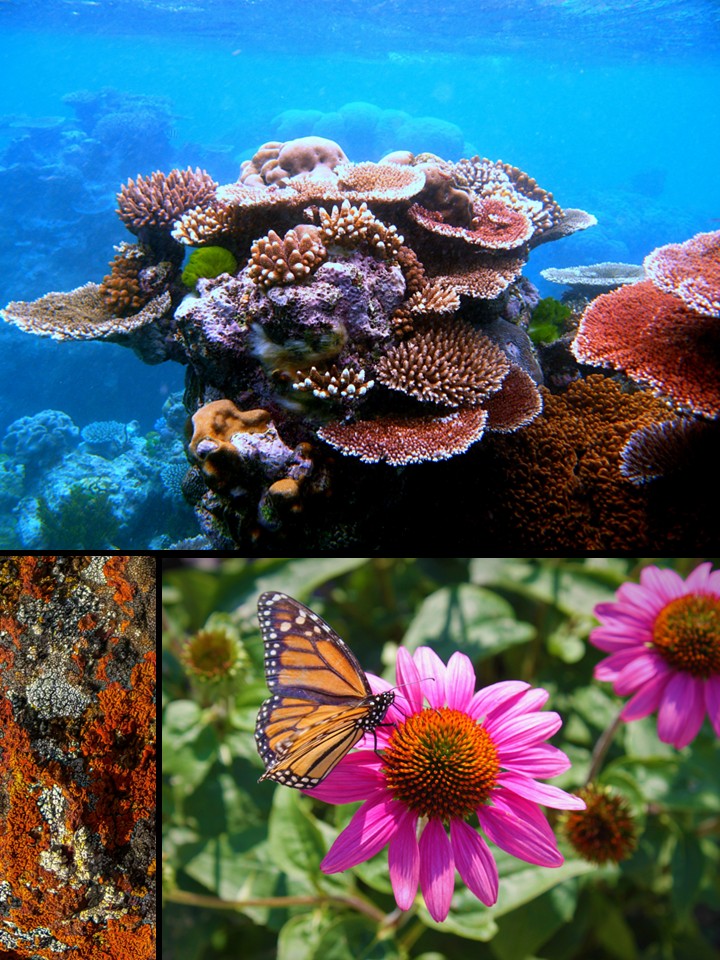
Examples of symbiosis. Image Credits: coral, lichen, butterfly.
Background
Scientific discourse on Earth system narratives could benefit from a new term to describe a future state of the Earth system in which humanity achieves a more harmonious relationship with the biosphere. Here, I propose the term “symbiotic technobiosphere” for that aspirational state.
I originally adopted the term technobiosphere in 2011 to describe the coupled system of technosphere and biosphere. The context was a paper advocating advanced monitoring tools, especially satellite remote sensing, for application in global environmental management.
The biosphere and the technosphere are usually viewed separately in the Earth system science literature. Each is a dissipative system with mass, energy flow, and materials cycling. Both spheres significantly impact Earth’s climate and biogeochemical cycling. At present, they are spatially contiguous but not sustainably coupled.
If the human enterprise on Earth is to flourish, the biosphere and technosphere must become highly integrated – hence the term technobiosphere. I’ve added the metaphorical “symbiotic” as an adjective to emphasize an idealized codependency between the spheres.
The term symbiosis is generally accepted to include any intimate association of two dissimilar species. In the discipline of biology, symbiosis originally referred only to mutualisms (both species benefit). However, later authors extended the meaning to cover all intimate interspecies relationships along a continuum from parasitism (one benefits, the other is harmed), to commensalism (one benefits, the other is neutral), to mutualism (both benefit). A change from one type of relationship to another, depending on the physical environment, is sometimes observed.
A lichen is the classic example of mutualism-based symbiosis – its biomass includes an algal partner doing the photosynthesis and a fungal partner providing a structural foundation and scavenging for nutrients. Other widespread mutualism-based symbioses include corals, mycorrhizae, and gut microflora of ruminants and termites.
The characteristic physical intimacy of two living things associated with symbiosis is certainly found in the biosphere-technosphere relationship. The ubiquity of the biosphere on the surface of Earth is evident from the satellite-based monitoring of photosynthesis on the land and ocean (Figure 1). Likewise, the ubiquity of the technosphere is evident from satellite-based monitoring of Earth at night (Figure 2). The spheres interact by way of physical impacts as well as exchanges of energy and material.
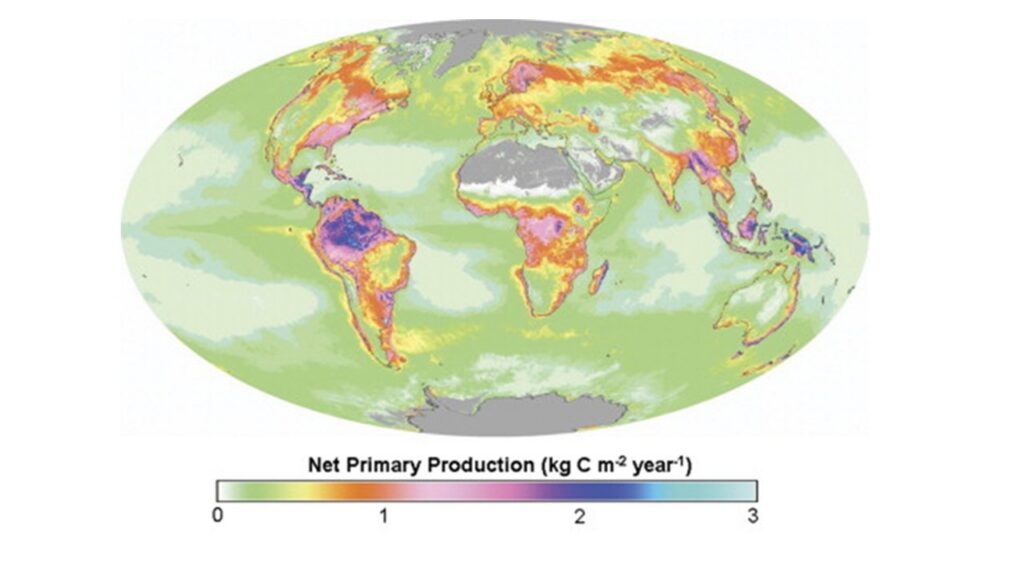
Figure 1. Global Net Primary Production based on satellite imagery. Image Credit: Woodward 2007.
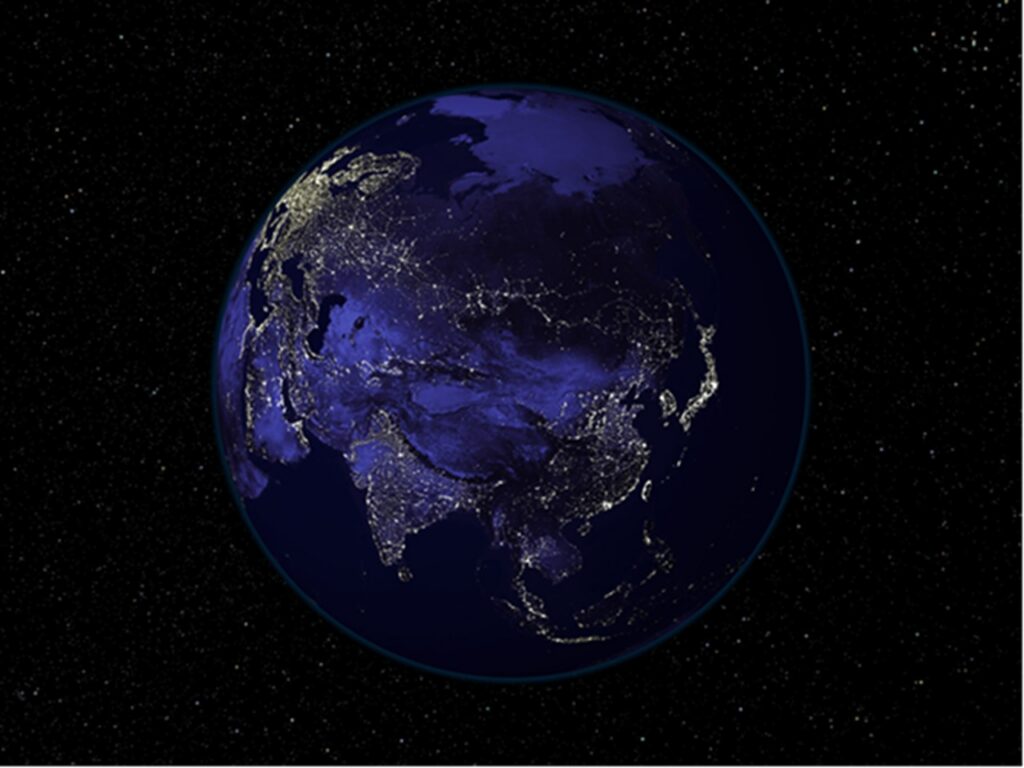
Figure 2. Earth at night. Image Credit: NASA/GSFC/Visualization Analysis Laboratory.
The emphasis in biological symbiosis on a genetic basis for the partnership does not apply directly to the technobiosphere because the information that drives the technosphere is mostly digital rather than genetic. Nevertheless, there is coevolution of sorts going on. The gene-culture coevolution that could eventually generate a mutualistic technobiosphere will rely on genetic evolution on the biosphere side and cultural evolution on the technosphere side.
In memetic theory, cultural evolution in humans is based on selection of memes, i.e. ideas, words, and cultural practices (bits of information) that are transmitted horizontally (within generations) and vertically (between generations) by speech and example. Memes are loosely analogous to genes in the sense of arising like mutations (new thoughts) and being selected (adopted by other humans).
Cultural evolution clearly operated in the case of agriculture’s origin – humans were initially only seed predators of wild grain plants, but through cultural evolution they began to plow and plant and harvest. In the gene-culture coevolutionary framework, the genetic characteristics of the crop plants, such as seed size, were simultaneously changing by way of artificial selection.
On a contemporary farm, the crop plants (e.g. corn) have become highly genetically modified from their wild forms so as to be compatible with machine-oriented management. The human management (technosphere) side of the relationship has also radically evolved, in this case via cultural evolution of machine design and management practices.
Biosphere Services to the Technosphere
I suggest here that the symbiosis metaphor can be fruitfully extended to the whole biosphere/technosphere relationship.
The current relationship of technosphere to biosphere is mostly the parasitism form of symbiosis. The technosphere utilizes over 25% of terrestrial net primary production (NPP). Domesticated livestock scavenge global grasslands and shrublands for edible plant biomass, heavily mechanized agriculture produces crops for human consumption, heavily mechanized forestry extracts wood for construction and paper products, and a global fleet of fishing vessels scours the seas for marine wildlife. Natural wilderness occupies only about 25% of the global ice-free land surface. Broadly speaking, technosphere capital is rapidly depleting biosphere capital. Unregulated capitalism tends to facilitate biosphere degradation because negative externalities of natural resource exploitation are ignored.
The technosphere is also dependent on the biosphere for a steady supply of oxygen (produced by photosynthesis). Human respiration, and fossil fuel combustion, require ample oxygen. Other ecosystem services like provision of fresh water and organic matter decomposition are similarly dependent on the biosphere, and crucial to technosphere metabolism.
Technosphere Services to the Biosphere
It is not intuitive, but I would argue that the Anthropocene biosphere is becoming increasingly dependent on a well-functioning technosphere. Most of the technosphere services noted here exist only in nascent form but could be purposefully augmented.
Most generally, the technosphere could provide a network of institutions for global monitoring (of both biosphere and technosphere), modeling (for diagnostic and prognostic purposes), and environmental governance (at all relevant scales). Associated feedback loops would then link the functioning of the technosphere to the functioning of the biosphere.
Monitoring by the technosphere would extend to environmental variables like land cover, water quality, and biodiversity. In each case, monitoring is needed to inform environmental governance institutions.
Notably, the technosphere should monitor and regulate (if needed) greenhouse gas concentrations. In the case of carbon dioxide, high concentrations would be moderated by negotiated targets achieved by reduced emissions, Natural Climate Solutions (e.g. afforestation), and various geoengineering approaches.
Another critical technosphere service would be environmentally friendly recycling of all technosphere material waste. This requirement extends from sewage to everything currently going into landfills.
Besides monitoring the Earth system, the technosphere sensory system could extend out into the solar system to detect and possibly deter threats to the biosphere, such as asteroids having potential to collide with Earth.
Homeostatic Coupling of Technosphere and Biosphere
A more highly integrated coupling of technosphere and biosphere will rely on emerging feedback loops. As a start towards engaging those feedbacks, Earth system scientists have established a set of planetary boundaries i.e. measurable features of the Earth system that are impacted by the technosphere and can be monitored. For each variable, a threshold has been established beyond which the Earth system is considered substantially altered away from the Holocene reference state. A relatively stable climate during the Holocene (~9,700 BCE to present) favored the origin of agriculture and the buildout of the technosphere.
Planetary boundaries related to the biosphere include the rate of species extinction, the proportion of biosphere NPP appropriated by humans, and the area of forested land as a percentage of the original forest cover. The feedback loop needed between the technosphere and biosphere requires a purposeful (teleologic) humanity that responds (self-regulates) when it observes a planetary boundary threshold is crossed.
Take the case of the species extinction rate boundary. Because of technosphere practices like deforestation, the rate of species extinction is much higher now than in most previous geologic periods. Yet the technosphere is also monitoring the extinction rate and consequently is beginning to alter land use so as to selectively leave more undisturbed habitat for endangered species (i.e. a negative feedback loop).
Conclusion
Since the technosphere and the biosphere are co-dependent, co-evolving, and intimately associated, it is worthwhile evoking the symbiosis metaphor for their relationship at the global scale. It reminds us to see ourselves as embedded in a complex global system rather than as detached managers of natural resources.