Protein artists
- 2010 Protein Portraits in the news
- Alissa Eckert
- Bathsheba Grossman
- Byron Rubin
- David Goodsell
- Drew Berry
- Gael McGill
- Irina Bezsonova
- Irving Geis
- Jane Richardson
- Janet Iwasa
- Jenny Langley
- Julian Voss-Andreae
- Mara Haseltine
- Mike Tyka
- PDBe Exhibits
- Protein art by May_k
- Roger Armen
- Steve Miller
- Wunderkammer crochet
Protein science
- AlphaFold
- AlphaFold: How to predict structures
- AlphaFold: Tutorial
- David Baker
- David Goodsell's Molecule of the Month
- DeepMind
- Domain classification: CATH
- Domain classification: SCOP
- Folding at home
- Foldit
- Jane Richardson modeling
- Perkins: History of Molecular Representation Part 2
- Protein Spotlight (SIB)
- Protein structure hierarchy
- RCSB PDB: Search the protein databank
- The Encyclopedia of Domains (TED)
Studio tricks and materials
Viral artistry
- 2015 Year of the Phage
- Ann Kiernan for The Washington Post
- Bad news wrapped in protein
- Corona virus mandala
- Goodsell CoV-2
- Illustration by Nicholas Konrad
- SARS-CoV-2 Spike Glycoprotein- 2D illustration
- SARS-CoV-2 Spike Glycoprotein-Macarroni models
- SARS-CoV-2 spike protein models, space filling, by David Veesler
- Sean McSorley, Virosphere illustration
- The Spiky Blob Seen Around the World
Weekly topics
Meta
yay!
I love everyone’s projects they are all sooo beautiful! I had a lot of fun in this class and just wanted to say thank you all for making it so much fun. :] Congrats to the seniors who are graduating! Also, if you guys aren’t doing anything on Friday at 4, it’s my accapella group’s last show. It’ll be either outside the bookstore if it’s sunny, or inside the MU on the main steps if it’s rainy. I’d love to see you guys there (you can hang out with Casey!) There’s also a chamber choir concert on Friday, but let’s get real, that’s no fun.
Thanks for everything guys,
:] E
Posted in Student posts
1 Comment
CONNIE!
Hi Connie, when are you going to set up tomorrow so I know when to bring the easel? I have a meeting at 9. But 10 and after I should be good to go.
Posted in Student posts
4 Comments
Ribosome Blurb
Sorry, I totally forgot about making this blurb until today.
Author: Elvis Nguyen
Blurb:
Where would we be without ribosomes? Ribosomes are biological structures in the cells consisting of 2 subunits and made up of lots of RNA and dozens of proteins. It reads incoming mRNA transcriptions and translates them into beautiful polypeptide chains. No other proteins would be possible without the “Mother of all Proteins.”
Posted in Student posts
Leave a comment
Integrase Label (Ah! Sorry I’m late!)
Protein: Integrase
Protein Data Bank ID #: 1K6Y.
Artist: Erica Puopolo
The HIV/AIDS pandemic has had a large impact on our world in the past thirty years, it is estimated that there are upwards of 35 million people living with HIV/AIDS and over 25 million have died AIDS related deaths. When the virus enters the body it attaches to the CD4 receptor of the helper T-cell. In my model, the globe is represents a T-cell that has already been infected by the virus, it is covered in pictures of people, showing that HIV has left no gender, age, or ethnicity untouched. This was also meant to put faces to the pandemic, when a disease is as widespread as HIV/AIDS it becomes easy to see it’s inflicted as mere statistics, but I think it is important to remember that every person infected is a mother, a father, a sister, a brother, a daughter, a son, or a friend to someone. The syringe represents the CD4 receptor which HIV has used to enter the cell, the syringe is also symbolic of the large role that IV drug has played in the spread of the virus. Red and black viral DNA is being combined with the blue and yellow host DNA by integrase, which seals the fate of the cell. It is now a viral DNA lead workshop, and will begin replicating and releasing more viruses that will degrade the very immune system that is trying to fight against it.
Posted in Student posts
Leave a comment
Really great posts
Rather than comment on each separate label, here’s a hip hip hooray for all of you who have posted your label so far! Very very nice!
Posted in Student posts
Leave a comment
Sculpture Caption Card
Newcastle Disease Virus F-Protein in the Post-Fusion Conformation
PDB ID#: 3MAW
Exotic Newcastle virus (ENV) is a lethal and contagious antisense ssRNA viral disease of all birds, and an international threat to the agricultural poultry industry. Since this virus is only known to infect birds the bones are based on a chicken (Gallus gallus) skeleton, as are the feet. The F-protein is a trimeric surface glycofusion protein used by viruses in the Paramyxoareviridae family to fuse with host membranes. The F-protein changes from a pre- to a post-fusion structure upon binding.
Media: firm super sculpey, foil, acrylic paint, and wire.
Posted in Student posts
Leave a comment
Blurb (in Villanelle form!)
Protein: p53 Tumor Suppressor
PDB ID: 1TUP
Artist: Connie Shen
Protections a special protein provide,
Protein Fifty-Three is cancer’s bane.
A guardian angel with her wings spread wide.
On your DNA, p53 sits astride,
And monitors your DNA for damages’ stain.
Protections a special protein provide.
p53 prevents unhealthy cells to divide.
DNA breaks found, its replication p53 will constrain.
A guardian angel with her wings spread wide.
Activation of DNA repair proteins p53 will then guide,
And they fix the breaks within the time domain.
Protections a special protein provide.
If damage is irreparable, the whole cell p53 sets aside
By activiating the apoptosis mechanism chain.
A guardian angel with her wings spread wide.
Cancerous tumors p53 does not abide.
Be it through DNA repair or sick cells slain,
Protections a special protein provide.
A guardian angel with her wings spread wide.
Posted in Student posts
Leave a comment
Label
Protein: Prion and prion protein
PDB ID#: 1dwy and 1tpx
Is Betsy feeling a bit mooooody? Perhaps she’s come down with a case of mad cow disease! Also known as bovine spongiform encephalopathy, mad cow disease is a fatal neurodegenerative disease of cattle. Infected cattle show behavioral changes, have difficulty standing and walking, and will lose weight without losing appetite. By a process not completely understood, normal prion proteins, shown in yellow alpha helices and pink beta sheets, transform into abnormal prions. These prions, represented by orange alpha helices and numerous red beta sheets, aggregate and give brain tissue its spongy appearance. The bipolarity between a mad cow and a happy one couldn’t be more obvious!
Posted in Student posts
Leave a comment
In need of ideas
Hi everybody,
I’m finishing up my protein model, and need an idea for hanging it. I’ve heard coat hanger, diorama box…has anyone else had a similar issue and solved it?
Thanks!
Posted in Student posts
1 Comment
Label
Protein: Immunoglobulin Gamma (IgG)
PDB ID: 1IGT
Artist: Anna Vigeland
The caduceus, depicting two serpents intertwined around a winged staff, has become familiar as a symbol of medicine and the doctors who practice it. In our bodies, the agents that bring about recovery from illness by fighting infectious diseases are antibodies, immunoglobulin proteins, which bind to foreign antigens and allow them to be eliminated by other immune system actors. Immuloglobulin gamma is a type of antibody which is secreted by active B-cells, and is the type received by fetuses and newborn infants from their mothers. If there were a symbol representative of health and medical aid on the microscopic level, the characteristic twisted Y-shape of the immunoglobulin molecule would be it.
Posted in Student posts
Leave a comment
Label
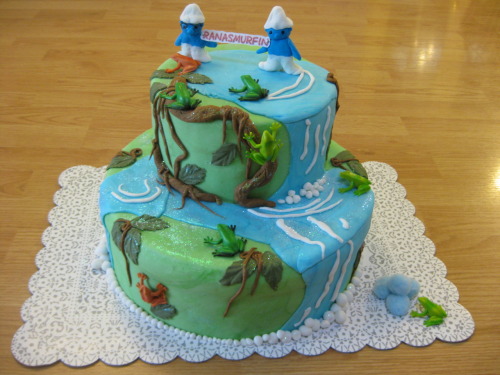
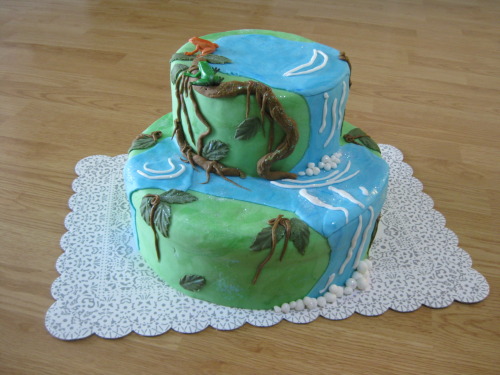
Protein: Ranasmurfin
Protein Data Bank ID #: 2VH3
Artist: Paulina Nguyen
Ribbet Ribbet Ribbet…the distant sound of frogs completely at home in their rainforest we hear all the time. However, such a setting could also be home to the tiny blue creatures known as the Smurfs.
When mating, the female excretes a protein-rich fluid that she, together with the male, whips into a sticky foam nest that is then stuck to a structure or plant overhanging a body of water. The dark greenish-blue color of the nests of Java whipping tree frog stems from ranasmurfin. Certain species of tree frog use biofoams to create nests for their eggs, protecting them from dehydration, predation, microbial infections, and other dangers.
The name of the protein itself already gives a hint as to the color of this protein – an odd electric blue that is characteristic of the playful cartoon Smurfs. In the rainforests of the Malaysia, the nests of these frogs are situated near the edge of the river where the young helpless tadpoles can swim to their new home under the safe cover of the blue foam.
Posted in Student posts
Leave a comment
Blurb- Now with 30% more limerick!
Enzyme: α-amylase (alpha amylase)
Artist: Alexander Carsh
These enzymes, whose special domains
Consist of potatoes and grains,
Start breaking down starch
Into component parts,
To fuel people’s bodies and brains.
Posted in Student posts
Leave a comment
Blurb
Protein: Spider Capture Silk
PDB ID: 3LRD
Artist: Kayla Bell
Picture a web spun between two leaves. It was made with spider capture silk, a thin, flexible protein capable of remaining strong even under intense temperature, pressure, movement, and weight. With these properties, it has the potential to become the next Kevlar or steel. But don’t let the sturdiness fool you- a swirling mixture of alpha helices resembling silk itself forms this protein. Next time you brush away a web in your path, remember the power put into this miniature display of art.
Posted in Student posts
Leave a comment
Label. Too Long?
Protein: One-Humped Camel Derived GFP-Nanobody
Protein Data Bank ID #: 3G9A
Artist: Casey Kernan
Who knew that camels, dromedaries and llamas held the key (a very small one) to unlocking a number of scientific mysteries and medical advancements? In 1993, nanobodies, nearly a tenth the size of conventional antibodies were found circulating in the blood of these animals. Working similarly to a conventional antibody, nanobodies work in concert with the immune system, recognizing unique antigens and combating foreign molecules. I have depicted the green fluorescent protein (GFP) bound nanobody using pure technology: chips, wires and other internal computer bits. Technology, derived from the Greek word techno meaning “art, skill, craft” was an ideal media to portray the GFP-nanobody which has obvious ties to both science and technology. The future looks bright and green for the GFP-nanobody! Its potential role in effectively treating cancer, neurological and gastrointestinal disorders (to name a few) has deemed it a worthy pioneer of medical and technological research and advancement.
Posted in Student posts
Leave a comment
Structure complete!
I just finished molding all the pipe cleaners into the shape of amylase. All it needs now is a few more fishing-line bonds and some decorations, and it should be ready for showtime. Provided it doesn’t tangle up again.
Hopefully, I should be able to pictures up by the time I write the blurb about it.
Posted in Student posts
Leave a comment
Example project label
Here’s an example label for a Protein Portrait of hemoglobin, a molecule that definitely is on my all-time favorites list.
Protein: Hemoglobin
Artist: Phil McFadden
Take a breath… where did it go? Hemoglobin, the vividly red oxygen-carrying protein of our blood, has carried it away to your heart and beyond. Here I portray hemoglobin in the shape of our four-chambered heart. Two of the subunits, shown as red, still hold onto their oxygen, tightly bound to iron. The other two subunits, shown as blue, have let go of their oxygen. So get ready… soon it will be time to take another breath.
(OK, I didn’t actually make a portrait. But you get the idea — a label should be short, not-too-technical, and should tie together the art and the science of your portrait. Please post the text of your label by the end of Week 9; you don’t need to post any graphics.)
The above drawing of the 4-chambered heart is from www.pted.org. The model of hemoglobin is by David Goodsell from his Molecule of the Month for May 2003.
Posted in Student posts
Leave a comment
At thesis fair
Hi guys,
I’m sure you are all aware that the thesis fair is today from 11:30 to 1:30. Since we need to set up around 11, I won’t be coming to class 🙁 Wish me luck!
Nicole C
Posted in Student posts
Leave a comment
IgM
Hello,
I’m not going to be in class on Wednesday since I will be presenting my research poster at the thesis fair. Sorry to miss out on the presentations!
I haven’t been able to find a complete Immunoglobulin Gamma structure on the PDB, but I did find a cool ID for the pentameric form of Immunoglobulin Mu in solution: 2RCJ. I’d post a picture but the blog won’t let me; doesn’t seem to like bitmaps.
See you next week,
~Anna
Posted in Student posts
Leave a comment
Spread the word!
Mark your calendar – BB399H Protein Portraits Art Competition
Students enrolled in BB399H will display their Protein Portraits artwork from Tuesday through Friday of Week 10 in SLUG 2, STAG 032 (May 31 – June 3). Please come see these works of molecular art+science and fill out a ballot to vote for your favorite(s). The winners will be announced in our course blog at http://blogs.oregonstate.edu/psquared/
Posted in Student posts
Leave a comment
Not feeling too good…
Hi all,
My cold has gotten pretty bad, so I think it might be better for me to stay home for the morning. I’m sorry for missing out on people’s presentations, I’ll be excited to see more about them towards the show.
Thanks,
Nicole
Posted in Student posts
Leave a comment
Pictures!
Hi Everyone!
So I’ve made a good start on the project finally…I found this cool ribbon that has wire in the edges, and curled it with the end of my hairbrush to make alpha helices. This picture only shows half of them because I ran out of ribbon, but my plan is to join them together with some electrical wire.
Posted in Student posts
1 Comment
:(
Hi Everyone,
I wasn’t in class today because of an important appointment I had made earlier that I couldn’t reschedule…and I realized that that means I missed Linus Pauling 🙁 See you all next week.
Posted in Student posts
1 Comment
Sculpture Update
Protein: 3MAW
Structure of the Newcastle disease virus F protein in the post-fusion conformation.
Alright, well my Firefox crashed once while doing this. We’ll see if it handles the Flash Uploader this time.
I took some time between studying this weekend to work on my sculpture. Instead of trying to explain what I am doing in words I figured it would be easier to post photos instead. And then explain them.
Here is the Super Sculpey Firm on a cooking tray covered in aluminum foil for me to have a clean, non-stick surface to work on. I definitely recommend working on a easily moved surface and try to not work on lacquered wood surfaces (like my desk). I do like this Sculpey much better than the normal Sculpey, it is less “buttery” as you can tell I need a knife to cut it since tearing it is difficult.
I’m going to be designing the alpha-helices as bones (roughly modeled off of chicken bones) and then I will either wrap a second pieces of Sculpey for the coil, paint the coil on the “bones,” or make it out of wire. Or I might use feathers as the helices around the bones. I’m still debating, as sculpting the bones might take some time. I have the length of the helices mapped out in inches on my board so I don’t have to continually measure them with a ruler.
Here is a overall view of my general work station, as well as my parasitology notes (ahahaa…..).
I might not be in class on Monday, just a quick heads up.
Posted in Student posts
2 Comments
Protein Database Number (and media gripes)
It just occurred to me that I haven’t posted my database number. It’s 1TUP (I’m fairly positive).
Haha, how professional does the end result have to be? Because currently, I’m sure a third grader can watercolor better than me. And it turns out that my acrylic paint is more transparent that I thought it was.
Oh well, I’ll just use less acrylic than planned. I’m still kind of nervous of my lack of skill, however.
Posted in Student posts
1 Comment
Setting the stage for the GFP nanobody!
Placed the black light in the computer screen – need to figure out how to hide it better, not sure how i am going to hang my nanobody from the roof of the hallow screen either. I may spray paint the inside of the computer screen black so the blacklight appears brighter.
Haha notice the brand of the computer screen…”tiny”
Posted in Student posts
2 Comments
DNA Strands
I worked on my project a bit this weekend and I don’t want to give it away too much. But here are the DNA strands that will be going in my globe, i really can’t tell you what they’re made of… I asked my dad if he had anything I could make an alpha helix out of and he handed me these little metal ladders and ta-da, the benefits of having a father who is an engineer. :]
Posted in Student posts
1 Comment
Finally remembered
OK, so I finally remembered to put my protein ID on the site while I could actually do it.
The protein ID for my alpha-amylase molecule is 1PPI.
Posted in Student posts
Leave a comment
Change of Plans…10^-9 m
I decided to change my protein concept, i got 5-6 weeks left to start/finish the project so I should be fine….
Was looking on the PDB today and “nanobodies”, the molecule of the month, caught my eye. Their potential use in many fields of science make it an exciting and innovative protein to research or in my case ‘attempt to build’. Nanobodies are extremely small and stable and are highly specific to certain target molecules. They have a number of applications and can even be used to create highly detailed crystallized protein structures, similar to the ones on the PDB. The next step will be choosing a PDB ID and specific protein to which the nanobody will be bound. As far as medium, I’m thinking of using something crystal-like (glass? plastic?), internal computer bits and metal.
Here is the link to the Molecule of the Month article and some other interesting nanotechnology articles:
http://www.nytimes.com/2011/01/26/science/26light.html?ref=nanotechnology
http://www.nytimes.com/2011/01/04/science/04obplane.html?ref=nanotechnology
Posted in Student posts
1 Comment
PDB ID
I found a PDB ID for the normal bovine prion. The PBD ID is 1DWY. I can’t find an ID for the misfolded prion though…
Posted in Student posts
Leave a comment
Media Decision
I think I’m going to go with Super Sculpey Firm for my main medium to work with, I have had issues in the past with the normal Super Sculpey going soft on me while sculpting. Especially when it initially started baking in the oven. Much of my process will be touch and go. I have a general idea of the overall sculpture but it’s difficult to put into words. I might throw up a sketch if I run into some free time.
– Tamsen.
Posted in Student posts
1 Comment
At home sick with mad cow
Hi guys,
I don’t really have mad cow haha, just a sore throat and not feeling well. So i wont be coming into class today. However, I have been painting my cow these past two days and here’s what he looks like so far! Half angus, half jersey. Although, my jersey kinda looks like a deer 🙂
Posted in Student posts
2 Comments