It’s possible that you don’t know me by my username, but I’m the one who started this blog a really long time ago…
We’re in a tough time right now. Beyond the tragedy and struggle outside our walls, for those of us here in the OSU Special Collections and Archives Research Center work and our interactions with all of our terrific users has fundamentally changed. Library staff are SO busy maintaining the building, getting us equipment so we can work remotely, and making sure ALL the people in the OSU community can access our digital and physical materials. While many of the SCARC staff are working “behind the scenes” from their homes doing descriptive work and creating research guides for our or collections, providing metadata for films and video, and offering opportunities for our researchers and students to engage with us in virtual office hours, others are also catching up on reading and taking a break. We are all making it work in our own ways, thinking about how much we look forward to seeing you all again.
Much of my work over the past several years has focused on brewing history in Oregon, but this term I’m also stepping up (and back into) my role as lead for our instruction program. Today I went into the library to scan some materials to do remote teaching for an English 200 class, but I also picked up the mail and some equipment to make my recordings a bit better. I thought I’d share some of my pictures with you to see what things look like on the inside of the library.
Thank you all for your patience. We are living through extraordinary
times.
Tiah
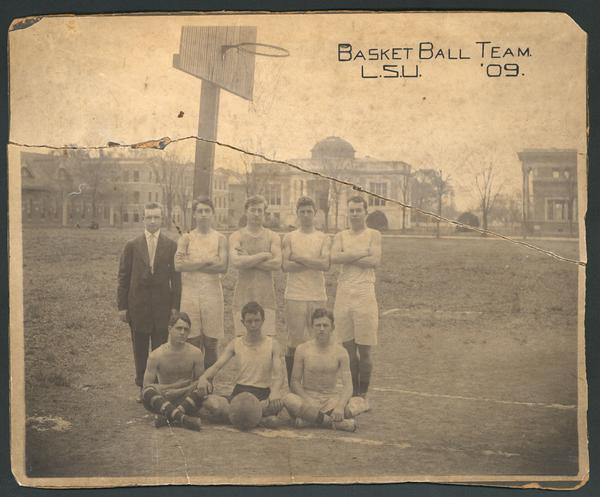
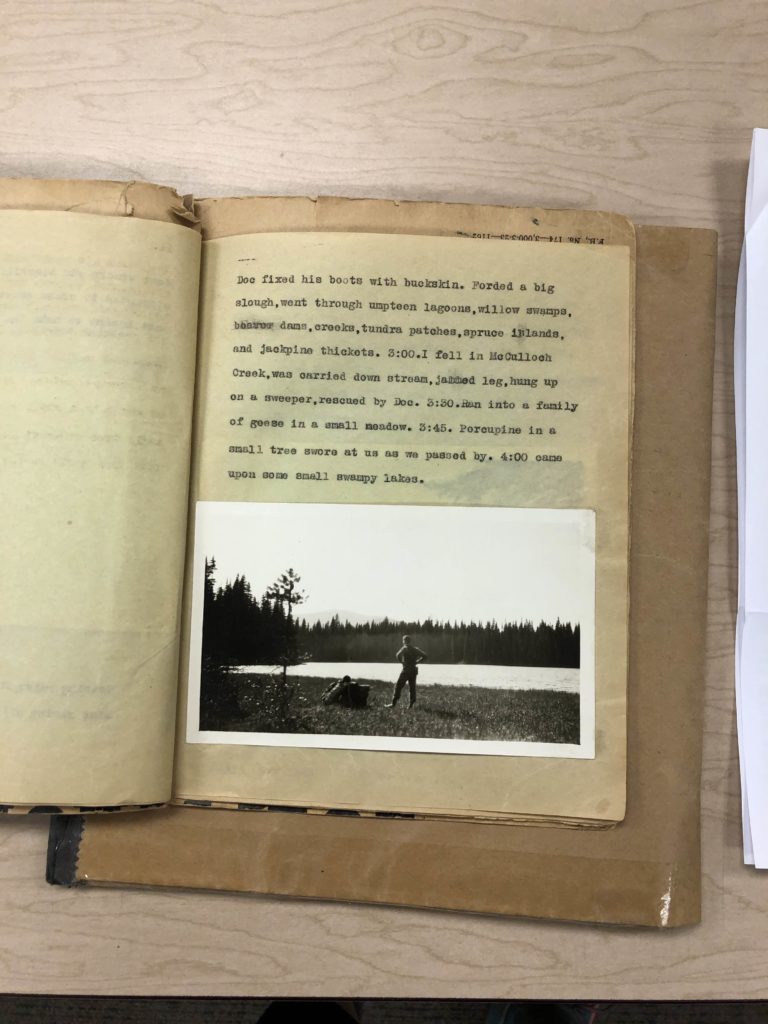
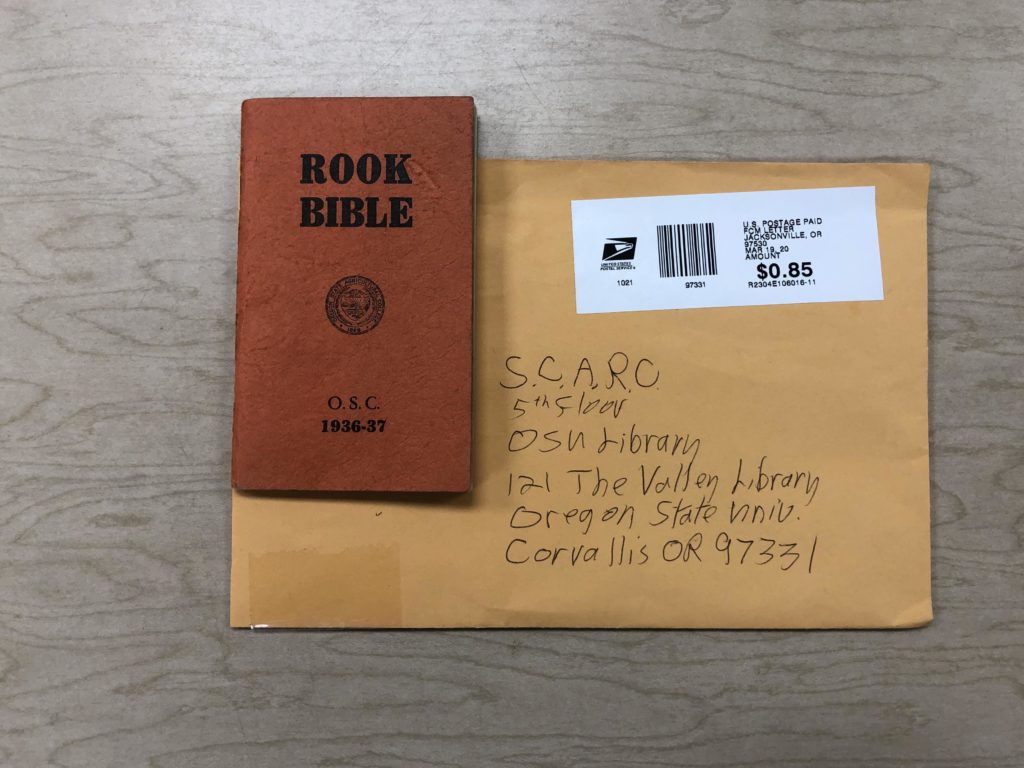
I’ll be ready to podcast by the time we’re back in the building!Opening mail! 😍Running shoes are optional for lake expeditions. This donation is a gem! We’ll be back soon to get it in proper housing and let you know more about it. We got a rule book in the mail too!My coworkers are looking for a good background for virtual reference. Zoom in and you’ll see a unicorn next to the disinfecting wipes!This is where I spent most of my time. The Library staff scanning course reserves and remote requests have been swamped, so they put our BookEye out in the alcoves to scan during the week. Scanning letters from the Civil War… We will get through this trying time too.
Among the wide variety of items in the Ava Helen and Linus Pauling Papers is the collection of molecular models, which sit serenely on display in the back shelves of the archives. These models were created by Pauling throughout his career; the earliest dates to the 1920s, and the later ones to the 1980s. Each piece is testament to how incredibly useful the visualization of molecular bonding and 3D space can be for scientific comprehension, particularly before computer modeling was commonly available. Pauling himself was an early and vital proponent of using these models in a classroom setting, and would often use them during his own lectures at Oregon State University and Cal Tech. From paper to aluminum, wood, plastic, and wire, the collection of Linus Pauling’s molecular models is diverse, and shows the progression of Pauling’s various interests in molecular chemistry, as well as advancements in the understanding of these concepts. Understanding the materials comprising an artifact and how those materials degrade is extremely important for a conservation team, as no two materials will deteriorate in the exact same way in similar environments. One of the more problematic pieces within this collection of models is the close- packing hard sphere models, which are comprised of latex balloons and marbles. After filling balloons with water, Pauling would insert the appropriate number of marbles and then drain the water and tie off the balloons. The final product is a small, globular object which was meant to demonstrate how atoms arrange themselves in solid crystalline patterns. While in its time this was a unique and useful tactic to show these chemical structures, the materials of these models have posed many issues with regards to archival use and display. Today, the balloons that once were elastic and held together the shape of the molecular model, have all but completely degraded. Some of the balloons have become brittle, flaking away with the slightest touch or movement. This rendered two of the balloon and marble models unstable- as soon as the balloon encapsulating the marbles breaks away, the marbles lose their structure and tumble down, spilling across the display stand. Many of the marbles themselves have degraded significantly, shattering into a dust-like consistency. The models, once practical and pristine, have been reduced to a pile of fractured rubber and glass, and it is almost impossible to understand what molecular form they once took.
Pictured above: Molecular Models 1 (left) and 2 (right)
Obviously, this poses significant issues in terms of display. Aesthetically, it is unappealing, this mass of aged, pale latex and yellowed marbles. Additionally, the original function of the objects as educational tools has been lost. In a classroom, molecular models are meant to be held, turned over in the hands so that a student can understand the symmetry, geometry, and space of atoms bonded together. In their current state, these balloon and marble models cannot be touched at all without further damage to the fragile pieces.
Unfortunately, there is not much that can be done to piece together these models. Any physical treatment option would certainly only cause more flaking of the latex balloons and marbles. Simply leaving these items on display can further exacerbate these issues – even the gentle breeze of a passing staff member could cause the marbles to topple. The best approach, therefore, is to make or purchase appropriately sized enclosures to safely house the models.
When choosing or creating enclosures for irregularly sized items, there are multiple things to consider. Choosing enclosures that meet archival standards ensures the materials used to make the enclosure will not degrade and release harmful vapors or chemicals that will further harm the object it is encapsulating. It is important that the enclosure, or box, fit the item snugly, but allow for easy removal if necessary. For unique items, such as the molecular models, it can be difficult to find enclosures with matching dimensions. To fully enclose the circular display stand and molecular model, I created boxes out of folderstock and mylar. On its own, folderstock can be somewhat flimsy, but with the box structure and the support of the display stand, it is structurally sound. The mylar display allows us to see the molecular model without interacting with it, and helps to prevent further damage. A drop front box is necessary in this case, it allows for easy removal from the enclosure in case the need arises. Acid-free tissue was used as padding around the display stand to prevent the pieces from shifting in transit. For now, the molecular models will return to the display case with the other Linus Pauling models.
Pictured above: the enclosure without marbles
Pictured above: a single enclosure with the marbles (left) and all of the enclosures with their marbles (right)
While it is impossible to stop the inevitable deterioration of the materials, it is important to keep the parts together. Additionally, a note detailing the materials, origin, and method of creation of these items is important for context, and allows these items to return to their original use as a tool for education. While the original form of the models no longer show the complexities of atomic packing, the information of how Linus created and used them can still be valuable for researchers of the history of science today.
Referenced: Chris Peterson, Linus Pauling’s Molecular Models and the Stories that they Tell, ScholarsArchive@OSU
The SCARC vault contains many of the rarest, most fragile, and most valuable items held in our collections. Babylonian cuneiform tablets, dating back to 2500 BCE, detail trade transactions involving sheep and goats. Charles Darwin’s expedition and experiences while aboard the The Beagle are detailed in a first-edition of The Voyage of the Beagle, published in 1836. The vault also contains historical manuscripts – including letters from famous scientists, a 13th century Bible on vellum, and Linus Pauling’s Nobel Prizes. There are many vault treasures – most of which are accessible to visiting patrons by request, and many of which are regularly used in class visits or SCARC events. One of the more unique items housed in the vault is the Scroll of Esther.
Tucked
into an ill-suited document case, wrapped in tissue paper, lies the Scroll of
Esther, which was probably made in the 18th century. The scroll
consists of a single wooden roller, handle, and the rolled pieces of parchment,
onto which the Hebrew book has been transcribed in handwriting, as per the
Jewish tradition. While delicate, the scroll is in generally good condition –
each part remains intact, the ink is still dark and visible, and the scroll can
be read somewhat easily, with gentle handling. The document case housing and
tissue paper wrapping, however, was decidedly inappropriate, and I was tasked
with creating a more suitable enclosure for the scroll.
The previous enclosure for the Scroll of Esther
When
designing a custom enclosure for an object such as a scroll, it is important to
note where the object is most fragile, and thus needs the most support. The
handle and top of the wooden roller are most subject to damage due to their
precarious attachment. In some areas, the handle has just started to crack, as
wood expands and contracts with the changing of its environment. Therefore,
protecting these portions of the scroll was of utmost importance, and I needed
to find a way to create a structure that would prevent the handle from becoming
loose and breaking off within the box itself, in the case of careless transport
or further degradation of the wood.
Before
I began, I found it necessary to do a little research on the subject of scroll
enclosures. An article detailing the acquisition of a large Torah scroll by the
Rubenstein Library at Duke University explains how enclosures were modified to
add frames to hold and support the handles of the Torah scrolls. I used this as
inspiration for an enclosure that would suit the needs of our much smaller
Esther scroll, which only had one handle and roller, as opposed to two, as many
Hebrew Bible books traditionally contain. The design was relatively
straight-forward: a box, a lid, and a structural frame for the wooden parts. Through
my rather chaotic construction plans, you can generally see the process of
manipulating the flat e-flute.
The new design plans
After
the necessary measurements were made, I began the construction of the box. Each
section was cut from e-flute board, folded, and shaped to form the parts.
Through trial and error, a structurally sound box was created, with the
appropriate dimension to enclose and protect the scroll. A label was added, and
the scroll was placed back into the vault, where it will remain until it is of
academic or intellectual use.
The finished project!
This blog post was authored by Hannah Lawson, a student archivist and chemistry major at OSU.
January is finally over! Throughout the course of last month, four new or updated finding aids (a.k.a. collection guides) were completed by SCARC staff. These collections are now fully processed and described and available for researcher use. Two of the guides are for new collections received since 2015 that were previously unavailable to researchers (the Zigler Papers and Summer Session Records). The other two guides are substantial updates to incorporate additions and reflect full processing and description. Descriptions of more than 1300 SCARC collections are available on the SCARC website; 1029 SCARC collections are now described in Archives West.
The Gilbert Zigler Papers document the career of Gilbert “Gil” Zigler, a nuclear engineer who specialized in reactor safety and monitoring. The collection is comprised of items collected during his education at the United States Air Force’s Institute of Technology and career as a reactor diagnostic engineer, spanning from 1962-2014. The collection includes scientific publications, reference materials, notes, and memorabilia from his career, and highlights Zigler’s professional expertise primarily through documents relating to his role in diagnosing and solving problems during the Three Mile Island reactor incident. Much of the collection addresses the field of reactor safety in its various applications and aspects.
The Summer Session Records document the operation and administration for courses and special programs and activities offered at Oregon State during the summer beginning in the 1910s. The records specifically pertain to academic courses and special programs and activities; enrollment and demographics for summer students; finances; and promotion and marketing. Summer courses were first offered at Oregon State in 1908.
Finding aids for collections that were only minimally described and are now fully processed and described:
The College of Science Records document the administrative activities of the College of Science at Oregon State University from its founding in 1932. The records include administrative records, biographical files for select faculty and staff of the college, correspondence, department histories, college publications, newspaper clippings, photographs, and microfilmed correspondence and reports. The College of Science was first established as the School of Science in 1932; it became the College of Science in 1973.
Russell and Katherine (Smith) Tegnell were students at Oregon State College who met on campus and married in 1934, just before their fourth year of college. The Russell and Katherine Tegnell Scrapbook was compiled by the couple, and contains numerous newspaper clippings as well as a smaller number of photographic prints. Much of the material included in the scrapbook is related to Russell’s time as the President of the Memorial Union as well as Katherine’s academic achievements. Initiation and award certificates, and a blank class officers ballot are also included.
The Department of Physical Education for Women experienced some turbulent years during the 1950s when one of their instructors, Dr. Florence Hupprich, requested a hearing from the Faculty Committee of Review and Appeals for wrongful termination of employment in 1952. She claimed that Dr. Eva Seen, the head of the Department of Physical Education for Women, after long denying her tenure, had fired her without reason. Dr. Hupprich’s case against Dr. Seen would reveal an almost decade-long feud between the two women, and instigate numerous reviews into their character, professional practices, and the department as a whole. Ultimately, these reviews would reveal a department pervaded by sexism, ageism, and maladministration practices.
Dr. Hupprich came to Oregon State College in 1937 as an associate professor in physical education. Before coming to OSC, she was an associate professor at Texas State College for Women. When she began at OSC, Hupprich had a master’s degree in physical education from the University of Wisconsin. In 1944, she requested a leave of absence to obtain her Ph.D. During her leave of absence, she was promoted to the rank of assistant professor. Hupprich obtained her Ph.D. in 1949, and it was then that she began asking Dr. Eva Seen about receiving tenure.
Dr. Hupprich did not mince words with Dr. Seen on this issue. By 1949, no one within the Department of Physical Education for Women had received tenure for over a decade. The department only had two tenured faculty: Dr. Eva Seen and Betty Lynd Thompson. Hupprich had been working at Oregon State for thirteen years by this time, and believed that she had earned the right to tenure. Hupprich pointed out to Dr. Seen that the Department of Physical Education for Men had already granted tenure to many of their faculty. According to Hupprich, Dr. Seen was opposed to granting tenure to any of her faculty. Dr. Seen changed her stance in 1952 when the department adopted and began practicing the standard tenure policy for institutions of higher education. However, Dr. Hupprich was not one of the faculty members to receive tenure in that year. In fact, the majority of the members who did receive tenure had been working at Oregon State for much less time than her. By the end of the 1952 school year, Dr. Hupprich received a letter from Dr. Seen informing her that her employment would be terminated by the spring of 1953. Dr. Seen did not give any reason for firing Hupprich.
Dr. Hupprich was crushed by this. She had spent well over a decade at Oregon State in the hopes of receiving tenure. At fifty-two years old, she worried her career would be over. She fought back against her termination of employment and requested a hearing from the Faculty Committee of Review and Appeals (FCRA). During this time, she contacted Dr. A.L. Strand, the president of Oregon State, informing him of her situation. Strand was well aware of the situation between Seen and Hupprich, as Hupprich had come to him before to ask about tenure policy. Strand agreed to allow Hupprich to remain working at Oregon State until the FCRA completed its review of her case. The review was long delayed and ultimately proved to be unhelpful to Hupprich. During her hearing, she was unable to gain insight into any accusations Seen may have made against her regarding her firing. The committee did, however, find that Hupprich should have received tenure years ago.
Hupprich took her case to the American Association of University Professors (AAUP) in 1954. Not long after she did so, President Strand received a letter from the association inquiring the nature of the relationship between Seen and Hupprich and the circumstances under which Hupprich was fired. Strand wrote back, explaining that Seen and Hupprich’s relationship was nothing more than a clash of personalities. He also stated that according to their policy, any untenured faculty can be terminated with no reason. If Strand’s letter was intended to mollify the association, it certainly did not work. They responded to inform Strand that any faculty member who had been working at the institution for as long as Hupprich had should not have been terminated without receiving a faculty hearing first. They then stated that they would be looking into why Hupprich and Seen didn’t get along.
While the AAUP conducted its review, Hupprich was allowed to continue working at Oregon State. During this time, Dr. Seen came forward and informed President Strand why she had not given Hupprich tenure. Seen claimed that Hupprich was not an engaging instructor and that she was unwilling to take on extra responsibilities outside her work hours. Seen pointed to Hupprich’s salary raises to prove her point. From 1937 to 1954, Hupprich never received a raise based on merit. However, the AAUP looked into student reviews on Dr. Hupprich to judge the quality of her teaching. While some students complained of Hupprich being too “exacting and detailed” in her beginning courses, the AAUP largely found positive reviews about her. They ultimately concluded that she was strict, but “a good teacher”. Ultimately, they concluded that this was in no way grounds for her termination. As for the relationship between Hupprich and Seen, the association found that the women had been feuding for almost a decade. Hupprich claimed that Dr. Seen practiced favoritism in granting merit-based salary raises and tenure. Hupprich and Seen also had many disagreements over teaching and administrative methods. Other staff members in the department concurred that Hupprich was one of the few people that occasionally stood up to Dr. Seen’s “autocratic procedures”. Hupprich even agreed with Dr. Strand’s explanation that the situation between her and Dr. Seen could be described as a character clash. However, she also added that she felt Dr. Seen had been jealous of her ever since she obtained her Ph.D. The association found that Dr. Seen had been encouraging Dr. Hupprich to seek employment elsewhere since 1945, when she was on leave to study for her degree. Hupprich had also been complaining about her low salary since that time. In a letter written to Dr. Seen that year, Hupprich complained about how little she was paid, given her education level. Dr. Seen had shown dissatisfaction with Hupprich’s decision to take a leave of absence to accept a graduate assistantship with the University of Oregon.
“Oregon State College, I feel, owes me some consideration since I served the department for a very low salary for several years. With new instructors just out of college getting only $225 less than I would after more than a year’s work toward a doctor’s degree does not seem to justify my returning at this time.”
The AAUP concluded in a letter written to President Strand that there was evidence that Dr. Seen had some failings as an administrator. In 1955, the American Association of University Professors concluded that Hupprich was unfairly terminated and was entitled to indefinite tenure. This was granted by President Strand.
But Dr. Hupprich’s case was not over yet. At this point, there was little reason for those in charge to think the case of Dr. Hupprich and Dr. Seen was anything more than an extreme character clash between two faculty members. It would be easy to assume the incident was an isolated occurrence within the department. But only a few years later in 1957, another faculty member, Betty Lynd Thompson, came forward and requested a review from the FCRA. Thompson claimed in 1957 that she was being unjustly differentiated against by Dr. Seen and Dr. Langton in her salary.
Thompson had a unique perspective within the department, because she had worked there longer than Dr. Seen had. She had seen how the department was run before Dr. Seen arrived. Thompson was also the only staff member who had already been tenured before Dr. Seen had arrived. In a letter written to President Strand, Thompson stated that the Department of Physical Education for Women had been negatively impacted by Dr. Seen’s leadership. She described the general atmosphere among the faculty as having a low morale.
Thompson had come forward in 1957 with the complaint that Dr. Seen showed favoritism in her decisions to grant promotions and salary raises. She also raised a complaint about Dr. Seen and Dr. Langton, the head of the Department of Physical Education, who she claimed had encouraged her students to petition against her.
According to Thompson, in 1957-1958, Dr. Langton and Dr. Seen had a private conference with two of Thompson’s students who were upset over their low grades from Thompson’s classes. They suggested to these students that they should circulate a petition against Thompson. Thompson was not made aware of these meetings or the petition until a year later.
Thanks to OSU alumna Julia Fox (class of 2018) for her research and writing of this piece!
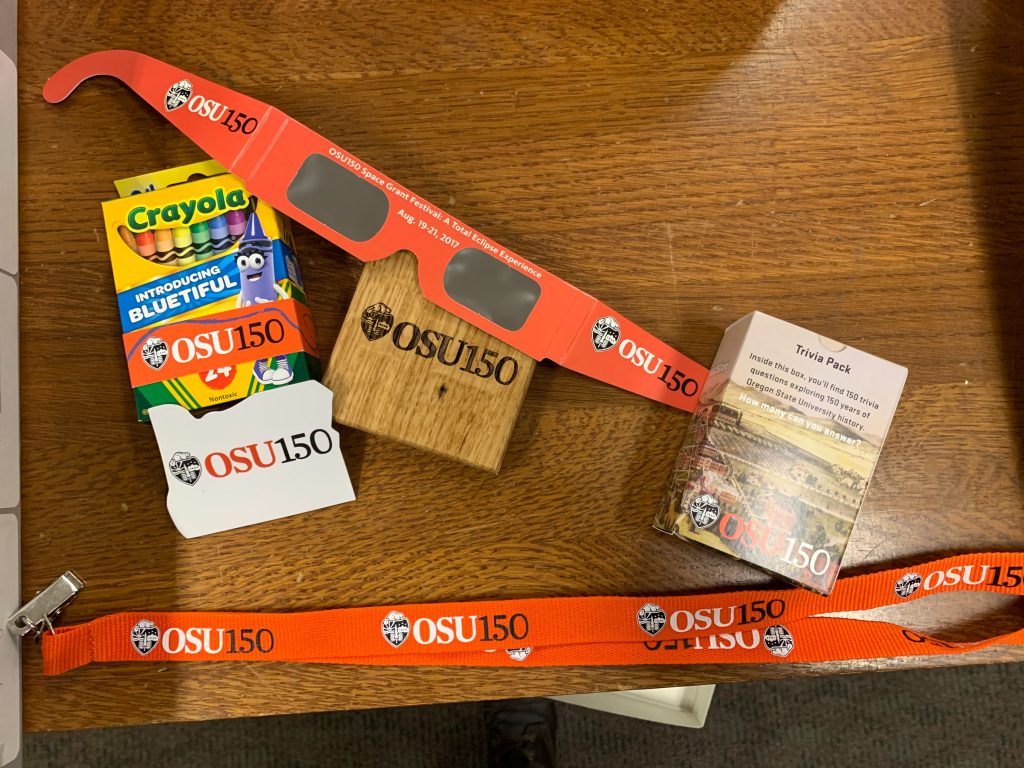
In 2017 and 2018, Oregon State University commemorated its 150th anniversary with the OSU 150 celebration. This experience consisted of several events over the course of the year, recognizing the abundant contributions made by OSU, including festivals recognizing OSU’s land, sea, space, and sun grants. [1] Though the celebrations wrapped up in 2019, memorabilia left behind will be preserved in the Special Collections and Archives Research Center (SCARC), as well as online through the Sesquicentennial Oral History Project.[2]
The materials collected from the OSU 150 celebration represent years of planning from many different individuals and departments across campus. The anniversary opened in August 2017 and continued through October 2018 with the goals to, “celebrate and commemorate OSU and its unique land grant mission; inform, inspire and engage diverse audiences; and distinguish what makes OSU unique now and in the future.”[3] Special Collections hosted its own cache of events, including the book launch of The People’s School: A History of Oregon State University, with a lively discussion by author William G. Robbins and SCARC Director Larry Landis.[4] With events such as this hosted all over campus, archival material collected for SCARC to preserve. Karl McCreary, OSU Collections Archivist specializing in campus history, is managing the accession process for this collection – which alongside documental material includes memorabilia from the celebration.
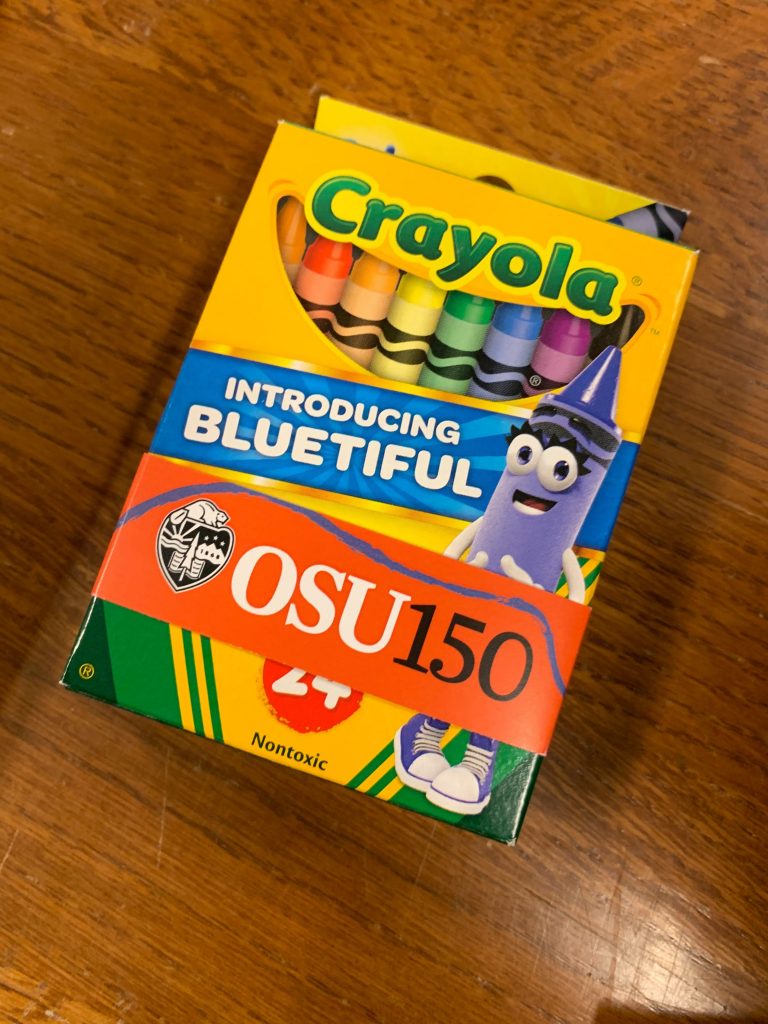
Crayola’s newest color, Bluetiful, based on a new blue
pigment discovered by OSU Chemist Mas Subramanian[5]
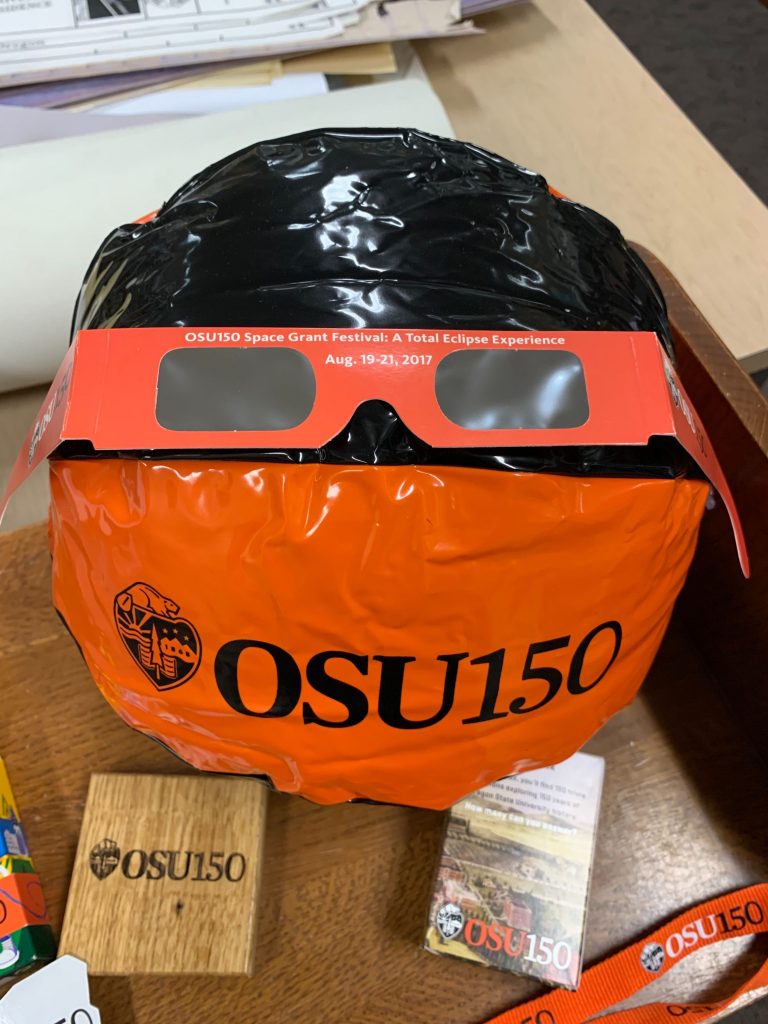
These glasses were distributed before the 2017 solar
eclipse, where Oregon experienced totality
A selection of some of the OSU 150 memorabilia to be
preserved in the collection
This
material, having been primarily accessioned by SCARC, will be fully described
in an online guide at a later date. At
that point, these treasures will be available to the public!
During the month of August, the Resident Scholar Program
at the Special Collections & Archives Research Center hosted Kali Furman, a
PhD candidate in Women, Gender, and Sexuality Studies here at Oregon State
University. During her term of residence, Furman conducted a case study
analysis of the formation of the Difference, Power, and Discrimination program
at Oregon State University. The program was instituted by the university in the
1990s to promote diversity and social justice education in response to a string
of racist incidents involving Oregon State students. While conducting the case
study, Furman focused on what historical, contextual, and institutional factors
come together to enable critical social justice education programs to take root
and find success in higher education.
Kali Furman at the OSU Leadership Conference
Furman’s presentation of her research, titled “Student
Activism and Institutional Change: A History of the Difference, Power, and
Discrimination Program,” provided an overview of the social climate on Oregon
State’s campus and the surrounding Corvallis community in the 1990s. Furman
specifically documented a span of a few days in 1990, when multiple students of
color were verbally assaulted by white students, leading to public protests and
other forms of unrest on campus.
OSU President John Byrne responded to these
high-profile incidents by tasking a commission to investigate them and to provide
him with recommendations for moving the university forward. Furman’s research
indicates that student leaders were not satisfied with this course of action,
and that they demanded that the university implement required coursework
related to issues of multiculturalism and diversity. Initially the administration
was slow in its adoption of this idea, but by the 1991-92 school year, the
Affirming Diversity Course Development Committee had been formed, which
ultimately grew into the Difference, Power, and Discrimination program that
exists at OSU to this day.
The creation of the program was a major success for student
leaders and concerned faculty, but obstacles remained throughout the course of
the decade. In particular, budget cuts enacted for the 1997-98 academic year
threatened the existence of the program, which again caused protests and
dissatisfaction among the student body. This time around, both students and the
community rallied around the DPD program, publicly expressing their feelings
about the value that the program brought to the student experience and the broader
culture of Oregon State University. In response to this outcry, the OSU Provost’s
Office provided interim budget support for the program, which finally received more
stable funding in 2002.
For nearly thirty years now, the Difference, Power,
and Discrimination program at Oregon State University has worked to develop a
comprehensive curriculum that promotes diversity and social justice, while
addressing institutionalized systems of inequity. A component of the
university’s Baccalaureate Core, the DPD program also sponsors guest speakers, film festivals, informal workshops
and seminars, and other special events.
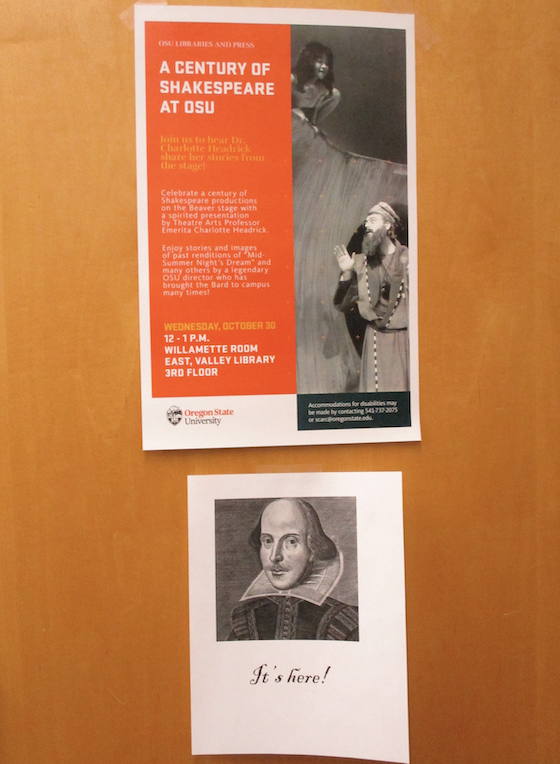
Puck, Ariel, and Romeo are familiar faces to the Beaver stage and their characters were brought to life by Professor Emerita of Theatre Arts Charlotte Headrick in a presentation on the history of Shakespeare productions at OSU. The event was organized by the OSU Special Collections and Archives in celebration of Oregon Archives Month and entertained 20 folks during their lunch hour on October 30th. In this quirky and fun overview, which began with a view from the first known student staging of a Shakespeare play (Julius Caesar) in 1895, Charlotte shared tales of near disaster (the actor who had to be roused from his bed at home to play his part on the opening night of the Merchant of Venice), unconventional productions (live chickens on the stage for Taming of the Shrew), and alums who would later shine bright in the world of theatre after OSU (Julyana Soelistyo, Michael Lowry, Soomi Kim, Sheila Daniels).
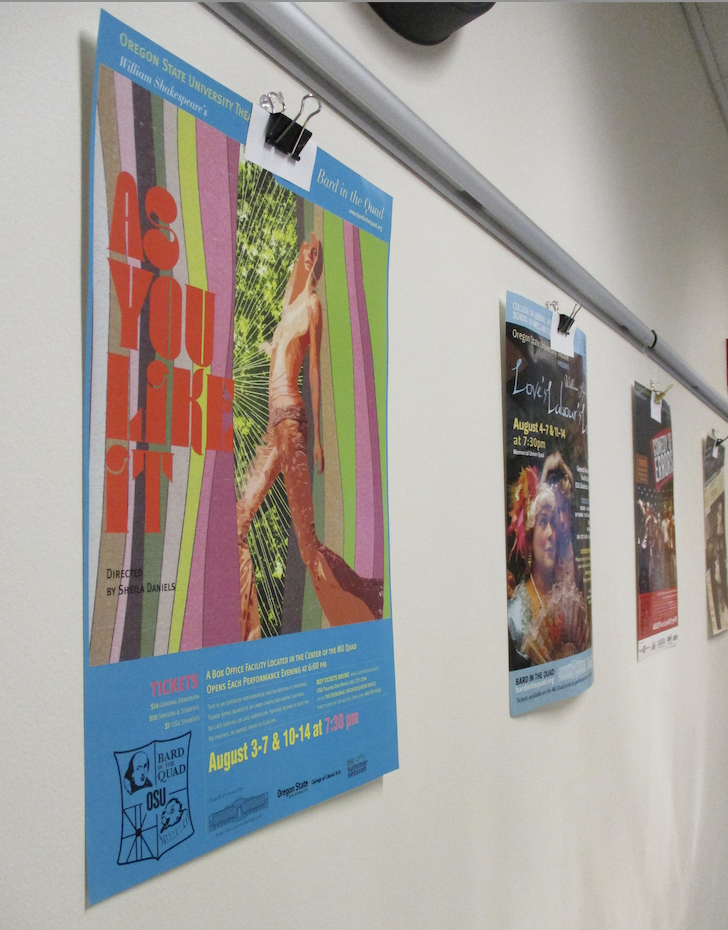
With a 35-year history of directing and performing in dozens of OSU theatre productions, Charlotte recounted stories of her many brushes with the Bard. These included details of the countercultural feel of a 2011 production of As You Like It where Charlotte played the character of Duke Senior wearing a patchwork quilt coat a la Ken Kesey. This play was a part of a very successful recent tradition of Shakespeare productions performed outdoors during the summer that began in 2006 and has continued on through this year. Posters for many of these annual “Bard in the Quad” productions were on display during Charlotte’s presentation, including the colorfully psychedelic one for As You Like It.
It was very fitting that Charlotte showcased campus history for Oregon Archives Month. For the nearly 20 years that I’ve been at OSU, Charlotte has been helping us preserve documentation of university theatre through many transfers of photographs, posters, programs, and prompt books. Not surprisingly, nearly all of the images featured in the presentation came from collections in SCARC. Her own career at OSU is reflected in The Charlotte Headrick Papers (unprocessed and not yet available) and there are two oral history interviews conducted with Charlotte in 2015 and 2019.
How can I even begin to answer that question? My experiences in the Special Collections and Archives Research Center (SCARC) and with SCARC faculty over the past four and a half years have been, in one word, amazing. But beyond that, there are not enough words to even begin to say what this experience has meant to me. Every day there is something new to discover and new people to interact with. But even more importantly, over the past four years I have discovered that my work in special collections and archives has fostered in me a love beyond merely conducting research, but being able to share in others’ work and excitement of discovery in the archives. Through working at SCARC I get to use my background in history and research to share with researchers (and the world through social media!) what amazing collections we have the honor of working with.
I have also
had the opportunity to work outreach events, events that I believe are crucial
to reaching people outside of the academic setting. I have volunteered to work SCARC open houses
and exhibit openings, while also traveling farther afield to work events in
Portland. This ability to share SCARC
with people beyond those who walk into the reading room is one of my favorite
parts of working here. And I LOVE
working the front desk. My hours spent
working the front desk have been some of the most fulfilling.
While
completing my PhD and working at SCARC I also had the opportunity to serve as
Deschutes Brewery Archiving Intern.
Aside from working full-time while going to school, this was an
eye-opening experience that allowed me another opportunity to share the archive
experience with those outside of the traditional academic setting. It was also the largest collection I had
processed on my own. This was a great
learning experience that truly brought the archives to life for me and gave me
a project I could call my own. I also
valued the opportunity to share the importance of archives for preserving not
only company records or artifacts, but the importance of the employees voices
in that company history.
But most importantly, I have decided that this is what I want to do for the rest of my life. Despite having spent seven years working on a Masters and then PhD in History of Science, I want to spend my days working at an archive. As I look towards the future and think about what I want it to hold, I know my future plans will ideally include working and teaching in an archive. With the experiences I have gained in my seven years at OSU, four of which I had to honor of spending working in SCARC, I know I don’t want my work in the archives to end. To me, the archives can serve as a place to bring all these experiences together and allow me to pursue a profession that brings together the best parts of being a historian while having the opportunity to share this knowledge through archives and aiding in each researcher’s own research and project development.
Anna Elizabeth Dvorak is a historian of science focusing on science in early Cold War policy. She recently completed her PhD dissertation on Leo Szilard’s fact and fiction here at OSU.
Anna Elizabeth Dvorak is a historian of science who focuses on science in early Cold War policy. She recently completed her PhD dissertation on Leo Szilard’s fact and fiction here at OSU. Processing the Gil Zigler Papers was her last project as SCARC’s Lead Student Archivist.
I recently finished processing the Gil Zigler Papers, and as this is my final project for SCARC it is bittersweet. But it was also the perfect collection to end on: Zigler’s collection combines my expertise with the reason I love working in an archive, the people. I have spent the past seven years working on a masters and doctorate in the history of science focusing on nuclear history, only to be convinced that my true passion lies in working the archive not as a researcher but as an archivist. Being a historian archivist allows me to share my passion for research over and over again with each patron that comes in. And by watching patrons get excited with each new find, I too get excited about the work I have the privilege to do at SCARC.
Because Gil’s daughter works on campus, she was able to come visit. It’s always amazing to meet the donors of collections we have the opportunity to work with here at SCARC. These donors are often the family members or friends who had the honor of knowing the person while they were still alive and can add so much personality to the pieces of paper we collect together in folders and boxes. It is even more so when the donors are relatives and share a deep understanding and appreciation for archives. Gil’s daughter was SO excited about the collections we have and to hear how her dad’s papers fit in with our other collections.
Zigler was a nuclear engineer specialized in reactor safety and monitoring. The collection is comprised of items collected during his education at the United States Air Force’s Institute of Technology and career as a reactor diagnostic engineer, spanning from 1962-2014. The collection includes scientific publications, reference materials, notes, and memorabilia from his career. The collection highlights his expertise through his participation at the Three Mile Island reactor incident and documents he collected in that role. Much of the collection addresses the field of reactor safety in its various applications and aspects.
The Zigler Papers have found a home among our other nuclear history and history of science collections and greatly enrich our holdings. Zigler has an extensive chronology through newspaper clippings of the Three Mile Island accident in 1979, including his role to help shut down the damaged reactor unit. The bulk of the items consist of articles and other published items by individuals, including Zigler, or organizations, like Babcock & Wilcox or the US Nuclear Regulatory Commission.
We are honored to announce this new collection on the fifth anniversary of Gil Zigler’s death, October 12, 2014.