This blog post was originally published on September 10, 2018 and written by Christopher M. Sullivan, Assistant Director for Biocomputing. Read the whole article here.

The Oregon State University’s Center for Genome Research and Biocomputing (CGRB) and the Plankton Ecology Lab at OSU Hatfield have been collaborating in implementing an image processing pipeline to automate the classification of in situ images of plankton: microscopic organisms at the base of the food web in the world’s oceans and freshwater ecosystems. The imagery collection from a 10-day cruise typically contains approximately 80 TB worth of video, which, in some cases, may convert into image data yielding several billions of segments representing individual plankton and particles that need to be identified; a near impossible task to carry out manually by human experts. While we have a fully functional Convolutional Neural Net (CNN) algorithm that does an excellent job at predicting the identity of the plankton organisms or particles, we have been limited by GPU computational capabilities. We started working with PCI bus based Tesla K40 and K80 GPUs, which were good enough to manage millions of segments. However, when it came to billions of segments, it became a near insurmountable challenge.

Continue reading

R’s default print function for data frames and matrices is not an effective way to display the contents, especially in a html report. RStudio created a R package, DT, that is an interface to the JavaScript library DataTable. DT allows users to have interactive tables that includes searching, sorting, filtering and exporting! I routinely use these tables in my analysis reports.

Install the DT package from cran

First, one must install and load the DT package. Open up RStudio and run the following commands to install and load the DT package:

# Install the DT package
install.packages("DT")
# Load the DT package
library(DT)

Example Table

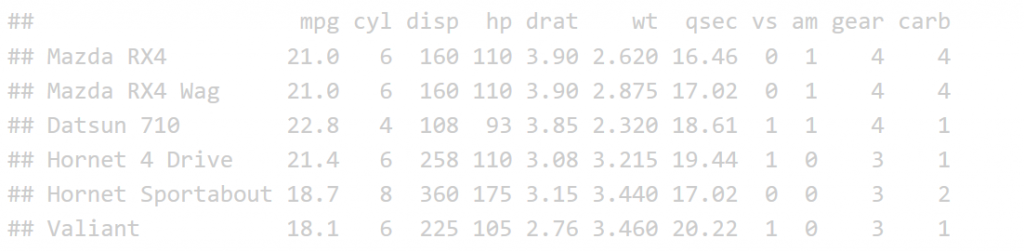
The print function is not the most effective was to display a table in an HTML R Markdown report.

print(head(mtcars))
This image has an empty alt attribute; its file name is image-10-1024x252.png

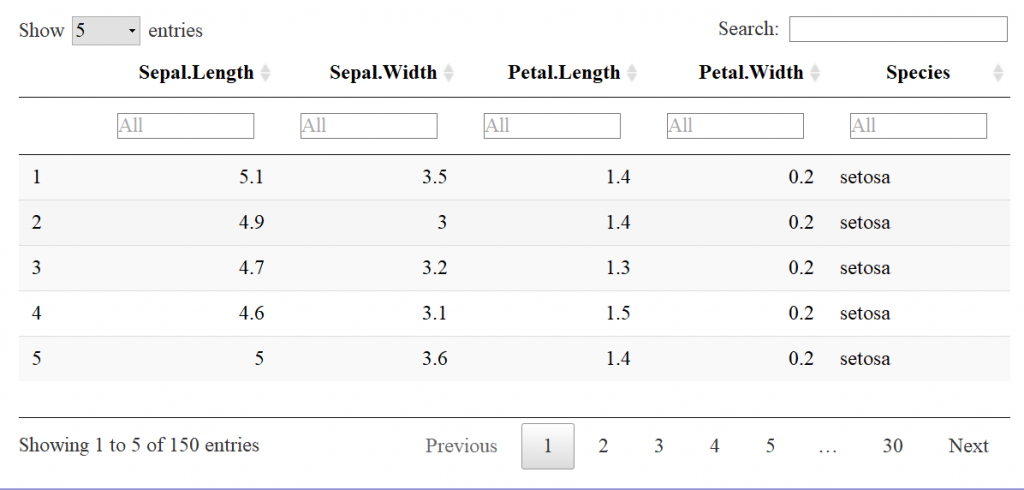
Now let’s look at the datatable function for comparison. The input to the datatable function is a data frame or matrix. Let’s make a table with the preloaded iris data that’s in a data.frame. The basic call is DT::datatable(iris) but in our example I’ve added the filter option to the top of the table, and limited the number of entries to 5 per table. See code and table features below:

datatable(iris, filter = "top", 
          options = list(pageLength = 5))

A screen shot of the output looks like:

This image has an empty alt attribute; its file name is image-1024x490.png

Already, the readability is much better than the base r function print. This is a JavaScript based table, stored in a HTML widget, so a flat image doesn’t convey all of the interactive features.

Features

NUMBER OF ENTRIES TO DISPLAY

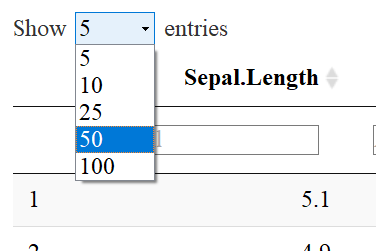
You’ll notice that there is a drop down menu that says: “Show 5 entries”. The default is 10, but I specified 5 as default with the code pageLength=5. One may select the number of entries to show by using the drop down menu like so:

This image has an empty alt attribute; its file name is image-1.png

SEARCH BAR

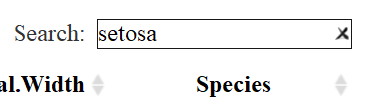
The widget also includes a search bar on the top right corner which can be very useful when interactively exploring data. Note at the bottom of the table it shows you how many entries (rows) were found and are being displayed.

This image has an empty alt attribute; its file name is image-2.png
This image has an empty alt attribute; its file name is image-3-1024x58.png

SORT COLUMNS

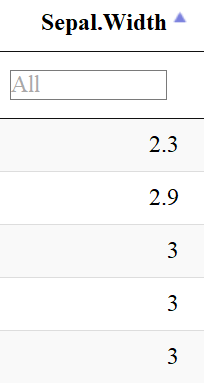
Notice that to the right of each column name are two arrows: One may sort by ascending or descending order and the direction of the blue arrow indicates by which direction you sorted the column.
This image has an empty alt attribute; its file name is image-6.png

FILTER COLUMNS

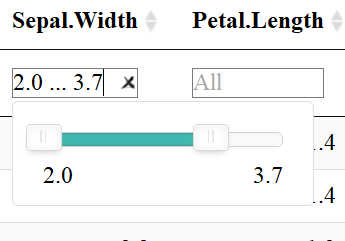
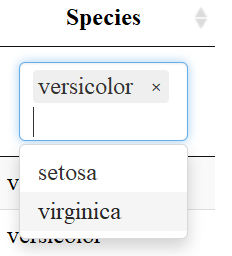
The datatable function also allows users to filter each column depending on the datatype: filter numeric columns with a slider & filter columns of class factor with a drop down menu. One must add the filter = "top" (or bottom, etc.) to the code to enable this feature.

This image has an empty alt attribute; its file name is image-7.png
Numeric columns have sliders
This image has an empty alt attribute; its file name is image-8.png
Columns of class factor have a drop down menu

Export Data

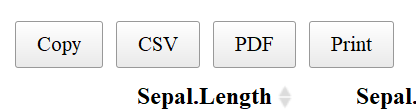
Another useful aspect of the datatable function is the “Buttons” extension. This enables users to copy the table, save as a csv, excel or PDF file, or print the table. The table “remembers” what you’ve changed so far—so if you sort by Sepal Length, filter pedal width to > 1 and select species “versicolor” the copied/saved table will have these same restrictions.

datatable(iris, 
          extensions = 'Buttons',
          options = list(dom = 'Bfrtip', 
                         buttons = c('copy', 'csv', 'excel', 'pdf', 'print'))

The above code adds “buttons” to the top of the table like so:

This image has an empty alt attribute; its file name is image-9.png

If one clicks “copy”, the table will be copied to your clipboard, “CSV” or “PDF” will save the table to the give file type, and “print” will bring put the table into a print friendly format and will bring up the print dialog box.

Links and Color

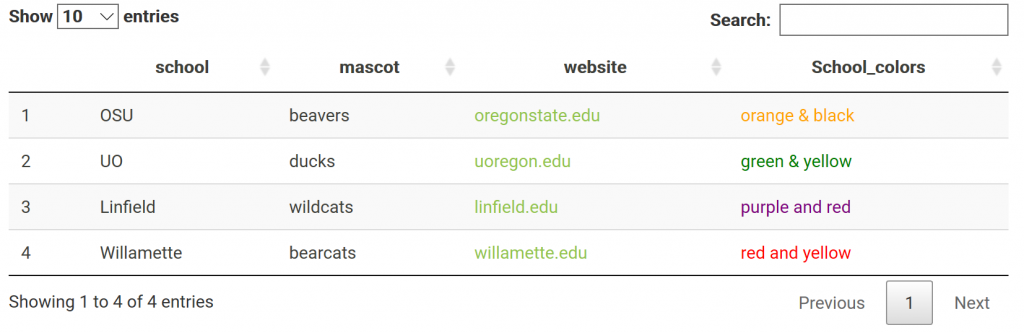
One may also have links in their table. Say you made a data frame with links you want to work in your html report. For example: a data frame of variants w/ links to their position in a genome browser. This is done through not escaping content in the table, specifically the column with the links. The links are made with html and must not be escaped to show up. This applies to other html as well; including color. For me, it was confusing that I had to not escape the html columns. Got it completely backwards the first time I tried it. NOTE: > got replaced with “& gt;” (with no spaces) when it is rendered on the blog… Need to find a fix!

# Make dataframe
df.link <- data.frame(school=c("OSU", "UO", "Linfield", "Willamette"), 
                      mascot=c("beavers", "ducks", "wildcats", "bearcats"),
                      website=c('<a href="http://oregonstate.edu/">oregonstate.edu</a>',
                                '<a href="https://www.uoregon.edu/">uoregon.edu</a>',
                                '<a href="https://www.linfield.edu/">linfield.edu</a>',
                                '<a href="https://www.willamette.edu/">willamette.edu</a>'),
                      School_colors=c('<span style="color:orange">orange & black</span>', 
                                        '<span style="color:green">green & yellow</span>', 
                                        '<span style="color:purple">purple and red</span>', 
                                        '<span style="color:red">red and yellow</span>'))

# When the html columns, 3 & 4, are not escaped, it works!
datatable(df.link, escape = c(1,2,3))
This image has an empty alt attribute; its file name is image-11-1024x333.png

Column Visibility

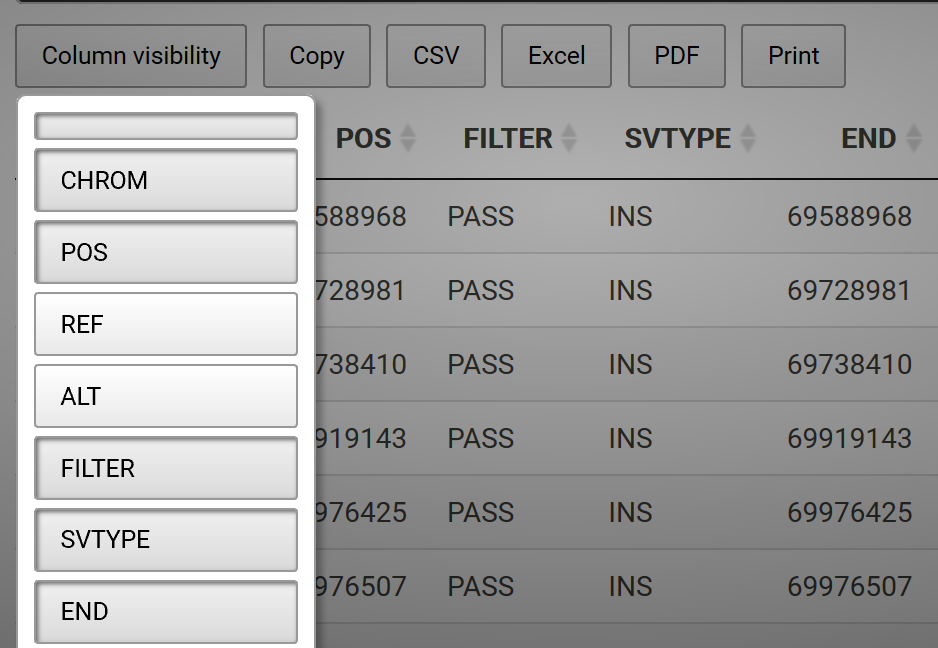
One may also hide columns from visibility and add a button to add the column back interactively. For example, say we have a data frame called sv.all.i.in. We can hide columns 3 and 4, which are long sequences and disrupt the readability of the table, with the following code:

datatable(sv.all.i.in, extensions = 'Buttons',
          options = list(dom = 'Bfrtip', columnDefs = list(list(visible=FALSE, targets=c(3,4))), 
                         buttons = list(I('colvis'),c('copy', 'csv', 'excel', 'pdf', 'print'))))
This image has an empty alt attribute; its file name is image-12.png

Learn More

There are many more useful features that you can add to your datatable! Learn more here: https://rstudio.github.io/DT/

The CGRB 2019 Fall conference registration is now open! Please join us for our annual event this September for informative talks, posters and a reception. This year the Fall Conference will also include lighting talks.

Important Information:

  • When: Friday, September 20, 2019
  • Where: CH2M Hill Alumni Center – Oregon State University
  • Registration: here
    • Registration fee: $25 (includes lunch and social hour)
    • NOTE: registration fee is waved for:
      • Undergrads presenting their research poster
      • Lightning talk presenters
  • Deadlines:
    • Lightning Talk Submission: August 15th
    • Poster Registration: September 7th
    • Conference Registration: September 13th (registration fee increases to $35 after Sept 13)

Featured Speakers

Ed Kelly
Associate Professor
School of Pharmacy
University of Washington

Daniel Liefwalker
Research Assistant Professor
Molecular and Medical Genetics
Oregon Health and Science University

Doris Taylor
Director
Regenerative Medicine Research
Texas Heart Institute

Conference Agenda

Time
8:00-8:50Registration & refreshments (Poster & sponsor setup)
8:50-9:15Brett Tyler,
Director, CGRB
Introduction, CGRB update
Morning
Session
Hosted By Jaga Giebultowicz
9:15 – 9:40Andrew Annalora,
Environmental and Molecular Toxicology
Exploring Splice Variant Biology in Nuclear Receptor and
Cytochrome P450 Genes
9:40 – 10:30Ed Kelly,
University of Washington
Organs on a Chip – Chips in Space
10:30 – 10:55Break (Poster and Sponsor displays)
10:55 – 11:35Morning Lightning Talks (8 talks) –
moderated by Jeff Anderson
11:35– 12:00Felipe Barreto,
Integrative Biology
Genomics in the Tidepool: Functional and Population
Genetics of Adaptation and Speciation in a
Tiny Crustacean
12:00 – 12:25Kevin Brown,
College of Pharmacy
Adventures in Complex Systems
12:25 – 1:25Lunch (Poster and Sponsor displays)
Afternoon
Session
Hosted By Craig Marcus
1:25 – 1:50Afua Nyarko,
Biochemistry and Biophysics
Selectivity and Specificity in Cancer Regulatory Proteins
1:50 – 2:40Daniel Liefwalker,
Oregon Health and Science University
Therapeutic strategies targeting c-MYC
2:40 – 3:20Afternoon Lightning Talks (8 talks) –
Moderated By Viviana Perez
3:20 – 3:45Break 25 mins (Poster and Sponsor displays)
3:45 – 4:10Morgan Giers,
Chemical, Biological, and Environmental Engineering
Regenerating the Intervertebral Disc: Developing Effective
Therapies in a Nutrient Limited Environment
4:10 – 5:00Doris Taylor,
Texas Heart Institute
Building Solutions for Heart Disease: A 2019 Update
5:00 – 7:30Poster Session / Reception, Sponsor Displays

Call for posters!

Invitation to present a Poster at the 2019 CGRB FALL CONFERENCE (Sept 20, 2019)
Students, Post Docs, Research Staff and Research Faculty are invited to present their research as a Poster. Presenters are strongly encouraged but not required to consider utilizing a revolutionary new trend in poster format: https://twitter.com/mikemorrison

https://osf.io/ef53g
(Posters in any format displayed at recent meetings are also welcome)
Prizes for Best Posters: $100 (Undergraduate, Graduate and Post Doc Categories).

All fields and research topics welcome. To submit a Poster, please navigate to https://beav.es/ZPd
DEADLINE Sept. 7, 2019.

Call for lightning talks!

Invitation to present a Lightning Talk at the 2019 CGRB FALL CONFERENCE (Sept. 20, 2019)
https://cgrb.oregonstate.edu/fall-conference
Students, Post Docs, Research Staff (FRA, Res. Associates, etc.), and Research Faculty are invited to present their research as a 5-minute Lightning Talk at the annual CGRB Fall Conference, Friday Sept. 20, 2019.
First Prize for Best Lightning Talk = $100
Conference Registration Fee is waivedfor all Lightning Talk Presenters

All fields and research topics welcome. To submit a lightning talk: Please navigate to beav.es/ZPA

Talks are limited to 5 minutes and 5 slides maximum. Please Submit no Later Than: August 15, 2019.
Talks will be selected by the Program Committee and Presenters notified by Aug. 31, 2019.

Committee Members

Thank you to our 2019 Fall Conference Committee:

Jaga Giebultowicz, Department of Integrative Biology
Craig Marcus, Environmental and Molecular Toxicology
Jeff Anderson, Department of Botany and Plant Pathology
Viviana Perez, Department of Biochemistry and Biophysics

Friday, October 12, 2018


Poster Award Winners

Undergraduate student: Michaela Buchanan, Computer Sci/Biochemistry & Biophysics  Using GPUs to Classify Oceans of Data
Graduate student:  Courtney Armour, MCB  A Metagenomic Meta-Analysis Reveals Functional Signatures of Health and Disease in the Human Gut Microbiome
Postdoc/Trainer: T. William O’Neill, Biomedical Sciences  Creating 3-Dimensional Models from Serial Histologic Sections Using Open-Source Software

8:00Registration & refreshments (Poster & sponsor setup) 
9:00Brett Tyler, Director, CGRB
Introduction
9:30Helen Poynton, University of Massachusetts   
The Toxicogenome of Hyalella Azteca, building genomic resources for healthy ecosystems
10:20Break (Poster & sponsor setup / displays)
10:45Gerrad Jones, Biological & Ecological Engineering
Environmental Change Drives Global Soil Element Fluxes
11:15James Watson, College of Earth, Ocean & Atmospheric Science
Manifold Learning of Multi-scale Dynamics in Complex Systems
11:45Joe Christison, Office of Commercialization & Corporate Development
Patenting and Commercializing University Discoveries
12:10Lunch (Poster and Sponsor setups / displays)
1:15Daniel Coleman, OHSU
Targeting BET Bromodomain Proteins in Castration-Resistant Prostate Cancer
2:10Maria Franco, Biochemistry & Biophysics
Role of Redox Signaling in Tumor Metabolic Reprogramming
2:40James Strother, Integrative Biology
Elucidation of neural circuit structures through imaging, optogenetics, and behavior
3:05Break 
3:30Maude David, Depts of Microbiology & Pharmacy
Children with autism and their typically-developing siblings differ in exact sequence variants and predicted functions of stool-associated microbes
4:00Vladimir Shulaev, University of North Texas
Neuroprotective effect of 17β-Estradiol (E2) on rat brain
4:50Closing remarks
5:00 – 7:30Poster Session/Reception, Sponsor Displays

Thank you to our conference committee:

Jared LeBoldus, Assistant Professor, Botany & Plant Pathology
Claudia Maier, Professor, Chemistry
Natalia Shulzhenko, Assistant Professor, Vet Biomedical Science

Fall Term 2018
September 26, 2018Andrew Cato
Karlsruhe Institutue of Technology, Germany
Development of Bag-1L as a Therapeutic Target in Androgen Receptor-Dependent Prostate Cancer
Host: Siva Kolluri
October 10, 2018Samara Reck-Peterson
UC San Diego
Molecular mechanisms of microtubule-based motors: how teams of motors work
Host: Michael Freitag
October 24, 2018Siobhan Brady
UC Davis
From networks to switches: systems approaches to unravel the control of biological processes necessary for plant life
Host: John Fowler/Molly Megraw
November 7, 2018Fitnat Yildiz
UC Santa Clara
Mechanisms and regulation of biofilm formation in Vibrio cholerae
Host: Claudia Hase
Winter Term 2019
Feruary 8, 2019William Hersh
OHSU
Three amazing ideas about microbial biogeography that will blow your mind
Host: Denise Hynes
March 6, 2019Nadja Cech
University of North Carolina – Greensboro
Anti-Virulence Strategies Against Drug Resistant Superbugs
Host: Sandra Loesgen
Spring Term 2019
April 3, 2019Chris Marx
University of Idaho
Phenotypic heterogeneity between genetically identical cells permits growth with letal levels of formaldehyde stress
Host: Patrick de Leenheer
April 17,. 2019Melissa Haendel
OHSU/OSU
The Yellow Brick Road of Open Science: Barriers to bringing data to its highest valued use
Host: Brett Tyler
May 1, 2019Kristine Alpi
OHSU
Host: Melissa Haendel
May 15, 2019Lucia Carbone
OHSU
Host: Tom Sharpton
May 29, 2019Andrew Kern
University of Oregon
Putting the HAL in Haldane: leveraging supervised machine learning for population genetics
Host: Aaron Liston

Friday, April 27, 2018

Conference Award Winners

Lightning Talk: Ellie Bors, Population genomics of rapid range expansion during marine invasions
Poster: Lilian Padgitt-Cobb, Toward a phased, diploid assembly of the hop genome

Program

8:00 – 9:00Registration & refreshments (Poster & lightning talk slides setup) 
9:00 – 9:10Chris Sullivan, Assistant Director for Biocomputing, CGRB
Opening Remarks
  Moderator: Duo Jiang, Assistant Professor, Statistics
9:10 – 10:00Haiyan Huang, UC Berkeley
Inferring Gene Interactions and Functional Modules Beyond Standard Statistical Models
10:00 – 10:25Break,time for poster setup
10:25 – 10:50David Hendrix, Assistant Professor, Biochemistry & Biophysics, EECS
Large-scale Automated Annotation and Analysis of RNA Secondary Structure
10:50 – 12:15Lightning talks
Moderator: Molly Megraw, Assistant Professor, Botany & Plant Pathology
12:15 – 1:20Lunch and Poster Session (Poster & Lightning Talk slides judged)
Poster & lightning talk ballot envelopes will be picked up for counting right after lunch
  Moderator: Rebecca Hutchinson, Assistant Professor, Fisheries & Wildlife, EECS
1:20 – 1:45Susan Tilton, Assistant Professor, Environmental & Molecular Toxicology
A 3D Vitro Respiratory Model for Predicting Chemical Toxicity
1:45 – 2:10Stephen Ramsey, Assistant Professor, Biomedical Sciences, EECS
Machine-Learning for Identifying Functional Noncoding SNPs
2:10 – 2:35Clinton Epps, Associate Professor, Fisheries & Wildlife, CAS  
Genetic applications in the Conservation and Management of Bighorn Sheep
2:35 – 3:00Break
3:00 – 3:50Fei Fang, Carnegie Mellon
Machine Learning and Game Theory for Biodiversity Conservation
3:50 – 4:00Vrushali Bokil, Associate Professor, Mathematics
Awards and Closing Remarks

Thank you to our conference committee:

Vrushali Bokil – Associate Professor, Mathematics
Rebecca Hutchinson – Assistant Professor, EECS, Fisheries & Wildlife
Duo Jiang – Assistant Professor, Statistics
Molly Megraw – Assistant Professor, Botany & Plant Pathology

Friday, September 8, 2017

Poster Award Winners

 Postdoc/Trainee: Fadi El-Rami, Subcellular proteomics of the 2016 WHO Neisseria gonorrhoeae reference strains for identification of vaccine candidates and antibiotic resistance signatures
 Grad student: Aayushi Manchanda, Loss of otoferlin alters the transcriptome profile and ribbon synapse architecture of sensory hair cells
 Undergrad student: Ryan Kitchen, CASSA: The new fast GPU DNA Sequence Aligner

Program

8:00Registration & refreshments (Poster & sponsor setup) 
9:00Brett Tyler, Director, CGRB
Introduction, CGRB update
  Moderator: Aleksandra Sikora, Pharmaceutical Sciences
9:25Caroline Attardo Genco, Tufts University 
Sex as a variable: Distinct Neisseria gonorrhoeae gene expression signatures expressed during mucosal infection in men and women
10:10Break (Poster & sponsor setup / displays)
10:30Nathan Campbell,  Columbia River Inter-Tribal Fish Commission 
Genotyping in Thousands by sequencing: A low cost, high-throughput, targeted SNP genotyping method
11:15Olena Taratula, College of Pharmacy  
A Tumor-Activatable Theranostic Nanomedicine Platform for NIR Fluorescence-Guided Surgery and Phototherapy
11:40Posy Busby, Botany & Plant Pathology 
Host genetic structuring of leaf endophyte communities in Populus and Maize
12:05Lunch (Poster and Sponsor setups / displays)
  Moderator: Brent Kronmiller, CGRB
1:20Melissa Haendel, OHSU
Crossing the chasm of semantic despair: ontologies to unify genomics and phenomics
2:05Brett Tyler, Botany & Plant Pathology
Does the pathogen always win – the co-evolutionary struggle between soybean and its oomycete pathogen Phytophthora sojae
2:30Molly Burke, Integrative Biology
Genomic lessons from laboratory evolution experiments  
2:55Break 
3:15Marian Waterman, UC Irvine 
WNT signaling and tumor heterogeneity                     
4:00Maria Clara Franco, Biochemistry & Biophysics
The Two Faces of Nitrated Proteins: Neurodegeneration and Cancer
4:25David Myrold, Crop & Soil Science
Glimpses into the microbial communities of Oregon soils
4:50Janine Trempy, Associate Vice Provost for Academic Affairs
Closing remarks
5:00 – 7:30Poster Session/Reception, Sponsor Displays

Thank you to our conference committee:

Pankaj Jaiswal, Botany & Plant Pathology
Ryan Mehl, Biochemistry & Biophysics
Aleksandra Sikora, Pharmaceutical Sciences

Fall Term 2017
September 27, 2017Geoffrey Wahl
The Salk Institute
Understanding Intra-tumoral heterogeneity using a developmental lens
Host: Arup Indra
October 11, 2017David Thomas
Biochemistry, Molecular Biology and Biophysics
University of Minnesota
Muscle Protein Structural Dynamics and Therapeutic Discovery 
Host: Weihong Qiu
October 25, 2017
Cosponsored by the Departments of Microbiology and Chemistry

ROOM CHANGE
**Withycombe 109**
Paul Jensen
Center for Marine Biotechnology & Biomedicine
UC San Diego
Ecological and evolutionary perspectives on secondary metabolism in marine actinobacteria
Host: Sandra Loesgen
November 8, 2017Brenna Henn
Stony Brook University
What do we gain by studying African genomes? : Examples from human evolution
Host: Thomas Sharpton 
December 6, 2017
Pat Schloss
University of Michigan
Understanding Disease through the Lens of the Microbiome
Host: Thomas Sharpton 
Winter Term 2018
February 7, 2018Scott Landfear
Dept of Molecular Microbiology & Immunology
OHSU
Critical Roles for Glucose Transporters in Parasitic Protozoa: From Cell Biology to Drug Discovery
Host: Sandra Loesgen
February 21, 2018Jason Slot
Fungal Evolutionary Genomics
The Ohio State University
Investigating fungal chemical ecology with evolutionary genomics
Host: Michael Freitag
March 7, 2018Rosalie Sears
Molecular and Medical Genetics
OHSU
Modeling and targeting intra-tumor phenotypic heterogeneity and cellular plasticity
Host: Siva Kolluri
Spring Term 2018
April 4, 2018John Taylor
UC Berkeley
The species problem for fungi in the era of genomics
Host: Nik Grünwald
April 18, 2018Catherine Royer
Biological Sciences
Rensselaer Polytechnic Institute
Pressure-based mapping of protein conformational landscapes
Host: Elisar Barbar
May 2, 2018Maret Traber
Linus Pauling Institute
Oregon State University
Ferroptosis, Mechanism of Cell Death in Vitamin E Deficiency During Embryogenesis?
May 16, 2018Steve Reichow
Chemistry
Portland State  University
Native Lens Gap Junctions Visualized at Near-Atomic Resolution by CryoEM
Host: Elisar Barbar
May 29, 2018
NOTE: Date change
Tuesday, May 29   3:30-4:30    ALS 4001
Rebecca Fry
Environmental Sciences and Engineering
UNC Chapel Hill 
The placental epigenome as a driver of early and later life health effects
Host: Molly Kile

Wednesday, June 21, 2017

 Program  provisional

8:00Registration & refreshments (Poster setup) 
8:30Brian Wall, Assistant Vice President, Research, Commercialization & Industry Partnerships, Oregon State University
Introduction
Session 1  Moderator: Joseph McGuire, OSU; Monique Lajeunesse, OSU
8:40Joseph Beckman, Distinguished Professor, Environmental & Molecular Toxicology, Oregon State University
Towards curing ALS (Lou Gehrig’s disease) and other neurodegenerative diseases.
9:00Laura Heiser, Assistant Professor, Biomedical Engineering, Oregon Health Science University
9:20John Bial, CEO, Yecuris
Commercial Translation, taking ideas from theory to practice
9:40Kristina Young, Earle A. Chiles Research Institute
Translational Research: Rational and Relevant Science
10:00Discussion
10:20Coffee Break 
Session 2  Moderator: Jeff Chang, OSU; Kristof Torkenczy, OHSU
10:50Hilary Ely, Life Sciences Applications R&D Engineer, HP Inc.
Advancing HP Beyond Ink: Applying HP’s technology to life sciences and healthcare
11:10Robyn Tanguay, Distinguished Professor, Environmental & Molecular Toxicology, Oregon State University
Integrating the power of the zebrafish model with automation to accelerate scientific discoveries
11:30Sandra Rugonyi, Associate Professor, Biomedical Engineering, Oregon Health Science University 
Predicting risks and outcomes in cardiovascular disease. Progress and challenges
11:50Yigit Menguc, Assitant Professor, Mechanical Engineering, Oregon State University
Soft Robotics combining Soft Materials, Mechanisms, and Manufacturing
12:10Discussion
12:30Lunch and poster session
Session 3   Moderator: Michaele Armstrong, Oregon Bioscience Association; Sigrid Noreng, OHSU
1:30Kyle Ellrott, Assistant Professor, Biomedical Engineering, Oregon Health Science University 
Big Data and Cancer Genomics
1:50Elain Fu, Assistant Professor, Bioengineering, Oregon State University
Paper-based testing for precision health
2:10Matthew Ryder, Research & Development Surface Biochemist, Qorvo
Qorvo Biosensors
2:30Summer Gibbs, Assistant Professor, Biomedical Engineering, Oregon Health Science University
2:50Discussion
3:10Coffee Break 
Session 4Moderator: Summer Gibbs, OHSU; Ward Shalash, OSU
3:40Karl Schilke, Assistant Professor, Bioengineering, Oregon State University
Bionanoparticles: A versatile platform technology for personalized medicine and bioprocessing
4:00Brian Maloney, Chemical Engineer, Patheon
Patheon Oregon Site Overview
4:20Greg Herman, Professor, Chemical Engineering, Oregon State University
See Through Sensors
4:40Discussion
5:00Brett Tyler, Director, Center for Genome Research & Biocomputing, Oregon State University
Closing 
5:10 – 7:00Poster Session and Networking Reception (cash bar)