Weeks 4 & 5

Yikes – haven’t posted for the last week and a half, now! Things have been busy in the best way, though, and this week has seen an explosion of interviews after a long period of time spent emailing and scheduling. In the last two days, alone, I’ve had conversations with seven different people.

Speaking with research personnel has been interesting because I’ve identified a sort of spectrum pertaining to their interests in outreach and engagement. At one end lie the researchers whose work could be called “hard science” that isn’t motivated by public interests and for which outreach and engagement activities don’t come as naturally. On the other end lie researchers whose work is inherently driven by societal relevance and lends itself readily to outreach and engagement work. Talking to people along that spectrum has been interesting in that they have very different experiences to speak to.

In my interactions with people, there continues to be a lot of discussion about terminology. Last week, someone introduced me to the importance of collaboration versus cooperation in research planning processes with the “general public”. Additionally, someone else outlined the differences between outcomes and impacts, related to the products of engagement activity. And, of course, everyone keeps asking me what I mean when I introduce my project as an “engaged research evaluation” because of the breadth of that terminology. Some of this doesn’t come naturally to me in the way I speak with people, but those that have focused their energies on these subtleties and differences in their own work have helped me work through some of them and, in the end, try to make myself more clear when interacting with people across the board.

After a long week, I’m looking forward to our Summer Scholars Mid-Summer Check-In tomorrow in Newport! And then I think the rest of my weekend will be occupied playing transcription-catch-up seeing as we’re almost halfway through the summer–whoa!

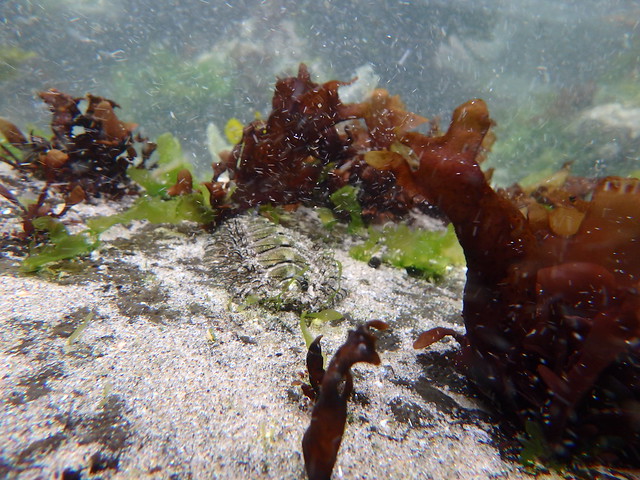
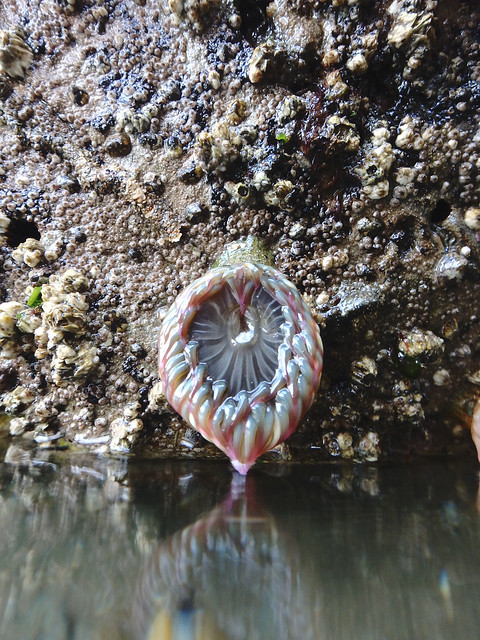
Finally, a quick note on Oregon life outside of work in the last week: I had the opportunity to go surfing for the first time and had a great day out at Otter Rock! I also met with the low tide at the end of the day and got to check out some of the marine gardens at that site. I was especially excited to see my first chiton, I don’t know that I ever saw any of those on the central California coast, growing up. It was a great day and I’m looking forward to future opportunities to explore the coast. The biologist in me has been missing some of that, but I’m armed with an identification guide for next time!

Untitled  Untitled

Untitled  Untitled

Surfs up at Oswald West

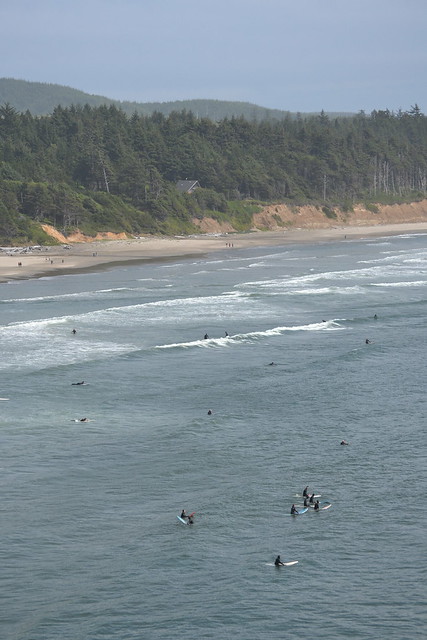
Anyone interested in surfing on the Oregon Coast should definitely hit up Oswald West State Park, specifically, Short Sands Beach (called Shorties by the locals). Every time we go down to this small stretch of sand and do visitor observation surveys we count almost 100 surfers in and out of the water! The waves here are great and the beach is generally super sunny and warm, and not too windy at all. I’ve even seen people get sunburned here, on the Oregon Coast if you can believe it! There is no longer camping at Oswald West due to unsafe natural conditions, but camping is available just a few minutes south in Nehalem or north in Ecola State Park. Bring your wetsuit and board and come join the party if you have a free weekend!

photo 2

A stream of consciousness postcard to another

I think about how the sky paints the sea purple and pink and orange, but only when it feels like it, on special days of warm nights and 9:00 sunsets. That sometimes it’s hard to find where the sea ends and the sky starts, but there’s beauty in continuity and some things are left for wonder. As we float away, ripples from the motor leave a trail behind– but this isn’t a lesson on impacts made or legacies left. Instead I want you to see the soft lines of the waves, how no one talks about how beautiful water is when both gently disturbed but also can be as powerful and encompassing as it crashes against overbearing cliffs, how easily it can take a life away but just as so give it. How it contributes to fluidity, as fluid as the blood in my limbs; the same red running current as what’s in you. The same soft lines on the surface of Anthropluera elegantissima, like water color paints– how water can spread and share and ignite hues of vastness and creativity. Or maybe more so those soft lines mimic a high school student trying oil paints for the first time– the intent is there but execution is anything but perfect. But that’s okay. Because the sea never waited for perfection; it never waited for coloring within the lines–or the sky. The sea does whatever the heck it wants. And it can not and should not ever be contained or described as a bathroom theme in an orange county beach house; the sea does not deserve that and water should never be taken for granted. But that sometimes colors should bleed from the sky onto everything we love.

Week Four: Celebrations and Sea Surface Temperature!

I am no longer writing for this blog as a teenager! My twentieth birthday was Saturday and my family and best-friend came down to Newport for the weekend! We walked around Hatfield, we walked along the Bay front, visited the beach, did a little hiking, and celebrated my birthday at the Noodle café. The weekend was like home at the beach!

IMG_20150711_150741

IMG_20150711_154106

IMAG0724

This week at work I was researching predicted sea-surface temperatures in 2100 for each ecoregion. I also had to find values for each of International Panel on Climate Change’s Representative Concentration Pathways (RCPs). These are emission scenarios that could occur over the course of the century depending on emission restrictions and other climate change initiatives that we pursue. The four scenarios are 2.6, 4.5, 6.0, and 8.5—named after the range of possible radiative forcings in 2100. As I am finding four projections for each of the twelve ecoregions, I have to find 48 values. However, the literature does not have all of those numbers and I am waiting until this week to talk to one of mentors, Henry, to get his opinion on what the course of action should be as he was out of town most of this past week.

Nonetheless, what I have found has been worrisome. All of the values I have found project at least a 1˚C increase by the end of the century with some scenarios predicting up to a 5˚C increase. In order to determine organisms’ relative vulnerability to an increase in sea surface temperature, Henry is developing a table of thermal cutpoints for each ecoregion based on current mean sea surface temperature data and the projected sea surface temperature values. None, low, moderate, and high risk of temperature increase for the species will be determined through the species’ thermal tolerance which is indicative of their current biogeographical distribution. Henry developed a complicated series of rules that I don’t completely understand and don’t think I can properly explain quite yet.

In addition to researching sea surface temperature, the other intern working in my office, Christina (my other mentor), and I were all supposed to get field work training on a boat last Friday; however, the intern was sick and we postponed the trip until next week. Since I was waiting for Henry to return, I didn’t have much research to do. Instead, I helped Christina write an abstract for a climate conference that she will attend in November. She will be presenting a poster on CBRAT and how it is incorporating climate change impacts and specific values to assess species’ vulnerability. She has presented at this conference before, but this will be the first time she is able to report on the climate side of CBRAT which will surely please the climatologists at the conference—many of whom have published studies that I have obtained values from.

Crustacean Examination

After successfully deploying 23 pit traps in the last week (one went missing), on the 7th we were able to check them after being open for 24 hours. The results were pleasing to see, as we did in fact have crabs of multiple species in all of our traps. Many sculpin were caught as well and were noted. The number of Hemigrapsus crabs seemed to increase as we got closer to shore and the number of Dungeness was less and more randomly distributed. We also found two strange looking crabs that turned out to be Pea crabs. As planned the size selection method worked in a fairly smooth manner. I say fairly, because the majority of the traps caught small crabs, but a few actually caught large crabs that we are unsure of as to how they managed to get in. (while molted soft enough to squeeze??). This will be repeated several more times as the summer continues on.

Here is a video of the Dungeness Crab GoPro footage that was shot a few weeks back. We believe the crab is exhibiting this behavior because he (it is a male) is trying to crack his own shell open so that he may begin molting. The video is sped up from 30fps to 120fps.

https://www.facebook.com/austin.r.prechtel/videos/10207203552717977/?l=3251973081910911355

Pit trap in action

Removing the zip ties on a trap to access the catch.

Staghorn sculpins that were caught in the traps


The panoramic camera work is taking a bit longer than expected, mostly because some equipment we were thought to of had by now, has not arrived so that testing our design is not possible yet. I have been working with a few video editing softwares that allow panoramas to be made via stitching.

This weekend a trip up to The Gorge is being made. Will post pictures!

Wading into the data…

The end of week three signaled the shift into high gear or perhaps “low gear” because time doesn’t pass so quickly. The databases have been selected, the data has been pulled from papers, additional numbers have been received from researchers in several countries, and now I’m  faced with making sense of it all. I know, it sounds pretty boring, and at times it can be. Looking at 4000 rows of data, debating how to weigh a lack or surplus of information from one site in order to compare it to another, figuring out how to make it all useful…it’s particularly challenging. But before we can begin teasing out exciting new information, the data mining stage is crucial. Outside the mind-numbing, we had a number of other activities going on this week: we had a productive and clarifying conference call with the lead developer of one of the models we will be working with, the Natural Capital Project’s inVEST Blue Carbon model. In addition, the grad/postdoc students at the EPA hosted an extremely helpful resume/CV workshop…it’s been 4 years since I changed the format of my CV and it definitely needed a refresh.

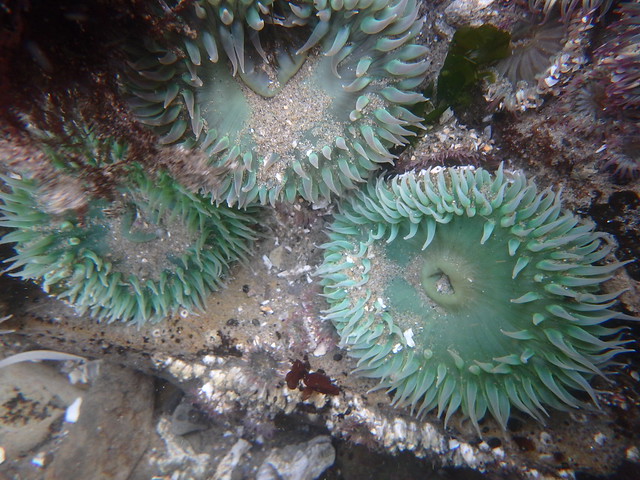
This past weekend was also the Fourth of July and I can’t think of any better way to celebrate America than going out bright and early to explore Caper Perpetua, part of a federally protected National Forest. It’s a beautiful manifestation of one of the world’s greatest land conservation schemes–the US National Forest System, which is truly something all Americans should be proud of. While there, I finally satisfied one of my goals coming out to Oregon: tide-pooling on the Pacific coast.


Is this the new normal?

For my final blog post, I wanted to discuss a project I have been working on for the past 6 months about a topic that impacts not just ocean and coastal ecosystems but all ecosystems across the state of Oregon. This year, Oregon fresh water systems are seeing harmful algal blooms (HABs), which are toxic to animals and humans, earlier than normal. HABs in the marine environment for the first time caused a coast-wide shut down of the razor clam harvest. The fire season is already ramping up and is predicted to be more severe and last longer than the traditional season. Drought conditions are causing emergency drought declarations across the state. The list of unusual and severe climate conditions and their impacts to the state is growing. While climate is influenced by many factors, including El Niño and the Southern Oscillation, the Pacific Decadal Oscillation, and “the Blob”, some are asking if this is the new norm? Climate change research indicates that it will be. So how prepared is the state of Oregon to maintain economic and social systems in light of this changing environment?
In 2010, the state began to grapple with these changes by writing a Climate Change Adaptation Framework (the Framework) that Oregon natural resource agencies could use as a guide to put plans in place to prepare and manage our systems under changing climatic conditions. The Framework identified 11 risks associated with climate change, many of which we are currently experiencing in the state (table 1). As the state begins to experience the likely future in Oregon, natural resource managers are looking to this Framework to help the state adapt to this new normal. Over the past few months, I have been surveying state natural resource agencies to synthesize their efforts for climate change adaptation since the Framework was created. This status report of adaptation efforts will provide the informational groundwork for moving forward with adaptation work in a more coordinated and strategic manner.


Risk Key
1Increase in average annual air temperatures and likelihood of extreme heat events
2Changes in hydrology and water supply; reduced snowpack and water availability in some basins; changes in water quality and timing of water availability
3Increase in wildfire frequency and intensity
4Increase in ocean temperatures, with potential for changes in ocean chemistry and increased ocean acidification
5Increased incidence of drought
6Increased coastal erosion and risk of inundation from increasing sea levels and increasing wave heights and storm surges
7Changes in the abundance and geographical distributions of plant species and habitats for aquatic and terrestrial wildlife
8Increase in diseases, invasive species, and insect, animal and plant pests
9Loss of wetland ecosystems and services
10Increased frequency of extreme precipitation events and incidence and magnitude of damaging floods
11Increased incidence of landslides

Table 1

Summary of risks identified in The Climate Change Adaptation Framework


From the momentum and direction established by the 2010 Framework, I have seen that many initiatives and efforts have taken place to address climate change adaptation. The North Coastal Climate Adaptation project is one notable project conducted by the Oregon Department of Land Conservation and Development’s Coastal Management Program and Oregon Sea Grant. This proof of concept project seeks to establish an effective suite of landscape-scale objectives as a foundation for decisions to improve community adaptation. The project has brought together a variety of state and federal agencies, local managers, and NGOs to address climate change adaptation at the landscape scale in Tillamook and Clatsop counties. If this proves a success, a similar format can be used in other communities in the state to address climate change adaptation. I was fortunate to participate in the 3rd of 3 meetings in this project. It was exciting to see such a range of individuals and entities represented at this meeting, and to talk in very practical terms about addressing climate change adaptation in these two counties. Much work remains to implement the strategies established during these meetings, but I am optimistic that this project can have an impact in adaptation efforts at the landscape-scale.
Many other state agencies have taken significant steps toward climate change adaptation. A Department of Environmental Quality (DEQ) Regional Adaptation Framework is scheduled to come out early next year. This document will guide DEQ efforts to better integrate climate change adaptation into existing programs. In 2010, Oregon Parks and Recreation Department (OPRD) produced a Climate Change Response and Preparedness Action Plan. Oregon Department of Forestry (ODF) staff have developed a Climate Change Workplan for the Board of Forestry to generate recommendations for climate change adaptation. Oregon Water Resource Department (OWRD) led development of the state’s first Integrated Water Resources Strategy, adopted in August 2012. This Strategy includes two recommended actions aimed at supporting continued basin-scale climate change research efforts, and helping assist water users with climate change adaptation and resiliency strategies. Oregon Department of Fish and Wildlife (ODFW) completed “Preparing Oregon’s Fish, Wildlife, and Habitats for Future Climate Change: A Guide for State Adaptation Efforts” in 2008. This Guide has outlined a set of basic guiding principles for managing fish, wildlife, and habitats in a changing climate. Oregon Department of Transportation (ODOT) developed an Adaptation Strategy, a high level assessment of risks and opportunities, in 2012. Oregon Health Authority (OHA) published a statewide report about the connections between climate change and health, the Climate and Health Profile Report, and works within their Climate and Health Program to better understand how Oregon can prepare for new health risks associated with a changing climate. The Department of Geology and Mineral Industries (DOGAMI) created Coastal Erosion Hazard Maps for Lincoln, Tillamook, and Clatsop County as well as for Gold Beach, Nesika Beach, and Alsea Bay. These are just a few of the state adaptation efforts that have taken place since the establishment of the Framework in 2010 and included in my full synthesis report of Oregon adaptation efforts.
With several adaptation plans completed and many projects planned for the future, there were 2 common themes that emerged regarding climate change adaptation across state agencies. Research and monitoring are critical to decrease uncertainties about specific impacts from climate change for continued adaptation planning. Monitoring has been key in developing adaptation plans in the state. For example, the Coastal Beach Monitoring Network has monitored several locations since 2004 for coastal hazards, like erosion, to use the data and understand changes taking place on the coast and develop trends on the more rigorously monitored sites. The beaches are an integrated indicator of sea level rise, storm increase, and shoreline retreat. There is a need for more monitoring information through the coming decades to continue adaptation planning for all climate related risks. The other theme that emerged was the need to align adaptation efforts across natural resource agencies. Not only was this clear in the projects taking place, but also in the conversations I had. Natural resource managers want to learn about other state agency climate change adaptation efforts and work with other agencies to leverage resources and create comprehensive actions that address the climate change risks impacting a given landscape.
Ultimately, climate change adaptation efforts should and will continue to evolve in the state in the coming years. There is abundant scientific and anecdotal evidence that Oregon is already experiencing the effects of climate change (State of Oregon 2010). The Oregon Climate Assessment Report documents these effects and describes the more pronounced changes that are expected to occur in the coming decades (Oregon Climate Change Research Institute 2010). Climate change will affect all Oregonians, our communities, our natural resources, and our businesses. Adaptation is the Oregon tool for creating resilient and strong communities now and into the future that can withstand changing climate conditions.

References:
Oregon Climate Change Research Institute (2010), Oregon Climate Assessment Report, K.D. Dello and P.W. Mote (eds). College of Oceanic and Atmospheric Sciences, Oregon State University, Corvallis, OR
State of Oregon (2010) The Oregon Climate Change Adaptation Framework. http://www.oregon.gov/ENERGY/GBLWRM/docs/Framework_Final_DLCD.pdf

A little staff bonding

This week has been great being back in the office with our mentor, Tommy. We have been catching up on data entry from all of the data that we have been collecting up at Cape Falcon Marine Reserve the past few weeks. We’re headed back up there this coming weekend for our first weekend trip, so we’re excited to see the crowds mobbing to the beach for some surf time! Being back in Newport has provided us with opportunities to engage in a little staff bonding. Theo and I decided to donate blood with the Red Cross together yesterday; the donation site was located right outside of Rogue brewery! A quick walk from Hatfield. We were gifted $7 giftcards to Rogue for our donation, which we promptly used immediately after our donation was finished. It feels great to be more a part of the Newport community!

The SRGP Receives $205 Million for 2015-17!

The Oregon Legislature recently approved $205 million to be used for the Seismic Rehabilitation Grant Program (SRGP). For 2015-16, $50 million will be spent on public schools. For 2015-2016, $125 million will be spent on public schools and another $30 million will be spent on emergency service buildings. The Legislature passed a separate bill to spend $125 million on a program to help build public schools in areas that are less seismically vulnerable. That means that Oregon will be spending at least $300 million in its effort to improve the seismic safety of public schools.

Check out this article: http://ijpr.org/post/2015-marks-banner-year-earthquake-preparedness-oregon