The twenty-four students in History 363: Women in U.S. History spent the final three weeks of Fall Quarter 2023 in OSU’s Special Collections and Archives Research Center exploring women in Camp Adair’s history. Archivist Tiah Edmonson-Morton made archival collections, oral histories, and other primary sources available for students to examine. She also shared her infinite enthusiasm, patience, and knowledge with the students, both in class presentations and frequent individual consultations. Students worked in groups of three to explore the sources, identify a historical question/focus, and find and read scholarship to help them contextualize what they were discovering. In the end, they produced new knowledge about the history of women at Camp Adair and Oregon State College.
Three groups were especially intrigued by portrayals of women in the Camp Adair Sentry, the camp’s official newspaper. A February 1943 front-page article about a PX Girl contest served as a starting point for all three groups, who were struck that a military training camp during wartime was holding what seemed like a beauty and popularity contest. The article led students groups in distinct directions. Two groups decided to further explore images of women in the Sentry. Bakhshoudeh, Hawes, and Kirschenbaum followed the PX Girl story and used it to discuss “Women’s Objectification in the Camp Adair Sentry.” Merims-Johnson, Lerner, and Johnson focused on the newspaper’s photographs more generally, using them to think about how media producers during the war grappled with the new opportunities available to women, in their post, “Mixed in Classification: The Paradox of Gender Roles in Media and the Mobilization of Women at Camp Adair.” Finally, Alam, McMillan, and Scalet wanted to learn more about “PX girls” and other kinds of women’s labor at Camp Adair, resulting in their post, “Image versus Reality: Women in the Camp Adair Sentry.”
In a related post, Collins, Cunningham, and Lake discuss the prominence of women as entertainers for servicemembers both at Camp Adair and at Oregon State College. In “Dances, Bands, and Pageants: Women and Entertainment at Camp Adair,” they argue that whether as nurturers reminding of the comforts of home or as objects of femininity, beauty, and sexuality, they found, women were enlisted during the war to maintain soldiers’ morale. Meanwhile, an exploration of the Oregon State Barometer led another group to focus on campaigns to promote women’s physical fitness at OSC during the war. While not directly about Camp Adair, the post “Promoting Physical Heath for Women at Oregon State College during World War II” by Blair, Matteo, and Zhang highlights yet another way that the war affected both ideas about and the experiences of women. The group found significant urgency around women’s physical conditioning, both as a way to fulfill wartime labor demands and as a general duty.
Moving forward in time, two groups were drawn to explore women’s roles at the first Adair Village, which the area was dubbed when it housed married OSC students in the late 1940s and early 1950s. They started with Dan Poling’s 1956 dissertation about that first Adair Village, which mentioned a Mothers Club. Students noted Poling’s reference to a newsletter, The Community Spirit, which archivist Tiah Edmunson-Morton uncovered in SCARC’s collections. McCarville, Buresh, and Howell, in their post “The First Adair Village: Women at OSC’s Postwar Married Student Housing,” noted its homemade quality, which was starkly different from the more professional, military-produced Camp Adair Sentry. Students in both groups documented the activities of the Mothers Club as evidenced in The Community Spirit and a 1949 Adair Village Directory. Bransetter, Kreitzer, and Miller looked for evidence of the club and its officers in OSC yearbooks and the Barometer and they were surprised to find little. They conclude therefore that most members were wives of male students rather than students themselves. They also suggest in their post “Adair Village Mothers Club: Invisible Community Builders in the Postwar Era,” that women’s community-building activities, while crucial to the well-being of Adair Village families, did not seem to qualify as news on campus. Both groups’ findings raised questions about the longer history of women’s community building labor. Under what circumstances have government and public institutions committed to providing social supports for families and for which families, for example, and how has community building changed as women’s roles have changed?
At the end of class, we discussed how students’ findings related to the broader content of the course, which emphasized how women’s lives and ideas about gender have always shaped and been shaped by been shaped by race and ethnicity, sexuality, class, and other axes of difference. There is still much to discover about the mostly white, economically secure, and able-bodied women whose lives intersected with Camp Adair. At the same time, it will take a different set of methods and sources to find women who do not fit those categories. I look forward to engaging new groups of students in this work.
Contributed by aman agah, 3rd year Ph.D. student in Women, Gender, and Sexuality Studies
In Summer 2023, Rare Books Librarian Anne Bahde began a project to construct a shared collection in HathiTrust. This library will include all pre-1927 rare books in SCARC’s collections that have been digitized in HathiTrust. The result will be full-text searchability for those volumes, enabling users to search our collections broadly over centuries. aman was hired to build the collection in HathiTrust, searching titles and adding matches to the library. The finished project will be available in 2024.
I love data entry. It’s calming. It satisfies the part of my brain that really appreciates a clear end to a task. Working on the special collections Hathi Trust project with Anne Bahde over the summer of 2023 was an opportunity to enter some data while also thinking critically and creatively about access to archives and information. What seemed initially to be a very straightforward and simple task, was at times lengthy and required more attention to detail than I had anticipated (this is not a complaint, this is an observation). This wasn’t just copy/paste data entry, though most of my searches did start out that way. This was tweak the pasted information, with maybe another re-tweak, and perhaps another after that, then locate and enter the correct data.
Perhaps a rewind is in order–this project entailed searching Hathi Trust for publications, publications which OSU has, from the 18th, 19th, and 20th centuries. If the publication was present, I added it to a collection I had created within Hathi Trust–this collection would ultimately be made available to Oregon State University students, faculty, patrons, etc. One of, if not the primary, purpose of this project was to make these texts accessible via Hathi Trust, because their platform allows for in-text searches. In-text searches. In-text. Searches. Do you understand how critical it is to be able to search within the text? How is that not even a thing in all digital collections? What was the point of making collections digital if we wouldn’t search within the text? If that wasn’t ever going to be a thing, I guess just send me back to the card catalog. Admittedly, I do love to hold a thing in my hand and walk down an aisle of books.
I worked from a spreadsheet of all the publications OSU has, divided into three sections based on century. In typical graduate student-meets ADHD-meets child of an immigrant-meets perfectionist style, I told myself I would complete the entire project of over 5000 entries in the roughly eight weeks ahead of me. I did not. I had not, despite over 40 years of experience, accounted for the meandering journeys my brain would take with nearly every title and author name. I would copy the title from my spreadsheet, and in the span of seconds from copying the title to navigating from the spreadsheet, I would find myself searching the author of the text, or maybe checking my email inbox which I could see from its little visible tab contained a new message, or maybe I decided to search the text itself on the internet to learn more about its topic and contents. At times my mind wandered into thinking about just how many books there are and have been and will be. When I was younger I wondered what it would be like to read every book ever written. I imagined I could speak and read every language, and sort of Burgess Meredith in Twilight Zone my way through all books ever with no interruption. Imagine. Imagine a world where we had the time to really truly delve into projects like this, to truly immerse ourselves. So…you know…that added time when it happened. And one of the fun things about working with my particular set of intersecting neurodivergences and learning disabilities is a combined tendency to forget paired with reversing letters and numbers. This happened just about every time I began a search. I would paste the copied title into Hathi Trust, but then have to return to the spreadsheet to confirm the author’s name and date of publication. It didn’t matter if the date before this search, and the date after, were the same. I still had to confirm. And confirm. And confirm again.
One of the things I began to quickly notice on the occasions that I managed to immediately navigate to Hathi Trust from the spreadsheet, was that Hathi Trust’s results were often challenging to navigate. Hathi Trust allows searches to be narrowed by author name, publication location, publication date, and some other areas. This is very convenient. What is not convenient, and frankly confusing, is that my search results would show, for example, a specific year, but then that year was not within the publication dates provided in the dropdown menu of Hathi Trust. Maybe my search results would show the name of the author of a text, but that same name was not within Hathi Trust’s narrowed down list. This then required me to amend my searches. Sometimes removing various punctuations within the title or reducing the search to a few words. I sometimes searched by author or publisher, then within decade, then year. Most of the time, these amendments to searches produced the desired result.
One of the other things that stood out to me was that most of the author names I was seeing were, presumably, men. Granted, some could be women using men’s names ala George Sands, but not always likely. And many of the few women whose texts were included, were credited as Mrs. So-and-so, placing emphasis on the surname of their husband. Some of the women were given the title of “lady” or “madame”, and frankly, I don’t know which of all three options I hate most. I also noticed that the majority of the names, and I am talking like in the high 90 percentile, were Western – US of European specific. I remember asking about this–and the problem seems to lie more within who is considered publishable, and also whose work is considered more important to archive. Who is the key word here for me – because it’s not just the who of this list I was working from, but also the who deciding the importance of various authors and texts and topics.
What I had not expected was how much working on this project would cause and even require me to reflect upon my own research. It began almost quietly, with a recognition that with author name and title, I wondered if and when anything related to Persia/ns or Iran/ians would appear. Upon realizing the likelihood to be low within these titles, I found myself reflecting upon the task itself, and the act of searching. How did I conduct my own research? And given that so much of my research focuses and relies upon Iranian feminisms, how could I learn from this project to better help me locate relevant texts? I had some prior experience searching OSU archives for information on Iranian students and searching for Farsi texts – both resulting in much less than I had hoped for, and even expected. And memory/remembering heavily inform my methods and methodology, so what does it mean to recognize that memory is something I struggle with? How does my poor memory impact my own research? Anne Bahde also said something that really struck me, that “different historical periods require different knowledges/skills.” It was not something I had actively considered or framed within this context. As someone with a background in media studies, and a lover of films in general, I understand the importance of analyses with a comprehension of the period within which something was produced. However, I had not taken the time to think about how this critical thinking should also be applied to researching – so when I am researching early Iranian cinema, for example, I have to hold a larger understanding of Iran (including political and social landscape, racial and gender dynamics, language, and so on) at the time of the nation’s early cinema. I would argue that understanding early cinema in general would also be helpful. As a lover of film, I have a deep appreciation for partaking in something that asks me to pause and reflect, to find meaning, to ask questions. And I can say that taking part in this project required all of this from me.
References
“Time Enough at Last.” The Twilight Zone, written by Rod Sterling and Lynne Venable, directed by John Brahm, Cayuga Productions, 1959.
We’ve released a new set of digitized historical basketball content just in time for the 2023/2024 season!
New posts will be released each Friday in November. This is post 4 of 4.
Seattle University basketball highlights, March 1953. (0:04:40). Led by All American guard Johnny O’Brien, Seattle is shown defeating Idaho State University and earning the right to play against the University of Washington in the NCAA tournament West Regional, which was held at Gill Coliseum. The film includes footage of Seattle players exiting a charter flight, perhaps at the Corvallis airport; fans assembling outside of Gill Coliseum; Oregon State College athletic director Roy “Spec” Keene; basketball journalists seated court side; and game action versus Washington.
Chris Petersen, Sr. Faculty Research Assistant and Beaver sports fan, selected and summarized these clips. Brian Davis, our Digital Production Unit Supervisor, digitized and process the nineteen Umatic tapes now available in our MediaSpace channel. Thanks to them!
We’ve released a new set of digitized historical basketball content just in time for the 2023/2024 season!
New posts will be released each Friday in November. This is post 3 of 4.
OSU Men’s Basketball montage, 1981-1982. (1:56:37). The 1981-82 Oregon State University men’s basketball team won the Pac-10 Conference championship for the third year in a row, completing the season with a record of 25-5, with only two losses in conference. The Beavers competed in the NCAA tournament that year, losing in the third round to Georgetown, the tournament’s eventual runner-up. For the year, OSU was led by senior guard Lester Conner (14.9 points, 5.1 assists), sophomore forward Charlie Sitton (12.9 points, 4.3 rebounds), junior forward Danny Evans (11.3 point), and junior guard William Brew (9.2 point, 3.4 assist). This film includes isolated game audio of Beavers head coach Ralph Miller from timestamps 1:22:30 to 1:38:30.
OSU Men’s Basketball montage, 1982-1983. (1:49:54). The Oregon State University men’s basketball team finished the 1982-83 season with a record of 20-11, losing to Fresno State in the third round of the NIT Tournament to complete the year. The squad was led by junior forward Charlie Sitton (18.8 points, 5.2 rebounds), sophomore forward A.C. Green (14 points, 7.6 rebounds), senior forward Danny Evans (10.7 points) and freshman center Steve Woodside (8.9 points, 3.8 rebounds). In addition to game footage, this film also includes scenes from Beaver practices and locker room preparation.
OSU Men’s Basketball montage, 1985-1986. (5:14:56). In 1984-85, the Oregon State University men’s basketball team struggled through a down year, finishing the season with a record of 12-15 — the program’s first losing season since the 1970-71 campaign. The team was led by junior center Jose Ortiz (16.4 points, 8.6 rebounds), senior guard Derrin Houston (12.3 points), senior center Steve Woodside (9.9 points, 6.3 rebounds), and senior guard Darryl Flowers (9.1 points, 4.2 assists). In addition to footage from numerous games, this lengthy film includes scenes from the locker room as well as media availabilities with players and coaches.
Chris Petersen, Sr. Faculty Research Assistant and Beaver sports fan, selected and summarized these clips. Brian Davis, our Digital Production Unit Supervisor, digitized and process the nineteen Umatic tapes now available in our MediaSpace channel. Thanks to them!
We’ve released a new set of digitized historical basketball content just in time for the 2023/2024 season!
New posts will be released each Friday in November. This is post 2 of 4.
Among the most decorated basketball players in Oregon State University history, Payton was the Pac-10 Freshman of the year in 1987, a three-time All Pac-10 selection and, in 1990, both Pac-10 Player of the Year as well as consensus All-American. By the time his four-year career at OSU concluded, he held the school record for points, field goals, three-point field goals, assists, and steals. During the Payton era, the Beavers made three NCAA Tournament appearances and one NIT. His number “20” jersey was retired during the 1996-97 season.
Gary Payton highlight footage, 1989-1990 (0:04:01). Silent footage of Oregon State University senior guard Gary Payton in action at Gill Coliseum and at the Far West Classic, held in Portland, Oregon at the Memorial Coliseum. Payton averaged 25.7 points per page, 8.1 assists per game and 4.7 rebounds per game in leading the Beavers to the Pac-10 co-championship and an overall record of 22-7.
Gary Payton – Pac-10 Player of the Week highlights, March 2, 1988 (0:00:34). Silent footage of Gary Payton, who was named Pac-10 Player of the Week on March 2, 1988. Payton is shown competing on the road versus Stanford, who were defeated by the Beavers 63-61. Payton scored 17 points in the victory.
Gary Payton – Pac-10 Player of the Week highlights, February 16, 1989 (0:00:44). Silent footage of Payton, who was named Pac-10 Player of the Week on February 16, 1989. Payton is shown competing at Gill Coliseum versus Arizona State, whom the Beavers defeated by a score of 73-59. Payton scored 22 points to lead the effort.
Chris Petersen, Sr. Faculty Research Assistant and Beaver sports fan, selected and summarized these clips. Brian Davis, our Digital Production Unit Supervisor, digitized and process the nineteen Umatic tapes now available in our MediaSpace channel. Thanks to them!
We’ve released newly digitized historical basketball content for the 2023/2024 season!
New posts will be released each Friday in November This is post 1 of 4.
In addition to season montages and Gary Payton footage, this 4 partrelease includes an interview with former coach Ralph Miller on his philosophy of basketball, and an unexpected film of Seattle University playing in Gill Coliseum in 1953. The memorial service for Earnest Killum, an OSU player who tragically died of a stroke in 1992, is part of this release as well.
“Ralph Miller’s Pressure Basketball,” ca. 1983 (1:47:29). Released by OSU Sports Productions ca. 1983, this film consists of a series of conversations between Oregon State University head basketball coach Ralph Miller and host Pat Lafferty, in which Miller details his philosophy of practice and play, breaking the game down into multiple components. In part one of the film, Miller focuses on the jump stop, the pass, 3 on 3 drills, 4 on 4 drills, pressure defenses, and the team concept. In part two, he analyzes rebounding and the outlet pass, the breaking game, the high lob pass, the inside game, passing against the zone defense, attacking the zone defense, and attacking the man defense.
Oregon State University men’s basketball season preview, 1984-85 (0:07:50). Partial season preview show featuring practice footage, capsule biographies, and statistics for five first year players: Jeff Hales, Mark Kaska, Eric Knox, Ian Russell, and Byron Thierry. The film concludes with a highlight package from the 1983-84 season, set to music. Led by senior forward A.C. Green, the Oregon State University men’s basketball team reached the NCAA tournament at the conclusion of this year, finishing the season with a record of 22-9.
Earnest Killum memorial service, January 22, 1992 (0:48:42). Footage of a memorial service held in Gill Coliseum for Oregon State University basketball player Earnest Killum, who died of a stroke on January 20, 1992. The ceremony included songs by soloists Gino Mingo and Jason Harris, and remarks by OSU basketball alum Rev. Darryl Flowers, OSU President John Byrne, head coach Jimmy Anderson, teammate Scott Haskin, and two unidentified speakers — one an academic adviser and the other a community religious leader.
Chris Petersen, Sr. Faculty Research Assistant and Beaver sports fan, selected and summarized these clips. Brian Davis, our Digital Production Unit Supervisor, digitized and processed the 19 Umatic tapes now available in our MediaSpace channel. Thanks to them!
We are so excited to be able to celebrate Archives Month in person with you all and are looking forward to seeing you at the following events:
Special Open House: Scrapbooks
What: Get glimpses from nearly a century of student experiences here at OSU in student scrapbooks during this Special Open House! These colorful, candid, and joyful documents of campus past were assembled by students from the 1910s through the 2010s. Where: SCARC Reading Room, 5th floor, Valley Library When: Wednesday, October 4, 10am to 1pm
Special Open House: Shannon Day Rettig Book Arts Collection
What: SCARC is excited to celebrate the gift of the Shannon Day Rettig Book Arts Collection. This collection of over 75 stunning artists’ books and fine press specimens will support book arts at OSU for years to come. Come explore selections from the collection, including rare fine press titles and unique, collaborative art pieces. Where: SCARC Reading Room, 5th floor, Valley Library When: Wednesday, October 18, 10am to 1pm
Add Glitter to the Archives: A Crafternoon with the OSU Queer Archives
Art created by 2016 Glitter in the Archives event attendees
What: “Glitter in the Archives” began in 2016 as part of both Oregon Archives Month and OSU’s Queer History Month celebrations. The crafternoon event, featuring copies of materials from the OSU Queer Archives, was hosted in the SCARC reading room and ran from 2016-2019, and it’s finally back! This year we are collaborating with the Libraries’ Crafternoon series and the event will be hosted in the main lobby of the library, hence the new name “Add Glitter to the Archives.” As before, one of the main goals of this event is to use archival materials as a way to imagine queer futures, particularly as they pertain to OSU and the surrounding community. Participants will have the opportunity to donate their craft creations to OSQA if they would like to do so. For information and photos from past events, see the blog posts for Glitter in the Archives, 2016-2019 Where: Main Floor Lobby, Valley Library When: Thursday, October 19, 4:00 to 6:00pm
“The OSU Queer Archives: Reflecting on the Past and Imagining the Future”
What: The Oregon State University Queer Archives (OSQA) was established in the fall of 2014 with a mission to preserve and share the stories, histories, and experiences of LGBTQ+ people within the OSU and Corvallis communities. The creation and development of the OSQA was the product of a collaboration between an archivist Natalia Fernández, and a professor, Dr. Bradley Boovy, who engaged in community-based initiatives that helped to build the archive. Almost a decade after its establishment, Fernández shares her reflections on the evolution of the OSQA as well as ideas for its future. More information can be found on the Corvallis Museum website about the event; the lecture is free with admission to the museum, which is $5 general admission, free for students including OSU and LB, and free to youth and families who have SNAP. Where: The Collins Education Center at the Corvallis Museum (411 SW Second Street, Corvallis, OR 97333) When: Thursday, October 26, 10:30am to noon
Taste of the ‘Chives Recipe Showcase
What: Sample and celebrate the flavors of the Fisheries and Wildlife Coffee Club and the founder of this Friday morning tradition, Professor David L.G. Noakes! For this year’s Taste of the ‘Chives, we’ll be preparing recipes featured in “Baking Connections: Coffee Club Memorial Cookbook.” Where: Willamette Rooms, Third Floor, Valley Library When: Tuesday, October 31, noon to 1:30pm
During spring term Dr. Kara Ritzheimer’s History 310 (Historian’s Craft) students researched and wrote blog posts about OSU during WWII. The sources they consulted are listed at the end of each post. Students wrote on a variety of topics and we hope you appreciate their contributions as much as the staff at SCARC does!
This post was written by Soraya Trujillo.
When it comes to understanding the activism of students at OSC during WWII, scrapbooks are an exciting way to examine the events that took place. One example of this is the scrapbook of the Oregon State University chapter of Alpha Lambda Delta. The scrapbook itself is considerably large (around 2’x 1’) and has rounded edges. Several pages are falling out, as are some of the glued-in letters and photos, but nonetheless, it is chronologically organized and presented in a formal fashion. This scrapbook is an ideal example of the activism of female student-led organizations at OSU during WWII.
Formerly known as Oregon State College (OSC), there were many events that took place during the war years. For instance, during the school years of 1943-44 and 1944-45, the scrapbook highlights Victory Drives and harvest help that the chapter organized. Victory drives were fundraisers held by the nation as a whole, Oregonians, and college students at OSC to help with the war effort in the United States. These drives asked citizens to ration, collect, and recycle certain goods in order to supplement resources being allocated to the war effort. Using the Alpha Lambda Delta scrapbook, this post explores student activism during WWII, especially female-student activism, as well as the overall sense of community that emerged after Japan’s attack on Pearl Harbor in 1941.
When it comes to student participation in the war effort, the enrollment size of OSC during the war years is important to note. The decrease in enrollment at OSC during 1943-1944 shines a light on why student-led organizations, like the Alpha Lambda Delta chapter, were important on a local and national level in regards to supporting the domestic fight against the Axis powers. The war impacted the size and composition of student enrollment, especially male enrollment. Moreover, nationally, there was a 14 percent decrease in enrollment in colleges. In other words, OSC’s decrease in enrollment was normal.[i] However, there is a significant variation in the population of Alpha Lambda Delta members during this time.
This graph is important to note due to the abnormal increase in the population of Alpha Lambda Delta during the first part of the war years: 1939-1941.
The scrapbook includes an exciting graph titled, “Graph showing the fraction of Alpha Lambda Delta members that have graduated for the years 1933-1942.” The data shows a relatively constant increase in members during the years 1940 to 1942. By the 1941-1942 academic year, the organization had grown to 59 members.[ii] Why did the Alpha Lambda Delta chapter grow despite enrollment declines at OSC during the war years? One could infer that the increase is due to Alpha Lambda Delta being an exclusively female student organization. In March 1943, the Oregon State Barometer published an article titled, “OSC Enrollment Records Drop of 23 Percent: Women Almost Equal Men in Numbers Excluding Engineers,” which explains that overall registration had dropped from 3586 students to 2753 students, a 23 percent decline. This number did not include “army engineers on the campus” who were being educated to actively serve in the military through programs at OSC.[iii] Although there was a decrease in civilian male students due to war and military-related education, OSC experienced an overall increase in women’s enrollment.
This shows Newspaper clippings of Victory Drives and harvestings that Alpha Lambda Delta took part in.
The local support that Alpha Lambda Delta mentions in their scrapbook leads to other avenues of interest. With the national war effort starting after Japan’s attack on Pearl Harbor, national-level drives that involved everyone in the US, such as the “National Victory Scrap Drive” of October 1st to November 15th in 1943, could have ignited the need to create local drives at OSC.[iv] Alpha Lambda Delta members responded by creating their own campaigns and aid for farmers. The scrapbook, for example, contains clippings of an article titled, “Alpha Lambda Delta Sponsors Farm work.”[v] Female student-led organizations at both OSC and the nearby University of Oregon participated in various Victory drives, such as the “Victory Book Drive” mentioned in the Oregon Daily Emerald (the University of Oregon’s newspaper) in 1943, and helped local farmers with harvesting or tending to land.[vi] They too wanted to be a part of the overall national support.
This image shows Alpha Lambda Delta Sponsors working at farms to help the war effort in 1943.
Much of the student body at OSC during WWII supported the fight against the Axis powers, and female-led organizations led the charge when it came to supporting the local community. Female students helped local farmers in Corvallis and the greater Willamette Valley. A 1945 article in the Oregon State Barometer titled, “Coeds to help Harvest Beets: Alpha Lambda Delta Will Recruit Workers,” urged female students to volunteer to help local farmers. It was important, the article explained, that “each women’s living organization should be represented by at least three girls.”[vii] This article indicates that other female student organizations, in addition to the Alpha Lambda Delta chapter, were helping. More than ever, girls from each living organization at OSC needed to tend the land and harvest vegetables which would be shipped beyond the Pacific Northwest, due to the labor shortages in the war.[viii]
This image shows the support of Alpha Lambda Delta during the war. One can see the Patriotism and their need to support locally through the newspaper clippings as well as an American flag model/ figure.
Adding to the broader roles of females during the war, female faculty at OSC also helped in the fight against the Axis powers. According to historian Marty Branagan, “Women’s resistance ranged from actions adopted en masse as a gender to the work of women’s groups and individuals.”[ix] An example of this is the work of female administrators at OSC: Ava Milam, Lorna Jessup, and Maud Wilson during the war years. Ava Milam, the Dean of the School of Home Economics for more than 30 years, contributed to the nutritional program at OSC. Lorna Jessup, assistant to the Dean of Women, and her secretary created ration books for the student body. Maud Wilson, a female faculty member of the Agricultural College organized war guests into different homes around OSC.[x] These are just some of the various ways in which the female student body and faculty members at OSC contributed to the wartime effort.
Universities across the country participated in philanthropic efforts as well, a reality that created a bond between institutions. Historian George Zook explains that this bond emerged after the US government asked higher education institutions to be more involved in the war effort. Zook explains that the National Committee on Education and Defense and the United States Office of Education, “undertook to sponsor what turned out to be the largest and most representative conference of university and college executives that had ever been assembled in this country, at Baltimore on January 3-4, 1942.”[xi] This large representation of university executives at the National Committee on Education and Defense shows that universities were actively participating and wanted to help the country in any way possible.
The poster campaigns that the US military developed were also a significant reason for the profound amount of support from the home front. Why and how did this support happen? Terrence Witkowski explains that the American government used poster campaigns that exaggerated the need for certain supplies to encourage both moderation and donations. Witkowski states, “Perhaps the single largest group of frugality-themed posters was sponsored by the U.S. Department of the Treasury and asked Americans to forgo their immediate consumption and instead buy war bonds and defense stamps.”[xii] War bond posters may explain why Victory Drives and harvestings were common at OSC during the war, especially for female students who could not actively serve in the war.
Both images found in the U.S. Government Printing Office highlight the emergence of consumer frugality in 1942, also found in Witkowski’s article.
Adding onto the war bond posters, the War Manpower Act and the War Manpower Commission both effectively created a bond between the military and universities and additionally addressed female citizens as well. William Robbins explains in The People’s School: A History of Oregon State University that the US government used the War Manpower Act to enlist the help of universities. Robbins states, “Gilfillan’s inquiry on behalf of his seven young staff members elicited a response when the War Manpower Commission reiterated that all young men with scientific training should register [to actively serve the country].”[xiii] The War Manpower Act, according to the American National Archives, was established to recruit, “labor for war and essential civilian industries” which implies that the government needed male students for the war. In addition to male students needed for the war, other students and civilians could still support the nation through different means.[xiv] Although men were wanted for actively serving, other women and men who did not serve actively and were students are also highlighted in the War Manpower Commission on August 19, 1942, which states, “the War Manpower Commission plans of guidance which will help the students where they can make the most effective contribution to the war effort, including essential supporting activities.”[xv] This highlights how universities nationally could potentially help with wartime efforts as seen by the national Victory Drives or, in the case of OSC, aid to local farmers.
Whether inspired by the poster campaign or the Manpower Act, female students at OSC participated in the war effort. Much like other colleges and institutions around the nation, OSC was no exception to the increasing effort to help the war front through local support. In this perspective, the examination of the Alpha Lambda Delta Scrapbook during the war years is a great example of how female activism in colleges was part of a larger home front effort. Through this lens, we begin to see examples of how students helped during the war despite the setbacks they faced. For further research, finding student females and their narratives from this time period would broaden the understanding of their roles at OSC and overall define the roles of women during WWII.
Oregon State College Chapter of Alpha Lambda Delta Scrapbook, 1933-1952, Oregon State University Special Collections and Archives Research Center, Alpha Lambda Delta- Oregon State University Chapter Records, 1933-1999, Box 3, Folder 1.
Zook, George F. “How the Colleges Went to War.” The Annals of the American Academy of Political and Social Science 231 (1944): 1–7. http://www.jstor.org/stable/1023159.
Robbins, William. The People’s School: A History of Oregon State University. (Corvallis, Oregon: Oregon State University Press, 2017).
Witkowski, Terrence. “World War II Poster Campaigns: Preaching Frugality to American Consumers,” Journal of Advertising, 32 No.1, (2003), 69-82. https://www.jstor.org/stable/4622151
[ii] Graph showing the percentage of Alpha Lambda Delta members who graduated between the years 1933-1942, Oregon State College Chapter of Alpha Lambda Delta Scrapbook, 1933-1952, Oregon State University Special Collections and Archives Research Center (hereafter SCARC) Alpha Lambda Delta- Oregon State University Chapter Records, 1933-1999 Box 3, Folder 1.
During spring term Dr. Kara Ritzheimer’s History 310 (Historian’s Craft) students researched and wrote blog posts about OSU during WWII. The sources they consulted are listed at the end of each post. Students wrote on a variety of topics and we hope you appreciate their contributions as much as the staff at SCARC does!
This post was written by Keaton Kahn.
Many of the Americans who served and died in the conflict of World War II are being forgotten; this tragic occurrence is nearly as devastating as their initial deaths. In the months and years following WWII, the War Department worked to provide universities with more information about the students and faculty who had died in the war by sending information about their deaths to their universities. The Department also worked to answer any questions families may have had about their lost loved ones. While the hundreds of thousands of brave Americans who died in World War II are all deserving of our remembrance, I will be focusing on William H. Bartlett Jr. and his legacy as it connects to Oregon State University.
With the outbreak of WWII in 1939, many American college students viewed the United States’ entry into the war as an inevitable outcome. College students had to consider a possible draft and decide whether they would try to defer their enlistment until after completing their degree so that they could enter the service as officers, or try to find a way out of the conflict completely. Many students dutifully finished college and filled the military’s needs by fitting into specialized roles such as doctors or engineers while others decided to enlist before they completed their degree.
A good example of one student who was too eager to wait for graduation is our soldier of focus, William H. Bartlett. Bartlett decided to enlist after only being in school for one year as an engineering major.[i] Like many of his fellow soldiers, Bartlett Jr.’s family had a proud tradition of patriotism and service to the U.S. Armed Forces. Bartlett’s father was a colonel in the army and served during WWII. He received the Silver Star Award in 1945 for his heroic actions in Thuringia, Germany; Bartlett Sr. had exposed himself to small arms fire to set up a forward observation post.[ii] This forward post allowed him to direct artillery fire which resulted in the assault force taking the city of Suhl with minimal casualties, a feat that would not have been possible without Bartlett Sr.’s heroic actions.[iii] Perhaps the elder Bartlett was battling grief as he did these heroic feats; he had learned of his son’s death only a few months earlier.[iv]
Tradition and heritage led many students like Bartlett Jr. to proudly enlist, allowing themselves to be fuel for the fires of the war machine. Unfortunately, this military fervor resulted in many OSC being killed before they could return home either to finish their degrees or use their expertise for something other than fighting. Such was the fate of our soldier of focus: Bartlett Jr. died fighting in the Battle of the Bulge in 1945, just months before his father, perhaps in his son’s name, risked his own life to save the lives of his soldiers.[v]
According to records held by the Special Collections and Research Center (SCARC) at Oregon State University, on February 12th, 1946 Bartlett Jr.’s father wrote to the president of Oregon State College informing him of his son’s service, telling the president that in letters he had written to his father and family, Bartlett Jr. expressed a “great regard for the glorious history made by his 95th Division.”[vi] Bartlett’s Division was a part of the Third Army, which earned numerous awards during the war. While Bartlett Jr.’s unit was conducting a night march in the Ardennes Forest during the Battle of the Bulge, he was killed as the Third Army was trying to secretly maneuver to a more opportunistic position.[vii] Private Bartlett was awarded the Purple Heart for his sacrifices during his service and was buried in Holland, along with 17,000 other Americans who, as Colonel Bartlett explained to OSC President Strand, “gave their lives to ensure the Great American Victory of the Battle of the Bulge.”[viii]
Colleges around the nation found their campuses drastically different than they had been in the past. With over ten million young men being sent to the war effort, females made up the majority of students on most campuses. The military had drafted a significant number of male students, and the only men remaining on campus tended to be those who obtained a deferment or were undergoing military training through the school. The lack of male students left a void in college attendance that was filled by those training for military service. Many colleges contributed to the war effort by allowing the military to conduct training on their campuses and holding events to help the war effort. Even before most men left campuses, many colleges incorporated mandatory exercise and drill training for men, as they were expected at some point to enter military service.[ix] College curriculums were streamlined, and free time, like summer break, became a thing of the past. Males in college were there only to learn their job and go serve the needs of the nation or the war effort.[x]
Oregon State University has a long and proud history of military training and excellence. Since 1872, the U.S. Military has had a relationship with what was then called Corvallis College, and students have been involved with various practices and programs since its partnership, such as the ROTC program and numerous military tournaments and drilling competitions throughout the life of this partnership.[xi] During the Spanish War of 1898, the college trained many soldiers and officers to fight: the start of a proud tradition of students at what is now Oregon State University serving their country through military service.[xii] The college became so proficient at supplying trained individuals to the service that in 1917 the War Department acknowledged it as a “distinguished” institution.[xiii] From 1911 into at least the 1930s the military regularly held tournaments at Oregon State, giving students the opportunity to participate in events that showcased their military training and even win cash prizes.[xiv] This extreme dedication to supplying trained individuals to the military earned the college the nickname “The West Point of the West.”[xv] During WWII, the institution was instrumental in training cadets for military service. The institution hosted and trained 4812 cadets (Junior officers) who were on campus through the Army Specialization training program—more than any other non-military institution.[xvi] And many students such as William Bartlet Jr. voluntarily enlisted, along with students who enter the service today and are continuing this tradition of dedication and proud sacrifice.[xvii] The ROTC continues to recruit and send students into the military: well-trained and ready to represent the proud legacy of service at Oregon State University.
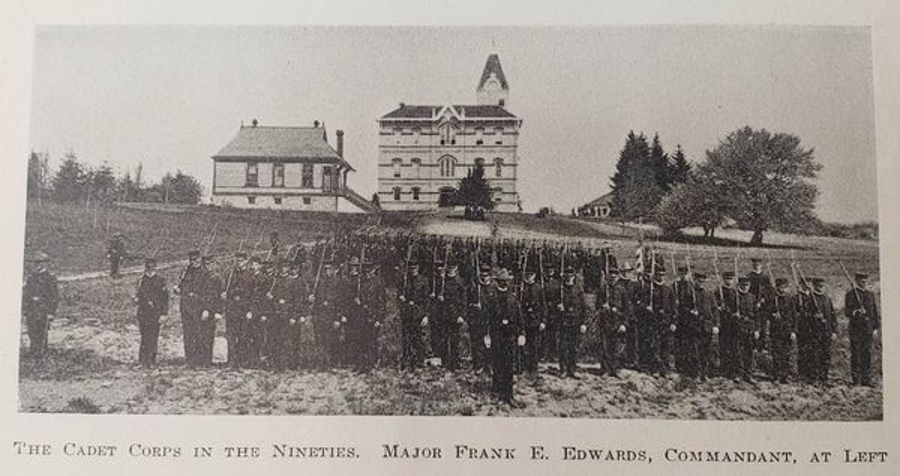
Third Detachment at “Retreat” outside Strand Hall, which would have been built just three years previous (May 9, 1916).[xviii]
This photo is from a pamphlet on military history at OSC, published by the Agricultural College on Dec 9, 1921.[xix] It displays the Corps of Cadets training at OSC. At that time, one of the uniforms they were wearing would have cost $16.[xx]
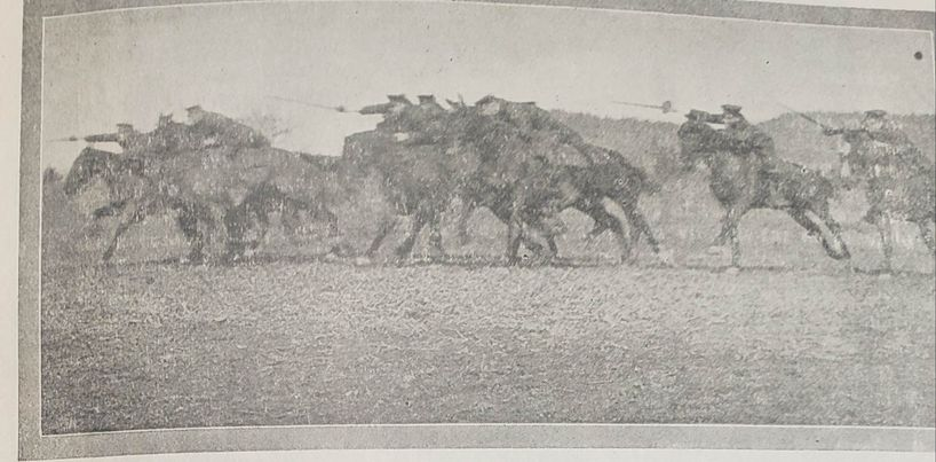
This photo is from a pamphlet (May 29, 1926) announcing an upcoming military tournament at OSC, shows a Pony Express Race, an event in which four teams of three from each cavalry unit compete. This event plays out a lot like a baton pass relay race, where they have a mailbag that they pass to the next person and so on; the first team to get the mailbag across the finish line wins.[xxi]
Next Memorial Day, if you have no one else to remember, remember them: the brave Americans who died fighting in a distant land.
[i] “BARTLETT, William H Jr.,” Fields of Honor Database, accessed May 25, 2023. https://www.fieldsofhonor-database.com/index.php/en/american-war-cemetery-margraten-b/50175-bartlett-william-h-jr. Letter from Colonel William H. Bartlett to OSC president A.L. Strand, February 12, 1946, Special Collections and Archives Research Center (hereafter SCARC) Oregon State College History of World War II Project Records (MSS ODCWW2), Box 1, Folder titled “Completed war service record forms 1940-1946 Agee-Kirk.”
[xi] “History of the Military Department,” Oregon State Agricultural College Pamphlet, 7, stamped December 9, 1921, SCARC Memorabilia Collection, Box 106, Folder 17.
[xiv] “Military Tournament of the Corps of Cadets O.A.C.,” 5, May 29, 1923, and “Military Tournament” January 21, 1911, SCARC: Memorabilia Collection, Box 106, Folder 17.
[xvii] Luther Cressman, “War Service Record – World War II – Oregon State College,” February 12, 1946, SCARC, History of World War 2 project, (MSS ODCWW2). Box 1, folder 1.
[xviii] Pamphlet titled “Oregon Agricultural College, Education for Enlisted Men,” December 15, 1918, SCARC Memorabilia Collection, Box 106, folder 17.
During spring term Dr. Kara Ritzheimer’s History 310 (Historian’s Craft) students researched and wrote blog posts about OSU during WWII. The sources they consulted are listed at the end of each post. Students wrote on a variety of topics and we hope you appreciate their contributions as much as the staff at SCARC does!
This post was written by Garrett Workinger.
Although battles and military victories may dominate histories of WWII, it was—at its core—a war of resources. As the United States scrambled to react to its involvement in the global crisis of WWII, many economic and cultural changes came about in the name of winning the war effort. The war effort on the domestic front created a national culture of conserving, creating, and rationing valuable resources such as food and raw materials. Communities, counties, cities, and universities across the nation became deeply involved in the domestic war front. Oregon State University (then Oregon State College) took quick action to help relieve the demand for resources that the nation felt. OSC and its extension program aided the war effort by promoting student and state involvement in Victory Gardens, food self-sufficiency, and raw material collection.
While looking through wartime documents preserved in Oregon State University’s Special Collections and Archives Center, I stumbled upon an Oregon State Extension Bulletin article located within a pamphlet subtitled “A Wartime Emergency Handbook for Community and Neighborhood Leaders.” Printed in 1943, the pamphlet was created to teach Oregon residents about how to handle food resources at home. At the top of the front page it states, in large letters “Victory Begins at Home.”[i] OSU Extension Service created this document to inform the local community about what they should grow in their own gardens so that rations could be reserved for the war effort. The article emphasizes Oregonians’ need to be self-sufficient at home in order to save commercially packaged goods for the troops overseas. This publication informed readers about a variety of topics, including how much to ration and what food to grow or store. For example, the bulletin stated that a family of five needed to store 1200 pounds of vegetables and 25o pounds of fruit for the year 1943. Other bulletins went into detail about how to grow a Victory Garden, or even how to can and preserve the produce that had been grown.
OSC Extension Bulletin 615 is 6 pages long; this is the first page. Federal Cooperative Extension Service, Oregon State College, 1943, “Victory Garden and Family Food Supply,” Corvallis, Or. Federal Cooperative Extension Service.
This OSC Extension Bulletin is part of a larger collection of bulletins that OSC Extension Services—still an important component of Oregon State University—has issued throughout its long existence. The OSC extension program was created in 1914 by the Smith-Lever Act which provided federal funding to land grant universities in order to further research in agriculture, home economics, and governmental policy.[ii] During WWII the OSC Extension Service printed these informational bulletins regularly. They contained information that the general public could use to expand their knowledge about agricultural topics and updated Oregonians about the country’s food and resource needs.
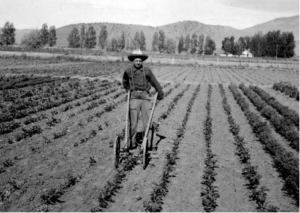
The Extension Service’s wartime bulletins provide a window into OSC’s involvement in the Victory Garden Program. The Victory Garden Program was a national movement created by the U.S. Department of Agriculture. Its goal was to increase the production of healthy food for the civilian population, as well as allow the troops to use the majority of commercially packaged food. Community gardens were often encouraged to people in cities who did not ample space to grow a productive garden. People in rural areas, or people who had farms, were urged to start their own Victory Garden on their own property. Victory Gardens could also take the form of a school garden.
The Victory Garden program was popular all over Oregon. “Man working in a Victory Garden, Klamath County Oregon, 1942,” OSU Special Collections & Archives Research Center, https://oregondigital.org/concern/images/df70cz48w
OSC used the Extension Program to encourage Oregonians living in cities and rural communities to plant their own Victory Gardens. The Victory Garden Program at Oregon State College was part of the larger victory movement at Oregon State that included a number of different Victory Programs. Oregon State was involved in 267 different wartime Victory Programs that were created to help the war effort. Aside from increased food production through the Victory Gardens, these programs focused on collecting raw materials needed for wartime production such as rubber and metal, increasing agricultural productivity, and researching the nutrition people needed.[iii] For example, the OSU Extension Service provided charts for families that laid out exactly the amount of food they would need in a year so families could preserve, can or freeze, the estimated amount they would use in a year.[iv]
The Victory Gardens and nutritional information were a significant part of Oregon State College’s agricultural Extension Service. The 1941-1942 Biennial Report of Oregon State College outlined five “broad fronts” that the OSC wartime extension programs were working on. The third “front” was the need to teach nutrition and home management to rural and farm homes.[v] The OSC Extension Service acted on this front by publishing curriculum such as a Food for Victory program for Marion County Schools. The curriculum’s objective was to provide children with an understanding of the contributions Oregon farmers were making toward the war through food production. The program provided teachers with songs, class activities, and stories they could use in the classroom.[vi] Curriculum and influence on rural homes apparently worked. By 1943, 90 percent of Oregon farms were cultivating Victory Gardens.[vii]
Victory Gardens were part of a national Victory Program movement. The National War Food Administration, along with the United States Department of Agriculture, initiated the Victory Garden Program. The Victory Gardens were a large part of the government’s WWII propaganda posters.[viii] These posters were distributed nationally with the hopes of bringing attention and support to different war efforts. Even the Science News-Letter, a national publication, provided readers with important Victory Garden information in 1943. The letter outlined the importance of joining a community Victory Garden, or if you had ample space, starting a Victory Garden at home. Also, the letter stated that gardens should allow plenty of space for the “most important soldiers in the Victory Vegetable army”—tomatoes.[ix]
Nationally, just as in Oregon, there was a sense of urgency in educating the youth about home gardening, self-sufficiency, and rationing. Schools from all over the nation participated in the Victory Garden Program by creating community gardens. For example, in early 1942, soon after America’s entry into war, teachers from Highland Park Schools in Michigan, aided by the Michigan Recreation Department, started a Victory Garden program for school students throughout the state. The program started because the teachers believed that home gardens were not enough to meet the needs of the war, and community gardens were needed in Highland Park. Over 100 students had an opportunity to work on their own gardens that were 4ft by 24 ft.[x] The production of food, and education of the youth in self-sufficiency skills, were a priority all over the U.S.
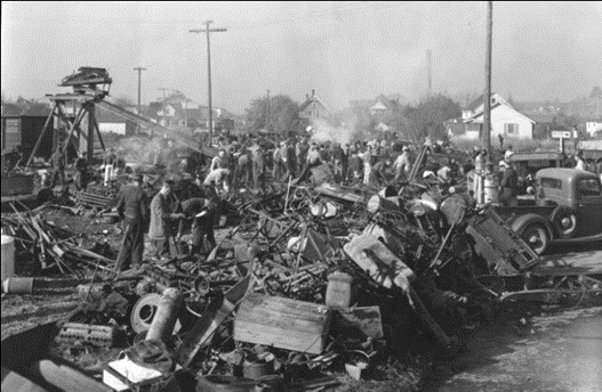
While Extension Services played a lead role in championing Victory Gardens at OSC and throughout Oregon, faculty and students throughout the college contributed to these Victory Programs. Victory Programs were any program that was organized to aid in the collection of resources or materials for the war effort. The Oregon State Barometer encouraged female students to donate their rubber and metal beauty items because “any little thing you give will help to win the war.”[xi] The need for metal was so extensive during the war effort that shop owners closed down their businesses to help with a scrap metal drive. OSC class presidents requested all of the men’s living group presidents to bring five men each to the drive that occurred in October of 1942 in Corvallis. The students were challenged by Dave Buam, an organizer of the scrap drive, and chairman of the Oregon Defense Council, to try to load more scrap metal than the working-class men who were also helping with the scrap metal drive.[xii]
Students and staff took great pride in their contributions to these programs. For example, Dorothy Gerling noted in the 1943-1944 Coed Code how all activities on campus were “directed toward the Victory Program.”[xiii] The Coed Code was an annual OSC women’s publication. OSC faculty member Dean Salser likewise told the 1944 Beaver, the college yearbook, that he had no time for other hobbies because “teaching and his victory garden have occupied most of his time.”[xiv]
Scrap metal drives were a common way to get many people from the community involved in the war effort. “Scrap metal collection day in Corvallis, Oregon,” 1942. OSU Special Collections & Archives Research Center, https://oregondigital.org/concern/images/df70ct058
Oregon State College’s efforts on the home front during WWII were extensive and successful. The Victory Gardens and other war effort programs that the OSC Extension Service organized helped create a culture of production, self-sufficiency, and with the local community. OSC was a small part of the national war effort movement, but its programs embodied the goals and culture of the domestic front that aided the Allies in winning the war.
[i] “Victory Garden and Family Food Supply” in Oregon State College Extension Service Bulletin 551-650 (Corvallis: Oregon State Systems of Higher Education, 1943), Extension Bulletin 615.
[iv] Mabel C. Mack, “Planning Your Families Food Supply” in Oregon State College Extension Service Bulletin 551-650 (Corvallis: Oregon State Systems of Higher Education, 1944), Extension Bulletin 588.
[vi] OSC Extension Ag. Economics, April 1943, “Food for Victory: A unit of Work for the Schools of Marion County, Oregon,” OSU Special Collections and Archives Research Center, Extension Service Records 1903-2011, RG 111, SG 2, X, Projects, Extension Specialists.