Announcing our Protein Portraits 2025 Movie
First, our movie needs a name. We’ll call it …
PRION-2025
Leading Protein Actor: Major Prion Protein. PDB ID: 1QLX
Poster Artist: Ollie Parsons (also calls himself our movie Director, GA-Romerase)
Major prion protein (PrPC) is a protein naturally expressed in the nervous system tissue of humans and animals. While harmless itself, a single amino acid substitution can cause it to misfold and become a prion (PrPSc). Prions, or “proteinaceous infectious particles,” are misfolded variants of major prion protein which cause several rare and fatal neurodegenerative diseases. They are infectious, with the ability to induce misfolding in other ordinary proteins. Some types of prion are resistant to action by proteinase K, an enzyme that cleaves peptide bonds, meaning that they are not readily broken down. As a big fan of the zombie genre, I drew immediate connections between prions and zombies. Prions’ ability to induce misfolding is similar to how a zombie bite can turn its unfortunate recipient into a zombie themselves. Their ability to mutate into a proteinase K-resistant form calls to mind the near-invulnerability of zombies in many films, books, and video games. I feel that if proteins were to make a monster movie, it would be about prions.
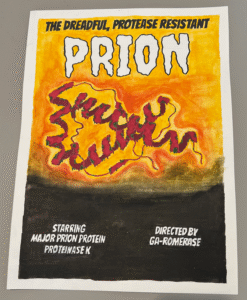
Therefore, I chose to make a movie poster for an imaginary movie about prions, right out of protein Hollywood. I chose a retro style, taking inspiration from the posters for early zombie movies, such as Night of the Living Dead, Dawn of the Dead, and Zombi 2. The movie stars major prion protein as it is slowly preyed upon by the monstrous prion, and proteinase K as it futilely tries to fight off the infection. Front and center is the prion itself, a rotting version of PrPC.
Next we need a movie script, written by …
Polymerase Playwrite, more commonly known as DNA Polymerase epsilon.
PDB ID: 2V6Z
Apprentice playwrite: Elise Jenkins
DNA polymerase is involved in synthesizing new DNA strands during replication, adding nucleotides and creating a complementary strand. Certain polymerase proteins can also proofread for errors and correct strands as they go. To fit into our movie theme, DNA polymerase is our playwright, crafting the script of the movie. 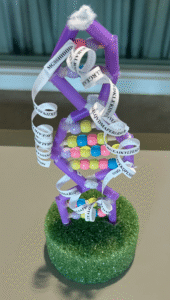
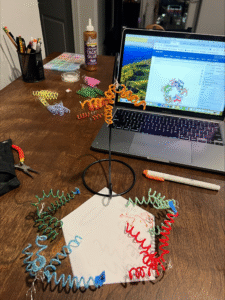
To represent this script-writing aspect, I made the DNA polymerase protein out of paper.
On the paper is the sequence of the protein, characterized by capital letters. Ultimately, DNA polymerase cannot operate without a DNA strand, hence its placement on the helix made out of pipe cleaners, straws, wooden dowels, beads, and lots of hot glue. The beads represent individual nucleic acids, while the straws make up the backbone of the DNA helix, filled with pipe cleaners to allow for flexibility.
As our Movie begins, we pass into a symmetry Portal…
Name of Portal: Protein S100-A4. PDB ID: 3M0W
Portal builder: Lua Akhtarkhavari
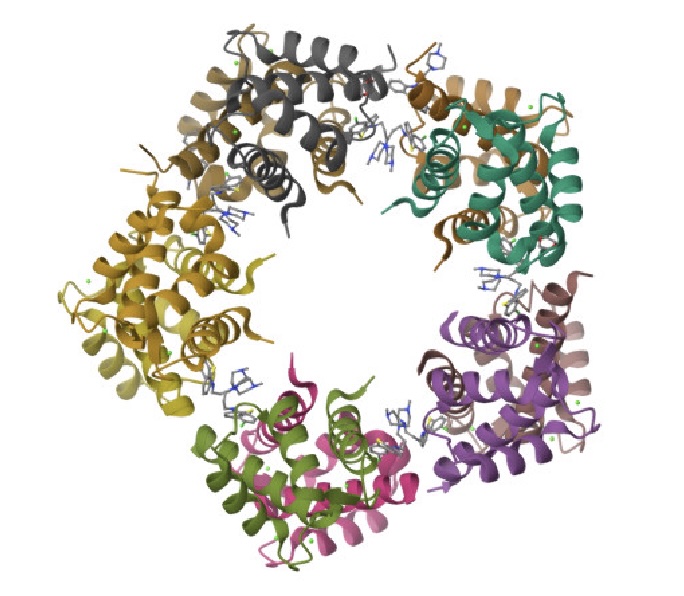
PDB 3M0W
The S100-A4 is a calcium binding protein found in homo sapiens — localized in the nucleus, cytoplasm, and the extracellular space. It is comprised of 10 identical chains, each 101 amino acids long. No comprehensive investigation of S100A4 protein expression in normal human tissue has been undertaken, but it has been extensively studied in other species over last two decades because of its metastasis-promoting properties.
The protein possesses no enzymatic activity and instead exerts function by interacting with and modulating the activity of other proteins. S100A4 is able to interact with cytoskeletal proteins, particularly nonmuscle myosin heavy chain (NMMHC) IIA, resulting in increased cell migration. Through interaction with annexin II (AII) and tissue plasminogen activator (tPA) on the surface of endothelial cells, S100A4 stimulates the conversion of plasminogen to plasmin, thus promoting angiogenesis. Angiogenesis is a vital process for growth, development, and wound healing, as it delivers oxygen and nutrients to tissues.
In cancer, angiogenesis is crucial for tumor growth and metastasis, as tumors need a blood supply to grow beyond a certain size. Metastasis is generally defined as the spread of malignant cells from the primary tumor through the circulation to establish secondary growth in a distant organ. With metastasis being the main cause of death in patients with cancer, if the presence of S100A4 in tumor cells were as important in humans as in rodents, expression of S100A4 in primary tumors should robustly predict patient outcome. In line with this reasoning, numerous studies have investigated the potential use of S100A4 as a prognostic marker.
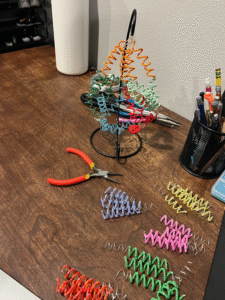
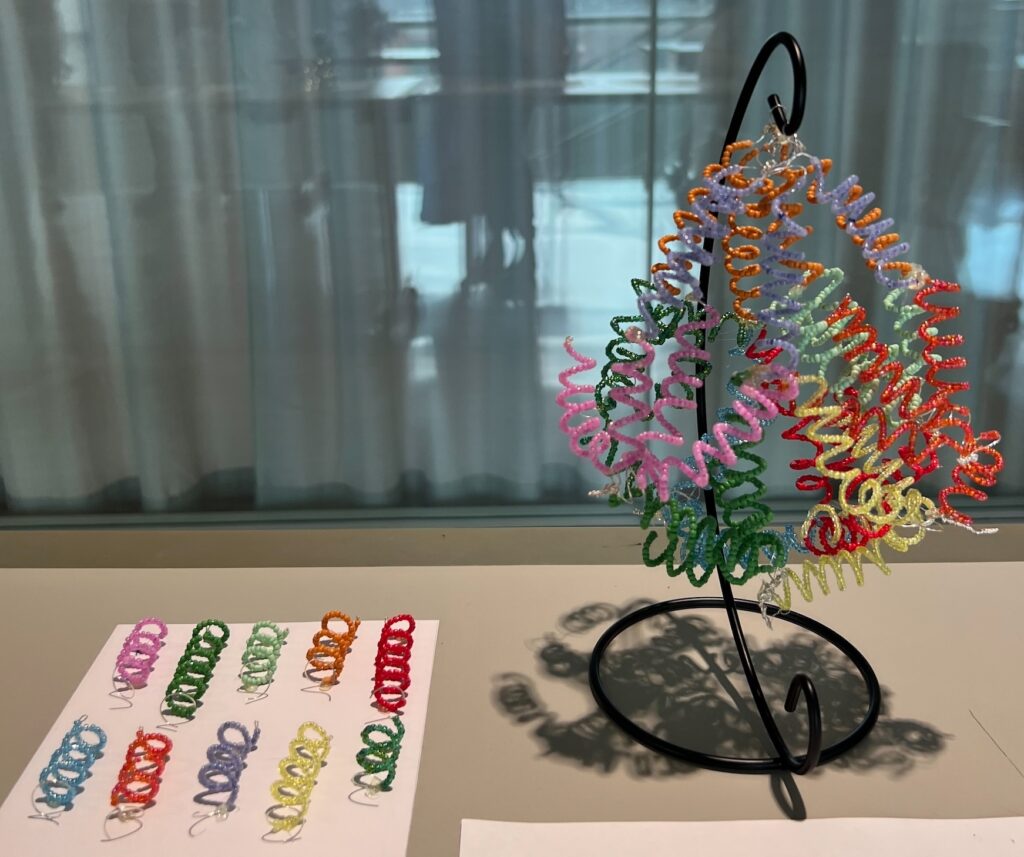
Due to it’s global symmetry (Dihedral -D5) structure, this protein stars as the “Portal to the Meta-Stasis”, through which the characters of this year’s protein portraits film traverse into a parallel universe, piercing the fabric of space and time where they fight their epic battle. To emphasize its portal-like structure and arrangement, I chose to artistically represent the 10 of the chains which are distinguished by different colored seed beads arranged on thin wire mostly comprised of the alpha helices.
Where we meet a famous superhero …
Spider-Man of the Protein-Verse: Major ampullate spidroin 2
Alpha fold ID: AF-A0A7I8DAP7-F1-v4
Molecular silk manager: Frankie Ruppert
Recently a spider had moved into my closet, he was honestly a great roommate and watching him spin his web (in the corner far away from me) was very fascinating to me. So when I was thinking about famous movies, Spider-Man immediately came to mind.
Spider webs are super cool, and Spider-Man shows off the flexibility and strength of the silk proteins.
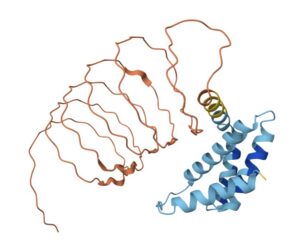
Alphafold A0A7I8DAP7-F1-v4
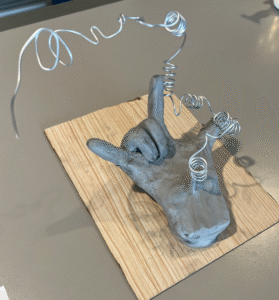 Spider webs are made up of at least four different silk proteins. I chose to focus on Major ampullate spidrion 2, because some of the strength to the backbone of the web and also some of the flexibility, both of which are very important to Spider-Man’s super power. The structure of the protein is relatively unknown because it takes on different structures in the gland and once shot. The structure chosen has 287 amino acids and has a bunch of beta strands and alpha helices.
But wait, oh no! We’re suddenly in the middle of a Gothic Horror Vampire Romance Scene …
Starring the blood-pressure raising cardiovascular protein: Angiotensinogen
Blood-sucking props designer: Isabel McCartin
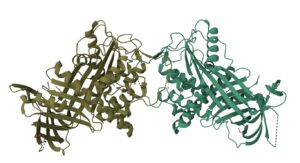
PDB ID: 2WXY
2WXY
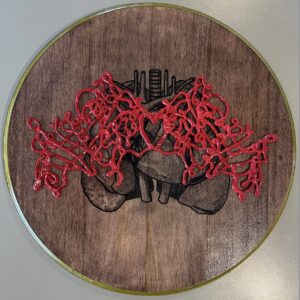
Angiotensinogen is a very important protein when it comes to sustaining life. It is a glycoprotein that is synthesized and secreted into the bloodstream by the liver. In a nutshell, it is the protein that helps regulate blood pressure and fluid levels. This portrait is representing the correlation between the protein and the cardiovascular system. It is in a gothic style to represent its role as one of the antagonists of the movie: a vampire. I wanted the drawing of the cardiovascular system to be in the style of old medical drawings. I decided to put in a thing of wood because I was inspired by old antique shops that sold plaques of various specimens. Finally I wanted the protein itself to be a dark read, representing the blood stream as well as the vampire movie it portrays.
And things get worse as even the greenery gangs up against us …
We meet the hungry carnivorous plant protein Dionain-1!
PDB ID: 5a24
Set botanist: Marissa Lane
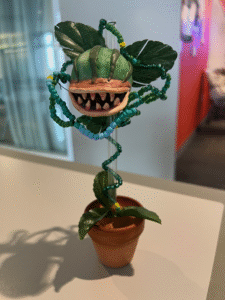
I chose this protein because I wanted to choose a plant protein. My initial instinct was RuBisCo, the photosynthesis protein. However, after introducing the monster theme for our movie, I started looking into carnivorous plants. Dionain-1 is a major endopeptidase involved in the digestion of food by Dionaea muscipula, the Venus Flytrap. I was drawn by its remarkable resemblance to the star of Little Shop of Horrors, Audrey II, who is a carnivorous plant that feeds on human flesh.
I have recreated Dionain-1 using beads, one for every animo acid that codes for the protein. The color scheme indicates what structures the amino acids fold into and is listed below. I added the straw for support and shaped the protein (with some artistic liberties) to hold the head of Audrey II. The head is polymer clay sculpted around a ping pong. Faux leaves were added to conceal the base and bring attention to the head.
Fortunately for us the heroic Microscopic Guardian can powerfully protect us!
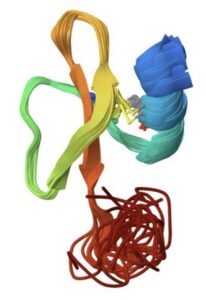
Protein Name: Human β-Defensin 6 PDB ID: 2LWL
Protein Keeper: Judy Shahin
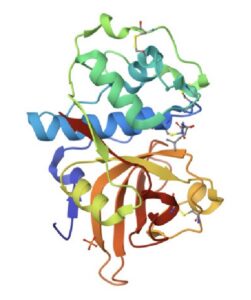
Human β-Defensin 6 is a small but powerful antimicrobial protein found in places like our skin and respiratory tract.
2LWL
It works like a natural antibiotic by killing or weakening bacteria and viruses. It also helps the immune system by sending signals to immune cells through the CCR2 receptor, guiding them to where they’re needed. It might even play a role in breast cancer by interacting with tiny vesicles from breast cells.

I connected this protein to the idea of a protector that is small but mighty like Ant-Man from the movies. I made a clay model of Ant-Man and added LED lights coming from his hand to show how the protein “sends signals” to the immune system. Even though it’s tiny, it plays a big role in protecting us.
As our movie winds towards a close, our wardrobe department deserves praise for providing gorgeous attire …
Protein Plumage: Feather Keratin B
Alpha Fold ID P20308
Costume designer: Brooke Downey
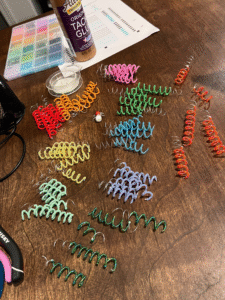
Protein Plumage is a sculptural exploration of feather keratin 4—the fibrous protein that gives bird feathers their strength and flexibility.
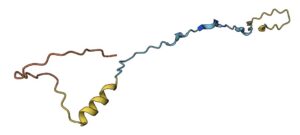
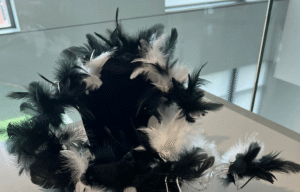
This wire feather boa represents the costume department for “Proteins at the Movies” as it translates the biological structure of feather keratin 4 into wearable art. By fusing science and style, Protein Plumage celebrates the elegance of nature at the molecular level by bringing the beauty of structural proteins to the spotlight.
And the Magic Behind the Scenes depended on skillfully applied Make-up …
Cosmetic base protein: Keratin PDB ID: 6E2J
Cosmetic artist: Rida Khan
Keratin is a structural protein that is well known for being a key structural component of nails, hair, and the outer layer of skin.
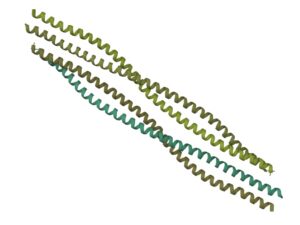
6E2J
While keratin is present in other structures such as scales, feathers, claws, and hooves, I chose a type of keratin that is found in intermediate filaments that support human epithelial cells (Type I keratin).
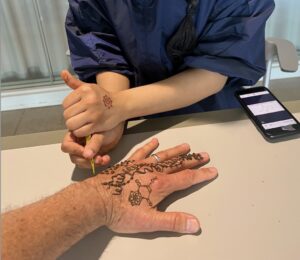
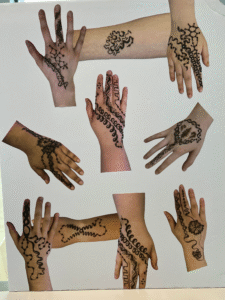
For this project, I chose to combine this protein with one of my favorite art forms, mehndi (also known as henna). The stain from mehndi arises from a chemical reaction (a Michael Addition, for those familiar with organic chemistry) between a chemical in the henna plant called lawsone and the keratin protein. This stain is technically permanent; the only reason why the stain fades over time is because the skin is shed. Similarly fading into the background, the keratin protein is playing an important role in our film as our makeup artist and hairstylist.
I chose to title this project “Magic Behind the Scenes,” because behind the scenes of anything you observe (even henna stains), there is science working behind the scenes. And what is science, if not magic that we can explain?
Our Gem of a Movie also has special Glimmer thanks to …
The Shimmer of Lustrin A. AlphaFold ID: AF-F6KD05
Jeweler to the Stars: Jordan Sandler
Lustrin A is a structural protein found in the shells of marine mollusks like the Haliotis tuberculata, also known as the green ormer. A species known for its beautifully iridescent, jewel-toned shell. While Lustrin A’s full structure hasn’t been solved experimentally, AlphaFold provides a predicted model that reveals its potential role in creating the shell’s strength, flexibility, and signature shimmer.
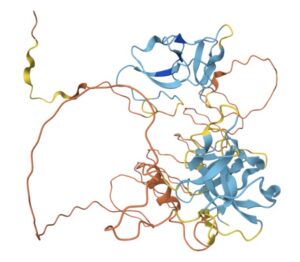
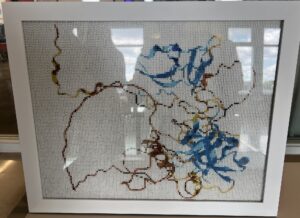
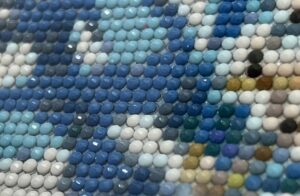
For this project, I translated Lustrin A’s AlphaFold structure into a custom diamond painting, using sparkling gems to reflect the protein’s complexity and the natural brilliance of the green ormer’s shell. As part of the Jewelry Department in our movie theme, my piece connects the science of proteins with the art of design, highlighting how proteins like Lustrin A help create nature’s most stunning, gem-like structures.
In the final scences, Good met Evil, Love invented Beauty, and we can now depart…
Through an Aquaporin storm door: PDBID: AQP1
Aquaporins are special membrane proteins that facilitate rapid diffusion of water into and out of cells. They are extremely important for osmoregulation and almost all cellular and bodily functions. Aquaporins consist of four identical monomers assembled in a tetramer, where each monomer contains 6 alpha helical transmembrane chains and a distinct water pore.
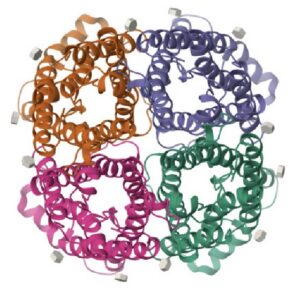
In this sculpture, one of these monomers is constructed using a wire to depict the primary structure of the protein, with intricately weaved embroidery floss sections to illustrate the alpha helical transmembrane chains (secondary structure). The wire was then folded according to the actual tertiary structure of the protein, displaying how and where the protein folds and interacts with other parts of the structure.
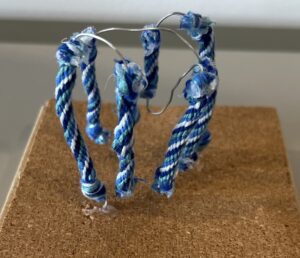
In Proteins at the Movies, the aquaporin holds multiple roles. Similar to how theater doors control the influx of movie goers before and after the show, aquaporins facilitate the diffusion of water molecules into and out of the cell, making them a critical addition to our movie set.
That’s it Ladies and Gentlemen. The journey is over …
All that’s left is The End, portrayed by the NrdR protein, which puts a halt to transcription.
Alpha Fold ID: AF-B1MCZ3-F1-v4
My protein is Transcription Repressor NrdR found in Mycobacterium abscessus. This protein negatively regulates transcription by binding to DNA. Which blocks RNA polymerase from binding to the promoter. Meaning, it prevents the process that leads to the production of proteins. Thus, leading us to “the end” of proteins.
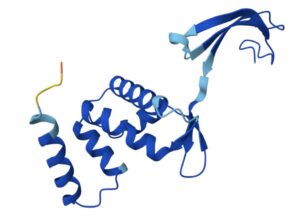
My portrait acts as the end credits in this film. Every protein has played their part in this production, so it’s only fitting to have end credits to accompany it. I was inspired by both my protein being the end as well as credits of old Hollywood movies. The font is inspired by the end title card in The Wizard of Oz. I painted in layers to give the painting texture. The frame around “The End” is inspired by the frames that adorn dialogue cards in silent films. Each corner of the piece has 3D sculptures of Transcriptional Repressor NrdR that are a part of the frame.