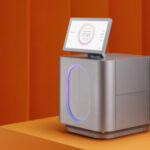
The CQLS is pleased to announce our new Illumina MiSeq i100 sequencer. As Illumina phases out their original MiSeq we have upgraded to the new MiSeq i100. The CQLS MiSeq i100 sequencing service is now available.
Illumina’s new MiSeq is a lower output sequencer compared to the NextSeq or NovaSeq. The new MiSeq i100 offers similar flow cell sizes to the original MiSeq with greatly reduced sequencing costs and additional sequencing lengths, including 500bp paired end runs. Updated prices are found on our fee site: CQLS Service Fees.
Illumina’s MiSeq i100 is a patterned flow cell like the NextSeq. Patterned flow cells are subject to low levels of index hopping. We suggest reviewing and adopting the mitigation techniques outlined by Illumina: “Minimize index hopping in multiplexed runs.” Please contact us with questions.
CQLS will host an information session with Illumina on Friday, February 20th at 12:30. Food will be provided. Please join us to learn about the MiSeq i100.
The CQLS’ original MiSeq service contract will end on June 30th. Please contact us if you would like help transitioning experiments to the new MiSeq i100.
The Illumina MiSeq i100 purchase was made possible by the DRI 2025 Research Equipment Reserve Fund.
High-quality reference genomes are the foundation for much of what our collaborators do at OSU — from mapping reads and calling variants to identifying genes of interest and performing CRISPR knockouts. Obtaining high-quality genomes is still an evolving field: only recently did NIH researchers from the Telomere-to-Telomere consortium bring to full completion a human reference genome; this milestone led to the discovery of nearly 2,000 additional gene predictions, broadly improving our ability to understand genetic variation and epigenetic activity (Sergey Nurk et al. 2022). At the forefront of this achievement was developing protocols for Nanopore ultra-long (UL) sequencing: critical for spanning centromeres, telomeres, and other repeat-rich, heterozygous, and duplicated regions. At CQLS, we’re adapting this methodology for plants to overcome technical biases that persist in traditional short-read and long-read sequencing.
Traditional methods for plant DNA extraction typically rely on aggressive homogenization and lysis methods to break down cell walls, resulting in highly fragmented DNA. Bead beating, vortexing, and even pipette mixing can shear long DNA molecules. By isolating intact nuclei and removing cytoplasmic contaminants without rupturing the nuclear membrane, we can recover DNA fragments that span >60 kilobases to 1Mbp ideal for UL sequencing. We’re pleased to report that our yield of UL reads is on par with other leading institutions.
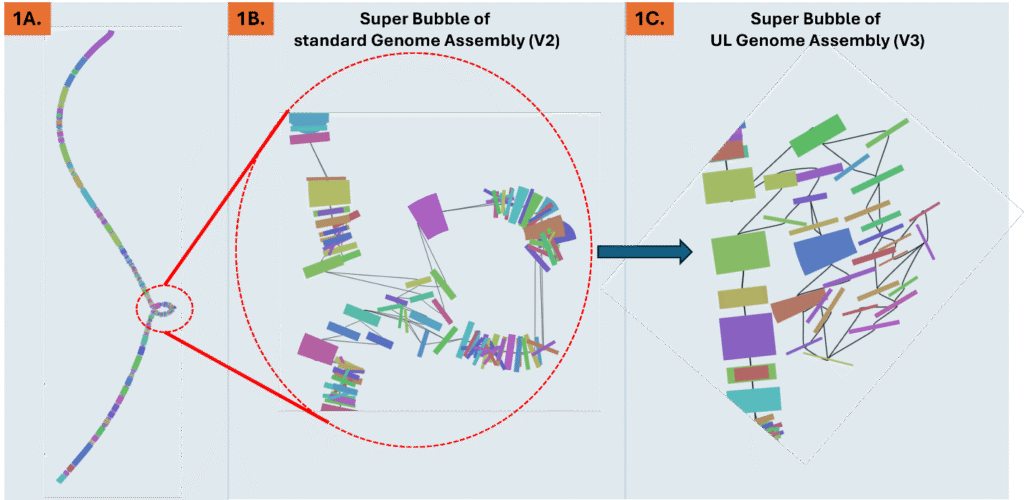
Figure 1. A. Visualizing of a DNA genome assembly graph (V2) that lacks ultralong reads. Different colors along the graph indicate Simple Bubbles that represent heterozygous loci. The dotted red circle is a Super Bubble composed of many bubbles at different positions within the allelic locus. B. Magnification of the dotted-red circle Super Bubble from a genome assembly that lacks the ultralong reads. C. The same Super Bubble from 1B. identified in the ultralong assembly (V3) shows a significant reduction in the number of bubbles within, vastly reducing complexity of heterozygous calls and read mapping at this allelic locus.
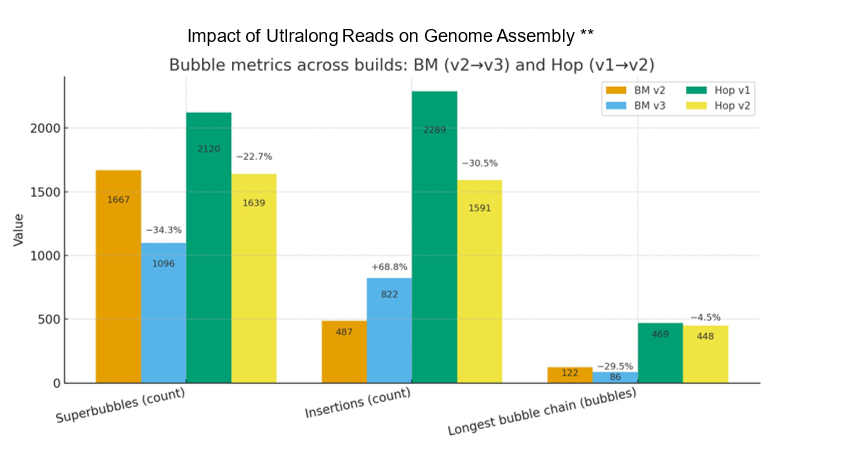
Even modest UL coverage simplifies assemblies and improves accuracy. In benchmarks on a polyploid mint and highly heterozygous hop, ~5x UL depth reduced the total number of spurious short contigs by three-fold compared to genomes without UL support. To illustrate this, Figure 2A. shows a genome assembly graph that lacks UL support. Complex regions in the graph often contain numerous heterozygous loci that exist within a larger heterozygous locus (known as a super bubble). Comparing the same super bubble between two genomes, one without ultralong (Figure 1B) and one with 5x UL coverage (Figure 1C), we can see a significant reduction in total bubbles and complexity. Across the entire genome, UL assemblies reduce super bubbles by ~30% versus no-UL assemblies (Figure 2). These structural improvements carry through to the chromosome validation, yielding cleaner Hi-C contact maps that contain less technical artifacts and stronger assembly metrics overall.
Figure 2. Impact of ultralong reads on raw genome assembly graphs of two plant species. A polyploid species of mint is represented in orange (raw assembly) and blue (UL reads). Highly heterozygous hop in green (raw assembly) and yellow (UL reads). Plots represent three distinct categories of assembly graph statistics: the number of super bubble, the number of insertions within bubbles and the total number of sequential bubbles.
Ultralong reads deliver biological insights by resolving previously unknown regions that can erroneously impact downstream analysis. Many facets of gene function and regulation have been found to be embedded within or adjacent to transposable-element rich regions that are difficult to assemble correctly without ultralong support. In mint, UL reads led to a nearly seven-fold reduction in an expanded higher-order nucleotide repeat, greatly clarifying our understanding of a centromeric region. We expect UL data to continue strengthening our understanding of biology, especially in non-model species that may hold unknown complexity.
References
Sergey Nurk et al. ,The complete sequence of a human genome.Science376,44-53(2022).DOI:10.1126/science.abj6987
Registration is free this year. Lunch is optional.
Friday November 22, 2024
PROGRAM
Time
Event
8:00 – 9:00 AM
Registration, poster & sponsor set-ups, coffee and light refreshments
9:05 – 9:15 AM
Brent Kronmiller, Interim Director, CQLS “CQLS Introduction and updates”
9:15 – 9:50 AM
“Lightning Round” Research Presentations
9:50 – 10:20 AM
Break – Poster setup and Sponsor displays
10:20 – 11:15 AM
Key Note Speaker, Moderator: Siva Kolluri Joe Gray, Biomedical Engineering, OHSU“Rethinking Precision Cancer Treatment for Advanced Cancers – A Systems Biomedicine Approach”
11:15 AM – 12:00 PM
OSU Faculty Research Presentations Moderator: Chrissa Kioussi
Olena Taratula, Pharmaceutical Sciences, OSU“Nanotheranostics for potential management of ectopic pregnancy”
Alex Weisberg, Botany and Plant Pathology, OSU“Evolution and epidemiology of global populations of Agrobacterium vitis”
12:00 – 1:00 PM
Lunch – Poster setup and Sponsor displays
1:00 – 2:30 PM
CQLS Core services Moderator: Brent Kronmiller
CQLS Bioinformatics Staff“CQLS Sequencing and Bioinformatics Consulting Services” Laurent Deluc, Horticulture, OSU“Sequencing of the Microvine Genome: an example for genome editing studies and modern genomic data resources”
Denise Hynes and Joe Spring, CQLS“CQLS Health Data Informatics Services” Veronica Irvin, School of Human Development and Family Sciences, OSU“Be Well: An example of using REDCap for NIH-funded studies”
Anne-Marie Girard, CQLS“CQLS Confocal Microscopy Services” Maria Camila Medina, Botany and Plant Pathology, OSU“From cell to shapes: Confocal insights into plant development”
2:30 – 3:00 PM
Break – Poster setup and Sponsor displays
3:00 – 4:10 PM
OSU Faculty Research Presentations Moderator: Fritz Gombart
Brandon Pearson, Environmental and Molecular Toxicology, OSU“Non-cancer health outcomes for environmental mutagens”
Maria Purice, Biochemistry and Biophysics, OSU“Impact of sex and aging on glia-neuron interactions in C. elegans”
Erin McParland, College of Earth, Ocean, and Atmospheric Sciences, OSU“Chasing the elusive chemical currencies of marine microbes with metabolomics”
4:10 – 4:20 PM
Irem Tumer, VPR, Division of Research and Innovation
It is my pleasure to announce that Dr. Brent Kronmiller has been selected to serve as the Interim Director of the Center for Quantitative Life Sciences (CQLS) effective March 1.
Dr. Kronmiller has been at OSU and affiliated with CQLS for 11 years. Most recently, he has served as the CQLS Assistant Director of the Bioinformatics and Data Science Group that helps consult and collaborate on bioinformatics and data science research across the university. He is also an Assistant Professor (Senior Research) in the Department of Botany and Plant Pathology in the College of Agricultural Sciences.
In the CQLS, he has provided technical and scientific advising to staff and the OSU community and provided guidance and direction to both the CQLS Biocomputing group and the CQLS Core Laboratory group. He also manages the CQLS teaching effort, courses and workshops for students and employees to learn high-performance computing (HPC), bioinformatics and data science skills. Dr. Kronmiller also provides scientific leadership for designing experiments, providing laboratory quotes and troubleshooting errors and issues.
Dr. Kronmiller succeeds Dr. Kathy Higley, who has served as CQLS interim director since December 2021. My special thanks to Kathy for leading the CQLS during this transition period for the center. While Kathy will remain as OSU faculty, she will also be assuming the duties as the President of the National Council on Radiation Protection and Measurements.
Please welcome Dr. Brent Kronmiller to this new role as we take the CQLS to the next stage in support of Prosperity Widely Shared.
Best,
Irem
Irem Y. Tumer, Ph.D., ASME Fellow Vice President for Research and Innovation Professor, School of Mechanical, Industrial, and Manufacturing Engineering
Division of Research and Innovation Oregon State University | 541-737-0664
Radniecki, CQLS et al – 06/29/2022 Evaluation of a Wastewater-Based Epidemiological Approach to Estimate the Prevalence of SARS-CoV-2 Infections and the Detection of Viral Variants in Disparate Oregon Communities at City and Neighborhood Scales
CQLS et al – 04/22/2022 Detection of SARS-CoV-2 B.1.351 (Beta) Variant through Wastewater Surveillance before Case Detection in a Community, Oregon, USA
In celebration of our recent name change, the theme for this year is “Frontiers at the Intersection of the Life & Quantitative Sciences.” Anyone with an interest in life sciences or quantitative sciences is invited to attend. The Fall Conference will feature excellent science presentations from invited guest speakers, OSU faculty, students and staff.
Because this is our first conference since our name change (and because the event is fully online this year) the conference this year is completely free for all attendees.
The poster session will be held online on Friday, September 17. More details of the format and time will be provided soon. Posters are welcome from all participants. Posters from registered undergraduate students, graduate students and postdoctoral fellows/trainees will be eligible for one of three cash awards, and there will be one award for lighting talks.
DEADLINES
Lightning Talk Registration: September 10
Poster Registration: September 15
Conference Registration: September 15
Thank you to our 2021 Fall Conference Committee
Kevin Brown, Pharmaceutical Sciences and Chemical, Biological, & Environmental Engineering Molly Burke, Integrative Biology Maude David, Microbiology & Pharmaceutical Sciences Patrick De Leenheer, Mathematics and Integrative Biology Perry Hystad, Public Health & Human Science Natalia Shulzhenko, Biomedical Sciences, Carlson College of Veterinary Medicine
Frontiers at the Intersection of the Life and Quantitative Sciences
Friday, September 17, 2021 Online
Location
Time
Event
Conference Floor
8:00
Doors open. Explore the virtual conference space and watch a SpatialChat tutorial
Stage
9:00
Brett Tyler, Director, CQLSIntroduction to the Center for Quantitative Life Sciences
Stage
9:30
Matthew Bennett, Professor of Biosciences, Rice UniversityDynamics of synthetic gene circuits: from cells to consortia to organisms
Free
10:15
Break (setup for posters)
Stage
10:45
Gail Rosen, Professor, Electrical and Computer Engineering, Drexel UniversityMachine Learning of Microbiomes: Learning and Exploring Structure and Function of DNA and Proteins at Multiple Scales
Stage
11:30
Richard Rodrigues, Bioinformatician at Leidos Biomedical Research, IncHost-Microbiome Multi-Omics Data Integration in Cancer Immunotherapy
Discussion Rooms
12:00
Lunch (networking with guest speakers and Presentation by Agilent from 12:15-12:45)
Stage
1:00
Maya Kaelberer, Medical Instructor in the Department of Medicine, Duke UniversitySugar transduction in the gut
Stage
1:45
Marian Hettiaratchi, Assistant Professor, University of OregonDeveloping Biomaterials for Tissue Repair using Bio-transport Modeling
Stage
2:15
Mark Phillips, Department of Integrative Biology, Oregon State UniversityUsing Experimental Evolution to Study the Genetics of Adaptation
Kevin Brown, Pharmaceutical Sciences and Chemical, Biological, & Environmental Engineering Molly Burke, Integrative Biology Maude David, Microbiology & Pharmaceutical Sciences Patrick De Leenheer, Mathematics and Integrative Biology Perry Hystad, Public Health & Human Science Natalia Shulzhenko, Biomedical Sciences, Carlson College of Veterinary Medicine