Yaquina Head Early Season Update, Summer 2026

By Will Kennerley, Faculty Research Assistant

On the morning of May 9th, I drove out to Yaquina Head and walked to the overlook at the base of the 93′ light tower. Thousands of murres were already on the rocks and buzzing around like so many bees, cormorants were flying back and forth with mouths full of nesting material, and oystercatchers chased one another across the intertidal rocks. This day was like so many others yet was notable for kicking off our 20th consecutive season of seabird monitoring at Yaquina Head (and 25th overall!).

Twenty years sure feels like a long time; after all, when monitoring was revived in 2007 under the direction of then-OSU Professor Rob Suryan, Rhianna’s “Umbrella” was dominating the airwaves, the very first iPhones were being released, and George W Bush was still in the White House. About 60% of murres that season reproduced successfully, a percentage we haven’t managed to reach in the last decade. Amazingly, given the relatively long lifespans of murres and other alcids, some of the chicks from that season are almost certainly still with us, breeding this very year at the colony!

Over this time we’ve seen a number of changing influences on Yaquina Head’s birds, most especially rising avian predator predation and the occurrence of several severe marine heatwaves. Yet, over all this time our methodology has remained essentially unchanged and many of the same rocks and subcolonies are still being monitored. This gives us the incredible ability to effectively document and quantify changes in seabird vital rates over a relatively long timespan, helping us learn how Oregon’s seabirds are adapting to a changing world.

After a month of monitoring, it seems like it’s set to be an early year, particularly for cormorants. Brandt’s Cormorants were already starting to lay eggs by May 12th and Pelagics were doing so just a week later. Assuming standard incubation periods of 30 days for both species1,2, it’s likely we’ll start to see our first cormorant chicks hatching at the end of the week. In many years, median hatch dates for both species aren’t until early-mid July, suggesting we could be several weeks earlier than in a “typical” year!
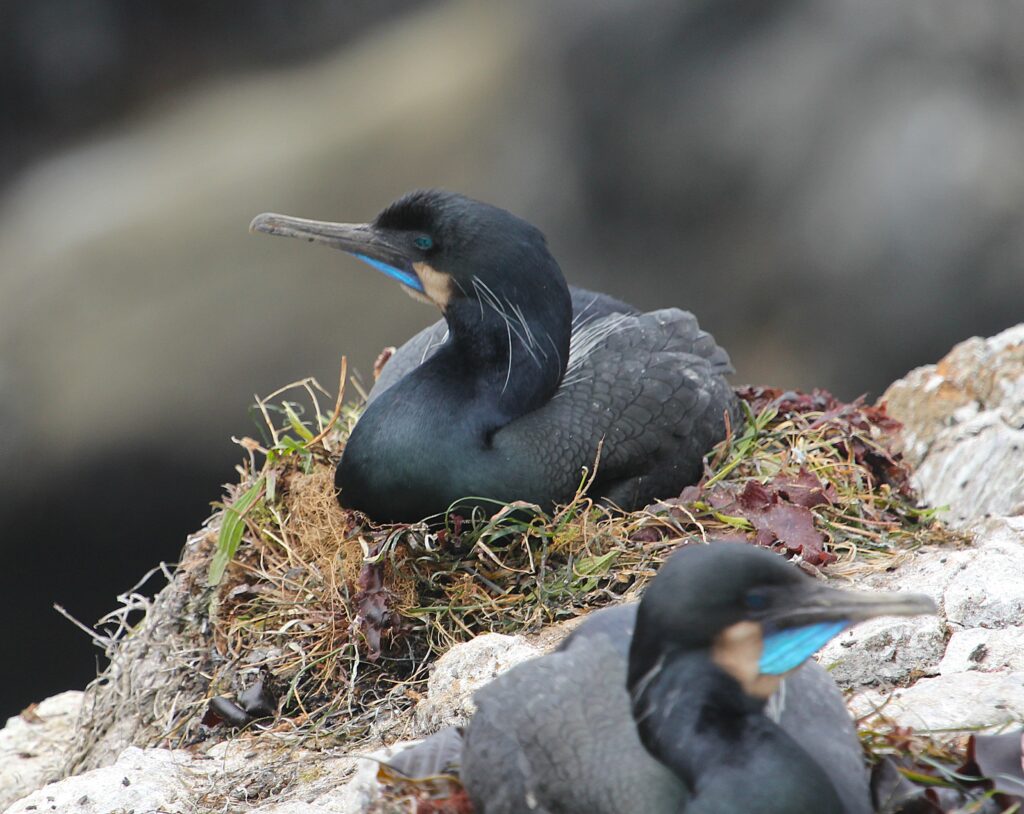
Two Brandt's cormorants on nests
Brandt’s Cormorants seem poised to have an exceptionally early year, with the first nests being laid a week or two earlier than the norm. The first chicks at Yaquina Head may hatch within a few days.

However, there’s also evidence of two distinct waves of cormorant nesting this year at both the Yaquina Head and Pirate Cove colonies. Many early nesting attempts in mid-May (particularly at the more exposed sub-colonies) were subjected to extensive eagle disturbance and were kept empty while those at more protected sites nearby were already incubating. Eagle disturbance tends to decline over the course of the summer and cormorants established more widely by early June. Because of this, I suspect we’ll see some exceptionally early chicks but perhaps the median hatch date that we calculate every year won’t be quite so dramatically different from normal.

Although cormorants show great variation in the timing of nest initiation between years, we haven’t seen evidence of an obvious change towards earlier or later nesting. Murres, in contrast, have been nesting later and later in recent years at Yaquina Head; whereas chicks in the 1990s and early 2000s hatched mostly in late June, we typically don’t see our first chicks until mid July now. At present, murres are occupying nest sites at both Yaquina Head and Pirate Cove, yet only in the last week or so have eggs begun to appear.
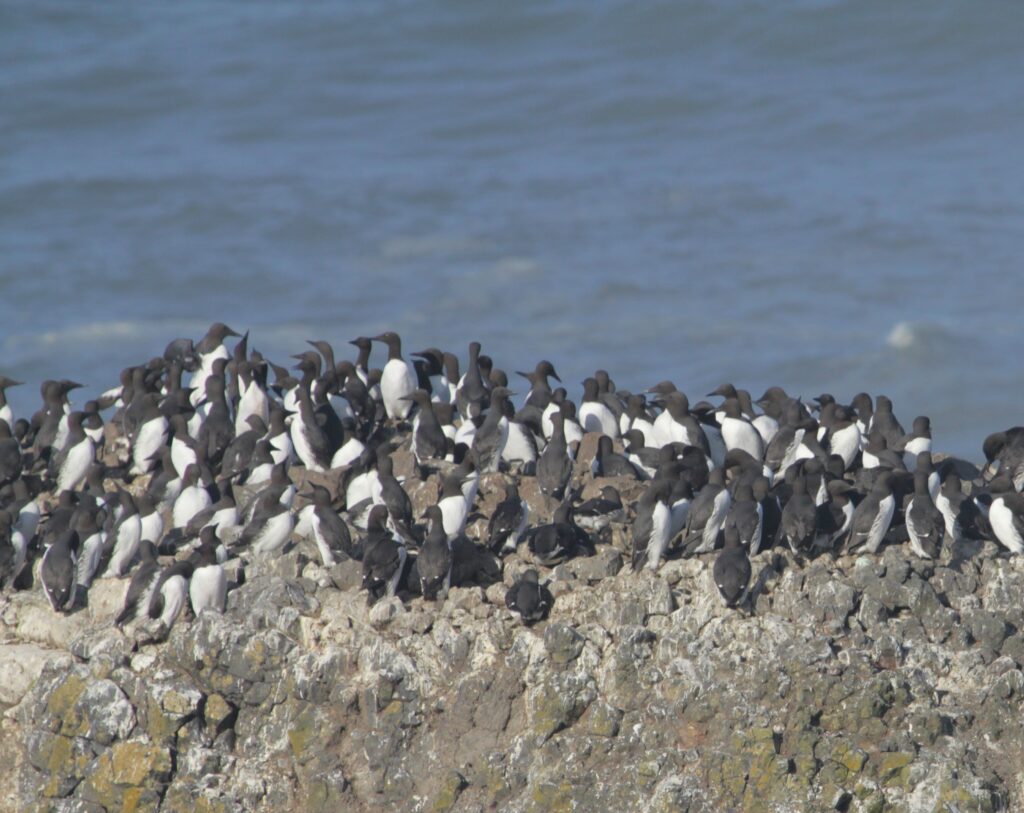
A large number of common murres standing on a rock.
Common Murres have been occupying the rocks at Yaquina Head on and off for several months now, but only recently have they begun to lay eggs. When Rob Suryan reinstated the Yaquina Head monitoring work in 2007, murres would have been well into the incubation period by now.

The timing of reproduction can be incredibly important when there are great seasonal differences in local productivity3. When breeding phenology more closely aligns with peaks in local productivity, animals may be more successful in raising young since the period of peak food demand will match the period of peak food abundance4. This is important as spring plankton blooms change, the timing of trees leafing out advances, and other climate change-induced phenological changes affect seemingly every ecosystem on earth.

Less predictable changes to local productivity may also be mediated by the timing of reproduction. This year, I’m particularly intrigued to see how the early nesting of some of our cormorants will align/misalign with the impacts of the major El Niño event currently developing in the equatorial Pacific. The coastal upwelling that drives marine productivity in the California Current tends to be reduced during El Niño events, so that El Niño years tend to be marked by seabird breeding failures and reduced adult survival rates5. If cormorants can raise and fledge chicks before the impacts of El Niño are felt here in Oregon, they could still reproduce successfully. Alternatively, if waters warm and productivity is reduced while chicks are still nest-bound, they may be abandoned by starving adults and die in the nest.
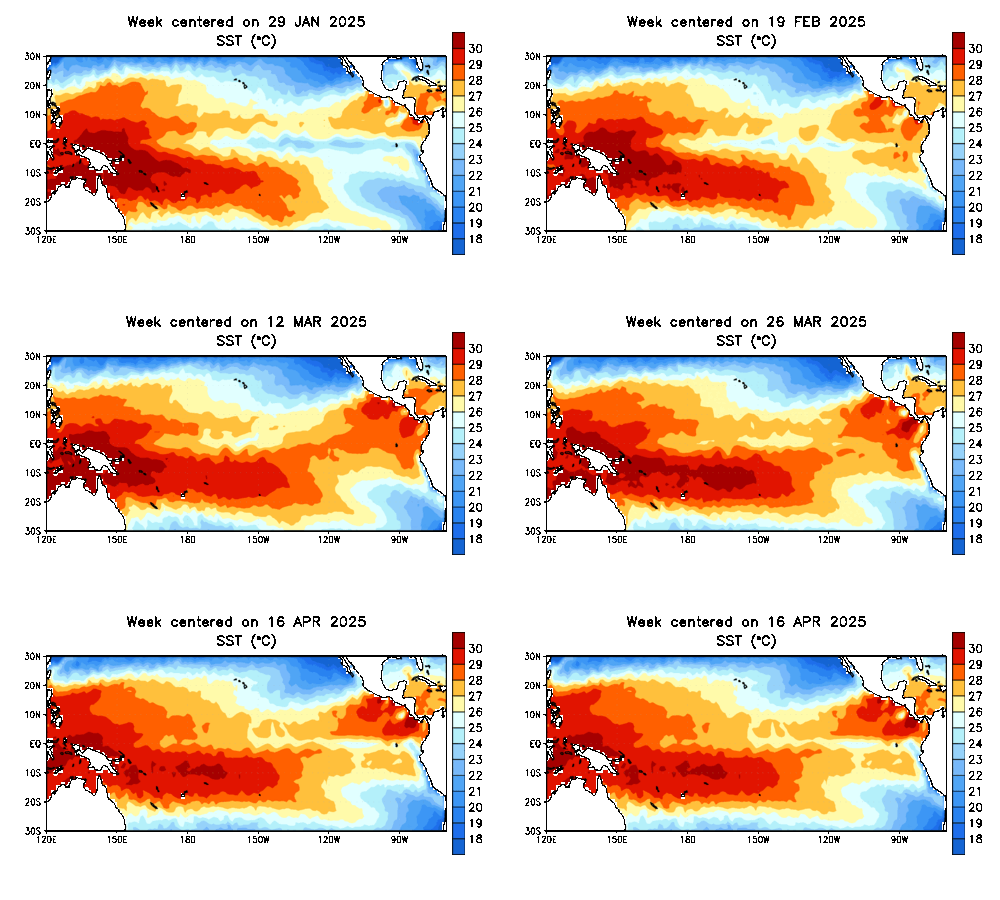

Tropical Pacific Sea Surface Temperature Animation
Higher sea surface temperatures (oranges and reds) are covering increasing areas of the equatorial Pacific. Models predict an 82% probability of transition to ENSO positive (El Niño) conditions in the coming months. Graphic courtesy of NOAA’s Climate Prediction Center https://www.cpc.ncep.noaa.gov/products/precip/CWlink/MJO/enso.shtml).

Events like El Niño are constantly occurring throughout the world’s oceans and act as fascinating “natural experiments” for researchers to better understand how seabirds interact with, and are impacted by, their environments. The responses of birds may also vary in response to seemingly trivial differences in the timing, severity, geographic extent, or duration of these events, making it challenging to accurately predict their impacts. We never really know what kind of season we have ahead of us, but it’s this mystery that keeps us excited each spring to begin monitoring at Yaquina Head again, 20 long years in a row.

References

1 Hobson, K. A. (2021). Pelagic Cormorant (Urile pelagicus), version 1.1. In Birds of the World (Editor not available). Cornell Lab of Ornithology, Ithaca, NY, USA.

2 Wallace, E. A. and G. E. Wallace (2021). Brandt’s Cormorant (Urile penicillatus), version 1.1. In Birds of the World (A. F. Poole and F. B. Gill, Editors). Cornell Lab of Ornithology, Ithaca, NY, USA.

3 Lack, D. (1950). The breeding seasons of European birds. Ibis92(2), 288-316.

4 Thomas, D. W., Blondel, J., Perret, P., Lambrechts, M. M., & Speakman, J. R. (2001). Energetic and fitness costs of mismatching resource supply and demand in seasonally breeding birds. Science291(5513), 2598-2600.

5 Ainley & Boekelheide. 1990. Seabirds of the Farallon Islands: Ecology, Structure, and Dynamics of an Upwelling System Community. Stanford University Press, Stanford, CA, USA.

To Breed or Not to Breed

Yaquina Head Early Season Update, Summer 2024

It’s the start of another summer on the Oregon Coast and I once again find myself spending most mornings out on rocky headlands for another season of seabird monitoring. Since early May, I’ve been following the breeding activities of murres, cormorants, and gulls at Yaquina Head (Newport) and Pirate Cove (Depoe Bay). As the season begins to take shape, I wanted to share what I’ve been seeing through my spotting scope.

Initial signs are mixed, but seemingly point to a year of low to moderate breeding success for most species. Common Murres have been around the two colonies for months by now, yet occupation of nesting sites has so far only been sporadic. I’ve yet again been observing frequent disturbances by up to four bald eagles at a time, which has prevented the murres from regularly settling into the colony and their nest sites (Figure 1). Because of the frequent eagle activity, I’ve rarely had the opportunity to see murres fully occupy all the Yaquina Head subcolonies; my best guess, however, is that the number of murres attending the colony is lower than at this time last year.

Despite regular disturbances, I observed the first few murre eggs at Yaquina Head on June 6th! While these eggs were predated within a few days, this does indicate that murres are willing to attempt breeding and I suspect more eggs will be seen soon. The ability of murres to breed successfully last year, despite heavy eagle disturbance early on, gives me reason to be cautiously hopeful that at least some Yaquina Head murres will manage to fledge chicks this year. Eagle disturbances appears to be fewer and less severe at Pirate Cove, and I’m eager to see how long the first few murre eggs at that colony persist. Despite the challenges imposed by eagles, murres appear motivated to attempt breeding.

Figure 1. One of several subadult Bald Eagles frequently seen disturbing the seabirds breeding at Yaquina Head, Oregon.

In contrast, Pelagic Cormorants are by and large not attending either the Yaquina Head or Pirate Cove colonies this year. Last summer saw record-high Pelagic Cormorant productivity and each monitored nest fledged an average of 2.8 chicks; however, so far this summer, I’ve only been able to locate a single nest with eggs across our two sites.

Cormorants, generally – and Pelagics, in particular – are known for highly variable reproductive outputs (Figure 2). Some seabirds (e.g., tubenoses) take more of a “low and slow” approach to reproduction that leads to a moderate but fairly consistent output across years, but Pelagic Cormorant reproduction is typified by highly variable, “boom or bust” cycles. Ainley and Boekelheide note in their Seabirds of the Farallon Islands (1990) that Pelagic Cormorants experience the most extreme interannual variation in breeding effort and success of all the seabird species that breed there. Cormorants are sensitive to fluctuations in prey populations and may skip breeding when prey is scarce, but they can also lay large clutches to take advantage of highly favorable conditions.

While 2023 was undoubtedly a “boom” year, 2024 is shaping up to be the accompanying “bust”. Initial monitoring of many well-built nests saw birds abandon nest-guarding early on and relatively few Pelagic Cormorants even appear to be attending the colony. Cormorant reproduction in the California Current System is related to sea surface temperature, with low reproductive effort often associated with warm-water, El Niño periods (Schmidt et al. 2015) like we experienced this last winter.

Figure 2. Pelagic Cormorant productivity at Yaquina Head from 2008-2023. Reproductive output from this species is highly variable between years.

Brandt’s Cormorants (Figure 3), on the other hand, are attempting to breed this year at both sites. Most are busily incubating three or even four egg clutches now, with the first chicks expected by the end of June. It’s possible that Brandt’s Cormorants finished the winter in better body condition than Pelagics, perhaps because they often exploit different foraging habitats and prey types (Ainley et al. 1981). Brandt’s Cormorant reproduction does tend to be somewhat less variable than that of their cliff-dwelling relatives (Ainley & Boekelheide 1990), but still varies considerably between years in relation to ocean conditions and prey abundance (Schmidt et al. 2015; Ainley et al. 2018). It’s interesting to observe these two congeneric species of seabird respond so differently to these conditions. However, cormorants may also abandon breeding efforts mid-season if prey availability should suddenly decline, so I’ll continue monitoring to see how the Brandt’s manage to do this summer.

Figure 3. Brandt’s Cormorant males spend lots of time collecting nesting material. Breeding Brandt’s were frequently seen collecting grasses from the headland at Yaquina Head, as well as stealing material from their neighbors’ nests.

As for other species, Western Gulls have been faithfully incubating their two and three egg clutches at both sites for several weeks now – it’s just a matter of time before our first downy chicks of the year are around. The Black Oystercatchers aren’t nesting at easily-visible sites this year, but their raucous calls continue to be a near-constant presence at both colonies. Excitingly, I’ve also observed Tufted Puffins circling the Yaquina Head murre colony on several occasions, and once saw one flying over Pirate Cove! While neither site has much suitable nesting habitat for puffins, the USFWS recently placed puffin decoys and artificial burrows on Gull Rock (located squarely between the Yaquina Head and Pirate Cove colonies) to draw them there. The puffins’ continued interest in these sites continues to raise my hopes that one day soon we’ll have Tufted Puffins nesting again on the Central Coast. 

So far, it seems challenging to predict just what kind of year we’ll see on the Oregon Coast. Reduced breeding effort by Pelagic Cormorants and (to a lesser extent) murres, suggests unfavorable conditions. Yet, murres (though perhaps in somewhat lesser numbers) have begun to lay eggs at both sites and Brandt’s are attempting to breed in seemingly typical numbers. I’ll continue to brave the wind and fog to document how this annual drama plays out.

References

Ainley & Boekelheide. 1990. Seabirds of the Farallon Islands: Ecology, Structure, and Dynamics of an Upwelling System Community. Stanford University Press, Stanford, CA, USA.

Ainley et al. 1981. Feeding ecology of marine cormorants in southwestern North America. The Condor 83: 130-131. https://doi.org/10.2307/1367418

Ainley et al. 2018. Ecosystem-based management affecting Brandt’s Cormorant resources and populations in the central California Current region. Biological Conservation 217: 407-418. https://doi.org/10.1016/j.biocon.2017.11.021

Schmidt et al. 2015. Shifting effects of ocean conditions on survival and breeding probability of a long-lived seabird. PloS ONE 10(7): e0132372. https://doi.org/10.1371/journal.pone.0132372

Linking Rivers to the Sea(birds): Initial Surveys of River Otter Predation on Leach’s Storm-Petrels

By Eleanor Gnam, Seasonal Field Technician

The southern Oregon coast, between Port Orford to the north and Brookings to the south, hosts the largest colonies of Leach’s Storm-Petrels (Hydrobates leucorhous) in the lower-48. Goat Island, half a mile offshore from Harris Beach State Park, is estimated to host more than 100,000 of these small, dusky-colored seabirds. But looking at the island from the shore, you might never know that they’re there.

Leach’s Storm-Petrels

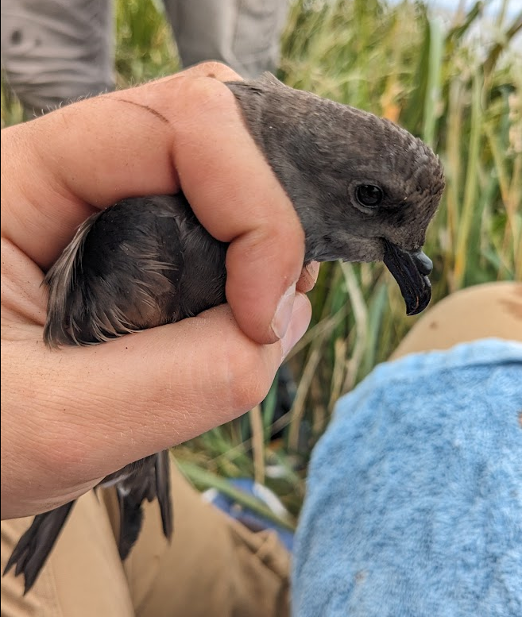
One of Goat Island’s many Leach’s Storm-Petrels.

Leach’s Storm-Petrels, which top out at just under 50 grams at the heaviest, return to their colonies only at night, and nest in underground burrows hidden beneath mats of long grass. Beachgoers who are in the know might be made aware of the colony from the distinctive, musky odor that petrels are famous for—which is strong enough to waft ashore—but otherwise, the colony is practically invisible from more than a few inches above the ground.

LHSPs feed on zooplankton and other planktonic creatures far out to sea, and only return to their colonies under the cover of darkness. During the breeding season, members of breeding pairs will take turns incubating their single egg or chick in the burrow, sometimes remaining underground for four or five days, while the other member of the pair forages. This cryptic, nocturnal behavior likely provides protection against diurnal avian predators. Southern Oregon’s LHSP colonies are close enough to shore, however, that nocturnal mammalian predators can pose a threat.

Project Goals

In collaboration with the U.S Fish and Wildlife Service, Luke Stuntz (MSc student, Seabird Oceanography Lab) and I (Eleanor Gnam, seasonal field tech) are investigating the impact of mammalian predators (mainly North American River Otters Lontra canadensis) on southern Oregon’s Leach’s Storm-Petrels.

We’re seeking to understand how, where, when, and to what extent these predators use petrels as a food source—knowledge that will help inform potential predator management in the future. River otters tend to operate either in loose social groups of unrelated males or in family units of a mother and her cubs. We’re hoping that our research will help us understand the social organizations of the river otters that are using these islands, as well.

Field Work (May-June)

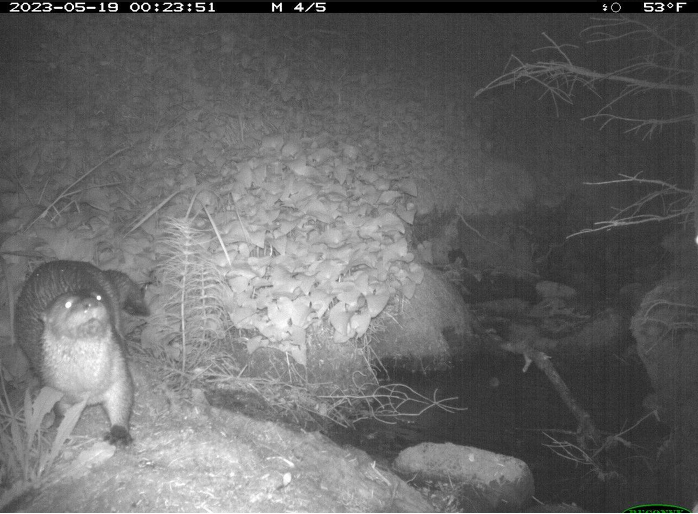
Luke began fieldwork for this project in May, with trips to our focal islands to survey for predator sign and set up motion-activated game cameras.  Two of the four islands showed definite signs of predator activity (trampling, scat, and prey remains). Cameras on Goat Island quickly revealed activity from multiple social groups of river otters, including a pair of adults and a female with cubs. Because river otters commute between these islands and the mainland, surveys along the coastline are also important for monitoring their activity.

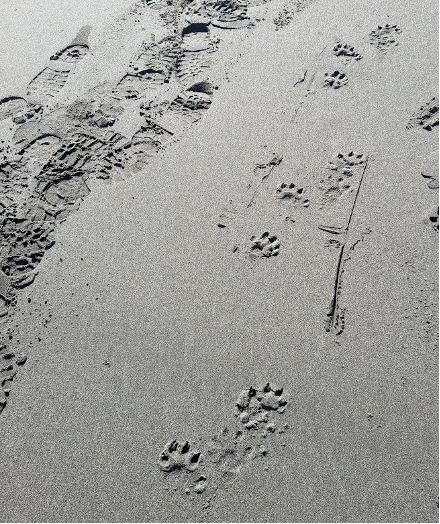
Luke’s initial surveys in May and early June revealed quite a bit of predator activity along the beaches and creeks near these colonies. River otters tend to deposit scat in shared, regularly-used locations called latrines, which aid territory marking and scent-based communication between individuals. They also need to return to freshwater sources frequently, especially after swimming in the ocean, both to drink and to groom their fur. The scat found in the latrines near our focal islands definitely contained digested storm-petrel remains—obvious from the distinct odor.

On June 15th, we moved into OSU’s Port Orford Field Station to commence full-time fieldwork on the project. Our first step was to revisit the coastline sites near our colony islands and to check out some new sites with the potential to be good river otter habitat. We were surprised by how little fresh river otter activity we found at some of our sites that were very active in May and early June. We’re also seeing them on our game cameras less often than before.

We found evidence of recent activity in several new locations, though, and we continue to see a lot of activity on the beach closest to Goat Island. This raises questions about how frequent and how seasonal these island-going behaviors might be. We’re also starting to wonder about the impact of Route 101 and its associated culverts on river otters’ use of coastal streams. Continuing predator sign surveys throughout the summer, both along the coast and on our colony islands, will help fill in our picture of this predator-prey dynamic and will help us understand how much of a problem it might be for these seabird colonies. We’re planning to expand our predator sign surveys up some of the larger creeks and rivers in the area, as well, using an inflatable sea kayak.