
By Alastair Baylis, South Atlantic Environmental Research Institute
A globally significant wildlife wonder spot
The Falkland Islands, located on the southeast Patagonian Shelf, are a self-governing UK Overseas Territory (UKOT), and a globally significant wildlife wonder spot. Home to 75% of the global population of Black-browed albatross, 50% of the global population of South American fur seals, 30% of the global population of Rockhopper and Gentoo penguins, to list but a few. This means that population trends of Falklands seals and seabirds disproportionately influence the global population trends and conservation status of these species.


Marine Managed Areas & IUCN Key Biodiversity Areas
In recognition of the importance of the Falkland Islands environment to both wildlife and the community, and striving toward holistic marine management, the Falkland Islands Government started a process of Marine Spatial Planning. This included identifying marine areas for enhanced protection as Marine Managed Areas (MMAs)– a broad term that includes Marine Protected Areas (Esch 2006). MMAs focussed on marine wilderness areas – areas that have irreplaceable biodiversity and are near-pristine due to low fishing impact, but presently do not have a legal framework for protection. Through stakeholder engagement, several areas were chosen as proposed MMAs. These areas included seaward extensions of globally important breeding colonies of seabirds and seals where animals are known to congregate (Granadeiro et al. 2008).
To inform the Falkland Islands MMA process, we identified important at-sea areas for seals and seabirds to understand how these predators use the proposed MMAs. One overarching aim of our paper was to place the conservation value of the proposed MMAs into a global context. Hence, we also identified IUCN Key Biodiversity Areas (KBAs) – (marine) areas that “contribute significantly to the persistence of global biodiversity”, which are a widely adopted approach to help inform systematic conservation planning, and compared these to proposed MMAs.

Our KBA journey
Much of this blog is focussed on our KBA journey, which is one component of the paper. In-part, because using tracking and survey data to identify KBAs are of particular interest locally. But, in general, we found limited discussion regarding challenges. This is perhaps, a good point to emphasize the distinction we make throughout the paper and again here, between the KBA concept (which we do not critique), versus methods used to identify polygons to assess against KBA criteria.

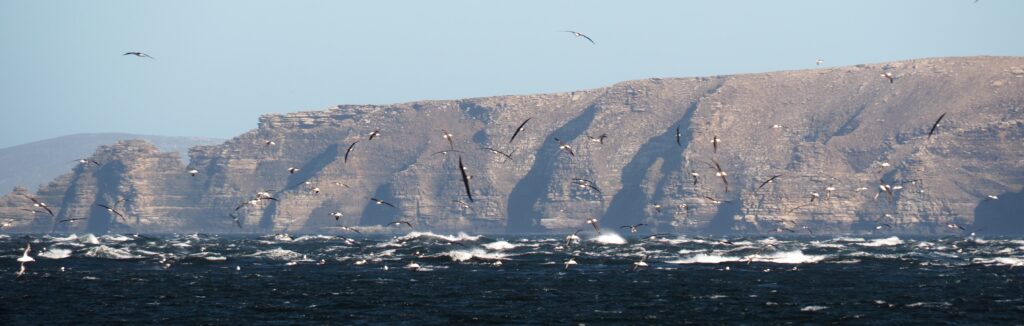
Looking out over the Jason Islands. Photo: R. Orben
Our methods
Briefly, our methods went something like this – we collated tracking data (1999-2019) and used a several approaches to identify areas for assessment against KBA criteria (for those wanting the details, a combination of kernel density estimation methods originally designed to identify Important Bird and Biodiversity Areas (IBAs) and model-based predictions).
Here is what we found:
1. The Patagonian Shelf is vast and vastly important for marine predators.
It should come as no surprise that much of the Patagonian Shelf around the Falkland Islands is important (see also Augé et al. 2018, Baylis et al. 2019). In fact, depending on the methods used, over 70% of the Falkland Islands EEZ could qualify as a KBA. This is because the Falklands are home to numerous and globally significant populations of seals and seabirds – many species of which breed almost ubiquitously around the Falklands. We will touch briefly on how this could influence management later in this piece (see point 4). In terms of overlap with proposed MMAs, depending on methods used, up to 45 % of KBAs were overlapped with proposed MMAs. But this comparison and indeed the significance of findings, are a little clouded by caveats associated with methods (see point 2 and 3).
2. Threshold-based criteria of KBAs are standardized, repeatable, and globally applicable – which is worth celebrating. For tracking data, the methods used to identify areas to assess against KBA criteria are not standardized.
Given KBAs might be considered for potential protected areas, it would be useful to understand and quantify uncertainty in areas selected to be assessed against KBA criteria. This is because as scientists, we want to provide decision makers with reliable data and robust science narrative, which ensure the areas identified as important are well supported.
A couple of challenges that we encountered when following popular methods, are as follows. Firstly, common to all tracking datasets, tracking data were inevitably imperfect and biased by tracking effort. This isn’t a deal breaker, but our potential KBAs reflected colonies from which seals and seabirds were tracked from, but not necessarily where they occur. For example, tracking data from one colony, might not represent important areas for other colonies.
A second widely recognized challenge is that current methods based on kernel density estimation are sensitive to often arbitrarily selected values. Indeed, areas identified for KBA assessment can vary by thousands of km, depending on model values selected. Ideally, with a bit of common sense and knowledge of species biology, you can make some informed decisions about what values are sensible to use, but it isn’t always clear, and this can create uncertainty in which areas are most appropriate to assess against KBA criteria. One approach to address these limitations was to use models to predict the distribution of animals from all colonies around the Falklands. But then the entire Patagonian Shelf around the Falklands is potentially a KBA (point 1).
3. IUCN KBA guidelines continue to be refined and updated.
Too right! It is important that the guidelines continue to evolve to ensure KBA guidelines are applied rigorously. The most recent guidelines (IUCN 2020) clarify that species must predictably aggregate at a site to trigger KBA criterion D1a (just one of several criteria, but the one we felt best suited our data). However, predictability is scale dependent and we don’t yet know how this definition will apply to tracking data for wide-ranging marine predators that forage on patchily distributed prey. Hence, a range of challenges exist with current methods and the motivation for highlighting these challenges are to stimulate discussion on how we can continue to improve methods that better serve the globally standardized KBA criteria.
4. Fixed boundary approach to marine conservation (MMAs, KBAs etc).
Moving away from challenges associated with methods, it is clear that the proposed Falkland Islands MMAs are imperfect in the context of encompassing the entire foraging ranges of wide-ranging marine predators. So where does this leave species that forage across vast areas of the ocean, and for which KBAs might also encompass vast marine areas? It might be that a fixed area approach to management may not be feasible or the most effective way to manage and conserve species, and we should look to combine fixed area management with other approaches.
The good news is that, in addition to existing large-scale regulations that are not area-specific (e.g., bycatch mitigation), other innovative options exist, which could potentially be used in combination with MMAs. For example, Dynamic ocean management, could achieve similar protection to fixed-boundary spatial management in a smaller area, as it tracks the temporal shifts in the distribution of species and their threats, rather than having to encompass the entire temporal variability in a species range, within a fixed area (Maxwell et al. 2015). For some examples of this implemented in the USA check out TurtleWatch, WhaleWatch, and EcoCast.

Falkland Islands proposed MMAs
Despite limitations there is much to celebrate. The Falkland Islands proposed MMAs are an incredibly exciting development for marine management and conservation in the South Atlantic. The proposed MMAs include much of the Falkland Islands kelp forests, which play an important role in nutrient cycling, carbon sequestration and are crucial to larval life history phases of squid and fish, important to both fisheries and higher marine predators. They protect near-pristine benthic habitats and encompass the foraging ranges of many marine predators, while benefiting others by providing a buffer around breeding colonies.
In total, these areas would protect about 15% of the Falkland Islands Conservation Zones (i.e., Exclusive Economic Zone), allowing the Falkland Islands to make great strides towards contributing to the 2010 Aichi Biodiversity Target of 10% ocean protection (and the proposed 2030 Target of 30%).
The proposed MMAs, if designated, would also establish the policy and legislative framework for marine protection, which will pave the way for any future designations, facilitate the management and conservation of globally significant populations of marine predators, and usher in a new era of ecosystem-based management. However, there is more work to be done to support and refine this process. We are currently exploring how innovative methods, such dynamic ocean management, could compliment fixed area management to help conserve wide-ranging marine predators at relevant spatial scales.
To access our paper please follow the link below:
Baylis, A.M.M., de Lecea, A.M., Tierney, M., Orben, R.A., Ratcliffe, N., Wakefield, E., Catry, P., Campioni, L., Costa, M., Boersma, P.D., Galimberti, F., Granadeiro, J.P., Masello, J.F., Pütz, K., Quillfeldt, P., Rebstock, G.A., Sanvito, S., Staniland, I.J. and Brickle, P. (2021), Overlap between marine predators and proposed Marine Managed Areas on the Patagonian Shelf. Ecological Applications. Accepted Author Manuscript e02426. https://doi.org/10.1002/eap.2426
This research was funded by the UK Government through The Darwin Initiative, The Falkland Islands Government, & the Winifred Violet Scott Estate Trust.
References
Augé, A., M. P. Dias, B. Lascelles, A. M. M. Baylis, A. Black, P. D. Boersma, P. Catry, S. Crofts, F. Galimberti, J. P. Granadeiro, A. Hedd, K. Ludynia, J. F. Masello, W. Montevecchi, R. A. Phillips, K. Pütz, P. Quillfeldt, G. A. Rebstock, S. Sanvito, I. J. Staniland, A. Stanworth, D. Thompson, M. Tierney, P. N. Trathan, and J. P. Croxall. 2018. Framework for mapping key areas for marine megafauna to inform Marine Spatial Planning: The Falkland Islands case study. Marine Policy 92:61–72.
Baylis, A. M. M., M. Tierney, R. A. Orben, V. Warwick-Evans, E. Wakefield, W. J. Grecian, P. Trathan, R. Reisinger, N. Ratcliffe, J. Croxall, L. Campioni, P. Catry, S. Crofts, P. D. Boersma, F. Galimberti, J. Granadeiro, J. Handley, S. Hayes, A. Hedd, J. F. Masello, W. A. Montevecchi, K. Pütz, P. Quillfeldt, G. A. Rebstock, S. Sanvito, I. J. Staniland, and P. Brickle. 2019. Important At-Sea Areas of Colonial Breeding Marine Predators on the Southern Patagonian Shelf. Scientific Reports 9:1–13.
Esch, G. . (Ed). 2006. Marine Managed Areas : Best Practices for Boundary Making. NOAA Coastal Services Cente.
Granadeiro, J. P., L. Campioni, and P. Catry. 2018. Short Communication Albatrosses bathe before departing on a foraging trip : implications for risk assessments and marine spatial planning: Bird Conservation International, 28:208–215.
IUCN. 2020. Guidelines for using A Global Standard for the Identification of Key Biodiversity Areas. Version 1.1. Prepared by the KBA Standards and Appeals Committee of the IUCN Species Survival Commission pp.220.
Maxwell, S. M., E. L. Hazen, R. L. Lewison, D. C. Dunn, H. Bailey, S. J. Bograd, D. K. Briscoe, S. Fossette, A. J. Hobday, M. Bennett, S. Benson, M. R. Caldwell, D. P. Costa, H. Dewar, T. Eguchi, L. Hazen, S. Kohin, T. Sippel, and L. B. Crowder. 2015. Dynamic ocean management: Defining and conceptualizing real-time management of the ocean. Marine Policy 58:42–50.