Hurry Up and Wait: A Delayed Start to Marbled Murrelet At-Sea Surveys and Our Attempt to Salvage the 2026 Season

By Will Kennerley
Faculty Research Assistant, OSU Seabird Oceanography Lab

A small, dark brown seabird rises from the waves and quickly takes flight, grasping a flashing, silver fish in its short bill. This is a breeding adult Marbled Murrelet getting ready to take fresh food to its young back at the nest site. But the murrelet doesn’t follow behind the murres that are flying nearby, similarly laden with fish for their young. Instead, the Marbled Murrelet flies not to rocky sea cliffs and islands like the murres and most other seabirds, but rather into the forested, coastal hills. Here, high up in a massive, old-growth tree, this Marbled Murrelet works with its partner to raise a single chick, perched in a depression on a wide, mossy branch.

The incredible nesting strategy of Marbled Murrelets has made them uniquely vulnerable (among seabirds) to the logging of the Pacific Northwest’s ancient old-growth forests. Like the more popularized Northern Spotted Owl, Marbled Murrelets have seen their populations fall with the old trees; the result is that both species are now the focus of critical population monitoring efforts as part of the Northwest Forest Plan. Both Northern Spotted Owls and Marbled Murrelets are listed as Threatened under the U.S. Endangered Species Act, and it is only through population monitoring surveys that we can learn how these species are faring.
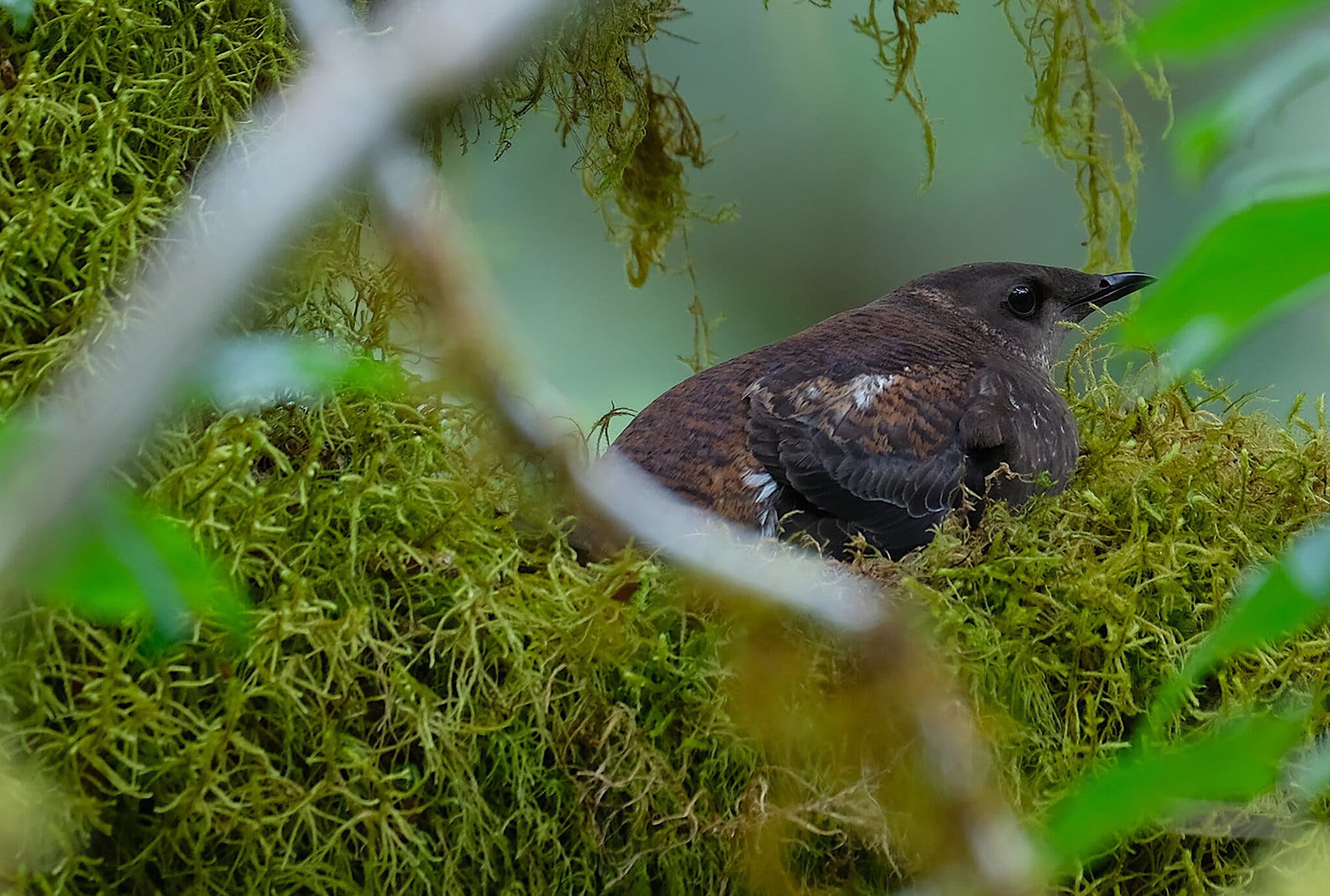
A brown bird with a long bill sits on a moss covered tree branch.
Figure 1. Marbled Murrelets forage for fish and marine invertebrates at sea but return to old-growth forests to raise their young on mossy branches high in old trees. Photograph by Brett Lovelace, Oregon State University

Some of these surveys for Marbled Murrelets occur via small boat work up and down the U.S. Northwest Coast, featuring a small team of researchers aboard to count and record murrelets observations. These at-sea surveys zigzag along the coast and collect the data necessary for informed estimates of Marbled Murrelet population sizes and distribution . This survey work has been conducted regularly since the mid-1990s, reliably providing an invaluable dataset documenting murrelet population changes while battles over old-growth forest cutting were waged on land and while coastal oil spills and marine heatwaves added new stressors to marine life.

This year, unfortunately, the survey’s annual start date of May 15th came and went without any word on when pending grant money would arrive from the US Fish & Wildlife Service. Primed and ready for work, our lab was forced to wait for the promised federal funds to arrive before we could begin; we knew the murrelets wouldn’t wait and no amount of money can bring this lost time back.

Fully halfway into our eleven week field season, funding suddenly came through – a delay without precedent in the nearly 30 years of this program. The lost time means that this year’s survey effort won’t be able to provide a proper population estimate in meeting with Northwest Forest Plan monitoring. However, with a potentially record-breaking El Nino developing, these data will still provide a valuable context for Marbled Murrelet populations in 2026. Following the confirmation of funding, a mad scramble arose to get out on the water and collect as much data as we could before the entire season was lost. Thanks to the hard work of our team and the support of the OSU Small Boat Program, it took only two weeks before we were on the road with our gear packed, boat on the trailer, heading out to our first port.
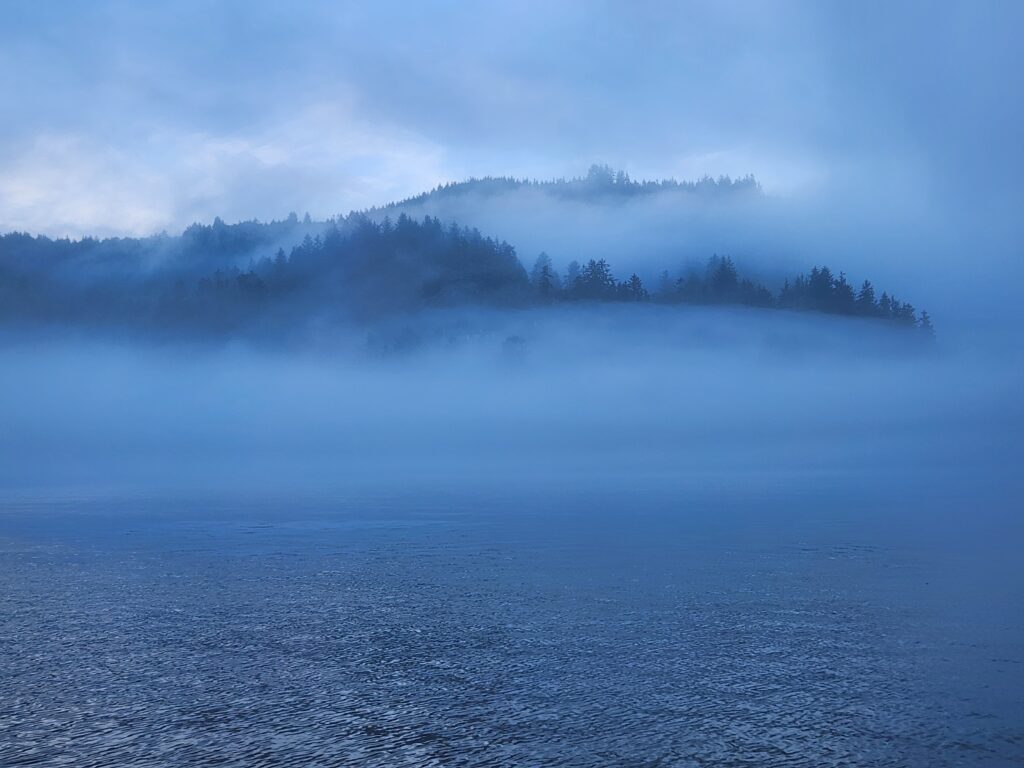
A view from on the ocean looking back towards fog rolling over the hills. Everything is blue.
Figure 2. Most Marbled Murrelet survey days began with cool, foggy mornings in one of Oregon’s small coastal towns. Here, fog clings to the hills behind Tillamook Bay, near Garibaldi, Oregon.

Surveying At-sea

A typical day began before dawn at a campsite in a small, coastal Oregon town (Figure 2). Damp fog hung coolly in the air as we packed up camp and launched our boat, a 27’ Boston Whaler named the Mishki (an indigenous Siletz word for ‘seabird’). Once the sun was up and the fog cleared (hopefully!), we were able to get to work, following a series of transect lines along the coastline in one of the 17 separate primary sampling units (PSUs; Figure 3) within this year’s survey zone.

While on survey, our team of three researchers divided up duties: one surveyed the port (left) side of the vessel, another surveyed the starboard (right) side, while a third drove the Mishki along a randomized transect line. To minimize observer bias, roles were rotated throughout the day. For this to work, each member of the team has to be both a skilled observer and boat operator.

In short, we followed a line transect protocol looking for Marbled Murrelets, aiming to count each and every murrelet we could see from the vessel as we moved along the coast. For each sighting, we recorded the number of murrelets seen, the age and molt class, the bird’s behavior, and an estimate of how far off the transect line the bird was located. Sometimes we got to observe murrelets at close-range on the surface and could fully appreciate the subtle beauty of their “marbled” plumage. As often as not, however, murrelets were detected at substantial distances, flying quickly on dark, rapidly-beating wings in a distinctive, bumblebee-like flight (Figure 4). Look away for just a moment and you could easily miss some of these challenging-to-survey seabirds!
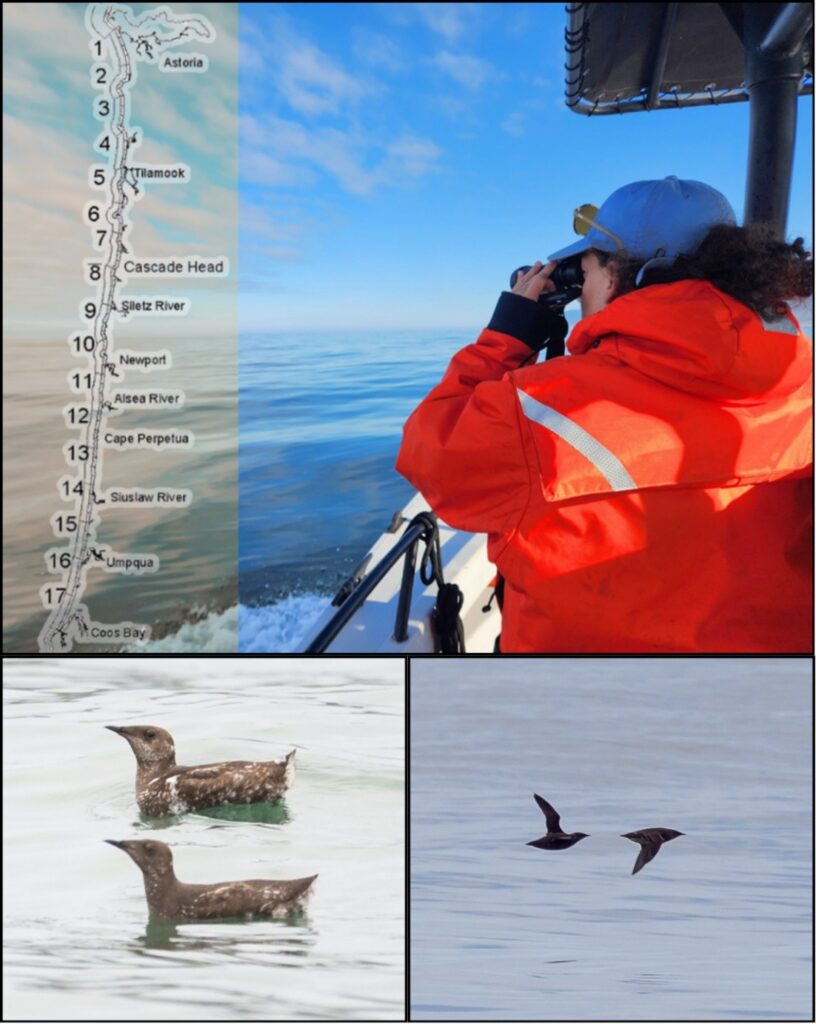
A four paneled figure with a map of Oregon, a person in orange looking out to sea holding binoculars, a pair of brown plumage marbled murrelets sitting on the water, and two marbled murrelet silhouettes flying by.
Figure 3. In 2026, we surveyed Murrelet Conservation Zone 3, covering 17 survey units from the Columbia River south to Coos Bay. Here, Cal Poly Humboldt graduate student Cheyenne Stephens uses binoculars to determine the age and molt class of a Marbled Murrelet off Waldport, Oregon (PSU 11). Below, an ideal view of two adult Marbled Murrelets (left) and a more typical view of murrelets far away and in flight (right). [Murrelet images courtesy of Ryan Mense (left) and Greg Harrington (right)].

Additionally, we counted all birds seen on the water within 50 meters of the vessel’s path as well as all marine mammals observed, regardless of distance. These data provide valuable insight into how the whole community of coastal marine life is faring, from Common Murres (Strong & Duarte 2023) to Gray Whales (Barlow et al. 2024). These data on the ecological community provide essential context for any changes observed in Marbled Murrelet population size or distribution.

Our team followed predetermined transect lines comprised of ~5 km segments at varying distances from shore, as well as a zigzagging transect line farther offshore. This variation helps biologists capture inshore-offshore gradients of murrelet distributions since murrelets may be found in different parts of Oregon’s coastal waters depending on the time, place, and conditions. In general, we noted the greatest concentrations of Marbled Murrelets along Oregon’s central coast (roughly from Depoe Bay to Florence), about 500 to 1200 m offshore of sandy beaches. This area has some of the state’s largest remaining tracts of coastal, old-growth forests for nesting and these shallow, sandy-bottomed waters shelter the schools of sandlances, herrings, and other small fishes that murrelets rely upon for food.
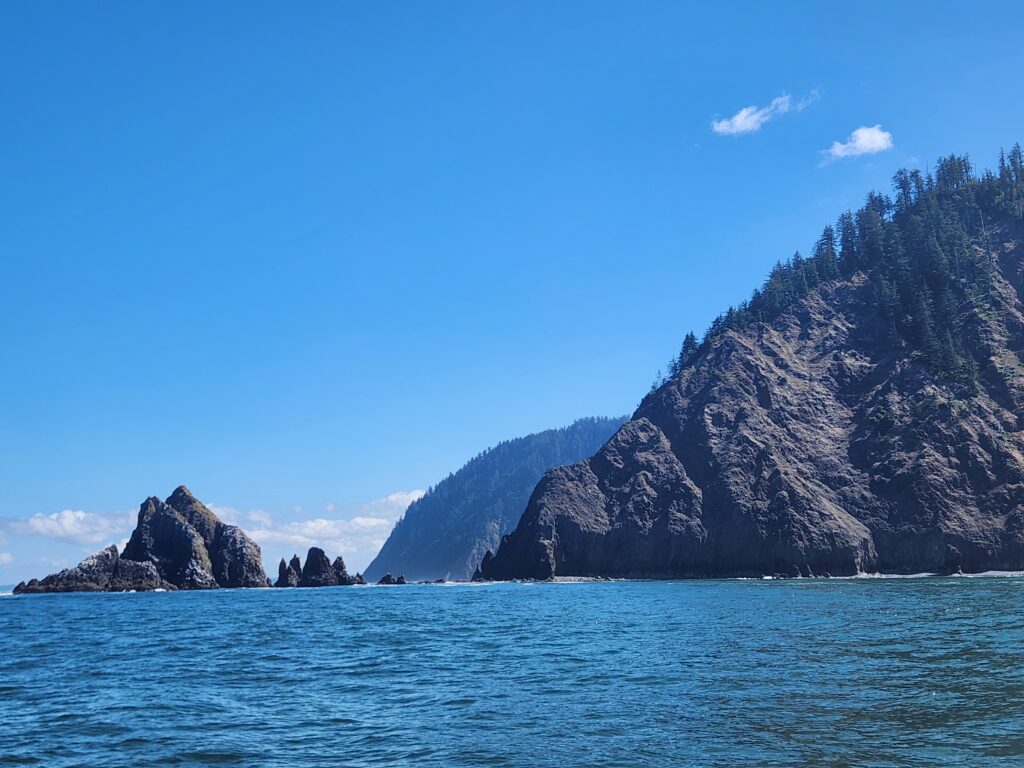
The view from the water of a series of two rocky headlands and some off-shore rocks.
Figure 4. Tillamook Head falls hundreds of feet into the sea on the northern Oregon Coast (PSU 2). Daily views of stunning coasts like this were one of the highlights of this survey work!

Each PSU comprises 40-50 km of total survey effort and takes about half a day to complete. Some days, the weather allowed us to complete two PSUs, although more often than not rising winds, incoming fog, bar closures, or other fast-changing conditions forced us to head back to shore in the afternoon. Once safely off the water, the boat was put on the trailer, the data was downloaded and backed up, and our team was back in the truck, driving down US-101 to our next port. We attempt to randomize our survey effort along the coast, which means we bounced back and forth, north to south and north again, completing PSUs one by one. We put a lot of miles on the truck and many hours on the Mishki’s engines, but we were rewarded with views of countless incredible seabirds and some of the country’s most spectacular coastline (Figure 4).

The evening of July 31st marked the end of this year’s abbreviated survey season. All told, we managed to complete 16 of 17 PSUs in this year’s target region – not bad for a 4 week survey season! During this time we surveyed 640 km of transect and observed more than 1,600 Marbled Murrelets, as well as thousands of other seabirds like Common Murres, Rhinoceros Auklets, and California Brown Pelicans. Our data are currently being reviewed and proofed with the hope that they’ll soon be able to provide a little more insight into how this unique seabird is surviving. Given the many challenges Marbled Murrelets face – unsustainable logging practices, marine heatwaves, El Niño events, and uncertainty in federal funding to support population monitoring – their outlook in the Northwest is far from certain. In any case, we hope to be out on the water on time next summer, collecting more data to help inform the management and conservation of this threatened species.
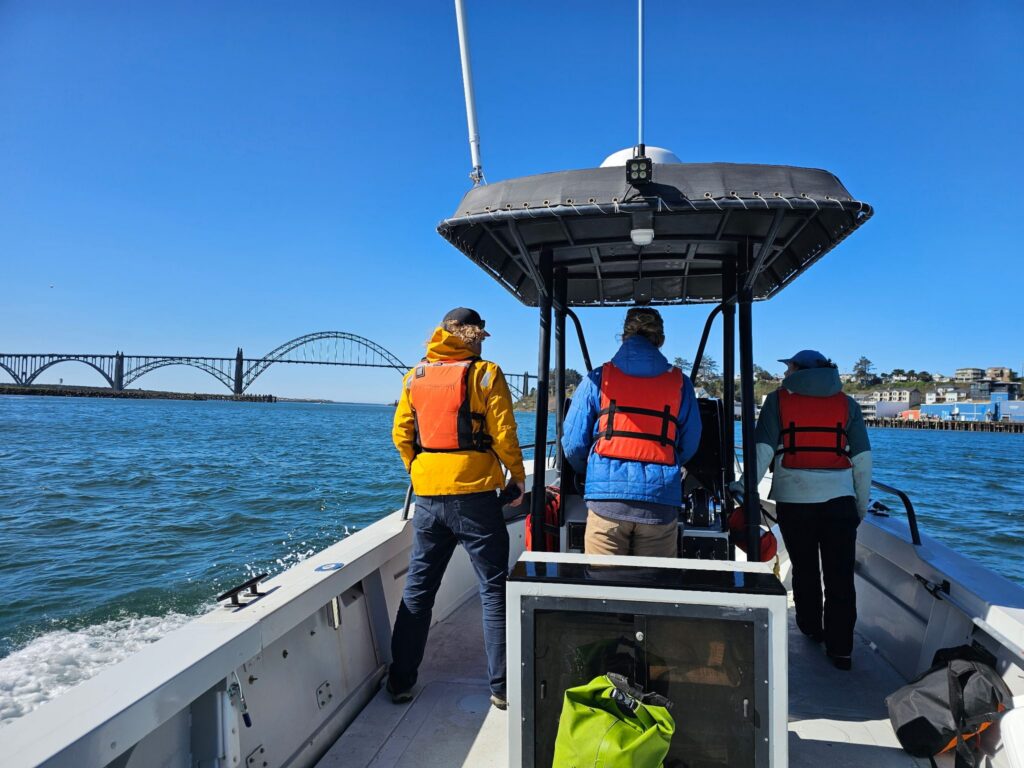
Three people in a row wearing life jackets on a boat with a center console heading towards a large arch bridge.
Figure 5. Some of the 2026 Marbled Murrelet survey crew aboard the Mishki on Yaquina Bay. From left to right: Adam Peck-Richardson (OSU), Will Kennerley (OSU), and Cheyenne Stephens (Cal Poly Humboldt). Experienced observer Craig Strong completed our observer team during the latter half of the season.

Yaquina Head Early Season Update, Summer 2026

By Will Kennerley, Faculty Research Assistant

On the morning of May 9th, I drove out to Yaquina Head and walked to the overlook at the base of the 93′ light tower. Thousands of murres were already on the rocks and buzzing around like so many bees, cormorants were flying back and forth with mouths full of nesting material, and oystercatchers chased one another across the intertidal rocks. This day was like so many others yet was notable for kicking off our 20th consecutive season of seabird monitoring at Yaquina Head (and 25th overall!).

Twenty years sure feels like a long time; after all, when monitoring was revived in 2007 under the direction of then-OSU Professor Rob Suryan, Rhianna’s “Umbrella” was dominating the airwaves, the very first iPhones were being released, and George W Bush was still in the White House. About 60% of murres that season reproduced successfully, a percentage we haven’t managed to reach in the last decade. Amazingly, given the relatively long lifespans of murres and other alcids, some of the chicks from that season are almost certainly still with us, breeding this very year at the colony!

Over this time we’ve seen a number of changing influences on Yaquina Head’s birds, most especially rising avian predator predation and the occurrence of several severe marine heatwaves. Yet, over all this time our methodology has remained essentially unchanged and many of the same rocks and subcolonies are still being monitored. This gives us the incredible ability to effectively document and quantify changes in seabird vital rates over a relatively long timespan, helping us learn how Oregon’s seabirds are adapting to a changing world.

After a month of monitoring, it seems like it’s set to be an early year, particularly for cormorants. Brandt’s Cormorants were already starting to lay eggs by May 12th and Pelagics were doing so just a week later. Assuming standard incubation periods of 30 days for both species1,2, it’s likely we’ll start to see our first cormorant chicks hatching at the end of the week. In many years, median hatch dates for both species aren’t until early-mid July, suggesting we could be several weeks earlier than in a “typical” year!

Two Brandt's cormorants on nests
Brandt’s Cormorants seem poised to have an exceptionally early year, with the first nests being laid a week or two earlier than the norm. The first chicks at Yaquina Head may hatch within a few days.

However, there’s also evidence of two distinct waves of cormorant nesting this year at both the Yaquina Head and Pirate Cove colonies. Many early nesting attempts in mid-May (particularly at the more exposed sub-colonies) were subjected to extensive eagle disturbance and were kept empty while those at more protected sites nearby were already incubating. Eagle disturbance tends to decline over the course of the summer and cormorants established more widely by early June. Because of this, I suspect we’ll see some exceptionally early chicks but perhaps the median hatch date that we calculate every year won’t be quite so dramatically different from normal.

Although cormorants show great variation in the timing of nest initiation between years, we haven’t seen evidence of an obvious change towards earlier or later nesting. Murres, in contrast, have been nesting later and later in recent years at Yaquina Head; whereas chicks in the 1990s and early 2000s hatched mostly in late June, we typically don’t see our first chicks until mid July now. At present, murres are occupying nest sites at both Yaquina Head and Pirate Cove, yet only in the last week or so have eggs begun to appear.

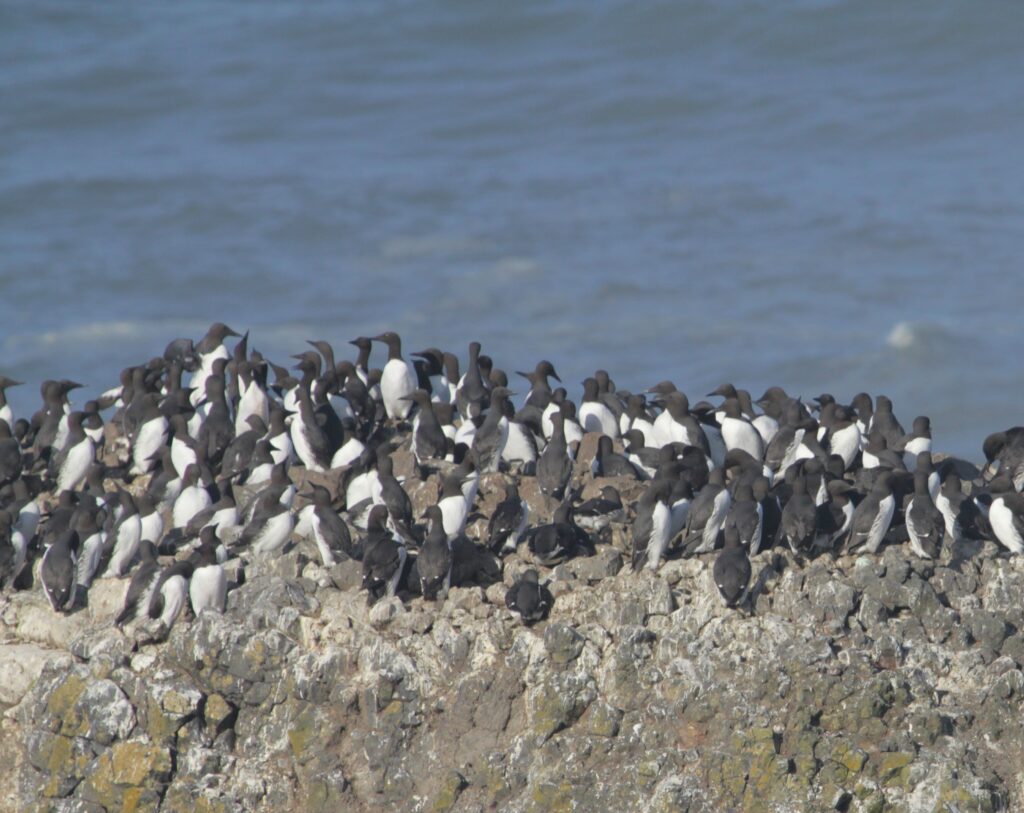
A large number of common murres standing on a rock.
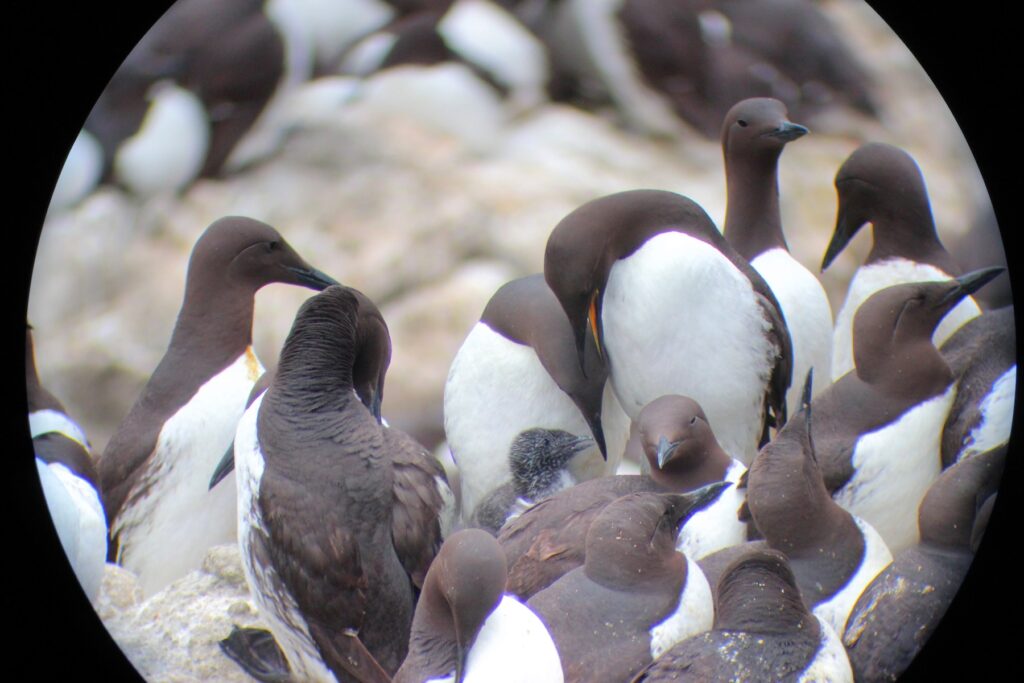
Common Murres have been occupying the rocks at Yaquina Head on and off for several months now, but only recently have they begun to lay eggs. When Rob Suryan reinstated the Yaquina Head monitoring work in 2007, murres would have been well into the incubation period by now.

The timing of reproduction can be incredibly important when there are great seasonal differences in local productivity3. When breeding phenology more closely aligns with peaks in local productivity, animals may be more successful in raising young since the period of peak food demand will match the period of peak food abundance4. This is important as spring plankton blooms change, the timing of trees leafing out advances, and other climate change-induced phenological changes affect seemingly every ecosystem on earth.

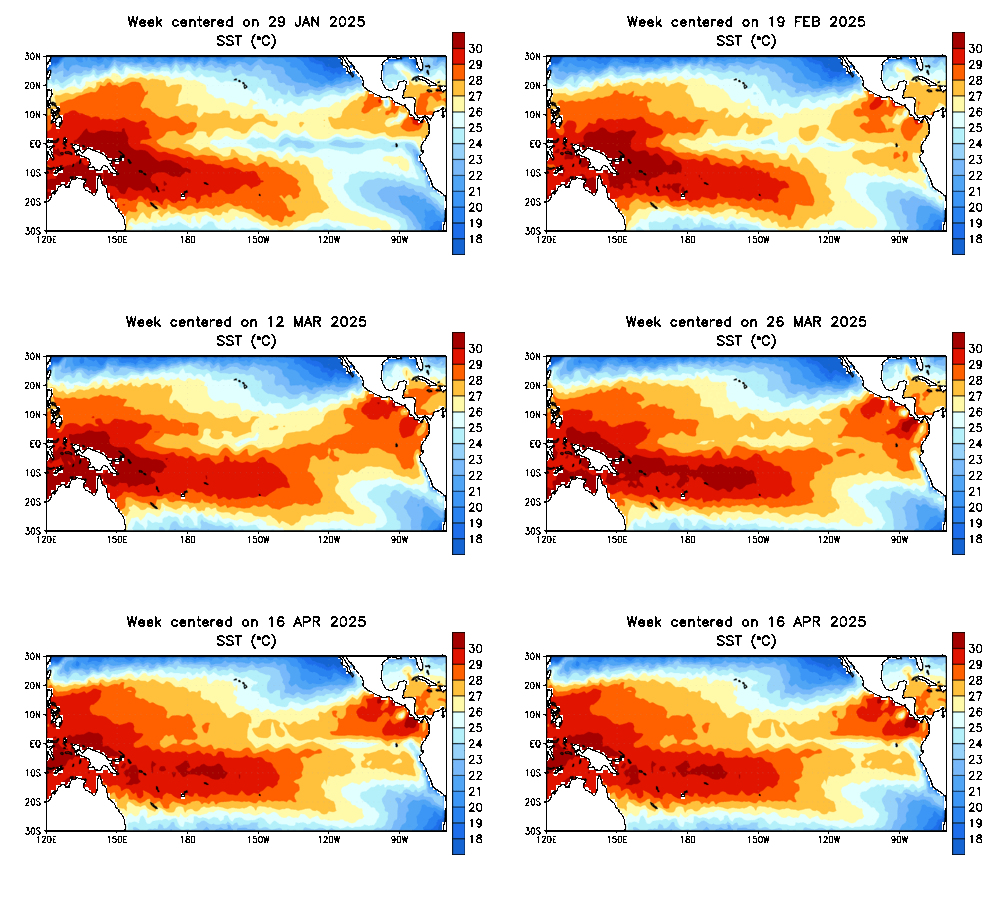
Less predictable changes to local productivity may also be mediated by the timing of reproduction. This year, I’m particularly intrigued to see how the early nesting of some of our cormorants will align/misalign with the impacts of the major El Niño event currently developing in the equatorial Pacific. The coastal upwelling that drives marine productivity in the California Current tends to be reduced during El Niño events, so that El Niño years tend to be marked by seabird breeding failures and reduced adult survival rates5. If cormorants can raise and fledge chicks before the impacts of El Niño are felt here in Oregon, they could still reproduce successfully. Alternatively, if waters warm and productivity is reduced while chicks are still nest-bound, they may be abandoned by starving adults and die in the nest.


Tropical Pacific Sea Surface Temperature Animation
Higher sea surface temperatures (oranges and reds) are covering increasing areas of the equatorial Pacific. Models predict an 82% probability of transition to ENSO positive (El Niño) conditions in the coming months. Graphic courtesy of NOAA’s Climate Prediction Center https://www.cpc.ncep.noaa.gov/products/precip/CWlink/MJO/enso.shtml).

Events like El Niño are constantly occurring throughout the world’s oceans and act as fascinating “natural experiments” for researchers to better understand how seabirds interact with, and are impacted by, their environments. The responses of birds may also vary in response to seemingly trivial differences in the timing, severity, geographic extent, or duration of these events, making it challenging to accurately predict their impacts. We never really know what kind of season we have ahead of us, but it’s this mystery that keeps us excited each spring to begin monitoring at Yaquina Head again, 20 long years in a row.

References

1 Hobson, K. A. (2021). Pelagic Cormorant (Urile pelagicus), version 1.1. In Birds of the World (Editor not available). Cornell Lab of Ornithology, Ithaca, NY, USA.

2 Wallace, E. A. and G. E. Wallace (2021). Brandt’s Cormorant (Urile penicillatus), version 1.1. In Birds of the World (A. F. Poole and F. B. Gill, Editors). Cornell Lab of Ornithology, Ithaca, NY, USA.

3 Lack, D. (1950). The breeding seasons of European birds. Ibis92(2), 288-316.

4 Thomas, D. W., Blondel, J., Perret, P., Lambrechts, M. M., & Speakman, J. R. (2001). Energetic and fitness costs of mismatching resource supply and demand in seasonally breeding birds. Science291(5513), 2598-2600.

5 Ainley & Boekelheide. 1990. Seabirds of the Farallon Islands: Ecology, Structure, and Dynamics of an Upwelling System Community. Stanford University Press, Stanford, CA, USA.

Yaquina Head Mid-Season Update, Summer 2025

By Cherish Lyda, Seabird Monitoring Technican, OSU Seabird Oceanography Lab

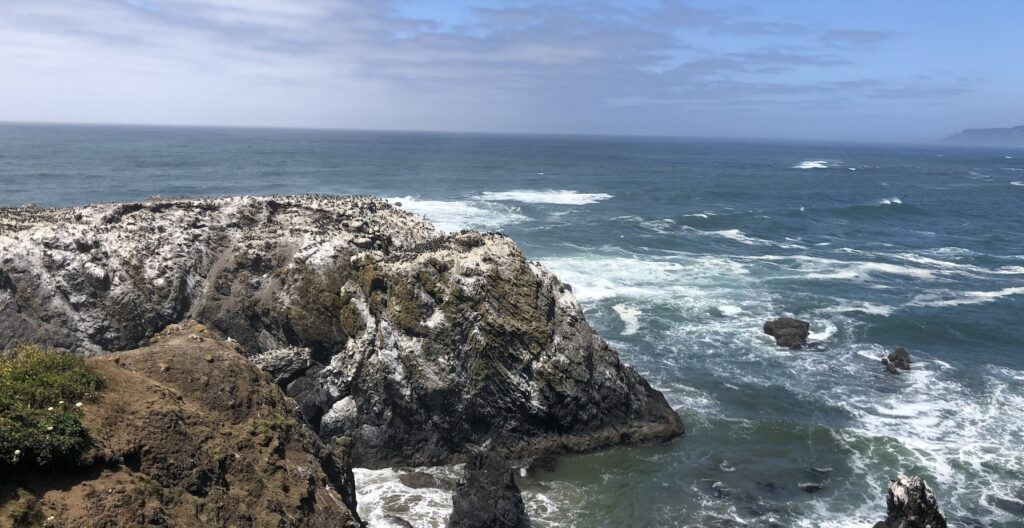
An image on a sunny day of an off-shore rock, Main Colony Rock at Yaquina Head, covered with guano. The nesting seabirds are small and hard to see.

Hello everyone!

My name is Cherish Lyda, and I’m a senior at Oregon State University, majoring in Fisheries, Wildlife, and Conservation Sciences with a focus on avian conservation and management. This summer, I’m the Yaquina Seabird Monitoring Technician for the Seabird Oceanography Lab. This is my first season working with seabirds – and it has been amazing so far!

Despite frequent Bald Eagle disturbances, Yaquina Head Outstanding Natural Area is once again bursting with new life! Although nesting started late this year, the birds have shown resilience and are beginning to proudly display their chaotic nests and adorable chicks. We are currently monitoring 13 plots and following 93 Common Murre nests, 36 Brandt’s Cormorant nests, 28 Pelagic Cormorant nests, and 13 Western Gull nests.

Western Gulls hatched first and are already wrapping up the season with seven successfully fledged nests. (Take a look at the top of Colony Rock and you’ll see these brown spotted fluff balls wandering around!) Brandt’s Cormorants started hatching on July 2nd and 21 nests have hatched so far with more on the way. Pelagic Cormorants have taken up their usual spots at Smuggler’s Cove and Whale Rock, and we saw our first chick on July 9th.

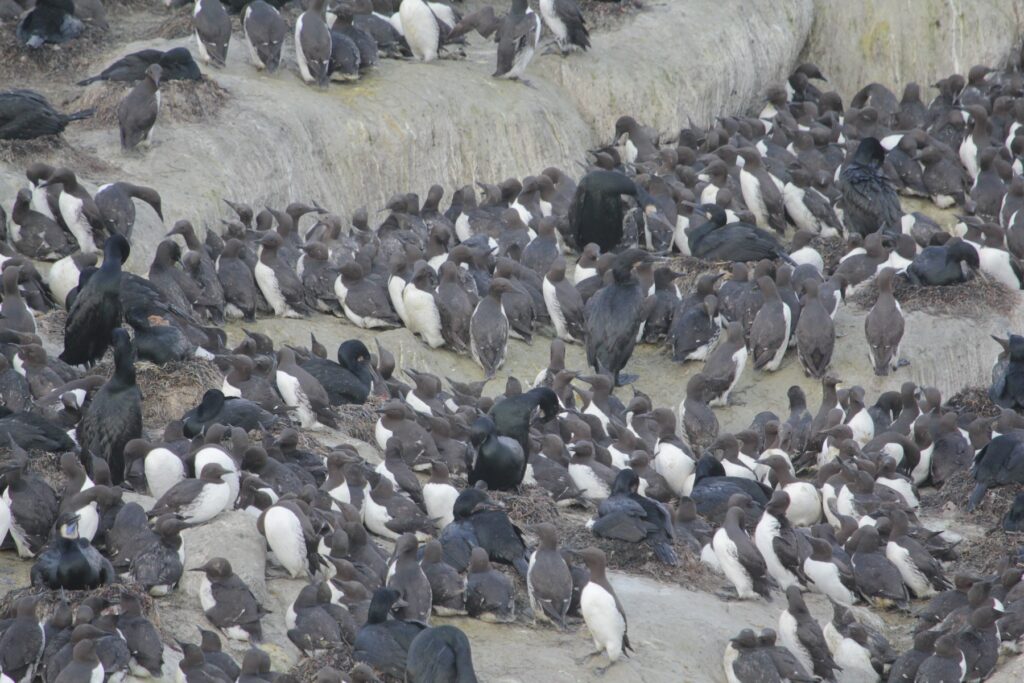
A close-up image of a mixed species seabird colony with clusters of nesting common murres and a few Brandt's cormorants.
Common Murres and Brandt’s Cormorants at Pirate Cove, Depoe Bay. Note the chick in the center cormorant nest.

As for the Common Murres, their season started out tough but is now looking very promising. Frequent early-season eagle activity hit the south half of Colony Rock and top of Whale Rock hard, clearing multiple plots of eggs. For a couple days, two immature Bald Eagles were seen perching continuously on the rocks. However, as eagle activity dropped off in late June, the murres regrouped and began laying again (along with lots of Brandt’s Cormorants) in the center and south parts of Colony Rock. The decrease in disturbances seems to have bolstered the murres’ courage, and they are starting to stay on their eggs during disturbances. Instead of flushing in panic, they’re standing their ground. It’s risky, but it seems to be paying off with fewer eggs being lost to the surrounding gulls.

We confirmed our first murre chicks on July 14th and we are now up to 25+ hatched with many more on the way. The parents are now busy bringing fish to colony, and it’s been cute watching the murres attempt to feed their eggs small fish – a sign that they are getting close to hatching!

A view through a scope of common murres, centered on a murre chick and its parents.
Young Common Murre chick at Depoe Bay

As for other avian species, Tufted Puffins continue to make occasional, delightful fly-bys. We’ve seen both single birds and a pair flying loops and heading north. The noisy Black Oystercatchers have been busy with nests at both field sites and Pigeon Guillemots are on their nests tucked deep into the cliffs of Smuggler’s Cove. Listen for their high-pitched, squeaky whistles coming from the rocks!

In addition to Yaquina Head, we have been keeping a close eye on Pirate Cove in Depoe Bay. With almost no eagle disturbance (none since mid-June), the birds have been doing great. As of this writing, 42 of our 97 murre nests have hatched. Amazingly, every one of our 31 Brandt’s Cormorant nests have hatched chicks! Although our Pelagic Cormorants have been nesting in some hard-to-see cliffs, we were able to confirm their first hatches this last week as well.

A pelagic cormorant brooding a very tiny chick on a large well built nest of vegetation and guano.
Pelagic Cormorant with its first chick nesting at Smuggler’s Cove, Yaquina Head.

Now that murre chicks have arrived, we’ll soon be conducting all-day nest watches to observe how often adults deliver food to their chicks. We’re also continuing to collect bill load photos of their prey items for diet analysis.

Working alongside Dr. Rachael Orben, the interns, and other researchers on this project has been amazing. I’ve gained so much knowledge about seabird life history and current research from our conversations and time together in the field and lab. Being able to wake up each morning at sunrise to the salty wind in my hair, the raucous calls of the murres, and the flaring brilliant blue throats of the cormorants has been an incredible way to spend my summer.

I can’t wait to see what the rest of the season brings — stay tuned!

To Breed or Not to Breed

Yaquina Head Early Season Update, Summer 2024

It’s the start of another summer on the Oregon Coast and I once again find myself spending most mornings out on rocky headlands for another season of seabird monitoring. Since early May, I’ve been following the breeding activities of murres, cormorants, and gulls at Yaquina Head (Newport) and Pirate Cove (Depoe Bay). As the season begins to take shape, I wanted to share what I’ve been seeing through my spotting scope.

Initial signs are mixed, but seemingly point to a year of low to moderate breeding success for most species. Common Murres have been around the two colonies for months by now, yet occupation of nesting sites has so far only been sporadic. I’ve yet again been observing frequent disturbances by up to four bald eagles at a time, which has prevented the murres from regularly settling into the colony and their nest sites (Figure 1). Because of the frequent eagle activity, I’ve rarely had the opportunity to see murres fully occupy all the Yaquina Head subcolonies; my best guess, however, is that the number of murres attending the colony is lower than at this time last year.

Despite regular disturbances, I observed the first few murre eggs at Yaquina Head on June 6th! While these eggs were predated within a few days, this does indicate that murres are willing to attempt breeding and I suspect more eggs will be seen soon. The ability of murres to breed successfully last year, despite heavy eagle disturbance early on, gives me reason to be cautiously hopeful that at least some Yaquina Head murres will manage to fledge chicks this year. Eagle disturbances appears to be fewer and less severe at Pirate Cove, and I’m eager to see how long the first few murre eggs at that colony persist. Despite the challenges imposed by eagles, murres appear motivated to attempt breeding.

Figure 1. One of several subadult Bald Eagles frequently seen disturbing the seabirds breeding at Yaquina Head, Oregon.

In contrast, Pelagic Cormorants are by and large not attending either the Yaquina Head or Pirate Cove colonies this year. Last summer saw record-high Pelagic Cormorant productivity and each monitored nest fledged an average of 2.8 chicks; however, so far this summer, I’ve only been able to locate a single nest with eggs across our two sites.

Cormorants, generally – and Pelagics, in particular – are known for highly variable reproductive outputs (Figure 2). Some seabirds (e.g., tubenoses) take more of a “low and slow” approach to reproduction that leads to a moderate but fairly consistent output across years, but Pelagic Cormorant reproduction is typified by highly variable, “boom or bust” cycles. Ainley and Boekelheide note in their Seabirds of the Farallon Islands (1990) that Pelagic Cormorants experience the most extreme interannual variation in breeding effort and success of all the seabird species that breed there. Cormorants are sensitive to fluctuations in prey populations and may skip breeding when prey is scarce, but they can also lay large clutches to take advantage of highly favorable conditions.

While 2023 was undoubtedly a “boom” year, 2024 is shaping up to be the accompanying “bust”. Initial monitoring of many well-built nests saw birds abandon nest-guarding early on and relatively few Pelagic Cormorants even appear to be attending the colony. Cormorant reproduction in the California Current System is related to sea surface temperature, with low reproductive effort often associated with warm-water, El Niño periods (Schmidt et al. 2015) like we experienced this last winter.

Figure 2. Pelagic Cormorant productivity at Yaquina Head from 2008-2023. Reproductive output from this species is highly variable between years.

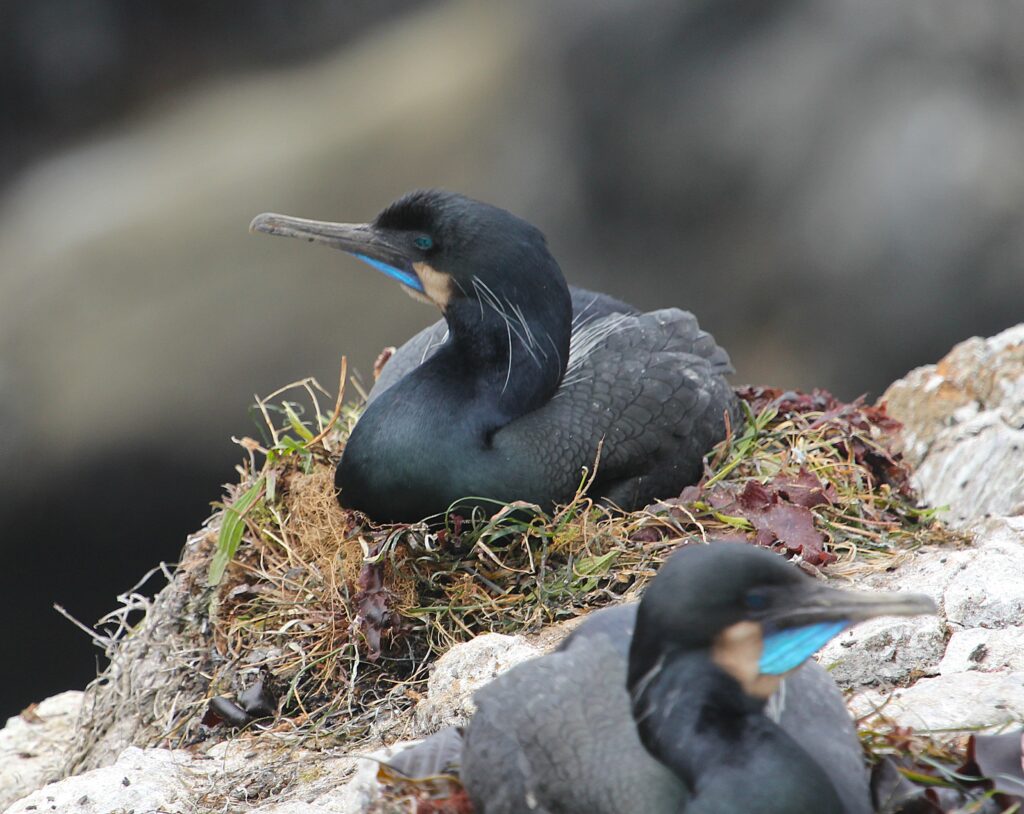
Brandt’s Cormorants (Figure 3), on the other hand, are attempting to breed this year at both sites. Most are busily incubating three or even four egg clutches now, with the first chicks expected by the end of June. It’s possible that Brandt’s Cormorants finished the winter in better body condition than Pelagics, perhaps because they often exploit different foraging habitats and prey types (Ainley et al. 1981). Brandt’s Cormorant reproduction does tend to be somewhat less variable than that of their cliff-dwelling relatives (Ainley & Boekelheide 1990), but still varies considerably between years in relation to ocean conditions and prey abundance (Schmidt et al. 2015; Ainley et al. 2018). It’s interesting to observe these two congeneric species of seabird respond so differently to these conditions. However, cormorants may also abandon breeding efforts mid-season if prey availability should suddenly decline, so I’ll continue monitoring to see how the Brandt’s manage to do this summer.

Figure 3. Brandt’s Cormorant males spend lots of time collecting nesting material. Breeding Brandt’s were frequently seen collecting grasses from the headland at Yaquina Head, as well as stealing material from their neighbors’ nests.

As for other species, Western Gulls have been faithfully incubating their two and three egg clutches at both sites for several weeks now – it’s just a matter of time before our first downy chicks of the year are around. The Black Oystercatchers aren’t nesting at easily-visible sites this year, but their raucous calls continue to be a near-constant presence at both colonies. Excitingly, I’ve also observed Tufted Puffins circling the Yaquina Head murre colony on several occasions, and once saw one flying over Pirate Cove! While neither site has much suitable nesting habitat for puffins, the USFWS recently placed puffin decoys and artificial burrows on Gull Rock (located squarely between the Yaquina Head and Pirate Cove colonies) to draw them there. The puffins’ continued interest in these sites continues to raise my hopes that one day soon we’ll have Tufted Puffins nesting again on the Central Coast. 

So far, it seems challenging to predict just what kind of year we’ll see on the Oregon Coast. Reduced breeding effort by Pelagic Cormorants and (to a lesser extent) murres, suggests unfavorable conditions. Yet, murres (though perhaps in somewhat lesser numbers) have begun to lay eggs at both sites and Brandt’s are attempting to breed in seemingly typical numbers. I’ll continue to brave the wind and fog to document how this annual drama plays out.

References

Ainley & Boekelheide. 1990. Seabirds of the Farallon Islands: Ecology, Structure, and Dynamics of an Upwelling System Community. Stanford University Press, Stanford, CA, USA.

Ainley et al. 1981. Feeding ecology of marine cormorants in southwestern North America. The Condor 83: 130-131. https://doi.org/10.2307/1367418

Ainley et al. 2018. Ecosystem-based management affecting Brandt’s Cormorant resources and populations in the central California Current region. Biological Conservation 217: 407-418. https://doi.org/10.1016/j.biocon.2017.11.021

Schmidt et al. 2015. Shifting effects of ocean conditions on survival and breeding probability of a long-lived seabird. PloS ONE 10(7): e0132372. https://doi.org/10.1371/journal.pone.0132372

Yaquina Head Seabird Monitoring: 2023 Early Season Update

By Will Kennerley, Faculty Research Assistant

It’s once again summer on the Oregon Coast and that means the seabirds are back at Yaquina Head.  My name is Will Kennerley and I’m the newest faculty research assistant in the Seabird Oceanography Lab. Part of my work will include leading the monitoring fieldwork at Yaquina Head this year.  I spent the previous six summers working with seabirds in the Gulf of Maine, including two seasons of fieldwork for my Master’s, which I completed here at OSU in May.  I’m looking forward to applying this experience to Oregon’s large and diverse seabird populations.

Monitoring work at Yaquina Head began towards the end of May with the confirmation that Brandt’s and Pelagic Cormorants were both breeding here this year.  Pelagic Cormorants failed to breed successfully in 2022, so we were anxious to see how they would perform.  Much to our relief, at least 70 Pelagic Cormorant nests have been documented in Smuggler’s Cove, alone, and most have healthy clutches of four eggs. 

Our very first Pelagic Cormorant chick was observed on June 23rd and we’re hopeful that there will soon be many more!  As for Brandt’s Cormorants, we recorded our first chick back on June 16th and most Brandt’s nests so far have at least one hatched chick, with even more on the way!  It seems that the cormorants are off to a good start this year.

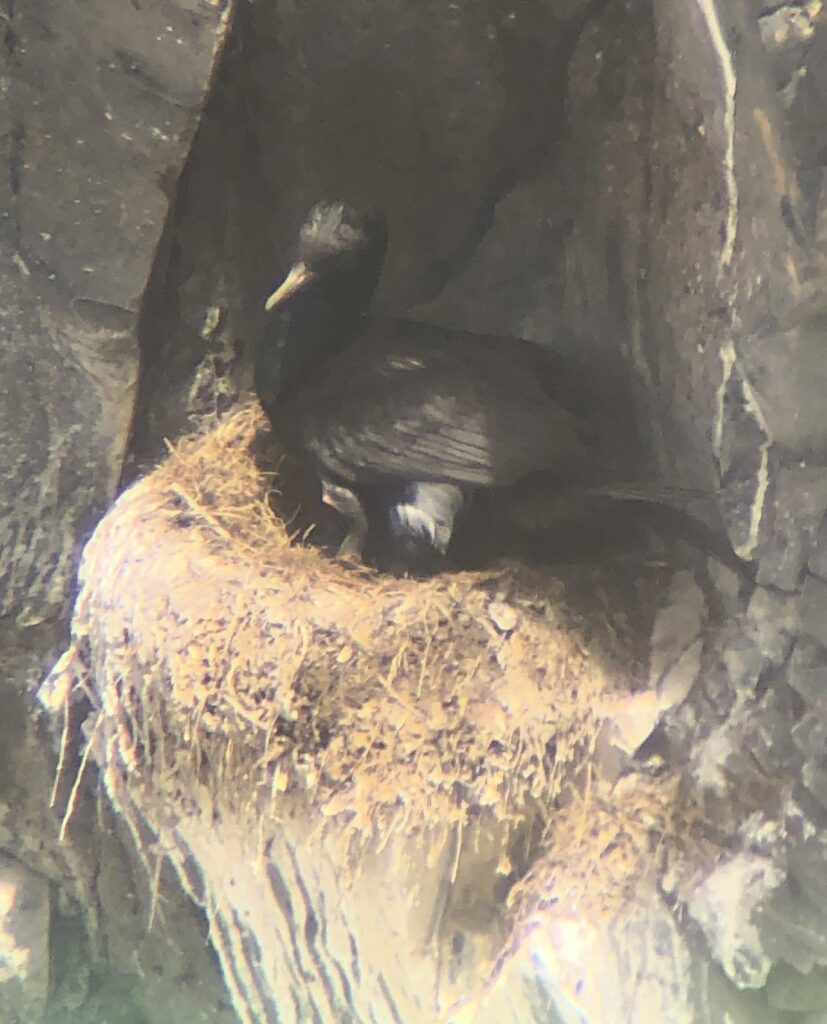
Most Pelagic Cormorants remain on eggs at the Smuggler’s Cove subcolony at Yaquina Head.  The first chicks for this species were noted in late June and many Pelagic Cormorant chicks will likely be hatching out over the next week.

In typical fashion, the situation for the Common Murres is a little less rosy.  Starting in the middle of June, murre eggs appeared in a slow trickle that was easily consumed by Western Gulls during the frequent eagle disturbances.  There were a couple troubling weeks in which our monitoring team would observe new nests in our monitoring plots during each visit without any of these eggs ever surviving until the following check, just two or three days later. 

This situation has improved somewhat during the last week, thankfully, and eggs are being laid in greater numbers; hopefully this bump in egg-laying can overwhelm the marauding gulls and allow some eggs to survive and develop.  Overall, I suspect murre productivity will be poor at Colony Rock, where I’ve seen as many six different Bald Eagles roosting at a time, but some of the smaller rocks around Yaquina Head provide better cover for the murres and have thus far avoided most of the disturbances and depredation.  Although the season is advancing rapidly, there’s still some time for murres to be at least somewhat successful – I’m not ready to be pessimistic just yet! If the murres do succeed in hatching some chicks, this year’s median chick hatch date will likely be the latest ever recorded at Yaquina Head.

The complex topography of “Stegosaurus” and the other smaller subcolonies at Yaquina Head may provide sufficient cover from aerial predators for at least a small number of murres to breed successfully.

This year we are also systematically monitoring breeding murres and cormorants at Pirate Cove in the town of Depoe Bay.  We’re employing the same protocols as at Yaquina Head, just with slightly less frequent visits.  While the situation at these two colonies is broadly similar, we’ve documented fewer eagle disturbances per hour of observation at Pirate Cove than at Yaquina Head so far.  Because of this, a small number of murre eggs have now been incubated for at least two weeks and I am hoping that murres at this colony will successfully produce at least a few chicks.

Also of note this year is the consistent Tufted Puffin sightings that we’ve had at Yaquina Head!  As many as three individuals have been observed at once, and we’ve seen the birds circle the murre colony numerous times over the course of some mornings.  One Tufted Puffin even landed on the backside of Colony Rock, where puffins once bred.  While there haven’t been any signs of a nesting attempt, our hopes are high for continued puffin activity throughout this season and next.

If you’re around at Yaquina Head in the mornings, come introduce yourself!  I’m typically joined by a great team comprised of Jacque (REU intern), Neci (Doris Duke scholar), and Ricardo (Environment for the Americas BLM/YHONA intern) and we’d be happy to say hello.

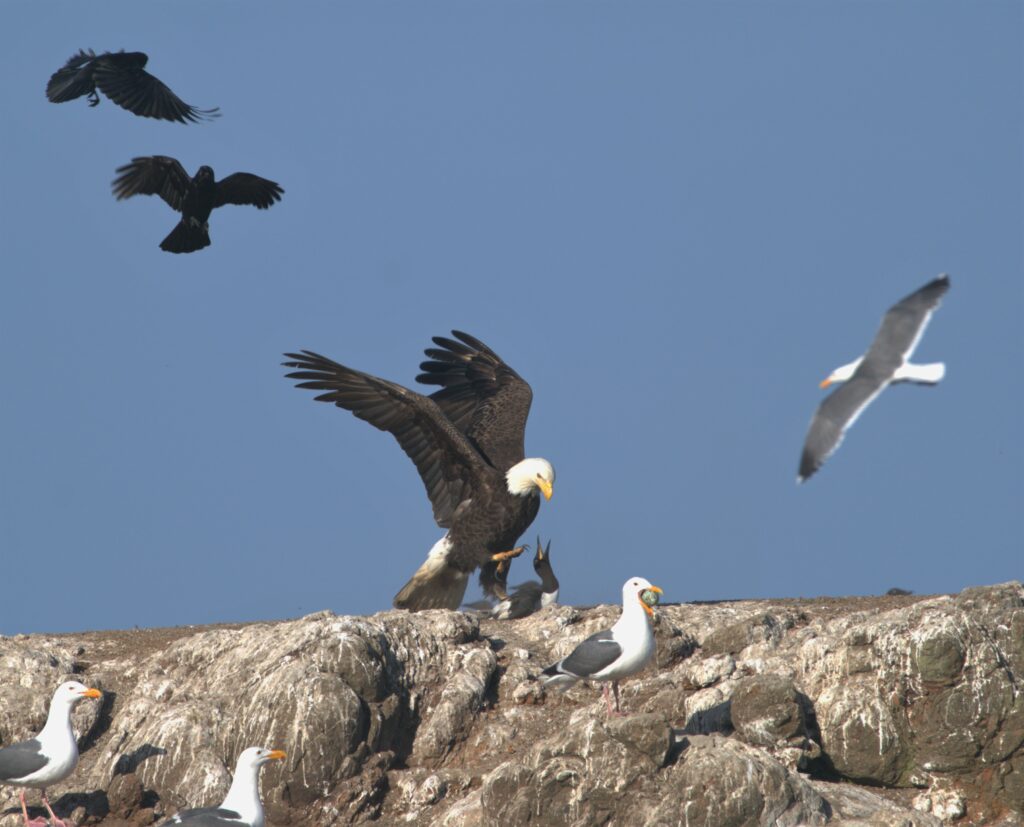
A Bald Eagle seizes an adult Common Murre at Pirate Cove.  This disturbance caused the rest of the colony to flee, leaving the eggs vulnerable to predation by Western Gulls (note the gull with its mouth full, just to the right of the eagle).