OSU Pride 2025!

The OSU Queer Archives hosted a booth at OSU’s June 2nd Pride event in the MU Quad and we had a blast! Lots of organizations shared information with the hundreds of attendees, there was an assortment of games, crafts, a photo booth, and free rainbow tamales, and Poison Waters and her friends performed a special drag show on the steps of the MU – they were all fabulous!

OSQA Booth

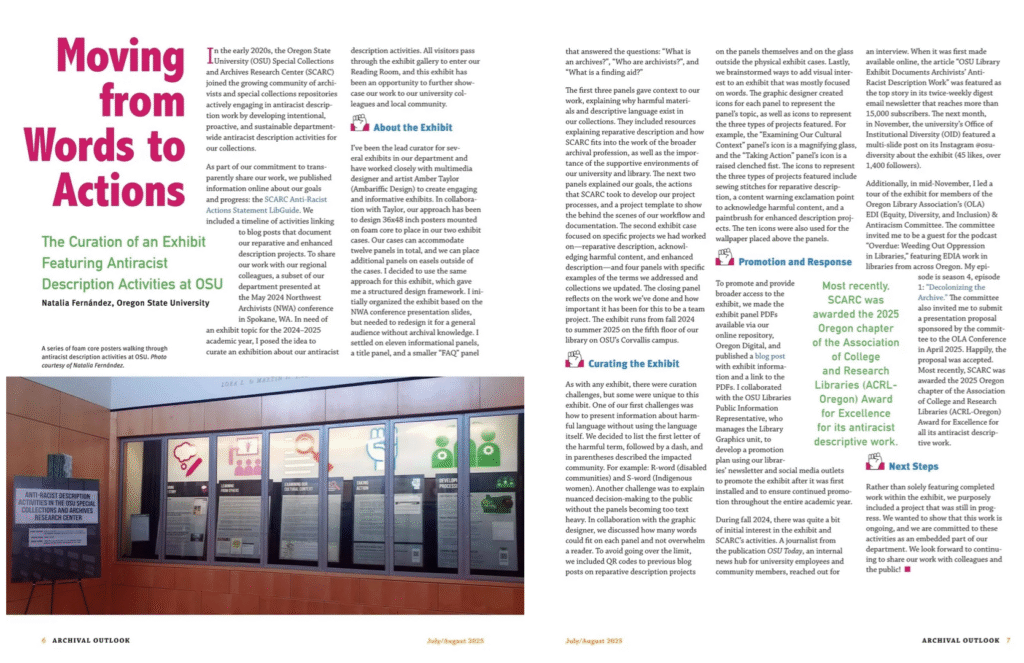
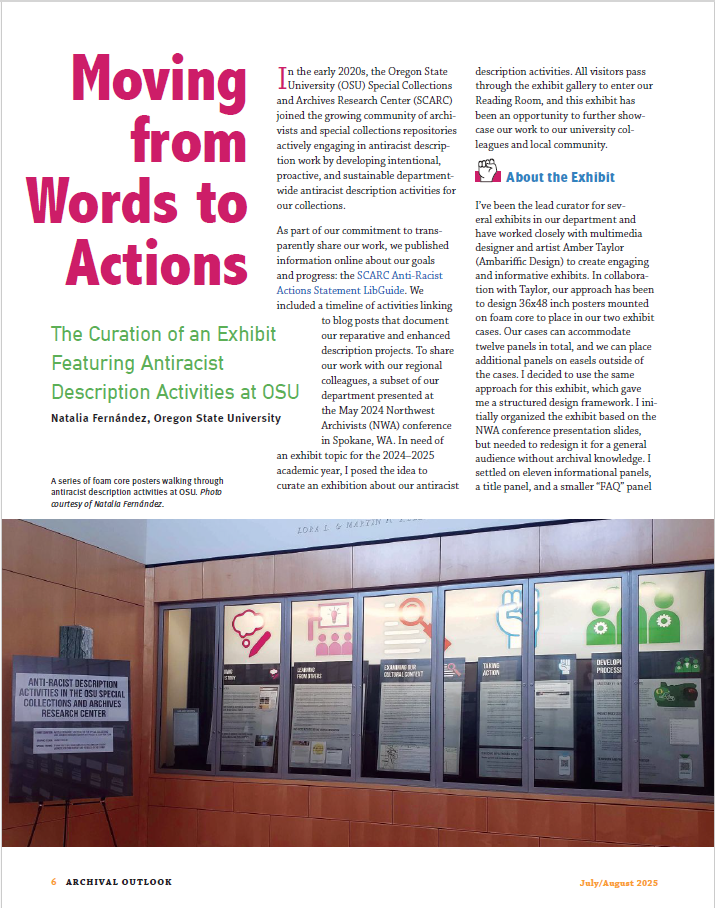
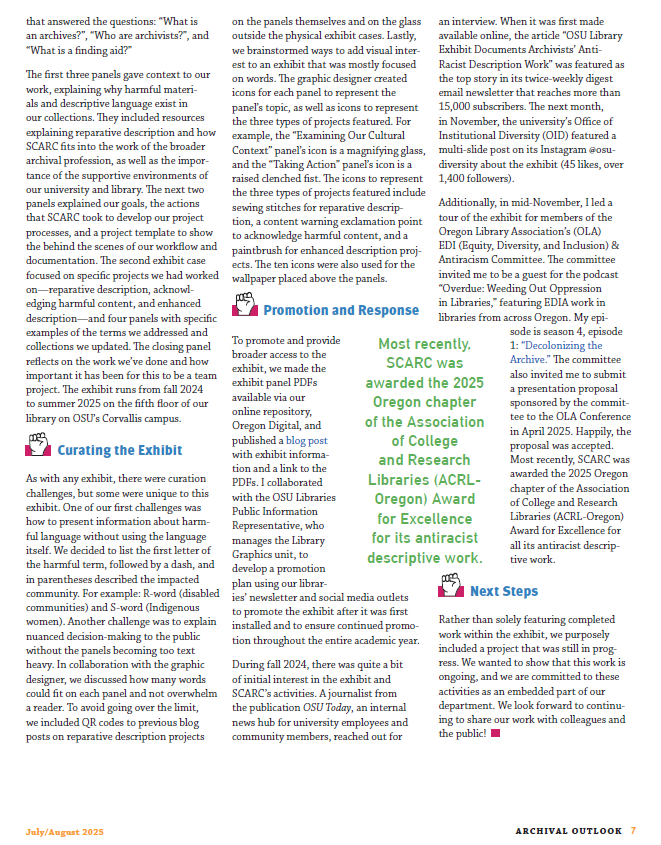
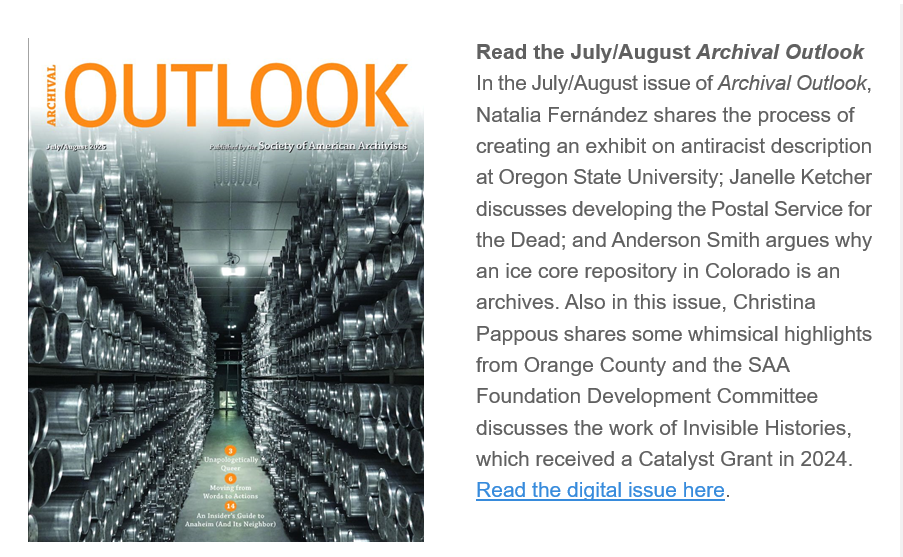
We had over 150 people stop by to view the materials and/or chat with us! We featured copies of materials from a few of our collections including the Corvallis Lesbian Avengers Collection, the After 8 Records, and The Lavender Network Newsmagazine. We also included some materials pertaining to general information for archiving personal papers and some newsletters from the Society of American Archives Archival Outlook newsletter that showcased how archives across the nation support traditionally marginalized communities. And, we gave away free Pride themed as well as cute Benny the Beaver pins 🙂

Photos of the Event

BONUS: Pride Display at the OSU Pride Center

OSQA shared digitized content from various collections for the OSU Pride Center to showcase as part of their renovated space, which includes permanent display space!

Sol: LGBTQ+ Multicultural Support Network Collection: The Sol: LGBTQ+ Multicultural Support Network Collection consists of records and materials documenting Sol’s history, from its beginning in the early 2000s up to its operations in 2023, at Oregon State University. Sol’s intention is to create spaces that celebrate the intersectional identities of queer and trans people of color. Sol works closely with the Pride Center (historically known as the Queer Resource Center), as well as other Cultural Resource Centers on campus. The collection contains administrative and programming records, as well as art related materials. The collection contains digital and physical items, including oversize materials. Sol related oral history interviews can be found in the OSU Queer Archives Oral History Collection.

Ellen and Carolyn Dishman Papers: The Ellen and Carolyn Dishman Papers are the collected materials and photography by the Dishmans documenting their involvement at Oregon State University in the late 1990s to early 2000s. As OSU students, they were involved in prominent LGBTQ+ groups on campus and served as primary advocates for the establishment of the Queer Resource Center (QRC) in 2001; the QRC is now called the Pride Center.

Pride Center (RG 236) (currently closed for processing): The Pride Center serves as Oregon State University’s resource center for lesbian, gay, bisexual, and transgender (LGBT) members of the OSU community and their allies. In addition to its roles in outreach and education, the center provides a safe space for anyone in the community to “explore aspects of sexual orientation and gender identity in an open and non-judgmental atmosphere.”

Corvallis Lesbian Avengers Collection: The Corvallis Lesbian Avengers Collection documents the activities of the Corvallis chapter of the Lesbian Avengers throughout the 1990s. The Corvallis Lesbian Avengers were a local chapter of the national Lesbian Avengers organization. Originally formed in 1992 in New York City, the Lesbian Avengers were a direct-action group focused on issues vital to lesbian survival and visibility. The bulk of the collection is made up of photo albums and scrapbooks containing photographs, news clippings, flyers, artwork, poetry, and other paper material. The collection also includes a small collection of artifacts, an annotated calendar, and 3 issues of the Necessary Friction zine produced by the Corvallis Lesbian Avengers.

Full Views of the Display

SPAN 399 “Bilingüismo local y personal” Winter 2025

Aqui se habla, May 2025 Book Launch Flyer

During winter 2025, the Oregon Multicultural Archives (OMA) collaborated with OSU Professor Adam Schwartz to gather materials from his course SPAN 399 “Bilingüismo local y personal” as an addition to the Oregon Multicultural Communities Research Collection. The set of materials includes course materials, documents pertaining to a book launch, an OSU Today article, and a sample of student projects.

About SPAN 399 “Bilingüismo local y personal”

“This course explores Spanish language education as a deeply personal, local (as opposed to foreign), and lifelong practice. Distinct from a survey course that introduces that thesis through published and multimodal texts, this class challenges students to realize their own bilingualisms as lived, dynamic experiences, and in ways that do not organize neatly into academic categorizations. Students will individually and collectively write, share, reflect, interview, sit in conversation, and present Spanish-English bilingualisms as lifelong relationships with and through teaching and learning.

Our work will be guided by the contents of Aquí Se Habla: Centering the Local and Personal in Spanish Language Education, a co-edited volume to be published this term. One of the co-editors of this text is the course instructor, and the other three will visit our classroom to invite students in as additional contributors. Over the course of ten weeks, students will read the text and learn about its foundational theoretical framework: The tension point. Aquí Se Habla raises awareness about long-standing points of tension that organize as ideological binaries (e.g. “home” vs. “abroad”) which relegate local and personal Spanish to marginalized status in academic spaces. Students will make the case for a tension point of their choosing, one that concerns not just themselves, but their families, friends and bilingual communities. In so doing, their own voices and testimonios will warrant inclusion alongside Aquí Se Habla’s diverse set of contributors, whose perspectives help to deconstruct disciplinary boundaries and elevate the knowledge and lived experiences of U.S. Spanish speakers. Final work in this course will prepare students to showcase how their local and personal bilingualisms may double as calls to linguistic justice. As such, students are invited to co-present with Aquí Se Habla’s co-editors at the volume’s official book launch at OSU in May.”

~ SPAN 399 “Bilingüismo local y personal” Syllabus

About the OMA and SPAN 399 Collaboration

Professor Schwartz shared the tension point the class selected to explore was “self-identity / imposed identity” — a tension point that resonated greatly with archival materials. As part of the students’ first of three visits to the archives, we talked about how archives can be a place in which people choose how their stories are represented on their terms as a form of empowerment and how archives can also be a place in which materials about but not by a community or individual can sometimes cause a great deal of harm. During their second visit, the students engaged with a curated set of materials that showcased the variety of ways in which communities and individuals have represented their identities — examples included diaries, songbooks, collective works of art, scrapbooks, and zines. On the third visit, we discussed the students’ ideas and questions for them to determine if they planned to donate their final projects to the archives. We discussed the importance of choice, representation, and consent, not only from them but for those who they interviewed for their projects. Of about a dozen students, five decided to share their final projects. At the end of the term, the students gave presentations of their findings and reflections, and many again shared their work as part of the Aquí Se Habla book launch on May 21, 2025.

Aqui se habla, May 2025 Book Launch Participants

New Finding Aids: January – March 2025

SCARC completed 2 new finding aids January – March 2025; as of the end of March, SCARC has 1153 finding aids in Archives West.

These finding aids are available through the Archives West finding aids database, the SCARC website, and the OSU Library discovery system a.k.a. “the catalog.” The links below are to the guides in Archon, SCARC’s finding aids website.

2 new (big!) collection guides were created this quarter:

Roy Haber Hanford Nuclear Reservation Downwinders Case Collection, 1942-1997

The Roy Haber Hanford Nuclear Reservation Downwinders Case Collection contains research materials used by the law office of Roy Haber, in litigation regarding radiation exposure suffered by individuals living close to (or ‘downwind’ from) Hanford from 1945 to the mid 1990s.

Dean of Students Office Records, 1943-1999

The Dean of Students Office was established in 1962 as part of a major administrative re-organization of the university to provide “a more efficient line of communication from the students to the university president.” The office ceased to exist as a separate unit of Student Affairs on August 1, 1997. The Dean of Students Office records document the programs and activities of the office, especially pertaining to student organizations, student living groups, student retention, non-traditional and commuter students, and services to students offered by the Dean of Students staff.

“The Living Legacy of Colegio César Chávez” Documentary Screening and Panel Discussion

Oregon Experience documentary The Living Legacy of Colegio César Chávez

On Wednesday, January 22, 2025, the Oregon Historical Society hosted the event “The Living Legacy of Colegio César Chávez Documentary Screening and Panel Discussion” as an accompaniment to the “Colegio César Chávez: The Legacy Lives On / El legado sigue vivo” exhibit at the Oregon Historical Society.

Over 230+ community members attended the event! And, the event was recorded and is available online for free via the Oregon Historical Society: video recording of “The Living Legacy of Colegio César Chávez” Documentary Screening and Panel Discussion (1 hour and 13 minutes)

The event invited the general public to join us for a screening of OPB’s new Oregon Experience documentary The Living Legacy of Colegio César Chávez. The event included a panel discussion led by documentary producer Alicia Avila, Colegio César Chávez co-founders Sonny Montes and José Romero, and PODER: Oregon’s Latino Leadership Network President, Anthony Veliz. Colegio César Chávez: The Legacy Lives On / El legado sigue vivo exhibition curator, Natalia Fernández, gave an introduction. The panelists shared their thoughts on the history and legacy of the Colegio César Chávez, ideas for the future of a Colegio 2.0, and then opened the conversation to the audience for questions. Prior to the film screening, attendees enjoyed live music from the Forest Grove High School Mariachi band and viewed the exhibition Colegio César Chávez: The Legacy Lives On / El legado sigue vivo.

Event Panelists:

Event Panelists: Alicia Avila, Sonny Montes, José Romero, and Anthony Veliz

Alicia Avila is a multilingual journalist and documentary producer based in Portland, Oregon. A common theme of her work is advocating for underrepresented communities, language justice, and accessibility. She is a champion of collaborative and community-led storytelling and leads her video production work through trauma informed practices and a bilingual, bicultural reporting lens. Her most recent work led Pacific Northwest based nonprofit, Oregon Food Bank, to transition into fully bilingual English-Spanish content. Avila is a proud first-generation Chicana born and raised in southeast Los Angeles.

Sonny Montes was one of the founders of the Colegio César Chávez, co-founded the César E. Chávez Student Leadership Conference in 1990, and was a member of the César E. Chávez Boulevard Committee in Portland, Oregon, that was successful in renaming 39th Avenue in honor of César Chávez. In 2010, he received the Distinguished Latino Educator Award from the Oregon Association of Latino Administrators.

José Romero was one of the founders of the Colegio César Chávez and co-founded the César E. Chávez Student Leadership Conference in 1990. He is a retired educator, administrator, and community activist for social justice and equality, and he is a life-long advocate for the well-being of the Chicano/Latino community. Romero taught Chicano Studies at Lane Community College and at Colegio César Chávez where he also served as Director of Academic Affairs and was Co-President.

Anthony Veliz is the founder of PODER: Oregon’s Latino Leadership Network, a nonprofit organization and collective movement of over 100 Latino-led and serving community-based organizations and private-sector businesses, plus thousands of Latinos across Oregon. Veliz is also the owner of IZO Public Relations & Marketing, a multicultural agency specializing in the Latino community; it is a People Focused, Purpose Driven agency. The son of farmworkers, Veliz is involved in the community where he lives and works, and he has a passion for public service. In August of 2023, PODER organized and sponsored a 50th anniversary community commemoration event to celebrate the history and legacy of the Colegio César Chávez.

Natalia Fernández is an Associate Professor and the Curator of the Oregon Multicultural Archives (OMA) and the OSU Queer Archives (OSQA) at the Oregon State University Special Collections and Archives Research Center. Fernández’s mission for directing the OMA and the OSQA is to work in collaboration with Oregon’s African American, Asian American, Latinx, Native American, and OSU’s LGBTIAQ+ communities to support them in preserving their histories and sharing their stories. In collaboration with Montes and Romero, she curated the exhibition Colegio César Chávez: The Legacy Lives On / El legado sigue vivo.

Event Photos:

PODER: Oregon’s Latino Leadership Network
Forest Grove High School Mariachi band performed.
Event attendees viewing the exhibit.
Standing room only for the event attendees!
Oregon Experience documentary: The Living Legacy of Colegio César Chávez

The “Colegio César Chávez: The Legacy Lives On / El legado sigue vivo” exhibit at the Oregon Historical Society and Beyond!

The Colegio César Chávez: The Legacy Lives On / El legado sigue vivo has been hosted by various organizations and featured at numerous events! Below are images from when the exhibit was hosted at the Oregon Historical Society.

Digital Copies of the Exhibit Panels are available online via Oregon Digital

We have numerous blog posts related to the Colegio César Chávez exhibit and related events – be sure to check them out!

Colegio César Chávez, Oregon Historical Society Exhibit Website

The Oregon Historical Society is hosting the Colegio César Chávez: The Legacy Lives On / El legado sigue vivo exhibit!

  • Dates: January 10 – April 27, 2025
  • Location: Oregon Historical Society, 1200 SW Park Ave, Portland, Oregon 97205
  • Audience(s): Free for Members, Family-Friendly, Researchers, Teachers
  • Description: Located in Mt. Angel, Oregon, and in operation from 1973 to 1983, Colegio César Chávez was the first independent, four-year accredited Chicano/a college in the United States. Rooted in the Chicano/a notion of “familia,” the college offered a unique and innovative educational philosophy that incorporated a holistic, integrated, community-based approach for students whose needs were not being met by traditional educational institutions. This bilingual exhibition highlights Colegio César Chávez’s significance and legacy by exploring the national and local context for its establishment, its educational philosophy and structure, as well as and the challenges it faced and how it overcame them.
  • Credits and Online Access: Colegio César Chávez: The Legacy Lives On / El legado sigue vivo was curated by Natalia Fernández, Associate Professor and Curator of the Oregon Multicultural Archives and OSU Queer Archives within the Oregon State University Special Collections and Archives Research Center. Digital copies of the exhibition panels are available via Oregon State University’s digital asset management system Oregon Digital.
  • More Information: Oregon Historical Society Colegio César Chávez: The Legacy Lives On / El legado sigue vivo exhibit website (note: this link will not be active once the exhibit closes)

Radio Interview via The Jefferson Exchange

On February 3, 2025, Jefferson Public Radio interviewed Natalia Fernández for a 15 minute segment about the exhibit! In the interview, Fernández discusses her work as an archivist as well as the exhibition. She shared that the college‘s primary goal was to provide equal education opportunities for Chicano/a and minority students through a bilingual, bicultural curriculum and experiential learning. With the exhibition, Fernández hopes to honor and share this significant history, to highlight the “incredible foundation of social justice advocacy for us to learn from,“ and that people take away the “inspiring legacy for us to continue.”  

Exhibit Photos

New Finding Aids: October – December 2024

SCARC completed 2 new finding aids and updated 1 finding aid October – December 2024; as of the end of September, SCARC has 1151 finding aids in Archives West. And, all three collections happen to be a part of the OSU Queer Archives!

These finding aids are available through the Archives West finding aids database, the SCARC website, and the OSU Library discovery system a.k.a. “the catalog.” The links below are to the guides in Archon, SCARC’s finding aids website.

New or updated collection guides created this quarter:

Queer History Research Collection, 1960-2024

The Queer History Research Collection (QHRC) is an artificial collection containing items of interest about LGBTQ+ communities within Oregon State University and to a lesser extent, the city of Corvallis, the state of Oregon, the United States, and the World. The digital folders described in this collection are available upon request.

Queer Theatre Collection, 1974-2015

The Queer Theatre Collection is an artificial collection containing theatre materials or educational materials that have queer subjects or characters. The materials were donated to the Oregon State University (OSU) Pride Center by OSU Theatre Professor Charlotte Headrick.

OSU Rainbow Continuum Records, 1993-2021

Abstract: The Oregon State University (OSU) Rainbow Continuum Records document the administrative and outreach activities of this student group, which has been active at OSU since 1976. The purpose of the Rainbow Continuum is to provide a social and educational space for lesbian, gay, bisexual, transgender, and other gender or sexuality diverse (LGBTQ+) members of the OSU community and their allies. Most notably, the Rainbow Continuum hosts OSU’s annual Queer Pride Week celebration in May.

OSU Faculty Oral History Interviews, SOC 318 Assignment

During fall term 2024, SCARC collaborated with Dr. Dwaine Plaza’s course SOC 318 Qualitative Research Methods on an assignment for students to conduct oral history interviews with Oregon State University Faculty. Early in the term, the students came for an instruction session held in the SCARC Reading Room and we shared the SCARC resource Oral History Interviewing Methods & Project Management. We now have 7 new oral history interviews available for public access!

Additions to the Voices of Oregon State University Oral History Collection

  • Selina Heppell, College of Agricultural Sciences, Department of Fisheries, Wildlife, and Conservation Sciences
  • Katherine MacTavish, College of Health, Department of Human Development and Family Sciences
  • Robert Mason, College of Science, Department of Integrative Biology, J.C. Braly Curator of Vertebrates
  • Richard Mitchell, College of Liberal Arts, Department of Sociology

Additions to the Oregon Multicultural Archives Oral History Collection

  • Itchung Cheung, College of Science, Department of Integrative Biology, Hatfield Marine Science Center (HMSC)
  • Dana Sanchez, College of Agricultural Sciences, Department of Fisheries, Wildlife, and Conservation Sciences
  • Sandy Tsuneyoshi, (retired) Director, Asian & Pacific Islander American Student Services, Intercultural Student Services

“The Living Legacy of Colegio César Chávez” A Documentary by OPB

“The Living Legacy of Colegio César Chávez” OPB Documentary Artwork

The Oregon Public Broadcasting (OPB) documentary “The Living Legacy of Colegio César Chávez” (17 minutes) is now available online to the public!

Documentary producer Alicia Avila interviewed Colegio César Chávez co-founders Sonny Montes and José Romero, Anthony Veliz of PODER: Oregon’s Latino Leadership Network, and Colegio César Chávez: The Legacy Lives On / El legado sigue vivo exhibition curator Natalia Fernández, just to name a few of those included as part of the film. Additionally, the documentary features materials from the Oregon Multicultural Archives related to the Colegio César Chávez. Note: while the documentary is in English, there is a Spanish language accompanying article “El histórico colegio Chicano de Oregon continúa a inspirar a la comunidad Latine a luchar contra la borradura de su cultura”.

OPB has some additional plans in the works for 2025 including an English and a Spanish episode of a podcast about the history and making of the documentary, as well as screenings of the documentary, especially for K-12 students. One such screening is already planned for January 22nd in Portland, OR!

“The Living Legacy of Colegio César Chávez” Documentary Screening and Panel Discussion

Join us for a screening of OPB’s new Oregon Experience documentary The Living Legacy of Colegio César Chávez. The event will include a panel discussion led by documentary producer Alicia Avila, Colegio César Chávez co-founders Sonny Montes and José Romero, and Colegio César Chávez: The Legacy Lives On / El legado sigue vivo exhibition curator Natalia Fernández, which will be on view at the Oregon Historical Society in 2025. They will share a behind-the-scenes discussion about the film, the significance of Colegio’s legacy today, and open the conversation to the audience for questions.

Our Town, Mt. Angel Publishing, a 3-part series

A local reporter in Mt. Angel, Melissa Wagoner, published a 3-part print series about Colegio!

UPDATE! In April 2025, the Northwest Regional Emmy Awards announced the nominations for the “Diversity/Equity/Inclusion – Long Form Content” award and “The Living Legacy of Colegio César Chávez” nominated!

BONUS! A few behind-the-scenes photos filming the documentary in the SCARC reading room in summer of 2024. Alicia Avila and her team interviewed Sonny Montes, José Romero, and Anthony Veliz.

Summer 2024 OPB Documentary Filming

Thank you to OPB for this amazing opportunity!

“School Spirit: Building A Dam Community”, our new mini exhibit, is now on display!

This exhibit explores the ways in which Oregon State students have cultivated and celebrated their campus community since 1868. 


Amongst Oregon State’s values is community engagement to build relationships between students, faculty, staff, and more broadly, the Beaver community. One way to foster these relationships is by invoking school spirit. Some of the ways the Oregon State community enacts its school pride include wearing school colors, participating in school traditions, and representing the university through sports, clubs, and activities. 

OAC athletes, Harriet’s Photograph Collection, 1868-1996, P HC

Beavers and the colors orange and black weren’t always a part of the Oregon State community. Some reports share that in 1896, students adopted orange as the primary school color in honor of Robert Reed Gailey, a Presbyterian missionary and popular former football player for Princeton University. At the time, he was visiting the Albany Collegiate Institute (now Lewis and Clark College), whose colors were orange and black. While visiting Oregon, students from Oregon State invited him to coach the football team for several days. In his honor, they chose orange as their school color. While black wasn’t officially adopted, it was used as a background color. Now, the Oregon State community proudly wears orange and black to show school spirit.

At the time of the university’s origin, mascots served a different role in academic communities. They were more akin to class pets, and were often real animals or even people. Early Oregon State mascots included “Jimmie” the Coyote and “Doc” Bell. Bell was a member of the Board of Regents, well-known for his tradition of marching to Marys River after each of Oregon State’s rivalry game wins and throwing his hat into the water to celebrate the victory. 

The beaver was eventually adopted as Oregon State’s official mascot after the school newspaper and yearbook used the name, “The Beaver”. Reports say that in 1951, graphic illustrator Arthur Evans (who famously designed a majority of the college mascots of the twentieth century) drew the first cartoon beaver mascot for Oregon State. In 1952, student Ken Austin showed up to a school rally dressed in a hand-made Beaver costume. These first renditions of “Benny the Beaver” are the origin of Oregon State’s modern mascot. 

Ken Austin with Benny, Beaver Yearbook Photographs, 1998-2005, P003:6500.

School spirit and tradition are closely related. Traditions are often used by students to portray a sense of pride in their institution by honoring those students who came before them. While traditions may play a role in school spirit, they are not an exclusive means of promoting school pride.

Historically, some traditions have been exclusionary, whether intentionally or not. For example, in the early-mid twentieth century, freshman students (known then as “rooks” and “rookesses”) were made to wear green on Wednesdays until the ritual “Burning of the Green” at the end of the academic year. This rule was enforced by sophomores and upperclassmen.

Burning of the Green, Graham & Wells Photograph Collection, 1919-1925, P021:026.

At sporting events during this time, there were also dress codes for student spectators. These students were also not allowed to “fuss”, meaning they could not sit or mingle with students of the opposite sex at sporting events. These days, campus has moved towards a more inclusive approach, allowing students of all levels to wear whatever they wish to classes and removing clothing and gendered restrictions for students attending sporting events. 

Other traditions are still practiced today. Among them are songs and cheers used at sporting events and academic celebrations, like convocation and commencement. The “Spirit and Sound of OSU”, Oregon State’s marching band, helps maintain these traditions and promote school spirit by performing at campus and sporting events. While playing music, they often form impressive shapes and scenes related to their performance.

Beaver songs, MSS MC Box-Folder 177.5.

Visual representations of school spirit are not the only means of building community at Oregon State, however. Many students participate in clubs and activities, pursuing hobbies or passions while at the same time representing the university at competitions and events. There, friends, family, and fans cheer them on. 

One of the most popular ways to show school spirit is to support Beaver athletics. Baseball is one of the most popular sporting events at Oregon State, with good reason. The Beaver baseball team won back-to-back NCAA championship titles in 2006 and 2007, and again in 2018. After each win, Oregon State students and community members gathered to celebrate the team after their homecoming.

Oregon State students have also competed internationally, to the excitement of the Beaver community. In 1964, Oregon State student Jean Saubert earned a silver medal in the giant slalom and a bronze medal in the slalom in the Winter Olympics. She also participated and placed in the World Championships in 1962, 1963, 1964, and 1966 as a member of the US Ski Team. Saubert graduated from Oregon State in 1966. Her accomplishments were celebrated in 1991, when she was inducted into the university’s Hall of Fame.

Jean Saubert, MSS MC 140.9.

Other clubs and organizations in which Oregon State students have participated or competed include Greek life, music groups and clubs, cultural groups, affinity groups, and more. 

Ultimately, there’s no one way to enact school spirit. Whether you wear orange and black to show your school pride, attend a volleyball game to support the student athletes on that team, compete in philanthropy events to fundraise for a good cause, or advocate for students’ rights, school spirit is about fostering and supporting the community around you here at Oregon State. 

~ Grace Knutsen


Grace Knutsen is the lead student archivist at Special Collections and Archives Research Center. She has HBAs in history, French, and German from OSU and is an MLIS student at Indiana University Indianapolis. 

Reparative Description of the Term “Gypsy” in SCARC Collections

Roma are an ethnic group that originated in Northern India and migrated to Europe between the eighth and tenth centuries. The majority of Roma, also known as Romani, live across Europe, where they have faced persecution and segregation. During World War II, Romani were subjected to deportation, forced labor, and medical experimentation, and hundreds of thousands were executed in killing centers across Europe. This genocide decimated Roma populations and social networks, and they continued to face persecution after the war. Roma women were sterilized across Eastern Europe until the 1990s. Today, 90% of Romani in Europe live below the poverty line and face violence from other citizens and police.

Approximately one million Romani live in America. According to a 2020 Harvard study, discrimination is widespread even though many Americans know little about Roma. Many study participants described hiding their ethnic identity to avoid stereotyping or discrimination. Across the U.S., including in Oregon, Romani people have historically been harassed by police, subject to discriminatory housing and employment laws, and smeared as criminals. 

The term “gypsy” is considered derogatory by many Roma people. It comes from the word “Egyptian,” where many Europeans mistakenly believed the Romani came from. In 1971, at the First World Roma Congress, a majority of attendees voted to reject the use of the term “gypsy.” However, some still use it to self-identify. In the U.S., it has also come to signify a free-spirited person, or someone who moves from one place to another without settling down. In industries like logging or trucking, it can refer to independent contractors. These uses reference the traditional migratory lifestyle historically practiced by Roma. There is greater debate about whether these uses of “gypsy” are offensive. 

In our collections, “gypsy” is used as a descriptor of Romani people themselves, costumes and student events themed around Roma stereotypes, an adjective (as described above), and a logging term. Primarily, however, it refers to the “Asian gypsy moth” or “gypsy moth,” a group of invasive moth species that includes Lymantria dispar dispar, Lymantria dispar asiatica, L. d. japonica, L. albescens, L. umbrosa, and L. postalba. In 2021, the Entomological Society of America (ESA) voted to change the common names, and in 2022, the USDA’s Animal and Plant Health Inspection Service (APHIS) announced new names for these species. Lymantria dispar dispar is now known as the “spongy moth,” and the rest are now the “flighted spongy moth complex.” According to APHIS, the name refers to the moths’ eggs, which have a “spongy” texture. This change avoids equating Roma with a pest insect, and is part of the ESA’s Better Common Names Project, which seeks to update names that refer to ethnic or racial groups. 

Around half of the uses of “gypsy” are mentioned in the collection finding aid or preliminary collection inventory. The rest appear in Oregon Digital scans of SCARC materials. SCARC describes the contents of its collections using the language and terminology of the collections themselves. In order to provide historical context and to enable standardized searching and access across our collections, we have retained the original wording in the collection descriptions. However, we have also added a note to each affected collection to inform users of its context, along with a link to the SCARC Special Collections and Archives Research Center Anti-Racist Actions website and this blog post. 

We acknowledge the racism represented by the term “gypsy” and the continued persecution that Roma face. Providing access to these historical materials does not endorse any attitudes or behavior depicted therein. For more information about Roma in Oregon, we recommend Carol Silverman’s report for the Oregon Historical Society. Another great resource is the RomArchive, a digital archive for Roma art and culture.

Affected Collections

John D. Lattin Papers, 1941-2004

Thomas Kraemer Papers, 1908-2018

Gerald W. Williams Electronic Records, 1985-2008

Liz VanLeeuwen Spotted Owl Collection, 1973-2004

Gerald W. Williams Papers, 1854-2016

Gerald W. Williams Slides, 1961-2003

Research Accounting Office Records, 1935-2010

Entomology Department Records, 1887-2003

Extension and Experiment Station Communications Moving Images, 1937-2007

Beaver Yearbook Photographs, 1938-2005

Hans Plambeck Papers, 1900-1995

Barometer Campus Newspaper, 1896-2014

Oregon’s Agricultural Progress Magazine, 1953-2016

William L. Finley Papers, 1899-1946 (MSS Finley)

Staff Newsletter, 1961-2009

Annual Cruise, 1921-2000

The Lamplighter Literary Magazine, 1936-1945

The Manuscript, 1927-1932

Oregon State University Memorabilia Collection, ca. 1860-present

This work was completed in large part due to the initiative of Margot Pullen (Student Archivist) and the support of the Anti-Racist Description Team. Margot wrote this post and completed updates to collection finding aids.