Category Archives: Uncategorized

Fraternities: The Unsung Housing Heroes of World War Two

During winter term 2025 Dr. Kara Ritzheimer’s History 310 (Historian’s Craft) students researched and wrote blog posts about OSU during WWII. The sources they consulted are listed at the end of each post. Students wrote on a variety of topics and we hope you appreciate their contributions as much as the staff at SCARC does!

Blog post written by Kyle Knott

            When researching college campuses during World War Two, many historians look at the student populations or faculty. Some might even look at religious groups or specific areas of study. However, compared to the previous topics, the history of fraternities during World War Two is an understudied topic. This brings up the topic of what happened to fraternities when there were minimal civilian men on college campuses.

On October 15, 1943, the Oregon State Barometer reported that campus fraternities were pausing rush that term.[i] The year before, fraternities pledged over 300 members, to make the total number over eleven hundred within 34 fraternities.[ii] This begs the question, how did fraternities go from pledging so any members, to suspending multiple chapters on campus due to low membership? The answer would be because of the war. Barometer editor Jack Bolter wrote the article, telling the reading audience, who would most likely consist of students and faculty, that the inter fraternity council had decided to pause rush for all fraternities. The decision came after Jim Leedy, president of the inter fraternity council, led a meeting between the Inter Fraternity Council and additional members of the 13 fraternities on campus to discuss the current state of fraternities on campus. Regarding the war effort, all members concluded that they should pause rush so all aims of the men would be towards the war. The pause came for multiple reasons, such as that most fraternities had very low member numbers and could not do their full rush rituals as well as the men who would rush, would eventually be taken into selective service once they became 18 years old. The individual article about the fraternities itself is part of a larger daily newspaper called the Oregon State Barometer. The document remained in good condition, printed in black and white, and has minimal damage to the edge of the paper. Looking from the perspective of a student during the time it was released to the public, I would see that the number of men enrolled in the college was dropping dramatically as the largest active fraternity only had 13 members.

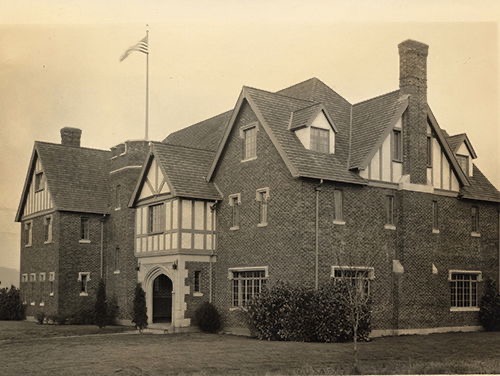
With fewer civilian male students and growing military presence on campus, the college had to adapt to the wartime demands of housing. In 1943, Oregon State College president Strand announced that the university would be transitioning Waldo Hall and Snell Hall from women’s dormitories to military use only. Because the university lost these buildings as dormitories and fraternities were losing so many members due to the draft and enlistment, the school began to lease fraternity houses and placed female students to live in them.[iii] The university allocated twelve houses to be specifically used for women.[iv] Along with Oregon State College, the University of Illinois was another university that used fraternities as makeshift housing, however, in their case, they would temporarily house soldiers while they were training.[v] In 1944, houses such as Kappa Sigma transitioned from a men’s fraternity the year prior, to an all-women’s group occupying the house.[vi] On December 10th, the Inter Fraternity Council cancelled all formal fraternity dances as diminishing numbers did not bring in enough revenue for the events to take place.[vii] Fraternities, such as Kappa Sigma, demonstrate how the university repurposed unoccupied houses to house women. Others, including Alpha Gamma Rho, housed athletes or other men due to limited space of the university’s dormitories.[viii] Later in March 1944, the Inter Fraternity Council met together to discuss whether the organization should continue as most men at that time had been sent off to the war.[ix] (Insert Figure 1 below)

Figure 1 The Theta Chi Fraternity House at Oregon State College, used to house female students during WWII[x]

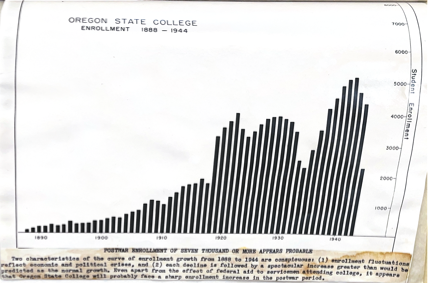
During the years of World War Two, many fraternities on campus had to suspend activities due to members being shipped off to the military and some shut down for good. In total, during the 1943-44 school year, fifteen men were living in fraternity houses. This was a drastic change from the year prior with that number being at 1,156 men.[xi] With the school being very active with training military troops, especially engineers and the development of the Army Specialized Training Program bringing in 1300 students, the dorms had become overcrowded, and the school had to look elsewhere to house its students.[xii] Along with Oregon State College, other universities’ enrollment took a massive hit. At the University of Washington, in the 1942/1943 school year, the school had a total of 6,521 stud ents [xiii] enrolled in the winter term, losing 1,341 students from the previous term.[xiv] Going into spring, at Oregon State College, the college’s enrollment dropped a staggering 23% compared to the previous year’s spring term.[xv] During the 1943/1944 school year, the number of civilian men enrolled in classes dropped as low as 258. The number of women outnumbered men by roughly 4 times with that number being 1,319.[xvi] (Insert Figure 2 Below)

Figure 2 The chart shows the number of students enrolled at Oregon State College from 1888 to 1943, demonstrating the drop in enrollment during World War 2.[xvii]

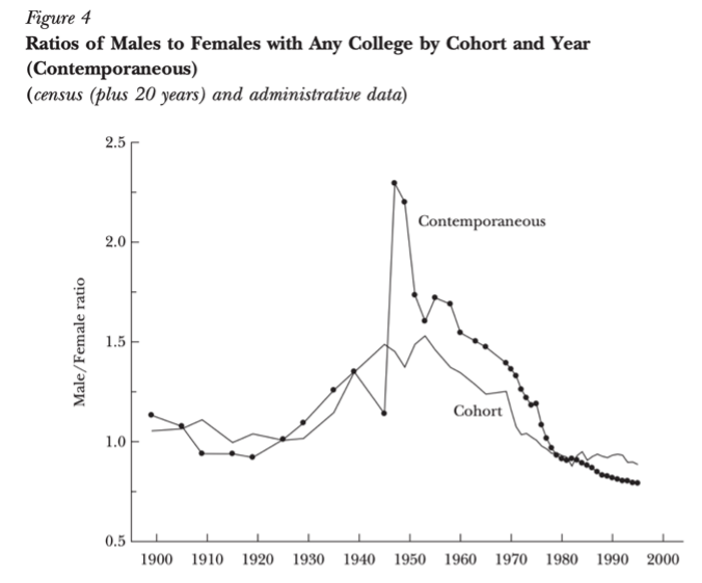
With most able-bodied men being drafted or volunteering to join the military, many universities saw a great decrease in the number of men enrolling in college. To deal with the issues of low enrollment of men, many universities had an increase in women registering for classes and began programs that brought in uniformed soldiers to take classes while preparing for war. [xviii] With the increase in students on campus, that being civilian and soldiers, the dorms on campus began to fill up. To keep up with the need of housing for students, many schools looked elsewhere for makeshift dormitories. Towards the end of the war, the number of civilian men enrolled dropped to 27% of the prewar enrollment numbers.[xix] With less civilian men enrolled in universities, the ratio of men to women enrolled in college dropped to a number that hadn’t been seen for 2 decades prior. Furthermore, the graph above shows a dramatically large increase in the ratio right after the war with the introduction of the G.I. bill. While the bill did make college free for all veterans, it also puts into perspective just how many men could have been enrolled in college during the time versus how many were.[xx] (Insert Figure 3 to right of paragraph)

Figure 3 The figure shows the Ratio of Men to Women throughout 1900 to 2000, with a decrease in the ratio during the period of World War 2 and a sharp increase right after.[xxi]

Looking at Oregon State College during World War Two, while fraternities were not able to operate, they still made a great contribution to the university. They leased their properties to the university to house female students so the college could bring in military troops to train and help the United States in the war effort. Without the use of the houses, the university would not have been able to bring in as many students or soldiers to train, lowering enrollment numbers even more than they already were.


[i] “No Rushing for OSC Men”, Oregon State Barometer, October 15, 1943, Oregon Digital, https://oregondigital.org/concern/documents/8k71nk05g

[ii] “Inter-Fraternity Council,” The Beaver 1943, 290, Oregon Digital, https://oregondigital.org/concern/documents/fx719t41x

[iii]U. G. Dubach, Biennial Report for Years 1942-1943 and 1943-1944, May 5, 1944, 5, Oregon State University Special Collections & Archives Research Center (hereafter SCARC) SCARC RG 013-SG 12 Annual & Biennial Reports Box 6 Folder 4, Department of Dormitories.

[iv] “President’s Office General Subject File, Oregon State College, Living Organizations – War-time housing, 1943-1946,” 1, Oregon State University President’s Office Records, Oregon State University, Oregon Digital, https://oregondigital.org/concern/documents/qn59q5195#citations

[v] Thomas Hendrickson, “World War II and University Housing,” University of Illinois Student Life and Culture Archives, December 9, 2015, https://www.library.illinois.edu/slc/2015/12/09/wwiihousing/

[vi]“Wartime Guests of Kappa Sigma,” The Beaver 1944, 244, Oregon Digital, https://oregondigital.org/concern/documents/zk51vh18n

[vii] “Ticket Refund for Frat Dance Set Today,” The Daily Barometer, 1, December 10, 1943, Oregon Digital, https://oregondigital.org/concern/documents/8k71nk21v

[viii] “Wartime Guests of Alpha Gamma Rho,” The Beaver 1944, 262, Oregon Digital, https://oregondigital.org/concern/documents/zk51vh18n

[ix] “Inter-frat to Meet,” The Daily Barometer, March 21, 1944, 1, Oregon Digital, https://oregondigital.org/concern/documents/8k71nk445

[x] “From the Archives: ‘Mother of Five Theta Chis’ Pays Tribute to Fraternity,” Theta Chi Fraternity, https://www.thetachi.org/from-the-archives-mother-of-five-theta-chis-pays-tribute-to-fraternity

[xi] U. G. Dubach, Biennial Report for Years 1942-1943 and 1943-1944, 2, SCARC RG 013-SG 12 Annual & Biennial Reports Box 6 Folder 4, Dean of Men.

[xii] “Army Specialized Training Program Records, 1943-1946,” Archives West ORBIS Cascade Alliance, https://archiveswest.orbiscascade.org/ark%3A80444/xv04125?utm_source=chatgpt.com

[xiv] “Scouting the Campuses,” The Daily Barometer, January 16, 1943, Oregon Digital, https://oregondigital.org/concern/documents/8k71nj28k

[xv] “OSC Enrollment Records Drop Of 23 Percent,” Oregon State Barometer, March 24, 1943, Oregon Digital, https://oregondigital.org/concern/documents/8k71nj62w

[xvi] “College Enrollment Hits Bottom”, Oregon State Barometer, April 18, 1944, Oregon Digital, https://oregondigital.org/concern/documents/8k71nk470

[xvii] “Presidents Biennial Report for 1943-1944,” SCARC, Annual and Binomial Reports, Box 6 Folder 4, 1944.

[xviii] Roger L. Geiger, The American University: A History (Princeton University Press, 1990): xix.

[xix] Geiger, The American University, xx.

[xx] Claudia Goldin, Lawrence F. Katz, Ilyana Kuziemko, “The Homecoming of American Women: The Reversal of the College Gender Gap,Journal of Economic Perspectives 20, no. 4 (Fall 2006): 139.

[xxi] Goldin et al, “The Homecoming of American Women,” 139.

Kappa Delta and the Contribution of the Greek Community at OSC During World War Two

During winter term 2025 Dr. Kara Ritzheimer’s History 310 (Historian’s Craft) students researched and wrote blog posts about OSU during WWII. The sources they consulted are listed at the end of each post. Students wrote on a variety of topics and we hope you appreciate their contributions as much as the staff at SCARC does!

Blog post written by Allyson English.

Like many people in the United States, sorority women around the nation were involved in contributing to the war effort to beat the Axis powers. In the case of Kappa Delta at Oregon State University, previously called Oregon State College (OSC), this sorority did their part during WWII to contribute to the war effort. One example would be a letter written to Kappa Delta from an organization supporting children impacted by the war in Europe. The letter itself is in excellent condition and contains creases where the paper has been folded to fit inside an envelope. The letter also contains pencil marks emphasizing paragraphs of Kappa Delta’s specific involvement with the organization. This letter shows Kappa Delta’s involvement towards the war effort on OSC’s campus. This blog post aims to articulate not only the efforts made by OSC’s Kappa Delta, but the organized effort among the Greek community on OSC’s campus and nationwide.

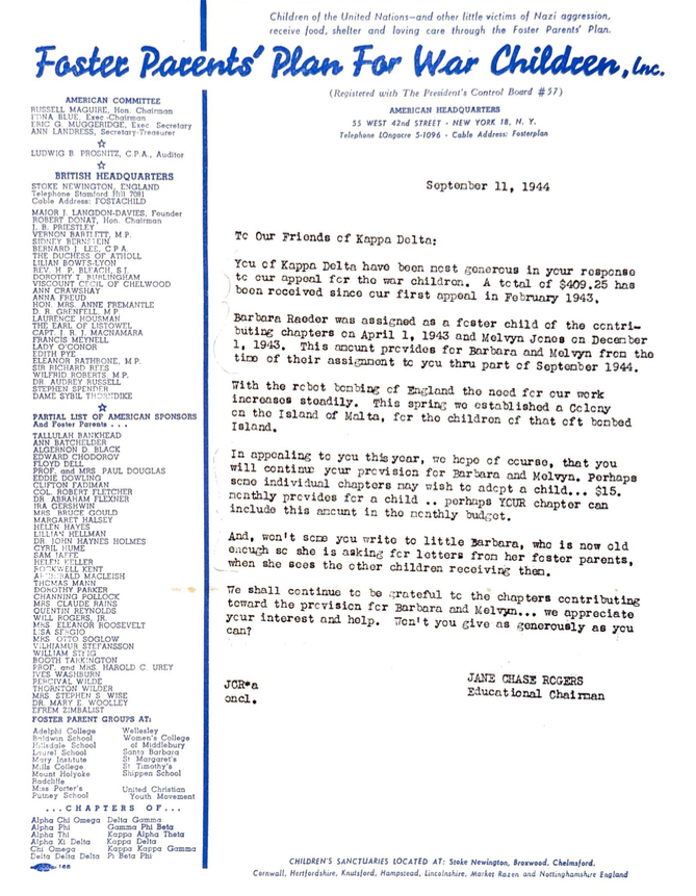
This image shows the contents of the letter written to Kappa Delta sorority from Jane Chase Rogers, the Educational Chairman of the Foster Parents’ Plan for War Children. Jane Chase Rogers to Kappa Delta, September 11, 1944, Foster Parents’ Plan for War Children, Alpha Kappa chapter of Kappa Delta Personal Records at OSU

Jane Chase Rogers, the Educational Chairman for the organization Foster Parents’ Plan for War Children, Inc., wrote this letter to the Alpha Kappa chapter of Kappa Delta. This organization was founded during the Spanish Civil War in 1937 by British war journalist Langdon-Davies and refugee worker Eric Muggeridge to protect children by evacuating them to safe countries.[1] Written on September 11, 1944, Rogers wrote this letter to thank the Kappa Delta chapter of OSC for their sponsorship of two foster children named Barbara Reader and Melvyn Jones. OSC’s Kappa Delta was assigned Barbara and Melvyn in September of 1944 by the organization.[2] The money that Kappa Delta raised and donated went to the provision of Barbara and Melvyn. The means of provision would go towards clothing and other necessities the children would need that they would not be able attain themselves. The letter continues to express the continuation for the provision of the children as well as asking some of the sorority members to write letters to Barbara as she is old enough to read and was asking for letters from her foster parents because she sees other children getting letters according to Rogers.[3]

While some sororities organized their own contributions to the war effort, Panhellenic sororities and other campus organizations across OSC banded together to do their part to aid wartime contributions. In result of the ongoing war, sororities faced the direct effects. These direct effects are expressed through the Oregon State Barometer, OSC’s student newspaper. In the fall rush season of 1943, one article reported: “Panhellenic [had] just recently deferred the first fall rushing period of three weeks” due to “Oregon State’s accelerated war setup”, according to the Oregon State Barometer. [4] Within the same issue of the newspaper, the reason for the deferment of the fall rushing period is because “Panhellenic council thought it inadvisable to take women away from their summer jobs which would probably be associated with war work.”[5] In 1943, Panhellenic approached the war head on. In their response to OSC engaging in war initiatives, “Panhellenic revised many of its policies to program with national defense.”[6] To align with the nation’s efforts to support the war, sororities within Panhellenic, along with other living organizations on OSC’s campus, participated in a coat hanger drive in response to Camp Adair’s request for hangers. Camp Adair was built during 1940 through 1942 to train men for the war.[7] The coat hanger drive required the living organizations who participated “to collect a minimum of two hangers from each Oregon Stater.”[8] During World War Two, metal was reserved for the war effort, resulting in a shortage nationwide among citizens. At Camp Adair, the men stationed there only had access to cardboard hangers which couldn’t support the weight of their coats, so “wire and wooden hangers [were] specifically needed.”[9]

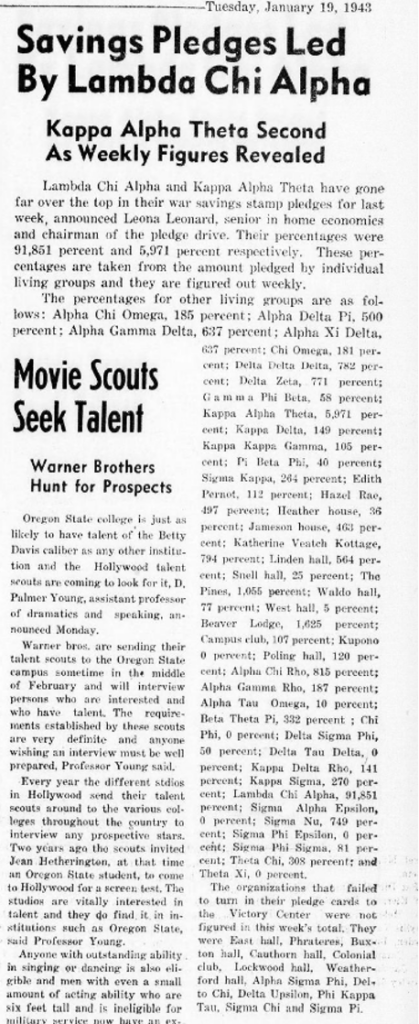
Panhellenic sororities, along with contributions of OSC’s Interfraternity Council (IFC), contributed to the war effort by buying war savings stamps. During World War Two, the United States Treasury Department issued war savings stamps that “allowed everyone in the country, rich or poor, young or old to save and contribute to the war effort.”[10] Sororities and fraternities at OSC pledged an amount of how many war savings stamps they purchased. In the early 1940’s, war savings defense stamps were priced ten cents, twenty-five cents, fifty cents, one dollar, and five dollars, the color of each stamp reflecting a different price.[11] Many of the sororities and the fraternities went over the initial pledge of stamps they originally made to buy. Lambda Chi Alpha took first, exceeding their original pledge of stamps by ninety-one thousand, eight hundred and fifty-one percent and taking second, Kappa Alpha Theta exceeding five thousand, nine hundred and seventy-one.[12] These percentages represent the percent of stamps exceeded by sororities and fraternities’ initial amount the pledged to buy.

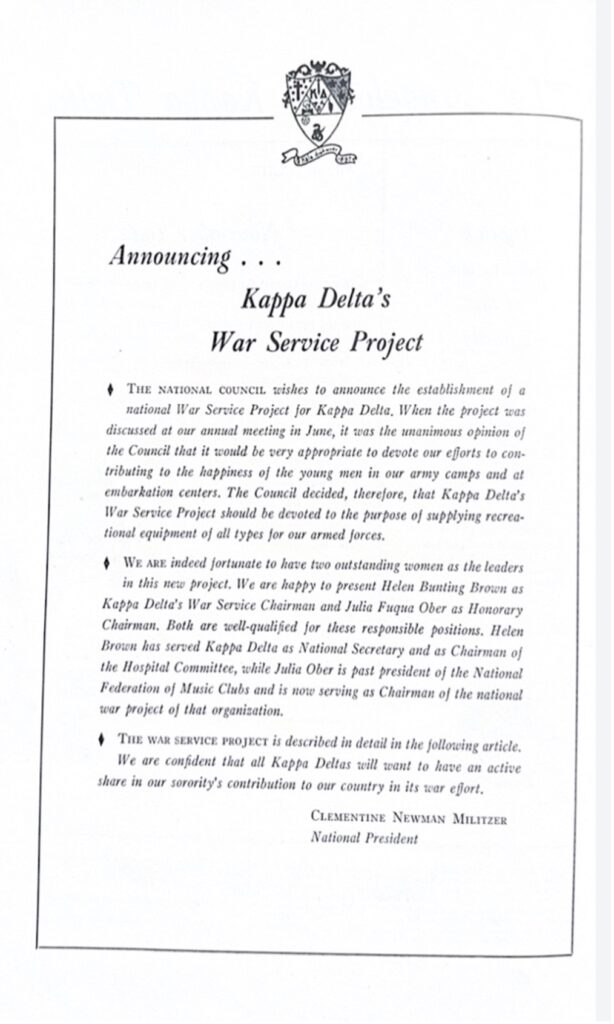
This image shows the announcement of National Kappa Delta’s War Service project written by the National President. Clementine Newman Milizter “Announcing Kappa Delta’s War Service Project” in The Angelos of Kappa Delta, November 1942, 2.

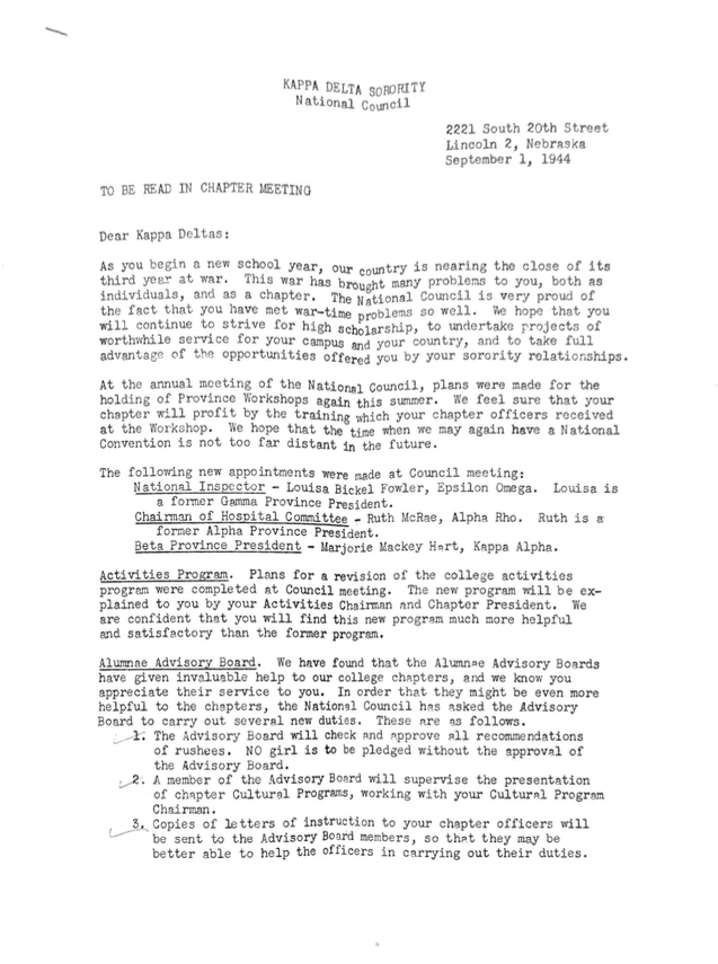
On a national level, Kappa Delta supported the war effort. Every Kappa Delta member has a subscription to the Kappa Delta magazine called The Angelos. The Angelos is a quarterly magazine with the purpose of informing Kappa Delta’s about other Kappa Deltas and their respective chapters around the nation on other college campuses. In the November 1942 edition of the magazine, National Kappa Delta announced its War Service Project written by the National President Clementine Newman Militzer. Headed by Helen Bunting Brown as the War Service Chairman and Julia Fuqua Ober and the Honorary Chairman, the purpose of Kappa Delta’s War Service Project would be “devoted to the purpose of supplying recreational equipment of all types for [the] armed forces.”[13] This excerpt is an excellent condition and there is no evidence of damage whatsoever. The announcement of National Kappa Delta initiating a War Service project shows that they are acknowledging the war and requesting aid in the war effort by recruiting as many Kappa Delta chapters on college campuses as possible to provide for the armed forces of the United States. While National Kappa Delta is initiating chapters around the nation to contribute their part to Kappa Delta’s War Service Project, National Kappa Delta addresses the war through letters to individual chapters. Addressed to Kappa Delta on September 1, 1944, Militzer the National President, opened the letter by noting that the “country is nearing the close of its third year at war,” acknowledging the impact of the war on the chapter, and emphasizing that the chapter “continue for high scholarship, undertake projects of worthwhile service for [the] campus and [the] country, and to take full advantages of the opportunities offered by sorority relationships.”[14] With the persistent attitude of contribution through National Kappa Delta’s War Service Project and a letter acknowledging the impact of the war shows the nature of importance made by Kappa Delta to contribute to the war effort during World War Two.

This image depicts a letter addressed to OSC’s Kappa Delta from the National President of Kappa Delta pertaining to the ongoing war. Mrs. Walter E. Militzer to Kappa Delta, September 1, 1944, Kappa Delta National Council, Alpha Kappa chapter of Kappa Delta Personal Records.

Much like other groups around the nation, college sorority women were no exception in contributing to the war effort to defeat the Axis powers. With the perspectives of Kappa Delta at Oregon State College and on a national level with National Kappa Delta, the devoted actions are shown from both, highlighting the importance what can be done on the home front to support the war overseas. If anyone is researching this topic, I would like to highlight the difficulty on finding scholarly writings on Greek life as a whole during World War Two.

Endnotes

[1] “History,” Plan International USA, https://www.planusa.org/about-us/history/.

2 Jane Chase Rogers to Kappa Delta, September 11, 1944, Foster Parents’ Plan for War Children, Alpha Kappa chapter of Kappa Delta Personal Records at OSU.

3 Jane Chase Rogers to Kappa Delta.

4 “Panhellenic Adopts Rushing”, Oregon State Barometer, May 21, 1943, 2, Oregon Digital, https://oregondigital.org/concern/documents/8k71nk01c.

5 “Open Rushing to Continue This Summer.” Oregon State Barometer, May 21, 1943, 1, Oregon Digital, https://oregondigital.org/concern/documents/8k71nk01c.

6 “Panhellenic” in 1943 Beaver (Corvallis, OR: Oregon State College, 1943), 292.

7 National Park Service, Preserving the Historic Military Landscape at Camp Adair, U.S. National Park Service, https://www.nps.gov/articles/000/preserving-the-historic-military-landscape-at-camp-adair.htm.

8 “Campus Begins Drive for Coat Hangers,” Oregon State Barometer, January 26, 1943, 3, Oregon Digital, https://oregondigital.org/concern/documents/8k71nj33f.

9 “Campus Begins Drive for Coat Hangers”, January 26, 1943, 3.

10 Harry K. Charles, Jr, Postal and Treasury Savings Stamp Systems: The War Years (paper presented at the National Postal Museum Symposium, Washington DC, September 26, 2015), 1 https://postalmuseum.si.edu/sites/default/files/charles-blount_symposium_paper.pdf.

11 Postal and Treasury Savings Stamp Systems, September 26, 2015, 34.

12 “Savings Pledges Led by Chi Alpha,” Oregon State Barometer, January 19, 1943, 1, Oregon Digital, https://oregondigital.org/concern/documents/8k71nj29v.

13 Clementine Newman Milizter “Announcing Kappa Delta’s War Service Project,” The Angelos of Kappa Delta, November 1942, 2.

14 Mrs. Walter E. Militzer to Kappa Delta, September 1, 1944, Kappa Delta National Council, Alpha Kappa chapter of Kappa Delta Personal Records at OSU.


[1] “History,” Plan International USA, https://www.planusa.org/about-us/history/.

[2] Jane Chase Rogers to Kappa Delta, September 11, 1944, Foster Parents’ Plan for War Children, Alpha Kappa chapter of Kappa Delta Personal Records at OSU.

[3] Jane Chase Rogers to Kappa Delta, September 11, 1944, Foster Parents’ Plan for War Children, Alpha Kappa chapter of Kappa Delta Personal Records at OSU.

[4] “Panhellenic Adopts Rushing”, Oregon State Barometer, May 21, 1943, 2, Oregon Digital, https://oregondigital.org/concern/documents/8k71nk01c

[5] “Open Rushing to Continue This Summer.” Oregon State Barometer, May 21, 1943, 1, Oregon Digital, https://oregondigital.org/concern/documents/8k71nk01c

[6] “Panhellenic” in 1943 Beaver (Corvallis, OR: Oregon State College, 1943), 292.

[7] National Park Service, Preserving the Historic Military Landscape at Camp Adair, U.S. National Park Service, https://www.nps.gov/articles/000/preserving-the-historic-military-landscape-at-camp-adair.htm

[8] “Campus Begins Drive for Coat Hangers,” Oregon State Barometer, January 26, 1943, 3, Oregon Digital, https://oregondigital.org/concern/documents/8k71nj33f

[9] “Campus Begins Drive for Coat Hangers”

[10] Harry K. Charles, Jr, Postal and Treasury Savings Stamp Systems: The War Years (paper presented at the National Postal Museum Symposium, Washington DC, September 26, 2015), 1 https://postalmuseum.si.edu/sites/default/files/charles-blount_symposium_paper.pdf

[11] Postal and Treasury Savings Stamp Systems, September 26, 2015, 34.

[12] “Savings Pledges Led by Chi Alpha,” Oregon State Barometer, January 19, 1943, 1, Oregon Digital, https://oregondigital.org/concern/documents/8k71nj29v

[13] Clementine Newman Milizter “Announcing Kappa Delta’s War Service Project,” The Angelos of Kappa Delta, November 1942, 2.

[14] Mrs. Walter E. Militzer to Kappa Delta, September 1, 1944, Kappa Delta National Council, Alpha Kappa chapter of Kappa Delta Personal Records at OSU.

TIL (Today I Learned): By Researchers, For Researchers

I’m by no means an expert, but I do refer to myself as SCARC’s resident “map nut.” Maps are like onions (or parfaits, if you will): each layer peels back a little piece of the historical narrative. Place names can provide insight into the way people of the past saw their world. The features highlighted or absent from a map can tell you the value placed on aspects of the physical environment. Items like Sanborn maps can tell you how cities grew and developed, and what features of the land and society affected that growth.

In my work as the Public Services Unit Supervisor in SCARC, I help researchers of all kinds, from Corvallis and around the world, access our materials, and introduce them to the tricks, tips, and tools to navigate our research portals. I always feel honored and humbled to be invited into their research processes, and whenever I can I try to highlight the products of their work. 

Cases en pointe are the four digital databases in this post. They all – to the surprise of no one who knows me – map aspects of the built and natural environment, from the vantage point of the past and the present. 

One quick item of note: one of the guiding principles of the archival profession is to protect all users’ right to privacy by maintaining the confidentiality of their research. To that end, the names of researchers have been omitted from this post in all except one case; only information about their research outcome is included.


OSU Campus Arboretum Web Map 

Dan Blanchard, Horticulture Instructor and Curator of Living Plant Collections for OSU Campus Arboretum, began work on OSU’s Arboretum Web Map as a graduate student in 2022. As a result of his work, OSU was granted ArbNet Level II Arboretum Accreditation in 2023. 

Since then, Dan and a number of dedicated student assistants have continued to document additional trees, and more are added to the web map frequently. To date, 630 trees  have been mapped on OSU’s main campus in Corvallis, including two blue atlas cedars planted in 1892, the giant sequoias in the Memorial Union quad, and OSU’s very own “moon tree” (located on the east side of the Peavy Forest Science Center).

On the left side of the main landing page of the Arboretum Web Map, visitors will find instructions for using various features of the map, and definitions of terminology and acronyms used. Drop-downs on the right side of the map can be used to identify individual trees by Common Name (e.g. American Elm, Bur Oak, Red Maple), Genus (e.g. Carpinus, Styrax), and Common Family Name (e.g. Beech family, Birch family). The scroll wheel can be used to Zoom in and out, and clicking on any individual orange pin will open a window with more information about that individual tree (e.g. height, diameter, and date of last measurement).

Atlas of Drowned Towns

The Atlas of Drowned Towns is a “public history project that explores the histories of the communities that were displaced or disappeared to make way for the reservoirs for…‘river development projects’ — aka large dams.” 

From the interactive map (linked at the top of the landing page), users can click on the compass icon on the left to apply filters and overlaps to the map (e.g. aerial photographs and historical maps), view “artifacts” associated with each community (e.g. photographs, documents, oral histories), and read historical research about displaced communities. Clicking on the lightbulb icon on the right side of the interactive map shows aggregated data for the number of displaced communities, the people displaced, and total cost of displacement. Alternatively, users can view a list of all displaced communities documented as part of the project from the Directory page

Please note that this project is still in development, and most content and functionality are currently focused on Detroit, Oregon. 

Mapping Inequality

The University of Richmond’s Mapping Inequality Project, an “open access project [focusing] on red-lining, the practice of denying financial services to residents based on race or ethnicity,” includes maps of a wide variety of U.S. urban centers. While the heaviest concentration of maps are of East Coast and Midwestern cities (e.g. Chicago, Detroit, Philadelphia, and Boston) cities in Oregon and Washington are also featured, including Seattle, Tacoma, Spokane, and Portland. From the map view, clicking the “Select City” box will show a list of all cities and counties featured on the map, arranged alphabetically by state.

For each map, information is included that documents how areas were categorized (e.g. Best, Still Desirable, Definitely Declining, and Hazardous), and populated (i.e. with regards to race). Clicking on any of the defined areas of individual city maps provides additional information on that area’s inhabitants and characteristics.

Please note: Some of the language used in the historical documents and maps on this site may be disturbing or activating. In several instances, map authors use racist, derogatory, and harmful language. Specifically, the use of slurs against Asian and Pacific Island people, and toward African Americans, is prevalent, as is anti-semitic language.

Living New Deal

What began in California in 2005, has since become a nationwide effort to inventory, map, and interpret New Deal public works. This interactive website allows users to access photographs, site information, historic documents, and personal accounts, and New Deal site maps can be browsed by city, state, artist name (arranged by first name), agency (e.g. Bureau of Public Roads), and category (e.g. Art Works, Civic Facilities). 
The interactive state map for Oregon alone includes historical information for over 300 New Deal sites. For each site, the following information is included as applicable and known: City, Site Type (e.g. Parks and Recreation, Dam), New Deal Agencies involved, when construction began and was completed, a brief description / historical narrative, and photographs (both present and historical). The Advanced Search feature – accessed by hovering over the word “Maps” in the blue banner at the top of each page – can be used to search across the nearly 19,000 sites documented to date.


Rachel Lilley (she/they) is the Public Services Unit Supervisor at the Oregon State University Special Collections and Archives Research Center (SCARC), and has worked as a reference archivist for over a decade (eight years of which has been at OSU).  She holds an M.A. in History with a concurrent certificate in Archives and Records Management from Western Washington University.

A Baby, Floodwater, and the Christensen River Farm

In historical and archival work, students are constantly reminded not to underestimate the power of a single historical artifact and the stories it can tell. Even an unsuspecting image of farmland can spur historical intrigue with just a bit of curiosity and detective work.

One such example came about while working with the Agricultural Experiment Station Bulletin Illustrations, 1925-1941. This collection is a part of SCARC’s ongoing “Photo Collection Tidying” project, wherein we work to ensure that all boxes and folders in photographic collections are clearly described in their finding aids. To do so, we ensure that the images represented in a collection’s finding aid match the images physically present in collection folders. 

While working with the Agricultural Experiment Station Bulletin Illustrations to organize and compare the physical photos present against the collection’s finding aid, I came across “Item SB 318: Cost and efficiency in dairy farming in Oregon, September 1933”, which is actually a series of 34 photographs and 46 diagrams. The preexisting description for this series of images reads, “Cows at pasture; types of pasture; alfalfa crop; kale and corn silage; R.H. Christensen Coos River Farm; loafing sheds”.

Photos of the R.H. Christensen farm in the Agricultural Experiment Station Bulletin Illustrations.

At this point, my interest was piqued. I am from Coos Bay, Oregon, and more specifically, grew up on Coos River (and still call this place home). Myself and my parents, my grandparents, and my great-grandparents have lived on Coos River at different periods since the early 1960s. Upon discovering this piece of Coos River history, I thought it likely that if I found where the farm had been located, I would recognize the land. Thus, I set out to find where this “R. H. Christensen Coos River Farm” had been located. 

Before going to maps collections, I quickly searched the name in SCARC’s holdings. A search for “R.H. Christensen” resulted in images from Laverne, Oregon, located on the Coquille River about a 40 minute drive south of Coos River. For example, the Agricultural and Resource Economics Department Photographs, 1925-1979, contains “Item 3-G-101: Homemade power plant, Laverne, farm of R. H. Christensen, June 1932,” as well as “Item 1-D-125: Irrigated pasture, Levern, farm of R.H. Christensen, June 1932”. As far as I am aware, there is no Levern in Oregon, but it seems reasonable to assume that this is a misspelling of Laverne. I thought it possible that R.H. Christensen owned several pieces of land in Coos County, and took note of this discovery to refer back to later. 

Next, I searched maps collections that might reveal land ownership, including Metsker’s Atlases of Oregon Counties, 1929-1988. Unfortunately, the three atlases of Coos County in this collection were dated 1941, 1958, and 1975. Because the initial item was dated 1933, I feared that these atlases were created a bit later than I hoped and may not contain the information I sought if Christensen hadn’t owned the farm into the 1940s. I still went ahead with my search and parsed through the 1941 atlas. Maps of Coos River did not show any land belonging to R.H. Christensen. I was disappointed, but given my earlier findings, went on to maps of Coquille River and to my surprise, found separate plots of land along the Coquille River to “R. H. and G. L. Christensen” on page 52 of the 1941 atlas. To practice due diligence, I also checked the 1958 atlas and found the same plots of land to be owned by “Gladys L. Christensen” 16 years later on page 53 of the 1958 atlas. By 1975, the land had changed hands.

1941 atlas showing plots belonging to “R.H. and G. L. Christensen”.
1958 atlas showing the same plots belonging to “Gladys L. Christensen”.

The spelling of the last name “Christensen” seemed unique enough to me that I thought this not a coincidence. After many searches of “R.H. Christensen” and “Gladys Christensen” in obituary and newspaper databases, I finally found an obituary for a “Ralph H. Christensen” dated May 7, 1948. This obituary confirmed that Ralph Christensen had lived in Coos County and married Gladys Abbott in 1914. His primary residence was in Bandon, Oregon.

Ralph H. Christensen’s obituary.

I thought it reasonable to assume that the Ralph and Gladys Christensen discussed in this obituary are, in fact, the leading characters in the story I have constructed so far. At this point, I believed that the evidence I had gathered pointed to two options: either the original photo of the Christensen farm in the Agricultural Experiment Station Bulletin collection was mislabelled and instead of being a Coos River farm, it was a Coquille River farm, or that Ralph Christensen (or his family) owned multiple pieces of property in Coos County. 

Now, understanding that Bandon was a place of interest, I still sought to learn more about the land that Ralph and Gladys owned, and whether there truly was a Coos River farm attached to their name. This time, I turned to Google and searched for “‘Ralph Christensen’ Bandon”, and when that did not yield useful results, “‘R.H. Christensen’ Bandon”. 

The latter search resulted in an unexpected find. I came across a Bandon Historical Society newsletter from 2017 that featured an article titled, “Miraculous Rescue Story…”. While not what I thought I was looking for, it was here that I got a look into what Christensen’s character may have been. 

According to the newsletter, a man named Richard Howell visited the Bandon Historical Society Museum in August 2016, where he sought out the museum director. With her, he shared a Bandon Western World newspaper article titled “Infant Lost in Flood Found Alive”, dated February 4, 1937. The article explained that the Howell family had lived in a house built near the Christensen farm on Lowe Creek (a tributary of Coquille River, located between Coquille and Bandon, Oregon). The house was built in a canyon, the article reports, and below a 20-foot-tall dirt dam. The dam was used for irrigation purposes on the Christensen farm. 

In 1937, a heavy downpour resulted in a flood that destroyed the dam and swept away the Howells’ home in the middle of the night. In their journey to the main road through the flooded canyon, they lost hold of their three-month-old son. Fearing the worst, the family searched for the child, but to no avail. 

The remaining Howell family members (both parents and two children) arrived at the Christensen farm for help. The article reports that Ralph Christensen built a fire for the family before hurrying to the home of Maurice Ray, who was the superintendent of the Moore Mill and Lumber Company logging operations and the employer of Mr. Howell. The pair then ventured into the canyon, where they rather heroically found the baby trapped in an alder sapling. The child was still alive despite being lost for an hour in the flood.

Richard Howell, the museum visitor, revealed to the museum director that he was the infant in that story. He shared that after his rescue, he was taken back to the Christensen home. Howell and his wife had visited the museum with hopes of obtaining a better copy of the Western World article and to see if they might learn any more on the 1937 flood.

Howell’s story did not inform me of whether the Christensens owned property on Coos River, but it did confirm that they owned and resided on a farm along the Coquille River. Given that there is a record of their land ownership along the Coquille River but not on the Coos River in the 1940s, I am inclined to believe that the original item was mislabelled. Alternatively, the Christensens may have owned property on Coos River in the 1930s that was sold before the 1941 atlas was created. 

Although my initial question remains unanswered, this search was not fruitless. I discovered where the Christensen family lived in the early twentieth century, but more than that, a riveting tale involving Ralph Christensen and Richard Howell. If this work has taught me anything, it is that while factual information (like addresses and land ownership) are important, the human stories that these facts inform are the true gems of the historical record. 

Coos River, Oregon.

This post was written by Grace Knutsen. Grace is a student archivist at Special Collections and Archives Research Center. She is an Oregon State alumna and Master of Library and Information Science student.

My first year (and change) at SCARC

I began working at SCARC in October 2023, during my first term at OSU. Now that I have spent a little over a year as a Student Archivist, I am able to look back and reflect on my experiences so far. When I applied to work at SCARC, I didn’t really know what an archive was, but I was excited about working in a library. My grandma was a school librarian, and I’ve always been passionate about history, so it just felt right. I don’t really remember what I expected my work to look like, but the first few months were a whirlwind. There were so many procedures and tasks to keep in mind as I began to learn how to assist researchers. My first attempt at paging books took me over an hour! But even as I needed to stop and ask for help at every turn, I was already having a lot of fun. Every day, I interact with deeply interesting historical materials, even when my task is something simple like reshelving a book. Experiencing this for the first time made me feel certain that being a student archivist was a good fit.

My first project was re-foldering Student Academic Records (SARs). I found the work almost meditative, and it was a great fit because I was new to campus and trying to find my place. Seeing the faces and stories of thousands of students who came before me was a meaningful experience and helped me feel more connected to OSU. When I held each person’s paperwork in my hands, it was like I was sitting there with them. As I transferred documents and copied name after name, I got a brief look into their aspirations, interests, and challenges. It was particularly interesting to see women who pursued non-traditional professions, the few Black students, and people who struggled academically but managed to stick it out and get their degrees. Through these individuals’ triumphs and losses, I was able to put my college experiences into perspective, and think about how much has changed in the last 70 years. Working with SARs was greatly moving, and I was a little sad to pass the project on to our newest Student Archivist. Despite this, it’s exciting to move on to more complex projects using the skills I have developed.

Another big project last year was updating the OSU Buildings LibGuide, which also helped me familiarize myself with campus and OSU history. I contributed to pages for over a hundred buildings. Now I feel that I could give an overly in-depth historical tour! I discovered that once I have a project, I tend to laser focus on getting it done, and it can be hard to balance projects with day-to-day collection management tasks. Being able to redirect my attention and keep all the different plates spinning is something I have made a lot of progress on this year. 

I’ve also been able to utilize SCARC materials in my coursework. Last term, I took SOC 360: Population Trends and Policy. For my final paper, I examined publications from Zero Population Growth (ZPG), an organization that was founded in the late 1960s and advocated for controlling population growth. I identified several articles that discussed suburban sprawl, and used them to frame land use planning discourse in the 1970s. ZPG had lots of praise for Oregon’s Senate Bill 100, which established a land use planning scheme for Oregon with 19 goals, such as protecting agricultural lands and ensuring affordable housing. Both the ZPG articles and debates around S.B. 100 show a desire to maintain the status quo and protect the “character” of neighborhoods. I argue this helps explain why S.B. 100 has been far less effective at addressing housing affordability than its other goals. The historical sources I accessed through SCARC contributed significantly to my paper. Very little information about ZPG is available online, and I was able to bring a unique perspective and story to the project through archival research. It was an interesting experience to switch roles and do research myself instead of facilitating research for others! 

When I first started at SCARC, I couldn’t imagine ever managing to remember all the protocols, or even what areas we collect materials in. A little over a year in, I feel confident in my understanding, and I am more comfortable in my interactions with patrons. I’m excited to continue learning in this supportive environment. My new project, processing photographs from News and Communication Services, is definitely pushing me out of my comfort zone, and I’m learning a lot. I anticipate this being a time-consuming project, but even though the finish line is far away, I’m feeling motivated to get there and see what comes next!


This post is contributed by Margot Pullen. She is a student archivist at the Special Collections and Archives Research Center. She studies public policy and history.

Learning About Margaret Krug Palen

As a student archivist, one of my primary projects is writing biographies for the more than one thousand individuals listed in the News and Communication Services Records. These individuals are primarily faculty and staff who were associated with Oregon State between 1940 and 2004. Oftentimes, the collection only holds an administrative document related to the individual. If I’m lucky, there might also be a CV or an article related to their professional work. While I do perform additional research to fill out a brief biography meant to communicate their birthdate, academic and professional history, and association with Oregon State, as well as to differentiate individuals with the same name, I’m still often left with only a snapshot of their life. I wish I could write detailed life stories for each individual in this collection, but alas, I am limited by time. 

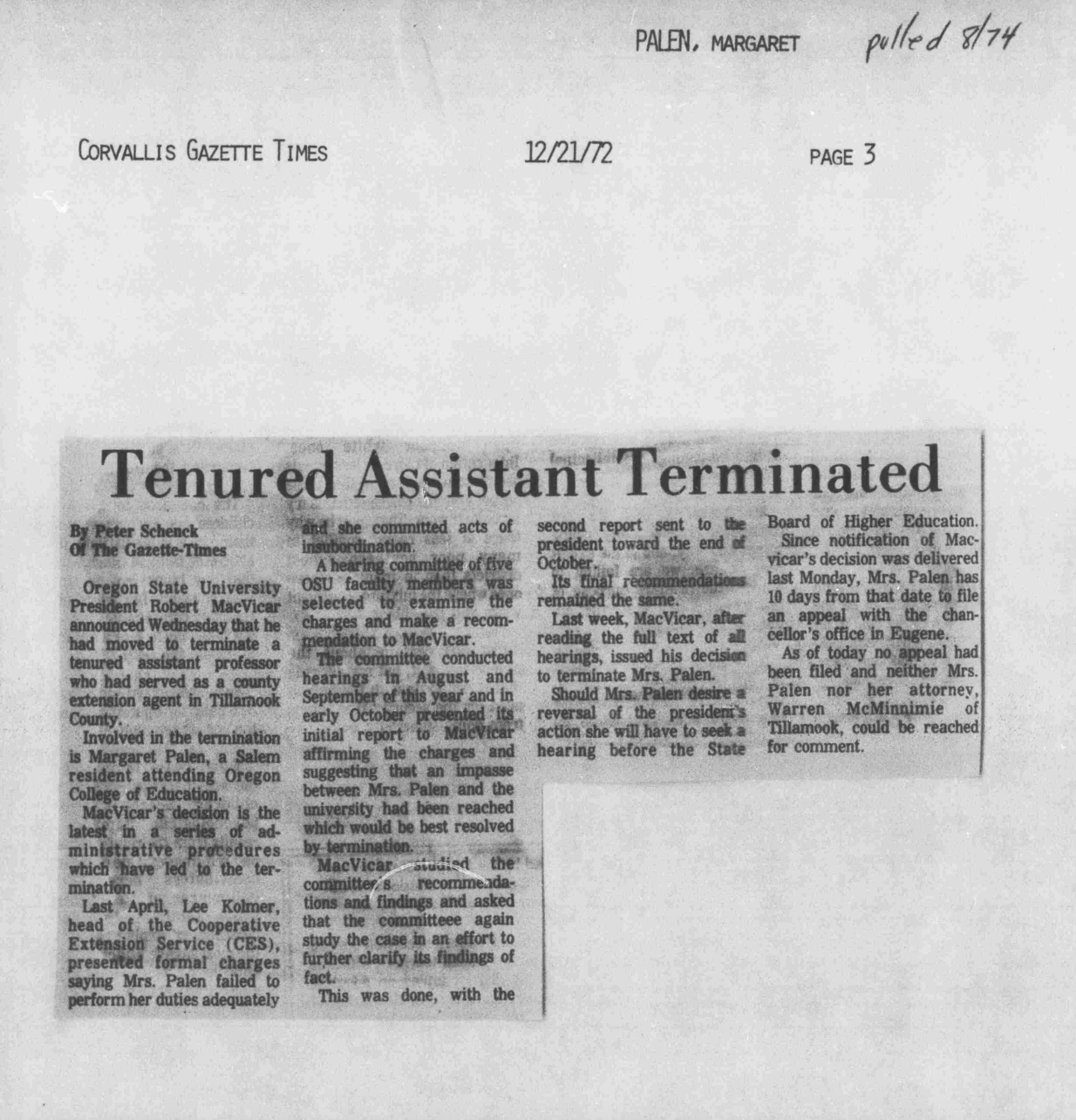
Margaret Palen is an example of the many individuals I wish to learn more about. The News and Communication Services Records hold two newspaper clippings related to her suspension and eventual termination from Oregon State in the 1970s. Reading these, I wished to understand her life beyond these events as well as share her professional accomplishments. As much as this blog post is about Palen, it is also about the privilege of doing the research and filling in the historical record. 

Who was Margaret Krug Palen, and what more can we learn about her life? 

Margaret L. Palen (née Krug) was born on May 14, 1931, in Iowa. She attended Iowa State College (now Iowa State University), where she earned a bachelor’s degree in home economics in 1952. After graduating, Palen was a textile chemist for one year before becoming a home extension agent in Iowa from 1953 until 1955. That year, she joined the Oregon State staff as a county extension agent for 4-H. She resigned in 1957 after her marriage to become a homemaker, working temporarily from 1958 to 1959 to aid Marion County as an extension agent. According to Palen’s employment records, her supervisors found her work to be effective and of quality. Palen returned to Oregon State in 1966, becoming a home economics extension agent in Tillamook County. She also became a master’s student at Oregon State in the early 1970s.

Despite her tenured status, Palen was suspended, then terminated, from her job in 1972 due to ten charges filed by Lee Kolmer, head of the Cooperative Extension Service. From August-September 1972, a five-person committee conducted hearings to evaluate Kolmer’s complaints, although the members of that committee are unknown. 

During these hearings, several witnesses appeared before the committee. Among them were a number of Tillamook County residents who spoke in favor of Palen’s work in their community. Even so, the committee found four of the charges to be proven and just cause for dismissal. 

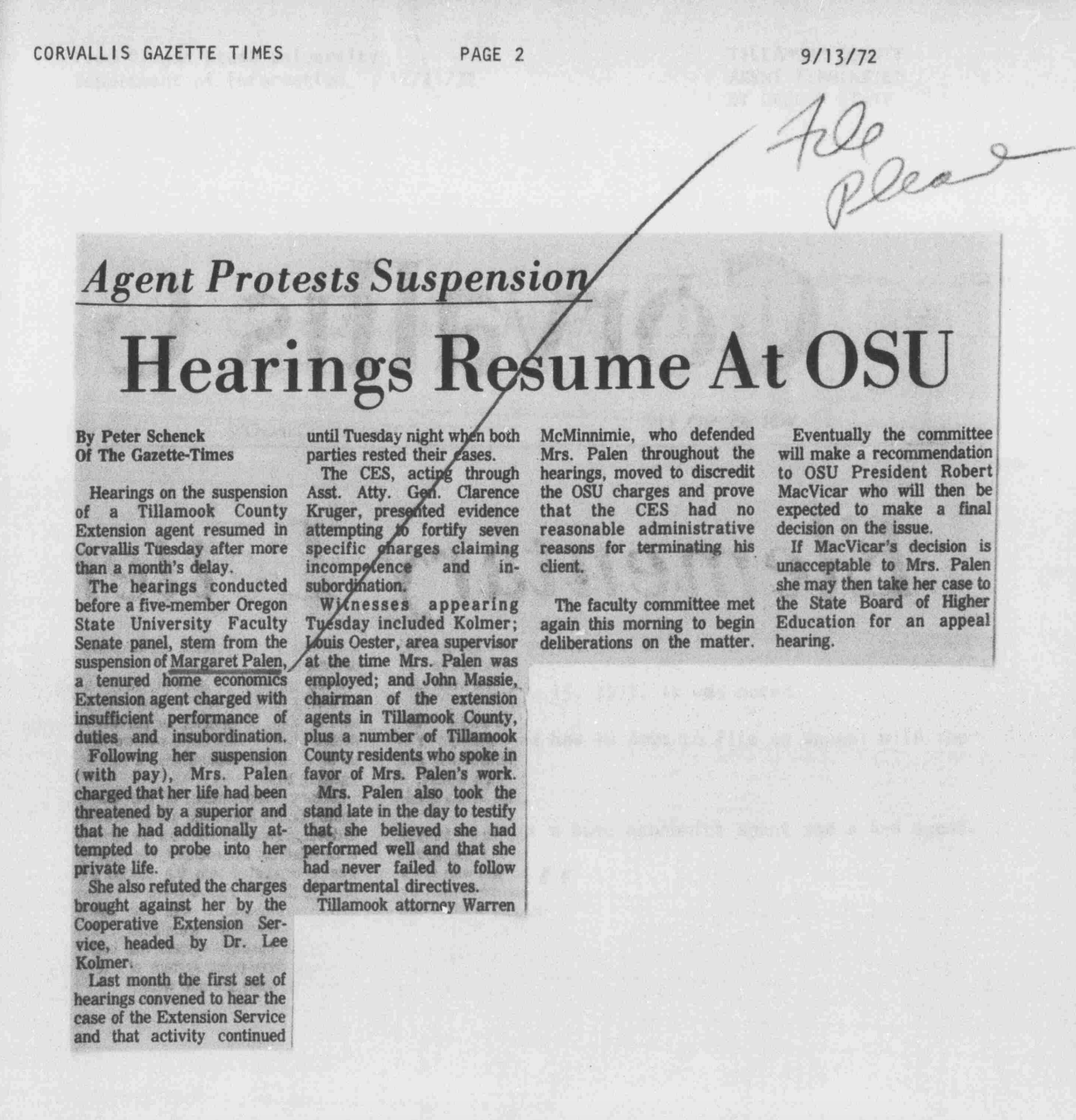
In October 1972, the faculty committee recommended that the matter would be best resolved by termination. Upon hearing this decision, OSU President Robert MacVicar fired Palen. This decision is included in the article, “Tenured Assistant Terminated” published by the Corvallis Gazette Times on December 21, 1972.

This is where the story ends in SCARC’s holdings. However, Oregon court records indicate that Palen did not succeed in protesting her suspension before the faculty hearing committee. In 1974, she appealed via the Oregon Court of Appeals, where the Board maintained that the university had just cause for dismissal. While we do not know the original seven charges, we do know these four because they were discussed in this case. They include that:

  • Palen reportedly made unsupported claims of improper and sometimes criminal conduct on the part of University administrators 
  • Palen reportedly was unwilling to cooperate with 4-H and Youth staff and leaders (that is to say, failing to adequately perform her responsibilities to the Tillamook County 4-H program)
  • Palen reportedly was unwilling to live in Tillamook County, and while the Extension Service did not present evidence of a formal written policy regarding place of residence, “Mrs. Palen had been informed of the desirability and necessity of living near her place of employment”
  • Palen reportedly refused to respond to direction from and provide a schedule of her activities to her County Chairman, claiming that she was on special assignment and not required to report to the Chairman

The Oregon Court of Appeals found the first and last charges and last “could properly conclude that petitioner’s conduct constituted cause for termination”. In the second, the Oregon Board of Education was found erred. In the third, the charge could not be sustained “because it was not proven to be one of the petitioner’s responsibilities to do so”. Therefore, the OSU president’s decision to fire Palen was upheld. 

While only listed as a staff member in Oregon State General Catalogs until the 1972-73 academic year, Palen’s name is listed in the 1974 Oregon State commencement program as a Master of Science in Education recipient (she likely graduated in Fall 1973, causing her to be listed in the 1974 program, because other documents in Oregon Digital list her graduating class as the Class of ‘73). That is to say, it appears that she still graduated from Oregon State after her termination. 

It’s difficult to trace the next decade of Palen’s life. She likely continued her career in community-oriented work outside of Oregon State. She also likely continued to raise and support her family. It’s possible that she spent some time traveling with her husband, Kenneth Palen, as his obituary states that the couple traveled to every continent and seventy-five countries of the world – an endeavor that would certainly take time to complete. 

A simple internet search of Palen’s name reveals that in the 1980s, she began her writing career. Inspired by her German family and her husband’s Scottish family’s immigration to Iowa, she authored Genealogical Research Guide to Germany in 1988, a guide for those individuals interested in tracing their ancestry. She would go on to write three related works: German Settlers of Iowa: Their Descendants and European Ancestors in 1994, Genealogical Guide to Tracing Ancestors in Germany in 1995, and Germany and Scotland Immigrants to Iowa in 2019. 

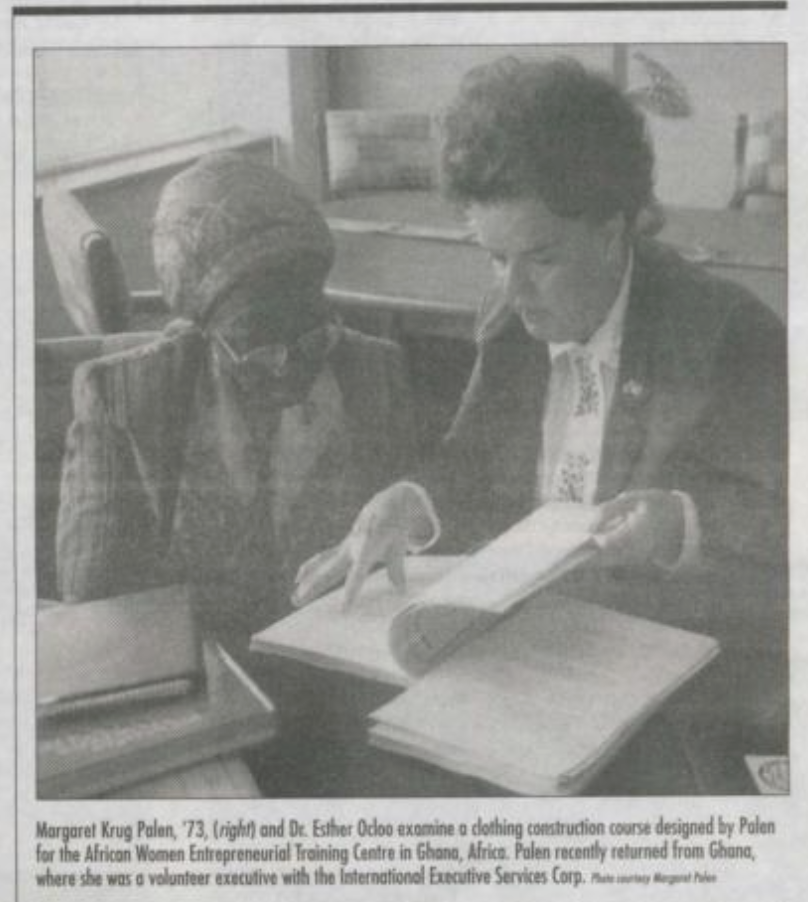
Searches in Oregon Digital reveal that Palen also continued her extension work as a volunteer executive with the International Executive Services Corporation. In 1996, she returned from a trip to Ghana, where she designed a clothing construction course for the African Women Entrepreneurial Training Centre. An image from this trip was even featured in the Oregon Stater in 1996. 

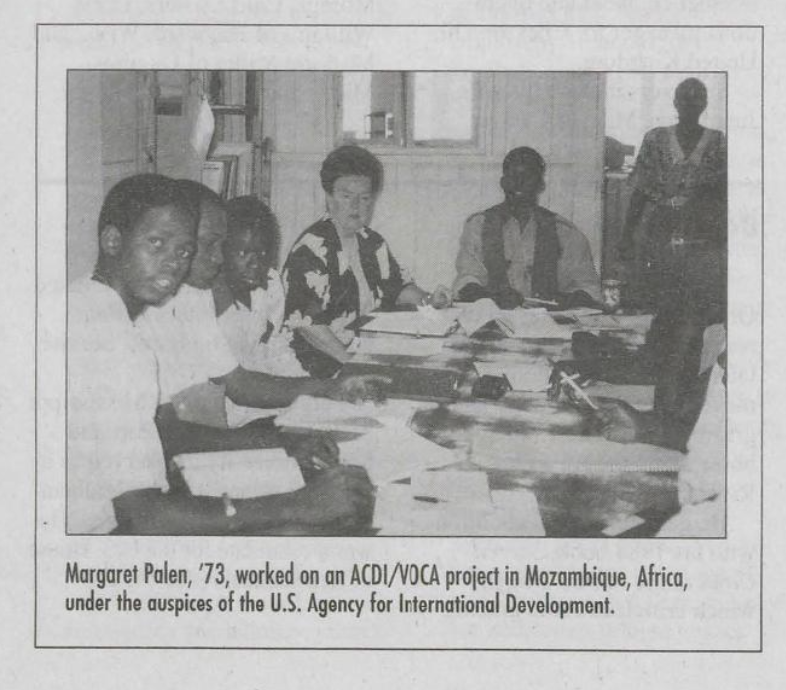
In 1999, she worked with the US Agency for International Development in Mozambique, featured in that year’s Oregon Stater

In both editions, Palen is referred to by her graduating class of 1973 and without reference to her prior employment with the university. She also continued international extension work to improve food production, textiles, and clothing, through travel to countries including Ghana, Ethiopia, Mozambique, Belarus, Bolivia, and Jamaica, described in her 2018 book A Different World: My Life and Making a Difference in the World.

When I first stumbled upon Palen’s name, I feared that she would only be remembered incompletely. Her story illustrates how important it is to paint full pictures of individuals in history, and how sometimes, preservation can be biased. Simply because the News and Communication Services Records only contains materials related to her termination, an individual utilizing these records might have a partial view of Palen. Further research shows that her dismissal from Oregon State did not stop her from continuing her career in extension work. Palen continued home economics work internationally for several decades, even earning recognition for this work from her alma mater and previous employer. It also shows other career-oriented pursuits, writing four books on the topic of genealogy and a fifth on her own life and work. 

~ Grace Knutsen


Grace Knutsen is a student archivist at Special Collections and Archives Research Center. She is an Oregon State alumna and Master of Library and Information Science student.

Taste of the ‘Chives

The Taste of the ‘Chives is a celebration of recipes that have tantalized the OSU community. This year we’re highlighting the various ways that Beaver Nation have prepared and publicized cheese!  

SIGN UP TO MAKE A RECIPE HERE

Cheese research and production has a long history on campus that is reflected in many university theses, articles, publications, and faculty papers held by the OSU Libraries.

To inspire the preparation of cheese-centric dishes for the ‘Chives event, we’re sharing some recipes from these sources in the form of links and PDFs listed below:

Inspired by a recipe here? Share your creation with other and sample other cheesy delights on October 31 from 12-1pm in Willamette East (Valley Library room 3622)!

My Time at SCARC Through My Top 3 Items

When I applied to work at SCARC, I wasn’t really sure what to expect. I knew from the job description what my duties would be, but I wasn’t familiar with archives. I had a vague interest in history and record keeping, but I’d never even taken a college course on history before. I figured my best bet was just to show up, do what I was told, and see if I enjoyed it enough to stay. Little did I know it would be one of the most impactful experiences of my life. 

Most of my time at SCARC was spent on the more common duties – paging and shelving materials, digitizing them, aiding patrons. These were all interesting and satisfying in their own ways. My favorite part, though, was always preparing for classes. It was so interesting to see the materials requested for different topics, especially when it was an opportunity to see some of SCARC’s archival materials and artifacts. To be clear, digitization is an important way of both preserving materials and making them more available to the public, which are crucial roles of an archive. I’m proud of the digitization I’ve done to improve learning and accessibility and I don’t mean to undermine that. But there’s really nothing like holding a literal piece of human history. 

One of the first artifacts that really captured me was Romeyn Hough’s The American Woodswhich was brought out for a class on horticulture in my first year. Hough developed a method of taking microscopically thin slices of woods in three directions, which he then mounted on pages. Seeing the slides was amazing. Hough worked in the 1880s onward, in a time when there were serious concerns about the future of American forests. To have a snapshot, a literal slice of time, is an amazing resource. As someone who majored in Environmental Sciences, one of the most important things we deal with is a shifting baseline – basically, people think that the environment they grew up with is “normal”. Over time, we culturally forget how big trees used to grow, how many insects there used to be, things like that. It makes it difficult to do retrospective studies when there just isn’t enough data on what the world was like. American Woods stands out as a tangible example of what the trees of that time were like – not just pictures or descriptions, but the wood itself. 

An ongoing project I’m glad to have worked on is the transcription of letters from the Oregon State Yank Collection. During WWII, recent OSU graduates Elaine Kollins Sewell and Kane Steagall decided to put out a newsletter for other OSU alumni in the military. The Yank Collection is comprised of more than a thousand letters written to Sewell with thanks, changes of address, and information. During my time working on this project, I’ve run the gamut of experiences. I’ve looked up authors, usually to confirm spelling for names, that had long, wonderful lives after the war. I’ve looked up authors only to find that they died before they could go home. I’ve read example of human resiliency, human callousness, and human prejudice. Above all, I’ve been surprised at how relatable they are. I intellectually knew that they were normal people, just the same as anyone else, but my own education in history has focused on the grand – wars, social movements, important dates. I’d never really sat down and read personal correspondence, and definitely not at this scale. Reading people apologizing for returning a letter so late (as I unfortunately find myself doing), or joking about being willing to live in California if they could only return from the war, or spelling out words like “pu-lenty” and “cutey” or even “bitchy” was a completely new experience for me, one that reminded me that I should never overlook humanity throughout time. 

If I had to choose one artifact, though, it would undoubtedly be one of the cuneiform tablets from the Early Written Word Collection, which I saw when they were brought out to be scanned for 3-D printing. It’s hard to understate the impact seeing it had on me. One of the things that I’ve always loved about history, the reason why I started working at SCARC despite not knowing what it would look like, is being able to see humanity shining through. The Yank was one poignant reminder, but there are overwhelming signs of people being people throughout time – fallible and flawed, but always striving to learn and to connect. It’s why Antigone is my favorite play to this day. Reading it and seeing the same questions and ideas that I have now written by someone who died thousands of years ago was proof of that concept. The cuneiform tablets are another. They’re tax records, not nearly as philosophical as a play or poem, but they’re physical evidence of people’s ingenuity, their ability to innovate to the point of creating something entirely new – writing. Being in the presence of something over four thousand years old, something that has been seen and touched and valued by countless people over the millennia, was incredibly meaningful for me. Writing has been developed individually in multiple places, but the alphabet that I’m using to write this down right now is part of that global heritage.  It’s something I will never forget. I don’t know what the equivalent for other people may be: seeing a religious relic, visiting the place where their grandparents grew up, reading their name in genealogical records. Whatever it is though, that appreciation for history and our connections to it was fully cemented when I saw those tablets.  

I’m not sure where I’ll go from here – work, grad school, whatever else may come. My skills from SCARC may not be directly applicable. Still, though, I do know that I’ll carry the knowledge and experiences from SCARC with me and be better for it. 


This post is contributed by Maxine Deibele. She was a student archivist at the Special Collections and Archives Research Center for nearly 3 years, including 1 year as Lead Student Archivist. She studied Environmental Sciences and Writing.

Welcome to Oregon Archive Month!

Join us for a month of activities. We will have presentations, Open Houses, and time to gather with crafts and food! Here’s what’s going on this month in SCARC:

Pride Center Grand Opening: OSU Queer Archives Display – POSTPONED! New Date TBD

  • Friday, October 11th, 11am-2pm @ the Pride Center
  • To celebrate the newly expanded Pride Center Grand Opening, the OSU Queer Archives (OSQA) collaborated with the Pride Center to curate a display of OSU queer history featuring materials from OSQA archival collections. 

Oregon River Maps Special Open House

  • Wednesday, October 16th, 10:30am-1:30pm @ the SCARC Reading Room
  • In collaboration with PRAx’s annual theme of watersheds, SCARC is highlighting hand drawn maps and figures from our “Plans and Profiles of Oregon Rivers” collection. Curated selections will include original images of the Klamath River from field data surveyed in 1923, just after the completion of the Copco dams but before the construction of Iron Gate. Months after the removal of these dams, these historic maps hold new interest.

Add Glitter to the Archives! A Crafternoon with the OSU Queer Archives

  • Thursday, October 17th, 4-6pm @ Valley Library Main floor, Kow Lounge
  • Join us in using (copies of) archival materials from the OSU Queer Archives (OSQA) for crafting projects! Participants will have the opportunity to donate their craft or a photograph of their creations to OSQA if they would like to do so. This event is a part of the OSU Libraries Crafternoon series and is hosted in celebration of Queer History Month.   

William Appleman Williams: A Retrospective

  • Wednesday, October 23rd, 4:00-5:30pm @ the SCARC Reading Room
  • This event will include reflections from three scholars on the life and work of William Appleman Williams (1921-1990), a major American historian and member of the History faculty at Oregon State University from 1968-1986. Regarded as a founder of the “revisionist school” of American diplomatic history, Williams’s The Contours of American History (1961) was named one of the 100 best non-fiction books written in English in the twentieth century.

Imag(in)ing structure: envisioning the atomic structure of crystals from x-ray diffraction

  • Thursday, October 24th, 4-5:30pm @ the SCARC Reading Room
  • For centuries, people have inferred that crystals have an ordered internal structure based on their external form. It was not until the 20th century, with the development of x-ray diffraction, that the atomic structure of crystals was revealed. Melissa Santala will draw upon her experience as a materials scientist and the SCARC’s rich history of science collection to discuss the process of imaging – and imagining – the atomic structure of crystals from x-ray diffraction patterns.

Betty Lynd Thompson Special Open House

  • Wednesday, October 30th, 10:30 am-1:30 pm @ the SCARC Reading Room
  • Learn about the amazing legacy of art nurtured by OSU Dance Professor Betty Lynd Thompson in a curated display featuring items from the archival collection about her in SCARC.  

Taste of the ‘Chives Recipe Cookoff

  • Thursday, October 31, 12-1p @ Willamette East (Valley Library room 3622)
  • Celebrate OSU’s longtime connections to cheese in this food sampling showcase courtesy of SCARC! Enjoy flavors from past and present recipes featured in campus publications and learn about historic OSU ties to the production, promotion, and research of this tasty and delectable dairy product.

 Jewish Student Experiences in Wartime at Oregon State University 

During fall term 2023 Dr. Kara Ritzheimer’s History 310 (Historian’s Craft) students researched and wrote blog posts about OSU during WWII. The sources they consulted are listed at the end of each post. Students wrote on a variety of topics and we hope you appreciate their contributions as much as the staff at SCARC does!

Blog post written by Jordan Lopez.

The evolution of American Jewish identity experienced a uniquely tumultuous period during the 20th century. Antisemitism on the home front, despite Jews being a central target of the war in Europe, remained persistent. For many Jewish college students on majority non-Jew campuses, coming into adulthood during this time presented a new set of challenges. Oregon State University, at the time Oregon State College, (hereafter referred to as OSC) has never had a robust Jewish student population.

This is not to say that the culture did not exist, especially considering how the surrounding city of Corvallis, over time, developed a Jewish community, which often included people related to OSC. In the early years of the university, OSC was very closely tied to Christianity. Until 1885, the Methodist Episcopal Church, South was the institution in charge of appointing the university’s president and overseeing other matters.[1] Naturally, the public institution of OSU today is no longer affiliated with the church. However, Corvallis knows and caters to its assumed population. In 2023, for the 39 churches in the city, there is only one Jewish synagogue.

Religious Emphasis Week flyer, from Leone Sands Johnson’s thesis.

The first document located for this piece was a graduate thesis analysis on religious activities at Oregon State published in 1948 and written by Leone Sands Johnson. The thesis analyzes how students explore religion on campus, and how this exploration relates to student’s lives. Typed on typewriter, it was later uploaded in 2017 to the database of Oregon State Graduate theses and dissertations. The work includes some scans of religious texts from the school’s groups, such as church handouts, a weekly calendar layout for the devout student, and an event flier for International Week in February 1947. Johnson mentions that his study was conducted with only civilian students, not including the ones stationed on or near campus, at Camp Adair, during WWII. There isn’t much about Jewish students’ experiences of possible oppression or advocacy, mainly because the study was more of a survey of Christian religious denominations on campus. As a result of this, he only briefly mentions Judaism. Johnson does give some context to the beginnings of the Hillel organization and mentions “Religion Emphasis Week” in October 1945, which included inter-faith discussions, although none of the talks addressed Jewish students specifically. He concludes later that “the Jewish preference by percentage of total enrollment has never reached more than 0.5. This percentage was reached in 1943.”[2]  In other words, Johnson suggested that Jewish students did not typically enroll at OSC in high numbers. 

The Oregon State Barometer newspaper proved the most useful in finding proof of Jewish student events at OSU during WWII. These short articles usually announced upcoming events or talks, and the earliest mention of the organization was in October 1946, when Hillel first began on campus. This was when President Strand gave a welcome address to the organization, and the article encouraged readers to contact Bob Cohn if they were interested in membership. At this time, Hillel’s goal was to increase membership so that activities could become “broader and more beneficial.”[3] A January 14, 1947 article in the Barometer advertised a Hillel talk given by Dr. Donald Wells on the subject of “Whom Should I Marry?”[4] This may have discussed interfaith relationships, or possibly how Jewish students could find each other for marriage.

Photo of Hillel Club in OSC’s 1949 yearbook.

OSC’s 1949 yearbook also includes the earliest documentation of “Hillel Club” at the school, accompanied by a photo showing eight students. The mission statement championed “harmonious relations…particularly with the various religious groups” as well as “to promote universal brotherhood and goodwill.”[5] The counselor at the time was Dr. J. W. Ellison. It seems that the club was open to both Jewish students and all others interested. The 1952 yearbook also includes the Hillel club, this time pictured with seven students.[6] However, in the 1950 and 1951 yearbooks, there were no matches with the term “Hillel.” There was no clear explanation found as to why the group was absent for two years, especially considering that it doesn’t seem possible that interest in membership suddenly disappeared.

One of the other few mentions of Hillel during wartime on Oregon Digital was correspondence from 1943 by the National Japanese American Student Relocation Council records, where Abram Leon Sachar, the National Director of B’nai B’rith Hillel Foundations, was listed as a member of the council.[7] This council was interested in assisting Japanese American students affected by relocation to continue their education. At the very least, this shows that Hillel was connected to assisting a fellow marginalized section of the student population.

Sylvan Durkheimer, OSC student during WWII. Sourced from the Oregon Jewish Museum and Center for Holocaust Education’s oral interview.

To examine Jewish student life, it’s also imperative to analyze the treatment of Jewish students by the university during the war years. Interviews provided by the Oregon Jewish Museum and Center for Holocaust Education show that Jewish students during WWII experienced considerable antisemitism from their peers. Sylvan Durkheimer received an invitation to join an Honors Fraternity on campus because he was second in his class, according to the college records. However, he was told by a fellow student later “that my membership in this fraternity had to be declined because of the fact that I was a Jew…”[8]Another student, Saul Zaik, returned from the Navy in 1946 and opted to attend the University of Oregon in Eugene when he found out that there wasn’t a Jewish organization on campus at OSC, nor was there available housing for veterans. Similarly to Durkheimer, a fraternity denied his pledge due to antisemitism. He shared a quote from the person who had invited him: “Zaik, you’re a dumb freshman even though you’re 19 or 20 years old. It’s the real world.”[9] Despite the fraternity member who invited him saying he was “great”, the self-described non-social Zaik was denied a pledge. 

In an interview for the Beit Am Matriarchs oral history project, Ruth Goldberg describes the city of Corvallis as having only a handful of Jewish families in 1942. She says, “My husband Ben felt that we wouldn’t win the war unless we were in it…He got his orders, and he was sent to Camp Adair in Corvallis.”[10] Based on this description, it’s likely that Jewish transplant families coming to Corvallis were also connected to the war effort. She also recalls that every Sunday, half a dozen Jewish servicemen came to their house to eat potato pancakes. 

The post-war years led to a slowly increasing Jewish population in Corvallis, most notably demonstrated by the founding of Beit Am Synagogue in 1974. In 1978, the Albany Democrat Herald ran a piece on OSU history professor Kurt Philipp’s experience teaching the history of the Holocaust as a German-born Jew. He struggled to talk about it with his students, on account of having close relatives who barely survived the event, and some who were taken by the Gestapo. Instead, he required them to watch the 1978 NBC-TV docu-drama Holocaust. Many reported to him that it made them feel sick, to which he responded that “You can read that 10,000 people were killed. To see it is different.”[11]

Comic run by Corvallis Gazette-Times.

An antisemitic comic ran in a November 1981 Corvallis Gazette-Times edition, and faced backlash from a Jewish man, Ze’ev B. Orzech. It contains a crude caricature of a Jewish man, portrayed as weak and sickly, seemingly complaining about the US government’s involvement in selling weapons to the “Saudis.” It’s not clear if this man is supposed to represent a specific figure in Congress, or rather just an “average” Jewish-American man. Insisting that antisemitism has never been a laughing matter, Orzech cites a “rising frequency of anti-Semitic incidents in our state and across the nation…”[12] This concern may be from 1981, but it still applies, increasingly so, today.

In the 1980s, the controversial questioning of the Holocaust’s existence led to an increase in antisemitism in Corvallis. The city looked down on “Christian Patriots” who attacked Jews by mail and threats, and the Corvallis Gazette-Times labeled them as “cowards.”[13]  This didn’t lessen the victim’s fear, though. A Jewish woman wrote to the Times in 1986: “World War II was not the first holocaust against the Jews, and I suspect it won’t be the last.”[14]  Even as local people looked back on the events of the war that happened in their lifetime and said it will never happen again, microaggressions continued. Due to the predominantly Christian background of both Corvallis and OSC, the culture for much of the 20th century seems to have been one that regularly experienced antisemitic rhetoric and behavior.

Many American Jews during WWII felt profoundly American, the same way those that felt inspired to serve the country at the time did.[15] But despite their patriotism, prominent American politicians still used Jews as a scapegoat. Edward S. Shapiro, a historian of Jewish and American history, writes that “The early 1940s was a difficult time for the Jews of the Lower East Side (of New York). They were terrified for their European relatives now threatened by the advance of Hitler’s armies…”[16] Although focusing on an East Coast population, it’s likely Jews across the country experienced that terror and anxiety. Additionally, Shapiro uses the death of notable congressman Michael Edelstein, who defended Jews placed in the role of “scapegoat” by his peers, as a turning point for American Jews. He argued that Jews were not to blame for America entering the war. This “martyr of democracy” represented a defensive stance for those being accused of bringing WWII to America.[17]

As women like Ruth Goldberg came to Corvallis with their husbands, their roles as Jewish housewives contributed to the city’s flourishing Judaism. In her article Transitions in American Judaism: The Jewish American Woman Through the 1930s, Norma Fain Pratt traces the broader development of women’s roles in preserving their religion. She notes that there was a rise of cultural pluralism between the world wars, leading to an increase in institutions of learning for American Jews, such as religious schools, Yiddish culture schools, and congregations.[18]  Despite this growth, women were occasionally blamed by rabbis and other men for a decline in Judaism, despite them being widely considered “defenders of the faith.”[19] Women’s groups were often connected with Hadassah organizations, which champion Zionism and “complete growth which living up to one’s historic heritage makes possible.”[20]  Many of the founding matriarch members of the Corvallis Beit Am synagogue were members of Hadassah. 

During WWII and into the 1950s, Jewish students experienced antisemitism and exclusion on OSC’s campus. It’s not too far-fetched to assume that some students felt targeted by the national rhetoric of blaming Jews for bringing America into the war. The heavily Christian community in Corvallis was alienating, and the early Hillel organization on campus remained low in numbers. Today, American Jewish college students still experience antisemitism, blame, and violence for their identity. The Hillel organization on OSC’s campus was not actually affiliated with Hillel International, and only is today as of 2015. OSU today gives the Hillel organization little to no advertisement in comparison to other religious groups on campus, despite the Hillel administration fighting for it. An example of this is obtaining a permanent location for Hillel to hold events, which would provide Jewish students with a safe place, something that other groups already have.

It still doesn’t seem like it’s incredibly safe to be publicly Jewish on a college campus right now, let alone outwardly proud. The culture at OSU is no longer blatantly antisemitic, like it was during WWII for many Jewish students, but that still doesn’t mean much if there’s a lack of support. OSU has the power to make all religious minorities on campus feel safer, so that we don’t risk experiencing history repeating itself.

Image 1 description: Reproduction of Religious Emphasis Week flyer, from Leone Sands Johnson’s thesis.

Image 2 description: Photo of Hillel Club and accompanying message as displayed in OSC’s 1949 yearbook.

Image 3 description: Sylvan Durkheimer, OSC student during WWII. Sourced from the Oregon Jewish Museum and Center for Holocaust Education’s oral interview.

Image 4 description: Comic run by Corvallis Gazette-Times, considered to be antisemitic.  


[1] William Robbins, The People’s School: A History of Oregon State University (Chicago: Oregon State University Press, 2017), 6.

[2] Leone Sands Johnson, “An Analysis of Religious Activities at Oregon State College” (Master of Science Thesis, Oregon State College, 1948), 159.

[3]  “Strand Will Address Hillel Group Sunday; All Students Invited,” Oregon State Barometer, October 16, 1946: 1, Oregon Digital, https://oregondigital.org/concern/documents/kw52jc94g.

[4]  “Wells To Speak At Hillel Meeting On Seeking Mate,” Oregon State Barometer, January 14, 1947: 1, Oregon Digital, https://oregondigital.org/concern/documents/kw52jd36s.

[5] Oregon State College, The Beaver (Corvallis, Associated Students of Oregon State College, 1949) 407, https://oregondigital.org/concern/documents/xd07gt12w.

[6] Oregon State College, The Beaver (Corvallis, Associated Students of Oregon State College, 1952) 28, .https://oregondigital.org/concern/documents/pz50gw440

[7] “Correspondence,” University of Oregon, National Japanese American Student Relocation Council Records, 1942-1946 [OAI], available through Oregon Digital. https://oregondigital.org/concern/documents/df665x694.

[8] Sylvan Durkheimer, “Sylvan Durkheimer-1975.” Interview by Shirley Tanzer, Oregon Jewish Museum and Center for Holocaust Education, (hereafter OJMCHE), January 1, 1975.

[9] Saul Zaik, “Saul Zaik-2019.” Interview by David August, OJMCHE, April 16, 2019. https://www.ojmche.org/oral-history-people/saul-zaik/

[10] Ruth Goldberg, “An Interview with Ruth Goldberg.” Interview by Judith Berlowitz, Beit Am Matriarchs Oral History Project, Beit Am Synagogue, September 20, 1991.

[11] Cindy Coffer, “For OSU prof, ‘Holocaust’ is real,” Albany Democrat Herald, April 19, 1978.

[12] Ze’ev B. Orzech, “Anti-Semitism, To the Editor,Corvallis Gazette-Times, November 1981.

[13] Melissa Grimes, “’Cowards’ Threaten City’s Jews,” Corvallis Gazette-Times, December 1985.

[14] Diana Artemis, “Help from a true friend,” Corvallis Gazette-Times January 2, 1986.

[15] Edward S. Shapiro, “World War II and American Jewish Identity,” Modern Judaism 10, no. 1 (1990): 65, http://www.jstor.org/stable/1396050.

[16] Shapiro, “WWII,” 66.

[17] Shapiro, “WWII,” 68.

[18] Norma Fain Pratt, “Transitions in Judaism: The Jewish American Woman Through the 1930s,” American Quarterly 30, no. 5 (1978): 690, https://doi.org/10.2307/2712404.

[19] Pratt, “Transitions in Judaism,” 695.

[20] Pratt, “Transitions in Judaism,” 695.