
During winter term 2025 Dr. Kara Ritzheimer’s History 310 (Historian’s Craft) students researched and wrote blog posts about OSU during WWII. The sources they consulted are listed at the end of each post. Students wrote on a variety of topics and we hope you appreciate their contributions as much as the staff at SCARC does!
Blog post written by Kyle Knott
When researching college campuses during World War Two, many historians look at the student populations or faculty. Some might even look at religious groups or specific areas of study. However, compared to the previous topics, the history of fraternities during World War Two is an understudied topic. This brings up the topic of what happened to fraternities when there were minimal civilian men on college campuses.
On October 15, 1943, the Oregon State Barometer reported that campus fraternities were pausing rush that term.[i] The year before, fraternities pledged over 300 members, to make the total number over eleven hundred within 34 fraternities.[ii] This begs the question, how did fraternities go from pledging so any members, to suspending multiple chapters on campus due to low membership? The answer would be because of the war. Barometer editor Jack Bolter wrote the article, telling the reading audience, who would most likely consist of students and faculty, that the inter fraternity council had decided to pause rush for all fraternities. The decision came after Jim Leedy, president of the inter fraternity council, led a meeting between the Inter Fraternity Council and additional members of the 13 fraternities on campus to discuss the current state of fraternities on campus. Regarding the war effort, all members concluded that they should pause rush so all aims of the men would be towards the war. The pause came for multiple reasons, such as that most fraternities had very low member numbers and could not do their full rush rituals as well as the men who would rush, would eventually be taken into selective service once they became 18 years old. The individual article about the fraternities itself is part of a larger daily newspaper called the Oregon State Barometer. The document remained in good condition, printed in black and white, and has minimal damage to the edge of the paper. Looking from the perspective of a student during the time it was released to the public, I would see that the number of men enrolled in the college was dropping dramatically as the largest active fraternity only had 13 members.
With fewer civilian male students and growing military presence on campus, the college had to adapt to the wartime demands of housing. In 1943, Oregon State College president Strand announced that the university would be transitioning Waldo Hall and Snell Hall from women’s dormitories to military use only. Because the university lost these buildings as dormitories and fraternities were losing so many members due to the draft and enlistment, the school began to lease fraternity houses and placed female students to live in them.[iii] The university allocated twelve houses to be specifically used for women.[iv] Along with Oregon State College, the University of Illinois was another university that used fraternities as makeshift housing, however, in their case, they would temporarily house soldiers while they were training.[v] In 1944, houses such as Kappa Sigma transitioned from a men’s fraternity the year prior, to an all-women’s group occupying the house.[vi] On December 10th, the Inter Fraternity Council cancelled all formal fraternity dances as diminishing numbers did not bring in enough revenue for the events to take place.[vii] Fraternities, such as Kappa Sigma, demonstrate how the university repurposed unoccupied houses to house women. Others, including Alpha Gamma Rho, housed athletes or other men due to limited space of the university’s dormitories.[viii] Later in March 1944, the Inter Fraternity Council met together to discuss whether the organization should continue as most men at that time had been sent off to the war.[ix] (Insert Figure 1 below)
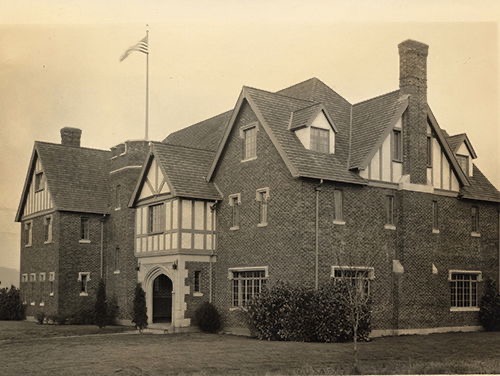
Figure 1 The Theta Chi Fraternity House at Oregon State College, used to house female students during WWII[x]
During the years of World War Two, many fraternities on campus had to suspend activities due to members being shipped off to the military and some shut down for good. In total, during the 1943-44 school year, fifteen men were living in fraternity houses. This was a drastic change from the year prior with that number being at 1,156 men.[xi] With the school being very active with training military troops, especially engineers and the development of the Army Specialized Training Program bringing in 1300 students, the dorms had become overcrowded, and the school had to look elsewhere to house its students.[xii] Along with Oregon State College, other universities’ enrollment took a massive hit. At the University of Washington, in the 1942/1943 school year, the school had a total of 6,521 stud ents [xiii] enrolled in the winter term, losing 1,341 students from the previous term.[xiv] Going into spring, at Oregon State College, the college’s enrollment dropped a staggering 23% compared to the previous year’s spring term.[xv] During the 1943/1944 school year, the number of civilian men enrolled in classes dropped as low as 258. The number of women outnumbered men by roughly 4 times with that number being 1,319.[xvi] (Insert Figure 2 Below)
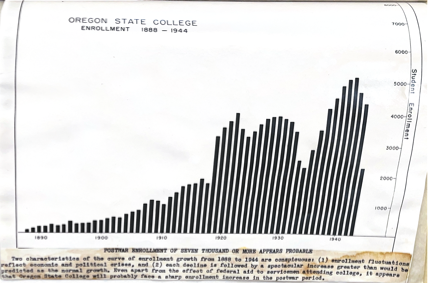
Figure 2 The chart shows the number of students enrolled at Oregon State College from 1888 to 1943, demonstrating the drop in enrollment during World War 2.[xvii]
With most able-bodied men being drafted or volunteering to join the military, many universities saw a great decrease in the number of men enrolling in college. To deal with the issues of low enrollment of men, many universities had an increase in women registering for classes and began programs that brought in uniformed soldiers to take classes while preparing for war. [xviii] With the increase in students on campus, that being civilian and soldiers, the dorms on campus began to fill up. To keep up with the need of housing for students, many schools looked elsewhere for makeshift dormitories. Towards the end of the war, the number of civilian men enrolled dropped to 27% of the prewar enrollment numbers.[xix] With less civilian men enrolled in universities, the ratio of men to women enrolled in college dropped to a number that hadn’t been seen for 2 decades prior. Furthermore, the graph above shows a dramatically large increase in the ratio right after the war with the introduction of the G.I. bill. While the bill did make college free for all veterans, it also puts into perspective just how many men could have been enrolled in college during the time versus how many were.[xx] (Insert Figure 3 to right of paragraph)
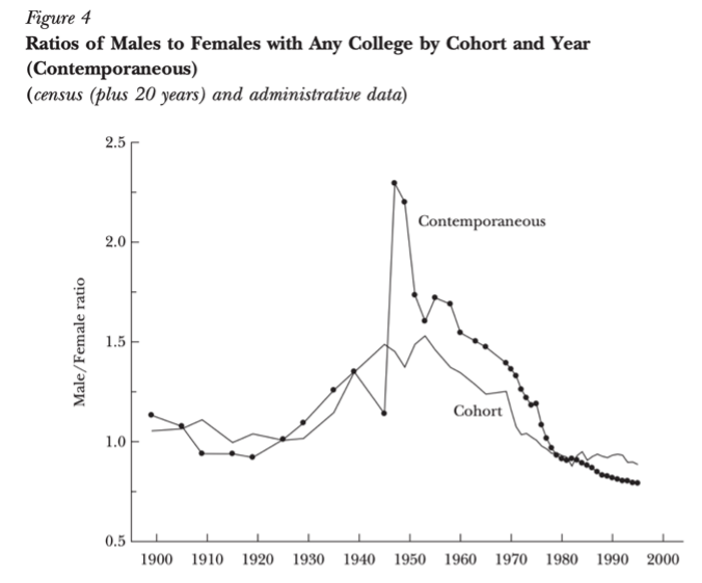
Figure 3 The figure shows the Ratio of Men to Women throughout 1900 to 2000, with a decrease in the ratio during the period of World War 2 and a sharp increase right after.[xxi]
Looking at Oregon State College during World War Two, while fraternities were not able to operate, they still made a great contribution to the university. They leased their properties to the university to house female students so the college could bring in military troops to train and help the United States in the war effort. Without the use of the houses, the university would not have been able to bring in as many students or soldiers to train, lowering enrollment numbers even more than they already were.
[i] “No Rushing for OSC Men”, Oregon State Barometer, October 15, 1943, Oregon Digital, https://oregondigital.org/concern/documents/8k71nk05g
[ii] “Inter-Fraternity Council,” The Beaver 1943, 290, Oregon Digital, https://oregondigital.org/concern/documents/fx719t41x
[iii]U. G. Dubach, Biennial Report for Years 1942-1943 and 1943-1944, May 5, 1944, 5, Oregon State University Special Collections & Archives Research Center (hereafter SCARC) SCARC RG 013-SG 12 Annual & Biennial Reports Box 6 Folder 4, Department of Dormitories.
[iv] “President’s Office General Subject File, Oregon State College, Living Organizations – War-time housing, 1943-1946,” 1, Oregon State University President’s Office Records, Oregon State University, Oregon Digital, https://oregondigital.org/concern/documents/qn59q5195#citations
[v] Thomas Hendrickson, “World War II and University Housing,” University of Illinois Student Life and Culture Archives, December 9, 2015, https://www.library.illinois.edu/slc/2015/12/09/wwiihousing/
[vi]“Wartime Guests of Kappa Sigma,” The Beaver 1944, 244, Oregon Digital, https://oregondigital.org/concern/documents/zk51vh18n
[vii] “Ticket Refund for Frat Dance Set Today,” The Daily Barometer, 1, December 10, 1943, Oregon Digital, https://oregondigital.org/concern/documents/8k71nk21v
[viii] “Wartime Guests of Alpha Gamma Rho,” The Beaver 1944, 262, Oregon Digital, https://oregondigital.org/concern/documents/zk51vh18n
[ix] “Inter-frat to Meet,” The Daily Barometer, March 21, 1944, 1, Oregon Digital, https://oregondigital.org/concern/documents/8k71nk445
[x] “From the Archives: ‘Mother of Five Theta Chis’ Pays Tribute to Fraternity,” Theta Chi Fraternity, https://www.thetachi.org/from-the-archives-mother-of-five-theta-chis-pays-tribute-to-fraternity
[xi] U. G. Dubach, Biennial Report for Years 1942-1943 and 1943-1944, 2, SCARC RG 013-SG 12 Annual & Biennial Reports Box 6 Folder 4, Dean of Men.
[xii] “Army Specialized Training Program Records, 1943-1946,” Archives West ORBIS Cascade Alliance, https://archiveswest.orbiscascade.org/ark%3A80444/xv04125?utm_source=chatgpt.com
[xiv] “Scouting the Campuses,” The Daily Barometer, January 16, 1943, Oregon Digital, https://oregondigital.org/concern/documents/8k71nj28k
[xv] “OSC Enrollment Records Drop Of 23 Percent,” Oregon State Barometer, March 24, 1943, Oregon Digital, https://oregondigital.org/concern/documents/8k71nj62w
[xvi] “College Enrollment Hits Bottom”, Oregon State Barometer, April 18, 1944, Oregon Digital, https://oregondigital.org/concern/documents/8k71nk470
[xvii] “Presidents Biennial Report for 1943-1944,” SCARC, Annual and Binomial Reports, Box 6 Folder 4, 1944.
[xviii] Roger L. Geiger, The American University: A History (Princeton University Press, 1990): xix.
[xix] Geiger, The American University, xx.
[xx] Claudia Goldin, Lawrence F. Katz, Ilyana Kuziemko, “The Homecoming of American Women: The Reversal of the College Gender Gap,” Journal of Economic Perspectives 20, no. 4 (Fall 2006): 139.
[xxi] Goldin et al, “The Homecoming of American Women,” 139.