A few weeks ago, the Daly Fund trustees met and selected 22 Daly scholarship recipients. To assure fairness and likelihood of college success, the trustees used a process whereby students were selected based on a weighted formula that combined SAT scores and overall high school grade point averages. The trustees only saw the ranked composite scores; they did not know the names of the recipients until they determined how far down the list they could fund scholarships.
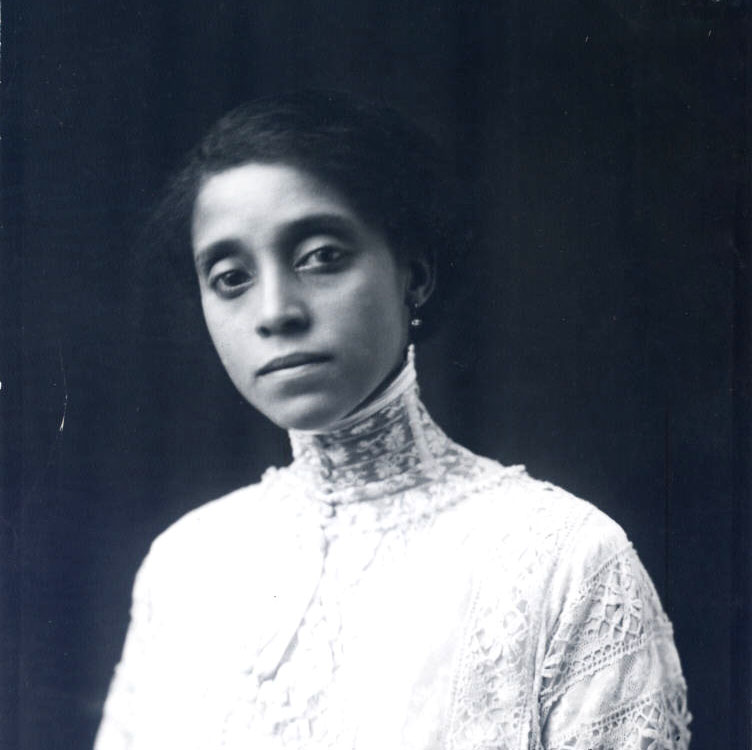
Sybil Harber, 1900, just a few years after arriving in Lakeview
Diversity, difference, and social justice. Issues that are in the news and all around us, even in Lake County. Back in the days when Daly lived in Lake County, it may have seemed that there wasn’t much diversity. Many were Irish, but not everyone. Some came from the east, some from neighboring states, and after the Dustbowl, from Oklahoma. Among those who came from California was Sybil Harber – a black single mother who was a mid-wife. It’s said that she came to Lakeview on the recommendation of Bernard Daly. She arrived in Lakeview in the spring of 1888, just a year after Daly.
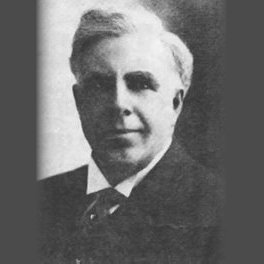
Bernard Daly was missing… but now he can be found in the Oregon Encyclopedia, an authoritative and free resource on all things Oregon. Some time ago, my friend, OSU Archivist Larry Landis, suggested that I write an entry on Bernard Daly. Larry knew that I had been researching Daly and noticed that there wasn’t an entry for him. Seemed like quite an omission given the remarkable breadth of the encyclopedia and the extent of Daly’s impact.
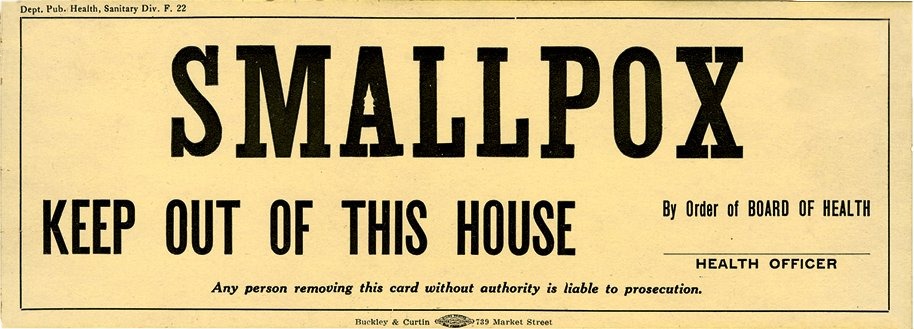
All the news of the coronavirus reminded me of correspondence between Bernard Daly and the State Health Officer and Daly’s order for a county-wide quarantine in May of 1903.
Daly was a doctor long before he became a judge. As a doctor, he knew about germ theory and that disease could be spread from person to person by microorganisms that couldn’t be seen. The last major U.S. smallpox epidemic was from 1901 to 1903. Smallpox was a particularly deadly virus. Between 300 and 500 million people died of smallpox in the 20th Century alone.
One question leads to another, and another… I noticed that the Lakeview High School graduating classes were especially large in the 1970’s. When I asked about it, people told me that those were the years when kids from Bly attended high school in Lakeview. Caused me to wonder: What was it like for the Bly kids? Long bus rides, knowing that the other kids were eligible for the Daly scholarship and they weren’t?
As we begin the new year and new century, there will be a number of hundred-year anniversaries, beginning with Bernard Daly’s death. It was early in the morning on January 5, 1920, after having been ill since before Christmas, when Bernard Daly died while on the train to San Francisco where he was to be treated by specialists. On the train, he was accompanied by his Lakeview physician, Dr. Charles Liethead; long-time business partner, Fred Reynolds; and the love of his life, Pearl Hall. He died on route, near Livermore California. On the following Sunday, a crowd of about 700, almost everyone who lived in or near Lakeview attended his memorial service – that was most of Lakeview as the total population in 1920 was just over a thousand.
Bernard Daly’s gift to Lake County was very generous and his gift inspired others to also be generous. There are so many examples I’m not sure where to start. An early example is Burt Snyder. Burt came to Lakeview from Plush in the early 1900’s and went to work at Thornton’s Drugstore. Burt wanted to become a pharmacist and Mr. Thornton helped him enroll in a correspondence course. When he completed the course, Burt traveled to Portland in 1910 to take the apprentice pharmacist exam. The journey took him two days by stage to Klamath Falls and then another day and a half to Portland by train. He got his license and returned to Lakeview to work for Vinton Hall and Fred Reynolds. In 1912, Burt bought out Dr. Hall’s interest and the store became known as Snyder and Reynolds.
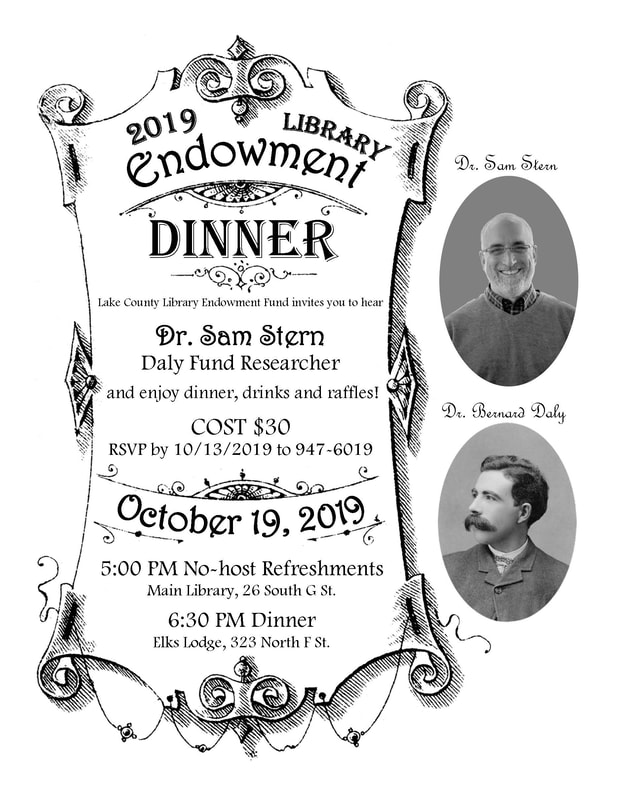
I’ll be in Lakeview this weekend to give a talk about my research on Bernard Daly and the impact of his scholarship at the annual Lake County Library Endowment Dinner on Saturday, the 18th. Hope many of you who live in the area will be able to attend and add your support to the Lake County Library Endowment.
It’s common for people to ask each other where they grew up; where they’re from; where’s home? In this time of greater mobility and seemingly fewer community connections, these can be challenging questions for some while for others, it’s straight forward – they have a strong connection to a place.
Paul Primak with Lakeview H.S. principal, Lane Stratton
Consider the example of Paul Primak. Paul was an “Air Force brat.” He and his family never lived one place for more than a few years. Paul’s family moved to Lakeview in 1970 and a year later he graduated from Lakeview High School and left for college. He lived in Lakeview for a total of one year, yet it’s the place he calls home. I saw Paul in June when I was in Lakeview for the annual Daly Fund trustee meeting. Paul was in town to present a painting of four Canadian “Honker” geese to Lakeview High School. The painting was done by Paul’s 1971 fellow graduate, Jimmy Johnston. When I asked Paul about his connections to Lakeview, he said, “It’s the place I consider home; it’s where I made lifelong friends; it’s the place I go back to.”
Very sorry to learn that Jim Lynch passed away last month. I first met Jim ten years ago during my very first my visit to Lakeview. Jim’s law office was my first stop. He patiently told me about the workings of the Daly Scholarship, provided me with a list of the recipients, and encouraged me in my research on the Daly Fund. He told me that it was his hope that someone would write a book about the scholarship, its impact and about Bernard Daly. I’ve tried to do just that, and hope that the result lives up to his expectations.
As his long-time friend David Maxey wrote, “By birth Jim was a cattleman; by vocation, a lawyer. He was a superb performer in both categories. He and I entered the legal profession at about the same time, at opposite ends of this country. It was inevitable, I believe, that Jim would decide to stay at home and serve the community he grew up in. Yet he achieved national recognition as an expert in trust and estate law.”