Research area
Plant–pollinator interactions
Resolving the pollination paradox
We study how pollinator behavior, plant mate choice and forest degradation interact to shape reproduction, gene flow and resilience in tropical plant populations.
Collaborative research: This work is conducted in collaboration with Matt Betts at Oregon State University and Helene Wagner at the University of Toronto.
The central puzzle
Why does local foraging produce long-distance mating?
Pollinator strategy
Forage locally
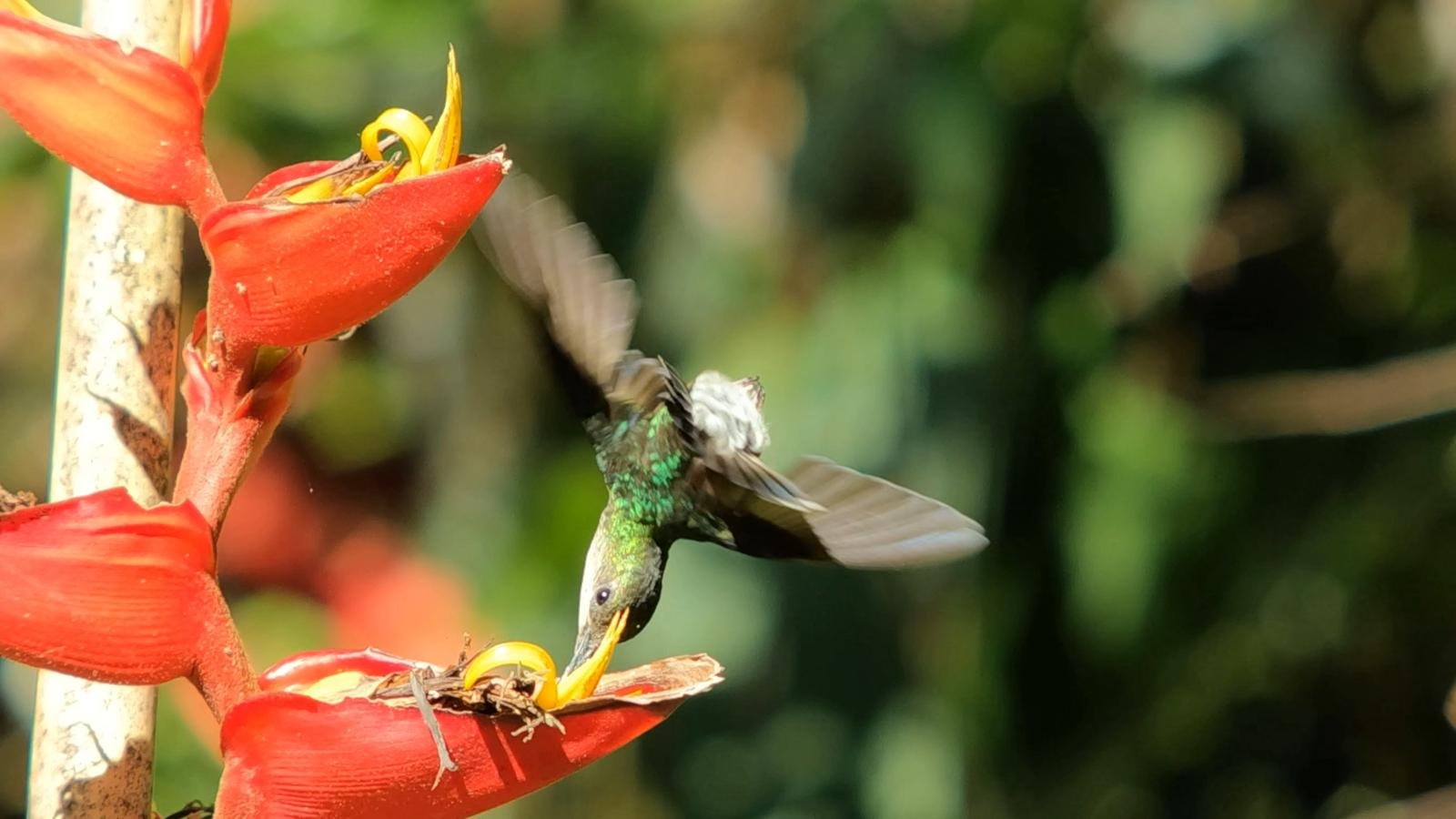
Hummingbirds minimize energetic costs by visiting nearby flowers. This behavior should mostly transfer pollen among neighboring—and often related—plants.
Plant outcome
Mate at a distance
Genetic evidence shows that long-distance pollen movement and mating can be common. Plants appear to favor rare, distant and less-related pollen through mechanisms we are working to identify.
Study system
Study species and pollinators
Our study species is the keystone understory plant Heliconia tortuosa. It is visited by a diverse hummingbird community. More than 17 years of observations show that both specialist traplining hummingbirds that repeatedly follow established foraging routes and territorial hummingbirds often visit nearby flowers—yet plants in intact forests largely avoid mating with their nearest neighbors.
In degraded forests, specialist hummingbirds that follow repeated foraging routes decline and this selectivity appears to weaken, increasing near-neighbor mating and inbreeding.
What the data show
Figures from Jones et al. (2022), Molecular Ecology. View the publication.

Field research
The study system in motion
Why it matters
Pollinator loss can reshape plant evolution
Understanding how forest degradation changes pollinator communities, mating systems and offspring fitness can improve tropical restoration strategies and help sustain genetic diversity in changing landscapes.
Selected plant–pollinator publications
Research connecting pollinator behavior, forest change, plant mating systems, gene flow and reproductive success.
- Pollinator‐mediated fitness differences do not fully explain the maintenance of gynodioecy in Sidalcea campestris (2026)
- Pollinator foraging tactics have divergent consequences for the mating system of a tropical plant (2023)
- Elevated inbreeding in Heliconia tortuosa is determined by tropical forest stand age, isolation, and loss of hummingbird functional diversity (2022)
- Tropical deforestation reduces plant mating quality by shifting the functional composition of pollinator communities (2021)
- The landscape genetic signature of pollination by trapliners: evidence from the tropical herb, Heliconia tortuosa (2019)
- The “jack‐in‐the‐box” stamens of Heliconia wagneriana (Heliconiaceae) (2018)
- Neighbourhood density and genetic relatedness interact to determine fruit set and abortion rates in a continuous tropical tree population (2008)